Responsible reporting: At what cost?

As submitted to The Daily Maverick

Free speech is not the only value that democratic societies subscribe to. Nor does, or should, our commitment to free speech always have to trump competing values such as national security or personal dignity. But the principle of free speech nevertheless stands in need of exceptional, and exceptionally strong, counterarguments in cases where we are told that it is not permissible to broadcast or publish any particular point of view.

This commitment to an open marketplace of ideas rests on the belief that each person should have access to the points of view in circulation, so that he or she is able to exercise their right to moral independence by considering the ideas themselves. As Mill reminds us, compromising free speech costs us both the opportunity to hear things that are true, which can help to correct errors; and also to hear things that are false, where the truth is strengthened by “its collision with error”.

Mark your X in the box labelled “stereotype”

As submitted to The Daily Maverick

Democracy and liberty are not equivalent, despite the fact that they are so often conflated in popular discourse. There is no logical obstacle to a dictator being democratically elected and then leaving us with little freedom. Likewise, a dictator could in theory be benevolent, and allow for more freedoms than we currently enjoy in South Africa.

This is why being silent in the face of oppression, tyranny, or abuse of power by the state should not be considered an option by those of us committed to both democracy as well as freedoms of various sorts. Fortunately, democracy and liberty are often positively correlated, so that an increase in the one tends to coincide with an increase in the other.

But because this connection is not a logically necessary one, we are sometimes required to fight these battles on independent fronts. Among the dilemmas and difficulties presented by these battles, we can identify the tone of our arguments as a significant complication, because sometimes struggles for liberty involve butting heads with majority sentiment – in other words with impulses arising from democratic discourses and ideals.

On rape by deception and state-sanctioned racism

As submitted to The Daily Maverick.

Most social interactions are likely to involve some measure of deception. This could range from feigning interest, or pretending to know more about the topic under discussion than you actually do, to calculated deception involving beliefs, character, or motivation. Many of these lesser deceptions are perhaps not even considered dishonest, but merely part of the everyday bargaining between our own multiple identities (which could vary according to context) and the identities of others.

Some more serious sorts of deception are of course legally actionable, and in many cases involve clear moral wrongs. One example of this is painfully fresh in many people’s memories, and involves entrusting financial investments to people who in the end misrepresented the extent to which they had the client’s best interest at heart.

But what to make of “rape by deception”, and in particular the case of Saber Kushour, recently sentenced to 18 months in prison for this “crime”? (The scare-quotes are of course not intended to indicate that rape is not a crime, or that it shouldn’t be, but rather to indicate that it’s not yet clear whether Kushour is guilty of rape at all.)

To ask for evidence is not (necessarily) scientism

As submitted to The Daily Maverick

Respect is due to people, rather than to ideas. While it may be politically incorrect to say so, there is no contradiction between saying that someone has a misguided, uninformed or laughable point of view, and at the same time recognising that person’s worth or dignity in general. But our sensitivity to being challenged, and to having the intrinsic merit of our ideas questioned, often leads us to conflate these two different sorts of respect.

Respecting a person is partly a matter of not causing them unnecessary trauma through ridicule or contempt. It also requires not prejudging their arguments or points of view, but rather judging those arguments on their merits. But if it is established that those arguments lack merit (when compared with competing arguments on the same topic), there is no wrong in pointing this out. It is perhaps even a duty to point it out, assuming that we care for having probably true, rather than probably false, beliefs about the world.

On Hitchens and the defense of reason

As submitted to The Daily Maverick.

On hearing that Christopher Hitchens had been diagnosed with oesophageal cancer, one response from a self-proclaimed man of god was the following post on Twitter: “God 1, Hitchens 0”. The motivation for such a callous response to a usually fatal disease (fewer than 5% of sufferers are alive after 5 years) is easy enough to trace: Hitchens, along with Dennett, Dawkins and Sam Harris, is one of the “4 Horsemen” of a groundswell of resistance to the unreason that is exemplified by religious faith, and he is thus a direct threat to the mysterious legitimacy that faith-based claims enjoy.

What our divine scorekeeper does not (of course) dwell on is the fact that according to his beliefs, all deaths are attributable to god, and that he could therefore just as well add another notch to this metaphysical bedpost if his mother, for example, were to die an equally unpleasant death. God’s victory is inevitable, as either she takes a believer “home”, or she smites down an unbeliever. Either way, a civilised response to human trauma is sympathy, rather than gloating.

Mandela’s autopsy

As submitted to The Daily Maverick.

Yiull Damaso’s painting of an imagined autopsy of Nelson Mandela has provoked outrage similar to that generated by Zapiro’s recent Mohammed cartoon. The outrage is similar in its severity, and unfortunately also similar in its knee-jerk thoughtlessness. Most troubling, the similarities extend to having to hear yet another argument in favour of the censoring of free expression on the grounds of cultural or religious sensibilities.

The painting, adapted from Rembrandt’s “The Anatomy Lesson of Dr Nicolaes Tulp”, shows a deceased Mandela being autopsied by Nkosi Johnson, while FW de Klerk, Helen Zille, Desmond Tutu and others look on. It is, of course, the portrayal of Mandela as deceased that is causing most of the consternation, on the grounds that this portrayal consists, variously, of witchcraft, disrespect, a violation of dignity, and a “insult and an affront to values of our society” – at least according to ANC spokesperson Jackson Mthembu.

As with the Zapiro cartoon, we can and certainly should ask whether images like these are in unacceptably bad taste. If they are, we should say so, and hope that we can persuade artists of the legitimacy of our point of view. Having fewer offensive artworks in our purview would no doubt make for a more comfortable life. But one person – or one group, no matter how large – does not have the authority to define what counts as unacceptable and what doesn’t, except within their own cultural universe.

The hand of god, revisited.

Originally published in the Daily Maverick.

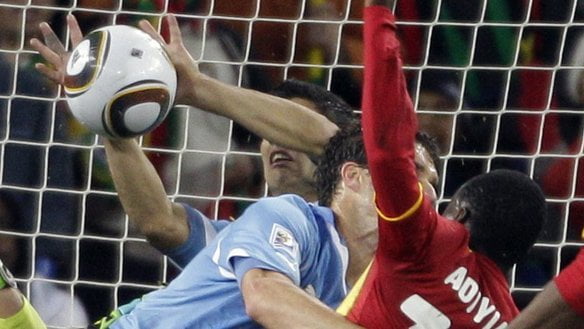
Uruguay’s Luis Suarez cheated in order for his team to beat Ghana in the Wold Cup quarter final. Of this there can be no doubt, for Suarez admitted as much in boasting that his was the new “hand of God”. There can also be no doubt that the referee did the right thing, according to the rules of the game. We can however doubt the rules themselves.

But there are some red herrings in the responses I’ve encountered to Suarez’s actions. First, it’s not obvious that he should be cast as a villain in this case. If we were being honest, many of us might admit that we would prefer that members of our own team sacrificed themselves in this way in similar situations. The rules of the game, as they currently stand, reward such sacrifices. If Siphiwe Tshabalala could have won South Africa the game against Uruguay by doing a Suarez, we might admire his honesty, yet perhaps regret it in equal measure.

Africa is not a country: football and nationhood

As submitted to The Daily Maverick.

In the minutes before Ghana took on the USA in the first round of 16 game, a friend and I were discussing where our support lay. She wanted Ghana to win, and I expressed a preference for a USA victory. I wanted the American team to win on grounds of their footballing culture, in that the approach the USA has taken to professional football of late seemed a better example of what the South African team and football administrators should aspire to.

I can understand why South Africans, and Africans in general, like the idea of one of “our” teams doing well. But it doesn’t quite make sense for me, as a football fan, to support teams simply because they represent an African nation, because there is much about Africa that is difficult to support. From female genital mutilation in Egypt and homophobia in Malawi, to assorted human rights abuses in Zimbabwe, there are things about this continent that clearly expose a fundamental divide between Africa as a collective concept, and the sort of world I’d prefer to live in.

As an example of African football, Ghana is of course also a complicated example, given that only one of their squad of 23 actually plays football in Ghana. When the vast majority of the national team lives and works outside of the nation reflected on the covers of their passports, to what extent does it still make sense to think of them as representatives of Africa?

Is Google making us stupid?

As submitted to The Daily Maverick.

It is not the Internet, or Google, that is making is stupid – it’s our brains. We’ve never been as smart as we’d like to think we are, and the current fashion of looking for reasons why we feel less clever than before partly amounts to a hope to find excuses – someone to blame – for our attention deficits.

It is of course true that there is more information available to us than ever before, and the amount of available information grows exponentially every day. But there has always been more information available than we can comfortably pay attention to, at least since Gutenberg made printed material available to the masses.

What changed are our cultural dispositions in terms of agency and blame – we used to understand that mastering a field took time and effort, and that work was required to filter signal from noise. Now, we blame the noise, even as we no longer invest the time and effort required for mastery of a field.

The vuvuzela discriminates against smokers

More on the vuvuzela, as submitted to The Daily Maverick.

Any claim made repeatedly does not become increasingly true in proportion to the number of repetitions. Yet, according to much of what you read on websites where the vuvuzela is discussed, it is now taken for granted that this musical instrument is “part of our culture”. Furthermore, one gets the impression that many believe it to be a long-standing part of our culture, such that its existence and continued use is beyond criticism. Attempts to raise questions about its cultural status – or more prosaically, about its value – are frequently deflected by accusations of “lacking gees” (on the civilised end of the debate), and of simple racism at the less civilised end.

Something being part of any given culture is, however, not a reason to regard that thing as being good. Instead, we should remember that things become part of cultures because people value them – whether we’d prefer they did so or not. Our culture has come to value democracy, because we regard democracy as having properties that are valuable to us. We don’t simply value democracy because we see it defended in the media every day (or at least, we shouldn’t). To value something simply through habit or programming is a prejudice, which puts it on the same epistemic level as sexism or racism.