2010 FIFA World Cup guide, part 1

The original text of this column in The Daily Maverick

If you manage to steer clear of the earthquakes, festering animal corpses, and the hordes of disgruntled locals with machetes that the British tabloids warn of, welcome to South Africa. We hope that you will enjoy the FIFA World Cup, and that your favoured team will do well.

Unfortunately, the spectacle has already been somewhat diminished by the absence of some perennial sources of entertainment. In particular, Didier Drogba (assuming that he does not recover from injury in time) and Michael Ballack will be sorely missed. Drogba, mostly because there is no finer exponent of the dark arts of “simulation” (or diving, as it is more commonly known) – not even any member of the Italian team, who basically invented cheating in football.
The Internet and cell phone pornography bill

The original text of this article in The Daily Maverick.

Last Saturday, in an act of flagrant disregard for the faiths of others, Pastor Ray McCauley had planned to promote his brand by exploiting paranoia around tourist safety at the World Cup. Unfortunately for Pastor Ray, a heart attack meant that he could not attend. But while tickets for the “National Day of Prayer” for a safe World Cup might as well have been accompanied by homeopathic remedies for xenophobia (which would be equally effective), the event still raises questions. Firstly, why do we need his god to help out with policing those pesky foreigners and other threats to World Cup harmony, like Ivo Vegter? Is Ray saying that the other gods aren’t up to the task or even – sotto voce – that they may not exist?

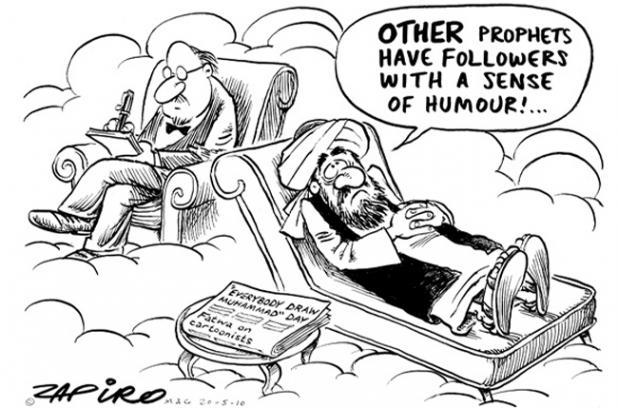
On Zapiro, and Draw Mohammed Day

The original text of this column, first published in Daily Maverick.

We all find something offensive. Many of us might prefer to live in a world which caters to our sensibilities, and limits how much offence we have to tolerate. I would like for everybody to be able to spell, for example, and also for most uses of quotation marks in advertising to be outlawed. Unfortunately, nobody seems willing to offer me any legal assistance towards achieving these outcomes.

Corporate Social Responsibility – what’s a company to do?

As published in The Daily Maverick.

KFC’s recent advertising campaign, based around their stated concern to rid Johannesburg streets of potholes, brought to mind Milton Friedman’s claim that “the business of business is business”. Although there is some dispute whether the phrase should be attributed to him, the idea that private companies are there only to make money (within the bounds of the law) has never met with universal agreement. Critics assert that the power which companies wield obliges them to demonstrate social commitment, for example via financial contributions towards pothole-repair. These purported obligations are backed up by policy and legislation, such as triple bottom-line reporting and the three King reports.

But we should always be wary of letting convention, as well as law, dictate our perceptions of what words such as hypocrisy, right and wrong, moral and immoral mean. The fact that we may prefer the world to look a certain way, and for companies and individuals to act in accordance with those preferences, does not mean that they are obliged to do so – or that they are morally negligent when they don’t.

Get your tuna while it’s hot (or cold)

The original text of this column in The Daily Maverick.

In 1968, the biologist Garret Hardin published “The Tragedy of the Commons”, a paper which argued for some unfortunate implications of the unrestricted exploitation of common resources. The primary example used by Hardin is a communal grazing pasture for cattle, where common use presents no problem until the maximum capacity of the pasture has been reached. After this point, overgrazing leads to the pasture becoming worthless to everyone, as it no longer has any capacity to provide food for the cattle. The problem, of course, is that each individual farmer is incentivised to maximise their own good. They therefore keep adding animals to the pasture, with little thought for the future, until the capacity is reached – thus ensuring the eventual destruction of the pasture.

Is freedom of the press that important?

The original text of my most recent column for The Daily Maverick:

As Opinionista Sipho Hlongwane reminded us on World Press Freedom Day, not only is the extent of press freedom a matter for debate, but much also still needs to be done in terms of bringing the benefits of a free press to most South Africans. This is not simply a matter of what goes unreported, or even of the potential stifling of a free press via intimidation of journalists or other forms of political interference. These are important concerns, but ones which presume an interest – as well as the ability – on the part of South Africans to equally engage with the issues discussed.

Our concerns should go deeper, in that for a developing country such as ours, the focus should perhaps more appropriately be on whether most South Africans have anything to say at all.

Insecurity, and the certainty it spawns

As published in The Daily Maverick

The social lottery of seating arrangements at a recent wedding provided numerous examples of the strangeness of our species. The particular sort of strangeness that was most apparent was our desire or need to have an opinion, even in cases where nothing seems to be at stake, or where the opinion-holder stands no chance of affecting the relevant debate. Much conversation revolved around the equally strange South African political landscape, as one might expect, but there was no shortage of discussion around the British election, despite the fact that many attendees had only snippets from the newswires to draw on as evidence.

The future of South African tertiary education?

The original text of this article in The Daily Maverick.

A Higher Education summit hosted by the Minister of Higher Education and Training, Dr Blade Nzimande, is taking place at the Cape Peninsula University of Technology on April 22 and 23. Much of the focus at the summit will be on “transformation”, one of the more flexible words you’ll encounter while working at a South African university. This is saying a lot, especially since many departments – at my university at least – still seem completely enamoured by the liberating brew of postmodernism, which of course allows for infinite lexical flexibility.

Perhaps this is simply another example of political correctness gone awry – we all know that transformation relates primarily to race, but to explicitly say so may be impolitic, in that colour-blindness is a virtue that we’re all meant to be aspiring to, even in cases where economic inequalities premised on race persist. Instead, transformation becomes code for various social issues, and allows us to collapse concerns around equity, throughput, policies on wheelchair ramps, and whatever else does not currently have its own committee under one handy banner.

For example, the most recent message from the Transformation Officer in my Faculty related to the “Executive Secretaries and Personal Assistants International Symposium”, which I had a difficult time relating to anything obviously to do with transformation. But then, perhaps I’m not transformed myself, or perhaps I’m simply insufficiently postmodern.

Playing the authenticity card

As published in The Daily Maverick

The nation’s favourite teddy-bear impersonator, Barry Ronge, recently wrote that “although Breyten Breytenbach has a point when he calls South Africa a ‘kleptocracy’, can we take someone seriously who doesn’t even live here?”

In response, we could perhaps ask whether we should take someone seriously if they think that the validity of someone’s point of view has anything to do with where they live.

The dangers of tolerance

As published in The Daily Maverick, a companion piece to my previous post entitled Suffer the little children (some overlapping content, sorry).

Julian Barnes’ novel “Nothing To Be Frightened Of” opens with the sentence “I don’t believe in God, but I miss Him”. This echoes a question asked by Daniel Dennett in “Breaking The Spell” – that of whether we care more about being able to believe that our beliefs are true, or about those beliefs actually being true.

We might have rational doubts about all sorts of beliefs, yet still want them to be true. Or find value in living our lives under the assumption that they are true. It would be impossible – or at least exceedingly difficult – to live your life feeling that your job was meaningless, that you were not loved or that you had no free will and no actual soul, despite the fact that one or more of those statements may be true. We seem to seek out (and perhaps that indicates need) some transcendence or metaphysics in our lives.

But those desires and/or needs do not make their objects true or real. We need to bear in mind the possibility that certain beliefs serve a social or psychological function only, and that “belief in belief” may take us as far as we can go. In other words, that no value is added by insisting on the actual truth of some of our beliefs. In particular, we need to contemplate the possibility that treating some beliefs as literally true could be harmful, rather than neutral.