Chief Justice Mogoeng, religion and the law

In September of 2011, I was one of those to express concerns regarding Mogoeng Mogoeng’s suitability for the position of Chief Justice. At the time, I noted that “there is a distinct danger that he would be unable to separate his faith from his duties as a jurist”, and also remarked on how his appointment would occur in a context of apparent tolerance for homophobia on the part of the President himself, as well as in the appointment of someone like Jon Qwelane as ambassador to Uganda.

However, there has been no reason (that I’m aware of, at least) to fear that the worst has in fact come to pass. Morally conservative he may be, and also homophobic, but I’ve seen nothing to indicate that Mogoeng has been anything other than the loyal servant of the Constitution that he swore to be when appointed.

On Elliot Rodger, #YesAllWomen and #NotAllMen

As news of Elliot Rodger having killed 6 people, then himself, spread across the Internet this past weekend, the Twitter hashtag #YesAllWomen started to trend. On the surface, the reason for the widespread uptake of this hashtag is easy to comprehend, given that Rodger had announced his intention to

“enter the hottest sorority house of [the University of California–Santa Barbara], and … slaughter every single spoiled, stuck-up blond slut I see inside there.”  To “all those girls I’ve desired so much,” he says, “you will finally see that I am the superior one, the true alpha male.”

elliot-rodger-fusillade-santa-barbara-islaTo those women (and men) who were using the hashtag sincerely (as usual, there was some satire, some trolling, etc.), Rodger’s actions and the apparent motivation for them provided a useful opportunity to note that sexism and misogyny – whether of the extreme sort that leads to things like beating and rape, or the more widespread sort that is documented on sites like Everyday Sexism – is something that is far too common.

It doesn’t matter that you might be able to cite an instance, or a handful of instances, of a woman who doesn’t appear to be the target of sexist attitudes. It also doesn’t matter that you might be able to cite an instance, or a handful of instances, of men who are the target of sexist attitudes.

Of course it’s true that men are also discriminated against. That is a problem, and one that isn’t given its due attention. But it’s a separate problem, and one that doesn’t diminish the fact that women are, in general, discriminated against more pervasively and acutely than men are.

As with race – particularly in a country like South Africa, but also more generally – a history of discrimination doesn’t get obliterated when legal equality arrives. Social attitudes are sometimes slower to change than jurisprudence is, meaning that you have a larger and more receptive audience for misogynous sexism than you do for misandrous sexism. This could manifest in advertising that objectifies women, or in unequal pay, or in the possibility that you get promoted more slowly as a woman than you would as a man.

Exceptions to this pattern say little about whether the rule is still accurate, until we reach a point where the exceptions start becoming, well, unexceptional. Nevertheless, it should be permissible to question whether this case – Elliot Rodger – is one of somebody acting out of a misogynistic mindset. It might be, for example, that he was simply disturbed in some more general fashion, and that the sexism aspect is a distraction from that more general motivation.

As is typical, a case like this turns the majority of columnists, tweeters and bloggers into psychologists, all offering their non-expert diagnoses of what Roger’s problem was. I’ll try to resist that, because I think it’s irrelevant to the message and the motivation of #YesAllWomen, and also irrelevant to how a competing hashtag #NotAllMen, missed the point about the role a hashtag like #YesAllWomen can play in raising awareness of a genuine social problem, as well as reinforcing solidarity amongst those who experience the discrimination the hashtag catalogued.

An exact diagnosis of Rodger is irrelevant because it’s a pretty safe bet that that misogyny was a large part of his motive, both because it’s a regular feature of his manifesto (which, incidentally, also offers an explanation of why he killed men as well as women. He hated them because they were more successful at attracting women than he was, and this seems to amplify, rather than detract from, a characterisation in which women are objects of conquest), and because of the everyday sexism that I’d suggest any honest observer would agree is real.

#YesAllWomen was noting, and bemoaning, this most recent and tragic expression of these sorts of attitudes. Twitter is a place where we broadcast in 140 characters or less, and a place where rhetoric counts greatly in terms of political effect. #TheVastMajorityOfWomen dilutes the message, regardless of whether it’s more accurate or not (I don’t think it’s more accurate, myself.) The hashtag was a rallying cry that summarised something that is indisputably real, regardless of whether there are details to be nitpicked over or not.

Also, it was a political moment. To accuse those who deployed the hashtag of opportunism or grandstanding misses the point that it wouldn’t matter if it happened to be the case, after detailed analysis, that the Rodger case was not a perfect fit for this broader protest. Yes, all women (leaving aside the nitpicking, as I say above) experience the effects of a patriarchal attitudes, and those attitudes can sometimes lead to tragedy just like this – regardless of whether this (Rodger) is the best way of making that point.

So, it’s in this context that the #NotAllMen hashtag lands, with (some) men rushing to defend themselves against the notion that they are responsible for the sexism that women are subjected to. But unless someone had said that you – Jacques Rousseau, or Keyser Soze, or whomever – are responsible for this sexism, #YesAllWomen isn’t aimed at you, and there’s no need to defend yourself. There’s no reason to take it personally, except as an opportunity for a self-assessment regarding whether you might in fact be complicit, and to what extent. Your actions thereafter, if any, should follow from that self-assessment.

Any sensible person already knows that #NotAllMen are like Rodger, or a diluted version of him. Objecting in the general sense that #NotAllMen does can only serve to give the impression of disagreement with the general point that sexism against women is prevalent, and that this sexism can be part of the reason that men like Rodger end up doing what he did.

It is a pity that conversations about discrimination need to start with qualifications and mea culpas – I would prefer to operate in a world in which any idea can be discussed without running the risk of being misinterpreted through assumptions of bad faith and so forth. But that’s not how politics works – discussions like these happen in a context, where the reception of a message is influenced by that context.

Regardless of what you might be intending to indicate by using #NotAllMen, you’re either saying something so obvious that it perhaps doesn’t need to be said, or saying something that takes attention away from a far more important issue – the issue captured by #YesAllWomen. The hashtag bemoans a real social malady, and our responses should take care to acknowledge that, rather than use it as an opportunity for nitpicking.

South Africa’s 2014 National Elections, in brief

I’ll be brief, simply because other people have written, or are writing, data-driven analyses that will end up being more valuable than these few fragments.

First, it is, or should be, a source of great head-scratching for some as to how the ANC didn’t lose more support than it did. My predictions had them achieving 62%, but even so, I think they should ideally have lost more ground than they did.

The short version of why I think they didn’t lose more is simply because there is a vast difference between the media I consume, and the people I talk to, compared with what the average South African consumes and who they talk to.

ELECTIONS-2014-01-709x700Those of us on Twitter, in academia and (occasionally, as I am of late) in the media themselves can, just as everyone else, mistake their personal filter bubbles for popular sentiment. And as much as one might wish it were different, it really doesn’t seem as if the scandals of Nkandla and Waterkloof, or the obscenity of Marikana, made as much of a difference as we thought it would.

This doesn’t necessarily mean, as some seem to want us to believe, that we have an unsophisticated electorate. Voters the world over vote on what they experience, and what they know – and the task before us is to understand the motivations for those who vote ANC despite these scandals, not think them defective because they don’t vote otherwise in protest. To be frank, in countries like ours (with the class divisions so closely correlated with race), arguments around “unsophisticated electorates” seem to frequently be little but cover for racist sentiments.

For example, note that in KwaZulu-Natal, the ANC won a larger number of votes than in 2009, and that even though the turnout there was lower than in 2009, the percentage drop in turnout was less than the national average. If Zuma was the problem (or rather, if Zuma was perceived to be the problem), KZN would be a likely place to observe a significant decrease in ANC support, or increasing apathy at the ballot box – neither of which seem to be the case.

So, why did the ANC not lose more support, in as adverse circumstances as one can imagine? One suggestion would be that the competition – besides the EFF, which grew from nothing to attracting 6.35% of the vote – isn’t offering a compelling alternative. The DA, as Stanley Greenberg put it a week before the election, might in retrospect have wanted to spend more time punting its successes than the ANC’s failures, one presumes because people are more interested in what you can do for them, rather than what the other party is failing to do for you.

This is perhaps related to the issue that I’ve mentioned before in my review of Eusebius McKaiser’s “Could I vote DA?“, namely that of the DA’s occasional tone-deafness, in this case arguably manifested in a focus on negative commentary on the failures of others, which – if you’re (wrongly, but nevertheless) identified as a white party – easily conforms to a race-based caricature whereby you’re the party of white privilege telling the (black) liberation party that they aren’t up to the job.

Even if people don’t think this way (and I don’t think many do), they might feel this way, and emotional factors also influence voting behaviour. This has been a concern for some in the DA for going back at least as far as Ryan Coetzee’s 2006 document detailing a strategy for becoming a “party for all”, and I’m not convinced that the lesson of separating the rational and emotional has ever completely been learnt in the party.

Which brings me, in conclusion, to today’s Business Day column by Gareth van Onselen, in which he discusses Lindiwe Mazibuko’s decision to take a sabbatical year, in order to study at the Kennedy School at Harvard.  First, congratulations and best wishes to Lindiwe, whom I’m friendly with. Regardless of anything else, it’s a great opportunity, and she’ll (and we’ll, if she returns to active politics) benefit from her choice.

But second, if his account is correct, it does point to significant tension within the Democratic Alliance around leadership and strategic direction. Some tension isn’t at all unusual in any large organisation, but the extent of it, as detailed in the column, should be very troubling to anyone who – like me – is committed to the liberal tradition in South Africa, and who has hopes for the DA to be flag-bearers for that tradition.

Not, to be clear, because I don’t think they’re capable of doing that. But more because internal squabbles, and their public airing, don’t create the impression of a coherent policy direction, or of broad agreement with a particular policy direction. As I’ve said many times over the years, I’d prefer to evidence to trump impressions, but it’s all too clear that they often don’t.

The ANC, with its established advantage in the electoral market, can get away with bad optics. The DA, less so.

[Edit]The DA’s current Director of Communications, Gavin Davis, has now responded to the van Onselen column linked above (my link is to his blog, but the piece was also carried as a letter in the Business Day.[/edit]

@ChesterMissing’s Guide to the Elections ’14

ChesterMissingChester Missing held his Cape Town book launch last night, and he was as entertaining/discomfort-inducing as ever (the latter, at least for middle-class white liberal types, whom he specialises in discomfiting). For those of you who don’t know Chester, he’s a puppet that routinely delivers fine political analysis, served up with plenty of satirical humour.

Conrad Koch is the man who stuffs Chester into a suitcase when traveling, and also the man who books Chester’s gigs, including – presumably – the deal for the book they launched last night, Chester Missing’s Guide to the Elections ’14. I’ve just finished reading it, and while anyone looking to learn anything about who to they should vote for on May 7 might end up disappointed (Chester being an equal-opportunity abuser of all the contenders), those looking for a simple collection of gags at the expense of those contenders may well also feel short-changed – but only because they might be asked to think through some uncomfortable issues, rather than simply chuckle along.

Gags there are aplenty, some of which are rather amusing, supported by some classic Zapiro cartoons. But a key purpose of the book – at least in my reading of it – is as a vehicle for Koch to explore the complexities of racial identity and class in our 20 year-old democracy, and to highlight the ahistorical and apolitical ways in which some of the likely audience for the book (and his shows) might be inclined to interpret South African political theatre.

As befits his training in social anthropology, Koch intends for the book “to explain why we should learn to understand voters’ motivations on their own terms”, rather than according to assumptions about what those motivations might be – whether those assumptions are the result of propaganda or our own prejudices. The book is, in this sense, a useful complement to Eusebius McKaiser’s Could I vote DA?, which (although more narrowly focused on one party) also highlighted the centrality of understanding the historical and psychological context in which political messaging is interpreted.

The second section of the book offers a potted history of South Africa, and the 10 pages dealing with South Africa pre-democracy are as effective a rebuttal to white folk who think apartheid a thing of the past as one could imagine reading in a comedic book. The point of the section is not to invoke lashings of white guilt, but to remind readers that if they don’t acknowledge the ongoing effects of racial discrimination, they can’t understand apartheid.

As I said in a previous column,

I did benefit from apartheid, as (on aggregate) all whites did. But I still benefit, because of the cultural capital, the confidence, and from the fact that the vast majority of people in power at my institution are white liberal males, just like me. How could I not have benefited and continue to benefit? After all, isn’t that what apartheid was designed for?

However you end up voting – if you vote at all – it’s useful to be reminded, as this book reminds us, that it’s not only our political leadership we’ve got to keep an eye on. We should also keep an eye on each other, and on ourselves, to make sure we engage with each other fairly and honestly, rather than according to well-rehearsed stereotypes.

Here’s Chester Missing at the EFF manifesto launch:

#FreedomDay, and 20 years of democracy in South Africa

My first experience of voting was on March 17, 1992, in the referendum that asked

Do you support continuation of the reform process which the State President began on 2 February 1990 and which is aimed at a new Constitution through negotiation?

That reform process, and the desire to be part of it, was one of the reasons that I returned from the USA, where I had been living during 1990 and 1991. I watched Mandela’s release in February 1990 from a small apartment in Rockville, Maryland, and even though sad I couldn’t be there, I was nevertheless optimistic about South Africa’s future, and the prospect of a fully democratic election.

On Kasrils, and spoiling your ballot

It’s perfectly reasonable to be dissatisfied with the electoral process. We might struggle to find a voter in any jurisdiction who can’t present a case for how things could be better, whether the improvement were to come from revisions to party funding legislation or the accountability of elected officials to those of us who elect them.

And, grumbling is what we do – all the more since the Internet and social media allowed for vastly increased numbers of people to join in the grumbling. But for all the grumbling, it’s perhaps worth thinking about – or revisiting – what the point of electoral systems in democracies is.

On the surface, of course the point is to show us what the will of the people is, and to allow for us to elect people to represent us in Parliament, or on city councils. (In South Africa, we don’t elect people but instead vote for parties, who choose the people – which is but another thing you could grumble about it you wish.)

But the dissatisfaction leads some to say we should simply opt out, either through not voting at all, or through measures such as spoiling your ballot. Recently, Ronnie Kasrils has been reported as recommending spoiling your ballot as a way to indicate that you believe our current ANC government has let us down (though, more nuanced accounts of his statements to the media indicate that he’s recommending a vote for a minority party first, and only spoiling your ballot if none of those parties are palatable to you).

To make one thing clear: spoiling your ballot is a legitimate choice in a democracy. But it’s the wrong choice, because it misunderstands the point of voting, in that it begins with fealty to a chosen party, where that fealty allows you to either endorse the way that they are doing things, or instead, to simply withhold your support from them.

The right choice is to understand your vote as purely a tactical gambit, deployed in the manner that might best achieve the outcome you hope to achieve. Signalling disappointment with a political party isn’t effectively signalled through spoiling a ballot, in that the signal is far too noisy – in brief, there is no way of telling whether you spoilt your ballot because you’re incompetent, or because you were protesting the electoral system rather than the party you ostensibly didn’t vote for.

A vote for an opposition party shifts the balance of power, however minutely. Voting for nobody, by contrast, indirectly rewards the incumbent through denying an opposition a chance to govern – especially when dealing with a significant majority such as the one the ANC enjoys in South Africa. A spoilt ballot might well decrease the majority party’s proportion of votes cast, but a vote for an opposition party will decrease it further, and alert them to the fact that they cannot take your vote for granted in a far more transparent way.

The tactical element of each person’s vote is of course a matter that can only be clarified by the individuals themselves. For a middle class liberal type like myself, living in the Western Cape, a vote for the ANC in the provincial ballot might play a part in alerting the governing party (the Democratic Alliance, or DA) that their steadily increasing social conservatism is diametrically opposed to liberal ideas.

It doesn’t necessarily matter that the ANC is illiberal – the vote signals that the party that is supposed to be liberal seems to instead be more focused on attracting votes through playing on fears of social decay than on defending its ideological turf. (It’s a separate issue whether the turf is the correct one, or whether the short-term gaining of votes is sensible strategy on their part – I’m simply addressing the voters’ choices and how they might be made.)

On a national level, a vote for the DA might well be the best signal of disaffection with the ANC – but then again, a vote for someone like the EFF might be more effective in the long run, because both the ANC and the DA are roughly centre to centre-right in economic terms, and the voice that’s missing in a poverty-stricken country like ours is the leftist one. Having a strong EFF presence in Parliament might be just what’s needed to shake the incumbent from their dogmatic slumbers, to paraphrase Hume.

And then, next election, you get to make the same choices again. The key thing to remember is that they are choices, and that you owe nobody your loyalty. If it’s the long-term future of the country that you care about, then you should vote in the manner that you think best supports a prosperous future for the country – not in a manner that best supports a prosperous future for any particular party.

Trigger warnings – Internet civility and the risk of infantilization

Those of you who frequent corners of the Internet that discuss prejudice against other human beings on the grounds of things like race, sex, sexual orientation, physical disability and the like would no doubt have come across the term “trigger warning”. For those who haven’t, a “trigger warning” is essentially an alert that the text that follows might contain words or ideas that “trigger” some negative reaction in the reader. For example, a victim of violent crime might be prompted to re-live their terror on reading a descriptive piece about an armed home invasion.

There’s no doubt that some of us can be insensitive to the needs and interests of others, some of the time. In fact, some people seem to take pleasure in being wilfully offensive, and might deliberately taunt others for some or other manifested difference (or even an imagined difference). Trolls are one example on the most egregious end of the spectrum, but more commonplace is the problem that for those of us – like me – who fit into the categories that have long been considered “normal”, it’s easy to find yourself offending others without realising it, and without intending to.

More worrying for us “normals” is the possibility that this social-baseline existence makes you blind (or contributes to blindness) regarding the privileged status you might occupy in life and social discourse. The relevant catchphrase here is “check your privilege”, and as I’ve previously argued, demands to “check your privilege” can sometimes be a complete nonsense, used to evade the responsibility of making and engaging with arguments, even if it is sometimes true that “privilege” can blind one to other ways of being.

But it can also sometimes be accurate, just as there might be – and are – situations in which we’d want to warn a potential audience that something they are about to read and/or hear could unsettle them. The concept isn’t an alien one – age-appropriate warnings for visual media rely on it, and news inserts are often preceded by a warning regarding graphic content.

Yet, we surely need to take some responsibility for ourselves, in that it would be unreasonably demanding to expect, for example, a support group for war veterans to precede every recollection of some event they witnessed with a “Trigger warning: violence” alert. Instead, the most obviously suitable place for trigger warnings (if we are to agree that they should be more prevalent, that is) would be on content or platforms where a responsible consumer of that content would be justifiably surprised to encounter that which they find triggering.

Take an unmoderated Internet discussion forum, for example – you cannot expect such a place to contain only things that don’t upset you. But you might more reasonably expect a discussion forum on how to raise children to not contain accounts of children or parents dying in labour – an unwritten social contract has arguably been violated in the latter case.

The broad point is that it’s impossible to protect people from all harms, and it’s also only morally expected of us to avoid causing foreseeable harms to others, and even then, it’s unreasonably demanding to expect that we take all such harms into account. I don’t want to explore the issue of which harms we’re obliged to take into account and which not (not today, at least), but for example, I know it might harm the feelings of a religious person to tell them that God is a fiction, but that shouldn’t prevent me from being able to say so.

In other words, both because the Internet is an unregulated place, and second because we can’t reliably predict what people might or might not be harmed by reading, the traditional distinction between what’s morally expected and what’s “nice to have” – supererogatory in philosopher-speak – needs to be maintained here. We might prefer for people to create a environment of type X, but might only be able to expect an environment of type Y.

Because the alternative – of always and only saying things that are guaranteed to not harm anyone – creates such a sanitised environment that it would run a serious risk of infantilizing us. We need to be able to tolerate different points of view, and that which we might find offensive, because that’s part of the way that we learn to cope with the slings and arrows of fortune.

Of course, this approach does advantage those whose points of view, or who – as people, are subjected to fewer of those slings and arrows. But at the same time, there are people who have endured traumas that prefer to talk about them openly, to not have them treated as a “special” topic that needs to be preceded by warnings, or confirmation that a certain conversation is permissible.

Striking a balance here requires empathy – and there’s no question that far more can and should be done by “normals” to be sensitive to the fact that they frequently win at life simply because they wrote the rules. But the solution isn’t to be found in swinging completely to the other end of the spectrum, and attempting to rule out all possibility that people might find themselves challenged, even hurt, by the things they encounter in the world.

The thoughts above were prompted by a worrying trend described in this New Republic article, namely that of college classes now carrying trigger warnings on class syllabi. If a class called “Histories of the Present: Violence” is expected to carry a trigger warning, then it seems clear that we’ve over-corrected – even if there’s a real problem at the heart of the motivation for that correction.

Zille on Carien du Plessis and the ‘race card’

Briefly, on Helen Zille criticising journalists, and specifically Carien du Plessis, on Twitter. As I said at the time, Twitter is the wrong medium for this in any case – prone to misinterpretation and uncharitable readings. Plus, Zille has a similar problem as Dawkins has on Twitter – she can all too often sound like she’s simply trolling, which doesn’t do her arguments any justice.

It’s entirely possible that du Plessis is overcompensating for something in her reporting. It’s entirely possible that this might have something to do with race, gender, experience and the like. But how could this ever be proved? The fact that it can’t be – that it’s unfalsifiable – makes making the claim the story, rather than the claim itself.

Making the claim that she does demonstrate bias now becomes a character slur of sorts, and in that context, can amount to ‘playing the race card’, even though Zille is quite right in her general description, in a comment to her column in Daily Maverick, regarding how we often misuse the idea of the race card.

Let us sort out this “race card” red herring. When a reference to race is relevant, it is NOT playing the race card. Only when race is irrelevant to the argument, does it involve the “race card”. e.g. if someone is corrupt and they claim they are persecuted because of their race, THAT is the race card. If I have come to the conclusion, over many years, that a reporter’s race and background is something that they have to constantly over-compensate for in every report, I will say so. It is not the race card. Of course it is offensive. But freedom of speech is the right to say things one believes to be true but that may be offensive to others. No-one has the right NOT to be offended. And why is everyone so shocked when a relevant point is raised about the baggage of race and history on some white South Africans — while there is not a word about the constant gratuitous racial insults others of us have to face on a daily basis. Stop this double standard and hypocrisy.

As she correctly points out, if race is relevant, there’s no logical fallacy in highlighting it. Playing the race card is just one instance of an ad hominem fallacy, and should be treated just the same, in a logical sense. Calling something ad hominem shouldn’t be used simply as a way to avoid dealing with the substance of the accusation, assuming there is any substance to the accusation. And that is where Zille errs.

Because if you want to make the case that there’s bias – and not simply create the impression that you don’t like what’s being said – you have to actually make the case, not simply allude to it. Helen Zille just asserts her conclusion regarding du Plessis, appealing to her impressions as evidence. But we don’t have access to those impressions, meaning that for us, as readers, the claim is without warrant. This sort of claim is permissible, and we shouldn’t shout it down just because we disagree.

We should shout it down (by which I mean, point out its failings) more because it’s poorly made, and because we care about good arguments.

Right?

Ugandan homophobia and those “mercenary” gays

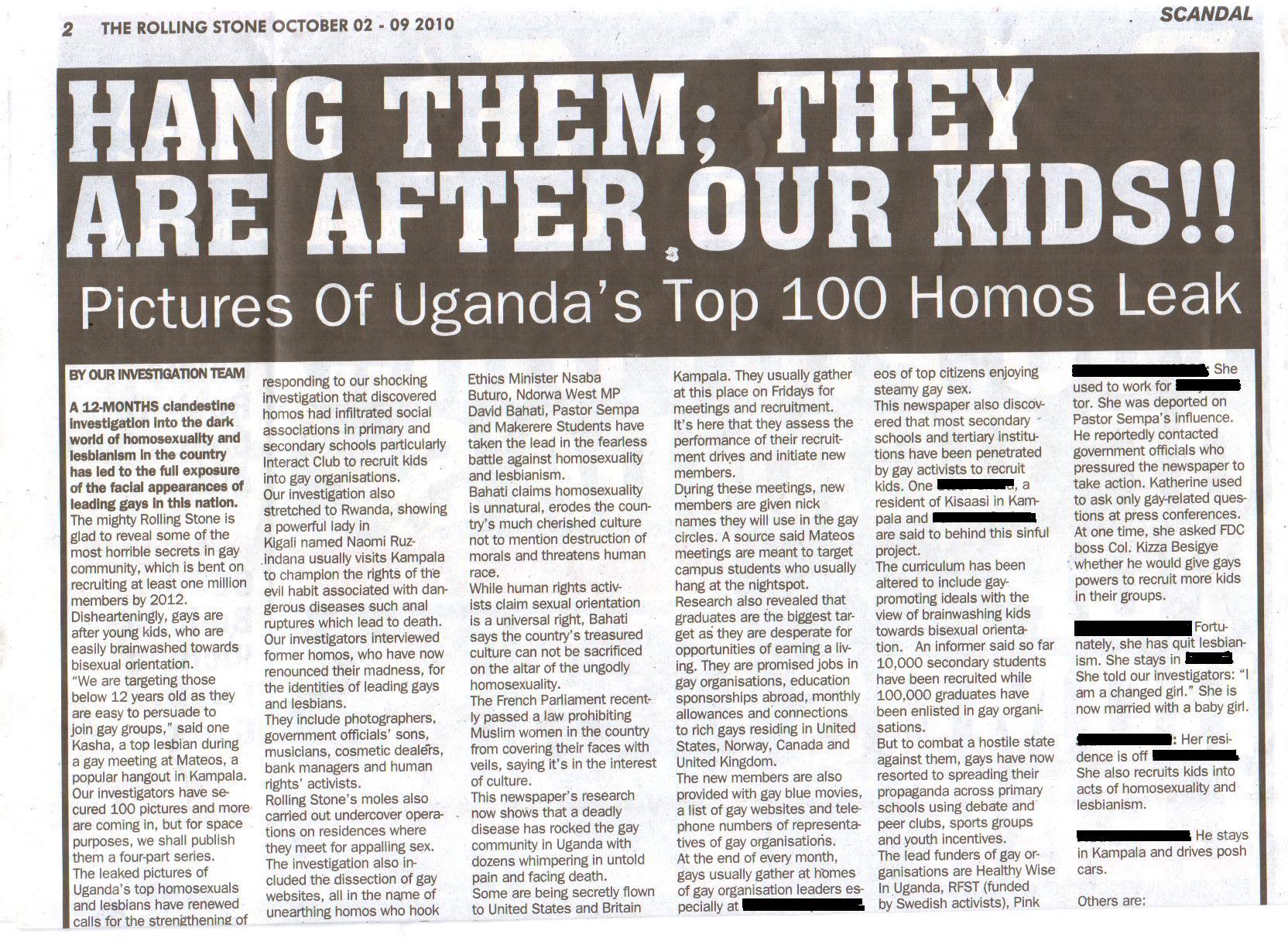
Three years ago, Uganda’s Ethics and Integrity Minister Nsaba Buturo observed that “killing them [gay people] might not be helpful“. The death sentence was indeed dropped from the bill that now awaits President Yoweri Museveni’s signature, after having been passed by their lawmakers in December.

hangthemprotectedBut that’s cold comfort to those persecuted for their sexuality – a sentence of life imprisonment can be imposed not only for gay sex, but also for “all behaviour, including touching, that might lead to or show an intention to have homosexual sex”. It gets worse, though – at least in terms of how much prejudice the Ugandan Members of Parliament are willing to flaunt: the ministerial task team advising the President on the bill “falsified the information contained in the report given by medical and psychological experts, twisting it to show that homosexuality should indeed be further criminalised“.

A concern for truth has never been a hallmark of this sort of bigotry, as you no doubt know. From claiming that homosexuality isn’t “African” (even though there’s plenty of evidence for pre-colonial same-sex sex) to Museveni’s own recent statements that people might become gay for “‘mercenary reasons’ or, in the case of lesbians, a lack of sex with men.”

In part, the blame for these fabrications and the attendant persecution can be laid at the door of American evangelical Christians, in particular Scott Lively, president of “Defend The Family International”, who thinks that homosexuality caused the Holocaust. But he’s also tapping into a rich wellspring of hatred and confusion – from David Bahati’s contempt for homosexuality (he’s the first-term MP who drafted the death-penalty version of the bill), to the current “Ethics and Integrity” Minister, who talks about “the right kind of child rape” (the heterosexual kind, of course – watch the interview starting at 35m40s in the video embedded below).

It’s laws and lawmakers like these that remind one of how far we still have to go as a species, before being remotely respectable.

http://www.youtube.com/watch?v=L9ytwGW9eO0

Eusebius McKaiser asks: “Could I vote DA?”

Finding myself in a bookstore with some time to kill, I sat down to read Eusebius McKaiser’s new book, Could I Vote DA?, and am now in a position to recommend that (some of) you do so, too.

Regardless of the book’s title – although the DA (the Democratic Alliance, South Africa’s only self-identified liberal party) is the main focus – Eusebius does a fine job of capturing the essence of some key ideas in politics, such as the point and value of a political ideology, what liberalism entails and doesn’t entail, affirmative action, and the strategic and tactical dilemmas faced by those in the political arena.

The book is overtly (even proudly) subjective, and Eusebius’s character is manifest on every page. For some people that will be a negative, but for those of you who can read past an impression of a character that’s not your preference, the personal narrative does, I think, help to bring the ideas to the forefront.

One aspect of the book and its subjectivity that I wasn’t enamoured of was what seemed (at times) to be gratuitous sniping at some former and current DA representatives or employees, in particular their former Executive Director of Communications, Gareth van Onselen (also a friend). They don’t see eye to eye on some things, and neither of them are fond of being told they are wrong, but Eusebius’s account of some recent dealings between van Onselen and people in the DA seemed a little too eager to “school” van Onselen.

(Much of the conversation regarding Gareth van Onselen is in a chapter detailing the disagreement between himself and Mmusi Mainane – the DA’s National Spokesperson and Deputy Federal Chairperson – on the topic of ubuntu, so this is an opportune time to link you to an email conversation Gareth and I had on the topic of ubuntu a couple of years ago.)

The language of the book is very informal, containing many colloquialisms and much slang. In tone and content, I’d think it well-suited to a younger audience – perhaps those “born frees” that will be voting in a National Election for the first time.

Those of you who know your political philosophy won’t learn much by way of theory, but can certainly still enjoy the book not only for how it might get you to think about issues again, even afresh (of value, because our beliefs and views can easily calcify without our realising it), but also for its gossip value – Eusebius gets to hear plenty of interesting stories while hosting his morning show on PowerFM, and in similar gigs prior to that.

The question of what market this was aimed at is an interesting one – the book retails for roughly R230, which might, I fear, place it slightly out of that youth market’s comfort zone. Stephen Grootes recently published SA Politics Unspun for around R185, and while Richard Calland’s The Zuma Years retails for a similar price to Eusebius’s book, Calland’s is research-intensive rather than a piece of reflective political philosophy.

These books aren’t directly comparable, but they do give a sense of what other publishers thought a reasonable price for a book about politics, in a market that we know doesn’t read an awful amount in any case. I hope I’m wrong, and that Eusebius can treat me to a gloating dinner with his royalties later this year.

A final though: the key point, for me, made in Eusebius’s book was regarding the tension between principle and pragmatism, and how difficult it is to strike a balance that both satisfies the electorate while not selling out the values you are ostensibly promoting. The DA has mostly stuck to (an attempted) defence of principle, even while foundering in doing so at various points (to mention just one example, Eusebius highlights the illiberal stance of Helen Zille on HIV/AIDS, something I’ve also previously written about).

But when they try to make a case for something that’s about more than only principle – or when they make a case for a principle in a way that’s designed to appeal to more people than only their liberal base (if that is still their base at all, as I questioned when writing about the Maimane vs. van Onselen thing, their message seldom seems both co-ordinated and coherent. Last year’s BBBEE confusion was the most striking example of this, and these examples all speak of a party that knows it needs to change it’s manner of engaging our voting population, rather than the voting population that can be found in textbooks.

Eusebius makes this case very well, and very thoughtfully, and his book is a welcome contribution to South Africa’s political debate, especially with an election less than three months away.