@Women24, sexism and @6000

One of yesterday’s social media flare-ups (the rule, I think, is that we need at least 3 per day) was caused by a post at 6000.co.za, in which Mr. 6K highlighted what he regarded as mixed messages emanating from the media outlet Women24.

The mixed messages, according to 6K, result from the fact that Jana Joubert of Women24 had asserted that it’s wrong to criticise Members of Parliament for what they wear, and that we should instead focus on how well they do their jobs. This standard – with which 6K agreed (as do I) – was highlighted as being in conflict with previous Women24 posts like this one:

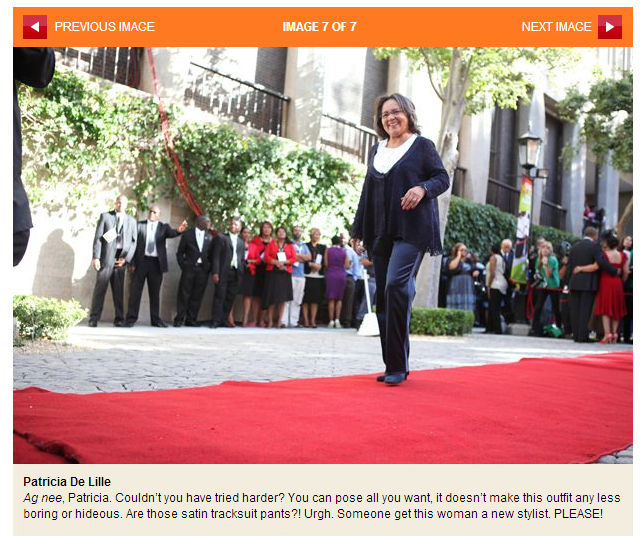
De Lille at SONA2013, image via 6K

For those who can’t see the caption, the text under this photograph of Patricia de Lille reads: “Ag nee, Patricia. Couldn’t you have tried harder? You can pose all you want, it doesn’t make this outfit any less boring or hideous. Are those satin tracksuit pants?! Urgh. Someone get this woman a new stylist. PLEASE!”

Highlighting this and a few other examples, 6K says:

But before women24.com go out of their way to tell us what we should or shouldn’t be saying about the fashion on the red carpet at SONA or anywhere else, maybe they need to get their own house in order.

So, is the accusation of “mixed messages” justified, and fair? I don’t think it’s fair, and I think that the justification available is weak – so weak, in fact, that the point didn’t merit making. But, I also think that Women24 – and specifically their editor, Lili Radloff – are avoiding a real issue in the way they chose to respond to 6K.

(An aside: the fact that there is arguably fault on both sides has nothing to do with the relative severity of the faults in question. I’m making no suggestion of equivalence, and as you’ll hopefully see, I think 6K was undoubtedly in the wrong – on aggregate – in this case.)

I don’t think the criticism of Women24 was fair because the image of de Lille (and the other examples used) were from the same event last year, while Joubert’s comment regarding shaming women for their outfits was made this week. Not only do times change and editorial policies change, but 6K and Radloff are also Twitter ‘friends’, so he could easily have sought comment or clarity from her on whether she sees a mixed message or contradiction, before making that accusation in public.

Doing so would be required of a journalist, and I can hear 6K (he’s a friend, in case that matters to anyone) telling me off, in that he’s “just a blogger”. I don’t think that matters – new media and old have blurred these distinctions, and when a flare-up like this ends up being discussed on radio (as this one was), we can be sure that there’s a chance for reputational harm – which incurs some responsibility, even if not the high levels of it we’d demand of a ‘real journalist’.

So, I’m claiming that 6K didn’t do sufficient homework before posting what he did. For those of you who don’t read his blog, he’s not averse to being controversial, and I think that impulse got in the way of common sense in this instance.

The reason his critique was only weakly (and insufficiently) justified is that a year isn’t that long a time, and that – to the best of my knowledge – the editorship have not made this policy change clear. In fact, Radloff’s early Tweets in response to 6K (“we might have botched it a bit this time“, or “I hear what you’re saying“) – posted before Radloff realised the images were from last year – make no mention of a policy change, which would seem to have been the strongest available response. Instead, we saw what amounted to an apologetic response at first, before 6K’s use of old images became apparent.

But make no mistake about it – in an environment where everyday sexism occurs, well, every day, Radloff and Women24 – a large, feminist-driven website – are obviously going to be aggrieved by being told that they are inconsistent, and unfortunately (but also, in reality) the sex of the critic will always come in to play in situations like these.

Arguments should stand or fall on their own merits, but given the lunacy of identity politics, they don’t. 6K could – and should – have anticipated that his post was going to read as an attack on the politics of Women24, which in turn could – and should – have made him ultra-attentive to getting his facts right.

In closing, where Women24 are erring is arguably in thinking that the market is able to separate individual voices from the overall brand, as Radloff asserted on Twitter (again, in an early defence before it became clear that 6K had used last year’s images). “Different opinions”, she said, are not the same as “mixed messages”, which was the phrase 6K used in his post title.

I don’t agree with that. A readership would perceive it as mixed messaging if a website set up (at least in part) to serve a cause spoke of the wrongness of mocking attire with one voice, and then did that mocking with another. The early rebuttals to 6K, which included the “different opinions” claim, didn’t strike me as indicative of having thought through this aspect of brand identity sufficiently.

But these are matters for another day, as is the unfortunate presence of pseudoscience on the pages of Women24 (both astrology and multivitamins feature strongly).

When we get around to engaging each other – on these and other issues – let’s try not to assume the worst, though. It’s getting more and more difficult to talk about issues without presumptions of guilt or virtue, and we all play a part in creating – but if we care to be more careful, undermining – a culture in which blaming, judging, and shouting are valued more than understanding is.
Journalists in politics, and the myth of objectivity

The news of Donwald Pressly’s suspension from Independent Newspapers (allegedly following his putting himself forward as a candidate for the Democratic Alliance in the 2014 elections) has given rise to some discussion on journalistic “objectivity”, and whether journalists should be members of political parties. I’m largely in agreement with Eusebius McKaiser’s views on this, but want to add a few comments of my own.

Both Pressly (and previously, Brendan Boyle) were suspended when it emerged that they had put their names forward for internal consideration by the Democratic Alliance (DA), in a process that is meant to be confidential. They had not yet been appointed to any position, nor been selected or assigned to any ranking on the Party’s list of candidates. Leaving aside the leaking of this information (itself involving ethical issues), they had indicated that they would be willing to leave their current jobs for a career in Parliament, rather than already taken up jobs involving representing a political party.

In other words, they already held the political viewpoints that made this a plausible career choice for them. All that changed was that those viewpoints were made more public. And despite already having those viewpoints, their ability to report fairly on matters political hadn’t been called into doubt before this, at least not to my knowledge. As a friend remarked, “both are excellent and ethical contributors in the public sphere, and, in their professional lives, have upheld the journalistic standards expected of them”.

Despite already holding these views, and doing their jobs (at least) competently, the view seems to be that once readers are made aware that you hold those views, you can no longer be trusted – even if you (arguably) write the same sorts of things before and after. This seems to imply that readers are unable to judge the content of the writing as presented to them, including considering whether details are accurately presented in whatever it is that they are reading, and whether or not the journalist is trying to nudge them into taking one side over another.

In other words, readers need their hands held, but more importantly, their hands are being held by an arbitrary fiction. First, arbitrary because not only do most people already hold political views, but also because it’s only certain forms of view that get counted in these situations. If you’re a member of Greenpeace, you can’t be “objective” in the strong sense demanded of Pressly and Boyle. If you’re a democrat, or a constitutionalist, or a non-racist, you’re expressing a view – but some views are deemed to not impugn your “objectivity”, while others apparently do.

And the arbitrary defining line between objectivity and not is simply party membership, regardless of what you write, or how you write it, because judging whether you’re making sense on the page is apparently beyond us. This seems a paternalistic, and infantalising, view of my competencies as a reader.

Then, objectivity itself is an impossible standard to set. What you’re looking for is balance, not objectivity, because we’re simply not capable of what Nagel called “the view from nowhere”. Whatever you write is going to include certain sources, exclude others, chase some leads and not others – and all of these decisions are made by a person, with existing beliefs. In other words, by a subjective human agent. But his or her job is to offer as balanced a report as they can – and this involves being aware of your biases to the extent that you are able, so that you can compensate for them when necessary.

So, I disagree strongly with how Boyle and Pressly were treated. We need to develop new norms about this, in my view – the traditional interpretation of ‘objective’ journalism simply isn’t sustainable, and was always a myth that we were simply afraid to acknowledge. Awareness of biases is what should be cultivated, with people being deployed on a different desk only when bias is interfering with accuracy. Anything else is, to my mind, awarding yet another victory to paranoia and fear-mongering – assignation of guilt by means of whispers and innuendo, in a way that rewards readers for the logical error of making ad hominem judgements about journalists.

Then, there’s also a practical problem, in terms of timing – both Pressly and Boyle are being asked to give up their jobs months before an election for the hypothetical possibility that they might become DA representatives. That doesn’t seem fair, and is most probably unconstitutional.

Having said all that, of course editors need to respond to the market as it is, not how I’d like it to be. So I can understand why these journalists were suspended, while still hoping that we can realise it’s an error to respond in this way.

On “quitting” activist (atheist) communities (or maybe, just changing strategy?)

Late last year, my friend Martin Pribble blogged – in a piece that was later adapted for Slate,

I’m through with being an “activist atheist”. That’s right, I no longer want to troll Facebook and Twitter for theists and tell them why they are wrong, I no longer want to make fun of theists for their unreasonable beliefs, and I no longer want to be part of the online atheist “community”.

I’m very sympathetic with much of what he expresses there, which by and large indicates a significant change of focus rather than a literal “quitting” of the community. After all, he’s still on the Internet, and he still talks about religion. Instead, what he was attempting to convey was a shift in strategy – less simply pointing out when and where religious folk say something that sounds silly, and more focusing on what we need to do to fill the spaces that religion seems to fill in people’s lives.

In defining and arguing for the priority of what he calls “methodological humanism” over fact-checking and refuting religious utterances, Pribble isn’t saying that you – as a hypothetical “firebrand” atheist – are doing something wrong. But some of the reactions (“The evident lack of self-awareness in this piece is awesome. Is it satire or is he really this dense?”) made it clear that to some, Pribble was having forbidden thoughts. If you’re an atheist, some twitterers seemed to be saying, it’s compulsory to call religious folk out on their every logical error, and to ignore any common ground you might find.

The quote above was from an atheist, but he received plenty of flack from religious people too (regardless of the fact that they seem to not have read, or carefully read, the piece in question. “Why in the world atheists feel the need to proselytize their beliefs is beyond me” hardly seems a fitting response to a piece that argues against proselytising, and “Impressive writing to fit so much hubris, bigotry, hatred, stereotyping, & intellectual bankruptcy into a short essay” just seems like someone, well, parodying exactly what Pribble is trying to steer away from.

We’ve got to try harder to see, and talk about, the nuance that’s available between the extremes. It’s difficult, yes, but that’s also where much of the truth lies. One size doesn’t fit all, and there’s no reason to reject someone else’s strategy simply because you – or one of your intellectual heroes – chooses a different path. And even if there are a number of errors or misrepresentations in a piece, that doesn’t always mean you can’t learn something from it.

Take, for example, this piece on Dawkins with the inflammatory title of “Richard Dawkins, shut up and listen“. There’s lots in there to find fault with, in particular, the consistently negative interpretation of Dawkins’ intentions in the Twitter exchange documented there. Dawkins is framed as an oppressor – never given the benefit of the doubt. As I’ve argued before, he adopts a particular tone and strategy on Twitter, and to my mind, it sometimes fails, and he’s sometimes wilfully misread.

But if you only focus on how Dawkins has been misrepresented in that piece, or if you only focus on what one commentator described “liberalism attempting to eat itself”, you might stand less of a chance of recognising whatever good might exist in the argument you’re addressing.

The last two paragraphs of the “shut up and listen” piece present a totalitarian and judgemental summary of an imagined Richard Dawkins, and are uncharitable to the extreme. But between the extreme of the (misrepresented) Dawkins and Dawkins’ misrepresentation (to my mind, at least) of Salya Shaban AlHamdi, we can find (via Dawkins) a reminder that identity politics are an easy (but lazy) shield against fair critique, and via AlHamdi, that the reminder in question often won’t be heard, if it’s said with a sneer.

actually

A South African “culture of entitlement”?

Stephen Grootes has a column titled “Analysis: A culture of entitlement that holds us back” in the Daily Maverick (disclosure: as many of you will recall, I used to write for them), and it’s causing some discontent on social media and in comments to the column. The discontent is due to the fact that Grootes is interpreted as “pathologising poverty”, and of perpetuating stereotypes regarding “lazy blacks”, waiting for handouts instead of getting on with things. Essentially, Grootes is being accused of expressing racist sentiments at worst, or of oversimplification at best.

The charge of racism isn’t explicit (at the time of writing this), but I’ve little doubt that it will come. Grootes has, at least, been accused of “enabling” racism in that he is thought to be providing a narrative that allows for dismissing poor people as simply lazy, rather than being victims of generations of oppression, that still compromise their prospects today.

My concern is this: both explanations could have merit, and both could be partially true, but only one of the two can be discussed openly without charges of racism or ill-intent being levelled at the author. In short, the concern Grootes was trying to address might be a forbidden topic – especially if broached by a white author.

But that simple analysis makes critical writing about race, poverty or politics in South Africa prohibitively difficult, in that most topics of conversation are going to be “about” black South Africans – that demographic is, after all, 79.2% of the population. Some (like Samantha Vice) would argue that white folk like myself (and Grootes) should accept our lack of credentials, an simply butt out of conversations like these entirely – but as I’ve argued before, that form of identity politics is unduly restrictive, infantilising both ourselves, and our conversations.

Instead, we need to address the arguments, rather than the utterer of those arguments. Of course black South Africans – easily identifiably as having been, and currently still (some will disagree with the “still”, but I’ve no doubt whatsoever that past privilege ripples into the future) relatively less able to secure loans, jobs, or access to universities – are going to have their potential artificially suppressed in ways that the (typical) white South African won’t. But it’s a separate issue as to whether there’s an additional problem – namely the “culture of entitlement” that Grootes speaks of.

Grootes is addressing the second issue, not the first. Yet, a racist reading of his column tends towards interpreting him as denying the first issue – in other words, playing into the hands of racists by implying that it’s simply because people are black that they are lazy, under performing, etc.

Of course poor people in this country will – by and large – happen to be black, simply because of the population demographics. But they – and others – might also risk falling prey to some grand narrative, including around entitlement. It’s happened before, with the “Rainbow Nation”, and can happen again – and a white man, no matter how privileged he might be – is allowed to talk about this as much as anyone else.

Politics, science, and the art of the possible

Green policy_0Otto von Bismarck observed that politics is “the art of the possible”, but the statement holds true in many more domains than that. It’s only trivially true to say that anything is constrained by what is possible and what is not – yet that sort of retort is usually as far as the conversation might go (on social media in particular).

It’s more likely that Germany’s first Chancellor was trying to say that there’s frequently a mismatch between our ideals and what can reasonably be achieved. Not, in other words, that things are literally impossible – more that we need to bear the trade-offs in mind when making judgements as to whether people are doing a good job or not.

Cognitive biases like the Dunning-Kruger effect describe how we overemphasise our own expertise or competence, leading us to ascribe malice in situations where the explanation for someone’s screw-up is most probably simple incompetence, or simply that the job in question was actually pretty difficult, meaning that expecting perfection was always unreasonable. (As some of you would know, this paragraph describes a more gentle version of Hanlon’s Razor – “Never attribute to malice that which is adequately explained by stupidity”.)

So, instead of paying attention to the arguments and their merits when it comes to something like blood deferrals for gay men, we claim prejudice. Or, when someone dies after taking the advice of a homeopath too seriously, some of us might be too quick to call the victim stupid or overly gullible, instead of focusing on those who knowingly (because some quacks are of course victims themselves) exploit others for financial or other gain.

The point is that some problems are difficult to solve, and certainly more difficult than they appear to be from a distance, or from the perspective of 20/20 hindsight. So, when you accuse your local or national government of racism, or being anti-poor, or some other sort of malice, it’s always worth pausing to think about the problem from their point of view, as best as you are able to. They might be doing the best they can, under the circumstances.

In case you aren’t aware of two recent resources for helping us to think these things through more carefully, I’d like to draw a recent comment in the science journal Nature to your attention, as well as a response to it that was carried in the science section of The Guardian.

In late November this year, Nature offered policy-makers 20 tips for interpreting scientific claims, and even those of you who aren’t policy-makers should spend some time reading and thinking about these (though, don’t sell yourselves short in respect of not labeling yourself a policy-maker, because on one level of policy, you’d want to include for example parenting. And what you choose to feed your children, or the medicines you give them, would usually be informed – or so one would hope – on scientific claims of whatever veracity.)

The Nature piece talks about sample size, statistical significance, cherry-picking of evidence, and 17 other import issues, many of which you’d hope some scientists would themselves take on board – not only those scientists who might play fast-and-loose with some of the issues raised, but also simply in terms of how they communicate their findings to the public. If you’re asked to provide content for a newspaper, magazine or other media, the article highlights some common areas of confusion, and therefore helps you to know where you perhaps be more clear.

Second, and in response to the first piece, The Guardian (who had also re-published the Nature list) gave us the top 20 things that scientists need to know about policy-making. And this piece I’d commend to all of you, but especially the armchair legislators that routinely solve the country’s political problems on Twitter, or make bold claims about how little or how much governments might care for the poor, and so forth.

In short, making policy is difficult, and doing good science can be difficult too, because among the things we can be short of is time, money, attention, the public’s patience, and so forth. In the majority of cases, both policy-makers and scientists might be doing the best they can, under those situations of constraint. So before we tell them that they are wrong, we should try to ensure we at least know what they are trying to do, and whether they are going about it in the most reasonable way possible, given the circumstances.

They don’t get the luxury of ignoring what is possible and what is not when doing the science, or making the policy. When criticising them, we shouldn’t grant ourselves that luxury either.

Things worth reading on South Africa, Mandela and fake sign-language

With so much content being produced on the average day, it’s easy for some of the most worthwhile pieces to pass you by, no matter how good your network of curators might be. Today, three pieces were published that I think worthy of your serious attention, and to them I’d want to add something written earlier this week. These four columns are superb, and because I suspect that the regular readers of this website would agree, I’d like to highlight them here.

First, Ivo Vegter’s Daily Maverick column on the old South African flag that he keeps as a reminder of where we’ve been as a country, and how we got to where we are today. Ivo and I are less than a year apart in age, and my experiences overlap considerably with those expressed in the column. But it’s not the veracity of the historical details that is most important in this column, rather the way in which Ivo captures the  mood of the time, and the soothing effect that Mandela had on a fractured nation.

As I’ve written before, though, that balm came at a cost – any grand mythology tends to do so, because they encourage us to substitute honest (and painful) self-reflection with optimistic cliches (the “Rainbow Nation”) or an inflated sense of our value to the rest of the world (to think that we belong in the BRICs, for example). Honest self-reflection about South Africa is what the second column, by Chris Roper (Editor-in-Chief at the Mail & Guardian) focuses on. In “The lies Nelson Mandela taught us“, Roper reminds us that we’re not special nor exceptional, and that nobody in the rest of the world has an obligation to think we are. Mandela allowed us to believe the opposite, and telling us these lies, Roper says, might well have given us a

kick-start as a nation. But they have run their course. It’s time to trade Mandela’s lies for Jacob Zuma’s truths, hard truths though they be. The truths of our extreme ordinariness and of our distressing propensity for the three isms of the apocalypse – nepotism, despotism and cronyism.

Third, and in a similar vein, Sarah Britten brings us a Thought Leader column (also on the Mail & Guardian website) on “The eloquence of the fake-signing man” – a title that readers would surely recognise as darkly ironic, in that Thamsanqa Jantjie (the “fake signer” in question) could hardly be less eloquent (in terms of the job he was paid to do) than he actually was on the day. Instead, he speaks eloquently, and tragically, of lowered expectations and standards in South Africa – on how convincing bluster can win the day, even if you have nothing of consequence to contribute to a debate, to a classroom, a Parliament, or a Presidency.

Which neatly (almost as if by design!) brings me to the fourth column, by Tony Weaver in the Cape Times. This column is arguably about what happens when you do your job well, but offend those with power and thin skins in doing so. Weaver’s “Man Friday” column is a first-hand account of the Cape Times newsroom on the night and early morning that Mandela died, and of how well the editor, Alide Dasnois, marshalled the various resources at her disposal to produce what Weaver describes as “the best newspaper I have ever worked on”, and which was also voted as “one of the 14 best front pages in the world” by Time Magazine.

Dasnois was relieved of her position that morning, just as many South Africans were first hearing of Mandela’s death. In writing this tribute to her editorship, for the same publication, Weaver has effectively told Dr Iqbal Surve (chairperson of the newspaper group in question) that whatever his strengths might be, defending editorial independence – and judging the quality of an editor – aren’t among them. Let’s hope he doesn’t lose his column for saying so.

To the four columnists who wrote these pieces – thank you. I know that it’s sometimes rather frustrating to put such energy and thought into constructing a column, only to find that it serves mostly as troll-fodder. There will be (and are) trolls aplenty on two of the columns already, but also many who, like me, are grateful and feel enriched thanks to work such as this.

Mandela, atheism and “borrowed interest”

flagAs I remarked in a post on the day after Mr. Mandela’s death, his value to South Africa (in particular) was in the unifying effect that his words, character and narrative offered to us. And while there’s certainly a risk of overdoing the praise-singing and mythologising when an important figure leaves us, it’s arguably more distasteful when such a figure becomes the subject of attempts to illegitimately bask in some reflected glory, through claiming some sort of kinship with them.

In asserting that Mr Mandela’s “atheism” is another reason to celebrate his life, The Freethinker magazine (and, presumably, those who, like Richard Dawkins, retweeted the story in question) seem to be exploiting what I’m told advertising types refer to as “borrowed interest”, but which you might know better as simple opportunistic exploitation of largely irrelevant details about someone’s life.

I say largely irrelevant, because Mandela’s role involved highlighting what we have in common, rather than our differences and antagonisms. If any of the labels we use to describe religion and related issues could fit, the one that would have the best chance would be humanism, because his relationship to the citizens of the world seemed to transcend the quite limited boundaries offered by religion and its explicit opponent, atheism. The focus in religion vs. atheism is on difference, rather than commonality, and hardly seems either a good fit or a fitting thing to bring up while people are still mourning Mandela’s death. It’s crass, and opportunistic.

Furthermore, it also seems largely a fabrication, or at least a fantasy, that he was an atheist at all. The “evidence” offered in The Freethinker consists solely of a birthday wish to Mandela from a South African atheist, urging Mandela to “come out” as an atheist. In another piece, it’s asserted that “the other [after Andrei Sakharov] great moral atheist leader of the 20th century was Nelson Mandela”, but we’re given no reason to believe this assertion to be true.

We do now know that Mandela was a member of the Communist Party, and some might therefore think it follows that he was an atheist. On the other hand, we do know that he was baptised as a Methodist, and we have Wikipedia quoting an interview with Mcebisi Skwatsha, in which Mandela apparently confirmed that he was a Methodist. In Mandela’s book Conversations with Myself, he says “I never abandoned my Christian beliefs”, and a comment on Pharyngula points to a CNN story, where it’s described how Mandela would regularly receive blessings from Chief Rabbi Cyril Harris.
Mandela also spoke at churches on a semi-regular basis, and in short, clearly seemed to have no antipathy to religion. Instead, his attitude to religion seems to have been exactly the right one for the leader of a nation to have – to hold it as a personal issue, and to devote himself to allowing others to exercise their religions, or lacks of religion, in the manner they see fit. In other words, regardless of what his personal beliefs were, he seems to have been fully committed to secularism in government.

When Christians or other religious folk try to claim deathbed conversions, there’s no shortage of voices pointing out how distasteful [it is] to “claim” people for one side or the other. It’s no less distasteful when atheists try to do the same. In this instance, exactly because of Mr Mandela’s apparent reluctance to choose sides in this matter, it’s perhaps even more distasteful than usual.

Hamba Kahle, President Mandela

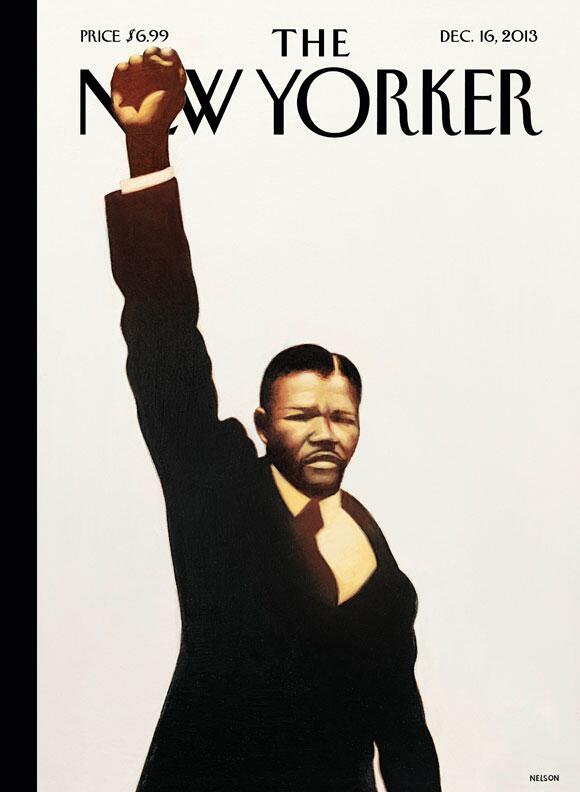
NYorker cover

My friend Jonathan Faull has already written a piece that captures the significance of Mr. Mandela’s death for most of us South Africans, and for many elsewhere in the world, better than I’d be able to. As 6000 remarked, British audiences could perhaps contextualise this as “the equivalent of a hundred – a thousand – Dianas”. Commiserations to all who are feeling somewhat bereft, today and in the coming weeks.

My contribution is simply to briefly state that if you’re concerned about honouring Mandela’s memory, or making his life mean something beyond the significance already captured in history, then remember that the symbolic force he generated was all about understanding why we are in disagreement, and trying to find a way out of that disagreement. It was about reconciliation, and hope, and progress. He offered a genuine source of energy for moral courage, and for effecting change.

Regardless of the details of history, and whether you think certain factual details should be emphasised or de-emphasised, that’s the effect of Mandela the icon rather than Mandela the man. So when idiots like those at the Westboro Baptist Church (WBC) say that they will be coming to picket his funeral (Mandela supported gay marriage, thus will be in hell, thus WBC are happy), the last thing you should do in honouring Mandela is to threaten them with violence.

Some hyperventilating types from the tabloids and Twitter (often indistinguishable, I guess) are worried about the fate of SA now that Mandela is dead. But that’s bollocks – we’re in as good or bad shape as we were yesterday. We’ve been saying goodbye to Mandela for months if not years already, and besides, the South Africa he presided over is not the same one we have today.

Our success, or our failure, rests more in whether democrats (and generally, ethical voices) inside today’s ANC can rescue it from the likes of Jacob Zuma. Jacob Zuma is not my president. I’ve not had one since Mandela, but hopefully I’ll have one again, sometime soon. And if you want Mandela’s death to mean something, then consider using it as a motivation to think about what his life meant, and the legacy he left us, and then to buckle down and renew your efforts towards helping us achieve his vision.

Academic freedom in South Africa

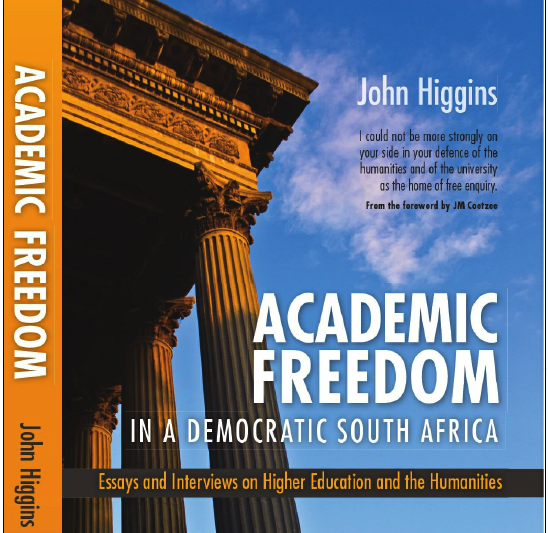
Higgins on academic freedomOn December 11, my University of Cape Town (UCT) colleague Prof John Higgins will be holding the Cape Town launch of his new book, “Academic Freedom in a Democratic South Africa” (click on the picture to enlarge and to get details). I’ll certainly be attending, both to support John (a friend) and also because it’s a subject of great interest to me.

In my capacity as chair of the Academic Freedom Committee at UCT, I was approached by a local journalist for comment on some issues raised in this book. Because only a sentence or two (if anything) might survive the editing process, here’s the full list of questions and my answers, for those of you interested in this topic.

1.Do you think academic freedom is under threat in South Africa?
There are certainly implicit threats to academic freedom, and also explicit ones such as the Higher Education and Training Laws Amendment Act.

2.If yes, kindly give us a few reasons to support your answer
Attempts to control the possession and dissemination of information as in the Protection of State Information Bill is an implicit threat, as is the occasionally hostile reaction of the State to uncomfortable questions being asked of it, for example regarding topics such as the arms deal or Nkandla. The South Africa public might itself present a different sort of threat, in that political and socio-economic preoccupations sometimes appear to create a distinctly anti-intellectual climate, where demands for “ideological purity” can intrude on academic activity. Then, legislation such as the Act – regardless of whether this is the intent or not – allow the Minister to subvert university autonomy for overly vague and broad reasons, thereby putting universities in a state of perpetual probation, hardly conducive to freedom.

3.Do you think that the ANC’s policies on higher education seek to subordinate universities’ important decision making to the policies of government?
Whether they seek to do so is one question, whether they will serve to do so quite another. Regardless of the intentions behind these policies – which some certainly seem to think sinister – the policies (the aforementioned Act, and also potentially the eventual scope and power of the Ministerial Oversight Committee on Transformation) could certainly serve to subvert university autonomy.

4.Does this amount to curtailing “academic Freedom?”.
The State has legitimate interests in the role and functioning of public universities, so the universities cannot demand that academic freedom be defined without any concern for those interests. But the way in which government has developed and seeks to implement these policies – often with little or no discussion or negotiation with the universities – does add up to an intrusion on academic freedom.

5.The ANC has clearly said it wants universities to churn graduates who are competent in dealing with a modern economy. In other words, universities suddenly become instruments to achieve certain policies of government. Does this pose a threat to academic freedom?
Yes, certainly. While the developmental needs of South Africa certainly merit a focus on, for example, STEM disciplines (Science, Technology, Engineering, Mathematics), this should not come at the expense of the long-term goal of producing strategic and creative thinkers of the sort that typically emerge from the liberal arts – history, philosophy and the like. A disproportionate focus on more practical fields might serve our interests in the short-run, but also serve to cripple academic enquiry and progress (and thus, freedom) in disciplines that are more esoteric.

6.Do you think the ANC’ s policies on higher education seek to control universities even more than what the National party did?
The comparison is unnecessary, and a distraction from the more important issue of whether the current government seeks to do so to a troublesome extent. This sort of comparison is perhaps emblematic of exactly the anti-intellectualism described earlier, in that keeping score in this way is good for headlines, rather than inspiring critical thought.

7.Do you think the Higher Education and Training Laws amendment Act is problematic for Academic Freedom? If yes, how so?
It could be problematic, depending on the extent to which the powers it allows for are used or abused. The Act makes it easier for government can place a university under administration, dissolving that university’s Council and assuming its powers. It sanctions more government intervention than is currently the case, and does so on grounds that are broad and poorly defined. We should have no objection to dysfunctional Councils being challenged or replaced, but if the Act allowing for this also allows, for example, Councils that aren’t “ideologically pure” to be replaced, then institutional autonomy and academic freedom are significantly threatened, and to an unacceptable degree. Further cause for concern regarding this Act is that key stakeholders, including Higher Education South Africa (Hesa), which represents the vice-chancellors and the Council on Higher Education (CHE) were not consulted in its drafting.

Occult crime unit – offensive to common sense and to morality

The following piece was originally published on GroundUp, and is republished here with their permission.

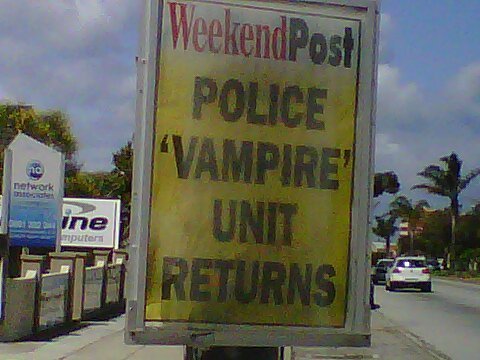
Vampire CopsDecades after its formation, the Occult-Related Crime Unit (ORCU, founded by Kobus “Donker” Jonker in 1992) continues to waste public resources, misdirect police attention, and stigmatise young people who are by and large more misunderstood than malignant.

Amongst all the crimes that we can speculate police in this unit might have seen, there’s one we can be sure of – and it’s one that they are complicit in. The crime in question is against common sense and morality, and is vested in the reinforcing of a Christian evangelical “Satanic Panic”.

In the context of South Africa’s constitutionally-protected freedom of religion, restricting membership of a police unit to only Christians – and dedicating that unit to protecting a Christian version of reality – is itself worthy of special attention as an occult-related crime.

Because a unit can’t investigate itself, I’d ask the Minister of Police to consider funding a new Occult-Related-Related Crimes Unit, which I volunteer to lead. Our mission? To be ruthless in pursuing crimes related to simplistic, moralising, and religiously prejudiced views of crime, society at large, and especially the youth.

Even on the very fuzzy definition of “occult” used by ORCU, too few such crimes occur to merit the existence of a dedicated unit. But it is in the definition of these crimes, as well as the background metaphysics and psychology, that ORCU starts to appear just as spooky as the crimes and motivations ORCU exists to combat.

In response (I presume) to a fairly constant barrage of criticism on social media, the South African Police Service (SAPS) removed the web page that gave us our best insight into how a unit in a 21st-century police force is being guided by ideas from the Dark Ages.

But thanks to the Wayback Machine, we can see not only that “Child has an interest in computer” is a sign that said child might be involved in a cult, but also that this and other equally ridiculous diagnostic advice has remained unchanged since September 2004 (the archived page from then – the earliest date the page was captured – being identical to the one that was removed in November 2013).

I don’t mean to dispute that adolescents, and others, commit crimes in the service of motivations they themselves think of as occult. But when they do so, why is it that this motivation is singled out for special attention? We don’t have a jealousy-related crimes unit, or a greed-related, tender-related, BEE-related, or alien-related unit – even though all of these provide possible motivations to commit crimes, mostly with far greater regularity than the occult would.

Then, if we find that a crime is committed because the guilty party thought themselves under some supernatural instruction, we know full well what to do next: arrange for that person to get the psychological help they clearly need, alongside whatever other sentence is appropriate.

Diagnosis and treatment of this particular confusion is not within the typical police-person’s field of expertise, perhaps especially when that police-person is selected explicitly because they hold a competing – and no less bizarre, to some – set of metaphysical beliefs.

As mentioned above, we have freedom of religion in South Africa. You can be a Satanist if you like, and if you were refused employment on those grounds, the person refusing you would be acting illegally. Hell (sorry), refusing you entry into ORCU would probably be illegal too.

But because of the strongly Christian bias of ORCU, and government in general, you’d of course keep your exercising of freedom of religion to yourself. If you’re a child, though – especially a child unfortunate enough to have parents who take SAPS’s word for these things – you might find yourself described as a Satanist or cult member through no fault of your own.

The warning signs for parents include your using a computer, engaging in sexual activity, watching horror movies, losing your sense of humour and “rejecting parental values”. In other words, being a teenager is a warning sign. Make sure to only part your hair to the right, because “draping hair across the left eye” is another dead giveaway.

It’s also important that you avoid getting a nickname at school, because “phone calls from persons requesting to speak with someone other than your child’s name” is apparently a warning sign for parents that you’re being contacted by your “satanic/demonic name”.

The document also speaks of cults, that come in “religion-based, personality, or secular” versions. I can’t imagine what a secular cult might be, but suspect it has something to do with Idols, or MasterChef, given that cults can involve “unique games”, “dress codes” and “chanting and singing”.

More seriously: these attempted analyses of occult motive are premised in an occult view themselves, namely that of Christianity. The occult, and what is problematic about it, is being defined in a completely partisan way, by an agency of a Government committed to freedom of religion.

It is undeniable that some practitioners of any given occult view engage in harmful behaviour. It would nevertheless be untrue and unfair for us to generalise from those cases, concluding that the entire set of occult practises should be criminalised – especially if we do so from a position of known bias.

Lastly, the vulnerable group here is the youth, who are already besieged by insecurity around their identities. The ORCU document told parents – in a country where homophobia is virtually endorsed by the President, and corrective rapes a scourge – that “child experiences sudden gender confusion” is a warning sign of the occult.

It’s therefore not simply the case that ORCU is a waste of resources that could better be deployed elsewhere. The unit, and its core beliefs, are themselves so offensive to common sense and morality that one might call it a crime.