

Brendan O’Neill, editor of Spiked and hero to the sort of conservative who imagines that words and phrases like “libtard” or “social justice warrior” win arguments, recently posted a Facebook status arguing that “freedom of speech doesn’t mean freedom from consequences” actually means “Best not say it, eh”.
Author: Jacques Rousseau
Jacques Rousseau teaches critical thinking and ethics at the University of Cape Town, South Africa, and is the founder and director of the Free Society Institute, a non-profit organisation promoting secular humanism and scientific reasoning.

Those who think that politicians should be held to a higher moral standard than other influential people seem guilty of an inconsistency. The primary clue as to what should be expected of you is in your job title or description – if you’re a teacher, you should be judged on your teaching, and if you’re a President, you should be judged on how well you preside.
I realise that this is a simplification, in that it is sometimes the case that other factors should influence our assessment of your suitability for a role. But we would typically require some clear link between your “crime” and the job you are employed to perform.

There is something to be said for the idea that anti-fascist protesters can resort to violence too quickly. But this idea can be debated without endorsing or excusing fascism, which you do when you describe these acts of violence as morally equivalent.

“The plural of anecdote is not data” is a phrase well-loved by scientific sceptics. Often attributed to Dr Ben Goldacre, but probably originating with Raymond WoIfinger, the phrase cautions us against the mistake of thinking that what you experience – or what you and your granny or friends experience – might not actually be representative of any significant trend, or give you valuable evidence regarding the causal efficacy or role of something you might regard as significant.

The Cape Town launch of Prof. Jonathan Jansen’s latest book, As by Fire: The End of the South African University, was held last week at the Book Lounge. I was invited to be the discussant and, having already read the book a few weeks ago and found it to be worthwhile, was pleased to accept.
On re-reading it in preparation for the discussion, my initial impression persisted: relative ‘insiders’ to the last few years of university politics and protests might not learn much that they didn’t know, while the general public certainly could.

The verdict in the OGOD vs. 6 public schools case was handed down on June 28, with Judge van der Linde ruling that schools were not permitted to promote “one or predominantly one religion to the exclusion of others”.
In theory, then, the days of a school promoting themselves as having a “Christian character” should be over, with countless schools across the country now having to edit brochures, websites, and even coats of arms.

Earlier this month, as a runaway fire was claiming many lives and many houses in Knysna, Ivo Vegter* wrote a Daily Maverick column that lamented the fact that essential communication channels for disaster-relief were being used to offer prayers and other religious homilies.
Given that Ivo was himself dealing with the same threat to home and safety, and assisting with the relief efforts, it’s understandable that he thought the “emoticons of praying hands, or even entire prayers” shared over WhatsApp were getting in the way of more essential communication, and many Christians will agree with him on this.

I’ve written two pieces pieces on Helen Zille’s recent tweets that led to today’s press conference with her and Mmusi Maimane, at which it was announced that she’ll continue as Premier of the Western Cape while withdrawing from DA activities generally, so there’s much I won’t repeat here.

As those of you who care about these things know, Helen Zille was (on June 7) suspended from all Democratic Alliance roles, pending the outcome of a disciplinary hearing. The hearing began on Friday June 9, and it’s fairly safe to assume that Zille will contest any finding that doesn’t exonerate her.
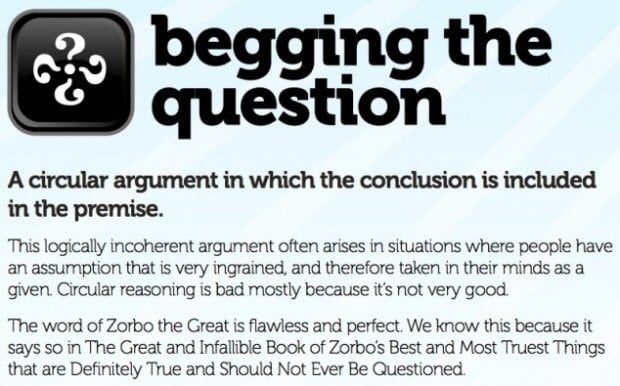
Greetings from the Franschhoek Literary Festival where, when we’re not sitting in panel discussions, you might often find us sitting drinking wine and debating important matters. Today, after our table resolved the issue of whether you should wear your name tag in a visible (to some, ostentatious) fashion (yes), we moved on to talking about whether it was worth contesting the increasingly prevalent misuse of the phrase “begs the question”.