
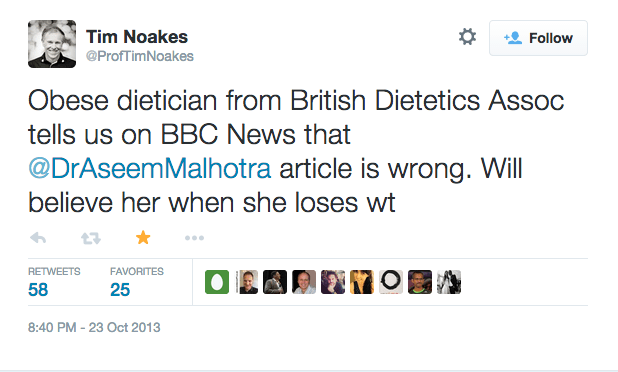
Well, this is a doozy. If Alastair McAlpine* was at all worried about negative responses to his review of Lore of Nutrition, he’s perhaps less so today. This is because Prof. Noakes and Marika Sboros have now responded to said review, and in doing so, made his case for him.
Author: Jacques Rousseau
Jacques Rousseau teaches critical thinking and ethics at the University of Cape Town, South Africa, and is the founder and director of the Free Society Institute, a non-profit organisation promoting secular humanism and scientific reasoning.

An earlier version of me regarded free speech as not only an absolute value, but additionally as one that should be shoved to the front of just about every queue. A value, to put it another way, that trumps most others (but not all – for example, it wouldn’t trump the value of continuing to exist, for most people).

On November 29, Professor Tim Noakes was interviewed on the Gareth Cliff Show. Much of the interview focused on his new book, and his reasons for co-writing it (with Marika Sboros). I’ve previously described some of this book’s inaccuracies and falsehoods in respect of its mentions of me, including the assertion that I’m part of some conspiracy against him.
Today, I’d like to briefly focus on a more worrisome theme – vaccine scepticism – that Noakes has tweeted about in the past, and one that he returns to in this interview with Gareth Cliff. The relevant segment’s audio is transcribed below, and embedded at the end of the post. It takes place between 44m07s and 45m37s of the full interview.
Since South African Airways dropped Dakar as their regular refueling stop, getting to Goree Island (a fifteen-minute ferry ride off Dakar’s coast) can be quite a journey. It took around 24 hours for me, flying from CPT to JNB-NBO-ABJ, then DKR.
Eighteen bloggers from Uganda, Zimbabwe, DRC, South Africa and elsewhere have gathered for an annual workshop, thanks to the generosity of the Konrad Adenauer Stiftung, who brought us together as AfricaBlogging around three years ago.
The Vitality ObeCity Index 2017 (pdf), released in October, “analysed data from Vitality members living in six cities across South Africa” in order to present an overview of South African eating trends and health statistics. The report describes some positive trends, while highlighting that “we still have a lot to do to combat obesity”.
I contributed three opinion pieces on science communication, the food industry and marketing to children, and the importance of consumers making informed choices. Here’s the last of the three contributions.
The Vitality ObeCity Index 2017 (pdf), released in October, “analysed data from Vitality members living in six cities across South Africa” in order to present an overview of South African eating trends and health statistics. The report describes some positive trends, while highlighting that “we still have a lot to do to combat obesity”.
I contributed three opinion pieces on science communication, the food industry and marketing to children, and the importance of consumers making informed choices. Here’s the second of the three, with the last to follow in the coming days.

The Vitality ObeCity Index 2017 (pdf), released in October, “analysed data from Vitality members living in six cities across South Africa” in order to present an overview of South African eating trends and health statistics. The report describes some positive trends, while highlighting that “we still have a lot to do to combat obesity”.
I contributed three opinion pieces on science communication, the food industry and marketing to children, and the importance of consumers making informed choices. Here’s the first of the three, with the others to follow in the coming days.

One good thing about the just-released “Lore of Nutrition“, documenting the campaign (allegedly) orchestrated by myself and others against an A-rated Professor with thousand of citations, hundreds of articles, many books, regular international speaking gigs, and constant (fawning) media coverage is that it leaves you in no doubt as to who the victim is (spoiler alert: it’s the celebrity scientist).
It’s rare to see social norms change as quickly as they currently are, as we seem to be seeing with respect to exposing alleged sexual predators. It appears to me that there’s at present a fairly widespread acceptance of the idea that not only do powerful men abuse that power in order to abuse women (typically), but also that this unspoken reality should become a spoken-of concern.
Woody Allen didn’t break the dam wall, Cosby didn’t, and neither did Trump. Going further back, folk like Polanski didn’t either, but something about the Weinstein revelations seems to have precipitated a sea-change in the willingness of victims to come forward with their stories, and in a more general sense, the willingness of the public to recognise that this is a systemic and serious problem.
I haven’t been inclined to write anything about Professor Noakes for a good long while. In fact, even as he carried on encouraging vaccine scepticism on Twitter, or being dogmatic about sugar ‘addiction’, or citing the likes of Mercola and the Weston A. Price Foundation as if they were credible, I thought I’d said enough, and kept quiet.