Lotter trial: Satan (or maybe God) made me do it

As submitted to The Daily Maverick

The primary function of a trial is to find out who is guilty of what, and to establish an appropriate sanction for that crime. Justifying the sanction chosen has traditionally involved either the belief that punishment could reform or rehabilitate offenders, or the notion that retribution is an appropriate disincentivising signal of how society condemns the criminal act in question.
Helen Zille on HIV

As submitted to The Daily Maverick

It’s easy to understand why the Premier of the Western Cape, Helen Zille, wants to do something to minimise the prevalence of and costs associated with HIV infection. According to her remarks at a wellness summit earlier this month, HIV treatment costs the provincial government close to R2 billion per year – and that is no small sum to spend on a preventable disease. Her proposed solution to this includes wanting to charge men who have unprotected sex with multiple partners with attempted murder.

In an interview with John Maytham on CapeTalk567 on November 9, Zille presented three complementary measures for minimising the problem of HIV infection: compulsory testing, compulsory disclosure of HIV status to potential sexual partners, and compulsory wearing of condoms in non-monogamous sexual relations. We were told that she desires for these measures to become law, and that similar sorts of responses to AIDS had been effective in various other jurisdictions.

There is much one can agree with in terms of her motivations – even if not in terms of the proposed remedies. It is in all of our interests to have public funds spent in the most effective possible ways, and it’s also normally in our interests to safeguard ourselves against threats to our health. But we pursue those interests unreliably and sometimes irrationally. Humans are disposed to something called hyperbolic discounting, namely the preference for smaller but sooner rewards over larger but later rewards.

What this means is something we all know well – thinking we’ll go to the gym, stop smoking, or start eating more healthily tomorrow. We’re enjoying it now, and we find it easy to discount the long-term costs of satisfying our immediate desires. This is not to say that it’s obligatory to care about your own health or longevity. It would certainly be weird, but not impossible to imagine being enough of a hedonist that you commit yourself to a shorter but more Bacchanalian life, understanding the potential consequences in full.

The concern raised by Zille is that we might be accused of excusing or forgiving reckless behaviour by funding treatment of its consequences from public coffers. While the state guarantees the right to medical treatment, the argument was made that these rights entail certain responsibilities – namely those three responsibilities outlined above.

But this conclusion would be somewhat hasty. While the idea that “rights entail responsibilities” seems axiomatic to many, it isn’t quite true. A positive right, where something is provided (such as a right to healthcare), is provided by the state as an obligation funded by our taxes. It’s certainly regrettable that we cause inefficient spending of that money through poor choices, but those poor choices don’t make us liable for an increased contribution to healthcare funding.

Leveraging that regrettable inefficiency into changed behaviour is a moral issue, but not one that can easily be legislated (whether doing so is desirable or not). We can try to persuade people to live healthier lives – for their own good as well as for the good of efficient healthcare spending – and we can try to guilt them into not allowing their preventable conditions from swallowing a disproportionate share of available funds.

However, if HIV infection following unsafe sex should become your legal responsibility to avoid, one can start to wonder where these sorts of responsibilities would end. I don’t have to have a car accident for alcohol consumption to become a cost to the state. I could drink to excess most nights in the safety of my own home, and still eventually require treatment for cirrhosis. Likewise for smoking and lung cancer or emphysema, and of course for my dietary choices also, where my diabetes or high cholesterol end up requiring expensive medication, surgery, or both.

These things might differ in scale, but not in type. It’s easy to find examples of self-inflicted harms that cost everyone else money through public provision of treatment, and it serves us well to try and eliminate all of them. But doing so always comes at a cost, and that cost can be a significant erosion of our liberty. We could, for example, require that everyone hand their car keys to the restaurant host, to only be returned on your successfully passing a breathalyser test. We don’t do this because of the belief that it’s appropriate to punish people for actually causing harms to others, and not appropriate to regulate their lives to the extent that it becomes impossible for them to cause those harms.

It’s not only concerns regarding the erosion of liberty that should make us wary of calls to criminalise unsafe sex in general, or force us to be tested for HIV. Readers of The Daily Maverick would mostly be in the position of having ready access to medical care, including things like HIV testing. It could be performed as part of an annual check-up, or even provided at the workplace. But this won’t be the case for the rural poor, meaning that the state would have to spend the money to roll out nationwide testing – or inadvertently make it the case that being poor automatically means being a criminal under this sort of legislation.

Then, it is also not clear that criminalisation of HIV does any good, despite Premier Zille’s claims to the contrary. Edwin Cameron’s 2008 paper in the Journal of the American Medical Association makes reference to a study comparing HIV infection in Illinois (which requires HIV disclosure and criminalises sex without informed consent) and New York (which has no such laws). No statistically significant difference in sexual behaviour was found in this comparison – and this in a country with significantly higher literacy than ours, and also one in which myths regarding HIV and its spread are largely absent.

There is also a stigma attached to HIV, and its criminalisation cannot but exacerbate that. Cameron points out that:

Tragically, it is stigma that lies primarily behind the drive to criminalization. It is stigma, rooted in the moralism that arises from sexual transmission of HIV, that too often provides the main impulse behind the enactment of these laws.

Even more tragically, such laws and prosecutions in turn only add fuel to the fires of stigma. Prosecutions for HIV transmission and exposure, and the chilling content of the enactments themselves, reinforce the idea of HIV as a shameful, disgraceful, unworthy condition.

This is not to say that we shouldn’t criminalise knowing infection of others with HIV, just as other sorts of intentional harms to others are criminalised. As I started out by saying, one can sympathise with Premier Zille’s frustrations, and her desire to go further than this. HIV and AIDS are significant problems, and large sums of money are being spent on treatment that could instead be spent on the treatment of unpreventable medical conditions. But addressing this one – HIV – with the force of law requires something like a camera in every bedroom, and could also be accused of unfairly targeting the poor and women.

Public awareness and understanding of the harms we can do to each other and our responsibilities to avoid those harms takes time to generate, especially in a context where under-education and mythology – in this area as well as others – abound. We need to keep informing and educating, but the law is too blunt an instrument to arrest HIV without compromising other values we hold dear. To think that it’s our best recourse seems utterly wrong-headed, and just about as crazy as believing that you live in a haunted house.

Also read Gavin Silber and Nathan Geffen on this topic.

More on Foschini’s sexist T-shirts

As submitted to The Daily Maverick

Drawing a line between hypersensitivity and justified affront is sometimes rather difficult. Political correctness often helps to facilitate the former, because we become so used to not being offended that it seems increasingly outrageous when others dare to offend our sensibilities. And while outrage is easy to manufacture, and difficult to ignore, the fact that someone is offended doesn’t mean that they are justified.

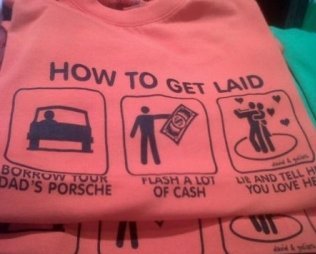
Eleven women, including the Daily Maverick’s Rebecca Davis, were recently offended by a selection of T-shirts they considered sexist being offered for sale by stores by stores in the Foschini stable. You can read the justification for this in Davis’s column, though I’d recommend only reading the ensuing comments if you’re feeling strong – or if you’re looking for further evidence in support of your application for asylum with some other species. Because what starts as a civilised and reasonable expression of disappointment by Davis and others that these T-shirts were put up for sale rapidly descends into quite unpleasant abuse of character and motive, especially targeted towards those commenters who dared to question whether the objections to the T-shirts were an overreaction.

The abuse came from all quarters, though – including from those whose apparent motivation was a call for greater respect for their viewpoint that the T-shirts were legitimately offensive. And here one can arguably see an interesting asymmetry, in that while the premise of the debate is that certain views aren’t being afforded enough respect (women’s rights and interests), the debate then proceeds as if alternative views aren’t worthy of any respect at all, and that people who express those alternative views aren’t entitled to do so.

It’s easy to forget that if we are campaigning on behalf of some interest, we become ambassadors or representatives of that interest. So, when someone dares to challenge your cause, we sometimes need to take care to not respond in such a way as to undermine the exact cause we’re fighting. If the issue is that certain interests or arguments are being sidelined, that issue can only win a hollow victory by sidelining dissent.

Now, of course some issues might take priority over others. Not only legal priority, as in the balancing of rights, but also moral priority in that it might sometimes be obvious that there is a genuine problem worthy of attention or redress. And sexism is such a problem in that we are perhaps less sensitive to it than to other forms of unfair discrimination. This is perhaps evidenced by our language, in that gendered epithets are given less attention than racist ones.

So on the surface of it, sexist T-shirts, or sexist jokes, are obviously a problem when they consistently target one sex rather than another. If sexism was an equal-opportunity offence we could accuse the offenders of crassness, but not of sexism. But hypersensitivity is also a problem, and we should take care to avoid undermining our causes through taking a fundamentalist approach to them, or through treating dissent as axiomatically reprehensible.

To try and avoid misinterpretation here, I did think that some (not all) of the T-shirts were sexist. Consumers are free to point that out, and you’d think that retailers are free to respond by withdrawing them from sale. The qualifier of “you’d think” hints at what some comments to the Davis column were perhaps trying to point out, in that it’s unclear that Foschini had any actual choice in the matter.

Because just as it’s difficult to imagine something like a sunset clause on affirmative action, it’s difficult to conceive of a point at which accusations of sexism can’t be levelled without being privileged. They are uttered from a position of not being privileged, but gain privilege in that they are impossible (or at least very difficult) to refute. Playing the “race card” already wins most of the battle, and making accusations of sexism can do the same – the sense of being offended can be justified merely by feeling that you are offended.

In these debates, we should be wary of words and attitudes that can act as silencing devices, and that can forestall or inhibit debate. Because viewpoints and attitudes can become immune to, and protected from, challenge. Immune because of their orthodoxy, and protected because of our fear of being labelled as racist, sexist or in some other way opposed to the orthodox view.

In the case of these T-shirts, there is a marked difference between the measured tone and argument of the original letter protesting these T-shirts and some of what came after, including on the comment thread to Davis’s column. Whether it’s true or not, it’s still legitimate to raise the question of whether the opposition to the T-shirts was a sense of humour failure (I don’t think it was). It’s also legitimate to ask whether calls for a boycott of Foschini are taking the matter too far (which I think it did).

To rule these questions as out of order, or to not engage with the questions without attacking the characters of those who raise them, forestalls any possible debate, and entrenches existing prejudices on both sides. We want Foschini to be able to withdraw the T-shirts, or not do so, through being able to make a decision – not through being subjected to what can easily become a form of moral blackmail.

The boundaries of what is acceptable and unacceptable offence (ie. merely risqué rather than legitimately problematic) are not only subjective, but also present a slippery slope problem. If T-shirts like the ones in question are withdrawn from sale without the possibility of debate – or with the polarisation of debate evidenced in the comments to the Davis column – a new level of what is acceptable and not can be set. And then, potentially, one less thing can be debated and one fewer thing can be a legitimate source of humour – because something is always potentially offensive to somebody.

One possible outcome of these sorts of (lack of) debate is simply a world in which those who shout the loudest get heard, or are taken more seriously than others. So even as we are fully entitled to object to things we find offensive and attempt to get others to see our point of view, we shouldn’t make the mistake of thinking that our own views are beyond challenge, or that we’re automatically justified in attributing some degeneracy to those who object to those views.

In this case, some of the offence was certainly justified, and I think the letter that Davis and the others wrote was not hyperbolic in the least. But some of the ensuing commentary raised the possibility of yet another issue where being offended is its own validation, and where it is unquestionable that others should bow to the demands of your offence.

We might be entitled to be offended at whatever we like, whether it’s justified or not. But with the exception of hate-speech (an exception which can itself be challenged), others are entitled to be offensive. While we can try and persuade them to stop, we should be careful to not do in a way that stops us talking – and listening – to each other.

Sensationalism, morality and the media

As submitted to The Daily Maverick

There is a difference between exposing hypocrisy for the sake of satisfying the public’s desire for scandal (thereby perhaps increasing newspaper sales), and doing so in a way that makes the hypocrisy part of a larger story. Much over the weekend coverage of Malema and Mbalula’s various indiscretions seemed to prefer the former, leaving at least this reader with the question: Why should I care?

It’s not obvious that we should expect moral virtue from political leaders – and even if we were to do so, we’d first need to agree on what those virtues are or should be. Who Mbalula has sex with is not my business, nor is it something that should be. Unless, of course, the Minister’s choice of sexual partner entails some direct impact on his credibility or on consistency between his words and deeds.

If we believe Mbalula himself, he was separated from his wife at the time of his liaison with Joyce Molamu, so it’s not even clear that he has contravened the standards he appeals for others to follow. Members of the public might nevertheless consider him a hypocrite, and this will no doubt complicate his attempts to position himself as the next ANC secretary-general.

But until Stephen Grootes discussed Malema and Mbalula in these pages, the liaison – rather than any of its potential implications – was the story. Likewise with Malema. It should be no surprise to any of us that he’s a far wealthier man than many of his supporters, and that he’s more likely to have friends who host R10m parties. Yet another example of the lack of consistency between his rhetoric and his actions is not, in itself, front-page news.

The timing of such a party and the way in which it dilutes the force of the Youth League march against poverty can be. But as was the case with the Mbalula story, the media focus was more on rubbing his nose in this apparent evidence of hypocrisy (notably also tainted evidence, in that the business class flights and accommodation were apparently sponsored by the groom).

Outrage and sensation might be effective ways to sell copy, but they do little good in fostering a society that welcomes debate, and is able to engage in it. There seems little reason to believe that these stories will do anything other than entrench existing positions, where either M&M are being victimised by some white media cabal, or are untrustworthy demagogues.

We get the society we deserve, in that we are that society and it takes on the forms we encourage. As someone said on Twitter over the weekend, what the public is interested in is not equivalent to the public interest – and it’s the latter that gives newspapers licence to broadcast what would otherwise be details of someone’s private life.

Where those details are not contextualised as part of a story that is in the public interest, such as succession battles in Manguang, the press is not only feeding our appetite for sensation, but also starts taking on the role of moral authority and watchdog. Feeding our appetite for sensation is the job of the tabloids – not of the few variably-respectable local newspapers we have access to.

And neither being a moral authority, nor policing whatever version of morality is concocted is their proper role. The line between reporting on the news and aiming for objectivity – or at least making your biases clear if you’re not interested in objectivity – and trying to regulate society has become increasingly blurred.

For this reason alone, the extensive overlap between LeadSA and some of our media is problematic. If we were to discover that a particular LeadSA campaign is founded on poor evidence, or that a representative of LeadSA was somehow corrupt, are the chances of reading about these matters in an Independent Group newspaper at all diminished by their affiliation with LeadSA? I’d guess the answer to be yes. But I’d also guess that if this sort of event were to come to pass, that we’d see much crowing from the competition, and very little analysis that tracks something we could describe as being in the public interest.

And where the media endorse this sensationalism by practising it, we cannot be surprised to find citizens thinking they should care. Not only care about details that are stripped of context and meaning, but also care so much for their own hyperventilations that they think their worldviews should be enforced on the rest of us. A recent example of this can be found in complaint laid against an advertisement for Axe deodorants, where a single viewer convinced the ASA that it was offensive enough to require being taken off the airwaves.

That the ASA were convinced by this complaint is mystifying, as Pierre de Vos has pointed out (http://constitutionallyspeaking.co.za/now-angels-cant-even-have-sexual-feelings/). What is perhaps more perplexing still is how they can proceed from here, having set the bar for offence so low. Every advertisement that includes images of an attractive man or woman could be described as sexist, and if we pretend to be offended enough (or sadly, actually feel offended enough), will the advertisement be pulled? Or how about those Fatti’s & Moni’s ads that so offend us Pastafarians, in subjecting us to images of our deity being boiled, over and over again?

If someone in the public eye has done something that weakens their case or exposes them as a fraud, this can certainly be in the public interest. But simply pointing out their indiscretions is not – we need to hear what this implies in terms of some larger issue. Without that context and analysis, the media is feeding a large and ugly beast. We know the public want sensation. And it’s likely that they’ll want more of it if we keep giving it to them. But perhaps, we should be encouraging them to want less of it.

You’re only 1% if you don’t Tweet

As submitted to The Daily Maverick

Perhaps – and only partly – as a consequence of the incredible volume of content generated on the Internet, it sometimes appears that we all have something to say. Not only through producing content such as opinion columns, but also in commenting on them and in passing them on to others via mediums like Twitter.

As I’ve argued before, this democratisation of knowledge – or at least opinion – comes with costs and benefits. Being able to participate in the conversation entails crossing a very low threshold, in that everyone with access to the Internet, even simply via their mobile phones, gets to have their say.

However, the noise can sometimes drown out any signal. More importantly, we can forget that while everyone is entitled to their opinion, nobody is obliged to treat an opinion with more respect than it merits – no matter how forcefully it is presented, or how much passion underlies its expression.

Twitter is beginning to present a problem in this regard. You might think it always has, and perhaps you’d be right. But I think it’s getting worse. The confluence of a 140 character limit, the attention economy, and our feelings of all being equally entitled to have our opinions creates endless fights, factions and frustration – at least for those listening in, trying to understand what the fuss is about.

Mostly, though, these factors can conduce to a bizarre sense of self-importance. Some Twitter users take delight in being inflammatory, with mini-revolutions started every hour and then forgotten when some new outrage comes along. The problem, however, is that these revolutions are usually against a caricature, a headline, or a set of assumptions about a person that might well be defamatory if they were spelled out in an op-ed.

But while they are underway, with hundreds or thousands of people endorsing your call to action, perhaps you can feel like you’re achieving something – even if that achievement later turns out to only be X more or fewer followers. And even if your call to action ends with a re-tweet, rather than with a portion of your audience changing their vote, changing their bank, or saving some endangered iguana.

Just as the weak and unprincipled parts of mass protest can drown out the voices of those who have something meaningful to say, social media allows one to get by with unsubstantiated rumour or even thinly-disguised character assassination. And when you get it wrong, it doesn’t matter. Nobody remembers, and nobody ever needs to apologise.

While these attempted revolutions are underway, they can seem significant enough to gain some traction. Last Sunday, for example, some Twitterers attempted to incite their audience to believe that the regular sarcasm emanating from Helen Zille’s Twitter feed somehow entailed a reason to never vote DA. Examples of her alleged lack of fitness for high office were Tweeted and re-Tweeted, all in an effort to justify inferences such as her having no respect for those less educated than herself.

Even if this inference were true, you’d still need to build a pretty impressive bridge to get from there to anything relevant to a rational voting strategy. The same people who, for example, argued that Mogoeng Mogoeng’s defensiveness or religious beliefs had no relevance to his suitability as Chief Justice were now claiming that a rude person (on their terms) could not govern well.

The fact is that these are separate issues. You don’t need to like someone to think they can do a good job – even if it’s indisputably true that our feelings regarding someone’s character do influence those judgements. So if you want to play it safe, it’s perhaps best to stick to bland, uninteresting contributions like those from Jacob Zuma’s Twitter feed. It’s impossible to find those objectionable – mostly because they rarely involve any substantive content.

The thing about Tweeting and politics, at least in a South African context, is not only that our memories are short but also that we’re mainly just talking to ourselves. It doesn’t seem plausible that any significant number of votes will be shifted, simply because the vast majority of voters aren’t on Twitter. This statement is not, I think, a result of selection bias as a consequence of only justified by the people I pay attention to – if you search for the hashtag of any emerging political story, the vast majority of Tweets are in 1st-language English.

We’re all still muddling our way along, trying to figure out how best to use resources such as Twitter. Now there is immediate access to people we’d previously have had to apply to meet in triplicate, and much of the time, they feel compelled to respond. And when they don’t, that’s another instant indictment of their characters.

But all of this is prone to over-reaction, and a sense that we and our Tweets are more important than they actually are. The space allows for conversation and for frivolity, and it can be enormously valuable in providing not only access, but also news at a faster pace than we’ve ever benefited from in the past.

We shouldn’t, however, mistake it for rigorous and reasoned debate. And we shouldn’t mistake people for activists, just because they can be shrill and condemnatory in 140 characters or less.

#Occupy doesn’t travel well

As submitted to The Daily Maverick

The latte revolution is now in full swing. On Saturday October 15, the dormant hippies inside many (though not that many) middle-class beneficiaries of global trade “occupied” various spaces across the globe, determined to express their discontent. This global occupation was organised on the Internet, often via expensive smartphones, and we got to see it all in the numerous Instamatic photographs captured using the protester’s iPhones.

Keeping Steve Jobs in perspective

As submitted to The Daily Maverick.

A few hours after hearing of Steve Jobs’ death, it started to seem as if Princess Diana would have reason to be jealous (if she could still be anything at all), such was the outpouring of praise directed at the CEO of Apple. “Praise” is of course the understated version of some of what we read, or witnessed at iStores across the world, where the behaviour often seemed more worshipful than what you’d imagine merited by the death of a man with no (ostensible) religious following.

But as Umberto Eco observed in 1994, the ongoing debates between supporters of the Mac and the PC has long been something like a holy war. PC users disparage the Mac faithful for embracing the paternalism of a world with prescribed choices, and Mac users sneer at the irrationality of us PC folk in making our digital lives so much more complicated than they could be. Eco said:

I am firmly of the opinion that the Macintosh is Catholic and that DOS is Protestant. Indeed, the Macintosh is counter-reformist and has been influenced by the ratio studiorum of the Jesuits. It is cheerful, friendly, conciliatory; it tells the faithful how they must proceed step by step to reach – if not the kingdom of Heaven – the moment in which their document is printed. It is catechistic: The essence of revelation is dealt with via simple formulae and sumptuous icons. Everyone has a right to salvation.

DOS is Protestant, or even Calvinistic. It allows free interpretation of scripture, demands difficult personal decisions, imposes a subtle hermeneutics upon the user, and takes for granted the idea that not all can achieve salvation. To make the system work you need to interpret the program yourself: Far away from the baroque community of revelers, the user is closed within the loneliness of his own inner torment.

As is the case with all cults, adherents tend to lose touch with reality. Something of a personality cult developed around Steve Jobs – partly because of the undeniable sexiness of the products he introduced each year, and more recently perhaps partly due to his well-publicised battle against pancreatic cancer.

Now we see Jobs lauded as the sort of innovator and business leader the world needs more of, despite the evidence suggesting that he was a somewhat abusive autocrat rather than the sort of consultative, politically-correct kind of leader that regularly gets held up as an example to follow in business as well as politics. There’s evidence of a double-standard here, and there is also a remarkable lack of balance in the range of responses to his death and his legacy.

Just as much of the reaction to the failure of South Africa to grant the Dalai Lama a visa prompted either overly flattering portraits of the man himself or character assassinations, Steve Jobs is now either deified or demeaned, depending on who you read. The truth is as always not that simple, and we do ourselves no favours by embracing these false dichotomies.

Of course Jobs changed the world, but he’s no Norman Borlaug, Rosa Parks, Thomas Edison or even Craig Venter. He refined and popularised various tools for making our digital lives more efficient, and more pleasurable. Apple, with Jobs at the helm, had mastered the art of making us believe that renaming and refining was the equal of invention – but it isn’t.

The iCloud is simply the cloud, as most of us knew before Jobs tried to get us there with fewer clicks of a button, and FaceTime is simply video-conferencing with a silly name. A mouse with one button, like Apple’s used to be, is simply a crippled input device. The most recent innovation, introduced at the launch of the iPhone 4S, is Siri – a voice-activated tool for performing various functions on your mobile phone. Siri no doubt has a lovely voice, but she’s doing the same job I’ve been able to do on my Android phones for the last three years.

An example of something actually invented by Jobs or Apple is difficult to find (just as it is for Microsoft). What they mostly do is package and resell the innovations of the real mavericks – those who truly “think different” (while perhaps respect [sic] grammar). What Jobs and Gates have historically done is encourage you to think the same – at least in terms of believing that their products, and their products alone, are the route to your digital salvation.

This is not necessarily or always a bad thing. Informed buyers can be aware of the costs and benefits of aligning themselves to one faction or the other, or mixing and matching if appropriate. I use iPods, but manage them with PC software because iTunes is horribly bloated and slow, at least on a PC. And I use PCs and Android devices because I want to tinker and customise, and I certainly don’t want to be told that Apple considers a phone app to violate standards of decency they have decided I should hold.

If you want things to just work, and don’t want to invest time and energy into learning how they work, there’s no question in my mind that Apple products can be superior. But as Andrew Orlowski points out, the problem is that claiming that they – or Steve Jobs – changed the world raises the question of how small that world – your world – started out being. A new way to do something we’ve always been able to do can be innovative, but it isn’t so by definition.

The endless queues around iStores on the release of a new Apple product, and the religious fervour accompanying the annual Apple product announcements, give the impression of a world of devotees that were letting Jobs do their thinking for them, rather than using the tools he introduced in order to do their own creating and innovating. This thinking is different, yes, but it’s perhaps not the kind of thinking that even Jobs would endorse, as much as he would have appreciated the resulting profits.

In an interview for Wired magazine in 1994, Jobs said that there is a “solution to our problems in education. Unfortunately, technology isn’t it. You’re not going to solve the problems by putting all knowledge onto CD-ROMs. We can put a Web site in every school – none of this is bad. It’s bad only if it lulls us into thinking we’re doing something to solve the problem with education. … What’s wrong with education cannot be fixed with technology. No amount of technology will make a dent.”

One thing that certainly helps in fixing education is to encourage critical thought, and to discourage the binary worldview which says that Steve Jobs is either a techno-Messiah or some sort of sweatshop-running magpie of digital innovation, taking and then rebranding other people’s ideas in furtherance of the cult of Apple.

But treating one person as so important and so meaningful to the world, when he was only doing the same thing as his competitors – sometimes years after them – seems rather hyperbolic. It’s true that he made computing easier for many, and has done the same thing for our smaller computers that also make phone calls. Whether this is a good thing or not is an open debate, because easier can often mean that there’s less for you to do, and less for you to think about.

Does it matter if you’re black or white? #CensusSA2011

As submitted to The Daily Maverick

On October 10, be ready to stand up and be counted. Well, you’ll need to stand up at least for as long as it takes to let the enumerator into your home, for that day marks the start of South Africa’s first census since 2001. There’s no question that conducting a full census costs plenty of money – R3 billion is the current estimate – but they also provide valuable information.

Woo-woo fest comes to Wits

As published in Daily Maverick

Did you know that “millions of people in SA have had their own personal experience with ETs and UFOs”? If you didn’t, Michael Tellinger has arranged a conference just for you, this November in the Linder Auditorium at the University of the Witwatersrand. It must be true, seeing as one of South Africa’s most prestigious universities is hosting the conference.

Gendered epithets: Short-term battles vs. long-term wars

As submitted to The Daily Maverick

This Saturday, September 24, Slutwalk comes to Johannesburg, and thousands will participate to protest victim-blaming and to affirm the right of all women to wear what they want, and act as they please, without fear of being misunderstood as welcoming sexual assault.

Many will participate dressed in clothing that might be considered sluttish – in the traditional sense of the word – because part of the point of Slutwalk is to reclaim the word ‘slut’ and to say that others (rapists, as well as those who deny women agency in less violent ways) don’t have the authority to impute desire where none might exist.

As I’ve previously argued in the lead-up to the Cape Town Slutwalk, calling these protests Slutwalks runs the risk of alienating some supporters who see the word ‘slut’ as inescapably pejorative. It also runs the risk of creating tension between those sympathetic to the cause, but divided on the appropriateness of the name.

In fact, one unfortunate consequence has been that some who question the name are thereby assumed to be unsympathetic to the cause, despite their reasons for objecting to its branding. The equation has sometimes appeared quite simple: Object to the name, and thereby reveal yourself as (at best) only partially aware of the deep-seated patriarchy and resulting lack of understanding experienced by many (probably most) victims of rape.

Another example of this easy equation is highlighted by my previous sentence, where I use the word ‘victim’. Criminal agents have recently violated my home, three times in the space of a month. That makes me (and my family) a victim of their crimes. To call those who are victims of crimes ‘survivors’ instead of victims is a choice, not an obligation – it can signal a certain attitude or mindset, but we start playing very fast and loose with language when choosing not to use that signal is taken as indicating a lack of sympathy.

Words mean something, and they can have consequences. One way to be help being clear about potential consequences is to agree on definitions and to allow for the fact that increased miscommunication – and misattribution of motive – becomes increasingly likely if we can revise those definitions as we please. This particular slippery slope concludes with a world of Humpty Dumptys, all asserting that “When I use a word, it means just what I choose it to mean – neither more nor less.”

Slutwalks have such momentum, and have achieved such significant consciousness-raising and debate, that even those who oppose the name need to acknowledge that they probably do more good than harm. I’d therefore like to appeal to a post-Slutwalk consideration of how we engage with such issues and causes in future – and in particular a consideration of whether gendered epithets like ‘slut’ merit a place in our discourse around social activism.

Besides the debates around whether (ostensibly neutral) designators like ‘Chairman’, personal pronouns like ‘he’ or words like ‘mankind’ perpetuate a gender bias, gendered epithets constitute another class of words that reveal a bias in our language and behaviour. Apologies to sensitive readers, but there are quite simply far more negative words used to describe women than there are to describe men.

‘Bitch’ is a mild example – not only because it’s sometimes used in reference to men, but also because it has been stripped of much of its sexist content in usages such as ‘to bitch about Arsenal’s defence’. But ‘cunt’, ‘twat’ or ‘whore’ have a visceral impact and malice that ‘cock’ or ‘prick’ lack. And then there is the word ‘pussy’, which, while applied mostly to men, is intended to accuse that man of being weak – just like a woman.

The primary question is really this: Why do these words not get the same attention and attract the same outrage as the words ‘nigger’ or ‘kaffir’? While I do believe that it’s possible to use all these words for effect – in humour, or to make a point about racism or sexism – most usages of them are instead in anger, and intended to silence or demean the target.

These expressions of contempt or hostility use words that are linked to a race or a gender, and as I’ve suggested above, that race is often black and that gender is often female. But while the racist versions of these slurs are unquestionably considered unacceptable, the sexist versions operate in a context where misogyny is so deeply entrenched that it can escape notice.

As Phil Molé argues in ‘The Invisibility of Misogyny’:

It’s not just the fact that misogyny is invisible that we need to face – it’s also the fact that this invisibility is a large part of what makes it the enormous problem it is. We cannot begin to properly address misogyny and the harm it causes unless we start being able to see it.

One aspect of seeing misogyny is perhaps recognising that words can be used to harm, and that when those harmful words are linked to race or gender, existing stereotypes regarding those races and genders can also be reinforced. Even if you use these words without holding sexist and racist attitudes, you can have little control over how your target perceives them, and the hurt they might cause.

In the context of this weekends’ Slutwalk, these targets include those women who have been subjected to hostility through being called a slut, and who find themselves unable to see the word as anything other than demeaning.

Furthermore, we sometimes forget other audiences – the genuine racists and sexists, who could overhear casual uses of such epithets, and interpret this to mean that their position is more broadly supported than is actually the case.

So while I can believe that the Slutwalk does more good than harm – and while I fully understand the point of calling it Slutwalk in the first place – I worry about how to reconcile it with the broader issue of how language can be used to reinforce misogyny. I imagine that many self-described feminists agree with me on sexist epithets in general, understanding them to be a subtle way of reinforcing negative attitudes towards a particular sex.

And if, in a few months or years time, a campaign is launched and marches are held to get people thinking about whether it’s appropriate to call someone a cunt, might it perhaps be the case that we’ll have little answer to someone who retorts “you’re simply missing the point to find ‘cunt’ offensive – why not simply reclaim it, just like you did with ‘slut’?”

Also read this interesting exchange initiated by Ophelia Benson at Butterflies and Wheels, which prompted many of the thoughts expressed above.