Slavemaster Dawkins and declining religious belief

As submitted to Daily Maverick.

Richard Dawkins’ recent failure to recall the full title of Charles Darwin’s “Origin of the species” served as a useful distraction from what many Christians would like to forget. Namely, that very few of them – at least according to recent research on Christians in the UK – are religious believers in any substantive sense of the word “belief”.

Dawkins certainly chose a poor example to demonstrate this in pointing out that an “astonishing number [of Christians] couldn’t identify the first book in the New Testament”. Remembering the title of a book is no indication of how little or how much of its contents you regard as significant, or of how much an influence it’s had on your life.

But using this example allowed the Rev Giles Fraser to ask Dawkins, on live radio, if he could remember the title of Darwin’s book. Dawkins asserted that of course he could, but then proceeded to be unable to do so. In case you’ve also forgotten, the full title is “On the Origin of Species by Means of Natural Selection, or the Preservation of Favoured Races in the Struggle for Life”.

While this is a longer title than “Matthew”, making these challenges asymmetrical, this is beside the point. Also beside the point is that remembering the order of four books isn’t the same sort of challenge as remembering the title of one. Dawkins was in error to use the example, and Fraser likewise misguided in thinking that Dawkins’ lapse demonstrated anything of significance.

What is of significance are the data collected in the survey of religious attitudes conducted by the Richard Dawkins Foundation for Reason and Science (RDFS). Because while not remembering the title of a book says nothing about what you believe, what you say you believe certainly does. And in terms of reported belief as well as reported practice among the 1136 people recorded as Christian in the 2011 census, you’d struggle to find much difference between some of them and most atheists.

Nearly half of the respondents had not attended any religious services or meetings in the last year. Of the group who hadn’t attended a service in the past year, 32% hadn’t done so in the past ten years either. Of course, attending services isn’t a prerequisite for being a believer. More interesting, perhaps, is the fact that only 28% of self-identified Christians surveyed reported that they believe in Christian teachings, and that 37% say that they “never, or almost never” pray. Other interesting details include:

  • 15% of them have never read the Bible
  • 32% believe in the physical resurrection of Jesus
  • 24% say that the Bible is inferior to other sources of moral guidance
  • 54% look to their own “inner moral sense” for guidance on morality, and only
  • 10% seek moral guidance from “religious teachings and beliefs”
  • 50% do not consider themselves to be religious

Looking at these results, it’s difficult to fathom what these respondents mean when they say they are Christian. When asked that question, 40% report that being Christian means “I try to be a good person”. As do most of us, I hope. But for being a Christian to mean as little as this must be rather alarming to any “real” Christians out there who take verses like John 15:14 seriously, where Jesus is reported to say that “you are my friends if you do what I command”.

It might come as a surprise to you that this is somewhat worrisome to atheists also. Well, at last for this atheist. Because it’s far more important to me that all of us think carefully about what we believe, and know our reasons for believing what we do. Whether or not Christians who read (and follow) the Bible and pray are right or wrong, they’re at least consistent. That consistency allows for more productive debate, in that if any of us can be persuaded that we’re wrong on some foundational principle, it’s possible for us to change our minds more generally.

By contrast, if your belief system is filled with instances of cognitive dissonance – often accompanied by the epistemological disposition known as “making it up as you go along” – debate tends towards pointless. Your mind can’t be changed, because in terms of some of your beliefs, you don’t really have one. Furthermore, the fact that you aren’t quite sure what or why you believe is rarely an impediment to simulating firm conviction in matters of public policy.

One-third of the respondents, for example, are sympathetic to the UK having an official state religion, and more than half want state-funded religious schools. In non-religious schools, 40% of respondents think that children should be obliged by law “to take part in a daily act of broadly Christian worship”. But then, 78% of respondents say that religion “should be a private matter and governments should not interfere in it”.

It’s clear that most of these respondents don’t really know what to think, and perhaps aren’t quite sure what they in fact do think. And some of their responses are clear indications of religion simply being a matter of culture rather than belief, where the culture in question revolves around some general notion of “being nice”. On this model, even God appears to be nice – twice as many of the respondents believe in heaven as do in hell, which is rather handy for the 38% (of Christians, remember) who report that Christianity is “not very” or “not at all” important in their lives.

Dawkins’ memory-lapse is simply a distraction from what amounts to a crisis for Christianity in the UK. Those who think that crisis merits attention will make little headway by focusing on that lapse, or indeed by attempting to discredit Dawkins through alleging that he is descended from slave owners.

Likewise, Dawkins’ argument isn’t strengthened by pointing out that many Christians don’t know which book is first in the New Testament. The more pertinent point is that many of them don’t know what that book (or any of the others) says – and that they don’t care.

A follow-up post to this (of sorts) can be read here.

Links:

Freedom’s just another word for “not allowed to choose”

As submitted to the Daily Maverick

Stronger evidence makes for stronger arguments. We all know this, and also know that it’s often difficult to discard our belief in some supposed facts that aren’t as well justified as we might think. Where this becomes an acute problem is with regard to moral claims, notably those that involve human equality and are aimed at eliminating discrimination.

Consider two examples. First, I’d imagine that most of us believe there is no scientific basis for discriminating on the grounds of race. Some of us might say that is too weak a claim, and that there is no scientific basis for even the idea of race. Second, it appears to be a widely-held notion that rape is about power, and not about sex.

For both of these examples, consensus serves a powerful rhetorical and political function. If we agree on the substance of these claims, we are able to construct arguments against racial discrimination and against victim-blaming (for instance, that  what a victim of rape was wearing or doing can be disregarded as irrelevant to the perpetrator’s crime). But what if we’re wrong?

It’s not good enough to simply assert that we cannot be wrong, or to hurl some academic paper or book in the direction of someone who dares to question an orthodox view. In the case of these two examples, dissenting voices exist, and you can often tell that they’d really prefer to not be dissenting. Treating propositions like these as axiomatic serves a useful function, whether or not they are true.

On both of these topics, there is ongoing research activity – lacking any obvious bad faith – which brings the consensus view into question. While we might prefer for both research projects to fail, we should also be prepared for their success. And if they do reveal that our common wisdom is faulty, my concern is that we’ll be ill-prepared to continue being able to mount robust defences against these forms of discrimination.

In other words, perhaps our most strident campaign against the wrongness of generalised discrimination should not be premised on facts (insofar as we know them), but rather on other aspects of the wrongness of discrimination. For race, we could say that even if racial differences exist, they are immaterial to the wrongness of generalising when it comes to individuals. For rape, we can say that regardless of the balance between the competing causes of sexual desire and asserting power, violation of consent is always the worst sin.

This is not to say that the evidence we have isn’t important, or worth emphasising. Instead, I’m arguing against exclusive reliance on it, carried by a form of evangelical zeal that assumes the facts to be fixed, and assumes those facts to be sufficient to carry the argument. Not only because our zeal could be misguided, but also because it can come with independent costs.

A recent example demonstrating this is provided by Cynthia Nixon, who you might know from all those Sex and the City episodes you didn’t watch. In Slate, she’s quoted as saying “I gave a speech recently, an empowerment speech to a gay audience, and it included the line ‘I’ve been straight and I’ve been gay, and gay is better.’ And they tried to get me to change it, because they said it implies that homosexuality can be a choice.”

It’s true that the scientific consensus is that homosexuality has a biological basis. But the other relevant fact is that the fight for social and legal equality for homosexuals has been premised on the “fact” that your sexual orientation is not a choice. It’s the latter detail that means Cynthia Nixon, in revealing her preference for women as sexual partners, can somehow be construed as an enemy of the gay-rights cause. And this is because a genuine scientific fact is not treated as merely that, but rather also, and arguably mostly, as an ideology or statement of evangelical faith.

In Brian Earp’s superb analysis of the Nixon issue, he points out that various factors influence sexual attraction, and that we can usefully separate the question of who or what you’re programmed to find attractive, in general, from who you happen to find attractive in reality. For many people, attraction operates on a continuum in any case, making labels such as ‘gay’ and ‘straight’ unhelpfully crude.

For Nixon to point out that in her case she’s decided to tend towards one end of that continuum says nothing about the extent to which others can make similar choices. If LGBT activists choose to make a dogma out of lacking choice they’ve picked a short-sighted strategy, and Nixon can hardly be blamed for not toeing the orthodox line.

There is a significant emotive context to this, not to mention a reality in which people are assaulted – whether physically or emotionally – as a result of a sexual orientation they have no control over. So it’s an important message that we send by saying that for most people, sexual orientation seems to involve little to no choice. But we also send a message when we say something like “you’re not allowed to call yourself gay, because we’ve decided that it can only mean one thing”.

The root of our concerns regarding discrimination in all of its forms could arguably be described as a conviction that people should be free to express themselves and pursue their good in whatever way they please, without society imposing any limiting generalisations on them. How sadly ironic it is, then, that a gay woman finds herself criticised by defenders of equality and freedom for daring to have an independent opinion.

The South African Charter on Religious Rights and Freedoms

Originally published in Daily Maverick.

While lacking the high-profile support and marketing opportunities that Primedia and others lent to the Bill of Responsibilities, there’s another document doing the rounds that is even more wrong-headed – if such a thing is at all possible. It’s called the “South African Charter of Religious Rights and Freedoms”, and according to one of its drafters, Rassie Malherbe, is intended to “flesh out the right to freedom of religion in the Constitution”.

This fleshing-out is apparently required due to the fact that “constitutional rights are described in cryptic, vague and general terms” (pdf). Sections 9, 15, 31, 185 and 186 seem fairly clear to me, and when read in conjunction with sections 10 and 12 of the Promotion of Equality and Prevention of Unfair Discrimination Act, it’s quite difficult to understand how religious belief could be better protected.

Of course, I’m assuming that religious beliefs should be treated as merely one form of belief competing with others on the ostensibly level playing-field provided by an impartial state. As matters stand, I’m already a candidate for appearing before the Equality Court for communicating words “that could reasonably be construed to demonstrate a clear intention to be hurtful” when speaking of religion.

Churches already enjoy preferential treatment from the taxman, while non-theistic organisations do not. The religious voice carries a disproportionate weight in debates around whether TopTV can screen pornography. On a more trivial note, for those who suffer from unpredictable thirsts for alcohol or who struggle to plan ahead, moral standards set by religion dictate the terms of liquor licences. One could go on, but the upshot of these facts is that many claims for religion requiring more protection are tenuous at best.

More worryingly, these sorts of charters have a history of allowing for discrimination against the non-religious, rather than simply proving equal protection for all. The UN resolutions on “Combating Defamation of Religions” that have made regular (and sometimes successful) appearances before various UN commissions and councils bear notable similarity to blasphemy laws such as those enforced in Ireland.

Under such laws it’s not only the case that you can (somehow) defame an idea or ideology rather than a person, but you can also go to jail for doing so. Presumably, the South African Charter would hope for such a future also. One of its clauses (6.4) states: “Every person has the right to religious dignity, which includes not to be victimised, ridiculed or slandered on the ground of their faith, religion, convictions or religious activities. No person may advocate hatred that is based on religion, and that constitutes incitement to violence or to cause physical harm.”

While the second sentence of the clause quoted above might be controversial for some, it’s nevertheless already entrenched in the Bill of Rights and Equality Act. So the Charter adds no protection by repeating it, assuming the Charter becomes law as intended by its drafters. But to demand protection from victimisation or ridicule is surely a step too far, especially when read in conjunction with something like 2.2: “Every person has the right to have their convictions reasonably accommodated”.

If reasonable accommodation comes to mean immunity from criticism – which it certainly could, with a broad notion like “victimisation” being very much an eye-of-the-beholder sort of thing – it would only be the religious that truly enjoy the rights to freedom of thought and expression afforded to us in the Bill of Rights. Those who want to express negative sentiment with regard to religion (and other categories like culture, which are also included) are of course not victimised as a result of having these protections withheld.

It goes further, as these things often tend to. On the grounds of religious belief, you can refuse to deliver “certain services, including medical or related (including pharmaceutical) services or procedures” (2.3b). And “no person may be subjected to any form of force or indoctrination that may destroy, change or compromise their religion, beliefs or worldview” (2.5) – but the same would of course not apply to that kid in the classroom who has doubts that women were magicked into existence from the rib of a man.

Furthermore, the state, including the judiciary, must “respect the authority of every religious institution over its own affairs” (9.3), and parents “may withdraw their children from school activities or programs inconsistent with their religious or philosophical convictions” (7.1). For a document that’s drafted partly in response to constitutional rights that are allegedly “cryptic, vague and general”, you’d hope for some more specificity in this charter. There is little to none of that, and I’ve only highlighted six of the thirteen clauses that are obviously problematic.

At the launch of this charter in October 2010, Deputy Chief Justice Dikgang Moseneke stopped short of endorsing it, saying that it might one day be a matter before the Constitutional Court. He nevertheless welcomed the initiative, and it seems likely that our new Chief Justice would be similarly inclined. As yet, though, there’s been little progress, and the charter has yet to be presented to even a parliamentary committee. But there are signs of life – a January article in Beeld spoke of it in positive terms, and callers to Radio Sonder Grense later that month seemed particularly enthused.

Perhaps most troubling, last week the Commonwealth Advisory Bureau issued an invitation for applications to write a paper on the right to religious freedom and belief in Commonwealth countries, in order to inform the proposed Commonwealth Charter. In this invitation, the South African charter is highlighted as an example of best practice. So even if it never reaches our parliament, there’s now a chance that other parts of the world will have the sensibilities of Malherbe and others imposed on them.

There’s no question that we need to tolerate diverse and dissenting views, and I’m sympathetic to the reality of many religious people feeling persecuted or victimised for their beliefs. Some instances of such victimisation are clearly unjust and immoral – but they are also usually already illegal and not meriting further legislation. This is part of the point of a broadly secular set of laws: that once we start creating special protections for one interest group, we have no principle by which to refuse doing so for all others.

Instead, ideas compete on their merits within a framework that attempts to give everyone an equal chance to air their views. Charters like this one hark back to a world in which a default privilege was afforded to the dominant view, and where that dominant view was a religious one. While that view is still dominant in this country as in many others, that dominance results at least in part from peoples choices and their freedom to make those choices. Let’s not entertain the nonsense that this freedom is threatened to such an extent that it can – or needs to – be protected through granting one view the sorts of protections all others lack.

#TwitterBlackout

As submitted to Daily Maverick.

It’s sometimes difficult to escape the feeling that we’re living under the tyranny of the perpetually indignant. Taking the time to think things through and developing a measured response to some hot-button issue is a luxury we’re infrequently allowed. Not only do media outlets thrive on sensation, but readers are also often eager to be the first to express outrage at some new conspiracy, malfeasance or instance of ineptitude.

And so those hot-button issues can get generated out of thin air, then recycled and amplified in the echo-chamber of Twitter and other social media. Last week, Twitter itself became the latest subject of hysterical misinterpretation when they announced their new policies for blocking tweets. As of January 26, tweets (or Twitter accounts) can be blocked on a country-by-country basis rather than globally, as was the case before software refinements made selective blocking possible.

The Forbes’ headline “Twitter commits social suicide” summed up many of the responses, which made accusations of charges of censorship and complicity in killing free speech trend under the hashtag #TwitterBlackout. Some even suggested that the once-plucky underdog had now sold out, and was caving to the (purported) illiberal demands of their new investor, Saudi Prince Al-Waleed bin Talal.

But bin Talal only purchased a 3% stake in Twitter, and we have no evidence that he has any interest in dictating policy. We also have no evidence that Twitter’s policy change is a bad thing for free speech. In fact the opposite seems a far more plausible reading, which makes it more the shame that most of the indignant seem to not have bothered to read the policy itself.

It is not the case that Twitter will be monitoring your delight at having found your car keys (in the last place you looked!) or your #occupation of some patch of suburban scrubland. Any blocking (or censorship, for that is what it amounts to) will be reactive rather than proactive, where a party with legal grounds for requesting a takedown of tweets or an account lodges an application with Twitter to do so.

This has always been Twitter’s policy. For example, evidenced claims by film studios of copyright infringement have led to tweets being deleted. The difference between the old policy and the new is that, instead of those tweets being deleted globally, they will only be blocked in the country where that tweet violated the law. If you tweet some pro-Nazi sentiment in Germany (where doing so is illegal), Germans won’t be able to see the tweet but the rest of the world will.

In other words, more people can now see the tweet than was the case before. And if you’re planning a revolution on Twitter, you could always tell your fellow Bolsheviks to simply follow Twitter’s own instructions for changing your country settings to “worldwide”, thereby allowing you to see any tweets, no matter how repressive your situation might be.

What’s more, users in countries where tweets have been blocked will be able to see that something or someone has been blocked. And here Twitter has again done its best to increase rather than decrease transparency, by committing to posting the details of who requested the censorship at Chilling Effects. The “Streisand effect” shows us how exposing attempts at censorship will tend to increase the dissemination of the undesirable material – here made easy not only by changing your Twitter settings, but also by the fact that the same undesirable material, if originating outside the censoring country, will not be blocked by Twitter.

In short, then, Twitter has done nothing to increase the likelihood or frequency of censorship, but instead attempted to obey the laws pertaining in certain jurisdictions without affecting information flow in others. It’s a positive move, and is being conducted in a fully transparent and defensible way. On balance, there’s good reason to suppose it could result in increased protection of free speech.

But for the #TwitterBlackout crowd, evidence takes a back-seat to indignation. Some indignation is of course justified – it shouldn’t be the case that governments attempt to censor speech (arguably, outside of some narrowly-defined cases). That they do so is not Twitter’s fault, and there is nothing that Twitter can do about it. Taking a stand against censorship by refusing to obey local laws would simply result in the complete unavailability of the service, as is the case in China.

Us advocates of free speech, and those campaigning for other causes, can forget that our idealised version of the world collides with the real worlds of politics and pragmatism. It’s not Twitter’s job to share your or my ideological commitments, and to run the risk of being shut down in more places than only China. Here, it’s governments that are censoring, and Twitter is doing is best to minimise the effects of that censorship while spreading its global reach for the sake of profit. That’s their job.

The privilege in not finding things offensive

As submitted to the Daily Maverick.

It’s easy to forget that arguments in favour of unfettered free speech often come from positions of privilege. That privilege could be economic, social or educational, but whatever its origin, the result can be a bewilderment at the thought that anybody could find mere words offensive enough to censure.

I’ve made this sort of case before, defending various people and a wide range of utterances – from Floyd Shivambu and Kuli Roberts to Annelie Botes. A consistent thread in those columns has been that we learn nothing by silencing odious voices – that it’s only through being exposed to opinions that make us uncomfortable that we develop defences against them.

Again, it’s easy for some of us to say these sorts of things. It’s easy for me. For others it’s less so, especially if you might have been subjected to years or generations of abuse. So the idealism of a position – mine, broadly speaking – which entails hoping that society will at some point grow up and learn to deal with offence can easily seem rather smug – not to mention condescending.

However, it remains paternalistic to impose constraints on what we’re allowed to read and hear when those constraints are intended to protect us from offence. We don’t have the right to be shielded from all potential offence, even if there may be cases where the offence is simply gratuitous rather than potentially instructive (even if not instructive to the target of the offensive claim, then to the wider audience that is exposed to it).

But conclusions regarding whether a particular case intends gratuitous offence or not are subjective ones, also complicated by the emotive nature of many such cases. A recent case involved an Advertising Standards Authority (ASA) decision against River’s Church, who were instructed to take a billboard down following a complaint by Eugene Gerber.

Gerber is reported as saying that the “billboard offends him as an atheist as he does not consider his existence to be an accident. Secondly, the depiction of a man with an empty head communicates that atheists are stupid”. In comments to an article addressing the judgement and the apparent contradiction of an atheist (where atheists often defend their right to offend the religious), Gerber clarified his motivation for the complaint, saying:

During our darker apartheid years, it was ultimately the reaction and pressure from the international community that allowed us to move into a democratic society. And now, as our free speech rights are dying a slow death in South Africa, we once again need the world to take note and join our outcry.

So one atheist in South Africa gets a Christian billboard taken down, and blogs all over the world (atheist and Christian alike) are up in arms about my infringement on free speech. Yet, about a month ago, a Christian had a television commercial taken off air for exactly the same reason, and not even a peep on the internet about free speech. My options were simple, impede on their free speech but the get the message out there that our country needs help, or let them have their billboard and sit back and watch free speech decline. The latter was simply unacceptable.

So as long as their [sic] are people out there who voice the concern at me being able to have a billboard removed, I think I made the right choice. Hopefully the next headline you read is ‘Atheist tries in vain to have billboard removed’.

Limiting free speech for the sake of protecting it is certainly counter-intuitive, yet not obviously mistaken. Gerber could have been attempting to highlight how easily claims of being offended can result in limitations on freedom of speech, thus gesturing at a broader, perhaps systemic problem. But the evidence for this motivation is sketchy – not only because examples of these sorts of limiting moves are easy to find, but also because he appears to be wrong about the facts.

Assuming that the television commercial Gerber is referring to is Unilever’s Axe Excite advertisement, featuring “super-hot angels crashing to Earth” then smashing their halos in order to (presumably) be able to “know” the man wearing the deodorant in question, it’s simply not true that this ASA decision went unnoticed. My browser bookmarks include five newspaper articles and three blog posts – most of them explicitly concerned with whether the ASA was being overly sensitive towards claims of offence.

Just as with the Axe advertisement, one can ask whether the River’s Church billboard was sufficiently offensive to merit censure. While these are subjective judgements, a broader question is whether the ASA should even be placed in a position of needing to make them – especially if they are placed in this position by those who regularly protest the hypersensitivity of others to criticism.

The ASA ruling on the billboard was at least consistent with the Axe ruling. But if a depiction of an atheist having an “empty head” (itself a subjective reading – I’d be happy to entertain the charitable possibility that this image depicts a head lacking in certain beliefs) or believing that they are accidents now meets a threshold of unacceptable offence, then that threshold is far too low.

Regulation of advertisements that make false claims is certainly merited. But in this case, as a colleague (and atheist) pointed out, many of us might know as fact that we are accidents. As for having empty heads, well, as Psalm 14.1 reminds us “The fool says in his heart, ‘There is no God.’” If a billboard isn’t allowed to call unbelievers fools (on the uncharitable, and more plausible reading), would Gerber now have us petitioning for the Bible to be withdrawn from sale, or edited to remove content offensive to atheists?

Gerber’s complaint to the ASA was hypersensitive and misguided, in that it serves to undermine free speech arguments in more typical cases involving things like blasphemy. But as I’ve indicated, some feel better equipped to shrug off insults than others, and cases like these are thin ends of very thick wedges. Speech (and advertisements are of course a complicated example of speech) can create a climate of hostility, serving as propaganda for encouraging negative attitudes towards certain groups.

I do still hope that we can learn to deal with these insults without feeling the need to run to the courts or the ASA for protection. It remains true that any restrictions on free speech on the basis of offence put us on an unprincipled and very slippery slope. And, as I’ve argued before, freedom to cause offence doesn’t mean that it’s the right thing for us to do. Somehow, though, I wish we could find a mechanism to shut some people up – but only the deserving ones, of course.

The ‘Protect Life Act’ and Republican conservatism

As submitted to the Daily Maverick.

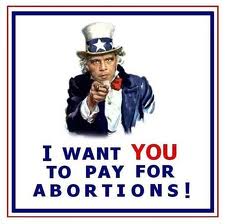
While President Obama could be accused of trying to curry favour with moral conservatives in rejecting the FDA’s recommendations on the “morning-after pill”, liberals can find some comfort in the fact that he’s at least pro-contraception, and isn’t planning to criminalise abortions just yet.

This puts him at odds with nearly every (plausible) Republican candidate with the exception of Mitt Romney who, while having changed his mind and become pro-life in 2004, is at least not a signatory to the regressive “Personhood Pledge” that has to date been signed by Santorum, Gingrich, Perry and Paul.

Ron Paul’s case is complicated by the addendum to his signing of the pledge, in which he disagrees with the Pledge’s assertion that the 14th amendment (which protects individual liberties from state encroachment) has a role to play in defending the interests of the unborn. While the addendum has led to some questioning of the sincerity of his commitment to the Pledge, he is nevertheless clear that “life begins at conception”, and that “it is the duty of the government to protect life”.

Of those who have not signed the Pledge (Huntsman and Romney), both want to repeal Roe vs. Wade, and Huntsman supports the introduction of a right to life amendment to the Constitution. While Romney thinks that current legislation has “cheapened the value of human life”, his stated intentions are to put abortion legislation in the hands of the state, rather than the Federal government.

Broadly speaking, then – because the details are, well, very detailed – all the candidates are pro-life to varying degrees of commitment. And while Romney and Paul can be credited with at least attempting to introduce a level of sophistication to their positions instead of simply appealing to the emotive fervour of a conservative base, the rest of the contenders speak of pre-born humans in terms that assume that the debate has an obvious conclusion, where a woman’s rights over her own body, and what to do with it, are significantly weakened.

As in most emotive issues, language is important here. A bias is immediately introduced in using terms like “pro-life”, given that it suggests an anti-life stance on the part of those that support abortion. Speaking of “unborn” or “pre-born” children introduces a similar bias, in that it encourages us to think of blastocysts, zygotes, embryos and foetuses as if they already had desires and aspirations capable of being dashed by those callous “anti-life” Democrats.

It is in the Personhood Pledge that these biases come to the fore in all their glory, where “every human being at every stage of development must be recognized as a person possessing the right to life”. While the Pledge’s opposition to assisted suicide and euthanasia increase the intended threats to individual liberty, it’s the language on abortion that is of most concern here.

Because it’s not only this pledge, but also a legislative move that should be seen as a concern. It should be concerning to Americans – most directly American women – but also to the rest of us, in that these sorts of developments can easily serve as example and inspiration to those who want to undermine South African liberties in this regard. It’s not only the ACDP that might want to do so – President Zuma’s visit to the Rhema Church during campaigning in 2009 included a reassurance that he’d be willing to entertain changes to legislation permitting both abortion and same-sex marriages.

The (American) legislation at issue is H.R.358, the Protect Life Act, which passed the House of Representatives in October 2011. The bill is considered unlikely to pass in the Senate, and President Obama intends to veto it even if it does. But in the hypothetical absence of the current Democratic Senate and President, the bill gives a clear insight into the how dedicated the current crop of Republicans in the House are to defend the unborn human, no matter how nebulous its form.

The first version of the bill submitted to the House by Rep. Joe Pitts (R-PA) called for a modification of the Patient Protection and Affordable Care Act to only allow for health plans to cover abortions in cases of “forcible rape or, if a minor, an act of incest”. Women who fall pregnant as a result of gentle rape – or adult victims of incest – must presumably have had it coming.

That language was removed in the bill that passed the House (you can see each version here), which now allows for coverage in the event of “an act of rape or incest”. But this concession to the reality of women sometimes needing an abortion through no fault of their own does not address some of the worst aspects of the bill.

The Protect Life Act, if signed into law, would prevent women from buying even a private insurance plan through a state health care exchange (these are not insurers themselves, but entities that attempt to promote insurance transparency and accountability) if that plan covers abortions – even though most private insurance plans currently cover abortion.

It would require any insurer that operates under an exchange and covers abortion to also offer otherwise identical plans that exclude abortion coverage. The administrative costs of managing two near-identical schemes – where one would do, save this conservative agenda – might well result in many insurers thinking it’s simply not worth the trouble to offer a plan that covers abortion.

Of course, consumers can join a plan that isn’t offered through an exchange. But because of the extra visibility of plans offered under an exchange, and the consumer protections ensured by these exchanges, it seems likely that the only women who would do so are those who are well-informed and financially advantaged – raising the possibility of this bill introducing a bias against the poor, who need more protection than most.

Perhaps worst of all, the bill opens up an avenue for softening current requirements under the Emergency Medical Treatment and Active Labor Act (EMTALA), signed into law by Reagan to protect poor and uninsured patients who need emergency care. The Protect Life Act would allow hospitals that are morally opposed to performing abortions to withhold treatment in cases where a woman requires an emergency abortion in order to save her life.

As Rep. Jackie Speier (D-Calif.) says of her own experience in this regard: “I was pregnant, I was miscarrying, I was bleeding. If I had to go from one hospital to the next trying to find one emergency room that would take me in, who knows if I would even be here today. What my colleagues on the other side of the aisle are trying to do is misogynist”.

Nobody should be required to die for the sake of someone else’s religious beliefs. And while I can understand the desire for abortion to be treated as a non-trivial matter, we shouldn’t satisfy this desire at the cost of eroding an existing and thinking person’s rights over her own body. While life might begin at conception, individual rights do not. This is the sort of case in which we might hope that public representatives attempt to fight the tide of populist sentiment, rather than allowing the most reactionary forms of that sentiment to stand the chance of influencing policy.

Ritual sacrifice and the ANC centenary

As submitted to the Daily Maverick.

Happy birthday, African National Congress. Congratulations on your centenary, and thank you for your tireless efforts to liberate South Africa from the unprincipled inequality that the majority of our population suffered under. As you enter your second century of existence, please consider eliminating various items of your own cultural baggage that are themselves unprincipled, and that become increasingly offensive within a modern democracy.

Besides the most obvious and most toxic tendencies, such as a patriarchal disposition that often seems inseparable from misogyny (as with President Zuma’s statements in his 2006 rape trial), or the apparent desire of some of your members to introduce new forms of racial nationalism, you could perhaps start with something small.

Small, but still meaningful, in that it would demonstrate not only a concern for the suffering of sentient creatures, but also an awareness that actions should be justifiable on objective evidence and impartial reasoning – and that nothing can be justified by an appeal to cultural traditions alone, no matter how longstanding those traditions are.

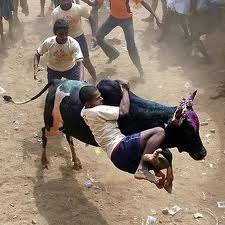
Please think about whether the 21st century is still an appropriate time to be slaughtering animals in rituals such as ukweshwama. I do understand that killing a bull or an ox with a spear is a deeply symbolic act, and that these non-human animals are not simply meat, but are instead signifiers of things like prosperity, or devices by which you attempt communication with ancestors.

My understanding here is of course not a lived one, and is no doubt incomplete. But you surely know as well as I that prosperity begins with gainful employ, and that the bread and circuses nature of some of what went on in Mangaung are a time-honoured (and no doubt useful) way of distracting those who don’t have jobs from that uncomfortable truth. These rituals unite, placate, and give hope for a future that might escape resembling the past.

Hopefully, you’re also aware that your ancestors are in fact dead and no longer capable of interceding on your behalf, no matter how many animals are slaughtered. Again, paying one’s respects to the dead is something we can all understand – but causing another animal to suffer as a method for doing so requires a justification beyond the simple assertion of cultural habit.

As I’ve said before, defending a practice on grounds of culture alone offers a slippery slope towards not being able to condemn anything at all. And we’d like to be able to condemn some things that are part of some cultures, like racism or sexism. We’d like to be able to say they are wrong – not simply illegal or unconstitutional.

So what else stops outsiders such as myself from saying that it’s wrong for President Zuma to have participated in the ritual killing of a black bull earlier this month, during the ANC’s centenary celebrations? The argument can’t end with silencing any opposition, simply on the grounds that they aren’t themselves part of the culture in question.

Perhaps those of us on the outside can’t say it’s wrong to stab a bull with spears, or (in more enthusiastic versions), to rip out its tongue and tear out his eyes. At least Zuma didn’t attempt to have sex with the bull, as Swaziland’s King Mswati is recently alleged to have done. Not simply because we don’t understand, but because we’re being inconsistent.

Or so one claim goes: those of us who eat meat cannot judge these rituals as wrong, because of our own complicity in needless suffering via the industrial farming of non-human animals for food. But this appears to privilege the relativistic defence of the argument from culture, in that it is possible to be a less or a more compassionate meat-eater, whereby those who are concerned with suffering can attempt to source their meat from farms which try to minimise it.

And even for the suffering that can’t be avoided in an omnivorous diet, there is still a noticeable difference between killing something slowly, tormenting it with the pointed end of a spear in a drawn-out ritual, and putting a bolt through its brain for the purposes of securing dinner. The former exhibits a bloodlust, the latter a dietary preference.

Wally Serote was quoted in the Mail&Guardian as saying “We spill the blood of these animals in the hopes that our ancestors will help us prevent spilling human blood in the future”. But what will stop us from spilling human blood in the future cannot be our deceased ancestors. It can only be the examples that they have set, and the lessons we can learn from those examples.

Perhaps we can best avoid spilling human blood in the future by continually moving toward a future in which needless suffering is always to be avoided, and in which we make our choices based on reasons that would be considered defensible, if not always acceptable, to any impartial observer. The ritual slaying of non-human animals, by contrast, is an artefact of the past.

Cultures can and frequently do change, even though these changes are sometimes slow to occur. And attempts to change them from the outside are typically doomed to failure, especially because they might be difficult to understand from a distance. In the 2009 case brought against King Goodwill Zwelithini, KwaZulu-Natal Premier Zweli Mkhize and others by Animal Rights Africa, Judge Nic Van der Reyden said it was difficult for him to rule on the matter of ukweshwama as the ritual went to the heart of Zulu tradition.

And so it does, as evidenced again in Mangaung last week. But the fact that these rituals are not proscribed by law does not mean we should endorse them, simply through a desire to appear politically correct. For those who engage in these rituals, their legality means they are permissible – not that they are necessary, or even appropriate.

If they are not appropriate, discovering this requires giving it some thought – not simply asserting the privilege of culture, but rather, debating the issue in order to determine which cultures happen to have gotten this one right, and whether the others shouldn’t consider changing their minds.

What happened to Plan A, Obama?

As submitted to Daily Maverick.

The man who said “We will restore science to its rightful place, and wield technology’s wonders to raise health care’s quality and lower its cost” in his inaugural address seems to have left the building. The building in question is the White House, and the man is of course President Obama.

We can hope that his absence is temporary, intended merely to provide for potential excursions into the hearts and minds of some Republican or undecided voters. But his endorsement of the decision to overturn the Food and Drug Administration’s (FDA) decision to allow “Plan B” (also known as the “morning-after pill”) to be sold over the counter to young teenagers rather than by prescription seems little more than a violation of that pledge to respect science.

Instead, he’s kowtowing to moral conservatives, alarmed at the prospect of their teenage daughters having sex. Seeing as many of these conservatives are equally fond of taking life guidance from religious texts, this is also another step back from the reassuring name-checking of “non-believers” in that same inaugural address.

Plan B is not an abortion pill, nor is it related to RU-486. The 1.5 milligrams of progesterone it contains helps to prevent ovulation and makes the lining of the uterus less hospitable to a fertilised egg. As the New York Times rightly points out, “this latter effect — shared by all hormonal and intrauterine contraceptives — makes it anathema to anti-abortion activists”.

Anti-abortion activists are perhaps unlikely to be voting for Obama in large numbers in any case. This is, after all, the President who shortly after taking office lifted the Reagan, then the George W. Bush, ban on federal funding for international health groups who support abortion rights. (The ban was briefly reversed by president Clinton before being reinstated by Bush.)

Then again, the man who campaigned as a pro-choice candidate did later sign an executive order ensuring that the healthcare law of 2010 would maintain the ban on federal money being used to pay for abortions (except in cases of rape or incest). So while it’s perhaps the case that his stance on abortion ends up evening out in terms of effects at the ballot box, this particular decision nevertheless stands out for its sacrifice of principles for potential political gain.

I say this for two reasons: first, this is the only time that an American Secretary of Health and Human Services has overruled an FDA recommendation. While the Secretary, Kathleen Sebelius, is the one who made the decision to do so, it’s clear that the decision was endorsed by Obama himself. A White House statement last week said:

The reason Kathleen made this decision is that she could not be confident that a 10-year-old or an 11-year-old going to a drug store should be able — alongside bubble gum or batteries — be able to buy a medication that potentially, if not used properly, could have an adverse effect. And I think most parents would probably feel the same way.

With eleven months to go before the US Presidential elections, the unprecedented overturning of an FDA recommendation is difficult to understand as anything more than an attempt to reassure conservatives that Obama is sympathetic to that nebulous concept of “family values” (which, like the term “neo-liberal”, seems in cases like these to mean whatever you do or don’t like about what the other guy is doing).

Second, the FDA recommendation appears to be well thought-through, making a principled objection to allowing over the counter sales of Plan B difficult to sustain. The need for drugs like this is clear in that the US has the highest teen pregnancy rates of any industrialised nation. Plan B is already available without prescription for women over 17, and by prescription for younger females.

The FDA’s proposal was for the drug to be available without prescription for younger teenagers also. It should of course go without saying that Plan B does not induce teenagers to desire having sex – many or most of them have that desire in any case, and would already have acted on it if they were trying to get hold of the drug in question . Furthermore, while making the uterus less hospitable to a fertilised egg could induce an abortion, the pill only lowers your chances of becoming pregnant to one in 40 (compared to one in 20 for unprotected intercourse), making it implausible that teens will use Plan B as licence for spontaneous orgies.

Sibelius’s claim is that we can’t be sure whether Plan B has harmful effects on eleven-year-olds, who can of course also fall pregnant. And naturally there might be risks. But in this case, we’re speaking of a drug which the FDA’s panel of experts regards as safe, and of which the assistant dean at the University of Southern California School of Pharmacy says: “very few medications are this simple, convenient and safe”.

A double-standard, informed by a moral panic around teens having sex, is clearly at play. Former F.D.A. assistant commissioner Dr. Susan Wood points out that drugs like acetaminophen (an analgesic found in Tylenol and many other over-the-counter medicines) can be fatal, but had not been specifically studied for effects on 11-year-olds, despite being potentially far more dangerous to them. She asks “why are contraceptives singled out every single time when they’re actually far safer than what’s already out there?”

We can of course also ask whether pregnancy itself is riskier to an 11-year-old than Plan B is. We can ask whether any of the people who might be heartened by this overrule, and Obama’s endorsement of it, were ever likely to vote for him in any case. More pertinently, we can perhaps ask what happened to the man who promised to restore science to its rightful place, and how did he become the man who seems willing to play politics with the bodies of the next generation of voters, for the sake of hypothetical sympathies from the current generation?

Sometimes we’re just like the rest of us

As submitted to Daily Maverick

We’ve read plenty of opinion in Daily Maverick on Premier Zille and HIV in recent weeks. And while encouraging thinking and debate on HIV and Aids is crucial, emotive topics such as this lend themselves quite easily to caricature – perhaps especially when protagonists in the discussion describe opposing views using hyperbolic labels such as “fascist”.

In Sipho Hlongwane’s column linked above, he asks whether Zille’s followers agree with her views on criminalising HIV and if not, why their opposition is mostly silent. While I reject the implicit association of a political party and its policies with one individual’s views (even if that individual is the party’s leader), I’ve expressed my opposition to those views in a previous column.

A broader issue raised by both the idea of criminalising HIV transmission as well as something like the Get Tested campaign is the extent to which scientific knowledge should inform policy. To put the issue that baldly might lead to some shaking of heads, in the sense that it might seem obvious and unworthy of debate that our scientific knowledge should inform policy.

But judgements often need to be made, and regardless of what the facts might be, we know that many – perhaps the majority – of votes are cast on the basis of perception. This is part of the reason that it becomes plausible to accuse a leader of populism, as some critics of Zille have done in this instance, or for her to accuse critics of fascism or “slacktivism” (itself often a grossly unfair charge, in that the only voice most of us have comes from behind our computer monitors, from where we are typically not able to control the budgets of state organs).

What I mean is this: On the one hand, the issue of whether criminalising HIV is a good idea or not could be regarded as a simple one, answerable though data telling us whether doing so results in fewer cases of transmission. With Get Tested, we could ask whether the campaign results in more people knowing their status, thereby potentially entering the treatment and counselling net. (Briefly, on the topic of Get Tested, I must regretfully withdraw some of my previously expressed support for the campaign, now that we know that baseline figures for testing rates pre-Get Tested are not available – meaning that we have no way of knowing how effective the campaign has been.)

On the other hand, the issues can never be this simple, because even if we all agree that control of the HIV epidemic is our most pressing concern, other values can nevertheless limit our pursuit of that goal. But what if the data did show that criminalising HIV transmission actually worked, or that Get Tested resulted in a 10% increase in the number of people who were tested for HIV? Would opposition to these measures cease?

My suspicion is that they will not, because we seem reluctant to trust the data to inform policy above all else, and because we’re unwilling to regard ourselves as one trivial data point in the aggregate. We’re of course not trivial to ourselves, and justifiably fear (for example) the imposition on our time that mandatory HIV testing would entail. At the same time, we might be perfectly happy for our sexual partners to engage in such testing, and to hypocritically insist that they do so.

In other words, we assign individual agency a greater value than we do the collective good. Which is as it should be much or even perhaps most of the time, at least if you subscribe to broadly liberal principles. But liberal-minded folk are still part of that collective, and can sometimes benefit more as individuals by focusing on the good of that collective, seeing as there are so many more of them (capable of doing you harm or good) than there are of you.

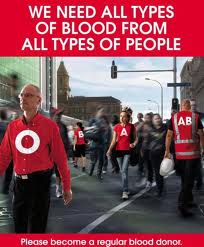
One particularly interesting test-case involving this conflict between perceived impositions on individual liberty versus the good of the collective is blood donation; and in particular the question of whether the South African National Blood Service and their international equivalents should accept donations of blood from homosexual men.

Gay men who have had oral or anal sex with another man in the last six months (whether protected sex or not) cannot donate blood in South Africa. In the UK, the deferral period for this category of donor was recently reduced to one year, while a lifetime restriction still applies in the USA for men who have had any sexual encounter with another man since 1977.

The phrase ‘category of donor’ is key to the issue I am raising here: We don’t easily think of ourselves as belonging to a category, no matter how clearly the data shows that people of type X, or who engage in behaviour Y, on aggregate merit treatment Z. This is the curse that actuaries have to bear: Their models that price our insurance premiums or motivate for medical interventions such as those mentioned above are in constant competition with the Pythonesque reality of all of us insisting in unison that “We’re all individuals”.

But laws or insurance premiums can’t be tailored to individuals. As much as we are individuals to ourselves, interventions intended to work on aggregate have to treat us as belonging to a category – and the question then becomes how those categories are defined. And here, we need to start thinking about the least wrong way of doing this, and perhaps being more willing to tolerate principled ways of treating us simply as a number.

Legislation based on one person’s moral viewpoint, in opposition to the available evidence, is far closer to most wrong than to least wrong. And science utterly divorced from morality offers its own nightmares, as a Twitter friend reminded me in a conversation on this topic. I’ll return to the specific case of blood deferrals for homosexual men – and other “categories” of human – in a future column.

For now, though, the concern is this: Seeing as most of us know little about science beyond misleading headlines, and our understanding of morality is largely subjective, perhaps more of us should be willing to respond as that lone voice in the crowd did in Monty Python’s Life of Brian. When Brian told the crowd “You’re all different!”, and they responded “Yes, we are all different!”, his muted response was simply “I’m not”. And neither, most of the time, are the rest of us.

Premier Zille is nudging people to Get Tested

As submitted to the Daily Maverick

As T.O. Molefe pointed out in a column last week, we can legitimately question whether a campaign like Get Tested will have any long-term effect on the willingness of South Africans to get tested for HIV. Launched by Premier Helen Zille to coincide with 16 Days of Activism for No Violence Against Women and Children, Get Tested offers a financial incentive for knowing your HIV status. Anyone who volunteers for HIV testing between November 28 and December 9 stands a chance of winning a first prize of R50 000 or one of five R10 000 runner-up prizes.

You might recall that Zille attracted a significant amount of criticism for her stated intentions of criminalising HIV transmission. As was the case then, an apparent problem with Get Tested is that according to Molefe, it tries “to achieve individual thought and responsibility by taking away thought and usurping responsibility”. Furthermore, Molefe draws on the work of Daniel Pink in arguing that the effects of the incentive will only be short-term, falling away once the prizes are no longer available.

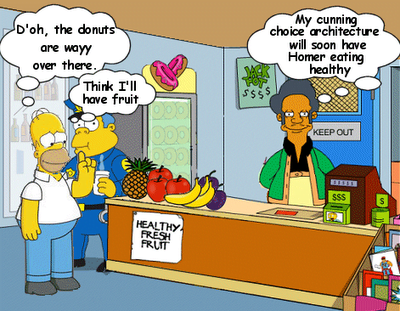
Both of these criticisms are to my mind at best not compelling, and at worst unfounded. While it’s true that behavioural economics is a contested science, the contestation more typically relates to whether findings in experimental conditions cross over into informing policy in the real world, and to whether the rise of “choice architects” – in other words, those who design the “nudges” – present an illiberal incursion into our freedom to choose.

Pink’s claim that carrots and sticks are less effective, and potentially harmful, in addressing complex 21st century problems raises questions relating to the design of these nudges. These questions don’t however rule out the potential usefulness of nudges. If the desired behavioural change depends on tweaking complex motivational forces, we might struggle to achieve it – but there seems little difference in kind from more simple behaviours. The question is one of degree only.

Of course, there might be problems too subtle to address via these sorts of nudges, but given that we’re talking about a science that arguably only came into existence in 1979, with Kahneman and Tversky’s “Prospect theory: An Analysis of Decision Under Risk”, it seems rather hasty to claim that the experimental work conducted by George Ainslie, Gary Becker and a host of others has been premised on problems already superseded by newer and more complex ones.

Despite this question, it remains true that our models of intertemporal choice behaviour and hyperbolic discounting (in this context, the choice habits that could result in people being tested now for the chance of winning money, instead of for their own long-term benefit) are imperfect. They could perhaps even be critically flawed, and as I mentioned earlier, applicable more to experimental conditions than to real-world policy.

But the successes of these sorts of interventions – at least on pragmatic criteria – seem to be far outweighing their failures. Long-term trials such as the 3-year J-PAL immunisation intervention in rural India have been tremendously successful. Offering parents 1kg of lentils and a set of metal meal plates upon completion of a course of immunisation for their child resulted in a more-than-doubled immunisation rate at half the cost, thanks to economies of scale resulting from increased uptake.

There are similar tales of success with HIV testing in South Africa. The 2008 intervention by the Men By the Side of the Road charity, which offered unemployed men R75 to test for HIV had a 100% uptake in the group it targeted, along with a waiting list in the thousands. The Discovery Health/Sunday Times Right to Know campaign (July 2008 to June 2009) attracted 55 000 volunteers for testing, thanks to the promise of one person per month becoming R100 000 richer.

But the question is of course sustainability, and whether these incentives have a long-term impact on behaviour. And here is where I’d urge Zille’s critics to a little more temperance, in that if relatively low incentives of one R50 000 prize and five R10 000 prizes end up resulting in significantly increased rates of testing, the R100 000 total spend could end up being a very worthwhile (and sustainable) investment, given that the Province currently spends a reported R661 million on its HIV/AIDS programmes per year.

What of the criticism that choice-architecture of this sort is somehow grossly illiberal, “taking away thought and usurping responsibility”? First, it’s perhaps worth noting that the liberal goal of securing freedoms is surely maximised by both good health, and by decreasing expenditure on preventable diseases so that the funds can be used elsewhere. The question is how we secure those goods, and whether we impinge on liberties excessively in doing so (as we would do by criminalising HIV).

While it’s true, as Molefe says, that HIV testing should be its own incentive, I’d suggest that those of us who know this already get tested. Offering people the chance of a cash prize for HIV testing can only increase the likelihood that any first-time testers can be exposed to that message, resulting in a probable net gain in terms of awareness. It’s not the case that the Get Tested campaign is replacing ordinary awareness campaigns – it’s a supplement to them, and one that seems worth trialling given its low cost.

Furthermore, it’s a supplemental sort of intervention that is widely accepted, rarely attracting the sort of criticisms Zille is confronting here. What, for example, do critics of choice architecture think of Discovery Health’s Vitality programme, which by Molefe’s reasoning “sends the unintentional message that [good health], something which is an incentive in itself, is so abnormal and exceptional a behaviour that those who get tested are entitled to a reward”?

While nudges like the Get Tested campaign are sometimes accused of violating human autonomy, it’s difficult to be sympathetic to these charges. South Africans retain their choice to be tested or not – and if some who would otherwise not be tested now come forward, they do so because they autonomously desire money. Their exercising that autonomy is potentially to all of our benefits, given the level of public expenditure on AIDS.

In short, the harms of Get Tested are unclear while the possible benefits are not. Given that it will cost us little in terms of money – and nothing, as far as I can tell, in terms of liberty – we should give it a chance. If it ends up working, some of those entitlement horses might eventually end up being able to find their own way to the watering-hole.