UCT, race, and the seductive moral outrage machine

Originally published in Daily Maverick

Despite the many columns I’ve written on the dangers of jumping to easy conclusions, the UCT student survey ranking how attractive various “races” are provided a reminder of how difficult it can be to follow one’s own advice. Especially with regard to emotive topics, the moral outrage machine can be quite seductive.

On that “most attractive race” thing in the UCT student newspaper

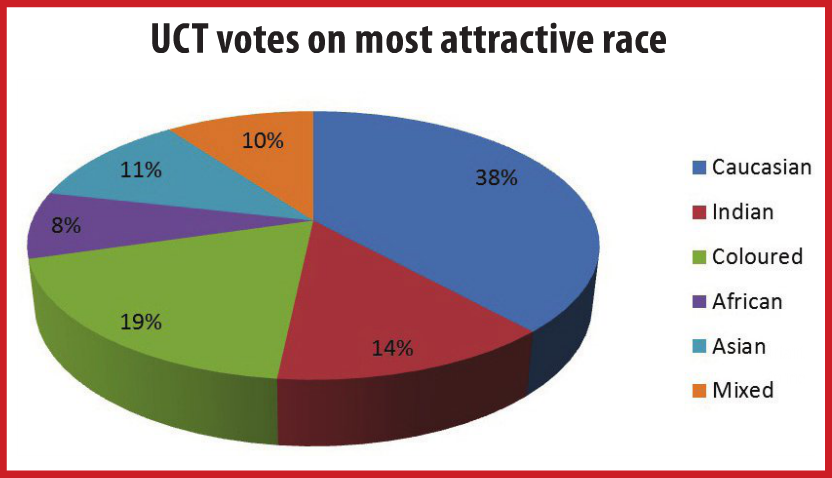
So, this peculiar thing appeared in the UCT student newspaper, Varsity, earlier in the week:

Screen Shot 2013-04-05 at 9.46.51 AM

A couple of people have asked whether I’d be writing about it. To one, I replied that it was “too silly”. Which it is. But even sillier than this is the news that the Young Communist League are apparently going to report Varsity to the Human Rights Commission (they are “shocked and disgusted“, you see).

For context, a couple of details: To repeat, this is a student newspaper, and it is not edited or subject to any pre-publication controls by any official agents of the University administration or staff. Second, it was published in the opinion pages, and third, it was an accompaniment to this article – in fact, it’s a graphical representation of the results of Qamran Tabo’s straw poll of 60 students.

Yes, 60 students. So, Varsity chose a stupid headline for the graphic, in that “UCT” haven’t voted on anything. Varsity no doubt chose the headline to attract attention, seeing as that is what headlines are for. But an attention-grabbing headline on such a sensitive topic should perhaps be chosen with more care.

As, of course, should be what you choose to publish in the first place, or how much you edit what’s been submitted. Presenting this as quasi-scientific was an error, as the editor concedes.  It’s not just the sample size, it’s also the peculiar way in which the sample was drawn. Tabo chose to survey 10 individuals from each of the following “racial groups”: “white, coloured (culturally), Indian, East Asian, biracial and African”. Now, Tabo doesn’t define how she knew who was who here, and whether they are all self-identified (as “culturally coloured” surely must be). Anyway – let’s leave it at that, agreeing that the pie-chart is a reflection of what these students reported, and nothing to do with UCT as a whole.

But even if it was about UCT as a whole, it’s still possible that – for whatever reason, but mostly for a reason Tabo cites (the preponderance of white people presented as attractive in popular media) – a larger group of people would report this same preference. And this would be a reflection of racism in popular culture, yes, where certain appearances are normalised as attractive, and others not. Furthermore, it’s a great shame that this is so prevalent, and so persuasive, that it’s probably the case that a large number of students (and others) have “fallen for it”, as it were.

It wouldn’t necessarily be racist to point this out, though. Saying “students report that they find race x more attractive than race y” (and please, throughout this blog post, assume the quotation marks around “race”) can simply be reporting a fact. The idea that humans might “rank” races on any characteristic is of course offensive, particularly in South Africa or anywhere (okay, everywhere then) where people have been oppressed as a result of their race. But the author knows this, and starts by reports the fact (for the 60 students) of these preferences, before going on to conclude:

Of course everyone has the right to choose who they want as a romantic partner, but it is interesting to observe how race, which is really just a collection of arbitrary physical features, acts as a barrier when it comes to who we choose to love.

Having been at UCT and in South Africa long enough, I have come to realise that we would have better luck creating a research wing at Med School dedicated to cloning white people to feed the demand than trying to understand the origins of some our supposed “preferences”. Hopefully one day, when the world’s entire population becomes creolised, characters will be the only deciding factor for who we want to date.

And that’s just right, surely? The author decries the fact that these students use an arbitrary characteristic, rather than someone’s character, to determine who they would like to date. There’s nothing racist about the conclusion, and it can’t be racist to report that people do have these (potentially racist) preferences. This really does seem a storm in a tea-cup, caused by little more than a poor headline and social media hysteria.

Furthermore, as I’ve previously argued with regard to the dos Santos and Tshidi cases, even real racist speech should perhaps not be reported to the HRC, and we certainly shouldn’t feed the pitchfork-wielding mobs of outraged folk on social media, because they’ll simply start feeling more entitled to bully us into silence the more they succeed in doing so. I confess I fell for it too, yesterday, when I described this as “embarrassing” for UCT on Twitter.

It is embarrassing, sure – but it’s also embarrassing that our knees jerk so quickly, and so violently, when anyone mentions the fact that people do still think in racial terms, regardless of the fact that we wish they wouldn’t. Outrage won’t make the problem go away, and neither will pretending that people don’t have attitudes we wish they didn’t.

[Edit]Related: I thought it was a mistake for UCT (the Vice-Chancellor, in fact) to apologise for the “blasphemous” Sax Appeal in 2009. They certainly shouldn’t apologise for this.[/edit]

Cansa indulges the quacks (and students indulge the homeopaths)

So, as mentioned in a Daily Maverick column, I was recently asked to grant a student an extension on an assignment deadline. Her request was accompanied by the “medical certificate” below:

sicknote

Yes, that is from a naturopath, who also advertises skills related to iridology (your eyes, the iris in particular, being a reliable source of information about your health), herbal tinctures, and homeopathy. And in what you’d hope is a joke, but isn’t, the course in question is explicitly about evidence-based decision-making. Worse still – during the week this particular assignment was due, the lecture topic was pseudoscience, with explicit reference to homeopathy.

A reader encouraged me to submit a complaint to the Registrar of the Allied Health Professions Council, which I’ve done as per the text below:

I would like to formally bring a matter to your attention, as Registrar of the Allied Health Professions Council. The attached note, bearing the letterhead of Renata Zijp (Reg A9803; Prac 0805564) was submitted in support of a student’s application to be granted an extension on an assignment in my course at the University of Cape Town.

While I realise that it’s not within your purview to completely eliminate pseudoscientific professions such as homeopathy, I would hope that legislation and common sense both argue against practitioners in these fields issuing certificates such as the one attached.

The certificate makes no mention of the ailment that was diagnosed, nor does it offer any information as to when the student would be fit to return to her studies. In other words, as a piece of testimony as to the medical condition of the student, it is useless for two reasons: the fact that Zijp is a practitioner of professions of dubious value; and even within those professions, has offered testimony that is useless and even misleading.

It is misleading because, in using the imprimatur of science, a less attentive or more gullible member of the academic community might accept such a certificate as a legitimate reason to grant the student an extension. It is not, and presenting certificates such as these is an insult to those who suffer from genuine ailments, and to the professionals who treat them.

Finally, even though the AHPC must of course concern itself with matters directly related to the professions in question, we arguably all have a responsibility to hold other citizens to account for the contributions played in promoting reason and rationality, or the converse of those. Students (ironically, in this case students in a course teaching evidence-based decision-making) should not be given the impression that these sorts of certificates have any merit, and practitioners should be dissuaded – if not barred – from issuing them.

If you encounter any similar instances, you can get in touch with the Registrar of the Allied Health Professions Council, Dr Louis Mullinder, at registrar@ahpcsa.co.za to officially lodge a complaint.

Incidentally, my complaint might bear some fruit, seeing as I’m reliably informed that the practitioner in question “is registered as a naturopath, but not as a homoeopath. It is a breach of the Regulations to the Act to give the impression that she is registered as a homoeopath. I expect that the Registrar will deal with it harshly – quite apart from the highly problematic wording of the actual certificate.”

While on the subject of quackery: CANSA, the country’s main cancer advocacy organisation, is promoting and marketing an untested supplement. Prof. Roy Jobson of Rhodes University pharmacology dept criticised them, and they responded with a lawyer’s letter threatening to sue.

Magical intentions and the principle of charity

Originally published on SkepticInk, and mostly of interest to people who follow the skeptic/atheist debates closely.

10042479-funny-robot-stay-with-headphonesOne of the things I’m struggling with this year is the transformation of a course I teach into an online version. Not a MOOC – a full, for credit course at the University of Cape Town, offered to around 1000 students this semester. In the first 3 weeks, I teach critical thinking, including some work on cognitive biases. The struggle is in getting students to see that things aren’t always easily divisible, because a particular example might share attributes of both the availability heuristic and representativeness, for example. Or, we might be dealing with a post hoc argument that also includes a smattering of something else.

Instead, we need to see things in context, I say to them, and try to justify our answers by reference to what is the most plausible interpretation. Also, we can justifiably be concerned with the politics of a situation, and be looking for a way to resolve an interpretive dilemma rather than being most concerned with defending our own point of view. One of the reasons I typically don’t get involved in what people here at the SkepticInk Network are calling “the drama” is because too much writing on it seems motivated by a desire to be right, rather than a desire to fix the problem. As I wrote a few months back,

when a debate gets heated, we should try to remember that no matter what’s come before, we’re constantly at a new decision-point, where we – and only we – are responsible for what we say in response to something we find provocative. Sure, someone else has committed a wrong, and we can be inflamed by that. But essentially juvenile questions of “who started it”, while diverting, seldom help illuminate the question of how it can be ended.

The détente involving Dr. Harriet Hall and Amy Roth (facilitated by Steven Novella, as described here)  has given rise to the most recent deluge of posts on “the drama”, here and elsewhere. Many of these contributions are making the point that the principle of charity is an important element of productive debate. This is true, but it’s also true that it’s possible to squander the goodwill you’d normally be entitled to, thanks to a track record of causing some form of (unjustified) offense. Some offense is merited, and some is not – and I’m not going to make any pronouncements on that here. The point of the quote above is that we can – at least in principle – separate the matter of whether the offense is justified from how best to respond to it given the desire for a certain outcome.

My presumption is that the outcome we desire is to be able to debate issues of substance from within a common framework of skepticism, atheism and humanism. If we can’t talk about how best to improve the world from within that framework, we’re using the wrong framework. And, if you think that some other value trumps those three and their cognate ideas, then whether you’re right or wrong is less relevant than the fact that you’re addressing a different – even if overlapping – constituency.

So, within that framework, perhaps we can sometimes be reminded that the real world is messy, especially the emotive, political world that we’ve constructed for ourselves within the skeptical community. Intentions are certainly not magical, but they’re certainly not irrelevant either – and deciding how to respond to claims regarding what people intended might require subtle and sensitive judgement. For this reason, I’d have to disagree with Justin Vacula’s post on intentions. Not necessarily because he’s wrong on the facts regarding how we should interpret others – I think I mostly agree with him there – but because his post strikes me as another example of what you could call a tone-deaf response.

It’s wrong to impute negative intentions – that’s where the principle of charity comes in. And while an insistence on people setting aside any pre-existing perceptions regarding your motives might be logically coherent, it’s not sufficient in this world of real insults and (at least psychological) harms. Once again, whether you think the harms as severe as some claim, or whether you think particular examples overblown or not, is only part of the point – and perhaps sometimes a small part. A larger part of the point might be that you’re talking to people who believe they have been harmed – and might even have been harmed – and adopting the blameless view-from-nowhere demeanour is a signal that you aren’t willing to acknowledge that.

Instead, it’s perhaps a signal that you’re willing to talk, but only on your terms, and only once the opposition grows up (or somesuch). A similar sort of tone-deafness is present in Richard Carrier’s post on the Hall/Roth correspondence, where he asserts that Harriet Hall is now “redeemed”. It’s the smugness, and the entitlement (my concern with his atheism+ post, also), that gets to me. As if Carrier is the arbiter on this, as if it’s now axiomatic that Hall needed redemption in the first place.

Both these posts have this in common – they ask you to accept a version of things that’s self-serving. In Vacula’s post, we’re encouraged (albeit subtly) to regard people who use phrases like “intent is not magic” as folk who over-react to criticism. The fact that Vacula doesn’t mention who they are is part of the subtlety here, in that we all know who they are, but it’s now more difficult to call him on it. In Carrier’s post, a version of history is written wherein Harriet Hall was known to be a transgressor of certain norms or rules, but has now been redeemed – and so, a little more authority to be the judge, or arbiter, is assumed.

It’s obviously problematic if we’re all having to constantly second guess what we write or say, because we know it’s going to serve as fodder for the confirmation bias others have with respect to our views. So, ideally, I’d love it if we were all able to operate in the domain of pure logic, clarifying intentions and meaning without making assumptions about the other. But that’s not the world we live in. But while we’re figuring this stuff out, let’s be wary of the tendency to assume that “they” are the ones getting things wrong, and that the truth is always a simple matter.

Jansen “ashamed of South Africa”. Or not.

jansen_40379bSo here’s a neat example of how bad South African media can be, or perhaps the negative consequences of treating it as a reliable source. The problem is in large measure due to a reliance on the South African Press Association (Sapa) for copy. And yes, Sapa is a real and quasi-respectable thing, unlike the National Press Club. The NPC is only real, and not at all respectable, following their award of “Newsmaker of the year” to “the rhino”. And that’s without even mentioning Yu(suf Abramjee) know who, chairperson of the NPC.

Sapa copy accounts for the vast majority of what people in South Africa read in their newspapers. So, when Beeld reports that Jonathan Jansen, the Vice-Chancellor of the University of the Free State, said he was ashamed of South Africa (that link takes you to an Afrikaans page), it is unsurprising that the copy in question comes from Sapa. But what the copy coming from Sapa also means is that you’re likely to find the same copy in a bunch of other newspapers.

Jansen said that the Beeld report was inaccurate, and is quoted in the Times as saying:

This is not what I said in my opening remarks to first year students. I did not say I am ashamed of South Africa; that is impossible. I did not say I would expel students for being angry. No, this is an irresponsible recollection of what I said by people who were not there i.e. the Beeld. The Volksblad is more accurate.

Alright, then – let’s look at what the Volksblad’s report said. Jansen is quoted as saying “Ek skaam my vel van my gesig af vir Suid-Afrika. Dit is ’n algehele skande dat jy matriek met ’n punt van 30% kan slaag” – the exact words he’s quoted as using in the “irresponsible” report from the Beeld, and words which mean … yes, that he’s ashamed of South Africa. Even if you don’t understand Afrikaans, you can verify for yourself that those words look the same, and in the same order, as these from the Beeld: “Ek skaam my vel van my gesig af vir Suid-Afrika. Dis ’n absolute skande dat jy matriek kan slaag met ’n punt van 30%”.

Of course this might still be a misquote. But you’d expect that Jansen would look at a source that he’s claiming is “more accurate” before doing so – especially when it’s effectively the same source, namely Sapa (Here’s an English version). And it’s annoying that he has to climb down from such a statement in any case – our basic education system is something that merits shame, and a university Vice-Chancellor is well placed to comment on the scandalous failure on the part of government to give kids a fighting chance at university success (or, to give universities a fighting chance at maintaining standards while also avoiding huge class rifts).

It’s annoying that he had to climb down from that statement because he really did say something offensive (assuming the report is true) during this welcoming address to first-year students. He said (in both Afrikaans versions quoted above, and in the English):

“I always make time for students, but before you make an appointment, my secretary looks at your academic record. If you’ve failed a subject, I’m not going to waste my time with you,” he told 4 000 first-year students.

However, he invited students to contact him on Facebook and Twitter if they have problems.

So long as you’re on Facebook or Twitter, Prof. Jansen would be happy to hear about the difficult circumstances you might be encountering, and that you fear might lead to you failing a course. Good news for those with smartphones, airtime, computers and the like. But don’t bother, say, waiting outside his office on crutches or something, to explain how (e.g.) a car accident caused you to miss an exam and fail a course.]

Talking to you would be a waste of time, you see.

I’m not known as a very friendly person with students. In fact, I know I’m perceived as fairly unwelcoming. And it’s true that there are students with whom it is a waste of time to speak. I can understand Jansen’s “tough love” rhetoric. But if you’re – as a Vice-Chancellor – going to speak off the cuff, you shouldn’t be surprised if you put your foot in it every now and then.

But being apologetic for the one remark, about being ashamed of South Africa, seems to be an attempt to recover some lost ground with patriotic minded (of a sensitive sort) South Africans, with the Department of Basic Education, and with Government more generally. From my vantage point, as a teacher of roughly 1400 first-year students of the sort Jansen was addressing, it’s the students that deserve the apology.

The 2012 TB Davie lecture: Introductory remarks

On August 1, 2012, Ferial Haffajee delivered the 47th annual TB Davie Lecture at the University of Cape Town. As chair of the Academic Freedom Committee, I had the privilege of introducing her, and this is the text of my introductory remarks.

TB Davie led the university as Vice-Chancellor from 1948 until his death in 1955. He is remembered as a fearless defender of the principles of academic freedom. He championed this cause and the autonomy of the university, defining academic freedom as the university’s right to determine who shall be taught, who shall teach, what shall be taught and how it should be taught, without regard to any criterion except academic merit.

This legacy is honoured through the TB Davie memorial lecture series, beginning in 1959 with a lecture by former chief justice and UCT chancellor, Albert van de Sandt Centlivres, after whom a building adjacent to this one is named. In subsequent years, the lecture has been delivered by, among others, ZK Matthews, Walter Sisulu, Wole Soyinka, Kader Asmal and Frederik Van Zyl Slabbert.

When the Academic Freedom Committee invited Ferial Haffajee to deliver the 47th annual TB Davie Lecture, it was in the knowledge that we were inviting one of South Africa’s media luminaries. Her career started with an internship at what was then the Weekly Mail in 1991 – a publication at which she gained immediate exposure to the challenges of working in a medium where a desire to reveal and discuss matters in the public interest would frequently be met by powerful dissenting voices, requesting (and sometimes requiring) that you refrain from speaking.

After leaving the Weekly Mail, Ferial worked in radio as a producer and reporter at the SABC, before joining the Financial Mail as Political Editor, and later Managing Editor. In 2004, she rejoined what had by then become the Mail & Guardian, where she served as editor for 5 years. In 2009, she was appointed editor in chief at the City Press.

Throughout these 20-odd years, Ferial has been no stranger to controversy and having to fend off attempts at censorship. In 2005, the High Court barred the Mail & Guardian from publishing a story on the Oilgate scandal, detailing how the Imvume oil company had paid millions of taxpayers rands to the ANC. Just as the publication had done in the 1980’s, Ferial insisted on running the story, but with the banned segments blacked out.

In 2006, she published one of what became known as the Danish cartoons, to illustrate a story about the protests generated by the infamous depictions of the prophet Muhammad. Threats to both herself and her family resulted from this choice.

The committee knew all of this when inviting her to address us today. What we did not, and could not, have been aware of is just how appropriate a choice of speaker Ms Haffajee would end up being. I refer of course to the events of May this year, when Brett Murray’s painting The Spear was hung and then defaced at the Goodman Gallery, and published then later retracted by the City Press.

The Spear highlighted various fractures and absurdities in South African society. One absurdity, for me at least, was in hearing a sitting Minister of Education call for the destruction of an artwork. Another was the inconsistency between the near-complete silence from social media pundits as well as government spokespersons when members of the political opposition are racially slurred or crudely insulted, and the contrast between this and the outrage generated by the alleged lack of respect shown by this painting, and the publication of it. A morality that appears to be selective is difficult to fathom, and sometimes difficult to respect.

For some, it was of course always absurd that an act of satire could be this divisive, this inflammatory. For others, the lack of sympathy or understanding for the outrage was the real absurdity – and a real travesty of decency. In South Africa, these fractures are sometimes quite shallow beneath the surface. A key question is of course how to deal with them. Another key question is how one gets – and perhaps stays – in a position to be able to address them, and at what cost.

Academic freedom and media freedom are natural bedfellows, perhaps most obviously because of the symbiosis between a media revealing things that might benefit from academic study, and through academic activity frequently being newsworthy. But more crucial, perhaps, is media freedom simply as a barometer of a country’s freedom more generally.

In a 2009 interview, Ferial said “Until just over a year ago, I was singing that we enjoyed world-class media freedom, especially compared to some other African countries such as the Democratic Republic of Congo, where four radio journalists were murdered last year, or Ethiopia, where all independent journalists are in jail or exile. But the ratcheting up of rhetoric against journalists since Polokwane is very, very dangerous. There is a fundamental philosophical difference between how the ANC perceives media freedom and how we journalists see it.”

Explaining her decision to withdraw The Spear from the City Press website earlier this year, she remarked “I hope we are not crafting a society … where we consign journalism to a free expression constrained by the limits of fear. This week society began the path of setting its mores on how we treat presidents in art and journalism; what is acceptable and what is not.”

Expression is at most partly free when one is afraid to speak. Arguably, it’s not at all free. Demands for silence on the grounds of culture, tradition or offences to dignity can sometimes be self-serving in that they forestall much possible debate or reflection on the merits of an artwork or speech act. Not the merits in terms of quality and originality, which are a separate matter, but the merits in terms of the discomfort and self-reflection the artwork could inspire.

The easiest way to justify poor arguments or mistaken ideas is simply to refuse to discuss them – and if it is a mistaken idea that presidents, for example, merit special protection from these sorts of insults, playing the race card or the culture card serves to rule that discussion out of order, leaving us unable to discuss those ideas.

It’s easy to agree that a painting like The Spear is disrespectful – I’d imagine that’s part of the point. You might think the painting in unacceptably bad taste, but your aesthetic preferences and cultural norms are of no more consequence than anyone else’s – at least in theory.

Many of you might share my hope that we can learn to deal with insults without feeling the need for protection from the courts, or from a Film and Publications Board which exhibits a very dubious moral authority in listing a known homophobic organisation as a “useful link” on its website.

I have this hope because it remains true that any restrictions on free speech on the basis of offence or slights to dignity threaten to put us on an unprincipled and very slippery slope. These sorts of things are perhaps easier for some of us to believe, and say, than it is for others. But it’s also true that some of us have easier access to the courts than others do.

Absolute freedom, including the freedom to offend, is usually not the only value at issue in contestations such as these. It is sometimes the case that one might be free to speak, but chose not to exercise that freedom – or simply, to regret having done so because the harms seem to far be outweighing any possible benefits, making absolute principles difficult to defend. As someone who experienced these dilemmas at first hand, we look forward to hearing Ferial Haffajee’s thoughts on creeping censorship, and the spearing of freedom.

You can download the audio of Ferial’s talk via this UCT page.

Previous posts on The Spear:

On Grayling’s New College of the Humanities

As submitted to The Daily Maverick

AC Grayling, Oxford professor of philosophy – and the author of a recently-published “secular Bible”, The Good Book – has recently announced his intention of establishing the New College of the Humanities (NCH), an elite tertiary education institution. He’ll be joined in this endeavour by a number of intellectual luminaries, including Richard Dawkins, Niall Ferguson and Steven Pinker, many of whom will be shareholders in the College.

News of these plans broke while I was writing a previous column on the value of intellectuals and defending the idea of elitism at institutions of higher education, and in the two weeks subsequent to that, the opinion pages of most British newspapers have been littered with responses. Some of these have been favourable, but the majority of them create the impression that Grayling is determined to destroy the notion of education as a public good, and that he and his partners should be defeated at all costs.

Conveniently for many of the critics, Grayling and Dawkins are prominent atheists, so some of the criticism simply accuses them of wanting to institutionalise secularism and then stops there, thinking that some worthwhile point has been made. But outside of a religious university, a secular approach can mostly be assumed – exposing this particular criticism of the NCH as a straightforward attack on the characters of its founders.

More significantly, the matter of the fees charged and the structure of the college have been raised as issues. These are closely related issues, in that the NCH is not a university at all, but instead a provider of tutoring and lectures to assist students in succeeding with their registration for degrees via the University of London International Programmes.

These international programmes have over 50 000 students spread across 180 countries, and around 70% of these students pay independent teaching institutions for tuition towards attaining their University of London degrees. The NCH intends to be one of these independent institutions, and students attending classes at NCH will still pay approximately £1500 in fees to the University of London, as well as a smaller fee of £20 for associate membership of the UL libraries.

On top of this, they will pay £18 000 per year to NCH – double the £9000 cap imposed by government on public universities. And this is where the trouble really starts, in that critics allege that only the rich will be able to afford to attend NCH, and that Grayling and his compatriots are therefore entrenching class privilege.

But this isn’t a public institution. The NCH will receive no state funding, and will offer a service to those who want it, and who can afford it. If it is the UK government’s view that anyone should have access to the best possible education at the lowest possible price, then it is their task to provide that. Disparities in the quality of any good – including education – should not be remedied by simply excising the top end of the market, eliminating healthy competition.

Two other relevant considerations should be born in mind. First, that this is an attempt to introduce a US-style private institution to the UK, and that a fee-comparison with those sorts of institutions might be more relevant than the £9000 public university fee cap. At Harvard, an undergraduate degree costs you £21 500 in tuition fees per year, leaving the NCH looking far less of an outlier.

Second, Grayling intends to offer scholarships to 20% of students at launch, and hopes to increase this to 30% over the first few years of the NCH’s existence. It is his intention that financial means will be no bar to the best students being able to attend classes at the College, thanks to endowments that are currently being solicited. Given the networks that the academics in question have access to, there are some grounds for optimism that sufficient funding will be forthcoming. But even if the endowment scheme does not prove fruitful, the stated wrongfulness of this elite institution remains somewhat mystifying.

Better staff command higher salaries, and well-equipped universities cost more to run than less well-equipped ones. If every student and every curriculum looked exactly the same, we’d eventually see similar rates being charged across the board. But this homogeneity does not exist, and if the NCH offers a superior product, they should be able to charge a higher price.

The notion of tertiary education being a right rather than a privilege underpins these complaints. But that misguided notion does not support restraint of trade – or even charges of moral turpitude – in the case of the NCH. If it did, we should just as readily be complaining about the discrimination of charging R 10 000 a year more at one institution compared to another, in that some potential student will thereby be barred from studying where she wants to thanks to her available means.

At the forefront of the attack on the NCH we find Terry Eagleton, who speaks of the “nausea which wells to the throat at the thought of this disgustingly elitist outfit”. One of his concerns relates to how frequently students at the NCH will even come into contact with Pinker, Dawkins and the other notables, given their teaching, public speaking and other commitments. It’s unclear how their potentially irregular appearances in class differs from Eagleton’s own 3-week per year residency at the (private) University of Notre Dame (annual tuition fee? £ 25 400 p/a), but the extent to which the ‘names’ will and won’t be available is known to students in advance, and they can make an informed and free choice regarding whether they think they are getting their money’s worth or not.

Eagleton’s primary concern is the matter of what he calls “educational apartheid”. He says that if “a system of US-type private liberal arts colleges like this one gains ground in Britain, the result will be to relegate an already impoverished state university system to second-class status”, where we could expect poor students to go to (poor) state universities, while privilege is amplified through rich students being able to access elite institutions such as the NCH.

And yes, this could happen. But people will continue striving to become wealthy in order to afford the sorts of things that (more) money buys, and one of the ways that they do that is through inventing and selling things that rich people want. An elite education is one of those things rich people want, and if it’s being created and sold in a manner which involves no deceit or compulsion, they should be allowed to buy it.

Class divisions and poverty might well be with us forever. But to the extent that we can minimise social ills such as these, the argument that we should do so through forcibly impoverishing any person’s education makes little sense. Disguising historical advantage through not allowing initiatives like the NCH to compete in the educational market does nothing to flatten out that advantage. If we want to get to a world in which every student enjoys an NCH-quality education, starting by denying that privilege to any particular student doesn’t seem the most sensible strategy.

Remedial teaching at universities

As submitted to The Daily Maverick

While my focus in last week’s column was on the question of universities as elite institutions, Dlamini’s column, and Molefe’s response to it, addressed the issue of whether universities should be engaged in remedial education and if so, to what extent they should do so.

Elitism and the university

As submitted to The Daily Maverick

In Business Day last week, Jacob Dlamini argued that “universities should not be doing the work of high schools. Universities should not be in the business of remedial education”. TO Molefe has responded to Dlamini’s column, making the case that academic excellence is not the only imperative at universities, and that they do have a role to play in reshaping society through ‘remedial’ education.

Religious education in South African schools

Originally published in the Daily Maverick

While South Africa’s Constitution attracts justified praise for its commitment to preserving various freedoms, we should remain vigilant in our defence of the rights it affords us, and consistent in our engagement with the responsibilities that correlate with those rights. When proposed legislation threatens to chill free speech, it’s appropriate for us to use that freedom to challenge measures such as the POI bill. In the absence of such vigilance, the Constitution could end up with little more than symbolic value.