A manual for creating atheists

RNS-ATHEISTS-MANUALHaving just finished Peter Boghossian’s first book, A Manual for Creating Atheists, I must confess to jealousy in that it’s the most recent example of a book in the category of “books I wish I had written, and should have written, but didn’t buckle down and write”. I’d have picked a different title, but nevertheless – Boghossian’s book is a fine example of how to deploy the principles of good critical thinking towards effecting social and political change, in this case undermining epistemologies based on faith.

I was fortunate to be at The Amaz!ng Meeting (TAM) earlier this year, at which Boghossian spoke, and was at the time impressed by how he was able to distill some quite complex debates in epistemology into very succinct, and actionable, principles. Like him, I’ve spent the last 20-odd years teaching basic critical thinking to young students, and have sometimes struggled to find the language to convey what (from one end of the telescope) seem completely obvious ideas to students who appear completely mystified by both the grounds of – and the motivation for – cynicism around “knowledge” they take for granted.

Boghossian’s book does a great job in describing these contested ideas, and does so in a way that it very charitable to the political dimension of the different points of view – if I were a religious believer, I shouldn’t feel insulted by anything in his book, because it’s painstakingly fair, even when very critical. This is why I’m no big fan of the title – as Boghossian says somewhere in the text, atheism is a byproduct or happenstance result of clear thinking (and seeing as this is something I have said for a while, I reserve the right to wave my timestamped slides around, Pete!), so it’s slightly unfortunate for that, rather than the “street epistemology” the book so cogently argues for, to be highlighted.

In focusing on “street epistemology”. the book’s strength is on things that you and I can do to nudge (usually gently) those who believe strange and unwarranted things away from those beliefs, or more accurately, toward realising how they are applying quite different standards when it comes to the merits of those beliefs than they are to other beliefs they might hold, and why this is a problem.

Besides the content that deals with epistemology, argument and rhetoric, one of the strengths of Boghossian’s book is the sample dialogues he offers of (reconstructed, but real) dialogues he has had with people of faith, in which the virtues of his approach are made clear, and the value of this form of “street epistemology” are brought to life. Also of value to other teachers of philosophy to young students is a handy flowchart at the back of the book, that offers a guide for disabusing students of the relativistic urge – if I’d known how pervasive, and pernicious, that urge was going to be when I got into this all those years ago, I’d have bought the book just for that.

Regrettably, 20 years later, such a flowchart is still useful, perhaps even necessary. Thanks to books like Boghossian’s, this might not be the case another 20 years from now.

Russell Brand, celebrity and imputed authority

As you no doubt know, Russell Brand has recently been calling for revolution. The revolution will most likely be televised (younger readers, that’s a reference to a Gil Scott-Heron song/poem that’s worth listening to, regardless of how you feel about Brand or revolutions), but that’s pretty much all we know about it. Things are broken, politics doesn’t matter, and you shouldn’t vote.

You can read Nick Cohen or even another comedian, Robert Webb, for arguments as to why Brand’s comments – even if well-intended – are wrong-headed. What I’m interested in adding to the conversation is the observation (not a unique one, of course) that while Brand’s interview on Paxman and subsequent columns have certainly been entertaining, and certainly deal with important issues, that doesn’t make them interesting or worthwhile as political commentary.

Honest communication about science

It’s easy to lose objectivity when we feel strongly about an issue. Some of the things we feel strongly about might also be of great consequence, making it even more difficult to separate the strength of your emotional commitment from the strength of your argument. Some of the comment following my blog posts regarding Prof. Tim Noakes‘ research (especially on Twitter, where nuance is sometimes in short supply) ask why people like me focus on these issues, when obesity (or diabetes, or whatever) are such enormous problems – and the answer is simple, albeit two-fold.

First, because the more important something is, the more important it also becomes that our reasoning be sound, so that we can stand a better chance of convincing doubters. And second, because there are more problems in the world than simply obesity (etc.), and just because one of those is your focus, doesn’t mean it has to be mine. Furthermore, in what might come as a shock to some, it’s possible to focus on more than one of those problems at a time – you can promote critical reasoning while also caring about public health, for example.

I attended EthicsXchange this morning, a TEDx-style event where 11 speakers spoke on ethical challenges and potential responses to them. The Doctor has written about this event also, focusing on some of the hyperbole (such as the ‘addictive’ nature of sugar) we encountered on the day. Besides a general grumble regarding the oddity of an ethics conference that featured no ethicists, it was a worthwhile event. My favourite presentations were the ones that focused on the complexities and apparent contradictions we sometimes encounter in seeking the good, and I thought that my Vice Chancellor, Dr. Max Price, and Peter Bruce of Business Day did the best job of raising those issues.

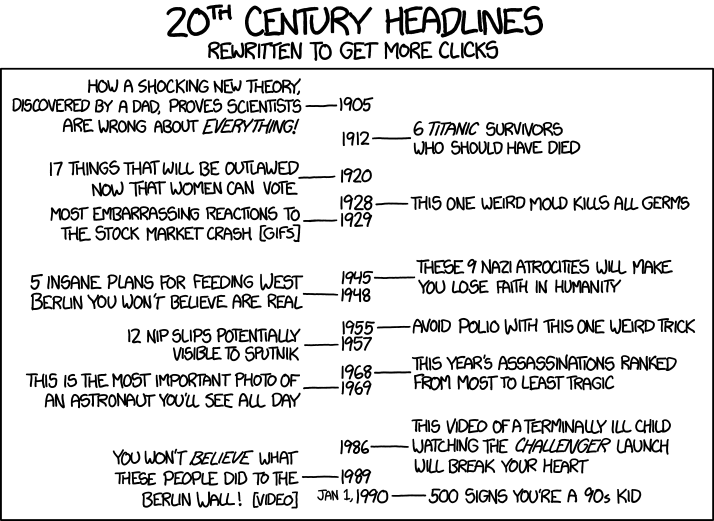
It’s the talks on scientific themes that I want to briefly address here. I do so mostly as a prompt to those of us who speak or write about science to remember that we do live in an age of celebrity, short attention-spans and a lack of patience for complex arguments. What this adds up to is beautifully illustrated by a recent xkcd panel, reproduced below:

xkcd on headlines as clickbait

Sensation and hyperbole grab attention. TEDx-style talks are meant to be slick, yes – and it’s also not a bad thing to make science compelling (quite the contrary, in fact). But we should remember that science is about the method, not the conclusion. When we forget to reinforce the method of good science in expressing our conclusions, we’re sending the message that things are a) more certain and b) easier than they actually are. Of course there are permissible shortcuts, or liberties. When we say that we know, for certain, that smoking is a cause of cancer, it’s only a pedant who asks you to confess that yes, of course, nothing is ever absolutely certain and there might be some other factor we haven’t spotted, with smoking and cancer being caused by that, etc.

When we get to a certain level of justification, we can say we “know” something – even though what/where that level of justification is can (rightly) be contested. But what we should not do is say things like:

  • “The literature says that X” – when we know full well that some of the literature says X, while other literature says Y, with no clear consensus having yet emerged.
  • “We now know that X” – where X is really your preferred view, and not at all “known” but instead the subject of significant dispute

And then, there are some words that we just know – going in to our talk, or sitting down to write our column – that people are going to invest with greater significance than is merited. Words like “caused”, or “proven”, or even sometimes, “evidence”.

I’m not saying that we need to include a ream of disclaimers with every sentence. But if a popular science talk or piece of writing doesn’t make it quite clear that there’s room for reasonable doubt, it’s doing a disservice to the goal of getting people to think more critically and clearly about knowledge-claims.

No matter how important the scientific subject under discussion, the goal of promoting sound reasoning is a worthy one too. And there’s no reason why one of these goals has to be pursued at the expense of the other.


UCT Admissions policy – race and redress

uctThe various Faculty Boards at the University of Cape Town are currently considering alternative models for UCT student admissions. These models arise from a debate the University has been having for some time now, regarding whether “race” is still the most effective identifier of likely disadvantage available to us. Some participants in this debate argue that race has become an increasingly crude proxy for disadvantage, resulting in a large number of false positives (which in turn has the effect of shrinking the number of places available for people who are actually disadvantaged, whatever their race might be).

That line of argument is also frequently accompanied by the observation that the racial categories we use in South Africa (and elsewhere, but South Africa has a particular history in this regard) are innately odious, and should be eliminated from legislation, policy and discourse wherever we can.

Some critics of that position argue that to eliminate recognition of race as a special category for attention simply perpetuates racism, and that any policy shift in this regard would be regressive. Others argue for the more moderate position that while race should be eliminated from policy in principle, it is too soon to do so – and that even though race is mostly a proxy for disadvantage, it remains the best one we have available to us in the present moment.

The contribution to the debate offered below merits wide distribution, and is shared here with the permission of the author, Professor Anton Fagan of the Law Faculty. For what it’s worth, I agree with his position, and find the paragraph below to be a strikingly crisp articulation of the obvious wrongness of including race as a criterion for disadvantage in perpetuity:

to make an applicant’s preferential admission conditional upon her having identified herself as ‘black’, ‘coloured’, ‘Indian’ or ‘Chinese’ is to make the receipt of something that is deserved, unconditionally, conditional upon a Faustian bargain. To get what she deserves, as a matter of justice, an applicant is compelled to validate one of the foundational principles of the racist apartheid order – the principle that everyone falls, naturally and in a way that can be read off one’s biologically-determined features in a mirror, or can be determined by inspecting one’s nails or one’s genitals, into one of the following groups: black, coloured, Indian, Chinese, and white.

___________________________________

UCT’S NEW ADMISSION POLICY

ANTON FAGAN

UCT’s new admission policy has much to recommend it. In so far as it seeks to undo inequality, by looking at home and educational circumstances, it represents a major step forward. However, the criteria by which the ‘Faculty Discretion’ is to be exercised, especially ‘racial diversity’, are troubling.

In 1987, I was an LLB student here at UCT. In an evidence class, the lecturer discussed a 1957 Appellate Division decision called R v Vilbro. It concerned the admissibility of a witness’s opinion as to whether the accused were ‘white’ or ‘coloured’ for the purposes of the Group Areas Act. The Court held that such an opinion was admissible. For, it said:

‘There may be people who have had a reason to apply their minds specially to the question of distinguishing the races. Such a witness was, in the present case, the Chief Inspector of Indian and Coloured Education . . . .’

‘[T]here may be people who, in respect of the persons whose race is in issue, may have had more opportunities of observing them than the magistrate. The latter only sees them in court, dressed up for the occasion, a woman probably with make-up . . . Other people may have seen them more frequently and in different circumstances, and have had more opportunities and more time of forming a definite impression about them.’

Upon hearing these passages, a student in the class, Zehir Omar, shouted out angrily: ‘Who was the judge?’ I sat forward expectantly, like everyone else, keen to hear who this racist was. The lecturer answered: ‘Fagan CJ.’

The effect of this view of admissibility was that the accused’s conviction under the Act was upheld. But that was not the main reason for Mr Omar’s outrage and my shame. Indeed, I am not sure that the lecturer even mentioned this outcome. Our outrage and shame were grounded, primarily, on something that Mr Omar, and I, and many others in the class took for granted: racial classification, in itself, is morally repugnant. We knew that the division of persons into ‘coloureds’, ‘whites’ and ‘natives’ had no biological basis. We knew that this division was not merely a social, but a political and ideological, construct. We knew that it took its life from, and was inextricably linked to, the practice of racism under apartheid.

You may know the book Racecraft, written by Karen Fields and Barbara Fields, and published last year. The Fields are sisters. One is Professor of History at Columbia University. The other is a sociologist, based at the Center for African and African American Research at Duke University. They have written a great deal on slavery, witch craft, and racism. The following extracts from their book show some of its key ideas:

‘Anyone who continues to believe in race as a physical attribute of individuals, despite the now commonplace disclaimers of biologists and geneticists, might as well also believe that Santa Claus, the Easter Bunny and the tooth fairy are real, and that the earth stands still while the sun moves.’

‘Race is not an element of human biology . . . nor is it even an idea that can be plausibly imagined to live an eternal life of its own. Race is not an idea but an ideology. It came into existence at a discernible historical moment for rationally understandable historical reasons . . . Thus we ought to begin by restoring to race . . . its proper history.’

‘[R]ace is neither biology nor an idea absorbed into biology . . . It is ideology, and ideologies do not have lives of their own. . . . If race lives on today, it [is] because we continue to create it today.’

‘[T]he first principle of racism is belief in race, even if the believer does not deduce from that belief that the member of the race should be enslaved or disfranchised or shot on sight by trigger-happy police officers . . .’

‘[W]hat “race” is’ ‘is a neutral-sounding word with racism hidden inside’.

The current UCT application form requires applicants to identify their ‘population group’, the choice being between ‘black’, ‘coloured’, ‘Indian’, ‘Chinese’ or ‘white’. An applicant may refuse to choose any of these, in which case he or she will be assigned to the open category. It is fair to assume that UCT’s new admission policy will be implemented with an application form that requires more or less the same.

The effect of this will be a continued naturalisation of race. The division of persons into ‘black’, ‘coloured’, ‘Indian’, ‘Chinese’ or ‘white’ is presented as part of the natural ordering of the world, rather than as what it really is, namely an historically-contingent, politically-constructed and ideologically-driven ordering. The historical, political and ideological connection between these categories and the racism of the apartheid state is simply swept from view. Rather than that categorisation being presented as being deeply-embedded in a particular history, politics and ideology, it is presented as a free-floating categorisation with a logic and reality all of its own.

Worse than that, the categorisation into ‘black’, ‘coloured’, ‘Indian’, ‘Chinese’ or ‘white’ is supposed to be insensitive to distinctions of social standing or class. Being the son of a billionaire entrepreneur, or the daughter of an unemployed domestic worker, will neither qualify nor disqualify an applicant for any of the categories. It follows that the primary basis for categorisation must be biological difference. The effect, therefore, is not merely to continue the naturalisation of race. It is to entrench a form of bio-racism.

The Fields sisters gave their book the title Racecraft, because they see the idea that a person has a particular race as analogous to the idea that a person is a witch. Just as there are not really witches, and never have been, so there are not really races, and never have been. Neither ‘witch’ nor ‘race’ has, as they put it, ‘material existence’. Both the idea that a person is of some race and the idea that a person is a witch are merely ‘illusions’ or ‘fictions’ created and sustained by social practices. Now imagine that a university has decided to provide redress for those who were victimised on the ground that they were witches. It would be odd for the university to pursue that redress by asking every applicant to the university this question: ‘Are you a witch or are you not?’, and then to make the provision of the redress conditional upon the person answering: ‘Yes, I am a witch.’

There undoubtedly are many applicants to UCT who, because of inequality, deserve preferential admission. However, to make an applicant’s preferential admission conditional upon her having identified herself as ‘black’, ‘coloured’, ‘Indian’ or ‘Chinese’ is to make the receipt of something that is deserved, unconditionally, conditional upon a Faustian bargain. To get what she deserves, as a matter of justice, an applicant is compelled to validate one of the foundational principles of the racist apartheid order – the principle that everyone falls, naturally and in a way that can be read off one’s biologically-determined features in a mirror, or can be determined by inspecting one’s nails or one’s genitals, into one of the following groups: black, coloured, Indian, Chinese, and white.

Getting what one unconditionally deserves is made conditional upon one’s willingness to treat as real, as essential, as natural, and as morally-neutral, an ordering of the world created by the apartheid state in order to pursue its racist objectives. If you do not admit to being a witch, you will get no justice. If you do not admit to being what D F Malan and H F Verwoerd decided you are, namely a coloured, a black, a member of the other, you will not get the justice you are entitled to. Writing about the American context, the Fields sisters make a similar point:

‘Like a criminal suspect required to confess guilt before receiving probation, or a drunk required to intone “I am an alcoholic” as a prerequisite to obtaining help, persons of African descent must accept race, the badge that racism assigns to them, to earn remission of the attendant penalties. Not justice or equality but racial justice or racial equality must be their portion.’

The continued requirement of racial identification in UCT’s application form reveals a failure of imagination on our part. Damaged as we are by the experience of apartheid, we find it hard to envisage a future in which South Africans do not see each other through the spectacles which Dr Malan and Dr Verwoerd welded onto our noses. And because we find it so hard to envisage this future, we do not recognise that one of the first steps we must take to secure it is to remove the distorting lenses of our racist apartheid past. We must refuse, collectively, to continue seeing the world, and each other, in the way which the racist apartheid project required.

It is possible to do so. We have a policy in my family that none of us refers to race. As a result, my six year old, Lihle, does not see race – at any rate, not yet. Of course he sees skin colour, and hair colour, and so on. But he does not see race. A few months back, my daughter’s boyfriend was having supper with us. Lihle turned to him and said: ‘Rahul, you and I are both brown.’ But that was not a case of Lihle seeing race, and certainly not race as constructed by the racist apartheid state. For then he would have said: ‘Rahul, you are Indian but I am black.’ – which he did not say.

Were I an idealist, I would now propose that all reference to race or population groups, as well as any requirement of racial classification, be removed from UCT’s application forms. Like the Fields sisters, I would argue that what matters is not racial inequality and racial injustice, but inequality and injustice full stop. And I would argue, as they do, that a continued focus on race, on the one hand, is not necessary to achieve equality and justice and, on the other, is likely to blind us to, and therefore also to leave uncorrected, many of the inequalities and injustices that plague our society.

But I am enough of a realist to curb my ambition a little. I therefore propose, as a compromise, the following:

No applicant should be asked to state whether he or she actually is ‘black’, ‘coloured’, ‘Indian’, ‘Chinese’ or ‘white’, or is a member of a population group so described. Instead, applicants should be asked to which of these groups the racist apartheid state most probably would have assigned them.

This way of posing the question makes visible the historical contingency of this racial classification and its connection with the racist programme of the apartheid state. It therefore helps to guard against the naturalisation of these racial categories, and against the entrenchment of the belief that they are an inevitable biological or cultural fact. It also avoids the Faustian compact spoken of earlier: an applicant entitled to redress would not be required, as the price for getting it, to treat as true one of the racist apartheid state’s great falsehoods, namely the claim that there are black persons, and coloured persons, and Indian persons, and Chinese persons, and white persons, and that each of these are a kind of person essentially different from every other.

More lessons in bad science (and reasoning) from Noakes

In case you missed it, there’s a 1400 word comment from Prof. Tim Noakes on my previous blog post. Seeing as the bulk of his comment is entirely unrelated to the subject of that blog post, I thought it offered a handy opportunity to provide an additional example of reasoning gone wrong, this time both in basic logic, and again in science. (Also, I’d need another 800 or so words to match his word-count.) So, below you’ll find block-quotes of his full comment, and an explanation of the errors committed. If you want to see his quote in context, please visit the original piece, Lessons in bad science – Tim Noakes and the SAMJ.

Apologies, but this will be somewhat lengthy. I’ll try to keep each unit of quote and response comprehensible on its own, though. Those of you who get bored, please do scroll down and read the bit headed (in bold) “A very important bit” before you leave.

And a reminder – my post the other day wasn’t about the diet itself. This post isn’t about the diet either. It would be fantastic if Noakes/Taubes and the rest were correct in this instance, in that they would have re-discovered or popularised a highly cost-effective way to treat an a highly significant public health problem. Or, various problems, including obesity and diabetes. That would be something to be celebrated, and I’ll be one of those celebrating.

However, if we can arrive at that outcome while supporting (and reinforcing) the scientific method and basic logic, surely that’s an even better outcome?

Noakes begins by re-stating a powerful anecdote:

What is really so funny is that this is a report of how 127 people felt their lives had been dramatically improved by following a particular diet. Included were 14 who claimed they had been “cured” of Type 2 diabetes – confirmed in 3 cases I investigated further. To my knowledge the SAMJ has never before carried a report in which patients with an “incurable” condition (type 2 diabetes) were cured of that condition. One doctor who had told his wife he would be dead in 7 years because he had 5 “incurable” conditions, was completely healed of all conditions (no more medications required) when he restricted his carbohydrate intake.

Everything else he had ever tried (according to his conventional medical training) including treatment by the best medical specialists in Cape Town had done little for his health. Naturally this medical practitioner who had never in 57 years been exposed to this information (why not?), concluded that the dietary advice I gave him had produced a “miracle”. He now includes this method in his treatment options for his patients with obesity/diabetes/metabolic syndrome. He now informs me at least monthly of how much success he is having with this dietary treatment for these patients.

After the words “felt”, “claimed” and then the quotation marks around “cured” in the first two sentences, the thing you’ll note about this anecdote is that it uses language that is entirely inappropriate to the level of evidence available. Imagine yourself to be someone who has Type 2 diabetes, or who is overweight, and who then reads the two paragraphs above. If your level of scientific literacy was that of the average person, you’d come away thinking that there’s something akin to certainty that this diet is effective.

If you’re a marketer, this tactic is completely understandable, and appropriate. But science should be a domain of reason and evidence, not of hyperbole, and not of presenting contested evidence as if it obviously demonstrates something that it is not known to demonstrate. Second, as I’ve said in my original piece, if the evidence exists, you wouldn’t need the anecdotes. Unless, of course, Noakes has so little confidence in the acumen of his peers that he thinks that they would be equally persuaded by either.

Paragraph two contains the quite typical injection of conspiracy theory, with its suggestion that something must be afoot for this medical practitioner to not have heard this dietary advice before. And yes, it’s possible that something was and is afoot – that there is a systematic bias against this approach to diet. If so, that’s a problem that should be remedied. But it has no bearing on whether the advice is in fact good or bad advice. It can have a bearing on how much evidence we have, in that research might have been stymied or inappropriately directed. (Noakes, however, keeps insisting that the evidence is clear, so it seems that this problem is surmountable.)

I wrote the article to alert my colleagues to the fact that there is a simple dietary option that might be able to reverse the very conditions that our profession finds so difficult to treat – obesity, type 2 diabetes, metabolic syndrome. I also referred to the extensive scientific literature showing why and how this dietary intervention does and should work for people with these conditions. The explanations are simple, obvious and proven.

But then perhaps you need a training in the medical sciences to understand those mechanisms, Without some understanding of biochemistry, it is not possible to follow that argument. What one cannot understand, one naturally dismisses as irrelevant.

As I’ve asked before, if the “extensive scientific literature” makes the case, why do we need the anecdotes? As above, the use of the word “proven” massively overstates the case, and again indicates a failure to understand why he comes across as pseudoscientific in these regards. If it were “proven”, there would be far less disagreement in the medical profession than there seems to be about this sort of diet’s efficacy.

In general, though, to quote from a comment I made on the previous post, “the issue is that if non-anecdotal evidence for the same conclusion exists (as he asserts), that evidence would be sufficient by itself. So, either it doesn’t exist, and he needs to rely on the anecdotal evidence (which teaches a bad lesson regarding scientific reasoning), or it does exist, but he thinks that the anecdotal evidence adds weight to the conclusion (which it doesn’t, as he should know)”.

The last paragraph contains another fairly typical tactic for Noakes, namely an attempt to discredit an opponent through focusing on something irrelevant or personal, as we saw in the “fat-shaming” comment in the previous post. Because there are two possibilities here: first, that he’s right that we need medical training to understand this. If so, I’m mystified as to why Noakes does all this public speaking to laypeople, and also that he writes on these matters in (almost exclusively) lay publications and books as much as he does, seeing as he knows none of those audience-members can understand what he’s saying.

Alternatively, he’s subtly suggesting I’m too thick to “get it”. But again, seeing as my post was not about the diet, but about what evidence and arguments look like, I’d have to protest and tell him that I “get that” very well, and that of all the medical practitioners who have commented or Tweeted about the post in question, everyone except Noakes thinks I’m on to something. Not, I again remind you, about whether the diet is good or bad, seeing as I don’t express a view on that, but simply that this sort of “research” or “study” sets a very low standard in terms of what we should aspire to as scientists.

At no point in the article is the claim ever made that this is an attempt at a scientific proof of a particular diet. That is why the title includes the words – Occasional Survey. It is simply a group of case reports showing that some patients achieve remarkable cures for their intractable medical conditions simply by following advice, the key point of which is that it normalises hunger. For the truth is that these patients are not dying of obesity etc, so much as they are dying of hunger. Once their hunger is controlled by simple dietary advice, they can start to cure the conditions caused by the overconsumption of addictive, highly processed, carbohydrate-rich foods (made worse by their insulin-resistant state).

I have been in science long enough to understand how people try to divert attention from the message. I wrote about this extensively in Challenging Beliefs. First they always question the methods. The methods I used in this study are entirely appropriate for the extremely limited goals of this paper. That simple goal was to show that some people benefit dramatically and in some cases miraculously from this simple advice. Whether or not they would have benefitted equally from other advice is utterly irrelevant since I am not trying to prove (in this article) that one treatment is better than another. Of course I would guess that 100% of the 127 had all tried the conventional advice and it had failed for them. But I only made that claim if I it was supported by the information I had.

A group of “case reports”? I don’t know about you, but that seems an awfully strong description for a series of self-reported and completely uncontrolled and in most cases unverified narratives. But it’s nevertheless a legitimate description, with a track record in medical literature.

However, because a large group of case reports, as in this case, can create an impression of generalisability or significance where there might be none, we find Johns Hopkins, for example, requiring IRB (institutional review board) clearance for any case studies (or a case series, in this instance) involving more than three participants. No clearance is mentioned in this case.

Again, I remind you that I’m simply saying that the study offers little of scientific merit, and that the SAMJ erred in accepting it for publication – not that the anecdotes are false. (It’s that we can’t know whether they are false or not that is part of the problem.)

As for “I have been in science long enough to know” – I refer you to the point about deflection and conspiracy mentioned earlier. The fact that methods are questioned isn’t evidence that the scientist is a martyr for the truth, as Noakes seems to want to imagine himself here. As Occam’s Razor suggests, it might also be because the methods are questionable.

It’s entirely relevant to question whether the participants would have benefited equally from other advice, precisely because 127 cases offers an impression of significance or generalisability. The goal was “to show that some people benefit dramatically and in some cases miraculously from this simple advice” (my emphasis) – and how do you show that through 127 unverified self-reported anecdotes? If the science already shows this, then it can stand alone, with the anecdotes as illustrations if one so desires. Noakes says (in the paper) that this “data” is “of value” and “challenges current conventional wisdom” – and yes, it would, if we had reason to believe it was replicable. It might well be replicable, but the anecdotes are not evidence for that conclusion.

A key point about South African medical ethics is that if there is more than one treatment options it is ethically unacceptable for a South African practitioner to prescribe only one. My ethical responsibility as an educator and scientist is to bring the attention of my colleagues to the established fact that there is more than one option for the treatment of obesity, diabetes and metabolic syndrome and that the scientific evidence for this is well established in the literature (as recently accepted by the highest Swedish medical authorities).

Having been involved in high-level research ethics myself, of course I’d agree in the main. Except, Noakes is leaving something crucial out of the summary: it’s not only when there is simply “more than one treatment option”. Instead, it’s when there is “more than one effective/proven/viable/etc. treatment option”. This might well become known to be one of those options, perhaps even the best one. But it isn’t known to be that as yet, which is a reality Noakes again evades in the above quotation.

A very important bit

Above, Noakes says “as recently accepted by the highest Swedish medical authorities”. This, in a nutshell, demonstrates his rather casual relationship with reality when it comes to promoting the conclusion he wishes to. You’ll note, as a starting point, that the language is unambiguous – a trusting reader will be left utterly convinced that the Swedes have accepted LCHF as obviously the recommended diet. So, let’s look at the evidence. The quote from his paper reads as follows:

The Swedish National Board of Health and Welfare has concluded that ‘low carb diets can today be seen as compatible with scientific evidence and best practice for weight reduction for patients with overweight or diabetes type 2, as a number of studies have shown effect in the short term and no evidence of harm has emerged … ’

It’s a direct quote, so you’d expect a reference (and quotation marks, which might look a little alien to some potential readers). We have both in this case, and the reference given is to the Swedish Board in question…. oops. No, sorry, my mistake – the reference is to a blog post titled Low-carb for You. The Swedes are eating more butter! In another interesting development, the full quote reads (my emphasis):

Professor Christian Berne, one of Sweden’s leading diabetes experts, had carefully investigated the case against Dr. Dahlqvist and presented his findings to the Swedish National Board of Health and Welfare. He said, “…a low-carbohydrate diet can today be said to be in accordance with science and well-tried experience for reducing [obesity] and type 2 diabetes…a number of trials has shown no effects in the shorter run and that no evidence for it being harmful has emerged in systematic literature researches performed so far. [There is] no scientific support yet for treatments in excess of 1 year. A thorough evaluation of long time treatment results is therefore an important demand on the practitioner.”

So what we learn here is:

  • In the source Noakes refers to in order to support a very strong claim, we find Berne reporting findings to the Board
  • But that quote is presented by Noakes as a resolution of the Board, rather than an opinion expressed to the Board
  • An important bit of the quote is left out, because it’s inconvenient (namely, that there is no scientific support for treatments “in excess of one year“)
  • Notice that this question – around long-term efficacy – was a central theme of my previous blog post that inspired this Noakes essay in response – and his own source makes the same point
  • Lastly, we learn that quotation marks don’t mean the same thing for Noakes as they might to you, in that a sentence like “a low-carbohydrate diet can today be said to be in accordance with science and well-tried experience for reducing [obesity] and type 2 diabetes” morphs, in Noakes’ version, into “low carb diets can today be seen as compatible with scientific evidence and best practice for weight reduction for patients with overweight or diabetes type 2” (I’m not asserting here that he changed the meaning – it’s just odd to quote-and-not-quote at the same time).

The SBU (Swedish Council on Health Technology Assessment) have however published guidelines on diet and obesity – but unfortunately, they’re not yet available in English, so Noakes couldn’t easily have quoted from them in an English-language journal. But let’s see what Google translate can do for us, seeing as we’re able to take such liberties on a blog post.

“SBU has previously addressed food for people with diabetes [link to English pdf]. The results for people with obesity and diabetes, pointing at large in the same direction.”

That direction, according to the English diabetes report, includes bits like this (my emphasis):

  • Scientific evidence is not available to evaluate the long-term safety of moderate and extreme low-carbohydrate diets. This includes cardiovascular morbidity and other complications of diabetes.
  • There is strong scientific evidence that lifestyle intervention, combining a low-fat diet with high fiber intake and increased physical activity, prevents diabetes in people that would otherwise be at high risk for the disease

Back to the Google translate version of the obesity report, which also says (my emphasis):

  • In the short term (six months) is advice on strict or moderate carbohydrate diet more effective for weight loss than low-fat diets advice. In the long run there are no differences in efficacy between weight loss tips on strict and moderate carbohydrate diet, low-fat diets, högproteinkost, Mediterranean diet, diet focuses on low-glycemic load diet or a high proportion of monounsaturated fats.
  • After that obese people have lost weight they can maintain their weight better with advice on low-fat diets with low glycemic index and / or high protein content than with low-fat diets with high glycemic index and / or low protein content. There is no basis for assessing whether even advice, eg, low-carbohydrate diet and the Mediterranean diet is effective in preventing weight gain after weight loss

Once again, it might one day be common knowlege that Noakes et. al. are right. But that day doesn’t seem to have arrived yet, and in the meanwhile, it certainly looks as if support is being appropriated where it doesn’t quite (as yet) exist. This, again, is bad science, if not simply dishonest.

Back to the Noakes comment

The reasons why this information is not taught more widely across the world is not material to this article and whether or not there is a conspiracy is not relevant. The point is that students in South Africa (as in most other countries) are currently taught only one side of a two-sided story. As far as patient care is concerned, that is unethical.

Sentence one, and then two and three seem somewhat contradictory. If students are being misled into providing unethical patient care, surely that must be relevant? But in any case, my point was that if something was obvious, and as evidence-based as Noakes keeps asserting, it would be taught all over the world. He constantly refers to conspiratorial reasons why that isn’t the case, rather than considering the possibility that others don’t think the evidence is as clear as he thinks it is.

Three years ago I decided that it my ethical responsibility to acknowledge publicly that my advice on high carbohydrate diets for runners, widely read in Lore or Running, was wrong for those with insulin resistance/type 2 diabetes/metabolic syndrome since it would contribute to their ill-health in the long term as it has to mine. This article is one outcome of that admission.

I could have kept quiet and hidden my error but I chose not to. Now that this article has been published in the SAMJ (and I have spoken about it at the most recent SAMA conference), South African medical practitioners, perhaps for the first time, have been exposed to the evidence that there is an alternative option that they might like to consider in future for the treatment of these conditions.

The result is that if the 127 patients reported here are any indication, many patients in South Africa with these conditions will be offered another treatment option that before they would not have been offered. I suspect that many will do much better on that therapy than if they continue to follow advice that does not work (for them).

Nothing to add here, except to repeat that the point is precisely that we have no reason to believe that the 127 patients reported here in fact are any indication.

So this focus of this discussion should not be about whether or not I am a good scientist who understands what is and what is not good science.

Erm, no. I choose what the focus of the discussion is on my own website, thanks.

Fortunately in science, there are simple markers of our standing as scientists that are based on hard measureables and not on the opinions of others. These are the h-Index and the number of citations. Anyone who wishes to determine my status as a scientist is welcome to find those numbers and what they mean. Those are measures of scientific influence over a life-time, not as the result of one single good or bad article.

Yes, they are indeed “simple” markers. “Crude” might be another appropriate word, as Prof. Noakes knows full well. They offer a valuable heuristic in making snap judgments, but they aren’t any sort of guarantee of sense or quality in perpetuity. I don’t dispute, and have no reason to dispute, that Noakes has done tremendous work in the past. But that tells us nothing about the present topic, except to make it statistically more probable that he’s worth paying attention to here than many others might be, because of that track record. This doesn’t mean that – once you look at a particular case – you need to grant extra authority to that person if they present weak arguments.

To do so would be to commit the informal fallacy of making (or rather, falling for) an appeal to authority. It’s particularly disappointing when the authority him or herself makes the appeal on their own behalves.

It is sad that this article which should be a celebration of how simple dietary advice may be able to reverse intractable medical conditions in some people (it would have been valuable even if it had reported just a single “cure”) has been used by some to argue what a dreadful scientist I am, who is trying to push some sort of devious agenda that has no scientific basis.

It’s arguably more sad when eminent scientists start practicing bad science, and then doubly so when they defend it as weakly as this. “This article”, meaning my blog post, is about that topic, not about the diet. Readers, or subjects of a post, don’t get to say what a post “should be” about. Furthermore, nobody is being described as being “devious”, or having an “agenda”. Someone is being described as making poor arguments for a conclusion.

My agenda is clear. I want my profession to teach more than one option for the management of obesity/diabetes/metabolic syndrome and to understand that our current dietary advice is in my opinion the cause of so much of our ill-health.

My agenda is also clear. I teach critical thinking, and the Noakes paper, and his responses to criticisms of it (and, general criticisms on social media) provide great classroom examples of how reputations are no guarantee of good sense.

I have spent 3 years researching this topic and am happy that the scientific evidence supporting this position is as powerful as any evidence I have touted in the past (see Challenging Beliefs). However the topic is much more important that anything I have ever tackled since it is the single most important medical problem in the world and is currently out of control and getting worse by the day.

Agreed entirely, which is why I want the science supporting it to be beyond reproach, especially on such obvious grounds.

What this paper shows it that there may be simple answers for what seem to be intractable conditions. That is why the final sentence of the article calls for a properly funded and designed study to test the hypothesis (not proof) advanced by the finding of this Occasional Survey.

As argued above, the occasional survey doesn’t present a case for doing so, because of the quality of the data. Furthermore, we are told by Noakes that non-anecdotal evidence exists – and if this is the case, the anecdotes are superfluous. This was the topic of my last post, so I won’t repeat the argument here.

I would be only too happy if that trial disproves me. But if it shows that a carbohydrate-restricted diet can reverse intractable obesity and some cases of Type 2 diabetes, then we will have shown that the causes of the obesity and diabetes epidemics are much simpler than we believe and that we might be able to do something to protect our future generations from these diseases. Of course, it there is a conspiracy, then it will do all it can to insure that we do not ever make that finding.

Agreed entirely. And of course a scientist should be happy to be corrected (even if it’s sometimes difficult to swallow).

Perhaps we can move the debate forward by focusing on what this paper actually found and how that might be of value in trying to understand what is causing the obesity and diabetes epidemics globally. Then we will be making a positive contribution to the future health of the world.

No, there are different debates. Noakes, and his peers, can move that debate forward. My focus is critical thinking, logical fallacies, the standard of education and so forth. That’s the debate I’m going to “move forward”, and these sorts of examples are great resources for doing so. In fact, they allow for us to make a positive contribution to the current – and future – health of the world too, by helping to inculcate and reinforce clear and cogent reasoning, without which medical science is doomed.

Thanks for the opportunity to express myself more fully and I look forward to your contribution to that agenda should you think it sufficiently important.

It’s vital. But also, that agenda is not my field. This one is.

“World-views” and secular education

imagesFourth-year medical students at a local university were yesterday witness to a panel discussion on various world-views, with the intention of familiarising them with some of the different points of view that their patients might one day hold. I was invited to participate in this panel, which I gladly did, seeing as these sorts of public interventions are one of the values we can easily, and cheaply, give to “the cause”, as it were.

Joining me on the panel were an Imam, an Anglican priest, a Hindu doctor and the daughter of an African traditional healer (who was also a student in the class). The point of the panel wasn’t to debate who was right and who was wrong, but more to sensitise the students to the differences, and to prompt them to how they might approach sensitive topics of conversation with these various sorts of world-views.

It was an interesting experience, partly because it again brought to the fore just how normal, and just how abnormal, a largely materialist, or naturalist, point of view was – even in a room of about 200 people trained in the scientific method. The student who arranged to have me invited to participate reported that around 70% of his classmates were religious, and after yesterday, I fear that might be an under-estimate. One horror-story he told me is of a group of students training in psychiatry who decided to pray over someone that was clearly experiencing some sort of mental episode, rather than getting her to somewhere she could be diagnosed and treated.

But it’s not only the uncommonness of a naturalistic outlook that struck me – it’s also how alien it seemed to be to the audience. The tenor of some of the questions seemed to regard me as some sort of curiosity, or exhibit – a rare creature from a strange and distant land. Over and over, for example, I had to repeat the point that they should think of me as representing the “secular” world view, because religious folk can be secular too. Secular doesn’t mean lacking in belief, it means leaving your (metaphysical) beliefs at home when you go to work, especially in the public sector.

Then, the usual questions also came up: how can love just be in the brain (well, it is, but that doesn’t make it any less special); where do you get your morals from (the same place as you, the same place as the apes, etc.); what is your purpose in life (that question loads the dice – I reject the need for an “ultimate” purpose).

So, when I sat at the end of the panel to talk to the local atheist and agnostic society about how to grow their society and build capacity, I stressed something they could do, that I fear many smaller, community-based groups forget: education. Take your core membership, and have them learn about the history of skepticism/secularism/humanism/etc. – and not simply learn to recite cutting lines from Hitchens, or the names of a bunch of logical fallacies.

We need people to go out there are dispell myths and misconceptions, and that requires the knowledge to do so. If you’ve got some of it, and also have access to a younger group of people wanting to promote the secular, scientific, humanist world view, help them to learn how to educate others about what we believe and don’t, but more importantly, why we believe and disbelieve. Even when you don’t persuade, the conversations will nevertheless be far more interesting as a result.

Jonathan Glover: TB Davie Memorial Lecture on Academic Freedom, 2013

NYXThis year, the Academic Freedom Committee of the University of Cape Town (that I’m privileged to be chairperson of) welcomed Prof. Jonathan Glover to present the annual T.B. Davie Lecture Memorial Lecture. It’s been a pleasure spending time with him, and hearing him speak – not only earlier today, but also yesterday at a seminar on the boundaries of psychiatry. I’ll post links to video once UCT makes them available, but in the meanwhile, here are the opening remarks I delivered earlier today.

___________________________

In his book HUMANITY: A MORAL HISTORY OF THE TWENTIETH CENTURY, Jonathan Glover discusses the brutality of that century with reference to the declining authority of morality, and diminished faith in the possibility of moral progress.

We don’t need to agree on a framework for moral judgments, or any particular content produced by such frameworks, to be sympathetic to one of Glover’s premises – that “questions about people and what they are like” should be central to our ethical debates.

He argues that the 20th Century has brought some erosion of our moral identities, making it easier for us to treat each other as mere objects, rather than as equally valuable members of overlapping societies. Among the potential causes of this he discusses are the imposition of belief systems or ideologies by powerful actors, especially governments; the postmodern abandonment of the search for objective truth; confusing ends and means; and the physical distancing between agents, often enabled by technology.

A suggestion he offers for resisting this erosion is for us to focus on developing a vision beyond the given, the surface impression, or the merely pragmatic. We should cherish our imaginative awareness, and foster the democratic habits of tolerance, persuasion and compromise. Crucially, Glover argues, we should develop our abilities to resist dogmatism and to accept complexity or ambiguity.

These forms of engagement are perhaps becoming increasingly rare, but the place where they are traditionally exercised is the University. Despite the need to respond to aspects of what markets might desire, we cannot forget that we’re not only in the business of producing marketable students, or generating research outputs that are aimed at attracting funding rather than developing knowledge.

Learning is sometimes found in our mistakes – in being wrong – rather than in our successes. When we no longer provide the space and opportunity to make productive mistakes, instead focusing on being an efficient production line of graduates and research outputs, we run the risk of sacrificing some of the virtues that make universities, and UCT, such fruitful places in which to work and learn.

Given these considerations, I’m very pleased to welcome Prof. Jonathan Glover to UCT today. His 1977 book CAUSING DEATH AND SAVING LIVES was certainly one of the texts that helped me realise that I wanted to devote my academic attention to philosophy, and in particular, that highlighted the role practical ethics could play in bettering our lives.

Glover’s work has frequently focused on improving lives – HUMANITY, discussed earlier, is one example, and numerous others can be found in his writings on neuroscience, psychology, disability and genetic design, and in his teaching of ethics, for many years at Corpus Christi and New College, Oxford, and now at Kings College, London.

Towards the end of HUMANITY’s first chapter, Glover writes: “another aim of the book is to defend the Enlightenment hope of a world that is more peaceful and more humane, the hope that by understanding more about ourselves we can do something to create a world with less misery”.

Understanding more about ourselves is facilitated by spaces such as the one we are in today, hosted by universities such as ours. Threats to academic freedom could be said to run counter to that hope of understanding ourselves, and by extension, counter to reducing the amount of misery in the world.

It is these interests and insights of his, among others, that make it my great pleasure to welcome Professor Jonathan Glover to UCT to deliver the 2013 TB Davie Memorial Lecture, on the topic of “Universities, the market and academic freedom – how treating education and research as merely marketable commodities can threaten academic freedom”.

UCT vs the Twitterati

This post represents my personal views. Any factual claims made herein are not approved or endorsed by the University, and I speak as a member of the UCT community, broadly speaking, rather than as a member or representative of any structures at the University.

KhohlokoaneSo, with that out the way, I told some folk on Twitter yesterday that I’d blog about Joseph Khohlokoane, who graduated yesterday – after completing his social sciences degree 17 years ago. As is sadly typical in South Africa media, a South African Press Association (SAPA) release was uncritically reproduced by nearly all the other media outlets, with none of them bothering to check any of the relevant facts with UCT first.

What the SAPA story told us was that:

  1. Khohlokoane finished his degree with around R30 000 of study debt in 1996
  2. he worked as a petrol attendant to try and pay his debt
  3. he would not be formally awarded his degree until he had settled his account.
  4. he was not allowed to pay his debt off at R100 per month, because UCT said that wasn’t enough
  5. accumulated interest had swelled the debt to R100 000

The Twitter outrage was immediate, and mostly focused on how shameful it was that this man was refused graduation for 17 years, and that UCT had allowed his debt to inflate to such a frightening figure. When UCT initially responded to say that students with outstanding debt don’t graduate, and that UCT has a comprehensive financial aid system in place, this sort of response resulted:

Various popular tweeters, including the account of the very well-trafficked Africa is a Country blog united in expressing their shame at UCT, with some asserting that the Vice Chancellor should apologise. Before getting to the later UCT response, which included further details regarding Mr. Khohlokoane’s debt, let’s pause and ask what UCT might need to apologise for.

https://twitter.com/JoziGoddess/status/342930261983502336

Zama Ndlovu is right. It is a shame that affordability serves as an obstacle to South African’s getting a university education. It would be tremendous if university study could be government funded, but I’m sure you’d agree with me that it’s not UCT’s fault that it isn’t. UCT can only be held to account for doing less than other universities do (or, less than you reasonably think they should).

But UCT has a very generous financial aid system. In fact, as things stand in 2013, the University has committed to the proposition that no otherwise qualified student will be denied entrance on financial grounds. Not that this could have helped Mr. Khohlokoane in 1996, of course. He did however receive plenty of financial aid, as I’ll get to in a moment. The pool of money is not bottomless, however, and any funding to one student comes at the expense of something else. The level at which one sets support can of course be debated, but wherever you set it has implications for something else.

We cannot protest that one student could have – or should have – been bailed out of a debt of X Rands because their story happens to be sympathetic, or in the news. Because that student is potentially 1000 students, or more, all of whom might be in similar circumstances. We have no principled way of further assisting a Mr. Khohlokoane, and can’t assist everyone, because doing so would mean trading off on something else. Perhaps transport, housing or food, or perhaps building maintenance or salaries. Even though the budget is huge, managing it responsibly involves doing so on principle, and the principle can’t be “forgive student debt” – because student fees make up roughly half of UCT’s income.

And UCT’s only way of ensuring that they receive that income is to use the only bargaining chip they have – to deny graduation until the debt is paid, as they did in Mr. Khohlokoane’s case. But even though they do that, they still attempt to make it possible for students to exploit the potential value of that degree, by informing prospective employers that a student has completed the degree (even though they have not been awarded it). So, if Mr. Khohlokoane had found a job for which his social sciences degree was an advantage, UCT would have attested to his qualifications.

Some have suggested that UCT should somehow find other sources of income to fund cases like this. But that’s too simplistic a response. First, because UCT already finds all the money it can, whether through donations, fees or government subsidy. A huge proportion of that is allocated to assisting students already, but it would be nonsensical to ring-fence some portion for cases like Mr. Khohlokoane’s, because there’s no objective reason why they – and not other cases – deserve that sort of ring-fencing. And you can’t ring-fence them all, because the money supply isn’t infinite.

What students often don’t get – and what many of the Twitterati aren’t getting – is that it’s sometimes contrary to justice and fairness to make policy based on exceptional cases. Fairness involves having a clear set of rules, and applying them consistently, to try to maximise the welfare or interests of all stakeholders. Bailing out Mr. Khohlokoane would have come at the expense of some other interest – in other words, someone else would perhaps have been wronged (although, an aggregate interest would probably have been wronged, so we would not have noticed it).

The financial aid policies and packages are designed to help as many students as possible. Top-slicing some money from that pool to help a Mr. Khohlokoane, or someone else, means that another student doesn’t get that money. Yes, it’s sad that Mr. Khohlokoane had to wait 17 years to graduate. But assuming SAPA’s figures are correct, if UCT had forgiven the R30 000 student debt that he left UCT with, that would be R30 000 that was not allocated to students who have attended classes (and hopefully graduated) from UCT since then. Or do their interests count less than Mr. Khohlokoane’s?

And finally, one reason you might want to be a little more cautious about unbridled sympathy for Mr. Khohlokoane’s case is that the details of the case seem partly fabricated, in crucial aspects. Let’s reprise my list from above, but using the details from UCT’s second response, once they had time to check the facts:

What UCT later told us was that:

  1. Khohlokoane finished his degree with around R5 196 of study debt in 1996 (not R30 000)
  2. he worked as a petrol attendant to try and pay his debt (as above – left to maintain symmetry)
  3. he would not be formally awarded his degree until he had settled his account (as per policy, and as argued for above)
  4. he was not allowed to pay his debt off at R100 per month, because UCT said that wasn’t enough (in fact, UCT accepted small amounts like this from him, but he stopped paying them. UCT then spend two years trying to contact him with no success).
  5. accumulated interest and debt collection charges had swelled the debt to R8 342 (not R100 000)

To this, some Twitterati responded with a “yeah, so the total owing was somewhat exaggerated by SAPA. Still, shame on UCT”. But no – it’s the initial debt, the fact that he was paying (then stopped), the fact that he could have pursued a higher-paying job than he did (on the strength of his “qualification”), and the final debt that are inaccurately reported (and we of course don’t know whether Mr. Khohlokoane is responsible for this, or not).

In short, someone left UCT with a debt of R5 196, after receiving around R69 000 in financial assistance from UCT over his four years here. Seventeen years later, a generous donor settled the R8 342 now owing, and the student graduated. Thanks to poor information, poor reporting and the pitchfork-wielding mob on Twitter, UCT is made to look like it’s betrayed some sort of social justice imperative.

But given that a) educations can’t be free; b) the money supply isn’t infinite; and c) every Rand spent comes at the expense of something else, please tell me what makes you certain that Mr. Khohlokoane was uniquely hard done-by, or that UCT has committed evil here?

Edit: For posterity, here’s one of the things the self-described left have to say in response –

So what are universities for?

Originally published in the Daily Maverick

uctLast week was Academic Activism week at the University of Cape Town, although you might not have suspected that judging from the session I participated in. The activism was all in a nearby room, where Minister Malusi Gigaba somehow kept a hundred or so students chanting and singing, despite not yet having arrived at the venue himself.

So, the panel discussion on the balance between research and teaching was poorly attended, and perhaps that’s as good a snapshot of reality as any: Gigaba is likeable and apparently fairly popular, connecting with a young demographic via a strong social media presence. However, he’s also responsible for at least one regulatory proposal that’s seriously lacking in intellectual rigour (the Internet and Cell Phone Pornography Bill, at this stage apparently stillborn).

This sometimes seems to be the choice we have, even in academia. Either embrace populism (in the case of the Bill, the easy win of a moral panic; and in academia, not making your students work too hard) or run the risk of losing goodwill, students or even elections through taking unpopular stances on issues, or even through researching unpopular topics.

As I remarked at the time, I don’t doubt that the two Deputy Vice-Chancellors who completed the panel – nor the rest of the executive team – are at all uncommitted to both quality research and quality teaching. However, we should be wary of talking as if – or believing – that there isn’t sometimes a clear tension between the two, especially when we consider who the student body is.

I arrived at UCT in 1991, and had the luxury of assembling a degree for myself, with my Faculty being assigned purely by the major subjects chosen. There was significant scope for taking subjects for the sake of interest, and also for changing your mind about your specialisation, in that you’d sometimes be able to discover your mistake after completing just one semester of accountancy, rather than having completed a suite of related courses.

By contrast, that sort of flexibility is rare today. The universities are also playing a different role, in that we’re educating more future town planners, engineers, lawyers and doctors than we are philosophers. There’s nothing wrong with a university contributing to addressing the developmental challenges of society. It would be wrong if it didn’t do so (with the caveat that it would be equally wrong to assume that philosophers can’t play a part in that enterprise).

The issue is to what extent the increasing focus on professional qualifications, alongside the challenges of teaching effectively to 21st century South African students, can’t help but compromise on high-level research (at least, in the absence of unlimited resources).

Students are somewhat different in the sense that a greater proportion of them arrive at a university looking to prepare for a career, rather than to get an education. Or more accurately, a greater proportion of their interest is directed at the former goal than was the case in the past. Yet, all students – at least at undergraduate level – are supporting an enterprise that intends to produce cutting-edge research, and bearing some of the costs of keeping that enterprise running.

Some students who are at a university for a 3-year vocational degree might appreciate the prestige that graduating from a research-leading university gives that degree, and willingly pay the premium. But I wonder if that number is as large as we hope it is, and whether many students might prefer to be paying middling fees to get an average education instead, and to what extent this question should inform what, and how, we teach them.

The competencies of university entrants are of course relevant also. A recent World Economic Forum survey lists South Africa’s maths and science education as being the 2nd worst in the world (we beat Yemen), and our education system as a whole was ranked 140 out of 144 surveyed countries. Yet, our Grade 12 pass rate is 74%, and 27% of school pupils achieve University Exemption.

Leaving aside any thoughts of policy, or the future of universities, it’s very difficult for me – having taught large 1st year classes for 15 years now – to see how this intake could do anything but change the way we teach, and often what we teach, thanks to the need to undo some of the harm caused by a dysfunctional primary and secondary education system.

With regard to research, a key concern is that if publicly funded institutions like universities were not studying the subtle and complex problems that could have a significant impact on society, who would do so? We do need to incentivise research, and we also need to play a very long-term game in terms of assessing the potential value of that research.

Academic researchers need support and time for working to complex problems, even if many of those problems might end up being insoluble. Making determinations of what’s worth investigating in advance would defeat the purpose of intellectual enquiry.

Both of these complex and demanding tasks, namely producing quality research and also quality graduates, come at a cost – yet both are vital to a flourishing society. We speak as if they naturally feed off one another, and that is to a large extent true.

Perhaps it’s only true up to a point, though. Mass education of those who have been denied competent secondary schooling is quite a different enterprise to honing the intellectual talents of those who had a privileged start, thereby producing innovative and productive researchers.

Doing both of these jobs well, and for the long-term, is the commitment we seem to be making to the country. I hope we don’t let you – and ourselves – down.

Hey, teacher, leave them kids alone!

Originally published in the Daily Maverick

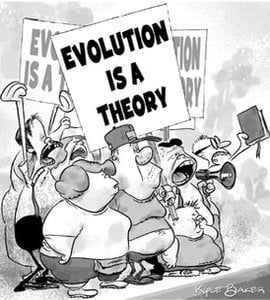
evolutionisatheoryIt’s important for all of us – whether religious or not – to defend the secular viewpoint in public institutions, law and policy. For one, because secularism means that you will never be forced to attend or participate in the ceremonies or practices of religions other than your own.

Defenders of religious expression sometimes forget the fact that often, it’s only contingently the case that you’re defending the expression of a religion you happen to belong to, and that this coincidence can’t be guaranteed. If your neighbourhood school were over time to evolve into one of a different faith, you might suddenly wish for the school to be stubbornly secular.

A second reason to defend secularity, at least in my view, is because a secular environment is well suited to fostering free and rational choice and taking responsibility for our choices, as I argued in this column defending the rights of children to wear religious headgear at public schools. It’s clearer to see the relationship between our beliefs and our actions if we aren’t forced – not matter how implicitly – to perform certain actions.

Secular does not need to mean (in fact, ideally would not mean) hostility towards religious expression. It would mean neutrality, while allowing for the free expression of religious belief so long as that expression accorded with the Constitution and any other relevant law.

South Africa has a mostly superb framework ensuring secularism in our public schools. I’ve written about aspects of this before, but a recent email correspondence with a friend regarding the school her son attends offers an opportunity to highlight what I have reason to believe is a fairly common occurrence – namely, public schools ignoring the explicitly secular (but tolerant) National Policy on Religion in Education.

The case in point is Glenstantia Primary, who approved a new policy on religion in September 2012 (citing the Constitution, the National Policy on Religion and Education and other documents as references). Despite name-checking the National Policy, the “Governing Body of this school decided that Glenstantia Primary shall be a Christian based school” – which can’t avoid but create an impression of bias rather than neutrality towards not only religion, but more importantly, a specific religion.

Pierre de Vos has previously argued that statements like “this school has a Christian character” might well be contraventions of Section 15 of the Constitution, as well as the Schools Act, both of which allow for religious expression, but only on an “equitable basis”. As de Vos points out, our Constitutional Court has shied away from ruffling any feathers in judgements on this issue, partly because some wiggle-room is afforded them through the limitations clause.

However, if a group of parents were to ask the Department of Basic Education to account for their numerous failures to enforce the Policy, I’d expect a similar outcome to the one achieved by Vashti McCollum in 1948, when the US Supreme Court agreed that calling religious observances “voluntary” could cover up a multitude of sins.

As the majority opinion in that case states, “both religion and government can best work to achieve their lofty aims if each is left free from the other within its respective sphere”. At Glenstantia, calling the school “Christian” already makes someone who believes in something else, or nothing, feels like an outsider. But the violations of the policy don’t stop there.

Clause 3.3 insists that the Bible is read at all “assemblies and school gatherings”, and then 3.4 insists that all pupils have to attend these events where hymns are sung and prayers said. You need not participate – but then you need a letter from your parents excusing you.

There are two clear problems in this: first that there’s nothing “equitable” about how religions are treated here, and second, a non-religious child in a religious family is either forced to lie (through participating in a charade) or forced into a very difficult confession of non-faith to a potentially hostile family.

In this sort of situation, who would blame the scholar for not simply taking the easy route, succumbing to peer, school and family pressure through pretending to be religious? For institutions like schools that are meant to teach the ability to think, be independent and so forth, this doesn’t seem a good start. Neither is it a good start in a life of Christian virtue, if you’re attracted to the faith via a subtle form of bullying.

The school has an obligation to support the National Policy, rather than make pupils and parents jump through hoops to ensure that they are not discriminated against. Clause 3.5 says that “other persuasions will be respected”, but when “every school day begins with a prayer and/or a reading of a portion of the Bible” (3.6), it’s difficult to take that pledge of respect seriously.

There is more, but the point is by now clear – one can speak of tolerance and equitable treatment of religions (and the non-religious), but get away with nothing more than paying lip-service to that equitable treatment. This is not only the grouching of an atheist, but a concern that should be shared by every Muslim, or Jewish, or whatever, parent that has a child at a school like Glenstantia.

The point of secular provisions such as the National Policy is that they protect us all from undue influence to toe a particular line, allowing for free expression of whatever beliefs you have, regardless of how fashionable, popular, or government-endorsed they are. We’re all free to believe what we like, and to engage in whatever religious practices we like – or not to, as the case may be.

Either way, it doesn’t have to be anyone else’s business other than yours. If you want to start and end your day with a prayer, go ahead. But why should doing so be forced on other people’s children, or made everyone (anyone) else’s business?