On UCT, transformation and #Rhodesmustfall

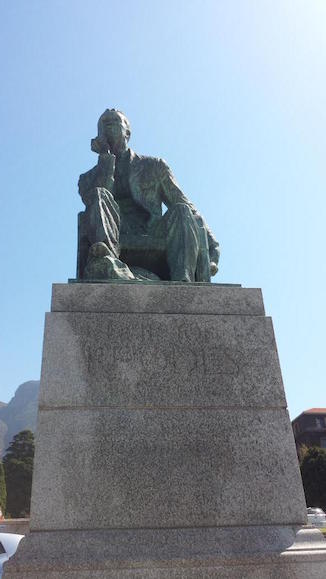
RhodesThe statue of Cecil John Rhodes you can see alongside these words stands on Madiba Circle at UCT, overlooking the sports fields. It’s there because UCT’s main campus is situated on land bequeathed by Rhodes in 1928 as “the site of a national university“.

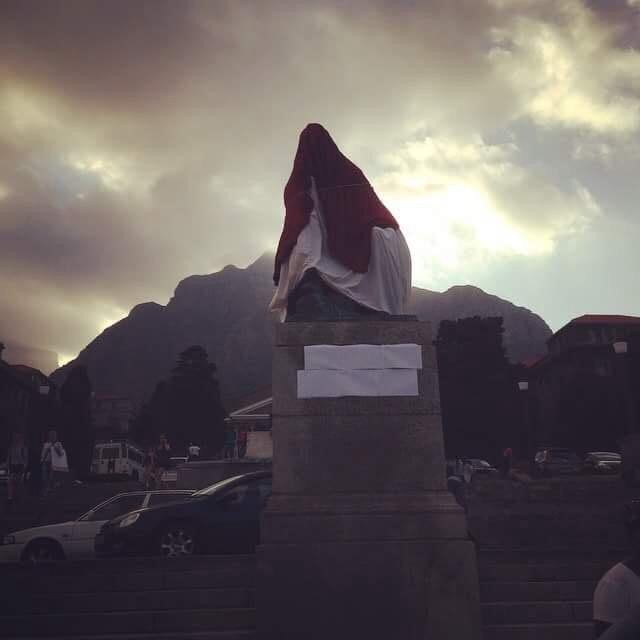
The fact that it’s currently there doesn’t mean it should stay there – and if an ongoing protest is successful, it won’t be there for long. The protest started last Monday, March 9, with Chumani Maxwele emptying the contents of a portable toilet on the statue, and continued with various ad hoc engagements as well as a rally on Jameson Plaza.

The protest is motivated by – and this is of course the nutshell version – students being aggrieved that a statue of an arch-colonialist, racist and sexist such as Rhodes occupies such a prominent place on our campus.

Pictures of the rally allowed for some wry smiles also, given that students who were facing the statue of Rhodes would also have had their backs to Jameson Hall – the building named after Leander Starr Jameson, Rhodes’ lifelong friend and ally in various racist land-grabs and other mad schemes like the Jameson Raid.

There are problematic names and symbols on UCT’s campus, to be sure – but there are also others that are less so, like Madiba Circle and the Steve Biko building. (Limiting the discussion to this one aspect, namely racism, apartheid and its corollaries.)

This doesn’t make the problematic ones okay. But it does speak to an awareness, on the part of UCT’s governing structures, of the need to make changes. And the fact that the current management of UCT is committed to building a campus that is welcoming to all is not, I think, something that a fair person can dispute.

You can dispute the pace of progress, or how things are prioritised, but I think the intentions are clear, and sincere. Furthermore, the last 5 years have been occupied by debates on exactly these issues, in the form of the admissions policy debate.

Before Maxwele’s protest, plans to have debates and consultative processes on signage, symbolism and naming had already been set in motion. The first such discussion (unless I’ve missed something) takes place tomorrow today.

What some critics don’t understand is that large organisations such as UCT can often not move at the pace that you’d prefer. Also, the headlines often obscure complexities – it’s quite possible, for example, that there are other stakeholders with regard to the statue, perhaps the City of Cape Town.

Second, and as a friend remarked, “removing a statue is easy” – but we don’t know if it’s the best option until more debate has been held. Perhaps you want to leave it there as a reminder of the past, adding a plaque explaining what a terrible man he was. Perhaps you want to build a statue of someone who serves as an “antidote” to Rhodes alongside him, symbolising the triumph of good over evil.

There are many options besides tearing it down, is the point – and while it’s true that the current mood is in favour of tearing it down, the university – and the SRC – should be acting in the best interests of the university as a whole, and most crucially, in the best interests of future students.

(As an aside, if the statue were to go, it’s not at all true that we’d have to start rejecting Rhodes scholarships and any other things called Rhodes. It’s entirely possible to make a logical and moral distinction between commemorative statues and bequests of land/money that serve some public interest.)

I’ve been at UCT since 1992, and it’s great to see significant student engagement with political issues after what has been quite a long slumber. But to some extent, there’s the possibility of a more highbrow version of Twitter slacktivism here.

The conversation shouldn’t only be about what will satisfy us now, but rather on what is the most principled and defensible choice to make. I fear that grandstanding is getting in the way of this to some extent. Second, I fear that the issue of the statue can obscure larger and more important problems – as I said above, it’s an easy win.

Will tearing down the statue help with throughput or graduation rates? Will it improve the comprehension of the first-year students I teach, many of whom struggle to engage with abstract ideas at all, after a decade of schooling that has taught them to be studiously literal?

I don’t think so. But having said that, my intuition is that the statue should go, if it can – although I’ll want to hear all the arguments for and against before committing to that intuition, because as I indicate above, its continued existence might serve the same purpose as the protesters desire.

More crucially, though, I hope that we can avoid letting this important debate end up being a distraction, or simply a vehicle for opportunism.

STATUE

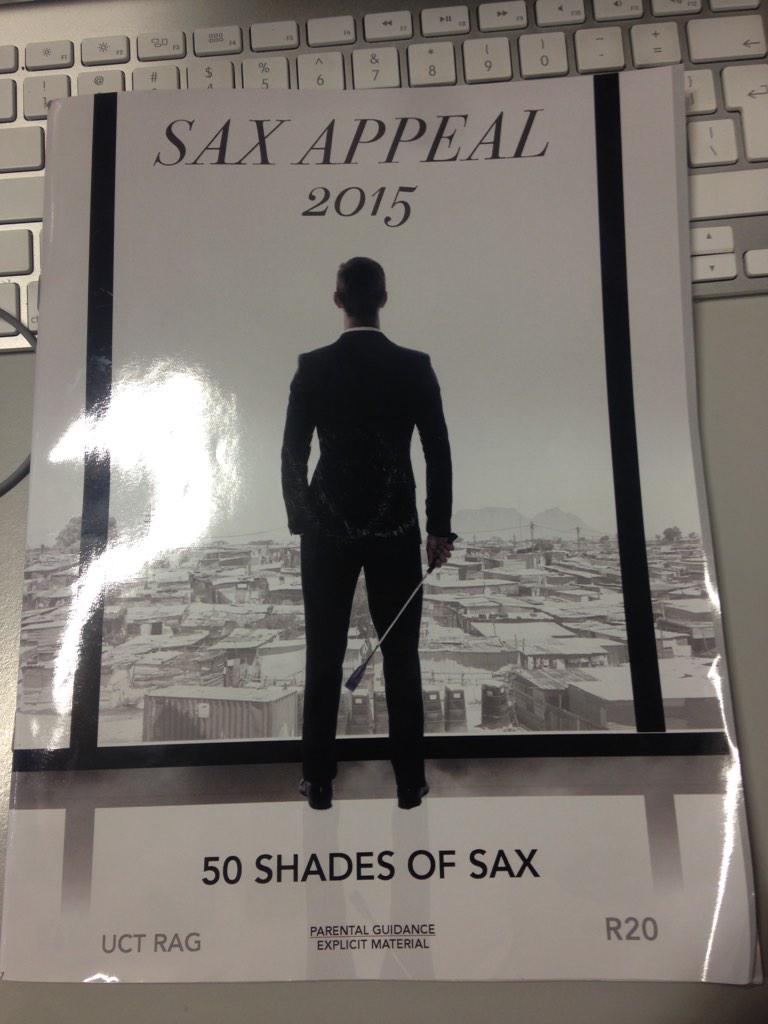
The 2015 #SaxAppeal cover

van_berger_2015-Feb-12
Credit: https://twitter.com/van_berger

This is not a “rage-blog”. I’m not indignant, offended or any of those things by the Sax Appeal 2015 cover that I saw via Twitter this morning. It depicts Christian Grey (a rich white guy who is into BDSM) looking out over shacks where poor black people live.

I do, however, think it was a poor choice of image, for the two reasons I’ll outline below. But first, a general point, which is the actual motivation for this post: there are usually intermediate options between the polarised sorts of shouting at each other that social media seems to encourage.

Criticism is quickly read as outrage, and in a case like this, can also lead to accusations of conservatism, fuddy-duddyishness and so forth. On the other end of the spectrum, those who support the image can overstate its virtues, and not recognise any value in concerns expressed by others.

There’s a gulf between those options, and that’s where I’m speaking from. I was shocked by the image, but I mean shocked in a descriptive sense, rather than as an index of moral outrage – it took me aback. So, that’s a plus for the “good satire” reading, in that being forced to take notice is a good start.

But the cover ultimately misses the mark, and was a poor choice. First, because risky satirical choices are only a smart move if you’ve got credibility as a satirist or satirical publication. Without that, you can appear to be simply echoing the reality you’re trying to critique, or appear oblivious to dimensions of it.

Simply being known as a satirical magazine one isn’t the same thing as people knowing you to be good at that job, and therefore interpreting you in that light – and sorry to say, but I don’t think Sax Appeal been good at it for a while.

Second, you significantly increase your chances of being read uncharitably by virtue of the targets that you pick. In this instance, there’s a context of:

  • 5 years of debate on admissions policy, race and transformation
  • public criticism from UCT academics on the perceived slow pace of transformation at UCT
  • a funding crisis at a national level, affecting the ability of poor students to enter universities
  • a rather public tantrum by a prominent media house owner on UCT’s transformation track-record
  • a university that is situated in a city that is perceived by some as racist

And so forth. In other words, this was a very risky issue on which to push the boat out. I certainly don’t think they were intending to be crude or offensive – in fact, I know some of the people involved, and trust them in this regard – but this was a poor decision.

(Sax Appeal has taken note of the reaction, and posted the statement quoted below to Facebook.)

STATEMENT ON SAX APPEAL COVER CONTROVERSY:

On behalf of the SAX Appeal Editorial Team, we regret the hurt caused by this year’s cover photo.

We understand the concern about what is perceived by some as racist or patronizing undertones of the image; but we would like to state unequivocally that our intention was not to make light of racism or to humiliate its victims.

Our intention was to open up discussion about the problematic power relations in South Africa. The legacy of apartheid has left a tragic divide between rich and poor, black and white, rural and urban – a divide that is still perpetuated daily.

Just as the themes of 50 Shades of Grey allude to power dynamics in sex, our hope with 50 Shades of SAX was to discuss the other power dynamics that still pervade our society. Even though the privileged no longer oppress the underprivileged daily with batons or whips, we hoped that the cover image would inspire discussion about the secretive, underhand ways in which the privileged still get their way.

These issues, including those within the magazine, such as the discussion around homophobia in Islam, the psychiatric profile of God and of golf being representational of white privilege, were included in the magazine to bring about such discussion.

In this way, SAX 2015 has taken a very different turn compared to previous editions. Sensitive topics were not written about to ridicule the marginalized or disadvantaged but to induce meaningful discussion about these topics. These are issues that we did not think we could avoid discussing, but if we missed the mark in our attempt at discussion, we regret the effect that this has caused.

We hope that this perspective might add to the debate that has been sparked on social media and that it might point it in a direction that is critical and constructive around issues of race and socioeconomics.

Wrong about race in South Africa and UCT

agi_events_010Two snippets, from two quite different sources, raise concerns about self-serving (as opposed to principled) thinking about race in South Africa and at the University of Cape Town, where I teach.

First, we have Douglas Gibson expressing concern that “race is back in fashion” in South African conversation. Gibson is the former Chief Whip of the Democratic Party, which became the Democratic Alliance (DA), South Africa’s official opposition.

I’ve only had a couple of conversations with Gibson, but have read many of his speeches and columns over the years, and regard him as a determinedly old-school liberal, rather than someone who is happy to let pragmatism dominate, as seems to be the case for many in today’s DA.

One character trait of what I describe as an old-school liberal is often an inclination towards idealism, in this case manifesting as a desire that South Africans be race-blind, to want to engineer a South Africa that is nonracial or post-racial. He opens his column with an example of race-blindness, in this case that of his son:

Thirty five years ago a little white boy aged three, standing in his bathing costume next to the pool, stroked the arm of a little black girl, also in a bathing costume, and said, “Ooh, you’ve got a lovely tan.” My son didn’t see race and certainly had no race prejudice. That was at the height of apartheid. He is still not a racist, just as many other whites are not.

There are two distinct points to make about examples like this. The first is that we can agree (or not) that this is an ideal future to try and arrive in. The second is that we can agree (or not) on how to get there.

A concern that I and others have about DA rhetoric is that it seems to want to get there by insisting on it, and by asking us all to just ignore race, because in doing so we’ll discover all sorts of other relevant and interesting things about each other as individuals.

As ever, I think some things are easier to say and support from one point of view rather than another. I don’t experience what it’s like to be black in South Africa, but if what I’ve heard is accurate – and I’ve heard it from black intellectuals far more qualified and socio-economically advantaged than me – they perceive racism far more often than they should (the “should” here would of course be zero times).

I’ve said in the past that the perception of Cape Town as being racist can’t simply be dismissed, and still think that even if we agree on an (eventual) goal of non-racism, we might find (a) that we can never get there or (b) that the way to get there is precisely to acknowledge race and prejudice, rather than pretend people don’t have these experiences.

To put it crudely – columns like Gibson’s, romantically espousing non-racialism, can be read as part of the problem in their denial of the validity of the lived experience of people who feel discriminated against. It can appear like you’re being told to simply “get over it”, and I think that’s condescending.

The other example I want to highlight is from Dr Xolela Mangcu, who is at the furthest remove possible from Gibson in at least two respects, in that he is a black Biko scholar, rather than a white liberal. Mangu has been columning voluminously about UCT’s new admissions policy for the past few months, and some of these columns have attracted responses from our Vice-Chancellor, Dr Max Price.

In Mangcu’s most recent opinion piece on race and transformation at UCT, he says the following:

Numbers matter also because there should be a critical mass of black professors in the University Senate, which is the highest decision-making body when it comes to academic affairs. I just find it difficult to imagine that doing away with race-based affirmative action would have been such a high priority for the Senate, or would have passed so easily, if that august body was populated by a large number of black full professors.

And here’s my problem: even if you think the admissions policy flawed, Mangcu’s words there seem to me to insult the black professoriate, or otherwise to indicate a laziness of thought on this issue, or are otherwise simply mendacious.

To briefly run through the options: the extract could insult black members of Senate, in that it suggests that they cannot be of independent mind regardless of perceived race-interest, and think that a policy might be the correct policy on principle even if it attracts the sorts of controversy it has.

Second, it could indicate a laziness of thought, in that he’s simply assuming that everyone who is a black Senator is somehow going to ineluctably reach the same conclusions about the policy as he did – in other words, that his is the only reasonable interpretation.

The arrogance of this would be one problem, and the second would be that it would make his argument circular, in that he’d be saying “the policy is wrong, and if Senate were black in the majority, they would vote against it, which proves that the policy is wrong”.

Finally, it could well be that Mangcu doesn’t think his analysis is the only defensible one, and it could be that he simultaneously knows that some black Professors support it. If these conditions were both met (and if I haven’t left out other options) then it seems that he’s misrepresenting the case for rhetorical effect – just like Gibson is.

My point, in short, is that given that we recognise how fraught these conversations are, we should be careful to have them honestly, contextually, and objectively, in the sense that the quality of arguments can still matter, even if you think there’s something distinct about how race informs an argument.

Is Noakes the North Korea of epistemology?

On November 25, I gave a talk with the above title at an event hosted by SAAFoST* and ADSA**. Unfortunately, the proceedings weren’t recorded, so you won’t be able to hear the superb presentation that preceded mine, by Dr. Celeste Naude, who focused on an evidence-based approach for differentiating between varying macronutrient-focused diets.

Those of you who are interested in the topic of diets, and specifically the role Prof. Noakes has played in popularising the LCHF approach to diet, might already know of the recent study by Naude and others, which found that low carb diets showed a similar reduction in weight to other diets. Noakes’ response to that study was to say that the “researchers have no clue”. I leave it to you to determine who you find more persuasive.

You won’t be able to watch my talk as presented either, but in case it’s of interest, I decided to record a version of it in any case, accompanied by the slides I showed on the day. By contrast to Dr. Naude, who focused on science, I focused on rhetoric, hyperbole, and sound scientific reasoning – or, the lack of it.

You can find that recording immediately below, followed by the approximate text of the presentation. It hasn’t been edited into essay form, so is telegraphic in places. Lastly, I’ve embedded the presentation slides at the end, for no particular reason.

*SAAFost: the South African Association of Food Science and Technology

**ADSA: the Association for Dietetics in South Africa

Is Noakes the North Korea of epistemology?

Betteridge’s Law – any headline that ends with a question mark can be answered with “no”.

Of course, “no” is part of the answer here – if we are asking the question of whether Prof Noakes is a propagandist who leads a repressive state, and is implicated in various human rights abuses, the answer is clearly no.

I’m also make no claims with regard to their relative levels of sincerity. In the case of Prof. Noakes, I’m of the view that he is utterly sincere, and desires nothing but to enhance the health and wellbeing of those he engages with. He’s received far too much abuse related to claims regarding a profit motive, for example, and I think that sort of abuse unjustified, and deplorable.

But that’s not what my title is alluding to. Instead, I’m highlighting the fact that the North Korean press machine has a habit of making hyperbolic claims, and Kim Jong Un for appearing in various baroque, grandiose, and sometimes merely perplexing situations, all to buttress his mystique and support a particular narrative.

This narrative is of him being misunderstood, a maverick, and a person who has privileged access to knowledge and opportunity that he is able to share with the enlightened or anointed. He serves as an inspiration, and in doing so, the impression created is more important than the evidence – marketing is the point, rather than content.

This is the sense in which Noakes is the North Korea of epistemology. As I will show, he displays a pattern of what philosophers and psychologists call “motivated reasoning”, which can be defined as confirmation bias turned up to 11.

You all know what confirmation bias is, I’d imagine: our predisposition to take evidence that confirms what we believe seriously, while discounting contrary evidence. What motivated reasoning adds is a substructure or foundation to this, in which the agent develops background rationalisations to justify holding the beliefs that others argue are false, or at least not settled conclusively at this point.

The motivated reasoner might see conspiracy instead of disagreement, and tends to react defensively to contrary evidence, seeing conspiracy, or dismissing it out of hand for other reasons instead of responding to it on its merits.

I ignore what I consider not to be evidence” – Noakes.

The goal of my talk today is quite simple. I want to suggest to you that regardless of any debate on the virtues of the Banting diet – which I’m not interested in discussing, and haven’t expressed any public view on – there’s a language, method, and character that we should all value in scientists and scientific enquiry.

I believe that any of us who work in fields including science, education, or journalism have a responsibility to encourage a responsible epistemic approach, rather than to aim for persuasion above all else.

By this I mean an approach that is objective as regards the evidence, where we are willing to be wrong, and where we resist attacking the character or motives of opponents when arguments are the relevant issue.

Prof. Noakes has frequently set a bad example in these regards, and my concern as an educator – particularly one active in the field of critical reasoning – is that with 50 000 Twitter followers, and as an engaging and hard-working media personality who has garnered as many accolades as just about anyone you can think of in South African science, he has a powerful influence on how people perceive scientific activity.

One of the virtuous traits I mentioned a moment ago was a willingness to be wrong. Defenders of Noakes might immediately retort that of course he’s willing to be wrong – after all, he famously changed his mind on carbohydrates! And while this is a notable change of mind, it doesn’t (and shouldn’t) reassure anyone that it’s representative of a general disposition. As you’d know, it’s a single data point, and we don’t find a pattern in a single data point.

More to the point, perhaps, is that his own language regarding that change of mind comes with significant warning flags regarding his commitment to sound reasoning. Take this example:

At a public discussion with his erstwhile supervisor, Lionel Opie, in May 2014, Noakes told the audience “I’ve said one thing, and now I’m saying the exact opposite. And they can’t both be wrong. And that’s key.”

While a statement like that plays well to a crowd – and in this case, did result in some appreciative chuckles – it’s nonsense as far as logic is concerned.

He’s presenting his change of mind as evidence that he’s right now. And there are two immediate problems here – one is that the argument only gains traction if you agree with him that he was wrong before. If you think he was right then, then you’d think that he’s just strayed into error now.

The second way in which the logic is fundamentally flawed is that he’s suggesting that the audience embrace the logical fallacy of the false dilemma. What I mean is that the truth might actually be undiscovered, and exist somewhere in the middle – it’s not the case that one of the two extremes he’s suggested at various points have to be correct. We have other options, and he’s misrepresenting the choices available to us in leaving them out.

We should all – maybe A-rated scientists, teachers, and public figures in particular – have a concern for good scientific thinking and clear reasoning in expressing the conclusions we’d like to see adopted. Science does not work in absolute truths – it’s an inductive process, whereby we chisel away at falsehoods to arrive at a clearer understanding of what’s most likely to be true. The example above recommends absolutism, despite that being manifestly incompatible with the messy world of empirical data.

At various points in today’s talk, I’ll be showing you examples of statements like these, made by Prof Noakes on public media. There are many more such examples, but it would be tedious to belabor the point through repetition.

But I mention this to offset concerns you might have that I’m indulging in cherry-picking here – the pattern is unmistakeable in itself, and more to the point, many of the examples I’ll show you are examples of Noakes responding to critics accusing him of over-simplifying. In other words, even after applying the principle of charity and seeking clarification from him, his responses validate the concerns I’ll be highlighting.

A taxonomy of trouble

For ease of reference, I’ve loosely categorized the issues into 5 groups:

  • Indiscriminate use of sources
  • Ad hominem & double-standards
  • Exaggeration and immunity to error
  • Salesmanship over science
  • Errors in scientific reasoning

INDISCRIMINATE USE OF SOURCES

Chemicals that may cause diabetes – Noakes links to Natural News.

This is the site that argues that Microsoft are developing eugenics vaccines. And that HIV doesn’t cause Aids. And Icke? The world is controlled by reptiles from outer space, who live in underground tunnels and take on human form (Thatcher, Bush)

Next they say it has been discovered before. Lastly they say they always believed it. Louis Agassiz.” – Noakes links to evolution-denier.

This from a series of tweets explaining how his conclusions will be vindicated in the end. But if you’re going to suggest that there are better and worse ways of proceeding in science, perhaps better examples than Agassiz could be chosen. He is, after all, an evolution-denier, and a proponent of scientific racism – does one want to cite him as an authority on the scientific method?

“@natachab Weston Price http://amzn.to/15c8xRz believed superior nutrition of trad societies protected against TB. Need LCHF HIV/TB trial” – and to a “holistic dentist”.

Weston Price – “holistic dentist” whose treatments included homeopathy. The site carries numerous articles arguing that vaccines cause autism. Current board member Joseph Mercola has received at least three FDA warnings for making misleading and/or unsubstantiated claims regarding the products he sells.

AD HOMINEM & DOUBLE STANDARDS

Starting on a sound note…
. @katjanechild Only you know what motivates you, Katherine. My advice: Play the ball, not the man and you will go far.”

Obese dietician from British Dietetics Assoc tells us on BBC News that @DrAseemMalhotra article is wrong. Will believe her when she loses wt

I do not understand why you pay any attention to Dr Witt, who has absolutely no qualifications in this field and is a few years out of medical school.”

On Anthony Dalby, a more recent critic: “Noakes said the doctor who said that happened to weigh 120kg.”

.@Fatworks @Briganto @livinlowcarbman @youmustbenuts That happens when the truth is not on your side. Yet to meet an obnoxious LCHF advocate

Prescription? A mirror.

OVERSTATING THE CASE/IMMUNITY TO ERROR

If you don’t eat carbohydrates, you don’t have to worry about cancer” – @ProfTimNoakes . Moerse gevaarlike stelling!!!

Noakes responds: “@RugbyPrinses Where and when did I say that? Or did someone else say I said that?Do you honestly think I would make such absolute statement?

Franschhoek: “If you’re insulin resistant, you do not have to get any disease whatsoever. If you eat a high-fat diet all your life, you will not develop diabetes, you will not get cancer, you will not get dementia. That I can guarantee you” – that’s where, and when (audio).

“Sweden becomes first nation to reject high fat dogma!” Noakes was making this claim in 2013, when the SBU report wasn’t even available in English, RT’ing AuthorityNutrition & Diet Doctor.

The authors of the (independent) body eventually had to step in and tell people to stop saying this. Report just on obesity, not necessarily generalisable, and:

Two mis-interpretations have, in our opinion occurred in the wake of the publication of the SBU report. One is that low carb high fat is by far better. Yes, during the first 6 months you lose weight faster on low carbohydrate diets. But after one and two years that diet has no advantage than other diets for obesity.

After having this pointed out to her, Teicholz blocks me and others. I couldn’t point it out to Noakes, because contrary voices also get blocked from being heard on his timeline. Contrary to what I think the ideal approach – of seeking out ways in which you could improve your arguments – motivated reasoning can involve simply shutting out dissent.

Then, addiction, where I fear that the LCHF movement is doing great harm to public understanding of the difference between compulsive and destructive behavior, and lifestyle choices which can be better or worse but are not intrinsically problematic.

From Real Meal Revolution:

The final blow to the gut: because carbohydrates are nutrient-deficient and often packaged with salt and sugar, you feel the need to eat more of them, thereby putting yourself into a near-perpetual cycle of weight gain.
Unless, of course, you break the addiction…

There’s plenty of “addiction” talk on his Twitter feed, as well as a partnership with Harmony Clinic in Hout Bay, that offers in and outpatient treatment for sugar addiction. Well, Harmony Clinic now liquidated, so perhaps not anymore.

The problem is – there’s no compelling evidence for sugar addiction, yet, and the case is being overstated in the service of promoting Banting.

What should we then say about so-called “addictive” foodstuffs? The first thing to remember is the point Paracelsus made in the 15th century – “the dose makes the poison”.

While there might be no safe number of cigarettes to smoke, there will be a dosage of carbohydrates, or sugar, that’s unproblematic in all but the most rare of cases.

Let’s look more closely at sugar addiction, and addiction in general. Two papers are typically cited as evidence for sugar being addictive. But what they mostly reveal is that science journalists no longer read or understand the journals, and that the public – and some professionals – are far too trusting when it comes to the sensational headlines that convey elements of those studies to us.

First, the Avena study, published in Neuroscience & Biobehavioral Reviews in 2007:

“we suggest that sugar, as common as it is, nonetheless meets the criteria for a substance of abuse and may be “addictive” for some individuals when consumed in a “binge-like” manner.”

Pause there – who might be inclined to consume in a “binge-like” fashion? Perhaps someone with a pre-existing impulse control disorder, who happens to latch on to sugar – the reverse inference from the bingeing to the sugar might get the causal direction entirely back-to-front. We’ll get back to the neurochemistry later, but also, notice the scare-quotes – the author is hedging her bets, with the text only weakly supportive of any claim to sugar addiction.

One is perhaps reminded of a line from Lewis Carrol’s “Through the looking glass”, where Humpty Dumpty said: “When I use a word, it means just what I choose it to mean—neither more nor less.”

Then, there’s Johnson & Kenny’s paper in Nature Neuroscience (2010) on junk food and addiction, also conducted on rats.

“Notably, it is unclear whether deficits in rewards processing are constitutive and precede obesity, or whether excessive consumption of palatable food can drive reward dysfunction and thereby contribute to diet-induced obesity.”

As in the Avena study, we don’t know whether an impulse control disorder is simply being expressed – rather than discovered as an effect, resulting from the junk food – in this experiment.

Yes, if you grow to like something (or find it rewarding), you’ll seek it out. This does not mean the thing is innately addictive. In fact, Hebebrand’s recently published paper in Neuroscience & Biobehavioral Reviews concludes that if anything, “eating addiction” rather than “food addiction” best captures what’s going on when people compulsively over-eat. The food is an expression, not a cause of the impulse control disorder.

We can easily engage in a battle of link-sharing – but the point is that the truth is complex, and not settled by individual studies. In this case, there’s one clear issue with using these studies as definitive, and this is that both of these studies use brain imaging to support their conclusions.

As Sally Satel (who works as a psychiatrist in a methadone clinic) puts it, brain scanning is “a perfect storm of seduction”. The technology promises great revelations and great objectivity. More to the point of my presentation today, it offers the possibility of eliminating your responsibility for what’s wrong with you – we can say, “it wasn’t me, it was my brain!”

This image is interesting is that it neatly summarises why you can’t reach firm conclusions from fMRI data. This fish is in fact dead, yet the scanner showed signs of brain activity.

fMRI data are suggestive, and weakly so at that, in that they reflect neural correlates of various stimuli, and nothing of the perceived and subjective mental responses to those stimuli.

In slightly more detail: Increased blood flow and a boost in oxygen are treated as proxies for increased activation of neurons, and from there we induce to what those neurons are doing. We compare that data to a baseline, and subtract the one from the other, averaging out over the many data points of all participants in a study, with software filtering out background noise, and creating the seductive images.

But our experimental conditions are imperfect – think of the difficulties of creating appropriate baseline tests, for one – and large sample sizes cost a lot of money. Add to that the fact that our brains can process the same stimuli in different regions – no one specific area can reliably be said to perform the same task for all of us – and it should be clear that it’s far too soon to reach definitive conclusions from fMRI data.

The philosophical problem is one of reverse inference – we reason backward from neural activation to subjective experience. But if identified brain structures rarely perform single tasks, one-to-one mapping between activation in a region and a mental state is very speculative.

To avoid the false positive of the fish brain activity above, we need to use multiple comparison fMRI, which comes at far greater expense in terms of cost and time. But headlines don’t have space for subtleties, and furthermore, novel and exciting claims get the public’s attention. If your fMRI scans can be said to show that sugar is more addictive than cocaine, you’re guaranteed some prime media attention, and who can blame you for trying to capitalize on that? Well, perhaps nobody can blame you if you’re trying to sell newspapers. And perhaps we can blame you, or be rather concerned, if you’re presenting yourself as a responsible scientist.

We can’t tell – yet – whether fMRI scans indicate an impulse that is irresistible, or one that simply hasn’t been resisted. But it’s easier to make choices when you believe that there’s a choice to make, rather than a forced one, such that an “addiction” narrative might support. Diminished expectations of agency lead to diminished agency – if you’re not aware of your choices, it’s more difficult to make choices. So, it’s politically useful to say that carbs are addictive – but that isn’t equivalent to it being true.

But at least we have a following. The great failing in science is not to be wrong – it is to be irrelevant.” – Noakes

SALESMANSHIP OVER SCIENCE & SENSITIVITY

Robin Williams was a vegan.Vegetarians are twice as likely to suffer mental illness.Humans are designed to eat meat.” @ProfTimNoakes RT’ed, the day of Williams’ suicide.

Response when challenged:
“@theviscountess @HermanBeukes Was Mr Williams informed about association between meat-free diet and mental health? http://1.usa.gov/1t2janN”

Then when people point out how poor that paper is, he appeals to the association, even though when anyone cites associational data in favour of low fat, he rejects it.

Dr Bill Wilson wonders if the Carbohydrate Associated Reversible Brain (CARB) disorder played a role in Newtown tragedy http://bit.ly/URArgp”… Where a 20-year old fatally shot 20 kids, and gun control might be a more interesting conversation.

ERRORS IN SCIENTIFIC REASONING

What does the future hold for a pastry chef?
@PastryKeegan The public will decide. In era of social media, public will eventually discover what works for each, independent of “experts

Why are “experts” being trivialized here? Experts do exist, and the public are often misinformed. If experts disagree with you, then you defeat them in the battleground of expertise – peer reviewed journals. An army of laypeople doesn’t make the scientific case.

Why is journo Gary Taubes pushing for scientific studies into #LCHF diets (http://blogs.scientificamerican.com/cross-check/2014/10/07/gary-why-we-get-fat-taubes-speaks-out-on-diet-studies-including-his-own/ …) while @ProfTimNoakes focuses on populism?

“.@sarahemilywild Because change will only come when public understands truth expressed in @garytaubes book. New science will not change that”

“New science” will not change the truth? And again, a scientist calling for less science?

September 2014, Australia

So, I watched it. Here’s one rather interesting bit (the text below is copied from a previous post):

And you must never trust consensus guidelines, because they are anti-science. Science is not about consensus, it’s about disproof, disbelief and skepticism. It’s not about consensus. When you’ve got consensus, you’ve got trouble.

This conflates two very different stories into one, to serve the rhetorical purpose of granting credence to the underdog-story. The two stories are first, that yes, dogma is antithetical to science. The second is that if a preponderance of evidence points in a consistent direction, consensus guidelines could be well-justified, and it would only be irrational or inattentive people who would not believe in that consensus.

In the second story, you’d have been rational to believe in the consensus account even if it later turns out to be false. The point is that denying a well-justified consensus doesn’t make you a better scientist – it makes you a conspiracy theorist, or simply wrong about the facts.

In other words, consensus guidelines that emerge out of honest engagement with the evidence, and that are open to correction, are not anti-science at all. They are the product of good science, and their later overturning (if that happens) in favour of a new consensus is also the product of good science.

You don’t measure or identify good science from its conclusions – because we don’t know that those will survive future data – but by method, and by openness to correction in light of evidence. The first kind of story mentioned above, involving dogma, is of course an example of bad science. That doesn’t mean that consensus is by definition bad.

Science is indeed about “disproof, disbelief and skepticism” – but all of these serve to challenge any existing view and replace it with a better one. They are tools, or methods, for reaching a better consensus, not for rejecting consensus in general.

The simplest way of putting the point is this: Noakes would like it to be the case that medical practitioners and educational programmes see the light, and teach the same message he professes. In other words, he’d like his own views to be the basis of a new consensus, because he believes that the existing consensus is wrong.

When you’ve got dogma, you’ve got trouble. And when you’ve got consensus, you might have dogma. But you might also have a bunch of responsible people agreeing that yes, that’s what the data imply, and until we learn something to overturn our view, the evidence leads us – as rational, responsible scientists – to a certain consensus.

In short, while the quote above can play as a sexy soundbite for undercutting received wisdom, it’s another instance of Noakes playing scorched earth with understanding of the scientific method.

He might say that the public health concerns are too significant to care about niceties like the ones I’ve been talking about today. To that, there are two immediate responses. First, sloppy thinking should arguably never be encouraged. For someone who is regarded as an inspiration by many budding scientists, and who is one of South Africa’s most decorated scientists, one might even argue that he has a moral obligation to encourage sound scientific thinking.

The second response is that even if this were true – that we should misrepresent the strength and consensus behind a certain dietary position, in order to save lives – we should be able to debate how far we’re allowed to take the misrepresentation.

But this would require agreeing that misrepresentation occurs, and Noakes insists that it’s others who are being obtuse rather than himself. More disturbing, perhaps, is that those who do disagree are ignored or blocked, or characterized as shills, or victims of “groupthink”.

In conclusion, two tweets that show the best and worst of Prof Noakes:

.@Magarietha @umduzu @JSDKirby @davegreenway Many of my most vocal critics think science is easy and definitive. It is nuanced and complex

Yes, it certainly is, and I wish he’d take his own counsel on these matters.

Overlooked: If I am wrong, all that suffers is my reputation. If diet-heart is wrong, billions suffer. Scary responsibility.

This is the worst, obviously, in that the consequences of him being wrong could be far more acute. The logic here is entirely circular, in that his conception of being “wrong” simply ignores all the harms that competing views say could result from a high-fat diet.

He’s assuming he’s right, even while speculating about the consequences if he were wrong.

Even Noakes’ supporters should expect more of him, for two reasons:

  1. The scientific method deserves better.
  2. If he’s right, he’s impairing the credibility his viewpoint garners. The same dietary advice could be given without the “aid” of examples like these, and that might well get the revolution taken seriously in a far more widespread fashion.


 

Talking with Eusebius about argumentation

Power_FM_(South_Africa)Earlier today, Eusebius McKaiser invited me to join him in a half-hour conversation on critical thinking – how we should do it, and how we fail. Seeing as I happened to be in Johannesburg, I was able to join him at the PowerFM studios for the conversation that ensued, which proved to be far more interesting – for me, at least! – than the more typical interview by telephone. For those interested in the topic, the Soundcloud podcast is embedded below.

[soundcloud url=”https://api.soundcloud.com/tracks/166178402″ params=”auto_play=true&hide_related=false&show_comments=true&show_user=true&show_reposts=false&visual=true” width=”100%” height=”300″ iframe=”true” /]

The TB Davie Academic Freedom Lecture 2014 – Max du Preez

mdpEarlier today, I had the privilege of introducing Max du Preez to the audience gathered for the 2014 TB Davie Lecture at UCT. The lecture was recorded, and once the video and podcast are available, I’ll be sure to let you know. In the meanwhile, here are my introductory remarks.


Over the course of a 40-year career in journalism, Max du Preez has earned multiple local and international awards for fearless and principled reporting, including the Nat Nakasa Award for Courageous Journalism, as well as having been named the Yale Globalist International Journalist.

He is the author of numerous books that draw on his long history in South African culture and politics, most recently “A rumour of spring”, in which he reflects on whether South Africa can expect “a long winter or an early spring” in relation to the evolution of our democracy.

In 1992, UCT awarded Max du Preez an honorary Master of Social Science degree, and the citation is worth re-visiting. It speaks of:

his fearless exposition of power corruption in high places, in the face of all kinds of attempts at silencing him, from criminal and civil proceedings in the Courts to extrajudicial strong-arm methods.

Max Du Preez has consistently made it clear that he is not serving any sectional interest, but that of all the people of this country, and his cause is to promote the values that should operate in the new South Africa.

After graduating from Stellenbosch University, he joined Die Burger as a cub reporter, and the Editor sent him to cover the Parliamentary sessions. This proved to be an error of judgement. Max Du Preez’ overall impression of the Parliament was one of moral corruption and intellectual poverty, and he conveyed this in his reports; Die Burger’s impression of Max Du Preez was that they had a problem reporter on their hands.

He was hastily transferred to Die Beeld in Johannesburg. There he reported on the Mozambiquan independence, and the Soweto riots of June 16 1976, but caused so many problems for the Government-supporting Nationale Pers that he was banished to the Siberia of South Africa, the Namibian desk.

In Windhoek, he was quickly branded a Swapo ally, and Du Preez and Nationale Pers soon parted company. In 1980 he joined the Financial Mail in the post of political editor, the only Afrikaner on the staff, and in his own words, “their token boer.”

Later he transferred within the same media group as political correspondent to the Sunday Times and Business Day.

In 1987 Dr Van Zyl Slabbert invited Du Preez to join the delegation of Afrikaner personalities who attended that highly controversial and historic meeting with the then banned African National Congress in Dakar, Senegal.

It was there that the idea of starting an independent Afrikaans language weekly newspaper was born.

That newspaper, launched in 1988, was die Vrye Weekblad- the Independent Weekly. The newspaper was almost immediately in court, thanks to the first few editions having to appear on the street illegally after the Minister of Justice responded to the threat it posed by raising the cost of registering a newspaper from R10 to R30 000.

At this newspaper, it was du Preez and his colleague Jacques Pauw who led the exposure of apartheid-era murder squads at Vlakplaas when other publications wanted no part of the story – or simply denied its truthfulness. Without their hard work and courage, many of these details might well have remained a secret to this day.

The paper was forced to close in February 1994, thanks to the costs incurred in defending its charge that South African Police General Lothar Neethling had supplied poison to security police to kill activists.

Du Preez went on to be the founder and editor of the television programmes Special Report (documenting the Truth and Reconciliation Commission) and Special Assignment.  Du Preez ended up being dismissed from Special Assignment for “gross insubordination towards management”, after objecting to a management decision to bar the screening of a segment on witchcraft.

That same weekend, Special Assignment won six awards at a television prize-giving.

If a more recent sort of threat, by actor and economic freedom fighter Fana Mokoena to “seize his farm” is more typical these days, it’s not because du Preez has slowed down, or toned down, his challenges to political authority and the abuse of power. Nor could it be because he has a farm, as he has none – but accuracy is seldom a primary concern for bullies.

It might instead be exactly because – thanks in part to him and other courageous editors – newspapers in South Africa no longer need fear being bombed, as the Vrye Weekblad offices were in 1991.

To return to the 1992 citation,

Mr Chancellor, the sensational disclosures which struck at the malignant core of apartheid are only part of Max Du Preez’ achievements. He is clearly a non-conformist, an independent thinker, a maverick. Some would use stronger terms. The French noun might be a sansculotte-  ‘without breeches”. In Afrikaans, the expression is earthier – he is hardegat.

Ladies and Gentlemen: please welcome Max du Preez.

Has #trolleyology gone off the rails?

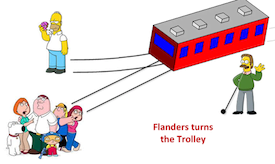
6a00d8342025e153ef01538e3a45b7970b-600wiI first heard about “the trolley problem” as an undergraduate philosophy student in 1991, as one of the countless thought-experiments moral philosophy uses to probe our intuitions regarding right and wrong, and whether we are consistent in our judgements of what is right/wrong. The problem, for those of you who don’t know it, is presented by its creator (Philippa Foot) as follows:

Suppose that a judge or magistrate is faced with rioters demanding that a culprit be found guilty for a certain crime and threatening otherwise to take their own bloody revenge on a particular section of the community. The real culprit being unknown, the judge sees himself as able to prevent the bloodshed only by framing some innocent person and having him executed.

Beside this example is placed another in which a pilot whose aeroplane is about to crash is deciding whether to steer from a more to a less inhabited area. To make the parallel as close as possible it may rather be supposed that he is the driver of a runaway tram which he can only steer from one narrow track on to another; five men are working on one track and one man on the other; anyone on the track he enters is bound to be killed. In the case of the riots the mob have five hostages, so that in both examples the exchange is supposed to be one man’s life for the lives of five.

Epistemic prudence, Noakes, and the limits of authority

Wittgenstein said “Whereof one cannot speak, thereof one must be silent”, and that quote seems as good a place as any to kick off a post on appeals to authority, the death of expertise, and the boundaries of disciplines. As I argued in a 2012 column, agnosticism is often the most reasonable position on any issue that you’re not an expert in (with “agnosticism” here meaning the absence of conviction, not necessarily the absence of an opinion).

Academic freedom in South Africa

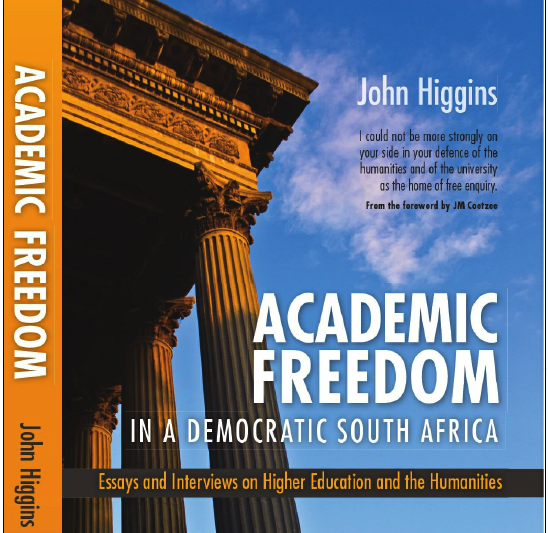
Higgins on academic freedomOn December 11, my University of Cape Town (UCT) colleague Prof John Higgins will be holding the Cape Town launch of his new book, “Academic Freedom in a Democratic South Africa” (click on the picture to enlarge and to get details). I’ll certainly be attending, both to support John (a friend) and also because it’s a subject of great interest to me.

In my capacity as chair of the Academic Freedom Committee at UCT, I was approached by a local journalist for comment on some issues raised in this book. Because only a sentence or two (if anything) might survive the editing process, here’s the full list of questions and my answers, for those of you interested in this topic.

1.Do you think academic freedom is under threat in South Africa?
There are certainly implicit threats to academic freedom, and also explicit ones such as the Higher Education and Training Laws Amendment Act.

2.If yes, kindly give us a few reasons to support your answer
Attempts to control the possession and dissemination of information as in the Protection of State Information Bill is an implicit threat, as is the occasionally hostile reaction of the State to uncomfortable questions being asked of it, for example regarding topics such as the arms deal or Nkandla. The South Africa public might itself present a different sort of threat, in that political and socio-economic preoccupations sometimes appear to create a distinctly anti-intellectual climate, where demands for “ideological purity” can intrude on academic activity. Then, legislation such as the Act – regardless of whether this is the intent or not – allow the Minister to subvert university autonomy for overly vague and broad reasons, thereby putting universities in a state of perpetual probation, hardly conducive to freedom.

3.Do you think that the ANC’s policies on higher education seek to subordinate universities’ important decision making to the policies of government?
Whether they seek to do so is one question, whether they will serve to do so quite another. Regardless of the intentions behind these policies – which some certainly seem to think sinister – the policies (the aforementioned Act, and also potentially the eventual scope and power of the Ministerial Oversight Committee on Transformation) could certainly serve to subvert university autonomy.

4.Does this amount to curtailing “academic Freedom?”.
The State has legitimate interests in the role and functioning of public universities, so the universities cannot demand that academic freedom be defined without any concern for those interests. But the way in which government has developed and seeks to implement these policies – often with little or no discussion or negotiation with the universities – does add up to an intrusion on academic freedom.

5.The ANC has clearly said it wants universities to churn graduates who are competent in dealing with a modern economy. In other words, universities suddenly become instruments to achieve certain policies of government. Does this pose a threat to academic freedom?
Yes, certainly. While the developmental needs of South Africa certainly merit a focus on, for example, STEM disciplines (Science, Technology, Engineering, Mathematics), this should not come at the expense of the long-term goal of producing strategic and creative thinkers of the sort that typically emerge from the liberal arts – history, philosophy and the like. A disproportionate focus on more practical fields might serve our interests in the short-run, but also serve to cripple academic enquiry and progress (and thus, freedom) in disciplines that are more esoteric.

6.Do you think the ANC’ s policies on higher education seek to control universities even more than what the National party did?
The comparison is unnecessary, and a distraction from the more important issue of whether the current government seeks to do so to a troublesome extent. This sort of comparison is perhaps emblematic of exactly the anti-intellectualism described earlier, in that keeping score in this way is good for headlines, rather than inspiring critical thought.

7.Do you think the Higher Education and Training Laws amendment Act is problematic for Academic Freedom? If yes, how so?
It could be problematic, depending on the extent to which the powers it allows for are used or abused. The Act makes it easier for government can place a university under administration, dissolving that university’s Council and assuming its powers. It sanctions more government intervention than is currently the case, and does so on grounds that are broad and poorly defined. We should have no objection to dysfunctional Councils being challenged or replaced, but if the Act allowing for this also allows, for example, Councils that aren’t “ideologically pure” to be replaced, then institutional autonomy and academic freedom are significantly threatened, and to an unacceptable degree. Further cause for concern regarding this Act is that key stakeholders, including Higher Education South Africa (Hesa), which represents the vice-chancellors and the Council on Higher Education (CHE) were not consulted in its drafting.