Culturally appropriative cuisine and “institutional collusion”

There certainly are offensive ways of stereotyping people or appropriating cultures, regardless of whether or not one intends to be offensive. Blackface is one, as is describing Jewish people as greedy, or Scots as miserly, or “immigrants” as lazy, and so forth.

Other stereotypes cause less offense, for example regarding lawyers as predatory or accountants as boring. Clearly, there’s are difference between these sets of examples, in that ethnic slurs – particularly those directed at marginalised groups – are likely to hurt more.

Germaine Greer, universities and false dichotomies

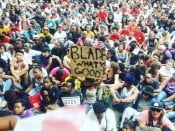
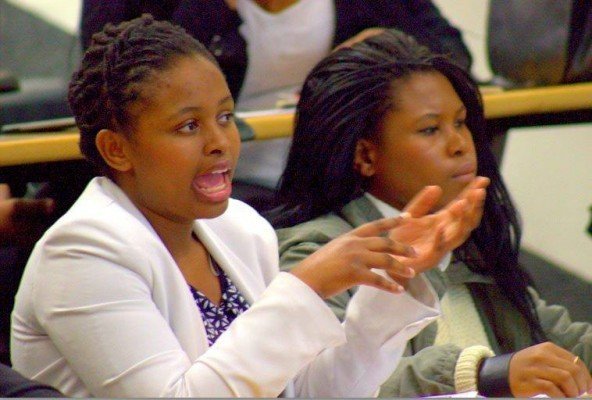
Student and worker protests continue, across South Africa, though it seems that we might be approaching a resolution at my university, at least. Getting back to (academic) work, including examinations and graduations, depends on whether protesting groups trust that they’ve received a good-faith commitment to addressing their demands, and I don’t know if we’re there yet.

But alongside discussion of (legitimate, as I’ve said before) demands, there are always elements on either side that hold things up, whether through acting unlawfully (for example burning books, at one university) or acting in bad faith, such as when academics, staff or other students disparage or insult what is, on aggregate, a coherent and disciplined group of disaffected students and workers.

Discussions get heated, and both the emotions and the urgency of the issues can lead discussions into attempts to make people choose between two extreme positions. Here are some examples:

Can police ever be allowed on campuses?

Answering this with a “no” is obviously correct for many of us, given the role police have historically played in the South African education system, and given the mistrust many South Africans have in the state in general, and the police in particular (thanks to events like the killings at Marikana).

Others would say “yes”, police should be allowed on campus, because they are the only way of dealing with people some of the “yes” group regard as hooligans, uncontrollable in no way besides the threat of legal censure. On this extreme end of the spectrum, the “yes” group is wrong, and is often just unwilling to challenge their own prejudices against those who disrupt the status quo.

Yet, treating the “no” answer as axiomatic would be a mistake also, in that it’s contingently the case that our police, in our circumstances, would be such an inflammatory presence. There’s no problem in principle with having police on campus, at least to my mind, although there’s certainly a problem with it now.

What counts as violence?

Various sides of these debates have cherry-picked examples of violence or non-violence to prove the point they want to make, but the fact of the matter is that the protests have been overwhelmingly non-violent, with the instances of violence I’ve seen mostly being perpetrated by police, or by students after provocation by police.

But focusing just on physical violence allows one to forget that simply not being physically violent does not yet mean that your actions might not be abusive in other ways. For instance, violations of rights are abusive. So, not being able to get to work, or to your car, or not being able to leave a meeting interferes with freedom of movement – and if an atmosphere is hostile enough that trying to assert those rights generates additional anger, we might have concerns even in the absence of physical violence.

Of course, forcing people into uncomfortable situations is one important way of making (or helping) them take your concerns as seriously as they should – so the tactical impulse is certainly understandable. My point is that the moral high-ground of being non-violent is at least complicated by these sorts of instances, and one should be able to discuss this also.

Demands for immediate action

It’s frequently been the case, during these university protests, that members of one or another group have demanded an answer to a complex problem immediately, even if the relevant decision-makers are not in the room. When this is said to not be possible, it’s taken as a sign of intransigence, so one is given the choice of appearing callous, or of capitulating.

Again, there is a middle-ground, because many decisions cannot be taken in the haste one or more parties might prefer. Adam Habib, Vice Chancellor of Wits, wanted time to investigate the economic implications of insourcing services at that university, but his request to have time to form a task-team to do so was mocked as evasive by students on social media.

Yes, asking for time to consider things can simply be a stalling tactic, but seeing as Wits had last considered the matter in depth over a decade ago, and seeing as it has enormous financial implications, it’s the sort of decision you don’t want to rush, and need to make with due care. (Because you might be able to insource some things now, others later, never mind coming up with creative schemes involving worker collectives and the like.)

And finally, is Germaine Greer transphobic?

GermainecropAccording to trans people and their allies, she certainly is. If you’ve been following the “no platforming” debate that has recently erupted around her being invited, then disinvited, and now again invited to speak at Cardiff University, you’d at the very least have been exposed to examples of her saying very dismissive things about trans people.

But as Rebecca Reilly-Cooper points out in this provocative but carefully-argued piece, the fact that someone doesn’t share your understanding of categories like race, gender, sex and so forth isn’t yet, and by itself conclusive of their either denying your humanity, thinking that your political claims aren’t worthy of consideration and so forth. It’s also not obviously hate speech in the legal sense, no matter whether some people find it offensive or not.

Reilly-Cooper presents examples and analysis of the excesses or extremes that identity politics can give rise to – and of course, it doesn’t necessarily give rise to those at all. Folks who want to dismiss her piece will say she’s caricaturing – and of course, a bunch of transphobes will claim her as a champion of their cause too.

You don’t have to make either of those choices, though. You can, as with all the examples I’ve given above and also others, say that our labels and analysis is often faulty, because we’re faulty reasoners with strong emotional commitments to various positions.

And, you can say that our best way of getting better at making good and clear distinctions is to let people speak, rather than demonising them or their views.


#FeesMustFall – the student protests at South African universities

While I’ve co-signed a (as yet unreleased) statement from the academic community on the current student protests, there are of course pieces of that statement that I’d support more strongly than others. I have, however, recently sent the text below out to members of the Free Society Institute, and I reproduce that below for your interest.

https://instagram.com/p/9GTkMnlnnM/

It would not have escaped your attention that students, nationwide, are currently engaged in protests regarding university fees as well as other causes such as the outsourcing of workers on university campuses. In fact, the protests have already spread beyond campuses, with workers and protesters gathering at a local Shoprite to campaign for #ThePriceOfBreadMustFall.

Of all the things that need to – or will – fall, one thing that shouldn’t fall is our deep sympathy for the struggles of those who are unable to gain access to things that some of us take for granted, and are no less deserving of those things than we are. Our understanding of the frustration should also not fall, in that the significant State subsidy cuts to universities are arguably “deliberately retrogressive measures” and also unconstitutional – and yet are also part of what has caused university fees to become a serious barrier to entry.

Despite our sympathy and understanding, there is of course another side to the story – my university, for example, makes the case that fees are set high precisely in order to (at least in part) run the most generous financial aid scheme for poorer students currently available in the country. In other words, a fee cut at UCT could plausibly be described as benefiting the rich rather than the poor, as argued in this related piece by a Stellenbosch academic.

We can also be sympathetic to students and staff – and even just members of the community – who are being inconvenienced in various ways, but some of them significant in that exams are currently being written. Some have felt intimidated, and some have even felt themselves to be victims of violence – but even if true, this would surely pale into insignificance by comparison to the violence of tear gas and rubber bullets.

This is not a time for facile judgments, often made outside of context or awareness of the complexities of how the universities have grappled – sincerely – with these issues. I’m frustrated with the protests myself, at times, because I know how seriously UCT takes the issues that are provoking the protests.

However, that has little impact on the legitimacy of the protests, and (in all but the most exceptional of circumstances) the legitimacy of how they have been carried out. From what I have seen in reaction to the protests – the aforementioned riot police, or racist abuse on social media – there’s no question in my mind that the reaction to the protests has been by far the least legitimate aspect of this situation.

Between 2011 and 2013, student protests in Chile demanded a new framework for education, one that would make it more egalitarian. This is a model of an economy closer to ours, when compared with wealthy countries that provide free education, such as Germany – and Chile has announced plans to do just that also. There are of course practical difficulties, and practical differences. And maybe you’d disagree that education should be a right at all, as it currently is in our Constitution.

These issues are by no means simple, and I am aware of instances in which the protests have overstepped various bounds, including practicality and even reason in the sense that some of the demands cannot possibly be implemented. It is also indisputable that universities should be institutions of elite learning, and that this costs money – money which can currently only come from student fees, at least in part, thanks to declining government subsidies. Yet, education is a right, and it’s one that we’re not fulfilling. No wonder students are angry.

TB Davie Memorial Academic Freedom Lecture 2015 – Kenan Malik

km11The University of Cape Town today welcomed Kenan Malik, who delivered the TB Davie Memorial Academic Freedom Lecture for 2015. As chair of the Academic Freedom Committee, I had the pleasure of welcoming him, and the text of my remarks is pasted below. I’ll link to the podcast of the lecture itself once it becomes available (here’s the transcript in the meanwhile).

Free speech in an age of identity politics – opening remarks

Three recent examples of disagreement regarding identity and its implications are: what is meant by transformation at UCT; what is meant by “black” or “white” in the Rachel Dolezal case; and how should we understand gender and sex, as in discussions sparked by Caitlin Jenner.

Two positions are commonly found when we disagree on issues such as these. First, you’d find a group of people who have borne the brunt of misunderstanding, mockery, prejudice and so forth. Second, you’ll find some who assert that the first group is poorly or incoherently defined, in that they are allied on grounds of purported identity alone, rather than shared arguments or ideas.

Regarding the first group, there’s no question that collectives of people – defined however they would like to define themselves – can mobilize around a shared conception of identity, finding courage, inspiration, ideas, or political heft through association.

And the second group can impede all those goals, often callously. It is surely beyond dispute that glib dismissals of these identities and their concerns can be used to silence, or to entrench existing power structures and so forth.

Consider the idea of “political correctness”, where those who deride the concept are sometimes largely interested either in being abusive, or simply in preserving their ideological positions. You don’t find a discriminated-against group complaining about “political correctness” as much as that complaint occurs amongst heterosexual white males, for example.

Over the weekend, you might have read about a programmer from New Zealand named Byron Clark, who devised a way to illustrate what some folk really mean when they talk about political correctness. He created a web browser script that automatically changed all mentions of the term “political correctness” to instead read “treating people with respect” – with the result that headlines might read “Donald Trump says that treating people with respect is getting out of control”, or somesuch.

But on the other side of the equation, politics premised on identity can also involve a suggestion or demand that those who don’t share the identity remain silent. This last week, in the debate on Amnesty International calling for the decriminalisation of sex work, certain interventions were ruled out of order not because they were necessarily uninformed, but because they came from rich white women, rather than from sex workers.

Of course, the interventions might also have been uninformed – but this feature could itself then serve as sufficient reason to reject them, rather than using the identity of the speaker to do so. In other words, some expressions of identity politics seem to entail that the identity of the speaker either confers – or diminishes – credibility as an independent feature, regardless of what they might be saying.

And yet, the liberal impulse of treating ideas according to their merits can be criticised for assuming the possibility of cultural and value-neutrality – and that possibility might well be a fiction, where it’s simply the case that one set of norms has become the default.

A related question is whether it is politically useful, rather than permissible – in terms of advancing whatever cause is at issue – for people outside of a particular identity to offer comment. If our answer is “no”, then we run the risk of silencing ideas that might be useful. If our answer is “yes”, the consequences would involve hearing at least some uninformed and prejudicial comment, but hopefully also some that adds value.

As a recent article in the New Yorker put it, Mill’s so-called marketplace of ideas is, “just like any other market, imperfect, and could … be improved by careful government intervention”, as in the case of hate speech. One concern raised by identity politics is that the marketplace is sufficiently distorted that not only do the historically advantaged get to define the terms of debate, but also what is worth debating, and that we might therefore want to recognise some self-imposed, socially constructed constraints on speech.

The question in short is: is the classic liberal position regarding free speech simply a way to legitimise existing power dynamics, or is it our best strategy for separating sense from nonsense, and learning which ideas are worth taking seriously?

These and related ideas are among the themes that Kenan Malik has been reflecting on in many of his columns, books, lectures and documentaries for over two decades now. He is the author of 6 books, including “From Fatwa to Jihad: The Rushdie Affair and its Legacy”, which was shortlisted for the 2010 Orwell Prize, and “Strange Fruit: Why Both Sides are Wrong in the Race Debate”, which was on the 2009 Royal Society Science Book Prize longlist. His latest book is The Quest for a Moral Compass: A Global History of Ethics, published last year.

His website, Pandaemonium, is not only a valuable archive of hundreds of thoughtful columns, but also a model of robust and fair debate, where Malik takes time to engage thoughfully with many of his readers – some of whom, as is typical with online comments, seem to have read an entirely different column to the one the author likely thought that they had written!

On Pandaemonium, he tells us that politically, he takes his cue from James Baldwin’s insistence that ‘Freedom is not something that anybody can be given. Freedom is something people take’, before going on to note how the Rushdie affair exposed the left’s partial abandonment of Enlightenment rationalism and secular universalism in favour of identity politics, and how as a result, much of his work is now in defence of free speech, secularism and scientific rationalism. Given his abiding interest in these issues, today’s lecture on Free Speech in the age of Identity Politics will no doubt provide plenty of food for thought and debate. Please join me in welcoming Kenan Malik to the University of Cape Town.

Identity politics, authority and freedom of speech

Originally published in Daily Maverick.

The University of Cape Town’s Academic Freedom Committee (AFC) hosts an annual lecture that explores issues related to academic freedom – the TB Davie Memorial Academic Freedom Lecture. TB Davie led the university as Vice-Chancellor from 1948 until his death in 1955, and is remembered as a fearless defender of academic freedom, including the autonomy of the university.

TB Davie defined academic freedom as the university’s right to determine who shall be taught, who shall teach, what shall be taught and how it should be taught, without regard to any criterion except academic merit. This definition is not without its detractors, with some arguing that the concept of “academic merit” is itself prone to embedding and perpetuating certain biases, in particular biases related to class and race.

Bigotry, free speech and student politics at UCT

Zizipho Pae, current UCT Student Representative Council (SRC) Vice President, posted this Facebook status following the US Supreme Court decision to strike down same-sex marriage bans:

We are institutionalising and normalising sin. God have mercy on us.

pae4-592x400I wasn’t planning on saying anything about this, but the most recent rant from Error Errol Naidoo of the Family Policy Institute is mad enough to prompt a quick response, because he – like many others – are confusing the freedom to hold odious views with a (non-existent) obligation on others to not call them out on those views, and freedom from any consequences expressing those views might incur.

Ms. Pae is free to be a homophobe. She implies that she’s not a homophobe in the video embedded below, but the facts are clear: she labels gay people sinners, and suggests that we are “normalising” sin – in other words, that they are a threat to all of our moral welfares. She has a seriously negative disposition towards gay people, in that she doesn’t want them to have the same rights as straight people.

Dress that up in whatever religious sophistry you like, but any non-religious person would regard that as plainly homophobic. Also, any person, regardless of religious persuasion, should realise that Ms. Pae is instead endorsing an (unconstitutional) ban on gay marriage. So, wrong on the morals, wrong on the law.

She can have and express these views, regardless of the fact that we might prefer that she didn’t feel inclined to such prejudice. Her prejudices are also more common than I’d like, which is exactly why we don’t put basic rights to a referendum.

But holding those views does not protect her from criticism, whether or not she thinks she’s doing a bigoted god’s bidding. The university, and the SRC, have chosen to adopt a certain set of values, and homophobia is in contrast to those values.

She was relieved of her duties as Acting President by the SRC, as they are entitled to do. She has not been suspended or disciplined by the university administration, contrary to Mr. Naidoo’s claims.

Her rights to freedom of speech are not being violated – she chose a more demanding standard than “speech without consequences” when she ran for the SRC (before that, in fact, as simply registering as a student here involves committing to promoting certain values). So, free to speak, but then we don’t want you representing us.

So, there is no “anti-Christian discrimination” here, but rather a defending of what the country, and the university, have chosen as their moral foundation, namely non-discrimination on various grounds. She chose to be part of that community, so needs to follow its rules.

Where Naidoo and Pae do have a point is only with regard to the issue of her office being vandalised, and any threats being uttered against her. Those cases need to be investigated and the offenders sanctioned.

In the meanwhile, it would be absurd to think that the SRC should tolerate homophobia in its senior structures, and perfectly reasonable for them to suspend her, pending fuller discussion and investigation.

You don’t get to insult a large proportion of the students you’re meant to represent without consequence, whether you believe in a god or not.

Rhodes, “mad panics”, and inappropriate analogies

Since leaving the Democratic Alliance, Gareth van Onselen has become one of the more consistently interesting columnists we have in South African media. “Interesting” might seem to be a weasel-word to some of you, but having now spent a few minutes trying to find the right word, I find it’s the best I can do.

His columns are seldom bad, and are sometimes very good. They are often challenging, especially to folks like myself who think of themselves as liberals, and challenging our views – and making us think – is the primary task of a columnist.

It’s true that some use the “liberal” label, as well as his past party affiliation, as convenient means of dismissing van Onselen’s contributions. These critics miss the point, I feel – mostly because those are fairly straightforward ad hominem comments rather than engagements with substance, but also because they see his dogged adherence to principle as evidence of ideological blindness.

Van Onselen isn’t subtle in his criticisms, but they are typically very thoughtful, and thought-provoking for those who choose to engage with them. He is also deeply committed to certain values, which can loosely be described as those of classical liberalism.

He makes no attempt to hide that ideological conviction, and applies it consistently – which means that we can either try to undermine the foundation itself, or his interpretation of it.

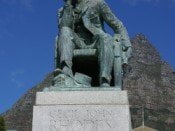
As with the Michael Cardo piece on UCT’s “pathetic capitulation” on the question of the Rhodes statue, I think van Onselen’s recent column on the same topic gives UCT too little credit, and also exaggerates the likely consequences of the Rhodes statue removal.

1339056551-fahrenheit451Furthermore, I find its liberalism unduly prescriptive, in that it asserts that the status quo (at least in terms of the historical record, and the statue in particular) must be preserved, because removing it is to succumb to an unthinking populism, or even worse, a re-programming of society, of language, and of value (as was portrayed in Bradbury’s Fahrenheit 451), rather than seeing how changing the status quo could better serve a liberal outcome.

He also uses the analogy of Brett Murray’s The Spear, and this analogy is to my mind equally poor – not for being hyperbolic (as is the case with Farenheit 451), but because the two things are crucially dissimilar.

You need to read his column (in fact, the transcript of a speech), because I’m not going to do it justice here. There is plenty in it to think about, and to be challenged by, especially if you regard yourself as a liberal. It’s long, and I want to be brief – so apologies for only picking up on a few things below.

First, the column takes a value-laden starting point – the presence of the statue at UCT – as a legitimate normative and neutral starting point. This is why the Farenheit 451 analogy is hyperbolic. If we are liberal, and committed to individual freedom, it is of course a concern if we start privileging certain views (by extension, cultures, artistic expressions and statues) above others.

But the point about the removal of Rhodes (for those who supported that decision, like me) is that its presence did that privileging already, and that its removal is therefore more compatible with this liberal goal, in that it was its presence in such pride of place that resulted in some students being unable to feel as much part of the institution as others.

A focus on the underlying goals and values of liberalism should not be obscured by historical contingencies, and should certainly not be defined by a privileged set of norms that are thought to be beyond question. We can agree that all things being equal, statues should not be torn down, sure – but all things were not equal in this case.

By contrast to burning books, students were forced to see this statue, and to see it as emblematic of their university. They could choose to not read a book, but they could not choose to have the statue standing in pride of place at UCT. There is no reason to burn a book, because you have the option of not reading it – here there was no analogous option.

Likewise with The Spear – the analogy fails because the cases are too dissimilar. An artwork like The Spear is created for a community who typically self-select to engage with it. This is not the case with the Rhodes statue. The Spear was a case in which people were perfectly entitled to their offence, but were not entitled to the remedy of destroying it or removing it.

Neither the Goodman Gallery, nor Brett Murray, are established as institutions for the national good, that are intended to serve an educational purpose while trying to avoid privileging people by virtue of their race, class and so forth. You can object to The Spear, lament its existence, and then move on – it’s wrong to destroy it. UCT, by contrast, is being negligent if it picks at some scab of yours every day you are there.

Our understanding of liberalism should not be allowed to ossify, as I think it can do when we take the current situation for granted, instead of being more Utilitarian about maximising liberty – even when that means changing something about the present (like moving a statue).

As I noted in the third part of this piece on modern challenges to free speech, other aspects of liberalism might need updating also, in that if the environment changes, different sorts of remedies or interventions might work better than those we used in the 19th Century.

Or, as John Maynard Keynes put it, “When my information changes, I alter my conclusions. What do you do, sir?”

Rhodes”Pathetic capitulation” or principled decision? More on #RhodesMustFall

rhodesI’d encourage you to read Michael Cardo’s piece on the “sinister underbelly” to the campaign that has succeeded in having the Rhodes statue boarded up, pending its removal from campus. I seconded the motion to have the statue boarded up, and voted in agreement for its removal, so while you might expect me to disagree with Cardo – and I do – he nevertheless makes many strong points.

The primary challenge he presents is in the form of questioning whether UCT and the Senate lacked courage in making the decision that we did, and whether we capitulated to both illiberal bullying as well as ideologically-flawed arguments in doing so.

I’m sympathetic to the dangers he points out – it’s certainly true that loud and persistent pressure, as well as muddled political thinking, can result in hasty and unfortunate decisions. However, I think that he’s wrong in this particular instance, and that his error rests in regarding all support for the removal of Rhodes to have originated from majoritarianism, mob rule and the worst sorts of identity politics.

Starting at the end of that list, I have to agree entirely with his criticisms of the arguments that come from the likes of Gillian Schutte. Any writer who regards words like “privilege” as trump-cards in arguments is shouting from a pedestal, rather than debating.

As I’ve argued before, though, there’s a difference between the mindless use of a phrase like “check your privilege” and the (correct, and necessary) acknowledgement that privilege exists, and that it can affect our objectivity. In this instance, writers like Cardo are assuming a certain norm, namely that Rhodes is there, and the burden of proof is on those who want him removed.

But there’s no reason that we should accept that as the norm, rather than recognising it as an accident of history, which we now have the opportunity to correct. In other words, can we not be said to be assuming a certain epistemic privilege in saying that the burden of proof is on those who want its removal, rather than on those who insist it should stay?

Yes, something is lost with its removal – but the case needs to be made that this loss (context, history, opportunities for debate etc.) is of more significance than what might be gained. In this case, the obvious potential gain is the sense of a more inclusive campus, and one that is clearly committed to working harder at its transformation goals.

As for our being bullied into this, it’s telling that Cardo only refers to Maxwele when speaking about the student voice. And even though I think Maxwele has been far more articulate than the quote Cardo uses to discredit him with (“I don’t have to justify anything to a white male or a white institution. Nothing whatsoever.”), even if he were not, there are many other student views that are persuasive to varying degrees.

Also, it’s not as if we only relied on student views. I’ve been party to four different staff debates on these issues now, where in each case, the pro-statue people were persuaded by arguments, rather than persuaded to shut up because of the negative political consequences of their view.

Cardo notes the possibility that “the senate [sic] was swayed by arguments so persuasive and unassailable that it had no choice but to heed the demand that #Rhodesmustfall”, but seems to have done no work in establishing whether that was the case or not – he segues from there immediately into his caricature of Maxwele as an intransigent racial nationalist.

Two other brief points – first, moving the statue is not necessarily equivalent to “erasing… the historical record”. For one, as per my burden of proof point above, it could be said that his presence erases another historical record, and that these protests were sparked by that. We can argue that a method needs to be found to note both (and potentially other) historical records, but that while we do that, this thing – that some find offensive – has to go because the negatives of its presence outweigh the positives.

It could return once we’ve figured out what to do, or something else could go up that does a better job of representing history. But to glibly assert that taking it away is equivalent to erasing a historical record begs the question of whether it necessarily does so, and furthermore assumes the primacy of a particular historical record – in other words, it also assumes that conclusion before the argument has even been conducted.

Lastly, seeing as Cardo’s argument rests on the view that as a “liberal” university, UCT should be embarrassed by acceding to “illiberal” demands for taking the statue down, I must note that I also reject his understanding of what a liberal is, or rather, what a liberal perhaps must be, since I read him as being quite ironically prescriptive on this point.

Broadly speaking, a liberal values liberty (surprising, I know), and attempts to secure that via vehicles such as democracy, rights and so forth. In terms of free speech in particular, this statue case could be interpreted as an example of Mill’s “marketplace of ideas” in full-flow, where the arguments in favour of taking it down won the day. That’s what I think happened.

Or, you can frame it as UCT having bowed to pressure – in effect, having been held to ransom. And there’s a danger of a false dichotomy here also, in that while I think that (some of) the students acted shamefully at times, that’s a separate issue to whether they – and the staff who support their arguments – are correct or not.

More broadly, the liberalism I subscribe to recognises the human flourishing that can result when people are treated equally, respectfully and so forth. Keeping a statue of an arch-colonialist on campus, in such pride of place, sends a signal that can quite plausibly be read as a lesser commitment to the interests of some rather than others.

I would have kept it on campus, and that was in fact the first proposal that Senate debated, before an amendment suggesting it be removed entirely was proposed. In later years, we might decide to bring it back, and have it form part of some new installation.

But whatever happens, there will no doubt be some significant recognition of what was in his place, and why it was moved. We’re not obliterating history at all, in other words – we’re making it.

UCT Academics Union statement on #RhodesMustFall

Rhodes_250x374On Monday (23 March), the UCT Academics Union (AU) met to discuss the statement released by the Executive of the AU. As a long-standing member of the AU, with a keen interest in the Rhodes statue and the University’s business in general, I attended for the purpose of supporting the statement, and also to join those arguing that the AU needed to say and do more in the coming weeks and months.

Needless to say, not everyone was on board – some thought that the students had gone too far, and that the Executive statement should have been more critical of them. But a majority sentiment was that the AU as a whole wanted to release a statement, and that it should express more committed support for the #RhodesMustFall movement.

More to the point, many of us desired to note our “past systemic failure to successfully engage with and pay attention to the experiences of marginalised voices on campus, especially Black students, academics and other staff”. As the academic staff at the University, we need to offer intellectual leadership, and on this issue, we’ve failed to do as much of that as we should.

You can read the AU’s statement below. In a poll that closed this morning, it garnered the support of over 70% of our membership. I do regret that the figure was not higher, but it’s of course possible that some of those who did not support it did so because they thought it didn’t go far enough.

A broad consensus statement will never satisfy everyone – work done by committees and collectives seldom does. Nevertheless, I voted in support, and am glad to be part of a union that was willing to make this statement.

UCT Academics Union statement on #rhodesmustfall

27 March 2015

Regardless of race, gender or rank, we are committed to excellence in higher education; and to the training of the next generation of South African leaders and academics. Engagement, debate and dialogue are essential and intrinsic to the academic project. UCT’s failure, over a period spanning decades, to address the institutional racism inherent in the naming of buildings and siting of objects on campus represents a signal failure to engage meaningfully with the symbolism of South Africa’s past, and with the university’s ‘heritage that hurts’.

That it has taken extreme action to bring the university to a realisation that urgent remedial action is required on the statue, and more importantly, for what the statue symbolises for the institution’s commitment to transformation, is itself testament to a past systemic failure to successfully engage with and pay attention to the experiences of marginalised voices on campus, especially Black students, academics and other staff. The AU acknowledges and accepts that it has been complicit in this failure. Had the university, including the AU, been more attuned and empathetic to these issues, the protest might not have taken the form it has.

It is the AU’s position that the statue has no place in its present position on campus. Nor is it relevant whether or not a majority of students, staff, alumni or Council members believe that the statue should be moved. That the statue is not appropriate on campus in its present position, where members of the university community are confronted with its hurtful symbolism on a daily basis, should be self-evident.

The AU believes that removing the statue from its present position is an essential first step towards creating the space for engagement, debate and dialogue on the pressing matter of institutional transformation at UCT. The AU calls on the Executive, Senate and Council of the university to support the call that the statue should be removed as a matter of urgency. We understand that constituencies external to the university, such as SAHRA, might need to be consulted. Should they be necessary, these consultations should commence as a matter of utmost priority so that delays in coming to a resolution on the statue are kept to an absolute minimum.

The statue, of course, has broader symbolism, raising important questions about structural and institutional transformation. As an important UCT constituency, the AU agrees with the students that there are specific issues relating to transformation that require the urgent consideration and engagement of academic staff. The most pressing of these relate to

  • The institutionalised discrimination, including racism, sexism, homophobia and transphobia and ableism, experienced by staff members at UCT;
  • Questions relating to curriculum content and design, and whether these are as appropriate as they should be in the context of transforming higher education in South Africa;
  • Ensuring greater transparency of the ad hominem process, to ensure that artificial barriers are not being placed in the path of marginalised staff members seeking promotion.

Starting in the second term, the AU will convene separate fora on each of these topics. These fora will engage members, as well as important stakeholders and interest groups, and will specifically seek to provide a platform for the careful articulation and identification of problems, as well as ensuring that marginalised groups are provided a safe and responsive space to express their views. Our first task is to listen, to understand, and to empathise. Thereafter, we urgently need to find and propose solutions and policies that address these in such a way to ensure that the transformation of UCT is advanced.

Transformation, and the challenging of institutional racism is not an issue important only to a few sections of the UCT community. If we all stand together and openly embrace and enact transformation, we will contribute towards a more inclusive, and unified university.

The engagement proposed represents a significant shift for the Academics Union at UCT. For too long, the Union has been too parochial, concerned only with relatively uncontroversial questions of working conditions, and representation of members’ concerns and grievances with UCT’s management. The AU has no intention of abandoning or downscaling these activities. However, by taking on the issues above, we will be able to more meaningfully represent all UCT academic staff, and thereby build a stronger Union.

The UCT Academics Union

#RhodesMustFall, race and essentialism

575fc635e692409d82cb27b378a5476cThe UCT protests sparked by Chumani Maxwele on March 9 are ongoing, with Students Representative Council members and other students currently occupying the Bremner building, where the Vice-Chancellor and other members of the executive sit.

As I said in my previous post on this, I do think that Rhodes should fall. But I also think that there’s scope in protests like these to be politically expedient, intellectually lazy, and also to fall victim to a (typically) well-intentioned but ultimately dangerous form of identity politics.

The identity politics I refer to are in the imagining of communities of agreement, to modify Benedict Anderson’s construction. In the worst manifestation of this (in a South African context), we might imagine that those communities are defined by the simple characteristic of “race”, but one can also wrongly conflate all sorts of beliefs under a category like “liberal”, as Xolela Mangcu does in a column today.

Sharing a skin colour, a nationality, or a gender (etc.) offers no guarantee of sharing opinions or ideologies. Yes, some inferences are reasonable – for example, in a country like South Africa, I think it immediately more likely that a white South African will be somewhat oblivious to his or her structural advantages.

White South Africans benefited from apartheid, and continue to do so. Some of us don’t acknowledge that, to be sure. But the fact that we did benefit from apartheid should not mean assuming bad faith when we speak about race and discrimination either – interlocutors should still be willing to hear arguments and judge them on their merits.

On the other side of that coin, being a member of a disenfranchised or oppressed group of whatever sort doesn’t automatically confer virtue on arguments or behaviour. It might be the case that your cause is more likely to be urgent, yes, but we have no guarantee of this.

The Rhodes protests going on at UCT are justified, and it is to our discredit that it has taken so long for the Rhodes statue to be an issue. But I do fear that some students are not being encouraged to think and debate by these protests, but rather to be dogmatic, and to make judgements according to simplistic categories like race alone, rather than arguments.

Any of you who have looked at comment threads on this might know what I mean. I also have privileged access, in that the discussion forums of my 1st-year course at UCT have carried much commentary on the protests, the statue, and transformation at UCT.

There is little consensus, and many students – across whatever categories you want to divide them into – are not supportive of certain aspects of the protest. Their complaint, and one I agree with, is that it’s antithetical to the purpose of a university to refuse to discuss something, as the SRC are doing by demanding that a date for the statue’s removal be provided before they engage in dialogue.

But what’s also going on is plenty of simmering racial judgement, where good faith or bad faith is assumed, based largely on race (as judged by the name of the student). In other words, prejudice, if not necessarily of the naked sort.

On social media, some folks are still talking about Maxwele and excrement, as if that’s the only issue – or even an issue at all. It’s not, really – it’s a detail trivial enough that focusing on it simply marks you out as someone desperate to deny the legitimacy of the protest.

There is scope for various lazy arguments, and for various easy forms of prejudice, in situations like these. Given that this protest is likely to go on for some time – and (rightly) focus attention on transformation more generally – everyone involved will hopefully remain aware that when emotions run high, we can lose sight of subtleties.

However things end up going, this is going to be one of those moments in time that gets recorded as part of UCT’s history. Let’s all do our best to make that history one that we can be proud of reading, and shaping.