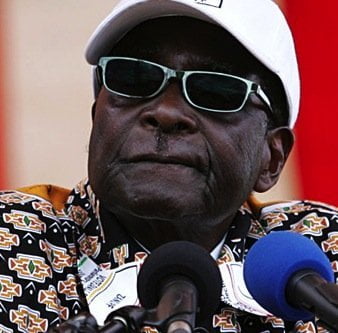
Mugabe’s “thuggish, incompetent and corrupt” Zanu-PF

20130727_LDP004_0The title of this post quotes a leader in The Economist this week. It’s worth reading, as is a more substantial treatment of Zimbabwe’s state in the same newspaper. It’s good to see the international media focusing on Zimbabwe, because the South African government – in particular “Number 1”, or Jacob Zuma – seem quite reluctant to do so. For those of you who have forgotten, and for some foreign readers, bear in mind that the current president of Zimbabwe, Robert Mugabe (on the Iron Throne for 33 years now) comprehensively lost the first round of presidential elections in 2008. The opposition Movement for Democratic Change (MDC) also won the parliamentary poll.

But, the leader of the MDC, Morgan Tsvangirai, declined to compete in the second round of the presidential elections, because Zanu-PF supporters had in the meanwhile murdered around 200 MDC campaigners. And as The Economist reports, the army, the police, the media and the courts are all sympathetic to Mugabe (or perhaps, sympathetic to staying alive) – so little can be done to end these injustices.

On top of that, the electoral commission, and the registrar of the voters’ roll, also seem to be in cahoots with Mugabe, who has sprung a surprise by moving the election date forward, making it more difficult to police that voters’ roll, in order to remove the suspected thousands of dead people who are listed on it, and who will surely be ‘voting’ for Zanu-PF come July 31.

So, what is South Africa – the ‘Rainbow Nation’ and supposed exemplar of democratic best-practice doing about this? Well, as in 2008, the answer is … nothing. Or worse than nothing, in that even mild criticism of Zimbabwe’s readiness to hold elections has been suppressed by our President, the reliable embarrassment that is Jacob Zuma.

The South African Development Community (Sadc) is monitoring the elections, and the Sadc’s mediator in Zimbabwe is Zuma. Last time around, the Sadc declared the (obviously tainted) elections free and fair, and there seems little doubt they’ll do so again, at least with someone as morally flexible as Zuma at the helm. We must pity folk like Zuma’s foreign-policy adviser, Lindiwe Zulu, who last week raised concerns regarding the legitimacy of any election in Zimbabwe before the 2008 electoral reforms were implemented.

Mugabe responded by calling her a “stupid, idiotic woman” and a “street walker”. The South African Presidency’s response? A statement “distancing itself from Ms Zulu’s, ‘unauthorised’ and ‘regrettable’ remarks”, to quote a Business Day report. And today, I read that Tsvangirai’s election organiser has been arrested, just days before the election. Yes, regrettable indeed to point out election-rigging and corruption, Mr Zuma – after all, we don’t want people to think too hard about issues like the latter one, do we?

Outside of election-rigging, Mugabe is more generally an man who routinely says things like “Tutu should just step down, because he supports gays, something that is evil. We say no to gays” or “Obama is one of us – African – but his support for gays is very wrong. The Americans want us to embrace gays. I say go away with your money as long as you support gays”. Odious, in other words, and worthy of general condemnation.

But, after July 31, I have little doubt that the elections will be declared “substantially free and fair”; fear that Mugabe will most likely hold on to power; and am fairly certain that Jacob Zuma will never say a word about how his big man friend up North embodies the opposite of much of what South Africa’s Constitution holds dear. And why would he, when he’s appointed a Chief Justice who seems to hold similar views?

EDIT: Just spotted on Twitter – an account of documents allegedly detailing exactly how Mad Bob plans to steal next week’s elections.

EU Guidelines on religion and belief

P010346001The EU Foreign Affairs Council recently adopted a report with 71 Guidelines on freedom of religion and belief. And while the guidelines don’t have legal force (EU guidelines that end up being legally enforceable are “regulations”), they nevertheless offer a clue as to the direction that particular councils are hoping for legislation to go. Furthermore, they send a strong political signal, especially with regard to emotive issues like religious freedom. In that context, these particular guidelines make for heartening reading.

There are 71 guidelines, and if you’ve got a moment to read them all, you’ll find plenty to applaud there. Some of the ones I’m most pleased to see are these (my emphasis):

  • “All persons have the right to manifest their religion or belief either individually or in community with others and in public or private in worship, observance, practice and teaching, without fear of intimidation, discrimination, violence or attack. Persons who change or leave their religion or belief, as well as persons holding non-theistic or atheistic beliefs should be equally protected, as well as people who do not profess any religion or belief.”
  • “The right to freedom of religion or belief, as enshrined in relevant international standards, does not include the right to have a religion or a belief that is free from criticism or ridicule.”
  • “The EU does not consider the merits of the different religions or beliefs, or the lack thereof, but ensures that the right to believe or not to believe is upheld. The EU is impartial and is not aligned with any specific religion or belief.”
  • “Coercion to change, recant or reveal one’s religion or belief is equally prohibited. Holding or not holding a religion or belief is an absolute right and may not be limited under any circumstances”.
  • “Freedom of religion or belief protects every human being’s right to believe or to hold an atheistic or non-theistic belief, and to change religion or belief. It does not protect a religion or belief as such. Freedom of religion or belief applies to individuals, as right-holders, who may exercise this right either individually or in community with others and in public or private. Its exercise may thus also have a collective aspect. This includes rights for communities to perform “acts integral to the conduct by religious groups of their basic affairs”. These rights include, but are not limited to, legal personality and non-interference in internal affairs, including the right to establish and maintain freely accessible places of worship or assembly, the freedom to select and train leaders or the right to carry out social, cultural, educational and charitable activities.”
  • Certain practices associated with the manifestation of a religion or belief, or perceived as such, may constitute violations of international human rights standards. The right to freedom of religion or belief is sometimes invoked to justify such violations. The EU firmly opposes such justification, whilst remaining fully committed to the robust protection and promotion of freedom of religion or belief in all parts of the world. Violations often affect women, members of religious minorities, as well as persons on the basis of their sexual orientation or gender identity. In dealing with possible violations, use will be made of existing EU human rights guidelines, notably the guidelines on the promotion and protection of rights of the child, on violence against woman and girls and combating all forms of discrimination against them, on human rights defenders, on torture and on the death penalty, as well as the forthcoming EU guidelines on the enjoyment of all human rights by LGBTI persons, and on freedom of expression on line and off line.”

To summarise a common thread in some of these guidelines, and a common-sense point: believe whatever the hell you like, and let others do the same. But your beliefs can never be used as an excuse to harm, oppress, impugn or otherwise malign someone who happens to not share that belief, or who has no religious beliefs at all. The EU Foreign Affairs Council should be applauded for this sober-minded and useful document, which will no doubt attract plenty of outrage from those who feel the grip of religion loosening its hold on the minds of increasing numbers of people all over the world.

Please look after the place while I’m gone

Originally published in the Daily Maverick

imagesIt’s time for a holiday. In a literal sense, because I am about to go off to a conference in Las Vegas (where some amount of holiday is difficult to avoid), but also in the more general sense of taking a break from what has become routine. One of those things is obsessing over the nuances of South Africa’s racial politics, and another is this column.

The optimism on display at the Agang launch earlier today was good to see. Many of you might share my fatigue at the constant succession of stories that don’t promote optimism – from the classification of the Nkandla report as top secret, to the ad hominem abuse of opposition parliamentarians. Last week, we even heard the absurdist – yet sadly apposite – story of how the very ambulance taking Mandela to hospital ran out of energy.

In the midst of all this, I had a Twitter argument with a black man over Dan Roodt – where I was criticising Roodt’s myopic nationalism and cherry-picking of evidence related to who was killing more of whom, and my interlocutor was defending Roodt’s right to hold those views. As long as the argument went on, I couldn’t persuade this man that while I agree that Roodt’s views can be held and freely expressed, we should certainly be on the same side in condemning them.

So, it’s a South Africa where a white liberal can now find himself disagreeing with someone (who has almost certainly borne a larger share of apartheid’s burdens) over whether a racist Afrikaner nationalist has a worthwhile point of view or not. These are strange days, indeed.

This isn’t to say that I share the pessimism that many seem to feel. I’d like to take a break from a certain form of engagement, a certain sort of discourse. Many of you might already avoid social media for exactly this reason – it’s too full of over-confident ad hoc opinions that tend towards the extremes. Depending on who you listen to, either we’re doomed or we’re in great shape, with little room for any position in-between.

The truth is most likely in-between, though, as it ever is. We’ll one day be rid of Zuma, and we’ll one day somehow get to a stage where we’re a democracy in more than only name – in other words, where the incumbent party feels the real possibility of losing power, and is thus fully motivated to do its job.

In the meanwhile, there’s plenty going on that’s far more local, far more manageable, and where it’s far easier for any and each of us to make an impact. If there’s no community project you can or want to get involved with, give to an organisation or charity that does things you support – Equal Education, DignitySA, a hospice, a hospital.

And, easiest of all, remember that each of us incentivises (and dis-incentivises) certain attitudes, behaviour and speech every day, simply though what we present to others as permissible or advisable. If you have kids, they will learn about how to treat others through you. If you have students, they learn how to think through you. Even in matters most prosaic – if you keep jumping the red light or rolling through the stop sign, don’t be surprised to see that behaviour becoming common.

In short, we can all contribute to upholding a social contract without indulging in the sanctimony of a LeadSA – and our despondency at the examples set by government sometimes allows us to forget that. We might think: with such a rot at the top, what difference does it make what I do? But for all the large-scale importance of what happens at the top, we affect each other’s lives frequently, and could sometimes do with a reminder that not everything can be blamed on the man in the high castle.

One of the things I’ve tried to do in most of the 158 columns I’ve written for the Daily Maverick is to deflate our certainty on various firm convictions. This is because oftentimes, it seems that we cede our responsibility to come to a reasoned conclusion and instead settle for something ready-made by emotion, political conviction or some other powerful force. In consequence, we’re less able to talk, debate and learn, and more often compelled to resort to the safety of stereotype.

In a young country, with a crippled education system, a corrupt administration, widespread economic inequality and still-seething racial tensions, the last thing we’d want to do is to stop thinking. So let’s not – and let’s keep encouraging each other to keep at it too. I’ll certainly be back to play my part – at this point it’s just not clear where or when that will be.

Parliament – where dead sheep savage one another

Originally published in the Daily Maverick

tumblr_lt41l0pGYC1qdhgq4o1_500When insults are traded amongst groups of friends, we can get away with being more abusive than we would with strangers. If your name is Dorothy Parker or Oscar Wilde, your insults are perhaps easier to forgive because they’re funny, or because we must admire your wit, even as it makes us wince.

But if insults are a substitute for argument – if they are all we have to contribute – then we should rather consider the option of remaining silent, lest we make a fool of ourselves, while exposing all those who support our insults as fools themselves. We should consider the option of silence – or of diplomacy – even if the insult serves the short-term goal of a rhetorical victory.

There are many things that work towards achieving a desired goal, but at a cost. You could silence your child through administering a mild sedative, but don’t be surprised if you’re condemned for doing so. And even where some of our means toward a goal might not be illegal, the standard of the law is not the only relevant one. It’s society’s job to help regulate conduct more generally, and to generate the sort of society that we can enjoy living in.

This holds true for standards of conduct (for example, trying to avoid drowning out all other conversations in a restaurant with your excessively-loud banter) as well as the content of our speech. If we don’t demand sense, interpretive charity, and a certain amount of civility from each other, the absence of those things can increasingly become the norm.

To appropriate a passage from John Stuart Mill’s “On Liberty”, if society lets “any considerable number of its members” think that insult should succeed as well as argument, rendering them “incapable of being acted on by rational consideration of distant motives, society has itself to blame for the consequences”.

So it is in Parliament, or perhaps in politics more broadly. When insults start coming in the form of excrement, as was recently the case in the Western Cape, we get a clear signal of one of two things: either that people are sufficiently disgusted by how they are being looked after that faeces are in fact most apposite to their anger, or that they don’t have the knowledge or arguments necessary to express that anger.

There are many permutations between those extremes, and the extremes are both crude. My point is merely to say that a form of protest that offends our sensibilities could (in a logically possible sense of “could”) nevertheless be appropriate, under the right circumstances. However, there are other circumstances in which it’s clear that offending our sensibilities is a simple substitute for having nothing useful to say, or not having the words to say anything useful.

Consider ANC MP John Jeffrey, who said of DA Parliamentary Leader Lindiwe Mazibuko last week: “While the honourable Mazibuko may be a person of substantial weight, her stature is questionable”. It’s not the possible sexism of this comment that’s the only notable thing. It’s also the fact that some people seem to think these insults the height of wit, judging from the television footage. Tell a fat joke and have MPs rolling in the aisles? I can’t imagine how they manage to keep breathing during a Leon Shuster movie, if that’s the level of humour that works on them.

I say “possible sexism” above because I don’t intend to make the case that it necessarily is sexism, although that does seem likely given the relative infrequency of comments regarding the girth of male MPs. Besides, the comment doesn’t need to be sexist to be ad hominem.

And yes, it’s true that members of the DA have levelled the same sort of abuse at ANC MPs. Helen Zille is reported to have commented to Zodwa Magwazao that there “is only one elephant in the room” (although this remark was, I think, ambiguous enough to be a problematic example for this column’s purposes) and Theuns Botha once likened the ANC’s Lynne Brown to a hippopotamus.

It’s also true that the same sort of thing happens in the UK Parliament, although my impression is that the calibre of the wit on display there typically exceeds that of the examples here. But even when it doesn’t, there remains a crucial difference between the House of Commons and the South African Parliament: a constituency-based system.

If an MP has nothing to offer but insult – or if their insults are insufficiently entertaining – voters can remove them from office at the next election. MPs are accountable to citizens, and not only to party leadership. Sometimes, accountability itself seems an impossible dream for us in South Africa, when the ANC Chief Whip’s response to Jeffrey’s remark is to excuse it as a pun, while simultaneously criticising Mazibuko’s fashion sense.

If I didn’t know better, I might call that victim-blaming. But it’s not – it’s simply a distraction and another ad hominem attack. And even though it’s true that Zille and Botha have been guilty of similar offences to Jeffrey’s, it remains possible to point this out in a way that nevertheless apologises – sincerely – for Jeffrey’s remark. A retort of “you too” (known to some as the logical fallacy tu quoque) is also evasion, and a juvenile one at that.

I’m not arguing that MPs shouldn’t be allowed to say the things they do, regardless of how juvenile their retorts might sometimes be. Robust debate must allow for offence, not only because we sometimes need reminding that our own standards of acceptable conduct aren’t sacrosanct, but also because without it, we’ll never get to know which MPs tend to believe and say offensive things.

Beyond the rules governing what is and is not appropriate language in Parliament, there’s also a market for what’s “unparliamentary” or not. Our market could be improved through a constituency system, but it nevertheless exists, and the Whips and other party leaders run it.

Ultimately, of course, the voters run it too. So if you want to appear to be a sexist windbag, you’re free to do so. And if your Chief Whip wants to inform us of your upcoming fauxpology while adding another insult, he should be free to do so – just as we’re free to punish your party at the ballot box if we so choose.

Having said that, I’d think it an over-reaction to punish a party for the conduct of individuals inside that party. I mention the possibility simply because the individuals in question sometimes don’t seem to care about substance rather than rhetoric, and could perhaps do with a reminder that we do care for substance.

The problem, in short, is that these rhetorical tricks and insults are the best that many of them have got – and I’d still like to believe that we deserve better.

Freedom of speech doesn’t come with a guaranteed audience

Originally published in the Daily Maverick

Phumlani-Mfeka-e1369903581366-250x250During one of Dara Ó Briain’s stand-up shows, he ridicules the way that panel discussions sometimes include lunatic views “for balance” (watch the clip below). His target in this skit is homeopathy and pseudoscience more broadly, but the general point he makes is that we aren’t obliged to offer a platform to any opposing view, no matter how entitled the holder of that view might be to believing what they do.

We can distinguish between your moral right to believing in something, rights to free expression of that belief, and then any obligations that others might have to listen to or even publish that belief. Crucially, defenders of free speech are not inconsistent in refusing to entertain any given view – they would need to actually attempt to stop you from expressing it.

What this means is that censorship, or violations of your freedom of expression, would typically only be something that a government could do. But when we speak of controversial things in the media – for example racism – there seems to be a view that not publishing racist rants constitutes censorship.

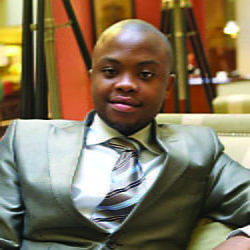
The City Press generated a debate on exactly this issue last week, when they chose to publish an anti-Indian screed by Phumlani Mfeka in which he reminds Indian citizens that they have never been comrades, and that they should “realise that Africans in this province [KZN] do not regard Indians as their brethren and thus the ticking time bomb of a deadly confrontation between the two communities is inevitable”.

Some of us were quick to denounce the publication of this piece as an instance of editorial failure, for reasons that I hope to make clear here. I also want to argue that refusing to publish a piece such as the one in question violates nobody’s rights to free expression, and is certainly no betrayal of your covenant with readers.

To start at the end: a newspaper can’t be obliged to publish everything. Someone on Twitter told me that “media must reflect all opinion to allow rebuttal”, but this is quite clearly nonsensical. If all opinions must be included, all publications would need to be infinite in length (and could never in fact go to print, since you’d have to spend an infinity looking for the nth variation of any given opinion).

Secondly, that view is nonsensical because editorial decisions to include or exclude content are are made all the time, for various reasons. One piece might be cut due to space considerations, another because it’s dated, and yet another because it’s too poorly written. And then, we can also choose to not publish something because it’s rubbish.

In whose view is it rubbish, I imagine some asking? The editor’s view is the answer – for that is his or her job. The editor has a certain vision for what the newspaper should carry, and for what sorts of ideals or ideas it is intended to highlight. Neither the City Press – nor, fortunately, most of our newspapers – carries horoscopes. Yet we would not humour an astrologer’s claims that his (I use the masculine because I’m reminded of Primedia’s CapeTalk567, who give stargazer Rod Suskin a full hour every week) right to free speech is being violated as a result.

So the City Press could have chosen to not publish the piece in question, without violating anyone’s rights. While it’s true that we sometimes want to hear what the racists are saying – both as a safeguard against soporific versions of the Rainbow Nation narrative, and in order to expose and rebut them, no particular newspaper is obliged to give space to particular types of bigotry.

Choosing to include content like this signals either inconsistency (why anti-Indian racism, and not homophobia, blasphemy, or articles advocating incest – they all raise “debate”, after all) or a willingness to enter the tabloid space, where you stop pretending to have editorial standards at all, and just pander to sensation.

The column has become a springboard for debate, in that we’ve already seen responses from the editor, Ferial Haffajee, and others. But while debate can be constructive and even sometimes necessary, let’s not make the mistake of assuming that it’s always any of these, nor that you can’t have this debate without publishing the likes of Mfeka.

While we know that racism exists and is even fairly prevalent, it nevertheless comes in different degrees of sophistication. This is true for all views, and we – as editors, publishers or simply conversationalists – indicate what our minimum standards of coherence and sense are through which of those views we decide to engage with.

If there are sophisticated racists out there, and we imagine ourselves to be a sophisticated discussant, we’ll talk to them rather than to Hendrik Verwoerd. Likewise, we might discuss same-sex marriage with someone other than the leader of Westboro Baptist Church, and evolution with someone who at least agrees that the earth is more than 6000 years old.

What we might prefer not to do is talk to, or publish, views that are so simple-minded that the only function they can serve is as a springboard for ridicule (if you’re feeling uncharitable) or sympathy (if you’re not). This has no bearing on anyone’s right to hold that view, or your right to publish it.

But those rights don’t come with the obligation to publish. And as a superb recent essay by Mark Rowlands puts it, the reader has the right “to be completely uninterested in views that you find stupid or abhorrent”.

It is of course up to those who manage content to decide what to publish. But just as readers can and will ignore some views, it’s a small step from ignoring views to ignoring platforms for those views. The racist, misogynistic or homophobic trolls have enough places to congregate already – let’s not give them the City Press too?

City Press Editor-in-Chief, Ferial Haffajee, has subsequently commented on the reasoning behind publishing Mfeka’s piece.

A culture of dying

Originally published in the Daily Maverick

623156_314164Kabelo Mokgweetse ran away from his initiation school in Pampierstad in November last year, to look for food. He was tracked down and thrashed with a sjambok, before having his feet burnt as further punishment. Then, he was left for dead at the side of the road, where a passing motorist happened to spot him.

Initially only his toes were amputated, but the nerve damage eventually required further surgery, where his right foot was removed in its entirety, along with most of the left. The question that’s difficult to ask – never mind answer – is whether he might prefer to instead be one of the 23 youth who recently died as a result of initiation ceremonies in Mpumalanga.

Mokgweetse and thousands of boys like him are sent (and often willingly go) to initiation schools to mark the transition between boyhood and manhood, undergoing ritual circumcision and being instructed about their social responsibilities. And in most years, children die in the course of “becoming men”. It’s so typical, in fact, that a government news agency can use a headline like “Traditional leaders welcome no initiation deaths”.

That headline was for a story about Limpopo in particular, and dealt with the 2010 season, where attendance at initiation schools was reportedly down by 75% thanks to the World Cup. Limpopo does seem to be a province that has taken the health of initiates particularly seriously, with deaths in the low single-figures for the past few years.

The key question that arises for outsiders like myself is this: do the children who go to initiation schools, the parents who send them there, and the Ramophato (initiation school owner) think that this is a fair price for preserving these cultural practices? And if one death is a fair price, how many would be too costly?

Part of the reason for the continued survival of poorly regulated initiation schools is surely that they provide a narrative to life – a structure, and a reinforcement of community and communal values. But if those goods can be acquired at a lower price – and they undoubtedly can be – then the dozens of deaths we’ve seen so far this year are surely not only too many, but also reason for widespread outrage as well as legal action against those responsible.

Because this is a matter of culture, though, people prefer to tread lightly, tempering their criticisms with politically correct noises about tolerance and respect. But isn’t this in itself condescending, perhaps even racist? Could we instead wonder whether, if the average adolescent in Mpumalanga knew that they had a decent prospect of a good education, a good job and so forth, they’d rather be joining protests against such schools – opting for medical circumcision at the very least, if not entirely rejecting cultural instruction of this sort?

But it’s been – and will continue to be – a long wait for more people to have a better shot at a good life through adequate healthcare, education, and those goods many of us take for granted. And what we put in place as substitutes to give meaning to life – namely cultural practices such as these – result in initiation schools, genital mutilation, corrective rape, culturally embedded homophobia, sexism and so forth.

“Culture” is used as an excuse for all sorts of things (in South Africa, often as a simple vote-getter). But it’s only when you get to choose what your “culture” is – and not have it forced upon you – that it stands a chance of being respectable. And even then, it should never be a stand-alone justification for doing or believing something.

Culture can explain why we do things, even if they appear to be irrational to outsiders. Justification is a different matter, though – if not, how could we complain if a Eugene Terre’Blanche, for example, cites culture as a reason to keep black slaves? Culture cannot serve alone as a reason for doing something.

Equally, culture should not serve as a reason to avoid intervening when needless deaths can be avoided. Last week, a caller to Radio702 recounted his experience of an initiation school (where a close friend of his happened to have died). The caller, Sam, explained that deaths were common thanks to initiates being deprived of water until the last week of proceedings, and also poorly fed – meaning that they had few physical reserves to cope with the gruelling nature of the rituals.

Furthermore, they would also be less able to fight off infection, more common as a result of the lack of qualifications of many who perform the circumcisions. All of these factors can be managed, and to some extent have been managed in Limpopo. This is clearly not the case in Mpumalanga.

Interviewed on eNCA, the MEC for Health in Mpumalanga said that, as a woman, she couldn’t get involved. Her precise words were: “This is a tradition. This is a tradition. So in other tradition whether there are deaths or what but a woman can’t come closer to that”. A competing tradition here involves avoiding needless death, and doing your job. Someone who chooses the tradition of turning a blind eye to death deserves to lose her job, at the very least, and seems at least partly responsible for any future deaths.

Appeals to culture, tradition and the like have causality entirely back-to-front: things could become cultural norms because they are good norms; but the fact that something is a cultural norm has no bearing on whether it’s a good or respectable norm or not. And a cultural practice in which there is no age of consent, poor or no medical oversight, and wilful ignorance on the part of government officials is problematic, to say the least.

“Only God knows who’s going to die, when” was Msebenzi Masombuka’s (a representative of King Mabhoko) comment following the deaths in Mpumalanga. Even if one does believe that, we’d still present ourselves as candidates for earlier or later deaths, through our actions or inactions.

Or sometimes, it’s others we present as candidates for an earlier death. And we sacrifice them on the altar of “culture”. In May 2013, culture killed at least 23 boys – yet we should respect it, just … because.

Mantashe wants to help you “Know your DA”

Originally published in the Daily Maverick

130418daThe headline “DA’s campaign a desperate propaganda” left me quite sure that the text was going to be one of those overwrought reader-contributed op-eds, or at worst a product of Jackson Mthembu’s excitable pen. The content did little to challenge that assumption, leaving me quite surprised to see the name of ANC Secretary General, Gwede Mantashe, adorning the foot of the column in question.

The campaign he refers to is of course “Know your DA”, the first of the Democratic Alliance’s campaigns for the 2014 elections. The campaign attracted criticism right from the start, when Helen Zille’s launch speech neglected to mention Tony Leon, who led the party throughout most of its growth from 1.7% to 12.3% of the national vote.

I’d be annoyed by this if I were Leon (though not as annoyed as Rhoda Kadalie apparently was, in comparing Zille’s “airbrushing of history” to that of Stalin (she’s since deleted the tweet), but I think I’d nevertheless understand the reasoning behind leaving him out of the launch speech. The man who was the face of the 1999 “Fight back” election campaign – at the time, derided as the “fight black” campaign – would be quite a hard sell in a 2014 campaign that centres on the DA’s role in fighting apartheid.

Not because Leon played no role, of course, but rather because election campaigns are often about attention spans and caricatures rather than facts. In the case of Leon, we have “Fight back”, the merger with the New National Party, and support for the death penalty. In the case of Helen Suzman, we have the sole consistent voice against apartheid in Parliament for the 13 years from 1961 to 1974.

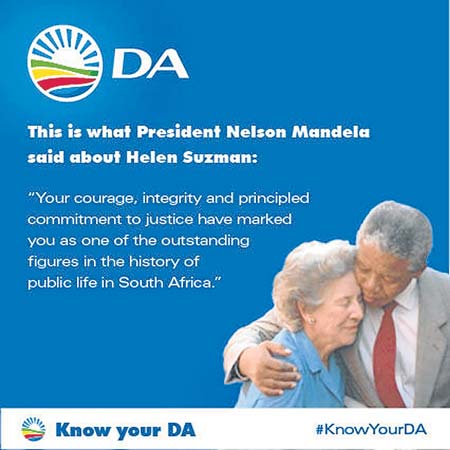
Suzman was a national treasure, and it strikes me rather bizarre that FW de Klerk has a Nobel Peace Prize while she (twice nominated) does not. But it was her principled contribution to ending apartheid that led Nelson Mandela to speak of the courage and integrity that marks her out as “one of the outstanding figures in the history of public life in South Africa”.

It’s that association the DA is aiming for by showing the image of Mandela hugging Suzman, rather than the image being an attempt to appropriate Mandela as a DA supporter. For better or worse, most South Africans regard Mandela as a moral authority. His endorsement of someone’s character therefore carries significant weight, as the ANC – never shy of invoking the Mandela brand – seems to realise.

Mantashe claims that this is propaganda. On one level, of course it is, just as all electioneering is propaganda of a sort. Expecting the “Know your DA” campaign to talk about “all its history and not just the struggle parts”, as an anonymous “PR and marketing expert who has done political campaigns before” did in this weekend’s City Press, is absurd – we always try to present ourselves in the best possible light.

Not only because nobody has the time to hear or present a comprehensive history lesson in each speech, but also because the alternative is unreasonable. While electioneering, we don’t expect Jacob Zuma to remind us that he was charged with rape, or took a shower to avoid HIV infection. It’s not propagandistic to highlight the things one is proudest of, and if it is true that the DA of today still represents those values Mandela recognised in Suzman, it’s legitimate to point this out.

My view is that they represent fewer of those values than I’d prefer, yet enough of them to make a poster and campaign like this one risky, but nevertheless legitimate. It’s somewhat opportunistic to highlight Mandela’s recognition of Suzman, but it’s not dishonest.

If we understand propaganda to mean a selective presentation of facts to inappropriately or dishonestly influence someone’s beliefs, then I’d suggest that Mantashe himself has a few questions to answer following Sunday’s column. In it, he asserts that what has remained throughout the “evolution of whatever trend among the white minority … has been either brazen advocacy for white domination and privilege or some elaborate schemes for its retention in the guise of liberal policies”.

That’s Mantashe’s interpretation of DA policy, and some of you might share the interpretation. And while he and you are of course free to do so, there is of course another side to the story, and Mantashe knows it. That story involves not only those mentioned in Zille’s launch speech, such as Seremane, Balindlela and de Lille – but also a large group of emerging leaders from the youth structures, many of whom are not white liberals.

Mantashe speaks of the “disdain with which the DA treats transformation” as if it becomes true in uttering it, or perhaps through repeated refrain – and what would that be, if not propaganda? Again, the DA might be wrong in how it approaches transformation, but that’s an entirely separate question to whether they are sincerely wrong, or whether they are lying about their intentions to buttress white privilege.

As Mantashe points out, the “combination of desperation and dishonesty is a lethal one”, and if the DA’s “Know your history” will be perceived as an exploitation of struggle history, we’ll know about it once the ballots are counted. But 20 years after our first democratic election, it’s certainly possible to question whether the ANC are the sole – or more importantly, the best – custodians of our freedom and our future.

And yes, it is also an interesting and legitimate question whether Suzman would support the DA of today. Just as interesting and legitimate, in fact, as the question of whether or not Mandela would support the ANC of today.

UCT, race, and the seductive moral outrage machine

Originally published in Daily Maverick

Despite the many columns I’ve written on the dangers of jumping to easy conclusions, the UCT student survey ranking how attractive various “races” are provided a reminder of how difficult it can be to follow one’s own advice. Especially with regard to emotive topics, the moral outrage machine can be quite seductive.

The sound and fury of sanctimony

Originally published in the Daily Maverick

imagesThe Easter holidays got me thinking – again – about what each of us could do to increase the odds of having a conversation on the Internet, thereby potentially changing our minds about something. In particular, changing our minds about how we perceive each other’s views on faith and religion. After all, changing our minds is what reading and writing should be about: discovering how we are wrong, rather than reinforcing to ourselves the ways in which we are right.

Easter brought these thoughts back because of the predictable squabbles that flared up between religious believers (well, Christians in this case) and those of us who don’t believe. Both of these groups can take themselves far too seriously: the non-religious through going out of their way to also be anti-religious, and the religious through taking offence at any slight, no matter how minor.

Some people did seem to go out of their way to be blasphemous, especially on Twitter, but jokes like the one that got me into brief trouble when I re-tweeted it (say Jesus backwards. Now say God backwards. Now say them together), or Barry Bateman’s quip about this being a day all about “caramel centered chocolate eggs” (which attracted a full day of judgement) are surely of the sort that can (and should) simply be laughed off as a difference of opinion.

Most of the time, a commitment to secular values would allow for both “sides” to leave each other alone, because their actions and beliefs, kept private, have no impact on others. But for both of these groups, the nuances of how (and why) people believe or disbelieve can get lost in convenient caricatures. In fact, sometimes even the truth is hostage to the will to (dis)believe. Two brief examples aren’t conclusive, but hopefully serve to make the point.

On the Christian side, the Church of England did themselves no favours through being caught out in what appears to be a blatant lie. In the run-up to Easter, they released the results of a poll indicating that 4 out of 5 people believe in the power of prayer – and gratifyingly for them, that belief in the power of prayer seemed to be on the rise in the youth.

The only problem is that the poll shows nothing of the sort. The 4 out of 5 figure is derived from the fact that when asked the question “Irrespective of whether you currently pray or not, if you were to pray for something at the moment, what would it be for?”, 80% of people gave a response instead of saying “I don’t know” or “I would never pray for anything”.

The desire to have a good-news story about the church, especially in the run-up to Easter, is understandable. And in light of 2011’s Dawkins’ foundation research indicating that fewer people seem to believe in the power of prayer than ever, this particular good-news story would no doubt be particularly welcome. But when your brand is built on virtue, and is in competition with others that claim you’re simply making stuff up, it does no good to make stuff up.

On the atheist side, I’m rather grateful to the majority of religious folk who are either disinterested enough or kind enough to not make more of an issue out of the continued civil wars around the role of social justice causes inside atheism, in particular the widespread allegations of misogyny. Instead, the focus continues to be on some of the more prominent voices for non-belief, and in particular, Dawkins himself.

And he seldom fails to disappoint those looking for a soundbite purportedly demonstrating the tone-deafness and hostility of atheists. While I do think most of the examples chosen to make this case are cherry-picked or misinterpreted, it remains true that doing our own cherry-picking or misinterpretation in response is no evidence of virtue.

Furthermore, he really does put his foot in it sometimes, like last week when he told his 660 000 Twitter followers:

He’s right on the logic, sure – but it would have been easy to be right while simultaneously not being maximally offensive.

I’ve addressed questions of strategy before, for example in relation to someone who does actually try to be the lightning-rod that Dawkins is perceived as being – David Silverman of American Atheists. While I haven’t changed my mind that we need people like him to expand the polarities of the debate, and perhaps to stretch the middle-ground for more moderate strategies, they do sometimes make the PR job difficult for those of us who think of religious people as mostly harmless, most of the time.

Likewise, the overly sanctimonious believers who seem to have sacrificed their sense of humour do the majority of believers no favours. Nor, of course, do those who argue against equal rights for gay couples or availability of contraceptives; or those who condone (through inaction, at least) child abuse or the stoning of adulterers and rape victims.

In short, there are all sorts of obstacles to being understood and to having a dialogue. Eliminating some of these require getting our own houses in order, rather than looking outward. But when we do look outward, let’s try to look at what’s in front of us, rather than being distracted by the convenient fiction of the stereotype.

On that “most attractive race” thing in the UCT student newspaper

So, this peculiar thing appeared in the UCT student newspaper, Varsity, earlier in the week:

Screen Shot 2013-04-05 at 9.46.51 AM

A couple of people have asked whether I’d be writing about it. To one, I replied that it was “too silly”. Which it is. But even sillier than this is the news that the Young Communist League are apparently going to report Varsity to the Human Rights Commission (they are “shocked and disgusted“, you see).

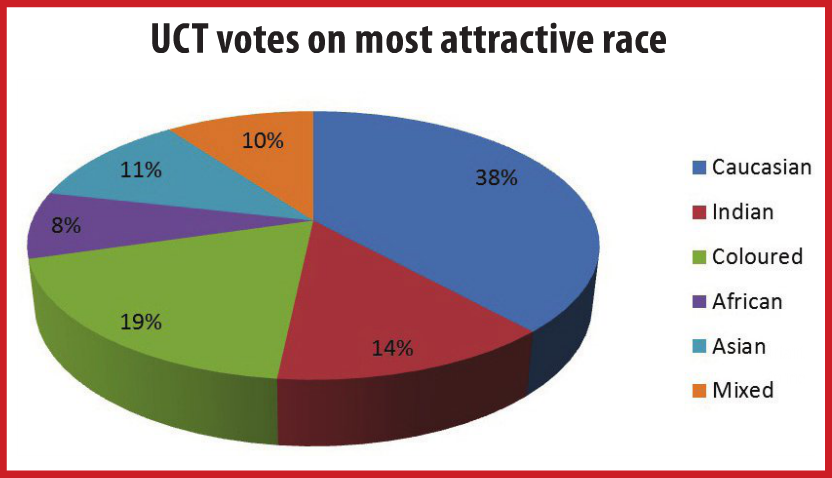
For context, a couple of details: To repeat, this is a student newspaper, and it is not edited or subject to any pre-publication controls by any official agents of the University administration or staff. Second, it was published in the opinion pages, and third, it was an accompaniment to this article – in fact, it’s a graphical representation of the results of Qamran Tabo’s straw poll of 60 students.

Yes, 60 students. So, Varsity chose a stupid headline for the graphic, in that “UCT” haven’t voted on anything. Varsity no doubt chose the headline to attract attention, seeing as that is what headlines are for. But an attention-grabbing headline on such a sensitive topic should perhaps be chosen with more care.

As, of course, should be what you choose to publish in the first place, or how much you edit what’s been submitted. Presenting this as quasi-scientific was an error, as the editor concedes.  It’s not just the sample size, it’s also the peculiar way in which the sample was drawn. Tabo chose to survey 10 individuals from each of the following “racial groups”: “white, coloured (culturally), Indian, East Asian, biracial and African”. Now, Tabo doesn’t define how she knew who was who here, and whether they are all self-identified (as “culturally coloured” surely must be). Anyway – let’s leave it at that, agreeing that the pie-chart is a reflection of what these students reported, and nothing to do with UCT as a whole.

But even if it was about UCT as a whole, it’s still possible that – for whatever reason, but mostly for a reason Tabo cites (the preponderance of white people presented as attractive in popular media) – a larger group of people would report this same preference. And this would be a reflection of racism in popular culture, yes, where certain appearances are normalised as attractive, and others not. Furthermore, it’s a great shame that this is so prevalent, and so persuasive, that it’s probably the case that a large number of students (and others) have “fallen for it”, as it were.

It wouldn’t necessarily be racist to point this out, though. Saying “students report that they find race x more attractive than race y” (and please, throughout this blog post, assume the quotation marks around “race”) can simply be reporting a fact. The idea that humans might “rank” races on any characteristic is of course offensive, particularly in South Africa or anywhere (okay, everywhere then) where people have been oppressed as a result of their race. But the author knows this, and starts by reports the fact (for the 60 students) of these preferences, before going on to conclude:

Of course everyone has the right to choose who they want as a romantic partner, but it is interesting to observe how race, which is really just a collection of arbitrary physical features, acts as a barrier when it comes to who we choose to love.

Having been at UCT and in South Africa long enough, I have come to realise that we would have better luck creating a research wing at Med School dedicated to cloning white people to feed the demand than trying to understand the origins of some our supposed “preferences”. Hopefully one day, when the world’s entire population becomes creolised, characters will be the only deciding factor for who we want to date.

And that’s just right, surely? The author decries the fact that these students use an arbitrary characteristic, rather than someone’s character, to determine who they would like to date. There’s nothing racist about the conclusion, and it can’t be racist to report that people do have these (potentially racist) preferences. This really does seem a storm in a tea-cup, caused by little more than a poor headline and social media hysteria.

Furthermore, as I’ve previously argued with regard to the dos Santos and Tshidi cases, even real racist speech should perhaps not be reported to the HRC, and we certainly shouldn’t feed the pitchfork-wielding mobs of outraged folk on social media, because they’ll simply start feeling more entitled to bully us into silence the more they succeed in doing so. I confess I fell for it too, yesterday, when I described this as “embarrassing” for UCT on Twitter.

It is embarrassing, sure – but it’s also embarrassing that our knees jerk so quickly, and so violently, when anyone mentions the fact that people do still think in racial terms, regardless of the fact that we wish they wouldn’t. Outrage won’t make the problem go away, and neither will pretending that people don’t have attitudes we wish they didn’t.

[Edit]Related: I thought it was a mistake for UCT (the Vice-Chancellor, in fact) to apologise for the “blasphemous” Sax Appeal in 2009. They certainly shouldn’t apologise for this.[/edit]