Ideology, interpolation and artistic intent

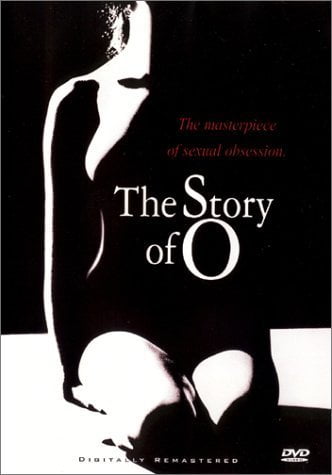
41M7ZMFHYMLThe Story of O is commonly considered to be a pornographic novel. As with any artwork that challenges moral sensibilities, a “pornographic” novel expose us to things that are morally abhorrent to us, while simultaneously leaving us uncompelled to condone what is described.

The interesting thing about The Story of O, for the purposes of this post, is that the brutality and abuse that O is subjected to seem to actually be morally acceptable in the fictional world of the story.

And herein lies my focus: is The Story of O, or any work of literature that has an implicit moral stance which we find unacceptable, to be valued less as a work of literature because of its unacceptable moral stance?

Second, should the fact that one or more of us feel outrage at something in an artwork mean that the artwork should not be shown, produced or performed?

The contemporary example that made me want to air these issues is the Estonian composer Jonas Tarm, who had intended to play “Marsh u Nebuttya” (“March to Oblivion”) at Carnegie Hall a few weeks ago.

The Carnegie performance was cancelled, after

it was brought to the administrators’ attention, in a letter of complaint signed “a Nazi survivor,” that the piece incorporates about 45 seconds of the “Horst Wessel” song, the Nazi anthem.

This, despite the fact that that the “Horst Wessel” song has been used in various compositions for many years, often as negative commentary on Nazism, and was in this piece framed negatively also (via the manner in which Mr. Tarm introduces the segment).

It seems that it was precisely his intention to get people to think about that historical period critically, and perhaps to feel some discomfort while doing so – but political and emotional sensitivities have made that impossible in the Carnegie Hall case.

This is not a judgement on those sensitivities themselves, but more on (as a friend put it) the apparent decline in our ability to interpolate between texts.

The failure of our ability to interpolate, in other words, is our failure to see things in a context, and to play off various texts (including, in the case of “O”, the moral text), off against each other.

More worrying, perhaps, is our conceding to that decline, in setting standards of offence, and what offence legitimises, that cater to serve the interests of those who are most offended (or who can claim to be so).

Victory goes to the most sensitive, which simply serves to incentivise people to be hypersensitive.

The same set of questions arise in terms of the genesis of art – for example, when (if ever) questions about the moral character of the artist matter, regardless of the quality of the art. For example, can (and should) one enjoy art produced by a child abuser, murderer, rapist, etc.?

This issue is, I feel, intrinsically connected to the question of what we value works of art for. It is true that we “possess a capacity to entertain a thought without accepting it”, to quote Malcolm Budd’s paper “Belief and sincerity in poetry”, and to my mind, this capacity is an essential component of enjoying art.

But Budd points out that a reader can enjoy a text “also on account of the poem’s expressing a philosophy that he believes”. If I subscribe to Christian values, I might enjoy Bunyan’s A Pilgrim’s Progress because of the way that text glorifies those values, just as Hitler would probably have derived great pleasure from watching Reifenstahl’s Triumph of the Will.

But works that can be described as propagandistic, in the sense that they exist primarily for the purpose of convincing the audience of the worthiness of a certain moral stance, are not, I feel germane to this discussion. The reason for this is the categorial intentions of the author.

It seems fair to say that most texts (and here I mean text in a broad sense, to include things like movies), while containing an implicit moral stance, do not exist primarily for the purpose of converting others to that stance. Works that do exist for this purpose may be considered as manifestos, but not as literary texts (for the purposes of this discussion).

So a movie such as Triumph of the Will may be viewed with distaste in the same way as we might view a swastika with distaste, while a text that can be more broadly conceived as containing a moral stance which we may find offensive, without actually having been conceived for the purpose of promoting it, should not be viewed with distaste for the same reasons. To do so would be, I feel, a type of category error.

If we set the bar at “someone could find this morally offensive”, the problem would be that is becomes impossible to find a text that has any objective (or at least, non-partisan) artistic value.

And that some texts have value, considered solely as literary texts, is a thesis which seems intuitively correct – they can make us feel, or make us think, as independent virtues regardless of their (for example) propagandistic value.

While it’s true that the moral or political stance of the audience often precludes the possibility of reading the art “on its own merits”, those merits have to include more than simply those stances.

And while there are contexts in which things are clearly simply abusive towards an audience, or only intended to provoke without additional artistic intent, the fact that we – or some of us – can’t read art in a context, outside of our subjective sensitivities, seems to be a deficiency of and in the audience, rather than in the art.

Speaking on related issues to these, the author of the New York Times piece linked above says (in relation to Mr Tarm’s composition):

I’d like a chance to think about [these issues] for myself. The New York Youth Symphony should program “Marsh u Nebuttya” on its next Carnegie program and give me, and the rest of the audience, that opportunity.

Precisely. These questions are sometimes not easy, but we get no closer to answering them by refusing to allow them to be asked.

Moderating or closing comment sections – the Independent Media Advisory Panel report

trollsWhile I would have wanted to submit comment to Independent Media’s panel on what to do about abusive speech on newspaper comment sections, I somehow missed the call for submissions.

Now that their report is out, and on the understanding that this is a continuing conversation, I’ve offered a few comments on the panel’s recommendations – and the underlying issues – below.

TheMediaOnline’s summary of the panel’s findings seems comprehensive and accurate enough to simply quote, instead of doing the work of summarising them myself:

  • In the interests of freedom of expression, it is desirable to host online comments
  • However, the constitutional rights of readers and members of the public should not be infringed by such comments
  • It would be preferable to moderate comments prior to their publication online
  • Online platforms should be staffed with suitably qualified personnel
  • If effective pre-moderation cannot be undertaken for any particular reason, Independent should consider closing its comments section
  • Independent Media should develop guidelines to define unacceptable speech, which take into account legal and ethical considerations, but should not amount to censorship of differing viewpoints

I’ll not be addressing those points sequentially, and might not even get around to addressing all of them. But the free speech issue is one that does have to be addressed, if only to emphasis an important distinction.

Free speech

A commitment to free expression makes it desirable, rather than necessary, to host online comments. In other words, even if you shut comments down entirely, you are not violating anyone’s right to free expression.

The right to free expression means that you’re not barred from saying something. It does not mean being required to provide you with the platform on which to say it. So, for as long as you can make your point on your own blog, Facebook, Twitter or wherever, your rights are not being violated.

Your opportunities are being circumscribed, yes, but a private entity like a media house has no legal or moral obligation to provide you with an opportunity to comment. In fact, an overall commitment to free expression might mean exactly barring some people from commenting, in the grounds that they provide a chilling effect on the comments of others.

A practical example: if you wanted to have a comment-section discussion on what it’s like to be black and poor in Cape Town, you’d naturally get fewer people who are black and poor commenting if you also allowed white racists to comment.

More problematically: you might also get fewer black and poor people commenting if you simply allowed rich people to comment, in that the target audience might feel some measure of alienation or of being typecast or misunderstood.

I use these examples not to recommend these sort of constraints on comment spaces, but in furtherance of the general point that specific restrictions on who can comment where might, in certain instances, enhance freedom overall. The point is that freedom of expression in the aggregate can sometimes be served by restricting limited instances of free expression.

Legality vs. tone/character

The right to free expression and the extent to which it is (or isn’t) violated is a separate matter from the tone or character of a website. As soon as you allow comments at all, you’re encouraging the formation of some sort of community, and with that comes goals as to what the character of that community should be.

What this means is that even if something is not legally proscribed, you might nevertheless want to prevent it from being said. The Independent report makes much play of the right to dignity in the Constitution, but I’d rather not rest on that, because even if you think the Constitution has it wrong on things like hate speech and dignity, you could still justify restrictions on some speech on your news portal.

You could justify them simply via wanting to have a certain level of discourse on your platform, where you hold characteristic X to be non-conducive to that. X could be excessive sarcasm, or whatever – for example, I didn’t publish a comment the other day simply because it was overly pedantic and argumentative, and added no value to the conversation.

What you choose to restrict and why will be a policy matter for each media house to decide on for themselves, and I make the points above to encourage them to be guided by more than just the law when they deliberate on these matters.

The value of comments

The high-minded rhetoric around why we have comments online (free expression, debate etc.) – at least when it comes from the media houses themselves – is only part of the story, and to my mind a very small part of it.

The value that comments have for them is that eyeballs return to their pages, either to watch the slow-motion car crash of someone being schooled or trolled in comments, or to join in the fun themselves. Either way, you’re on my page rather than a competitors, and ad revenue might increase as a result.

And (we need data here) I’m intuitively completely disbelieving of the idea that there will be a significant difference in traffic if you switch from live, unmoderated commenting to some system that involves comments being posted after a delay of some sort. Of course a delay of days might have an impact, but I doubt that 12 hours or less would.

What to do?

The panel’s report recommends pre-publication moderation, where a) the commenters identity is known to the publisher, even if the comment appears anonymously; b) word-filters flag any potentially offensive comments (for containing words likely to correlate with abusive comments); and c) editorial oversight, where “trained and qualified” editors check the comments before publication.

Step (c) is onerous, and unduly so in not taking advantage of existing mechanisms for knowing who is likely to abuse comment sections and who not. But before I get to the disagreement, let me say where I agree.

Identity: I’m a big fan of people “owning” their opinions, and taking responsibility for them. To put it simply, the fear of reputational harm is one of the ways we are kept in check, and keep each other in check.

So I’m supportive of using the “letter to the editor” sort of model where possible – use your real names, which need to be verified in some fashion, unless there’s some compelling reason why you can’t (where the editor must decide on the merits of that reason, remembering, as I said above, that you have no right to comment).

Word-filters: You’ll perhaps get lots of false-positives here, so sifting through the stuff that’s flagged might involve more work than is necessary. But besides this potentially adding unnecessary overhead, I have no principled issue with it.

Editorial oversight: Making this the norm will be far too expensive and time-consuming (of course related issues, but manifesting as two separate problems). It would also be unnecessary, as we already have ways to crowdsource information regarding who can (in general) be trusted to not abuse comment sections.

For example, here on Synapses I use Disqus, as does IOL, Daily Maverick and the Mail&Guardian. I’ve set each post up with fully moderated comments, but I do have the option of specifying that any given commenter be automatically published without going into moderation.

Any of us who dip our toes into comment spaces online know the names of some regulars. Those regulars who are not abusive can be approved pre-publication. Yes, it will take some time and work to determine who is given this privilege, but in the long-run, it would save having to look at their comments each time.

Of course, you’d want some sort of policy for granting this privilege – say, for example, 5 non-abusive comments gives you that status, and the understanding is that it gets stripped from you once you abuse it.

The level of moderation required to afford people the privilege described above is rudimentary – interns, student journalists in university courses, bored college kids etc. could all do it for a nominal fee, and at the same time flag potentially abusive comments for the attention of a “real” editor.

All of the benefits listed in section 7.2 (page 33) of the report can be enjoyed once you have established this sort of “database” of approved commenters. If you wanted to be more liberal about it, and save even more time, someone with a high reputation score on Disqus can automatically be green-lighted.

One could even consider database of trustworthy commenters, shared across media houses that use the same commenting platform.

And as I said above, if someone sins, you simply delete them – here again, the community can be of assistance, in flagging things for an editor’s attention.

The 2015 #SaxAppeal cover

van_berger_2015-Feb-12
Credit: https://twitter.com/van_berger

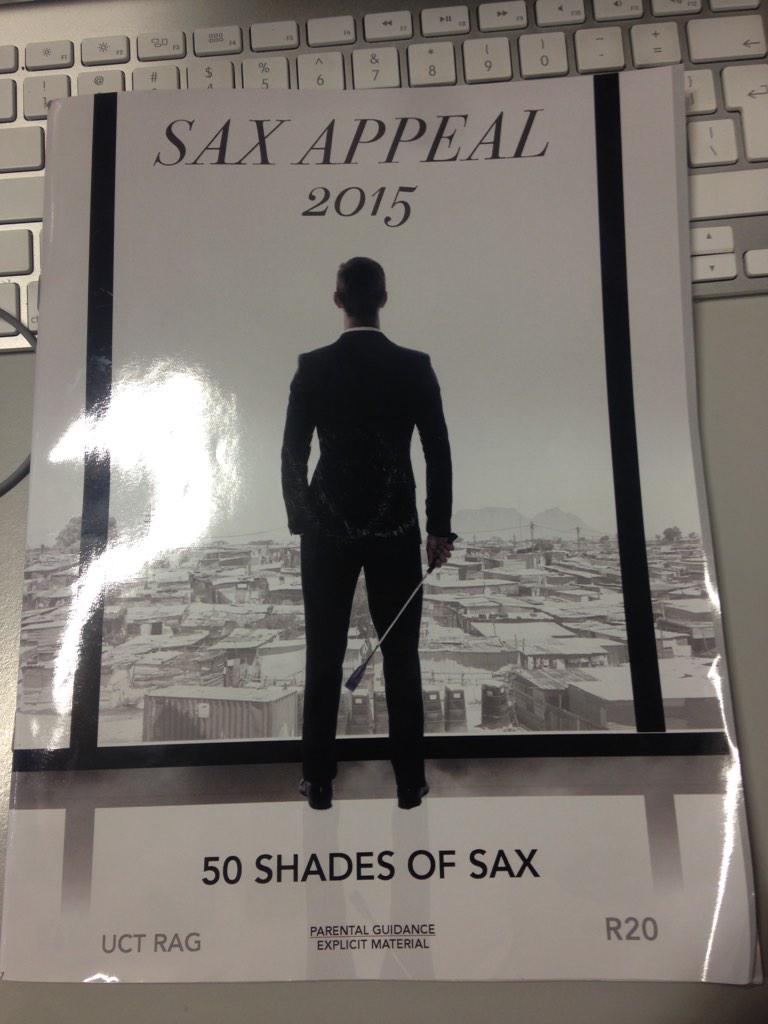
This is not a “rage-blog”. I’m not indignant, offended or any of those things by the Sax Appeal 2015 cover that I saw via Twitter this morning. It depicts Christian Grey (a rich white guy who is into BDSM) looking out over shacks where poor black people live.

I do, however, think it was a poor choice of image, for the two reasons I’ll outline below. But first, a general point, which is the actual motivation for this post: there are usually intermediate options between the polarised sorts of shouting at each other that social media seems to encourage.

Criticism is quickly read as outrage, and in a case like this, can also lead to accusations of conservatism, fuddy-duddyishness and so forth. On the other end of the spectrum, those who support the image can overstate its virtues, and not recognise any value in concerns expressed by others.

There’s a gulf between those options, and that’s where I’m speaking from. I was shocked by the image, but I mean shocked in a descriptive sense, rather than as an index of moral outrage – it took me aback. So, that’s a plus for the “good satire” reading, in that being forced to take notice is a good start.

But the cover ultimately misses the mark, and was a poor choice. First, because risky satirical choices are only a smart move if you’ve got credibility as a satirist or satirical publication. Without that, you can appear to be simply echoing the reality you’re trying to critique, or appear oblivious to dimensions of it.

Simply being known as a satirical magazine one isn’t the same thing as people knowing you to be good at that job, and therefore interpreting you in that light – and sorry to say, but I don’t think Sax Appeal been good at it for a while.

Second, you significantly increase your chances of being read uncharitably by virtue of the targets that you pick. In this instance, there’s a context of:

  • 5 years of debate on admissions policy, race and transformation
  • public criticism from UCT academics on the perceived slow pace of transformation at UCT
  • a funding crisis at a national level, affecting the ability of poor students to enter universities
  • a rather public tantrum by a prominent media house owner on UCT’s transformation track-record
  • a university that is situated in a city that is perceived by some as racist

And so forth. In other words, this was a very risky issue on which to push the boat out. I certainly don’t think they were intending to be crude or offensive – in fact, I know some of the people involved, and trust them in this regard – but this was a poor decision.

(Sax Appeal has taken note of the reaction, and posted the statement quoted below to Facebook.)

STATEMENT ON SAX APPEAL COVER CONTROVERSY:

On behalf of the SAX Appeal Editorial Team, we regret the hurt caused by this year’s cover photo.

We understand the concern about what is perceived by some as racist or patronizing undertones of the image; but we would like to state unequivocally that our intention was not to make light of racism or to humiliate its victims.

Our intention was to open up discussion about the problematic power relations in South Africa. The legacy of apartheid has left a tragic divide between rich and poor, black and white, rural and urban – a divide that is still perpetuated daily.

Just as the themes of 50 Shades of Grey allude to power dynamics in sex, our hope with 50 Shades of SAX was to discuss the other power dynamics that still pervade our society. Even though the privileged no longer oppress the underprivileged daily with batons or whips, we hoped that the cover image would inspire discussion about the secretive, underhand ways in which the privileged still get their way.

These issues, including those within the magazine, such as the discussion around homophobia in Islam, the psychiatric profile of God and of golf being representational of white privilege, were included in the magazine to bring about such discussion.

In this way, SAX 2015 has taken a very different turn compared to previous editions. Sensitive topics were not written about to ridicule the marginalized or disadvantaged but to induce meaningful discussion about these topics. These are issues that we did not think we could avoid discussing, but if we missed the mark in our attempt at discussion, we regret the effect that this has caused.

We hope that this perspective might add to the debate that has been sparked on social media and that it might point it in a direction that is critical and constructive around issues of race and socioeconomics.

Building a better society starts with recognising this one’s broken

Today’s horror is the rape of a Northern Cape high school boy, whose classmates tied him to a bed and raped him with a broom handle. “Today’s horror” is of course inaccurate, as there are no doubt many others. But this one stands out for me for various reasons:

The initial use of the word “sodomy” instead of the word “rape”, demonstrating an unconscious (and widespread) homophobia. It’s a mild form of homophobia in isolation – but to note that would really miss the point unless you follow it up with the observation that, for those who identify with marginalised and oppressed groups, all of these mild or micro cases add up to a environment of systemic discrimination.

The norm is white, male and heterosexual. This is not to say that it’s impossible for people to overplay their hand (whatever that hand might be) in terms of being part of some marginalised group – some people can be disingenuous, and excuse some personal failing by reference to a coincidental feature they happen to possess.

That’s an entirely separate issue from whether, on average, someone who is not white, male and heterosexual is likely to have a rougher deal than people like me. So, denying any person’s experience by reference to them “playing the x card” (x = race, gender, etc.) pretends that systemic disadvantage is nonexistent, and makes you sound like a heartless, uninformed and unreflective fool.

SASecond, on the rape case, is the fact that some seem to want to make this all about kids being kids at an initiation ritual, rather than it being a racially motivated attack. The bone I’ll throw at you is that of course we can’t know it was a racial attack. But it’s pretty likely to be, in South Africa, at least to the extent that certain inhibitions about not treating other human beings in a barbaric fashion are more present if the prospective target is white, male and heterosexual.

It doesn’t matter that the crowd of kids who were looking on, and (I’m told) cheering were modeling a united colours of Benetton poster, comprising people of various races. It’s possible to internalise racism against any group, even the group you belong to yourself.

And, as DA spokesperson Phumzile van Damme rightly notes in a statement on this attack

Under the cover of “traditions” such as initiations, children are given the platform to act on their racism and homophobia – sanctioned by the institution and often “protected” by just those who went through the same “rites of passage” themselves. Many of these kids are raised by racist, bigoted parents and then spend years and years in these situations where they barely have to disguise this. In fact, it often gets encouraged.

On Facebook, Max du Preez asked “Isn’t it time to consider legislation declaring racist acts (attacks and serious insults) hate crimes with harsh punishment?” I don’t want to get into hate crimes and hate speech at present, because there’s so much to talk about there, but one thing we do need is to at least recognise that they exist, and identify them for what they are.

We have too many folk who still believe the Rainbow Nation myth, and think we’re pretty much united, and too many who believe we’re still in some sort of (undeclared) race war, or at least socially (or otherwise) incompatible with each other. The truth is in the middle – we’re sorting things out, but that requires work, not mythologising.

For those of you who haven’t seen it, go read and play with the “parable of the polygons” to see an elegant demonstration of how (perceived) harmless choices can still add up to a harmful world. Also, read Oliver Burkeman’s recent Guardian piece, which argues that believing the world is intrinsically fair or just can lead to increased injustice, because we “blame the victim” instead of supporting remedial measures.

I don’t know for sure how we build better societies, but recognising our problems, instead of pretending we live in some alternate and superior universe would surely be a start.

Arguments, and assumptions of bad faith

I don’t know about you, but I’m finding that the news cycle – especially here in South Africa – is hitting fresh heights of bonkers-ness just about every day. And where scandalous news emerges, outrage on social media follows.

Outrage is oftentimes merited, and you should please not read this post as a complaint about people getting upset about things (although, as David Mitchell points out in a characteristically amusing column, it might be a problem that outrage has become our default setting).

More important than the outrage itself is the motivation for the outrage, in both senses of motivation – the originating argument or cause of it, and then the retrospective justification of it, where I think too many of us are operating in bad faith.

For those of you who aren’t familiar with the concept of the “principle of charity”, Wikipedia’s entry opens with: “In philosophy and rhetoric, the principle of charity requires interpreting a speaker’s statements to be rational and, in the case of any argument, considering its best, strongest possible interpretation.”

To put this into practice, one strategy might be to apply Rapoport’s Rules, summarised by Daniel Dennett as follows:

  1. Attempt to re-express your target’s position so clearly, vividly and fairly that your target says: “Thanks, I wish I’d thought of putting it that way.”
  2. List any points of agreement (especially if they are not matters of general or widespread agreement).
  3. Mention anything you have learned from your target.
  4. Only then are you permitted to say so much as a word of rebuttal or criticism.

But instead of taking this approach, much online commentary, whether in the short-form of Twitter or in blogs and columns, seems to be a frantic dash to demonstrate the evil of your opponent’s point of view.

There are important debates going on about left-wing politics, political correctness and what counts as fair and unfair criticism. It’s important that these debates aren’t won by those who claim that being offended is always a trump card, because that a) incentivises victimhood and b) is a race to the bottom for what entitles you to claim protection from offence.

It’s good to be challenged – we are often wrong (regarding science, for example), and need to be told so. But how we tell each other that we’re wrong is the problem, in the sense that if you criticise from a position of assumed certainty that you’re right, and your opponent wrong, nothing good is likely to come from the interaction.

I’ve so far stayed out of the Jonathan Chait debate that was occupying so many people in (the broad and very difficult to define) online political community I belong to. There are far too many triggers for hostility in the issues he raises, with a concomitant low probability of sober reflection on the issues.

But now that the fire of that debate has gone out, I do want to point you to his piece responding to his critics, in which he (rightly) reminds us that the fact that some people complain about political correctness simply as a way to excuse or mask their bigotry does not mean that others might also take offence too often, and for the wrong reasons (for example, the race or gender of the speaker, regardless of what the speaker is saying). To quote an important passage from that piece,

making distinctions is important and valuable. Voting may present us with limited and imperfect choices. But when we analyze the world, we don’t need to restrict ourselves to binary choices. We can oppose both racism and inappropriate responses to racism. Indeed, that kind of multifaceted thinking is a special responsibility for liberals.

imagesHaving begun this post with a vague allusion to issues in the South African political landscape, let me close with the specific case of the City of Cape Town having approved the renaming of a road in honour of the conservative apartheid-era president, FW de Klerk, who can among his achievements apparently count ordering the murder of 5 children (and a Nobel Prize).

I was one of the handful (around 250) that opposed the renaming during the consultative process, while around 1700 wrote in support of it. My reasons for opposing it were offered in a previous post, so I won’t rehash them here. But I do want to say something about last week’s council meeting, at which the City approved the renaming (initially proposed by this group of “prominent Capetonians“).

According to news reports, (at least) two quite disturbing things happened at this council meeting, to which I’d add one example of the language of politics gone utterly mad.

Disturbing thing number one is that our Mayor, Patricia de Lille, was apparently taunting ANC councillor Tony Ehrenreich by waving a red clown nose in his general direction whenever he spoke, and accusing him of engaging in “clown politics”. To my mind, if the Mayor engages in debate as if it’s happening on a school playground, there’s more than one person playing “clown politics”.

More disturbing, though, is this detail of how the council meeting proceeded (my emphasis):

The ANC then asked to caucus and, on their return to the chamber, found that the meeting had proceeded without their input. ANC councillors were outraged. The Speaker’s calls for order were drowned out by ANC councillors banging on desks while chants of “no” rang out. Smit then ordered the ANC to leave and the hall to be vacated.

The council sitting was moved to another room, with many DA councillors also shut out as metro police blocked ANC councillors from getting in. Chaos erupted when ANC members tried to force their way in, resulting in a tussle between some ANC councillors and metro police officers. There was continual shoving and pushing as ANC councillors tried to storm the room.

For the next two hours, ANC councillors tried to get in while remaining DA councillors were gradually escorted into the room, where ACDP and FF Plus councillors participated in the discussions.

I’m sympathetic to the DA and de Lille’s claim that the ANC might sometimes act in ways that are aimed at making the City “ungovernable”. But when you’re taking a decision regarding renaming a road after an apartheid president, in a city perceived by some as being racist, it’s quite mad – in terms of effect on public perception – for only the DA, ACDP and FF Plus to be debating the motion and making the decision (a separate issue to whether they were quorate, which they were).

Furthermore, if the meeting did proceed while the ANC was taking a break to caucus, that indicates serious bad faith on the part of the Democratic Alliance, in that they don’t give any impression of being interested in engaging with the ANC or Ehrenreich’s arguments.

In general, that’s the problem I’m highlighting in this post, in full awareness that doing so is hardly novel. But for those of us that care about debate, and its value in showing us where we’re wrong (which is essential to becoming more often right about things), the occasional reminder of why we do this, and how to do it, hopefully serves a purpose.

In our little corners of the Interwebs, or in meatspace, we can do better than simply yell at each other, or presume malice in others before we’ve even bothered to try and understand what they are saying. It’s difficult, to be sure, and I often fail at it myself. But not doing so, or giving up trying, simply cedes all public discussions to the idiots and the ideologues.

In closing, on the Humpty Dumpty language of politics, consider this quote from the Mayor of the City of Cape Town, on the ANC’s opposition to the above-mentioned street renaming:

[The ANC] are opposed to progressive politics and anything that is not backward-looking and embraced by the cold hands of racialised politics.

Renaming a road after an apartheid president is “progressive politics”? As a friend said on Facebook, “Yup, what self-respecting revolutionary could be against honouring a freedom fighter like FW? I want to cry.”

The value of comment sections and debates in digital spaces

Regular readers will know that I’ve recently been wondering whether to continue hosting comments here on Synapses, as well as about their value in a more general sense.

downloadI’m not shutting comments down, but will move to moderating them, meaning that it might take up to 24 hours for any comment to appear, and some comments will not appear at all, if I deem them abusive or idiotic. The decision to do so is precipitated by two coincidences, featuring two friends who raised overlapping conversations on Facebook, both of which I engaged with.

The debate on Nathan Geffen’s wall about trolls on GroundUp, and how to deal with them, raised the point that without full-time moderation, comment sections can easily become toxic.

Also, I’ve been led to believe that there’s a potential for legal liability for things posted on one’s own site by commenters, while no such liability exists on Twitter or Facebook (for what other people say, I mean).

Then, Eusebius McKaiser asked for a view on Nick Cowen’s IOL piece arguing that we can’t have productive debate in online spaces, and much of what I say below is a response to that piece (in short, I think we can, but that it takes more work than many of us care to do. In my case, I get few enough comments that the necessary moderation is possible).

Before I get to responding to that IOL piece, just a note on how things will work here with regard to comment and debate. Individual posts will have a moderated comment section, but please also feel free to do one of three things instead, if you prefer:

  1. The old-fashioned “letter to the editor”, where if you’re amenable, and I think your contribution might be of broader interest, I’ll post it as a separate entry.
  2. If you’re on Facebook, there is a page for Synapses. Every entry appears there, and you can comment as much as you like, unmoderated. The same is true for Google+.
  3. Lastly, there’s Twitter, which isn’t ideal for debate, but certainly gives you the opportunity to call me names (if that’s your thing), or to make more friendly noises.

On to the IOL piece, which you don’t have to have read to follow what is about to follow. To quote myself:

it seems to my mind at least plausible that we’re living though an era in which ideas themselves are not that welcome. Where, as Neal Gabler recently put it in a column John Maytham was kind enough to alert me to, the “public intellectual in the general media [has been replaced] by the pundit who substitutes outrageousness for thoughtfulness”.

Despite the demise of postmodernism in academic circles, it still lives and breathes in the popular viewpoint that everybody’s opinion is equally worthy of consideration, and that individuals are under no special obligation to set aside their opinions in favour of what the evidence points to.

The Internet, its potential anonymity, and the sheer volume of both opinions and outrage don’t encourage thoughtful reflection and engagement. I find that the overall quality of discourse and openness to correction is poor on the Internet, and as a result, I tend to only read comment sections to confirm that they are places where people seem unafraid to express their racism, sexism and (other forms of) stupidity.

There are pockets where people do engage earnestly and sincerely, and where there is a chance of shifting peoples’ perspectives. Eusebius’s Facebook wall is itself one small example of that. It’s true that people don’t often say “you’ve changed my mind”, but it’s something that can be intuited from how the tone and content of a conversation shifts.

Second, I’m not sure that the situation is significantly better in meatspace. There, just as on the Internet, people are stubborn, prone to confirmation bias and the backfire effect, etc. It’s partly the fact that there are more participants – with those participants not being carefully selected – in the online space that creates the impression that it’s more chaotic there. In other words, if we were to have an open house in meatspace to discuss something contentious, we might more often have the same impression of shouting past each other.

By contrast, if you do online what you do in meatspace, i.e. carefully select your interlocutors, you’d have the same “civilized” conversations (at least in a relative sense). The problem is that a) you don’t always get to select who talks to you online and b), all the non-verbal cues, such as smiles and body-language, aren’t available to us online.

Complicating this all is my sense of the conversations in both spaces being less civilized than they used to be, because everyone is now an expert in everything. The idea of democracy has been illegitimately expanded into epistemic territory, where the average person has been persuaded that their views are as legitimate as any other person’s view, and where they are somehow attacking you as a person when they criticise your view, rather than us simply having a contestation about the facts or interpretation of them.

We’ve become too personally invested in our beliefs, to put it simply.

Wrong about race in South Africa and UCT

agi_events_010Two snippets, from two quite different sources, raise concerns about self-serving (as opposed to principled) thinking about race in South Africa and at the University of Cape Town, where I teach.

First, we have Douglas Gibson expressing concern that “race is back in fashion” in South African conversation. Gibson is the former Chief Whip of the Democratic Party, which became the Democratic Alliance (DA), South Africa’s official opposition.

I’ve only had a couple of conversations with Gibson, but have read many of his speeches and columns over the years, and regard him as a determinedly old-school liberal, rather than someone who is happy to let pragmatism dominate, as seems to be the case for many in today’s DA.

One character trait of what I describe as an old-school liberal is often an inclination towards idealism, in this case manifesting as a desire that South Africans be race-blind, to want to engineer a South Africa that is nonracial or post-racial. He opens his column with an example of race-blindness, in this case that of his son:

Thirty five years ago a little white boy aged three, standing in his bathing costume next to the pool, stroked the arm of a little black girl, also in a bathing costume, and said, “Ooh, you’ve got a lovely tan.” My son didn’t see race and certainly had no race prejudice. That was at the height of apartheid. He is still not a racist, just as many other whites are not.

There are two distinct points to make about examples like this. The first is that we can agree (or not) that this is an ideal future to try and arrive in. The second is that we can agree (or not) on how to get there.

A concern that I and others have about DA rhetoric is that it seems to want to get there by insisting on it, and by asking us all to just ignore race, because in doing so we’ll discover all sorts of other relevant and interesting things about each other as individuals.

As ever, I think some things are easier to say and support from one point of view rather than another. I don’t experience what it’s like to be black in South Africa, but if what I’ve heard is accurate – and I’ve heard it from black intellectuals far more qualified and socio-economically advantaged than me – they perceive racism far more often than they should (the “should” here would of course be zero times).

I’ve said in the past that the perception of Cape Town as being racist can’t simply be dismissed, and still think that even if we agree on an (eventual) goal of non-racism, we might find (a) that we can never get there or (b) that the way to get there is precisely to acknowledge race and prejudice, rather than pretend people don’t have these experiences.

To put it crudely – columns like Gibson’s, romantically espousing non-racialism, can be read as part of the problem in their denial of the validity of the lived experience of people who feel discriminated against. It can appear like you’re being told to simply “get over it”, and I think that’s condescending.

The other example I want to highlight is from Dr Xolela Mangcu, who is at the furthest remove possible from Gibson in at least two respects, in that he is a black Biko scholar, rather than a white liberal. Mangu has been columning voluminously about UCT’s new admissions policy for the past few months, and some of these columns have attracted responses from our Vice-Chancellor, Dr Max Price.

In Mangcu’s most recent opinion piece on race and transformation at UCT, he says the following:

Numbers matter also because there should be a critical mass of black professors in the University Senate, which is the highest decision-making body when it comes to academic affairs. I just find it difficult to imagine that doing away with race-based affirmative action would have been such a high priority for the Senate, or would have passed so easily, if that august body was populated by a large number of black full professors.

And here’s my problem: even if you think the admissions policy flawed, Mangcu’s words there seem to me to insult the black professoriate, or otherwise to indicate a laziness of thought on this issue, or are otherwise simply mendacious.

To briefly run through the options: the extract could insult black members of Senate, in that it suggests that they cannot be of independent mind regardless of perceived race-interest, and think that a policy might be the correct policy on principle even if it attracts the sorts of controversy it has.

Second, it could indicate a laziness of thought, in that he’s simply assuming that everyone who is a black Senator is somehow going to ineluctably reach the same conclusions about the policy as he did – in other words, that his is the only reasonable interpretation.

The arrogance of this would be one problem, and the second would be that it would make his argument circular, in that he’d be saying “the policy is wrong, and if Senate were black in the majority, they would vote against it, which proves that the policy is wrong”.

Finally, it could well be that Mangcu doesn’t think his analysis is the only defensible one, and it could be that he simultaneously knows that some black Professors support it. If these conditions were both met (and if I haven’t left out other options) then it seems that he’s misrepresenting the case for rhetorical effect – just like Gibson is.

My point, in short, is that given that we recognise how fraught these conversations are, we should be careful to have them honestly, contextually, and objectively, in the sense that the quality of arguments can still matter, even if you think there’s something distinct about how race informs an argument.

Premier Zille, religious tolerance and atheist “fundamentalism”

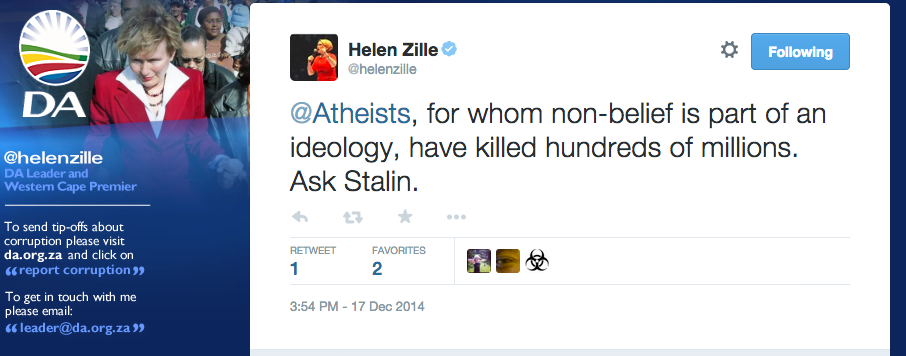
Yesterday, the Premier of the Western Cape, Democratic Alliance (DA) Leader Helen Zille said:

Worst kind of fundamentalists

and that’s how the fight got started. For a number of hours after this tweet, Zille was drawn into debate (well, insofar as the medium permits) on the religious views of Hitler, Stalin, Pol Pot etc., the putative moral virtue of Mother Theresa, and various other issues relating to religion and/or the absence of it.

Zille apologised for and retracted the tweet above, and it must be said that many who jumped into the conversation didn’t follow it from the start, and were guilty of some over-reaction themselves. In fact, the over-reaction persists today, where some legitimate criticism is being mixed in with abuse and caracaturing of her views and motivations.

If you read her tweet in the context of the conversation, I think it clear that she was responding to Kevin King’s introduction of the idea of religion-bashing by atheists, albeit in a rather glib and unfortunate way, given that the conversation began with Mandy de Waal offering an example of religious fundamentalism causing deaths.

But given the context of the conversation, it was a foot-in-mouth moment rather than an expression of religious intolerance. Despite this, her defence of the tweet, and a few follow-up tweets, indicate that Premier Zille does appear to hold rather misguided views on what atheism is, and what atheists believe.

First, though, I will agree with her on a central point, and annoy many atheists in the process: it’s entirely possible for atheists to be fundamentalists.

If you understand “fundamentalism” in the classic sense, in other words strict adherence to some set of doctrines, then atheists can’t be fundamentalists, as we have no doctrines. (Atheism being simply, and only, the absence of a belief in a deity or deities.)

But language and usage evolves, and it seems entirely permissible to me for “fundamentalism” to be taken as referring to certain ways of being anti-theist, rather than atheist. One relevant category of action would be to ridicule, mock, or insult; another would be to hold your atheism dogmatically, in the sense that you find it impossible to entertain any claims regarding the potential value of religion.

I’ve read my Dawkins, and know that folk will disagree with me on the first category above, insisting that “passion” gets mistaken for stridency. And on the second, I suspect many will say that there’s nothing to entertain, and that those of us who do are simply being “accommodationists”, weasels or something like that.

I’ll not rehearse those arguments now, but will instead point you to an earlier post which deals with some of these arguments at greater length. Here, I just want to say that I agree with Zille on that point, but nevertheless think that she should reconsider her beliefs with regard to atheism and its role in both history and contemporary society.

Even though she made repeated references to her party being committed to religious freedom, and asserted that she is similarly committed, her expressed thoughts on Twitter indicate prejudice against the non-religious. For example:

Atheists commit mass slaughter

Screen Shot 2014-12-18 at 10.47.24

As my earlier post argues, these sorts of sentiments are thoroughly confused, in that none of these examples were motivated by their atheism (for those who were atheists). The first tweet above should refer to “psychopaths” or “sociopaths” or something rather than atheists, because none of the claims made (commit mass slaughter; believe they are God; have an ideology) are remotely true of atheism in general.

The second tweet again makes the mistake of thinking that atheism is an ideology, or something that informs the lives of atheists in some sort of fundamental way. We’re just like you, Helen, and our atheism is usually as much of an “ideology” as your disbelief in Thor is.

And yes, perhaps people who happen to have been atheists have indeed killed many people, but either that’s coincidental, or you’re making a causal claim about either atheism conducing to evil deeds, or religion conducing to good deeds. Evidence suggests the final option might be what she thinks is the case:

Murder

And here I’ll say “sure, maybe that’s true” – but we’ve got zero reasons for believing it to be true. It’s an empirical question, and someone like Zille, who seems fond of data-driven approaches to things, might perhaps know of some of the ways we can distinguish better and worse answers to the question.

For example, does criminality, gender discrimination, murder and so forth tend to correlate positively with religious or non-religious societies? (The former, i.e. non-religious societies are more pleasant.) Does thinking about morality as necessarily connected to religion make any sense? (No – read your Plato.)

And, does thinking about morality as being intimately connected to religion impede moral understanding and thinking, by infantilising us, and making us unable to resolve moral issues through reason? (I think so.)

Zille does seem entirely sincere in her commitment to religious freedom, but that’s not much comfort when she appears to hold rather unsophisticated views on these matters. She’s endorsing dangerous stereotypes in tweeting these sorts of things, and furthermore, doing damage to the DA’s brand.

We’re living in a world where discrimination against the non-religious is quite a significant problem, and the leader of our only (quasi) liberal party should be expected to stand against discrimination, rather than offer it fuel.

Yet another opinion piece on #Shirtgate (or #Shirtstorm)

shirtgateWhile I realise that there are already hundreds of column-inches devoted to the issue of Rosetta scientist Matt Taylor and his shirt, I’m afraid I’m going to add a few more – mostly because most of those contributions have been in the international media, and 65% of my readership is in South Africa.

And it’s the South African responses that are annoying me, particularly on Facebook. They – like much of the international commentary, to be fair – are setting up an entirely false dichotomy between “feminist rage”, involving allegations of hypocrisy (“first you say we can wear what we like, but Taylor can’t?”); bullying (“Taylor harassed into a tearful apology”) offset against “the things that really matter”, whether it be the science itself, or the real root causes of sexism.

We don’t only have those choices. There are myriad positions available between them, and various combinations of them that are possible too – it’s entirely plausible that someone might, for example, be concerned about the signal that Taylor’s shirt might send (how it might be perceived, rather than how it’s intended), and also be gobsmacked by the scientific achievement of Rosetta.

And then, one can have this conversation without bullying – and talk about both these things at the same time. It’s not well-established that significant amounts of bullying even happened, depending on how you define bullying, of course. But because everyone is saying that’s what happened, it seems folk feel entitled to treat it as fact, even hyperbolising to the extent that Boris Johnson can speak of Taylor’s apology being “like something from the show trials of Stalin”, and his being

subjected to an unrelenting tweetstorm of abuse. He was bombarded across the internet with a hurtling dustcloud of hate, orchestrated by lobby groups and politically correct media organisations.

Of course you can find examples of Taylor being abused. My question is whether that was the typical or common response, or instead whether most commentators – perhaps outside of the filter-bubble of your prejudices (whether they be against “feminazis” or “misogynists”, both of which can be misidentified) – simply used the shirt as a springboard for a broader conversation about sexism in science, without vilifying Taylor?

In other words, is it true that the Left has “turned into Rick Santorum” – and even if it’s true, is this a good example of that, or is this case being misrepresented, meaning that we don’t get to talk about sexism in science for fear of being spoken of in this sort of supercilious tone:

Because you can criticise without “whining”, and you can celebrate the science while still criticising, less or more hyperbolically. When all the conversation is about how everyone who is criticising is “whining” – and everyone who is not is somehow complicit in sexism – then we don’t get to talk about both things (the science as well as sexism). And I’d hate to lose either topic.

To spell out why Dawkins is wrong, above: The problem here is that it sets up a simple false dichotomy, and again demonstrates the limitations of Twitter as a medium for expressing complex thoughts. (Which should make smart people, like Dawkins, more careful of what they say.)

The false dichotomy is in presenting the option of true feminism (whatever that is) in opposition to the “pompous idiots”, without recognising that there are permutations of feminism that are legitimate, and can be nevertheless be concerned about the shirt. (We’ll leave aside whether Dawkins gets to be the arbiter of what feminism is.)

There’s also an obvious straw man, on two counts – one, that everyone is whining (rather than expressing concern); and two, the implication that there’s a zero-sum game between talking about the shirt and talking about the marvellous scientific achievement of Rosetta.

Of course some treatment of Taylor can be over-the-top. But dismissing all concerns as whining from pompous idiots is oblivious, shoddy thinking.

And talking about “feminism” or “feminists” without allowing for these nuances involves painting with far too broad a brush. For me, the shirt is the springboard to a conversation that’s worth keeping going, and some “feminists” (or just humans concerned with fairness and so forth) are simply using it as that.

Other “feminists” are indeed over-reacting to the shirt as a token or instance of sexism, which then does (or can) detract from both the larger and more important issue of sexism in STEM, and can also detract from conversations about Rosetta. As I ask above, it’s legitimate to ask – not simply assert – that they are typical.

The Dawkins tweet, and comments saying that “feminists” are over-reacting, assume that everyone is in the second, hyperbolic and reactionary camp.

That’s a caricature, and to me, it’s a caricature that suggests an anti-feminist bias.

South Africa (apparently) intends to break the Westminster system

mmusibelieve11871416618143538425242123914580nEarlier today, I tweeted that I didn’t agree with the Democratic Alliance’s (DA) strategy of no longer recognising the Speaker of Parliament. Besides wondering quite how this could be effected, I also suggested that gambits aimed at breaking the Parliamentary process hardly seemed appropriate for an already broken institution.

A friend on Twitter asked what I would suggest as an alternative to what the DA has chosen to do, and this is my answer to him. Well, an answer, and also some reflection on the situation in general.

I’m not going to rehash what happened in Parliament yesterday, and will instead point you to Rebecca Davis’ column, which does a fine job of highlighting what a unfortunate session of Parliament this was for anyone who holds out hope that our nation’s affairs are being governed by reasonable people.

So, in light of those events, Mmusi Maimane (DA Parliamentary Leader) released a statement that begins with:

Events in Parliament yesterday represent a turning point for our democracy and has fundamentally changed the DA’s approach to Parliament. Baleka Mbete lost control of the House and destroyed her credibility as the Speaker. Accordingly, we will cease to recognise her authority as Speaker.

Every time she presides over the House, the DA will only send its Chief Whip, Deputy Chief Whip and those members participating in debates.

By “fundamentally changed”, Maimane seems to mean that they intend to read the mandate that many South Africans have given them to represent them in Parliament, vote on bills, hold the Executive to account and so forth, as giving them licence to rather take their toys and go home.

Because instead of a potential 89 (the number of DA representatives in the National Assembly) (NA) voices, there will now only be the handful described in that last paragraph, quoted above, and the 22.2% of South Africans who voted for the DA might as well have “fundamentally changed” their attitudes towards elections also, and not bothered to vote.

Yes, I get that these are tactics of brinkmanship, where the DA might hope that the pared-down Parliament resulting from this move might provoke the ruling party into fearing a loss of perceived legitimacy in respect of the National Assembly. But if what you’re complaining about is a ruling party that you think above the law, and contemptuous of the opposition, how likely do you think a favourable result is?

More important, for me, are some matters of principle. One, as I’ve already noted, is that DA MPs have a job to do, and their Parliamentary Leader is telling them not to do that job.

Second, tactics like walk-outs (and this is basically an extended and generalised walk-out) need to be used sparingly. A walk-out is one of the strongest protest signals the opposition has, and one doesn’t want to use your strongest currency without exhausting all other options. Now, in this case – given that riot police were in Parliament, assaulting MPs and so forth, a walk-out might well be the appropriate action.

Except, they do it all the time – not just the DA, but other parties too. So, instead of provoking as significant a reaction as it should (“What? All the elected officials of party X, paid R1-Million a year to do job Y, have walked out of Parliament? Either there’s a crisis, or they need to explain themselves. Either way, I care.”), one instead thinks of the boy who cried wolf, and what rhetoric Maimane will need next time he wants to lead a walk-out. Which will probably be next week.

Walk-outs can be an abrogation of your responsibilities to the voters. They can also impair credibility, not only because credibility can be impaired inside the NA but also with the electorate, some of whom still associate the DA with negativity and obstructionism.

Credibility is also impaired through what looks like opportunistic application of one principle in one case, and very different principles in another. Compare and contrast Helen Zille defending yesterday’s filibustering tactics with this DA statement (from Dene Smuts) on Ambrosini’s filibustering in 2011:

But we can, and do, object to the fact that he is subjecting the South African Parliament to a political stunt. His actions demean the national legislative authority of the Republic of South Africa.

It’s different when we do it, I guess.

Third, some of our conventions only have moral force through common assent – they’re grounded in a sort of social contract, where they work because we all agree that they should work in a certain way, and are valuable because they often, in fact, do so.

Maimane is dead right that Mbete is a terrible Speaker, who has utterly failed to hide the fact that she’s defending the ruling party’s interests wherever and whenever she can. She’s a disgrace to the position, and needs to be gotten rid of. But, according to the rules, if she tells you to leave the NA, you need to leave the NA.

And when she told Michael Walters (deputy chief whip of the DA) to sit, and then to leave after he refused to sit, it’s the DA who break that social contract. The DA can’t claim a moral high-ground involving Mbete and the ANC provoking the violence of yesterday, without reflecting on the fact that there were various provocations along the way to that – and that some of them involved the DA, and specifically involved the DA ignoring the same set of conventions that they want Mbete censured for ignoring.

There are differences of degree, no question – as I say above, I’m addressing matters of principle alone, and making the point that it’s not only the ANC who is breaking the relevant social contract. If told to leave, you leave, and use the fact that you were capriciously ejected as ammunition for future battles, rather than running the risk of your refusal prompting an even less productive session for your colleagues, and the citizens you represent.

To conclude, and in part-answer to the question that prompted this column, what would I have suggested instead of what Maimane says in his statement? Well, I suspect that I would have written a far more strongly worded letter, which would have made it clear that the party no longer recognised her moral, rather than her literal, authority.

I would perhaps have embarrassed her with a list of all the ways in which she’s let the NA, and the country, down, and highlighted moments in which she destroyed her credibility – in short, the purpose of the press release would simply be to demonstrate that she’s demonstrably not fit for purpose.

It would have been just on that topic, not about Zuma not attending question and answer sessions, or Lindiwe Zulu attacking an opposition MP, so as to make it clear that as far as you were concerned, this Speaker is contemptible.

Then, I would have told my caucus to get back to work, including respecting the Office of the Speaker, and including obeying instructions that the Speaker gives. If the party thinks they contravene the agreed conventions (and laws), then the people not ejected can make that point, sometimes winning and sometimes losing.

But at least the majority of the MPs will be in the House, able to do some work. Seeing them do that work in a dignified fashion, working within the rules, while simultaneously observing a Speaker making rulings that are biased, arbitrary and perhaps vindictive, might well do more good for both Parliament, and the DA’s share of the vote.