Homophobia and free speech at UCT, redux

-t2zWl54The Vice-Chancellor of the University of Cape Town has responded to the controversy provoked by Zizipho Pae’s Facebook remark that legalising gay marriage was “normalising sin”, in a statement that attempts to balance sensitivity to LGBTQIA+ concerns while also affirming Pae’s rights to hold unpopular views.

My previous comments on this issue stand, but I’d like to add a few clarificatory comments. I agree entirely with Dr. Price that a key issue here is the legality of the Student Representative Council (SRC) decision to terminate her membership of the SRC, and also that the abuse and intimidation Pae experienced is inexcusable.

As Nathan Geffen wrote earlier today,

Should the extent of the hatred, misinformation, prejudice or ignorance disentitle the speaker from holding office?

In some cases it may. In others, there’s an opportunity to educate — both the speaker and the general public — rather than respond with fashionable social media fuelled outrage. The same goes for homophobia.

My argument last time was that it was entirely appropriate for the SRC to suspend Pae, pending discussion regarding her fitness to hold office, based on what the SRC constitution says and does not say.

I do not believe that holding homophobic views should automatically disqualify one from office – my claim is the limited one that if this contravenes established and documented values, then you are accountable in accordance with those values.

So, you’re free to be negatively disposed to gay people – but just not when this is associated with your position. This is not a free speech violation, but is instead a restriction on who is eligible to represent a community. The latter (being a SRC member) is not a right, but an earned position, and if that comes with certain requirements, you could rightly lose the position if you don’t fulfil the requirements.

From what I can tell from the SRC constitution and the minutes of the meeting that expelled her, I strongly doubt that her expulsion was legitimate, and I’d expect it to be overturned in time (although, this will likely be a pointless exercise, seeing as the SRC elections for 2016 are about to take place, with the current SRC coming to the end of their term).

Where I don’t agree with Dr. Price’s statement is where he quotes a 1998 Constitutional Court ruling which held that “those persons who for reasons of religious belief disagree with or condemn homosexual conduct are free to hold and articulate such beliefs”, going on to say that

This is especially so when a religious belief is articulated in a way that is not intended to insult, harm or discriminate, and if there is no incitement to taking harmful action against others. On our reading, Ms Pae’s Facebook post was an expression of her sincerely held religious belief, rather than an intervention to insult or hurt those with whom she disagrees.

Yes, they are free to hold and articulate those beliefs, but firstly (and again), not necessarily without consequences. As I say above, one such consequence could be expulsion, if the relevant laws/policies dictate that.

Should that consequence be expulsion? I don’t think so, as long as the person in question was appointed or elected with the rest of us being fully cognisant of their views, at least with regard to our set of ideal values.

So, if Pae campaigned on a platform that included opposition to gay rights, and was elected on that basis, I couldn’t have any complaints. Geffen’s post says that she didn’t hide her Christianity, but that’s a different matter to being openly anti LGBTQIA+ rights.

My view is that if you don’t disclose this, you can reasonably be expected to share the values expressed in various UCT documents, including SRC documents, that support those rights. Once it’s discovered that you don’t, the electorate might justifiably feel deceived, in that these are assumed to be shared values in the community (even if they aren’t actually shared in practice).

And finally, the notion of an expressed prejudice being more excusable if it stems from a “sincerely held religious belief”, rather than being something intended to “insult or hurt” isn’t helpful in this case – it simply passes the buck, and avoids tackling the difficult issue of what to do when people are “sincerely” bigoted, and with good intentions.

As Pierre de Vos noted in a recent column, religious beliefs and practices often get a free pass when it comes to discrimination. If allowing for discrimination based on religious views is a reasonable interpretation of the law, then I’d call the law defective in that regard.

We know, in advance, that some sincerely-held views (such as held by Pae) are not intended to insult or hurt. But we also know that they do insult and hurt.

Secularists (like me) are emphatic on the point that religious precepts should not be permissible premises in debates on policy or law. But more to the point, some of us who lack any belief in god(s) struggle to see any principled difference between your long-standing and scripturally-located version of “proper” marriage and sexual conduct, versus someone who chooses to locate their racist tirades in some long-standing tradition.

Or even, their polite, “sincerely held” racist beliefs, that are not intended to “insult or hurt” anyone, but merely to make things more efficient by letting people know what their proper place in the pecking order is.


“Witch hunts”, Tim Hunt, and sexism in science

tim-huntAs with “shirtgate”, where Rosetta scientist Matt Taylor was in the news for wearing a shirt depicting naked scantily-clad women, the Tim Hunt case has prominently featured Richard Dawkins, telling us how to understand feminism and the issue of sexism in science.

In his letter to The Times (paywalled, so – sorry – I’m linking to the Daily Mail‘s quotes of the letter), Dawkins says:

Along with many others, I didn’t like Sir Tim Hunt’s joke, but “disproportionate” would be a huge underestimate of the baying witch-hunt that it unleashed among our academic thought police: nothing less than a feeding frenzy of mob-rule self-righteousness.

‘A writer in the Guardian even described it as “a moment to savour”. To “savour” a moment of human misery – to “savour” the hounding of one of our most distinguished scientists – goes beyond schadenfreude and spills over into cruelty.’

One might hope that Dawkins is demonstrating “disproportionateness” via example, but he’s no doubt serious in this one-sided portrayal of events. Not only that, he’s perpetuating a misunderstanding he found in the libertarian Reason.com in his “moment to savour” quote – the Guardian quote, in context, reads:

Yet this is a moment to savour. Hunt has at last made explicit the prejudice that undermines the prospects of everyone born with childbearing capabilities.

In other words, it’s not the Hunt resignation that the author is savouring, but rather the opportunity it provides for discussing the ingrained sexism that is still experienced by women in professional settings such as laboratories (not to mention elsewhere).

When the speaker of the offensive remarks has felt the need to apologise, fully acknowledging that the remarks were inappropriate, seeing a senior male scientist like Dawkins describing reaction to those as a “feeding frenzy of mob-rule self-righteousness” is unlikely to reassure anyone who has concerns regarding perceived or actual sexist treatment of women in the workplace.

Yes, it’s true that some on social media had strong words to say about and to Tim Hunt. I don’t think it clear that this forced his dismissal, though. As usual, one can find evidence to support the case you want to make – Hunt and his wife claim that he was “hung out to dry” by University College London, and UCL say that he resigned (from an honorary, not paid, position) before they had a chance to speak with him about the incident.

He says he was joking when he made the remarks. And it’s true that many of the quotes of his remarks have left out the “now seriously” he utters in the second paragraph below:

It’s strange that such a chauvinist monster like me has been asked to speak to women scientists. Let me tell you about my trouble with girls. Three things happen when they are in the lab: you fall in love with them, they fall in love with you, and when you criticise them they cry. Perhaps we should make separate labs for boys and girls?

Now seriously, I’m impressed by the economic development of Korea. And women scientists played, without doubt an important role in it. Science needs women and you should do science despite all the obstacles, and despite monsters like me.

But the issue is not whether he was joking or not. No reasonable person could doubt that he was intending to make a joke. The issue is what jokes you regard as appropriate or not, in which contexts. In a professional context such as this, addressing a room full of female scientists who have most likely encountered plenty of glass ceilings, this was a stupid and insensitive joke to make.

Furthermore, what Dawkins and others are perhaps not reading is the non-baying-mob part of the Internet, for example these tweets from someone who interviewed Hunt just after he made the remarks in question. Here’s one of the tweets:

Blum goes on to record that Hunt said “he was trying to be honest about the problems” – meaning he perhaps does have the sexist attitudes that the “joke” was purportedly ironising. If so, why should UCL want him in an honorary position?

I don’t know all the facts – very few of us do. And yes, I agree that social media can bring an unreasonable mob to your door. Another speaker at the same event (who confirms Blum’s account) Blum perhaps puts it best, though, in saying:

I do have sympathy for anyone caught in the leading edge of a media storm. But if we are ever to effect change, sometimes we need the winds to howl, to blow us out of our comfort zones. Because the real point here isn’t about individuals, isn’t about Tim Hunt or me.

The real point is our failure, so far, to make science a truly inclusive profession. The real point is that that telling a roomful of female scientists that they aren’t really welcome in a male-run laboratory is the sound of a slamming door. The real point is that to pry that door open means change. And change is hard, uncomfortable, and necessary.

Girl with cake – let them eat oversimplification

Marie Antoinette never said “let them eat cake”. At least, we have no reliable evidence that she did, and reason to think it unlikely. At the time (the other) Rousseau, Jean-Jacques, recorded the words, she would have been 14 years of age and not yet even resident in France.

Nevertheless, the words have come to stand for indifference to suffering, in that as the story goes, when the Queen was alerted to the fact that people were starving thanks to bread shortages, her response was “Then let them eat brioche.”

Given this widely believed historical anecdote, you’d perhaps think it an elaborate (and risky) joke if a privileged white woman were to travel the country giving cake to poor people. Or perhaps you’d assume that she’s not familiar with the anecdote.

I’m going with the latter option in the case of Girl with Cake, which involves a privileged white woman traveling the country giving cake to poor people, because “everyone deserves a cake made with love”.

Not only do they deserve it, the cake also “makes all the bad go away”. Given the Oprah-level powers of said cake, why is it that myself and some other grouches have concerns about this project – and why is it that expressing these concerns is so offensive to some?

poverty-porn

Starting with the first question: neither I, nor anyone I’ve encountered on the “concerned” side, have any objection to charitable giving. But something being charitable and perfectly well-intended does not make it immune to criticism.

In this instance, there’s a long historical context of romanticising poverty and of creating narratives of a white saviour rescuing black people from their miserable existences.

And it’s because of this context that when one engages in charitable giving, it’s usually a good idea to be somewhat discreet about it, rather than having a photographer in tow to capture your beaming white smile and the poor black people to whom you have provided the “joy of cake” (yes, that’s a quote from the website).

cake

The first photograph in this post comes from Robert Pijpers’ essay on stereotyping Africa and romanticising the poor, and I’d encourage you to read that for a fuller explanation of the point I’ve only briefly made here, that “depicting Africa as a place inhabited by helpless people that long for salvation” is a risk inherent in these sorts of endeavours.

The primary purpose of this post is rather to talk about reactions to criticism of Girl with Cake, which – in the case of one friend of mine – have made it clear that self-reflection is forbidden, nuanced discussions of poverty and charity are offensive, and that anyone who dares to do either must be evil.

Here are some quotes from Facebook:

  • All you’ve done is breakdown my faith in humanity – the lil bit that she restored
  • She should be giving them raw liver instead! #Banting (okay, that was me)
  • Because it’s so much more productive to write horrified Facebook posts? C’mon [X], at least she is making an effort and not at a distance, either.
  • Really disappointing that people get slammed for trying to uplift someone’s spirit.
  • What have you done for the poor lately?
  • you are really a sad human being
  • It is easy to sit back and be an acid queen about everything, but to take hand of your cock and stop wanking and start doing something for somebody else is something completely different.
  • do u have no humanity in u or are u just negative because ur life sucks?
  • The world doesn’t need people like you

There’s more, and it’s ongoing, but that’s enough. What these comments miss is that the problem isn’t the giving, but the apparent obliviousness to the impression of narcissism created by the manner in which the giving is promoted.

It’s irrelevant how much or how little the critic him or herself gives – all that could possibly indicate is hypocrisy, but it has no bearing on whether criticism of Girl with Cake is legitimate or not. And of course, it’s deeply ironic that defenders of charity can themselves be so lacking in charity, as demonstrated in these abusive responses.

Another friend asked me whether criticising Girl with Cake amounts to bullying, and I’ll close with a few thoughts on that. Of course it can be bullying, depending on what was said, and who it was said to.

In this case, the comment or criticism amounted to linking to her website, commenting “So here’s someone who literally thinks poor people should eat cake. And then she gives it to them while a poverty voyeur takes photos. AND THEN SHE PUTS IT ON THE INTERNET AND THANKS HER SPONSORS! I…you…WHAT?! WHAT THE FUCK?!”

The beaming white smile and the noble savage is a problematic image, and it’s one that she foregrounds on her website. Transpose her story and the cake with a missionary and a Bible, or somesuch, and we’ll have consensus that there’s an issue here.

Again, this isn’t to question her good intentions, but rather to point out that the optics are pretty unfortunate in how they give an impression of unthinking narcissism. That, albeit in more direct language, is what the Facebook post expresses.

That’s not “bullying”, but rather highlighting a problematic stance or behaviour. Doing so is not only permissible – it’s desirable, in that debate and argument is how we improve.

Sparks, Dlamini, and whether “cleverness” is praiseworthy

ASWhen I saw that Allister Sparks told the Democratic Alliance congress that Hendrik Verwoerd was a “smart politician”, I was relieved to have previously defended not only Mcebo Dlamini’s right to say stupid things, but also to have argued that we can (and should) distinguish between an individual’s sentiments and poor expressions of those sentiments.

Relieved, because the cases do have at least one similarity – Dlamini was apparently attempting to make a pro-Palestine comment rather than a pro-genocide/eugenics comment, and Sparks was apparently attempting to praise political cunning rather than to present Verwoerd as a morally praiseworthy individual.

Both of these individuals have made matters worse for themselves in their explanations of their remarks, to be sure. Dlamini has legitimised interpretations of him being anti-Semitic by speaking of his Vice Chancellor being a “Jew puppet” who bowed to pressure from “Zionists” in removing Dlamini from office, while Sparks initially doubled-down in saying that Verwoerd gave a “veneer of moral respectability” to apartheid’s slogan, “The K***** in his place”.

Sparks has now offered a fuller account of, and apology for, his remarks, asking us to blame forgetfulness and senility for his not having name-checked any black politicians as “smart”, and also reminding us that he was drawing from his personal frame of reference as a veteran political observer in an environment where he’d naturally have encountered more white politicians.

The Democratic Alliance (DA) has also distanced themselves from Sparks‘ remarks, albeit only a day after they were made – allowing for social media to spend the intervening 24 hours exchanging views and confirming their interpretations of the DA as oblivious to the politics of race in South Africa, even as they were busy electing their first black leader, Mmusi Maimane.

The link immediately above takes you to a YouTube video where James Selfe, Chairperson of the DA’s Federal Executive, explains (repeatedly) that Sparks is not a party member, was speaking in his personal capacity, and expressed views that the DA does not endorse. He also notes that they didn’t want to say this immediately after Sparks’ speech, as that would embarrass him.

And there’s the problem – it is embarrassing to run off a list of “smart” politicians, and in doing so to not only mention Verwoerd but also to not mention a single black politician. You should be embarrassed in this situation, as it’s a situation that’s only possible if you’re insensitive to context and history to the extent that this sort of racial myopia can go undetected (in yourself).

If you’re a political party that’s aiming to speak for all South Africans, and that currently presents itself as the “most diverse” party in the country, having this happen at your national congress should likewise be embarrassing, even if you think that the commentariat is over-reacting. Perceptions matter, even if you think those perceptions are unfair interpretations of what someone was saying.

As I’ve said in the past with reference to the mind-boggling decision to rename a road after FW de Klerk, if you know – as the DA surely does – that you’re perceived as a racist party, you need to bend over backwards to avoid signalling that those perceptions are true, even if it means embarrassing your outgoing leader’s friend and mentor.

Yes, of course it’s frustrating to have to cater for misinterpretation. But you need to do less of that once trust is established, and people no longer think of you as being a party of white (quasi) liberals. Once that trust is established, I’d be more sympathetic to the DA being annoyed at those who took offence at Sparks’ remarks.

But if the DA thinks they’ve already earned that trust, they’re sorely mistaken.

Rhodes, “mad panics”, and inappropriate analogies

Since leaving the Democratic Alliance, Gareth van Onselen has become one of the more consistently interesting columnists we have in South African media. “Interesting” might seem to be a weasel-word to some of you, but having now spent a few minutes trying to find the right word, I find it’s the best I can do.

His columns are seldom bad, and are sometimes very good. They are often challenging, especially to folks like myself who think of themselves as liberals, and challenging our views – and making us think – is the primary task of a columnist.

It’s true that some use the “liberal” label, as well as his past party affiliation, as convenient means of dismissing van Onselen’s contributions. These critics miss the point, I feel – mostly because those are fairly straightforward ad hominem comments rather than engagements with substance, but also because they see his dogged adherence to principle as evidence of ideological blindness.

Van Onselen isn’t subtle in his criticisms, but they are typically very thoughtful, and thought-provoking for those who choose to engage with them. He is also deeply committed to certain values, which can loosely be described as those of classical liberalism.

He makes no attempt to hide that ideological conviction, and applies it consistently – which means that we can either try to undermine the foundation itself, or his interpretation of it.

As with the Michael Cardo piece on UCT’s “pathetic capitulation” on the question of the Rhodes statue, I think van Onselen’s recent column on the same topic gives UCT too little credit, and also exaggerates the likely consequences of the Rhodes statue removal.

1339056551-fahrenheit451Furthermore, I find its liberalism unduly prescriptive, in that it asserts that the status quo (at least in terms of the historical record, and the statue in particular) must be preserved, because removing it is to succumb to an unthinking populism, or even worse, a re-programming of society, of language, and of value (as was portrayed in Bradbury’s Fahrenheit 451), rather than seeing how changing the status quo could better serve a liberal outcome.

He also uses the analogy of Brett Murray’s The Spear, and this analogy is to my mind equally poor – not for being hyperbolic (as is the case with Farenheit 451), but because the two things are crucially dissimilar.

You need to read his column (in fact, the transcript of a speech), because I’m not going to do it justice here. There is plenty in it to think about, and to be challenged by, especially if you regard yourself as a liberal. It’s long, and I want to be brief – so apologies for only picking up on a few things below.

First, the column takes a value-laden starting point – the presence of the statue at UCT – as a legitimate normative and neutral starting point. This is why the Farenheit 451 analogy is hyperbolic. If we are liberal, and committed to individual freedom, it is of course a concern if we start privileging certain views (by extension, cultures, artistic expressions and statues) above others.

But the point about the removal of Rhodes (for those who supported that decision, like me) is that its presence did that privileging already, and that its removal is therefore more compatible with this liberal goal, in that it was its presence in such pride of place that resulted in some students being unable to feel as much part of the institution as others.

A focus on the underlying goals and values of liberalism should not be obscured by historical contingencies, and should certainly not be defined by a privileged set of norms that are thought to be beyond question. We can agree that all things being equal, statues should not be torn down, sure – but all things were not equal in this case.

By contrast to burning books, students were forced to see this statue, and to see it as emblematic of their university. They could choose to not read a book, but they could not choose to have the statue standing in pride of place at UCT. There is no reason to burn a book, because you have the option of not reading it – here there was no analogous option.

Likewise with The Spear – the analogy fails because the cases are too dissimilar. An artwork like The Spear is created for a community who typically self-select to engage with it. This is not the case with the Rhodes statue. The Spear was a case in which people were perfectly entitled to their offence, but were not entitled to the remedy of destroying it or removing it.

Neither the Goodman Gallery, nor Brett Murray, are established as institutions for the national good, that are intended to serve an educational purpose while trying to avoid privileging people by virtue of their race, class and so forth. You can object to The Spear, lament its existence, and then move on – it’s wrong to destroy it. UCT, by contrast, is being negligent if it picks at some scab of yours every day you are there.

Our understanding of liberalism should not be allowed to ossify, as I think it can do when we take the current situation for granted, instead of being more Utilitarian about maximising liberty – even when that means changing something about the present (like moving a statue).

As I noted in the third part of this piece on modern challenges to free speech, other aspects of liberalism might need updating also, in that if the environment changes, different sorts of remedies or interventions might work better than those we used in the 19th Century.

Or, as John Maynard Keynes put it, “When my information changes, I alter my conclusions. What do you do, sir?”

Helen Zille’s resignation, and hyperbole in political commentary

helen-zilleOn Sunday, we witnessed an atypically shambolic press conference from the Democratic Alliance (DA). Part of the reason for the chaos was presumably the significance of the news, namely Helen Zille’s announcement that she won’t be standing for the position of party leader at their upcoming elective conference.

A journalist contacted me yesterday for comment on whether she “jumped or was pushed”, and it strikes me as unfortunate that the question seems as high on people’s lists of interests as it seems to be. The News24 live feed of the press conference chose “I wasn’t pushed” as their headline, even though the mere idea that she might have been was mentioned only once by Zille, and then once in a speculative tweet by UCT’s Professor Pierre de Vos.

My view is that the distinction is to a large extent a meaningless one, and one that mostly serves to feed a public demand for sensation.

Zille is undoubtedly a strong enough character to have stayed on if that was her preference – so to some extent, it strikes me as absurd to suggest she was “pushed”. But in this discourse, “pushed” is interpreted to mean something closer to “evicted”, or told/asked to go.

If you think of “pushed” in the less hyperbolic sense of being subject to internal pressures, it would be absurd to think that those were not present. For one, there isn’t a political party that has no internal dissent, and second, we also know that Zille has been contemplating stepping down as leader for some time now.

The fact that Zille herself made the possibility of stepping down public knowledge would also mean that anyone who would like to see her do so might have been emboldened to make that suggestion internally more often or openly than before. This wouldn’t amount to being “pushed” in any sense that represents an ousting or a coup, which is what the hyperbolic language suggests – it’s rather part of the ordinary growth and evolution of an organisation.

In this case, I think the timing poor. I of course don’t have access to all the information, and there might well have been compelling reasons why it couldn’t wait. But I think it poor first because it will have the likely effect of eliminating any serious competitors to Mmusi Maimane as Zille’s successor, and second because there isn’t much time for any successor to be confident of full control of the party in time for the upcoming elections in 2016.

The first issue undermines internal democracy, and has the effect of Zille anointing her successor, rather than that successor being chosen by the party. Postponing the federal congress to give other candidates a fair shot would have cost R5m, according to Gareth van Onselen.

On the second issue, a new leader will not only have to get to grips with a broader range of internal interests and pressures, but will also presumably want to put his or her own stamp on things, which means that those they lead will also have to adjust to a new regime. Add those complications to the strong suggestions that the DA will be launching a new “values” platform before the election, and the recipe seems to indicate an incoherent election campaign.

Regarding Maimane himself, I think he’ll struggle with internal and external credibility, at least initially. His rise has been too rapid to establish a track-record that inspires confidence, and beyond being a good rhetorician, we know little about him as leader – his strategic inclinations, his views on policy, and so forth.

Having said that, there’s a wealth of experience in the party that can offer advice during the transition, and I also doubt that Zille would have been as supportive of him as she has been until now if he were not up to the task. She’s also not going anywhere, having committed to seeing out her term as Western Cape Premier.

However it plays out, there are interesting times ahead for watchers of South African politics, same as it ever was.

Rhodes”Pathetic capitulation” or principled decision? More on #RhodesMustFall

rhodesI’d encourage you to read Michael Cardo’s piece on the “sinister underbelly” to the campaign that has succeeded in having the Rhodes statue boarded up, pending its removal from campus. I seconded the motion to have the statue boarded up, and voted in agreement for its removal, so while you might expect me to disagree with Cardo – and I do – he nevertheless makes many strong points.

The primary challenge he presents is in the form of questioning whether UCT and the Senate lacked courage in making the decision that we did, and whether we capitulated to both illiberal bullying as well as ideologically-flawed arguments in doing so.

I’m sympathetic to the dangers he points out – it’s certainly true that loud and persistent pressure, as well as muddled political thinking, can result in hasty and unfortunate decisions. However, I think that he’s wrong in this particular instance, and that his error rests in regarding all support for the removal of Rhodes to have originated from majoritarianism, mob rule and the worst sorts of identity politics.

Starting at the end of that list, I have to agree entirely with his criticisms of the arguments that come from the likes of Gillian Schutte. Any writer who regards words like “privilege” as trump-cards in arguments is shouting from a pedestal, rather than debating.

As I’ve argued before, though, there’s a difference between the mindless use of a phrase like “check your privilege” and the (correct, and necessary) acknowledgement that privilege exists, and that it can affect our objectivity. In this instance, writers like Cardo are assuming a certain norm, namely that Rhodes is there, and the burden of proof is on those who want him removed.

But there’s no reason that we should accept that as the norm, rather than recognising it as an accident of history, which we now have the opportunity to correct. In other words, can we not be said to be assuming a certain epistemic privilege in saying that the burden of proof is on those who want its removal, rather than on those who insist it should stay?

Yes, something is lost with its removal – but the case needs to be made that this loss (context, history, opportunities for debate etc.) is of more significance than what might be gained. In this case, the obvious potential gain is the sense of a more inclusive campus, and one that is clearly committed to working harder at its transformation goals.

As for our being bullied into this, it’s telling that Cardo only refers to Maxwele when speaking about the student voice. And even though I think Maxwele has been far more articulate than the quote Cardo uses to discredit him with (“I don’t have to justify anything to a white male or a white institution. Nothing whatsoever.”), even if he were not, there are many other student views that are persuasive to varying degrees.

Also, it’s not as if we only relied on student views. I’ve been party to four different staff debates on these issues now, where in each case, the pro-statue people were persuaded by arguments, rather than persuaded to shut up because of the negative political consequences of their view.

Cardo notes the possibility that “the senate [sic] was swayed by arguments so persuasive and unassailable that it had no choice but to heed the demand that #Rhodesmustfall”, but seems to have done no work in establishing whether that was the case or not – he segues from there immediately into his caricature of Maxwele as an intransigent racial nationalist.

Two other brief points – first, moving the statue is not necessarily equivalent to “erasing… the historical record”. For one, as per my burden of proof point above, it could be said that his presence erases another historical record, and that these protests were sparked by that. We can argue that a method needs to be found to note both (and potentially other) historical records, but that while we do that, this thing – that some find offensive – has to go because the negatives of its presence outweigh the positives.

It could return once we’ve figured out what to do, or something else could go up that does a better job of representing history. But to glibly assert that taking it away is equivalent to erasing a historical record begs the question of whether it necessarily does so, and furthermore assumes the primacy of a particular historical record – in other words, it also assumes that conclusion before the argument has even been conducted.

Lastly, seeing as Cardo’s argument rests on the view that as a “liberal” university, UCT should be embarrassed by acceding to “illiberal” demands for taking the statue down, I must note that I also reject his understanding of what a liberal is, or rather, what a liberal perhaps must be, since I read him as being quite ironically prescriptive on this point.

Broadly speaking, a liberal values liberty (surprising, I know), and attempts to secure that via vehicles such as democracy, rights and so forth. In terms of free speech in particular, this statue case could be interpreted as an example of Mill’s “marketplace of ideas” in full-flow, where the arguments in favour of taking it down won the day. That’s what I think happened.

Or, you can frame it as UCT having bowed to pressure – in effect, having been held to ransom. And there’s a danger of a false dichotomy here also, in that while I think that (some of) the students acted shamefully at times, that’s a separate issue to whether they – and the staff who support their arguments – are correct or not.

More broadly, the liberalism I subscribe to recognises the human flourishing that can result when people are treated equally, respectfully and so forth. Keeping a statue of an arch-colonialist on campus, in such pride of place, sends a signal that can quite plausibly be read as a lesser commitment to the interests of some rather than others.

I would have kept it on campus, and that was in fact the first proposal that Senate debated, before an amendment suggesting it be removed entirely was proposed. In later years, we might decide to bring it back, and have it form part of some new installation.

But whatever happens, there will no doubt be some significant recognition of what was in his place, and why it was moved. We’re not obliterating history at all, in other words – we’re making it.

UCT Academics Union statement on #RhodesMustFall

Rhodes_250x374On Monday (23 March), the UCT Academics Union (AU) met to discuss the statement released by the Executive of the AU. As a long-standing member of the AU, with a keen interest in the Rhodes statue and the University’s business in general, I attended for the purpose of supporting the statement, and also to join those arguing that the AU needed to say and do more in the coming weeks and months.

Needless to say, not everyone was on board – some thought that the students had gone too far, and that the Executive statement should have been more critical of them. But a majority sentiment was that the AU as a whole wanted to release a statement, and that it should express more committed support for the #RhodesMustFall movement.

More to the point, many of us desired to note our “past systemic failure to successfully engage with and pay attention to the experiences of marginalised voices on campus, especially Black students, academics and other staff”. As the academic staff at the University, we need to offer intellectual leadership, and on this issue, we’ve failed to do as much of that as we should.

You can read the AU’s statement below. In a poll that closed this morning, it garnered the support of over 70% of our membership. I do regret that the figure was not higher, but it’s of course possible that some of those who did not support it did so because they thought it didn’t go far enough.

A broad consensus statement will never satisfy everyone – work done by committees and collectives seldom does. Nevertheless, I voted in support, and am glad to be part of a union that was willing to make this statement.

UCT Academics Union statement on #rhodesmustfall

27 March 2015

Regardless of race, gender or rank, we are committed to excellence in higher education; and to the training of the next generation of South African leaders and academics. Engagement, debate and dialogue are essential and intrinsic to the academic project. UCT’s failure, over a period spanning decades, to address the institutional racism inherent in the naming of buildings and siting of objects on campus represents a signal failure to engage meaningfully with the symbolism of South Africa’s past, and with the university’s ‘heritage that hurts’.

That it has taken extreme action to bring the university to a realisation that urgent remedial action is required on the statue, and more importantly, for what the statue symbolises for the institution’s commitment to transformation, is itself testament to a past systemic failure to successfully engage with and pay attention to the experiences of marginalised voices on campus, especially Black students, academics and other staff. The AU acknowledges and accepts that it has been complicit in this failure. Had the university, including the AU, been more attuned and empathetic to these issues, the protest might not have taken the form it has.

It is the AU’s position that the statue has no place in its present position on campus. Nor is it relevant whether or not a majority of students, staff, alumni or Council members believe that the statue should be moved. That the statue is not appropriate on campus in its present position, where members of the university community are confronted with its hurtful symbolism on a daily basis, should be self-evident.

The AU believes that removing the statue from its present position is an essential first step towards creating the space for engagement, debate and dialogue on the pressing matter of institutional transformation at UCT. The AU calls on the Executive, Senate and Council of the university to support the call that the statue should be removed as a matter of urgency. We understand that constituencies external to the university, such as SAHRA, might need to be consulted. Should they be necessary, these consultations should commence as a matter of utmost priority so that delays in coming to a resolution on the statue are kept to an absolute minimum.

The statue, of course, has broader symbolism, raising important questions about structural and institutional transformation. As an important UCT constituency, the AU agrees with the students that there are specific issues relating to transformation that require the urgent consideration and engagement of academic staff. The most pressing of these relate to

  • The institutionalised discrimination, including racism, sexism, homophobia and transphobia and ableism, experienced by staff members at UCT;
  • Questions relating to curriculum content and design, and whether these are as appropriate as they should be in the context of transforming higher education in South Africa;
  • Ensuring greater transparency of the ad hominem process, to ensure that artificial barriers are not being placed in the path of marginalised staff members seeking promotion.

Starting in the second term, the AU will convene separate fora on each of these topics. These fora will engage members, as well as important stakeholders and interest groups, and will specifically seek to provide a platform for the careful articulation and identification of problems, as well as ensuring that marginalised groups are provided a safe and responsive space to express their views. Our first task is to listen, to understand, and to empathise. Thereafter, we urgently need to find and propose solutions and policies that address these in such a way to ensure that the transformation of UCT is advanced.

Transformation, and the challenging of institutional racism is not an issue important only to a few sections of the UCT community. If we all stand together and openly embrace and enact transformation, we will contribute towards a more inclusive, and unified university.

The engagement proposed represents a significant shift for the Academics Union at UCT. For too long, the Union has been too parochial, concerned only with relatively uncontroversial questions of working conditions, and representation of members’ concerns and grievances with UCT’s management. The AU has no intention of abandoning or downscaling these activities. However, by taking on the issues above, we will be able to more meaningfully represent all UCT academic staff, and thereby build a stronger Union.

The UCT Academics Union

#RhodesMustFall, race and essentialism

575fc635e692409d82cb27b378a5476cThe UCT protests sparked by Chumani Maxwele on March 9 are ongoing, with Students Representative Council members and other students currently occupying the Bremner building, where the Vice-Chancellor and other members of the executive sit.

As I said in my previous post on this, I do think that Rhodes should fall. But I also think that there’s scope in protests like these to be politically expedient, intellectually lazy, and also to fall victim to a (typically) well-intentioned but ultimately dangerous form of identity politics.

The identity politics I refer to are in the imagining of communities of agreement, to modify Benedict Anderson’s construction. In the worst manifestation of this (in a South African context), we might imagine that those communities are defined by the simple characteristic of “race”, but one can also wrongly conflate all sorts of beliefs under a category like “liberal”, as Xolela Mangcu does in a column today.

Sharing a skin colour, a nationality, or a gender (etc.) offers no guarantee of sharing opinions or ideologies. Yes, some inferences are reasonable – for example, in a country like South Africa, I think it immediately more likely that a white South African will be somewhat oblivious to his or her structural advantages.

White South Africans benefited from apartheid, and continue to do so. Some of us don’t acknowledge that, to be sure. But the fact that we did benefit from apartheid should not mean assuming bad faith when we speak about race and discrimination either – interlocutors should still be willing to hear arguments and judge them on their merits.

On the other side of that coin, being a member of a disenfranchised or oppressed group of whatever sort doesn’t automatically confer virtue on arguments or behaviour. It might be the case that your cause is more likely to be urgent, yes, but we have no guarantee of this.

The Rhodes protests going on at UCT are justified, and it is to our discredit that it has taken so long for the Rhodes statue to be an issue. But I do fear that some students are not being encouraged to think and debate by these protests, but rather to be dogmatic, and to make judgements according to simplistic categories like race alone, rather than arguments.

Any of you who have looked at comment threads on this might know what I mean. I also have privileged access, in that the discussion forums of my 1st-year course at UCT have carried much commentary on the protests, the statue, and transformation at UCT.

There is little consensus, and many students – across whatever categories you want to divide them into – are not supportive of certain aspects of the protest. Their complaint, and one I agree with, is that it’s antithetical to the purpose of a university to refuse to discuss something, as the SRC are doing by demanding that a date for the statue’s removal be provided before they engage in dialogue.

But what’s also going on is plenty of simmering racial judgement, where good faith or bad faith is assumed, based largely on race (as judged by the name of the student). In other words, prejudice, if not necessarily of the naked sort.

On social media, some folks are still talking about Maxwele and excrement, as if that’s the only issue – or even an issue at all. It’s not, really – it’s a detail trivial enough that focusing on it simply marks you out as someone desperate to deny the legitimacy of the protest.

There is scope for various lazy arguments, and for various easy forms of prejudice, in situations like these. Given that this protest is likely to go on for some time – and (rightly) focus attention on transformation more generally – everyone involved will hopefully remain aware that when emotions run high, we can lose sight of subtleties.

However things end up going, this is going to be one of those moments in time that gets recorded as part of UCT’s history. Let’s all do our best to make that history one that we can be proud of reading, and shaping.

On UCT, transformation and #Rhodesmustfall

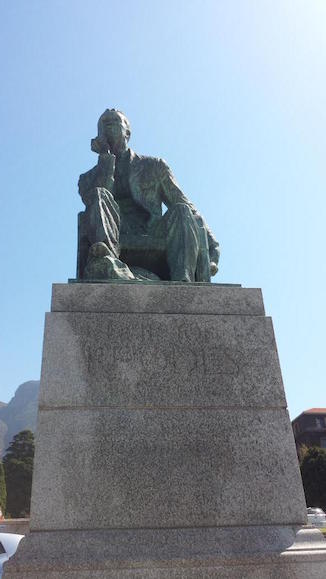
RhodesThe statue of Cecil John Rhodes you can see alongside these words stands on Madiba Circle at UCT, overlooking the sports fields. It’s there because UCT’s main campus is situated on land bequeathed by Rhodes in 1928 as “the site of a national university“.

The fact that it’s currently there doesn’t mean it should stay there – and if an ongoing protest is successful, it won’t be there for long. The protest started last Monday, March 9, with Chumani Maxwele emptying the contents of a portable toilet on the statue, and continued with various ad hoc engagements as well as a rally on Jameson Plaza.

The protest is motivated by – and this is of course the nutshell version – students being aggrieved that a statue of an arch-colonialist, racist and sexist such as Rhodes occupies such a prominent place on our campus.

Pictures of the rally allowed for some wry smiles also, given that students who were facing the statue of Rhodes would also have had their backs to Jameson Hall – the building named after Leander Starr Jameson, Rhodes’ lifelong friend and ally in various racist land-grabs and other mad schemes like the Jameson Raid.

There are problematic names and symbols on UCT’s campus, to be sure – but there are also others that are less so, like Madiba Circle and the Steve Biko building. (Limiting the discussion to this one aspect, namely racism, apartheid and its corollaries.)

This doesn’t make the problematic ones okay. But it does speak to an awareness, on the part of UCT’s governing structures, of the need to make changes. And the fact that the current management of UCT is committed to building a campus that is welcoming to all is not, I think, something that a fair person can dispute.

You can dispute the pace of progress, or how things are prioritised, but I think the intentions are clear, and sincere. Furthermore, the last 5 years have been occupied by debates on exactly these issues, in the form of the admissions policy debate.

Before Maxwele’s protest, plans to have debates and consultative processes on signage, symbolism and naming had already been set in motion. The first such discussion (unless I’ve missed something) takes place tomorrow today.

What some critics don’t understand is that large organisations such as UCT can often not move at the pace that you’d prefer. Also, the headlines often obscure complexities – it’s quite possible, for example, that there are other stakeholders with regard to the statue, perhaps the City of Cape Town.

Second, and as a friend remarked, “removing a statue is easy” – but we don’t know if it’s the best option until more debate has been held. Perhaps you want to leave it there as a reminder of the past, adding a plaque explaining what a terrible man he was. Perhaps you want to build a statue of someone who serves as an “antidote” to Rhodes alongside him, symbolising the triumph of good over evil.

There are many options besides tearing it down, is the point – and while it’s true that the current mood is in favour of tearing it down, the university – and the SRC – should be acting in the best interests of the university as a whole, and most crucially, in the best interests of future students.

(As an aside, if the statue were to go, it’s not at all true that we’d have to start rejecting Rhodes scholarships and any other things called Rhodes. It’s entirely possible to make a logical and moral distinction between commemorative statues and bequests of land/money that serve some public interest.)

I’ve been at UCT since 1992, and it’s great to see significant student engagement with political issues after what has been quite a long slumber. But to some extent, there’s the possibility of a more highbrow version of Twitter slacktivism here.

The conversation shouldn’t only be about what will satisfy us now, but rather on what is the most principled and defensible choice to make. I fear that grandstanding is getting in the way of this to some extent. Second, I fear that the issue of the statue can obscure larger and more important problems – as I said above, it’s an easy win.

Will tearing down the statue help with throughput or graduation rates? Will it improve the comprehension of the first-year students I teach, many of whom struggle to engage with abstract ideas at all, after a decade of schooling that has taught them to be studiously literal?

I don’t think so. But having said that, my intuition is that the statue should go, if it can – although I’ll want to hear all the arguments for and against before committing to that intuition, because as I indicate above, its continued existence might serve the same purpose as the protesters desire.

More crucially, though, I hope that we can avoid letting this important debate end up being a distraction, or simply a vehicle for opportunism.

STATUE