God bless you, Rest in Peace – on secular versus religious language

Andre P. BrinkWhen South African author Andre P. Brink died on February 6, I was one of the many who extended my condolences to his family and friends. I didn’t use the phrase “rest in peace” or its acronym “RIP”, because after death, there’s no agent capable of “resting”. That’s what death means, for those of us who subscribe to a naturalist ontology.

But that’s not all that “RIP” means – it’s a shorthand for extending commiserations, for demonstrating shared membership of a community of caring, and for marking the passing of someone who was considered valuable to that community.

To use – or exploit – the grief or sadness at the death of such a person to score political points for atheism is crude, unnecessary, and unfeeling.

Yet that’s exactly what I saw on some South African atheist online communities, and this is again an elegant example of why atheists need to be more concerned about their own PR, in that if you’re trying to argue – as we do – that gods aren’t necessary for being good people, it helps to behave like good people in the absence of gods.

The objections from atheists were the usual – focusing only on the fact that there’s no soul or spirit, they claimed that the words were meaningless, or even worse, that they demean the living by assuming that there’s more to life than just the here and now.

As I said above, there is more to the here and now, but in the limited sense of there being a social context in which words function, and what you signal when you reject that.

There is a time, and a value, to trying to get people to strip their language and their mental furniture of various metaphysical concepts. But that time – at least if you care about getting your point across, rather than scoring points – is when the matter can be considered in the abstract, rather than coming across as an insult to people who are grieving.

“Bless you” is a similar example, but different in a crucial way, in that you can easily poke fun at people who say “bless you” without poking at their open sores. The examples are different in degree, if not in kind.

“Merry Christmas” is another, and similar to “bless you” – it’s laughably precious to object to this in anything but the mildest of terms, and especially ridiculous to object so strongly that you get yourself thrown off a plane, as an American (presumably) atheist recently did.

Despite their religious origins, the point is that these phrases are now largely secular in usage. We know that they operate as shorthand for recognising a common humanity, and for reinforcing social bonds. No offence is intended by them, and our reactions need to be proportionate to the triviality of the “crime” committed.

Yes, I’d prefer for us to use alternatives. But for any alternatives to gain traction takes time. And motivating for them, and gaining consensus for their usage, won’t be easy if you approach that task by being an ass.

But for those of you who want to be offended, and treat any word or phrase with a religious origin as an insult, here’s your challenge: stop saying “goodbye” to people.

“Goodbye” is, after all, is a contraction of “God be with you”, and is thus surely pretty damn offensive.

Building a better society starts with recognising this one’s broken

Today’s horror is the rape of a Northern Cape high school boy, whose classmates tied him to a bed and raped him with a broom handle. “Today’s horror” is of course inaccurate, as there are no doubt many others. But this one stands out for me for various reasons:

The initial use of the word “sodomy” instead of the word “rape”, demonstrating an unconscious (and widespread) homophobia. It’s a mild form of homophobia in isolation – but to note that would really miss the point unless you follow it up with the observation that, for those who identify with marginalised and oppressed groups, all of these mild or micro cases add up to a environment of systemic discrimination.

The norm is white, male and heterosexual. This is not to say that it’s impossible for people to overplay their hand (whatever that hand might be) in terms of being part of some marginalised group – some people can be disingenuous, and excuse some personal failing by reference to a coincidental feature they happen to possess.

That’s an entirely separate issue from whether, on average, someone who is not white, male and heterosexual is likely to have a rougher deal than people like me. So, denying any person’s experience by reference to them “playing the x card” (x = race, gender, etc.) pretends that systemic disadvantage is nonexistent, and makes you sound like a heartless, uninformed and unreflective fool.

SASecond, on the rape case, is the fact that some seem to want to make this all about kids being kids at an initiation ritual, rather than it being a racially motivated attack. The bone I’ll throw at you is that of course we can’t know it was a racial attack. But it’s pretty likely to be, in South Africa, at least to the extent that certain inhibitions about not treating other human beings in a barbaric fashion are more present if the prospective target is white, male and heterosexual.

It doesn’t matter that the crowd of kids who were looking on, and (I’m told) cheering were modeling a united colours of Benetton poster, comprising people of various races. It’s possible to internalise racism against any group, even the group you belong to yourself.

And, as DA spokesperson Phumzile van Damme rightly notes in a statement on this attack

Under the cover of “traditions” such as initiations, children are given the platform to act on their racism and homophobia – sanctioned by the institution and often “protected” by just those who went through the same “rites of passage” themselves. Many of these kids are raised by racist, bigoted parents and then spend years and years in these situations where they barely have to disguise this. In fact, it often gets encouraged.

On Facebook, Max du Preez asked “Isn’t it time to consider legislation declaring racist acts (attacks and serious insults) hate crimes with harsh punishment?” I don’t want to get into hate crimes and hate speech at present, because there’s so much to talk about there, but one thing we do need is to at least recognise that they exist, and identify them for what they are.

We have too many folk who still believe the Rainbow Nation myth, and think we’re pretty much united, and too many who believe we’re still in some sort of (undeclared) race war, or at least socially (or otherwise) incompatible with each other. The truth is in the middle – we’re sorting things out, but that requires work, not mythologising.

For those of you who haven’t seen it, go read and play with the “parable of the polygons” to see an elegant demonstration of how (perceived) harmless choices can still add up to a harmful world. Also, read Oliver Burkeman’s recent Guardian piece, which argues that believing the world is intrinsically fair or just can lead to increased injustice, because we “blame the victim” instead of supporting remedial measures.

I don’t know for sure how we build better societies, but recognising our problems, instead of pretending we live in some alternate and superior universe would surely be a start.

Modern challenges with regard to free speech

Below, some notes on three concepts/arguments related to free speech – concepts that I think have become either more relevant (thus important to understand) or more complicated in the last 10 or so years (thanks in large part to the rapid uptake of social media like Twitter).

“Censorship” and the right to free speech

xkcd say pretty much what I’d want to, so let’s start with them (remember to read the mouseover text).
I can't remember where I heard this, but someone once said that defending a position by citing free speech is sort of the ultimate concession; you're saying that the most compelling thing you can say for your position is that it's not literally illegal to express.

Private citizens and companies are perfectly entitled to refuse to broadcast your opinions. It’s no violation of your rights that a comment section gets closed, or that your comment is deleted from a blog.

If someone were to refuse you permission to comment, or delete a comment, this might reveal various unpleasant things about their judgement or character. It might be capricious, it might be rude, it might be cowardly.

But they have a right to publish what they like, whether they make the right choices (in your estimation) or not. You don’t have a right to be published on other people’s platforms.

(On a related note, I suspect I’ll soon be shutting comments down here on Synapses simply because, besides a few reliable folk, there’s little of value that gets added there. If you have anything to say on that topic, this might be your chance to do so.)

Offence & sensitivities

Certain expressions are legally proscribed – here in South Africa, for example, hate speech is going to get you into trouble. If you’re reading this from elsewhere, you might have similar laws.

Those laws could be poorly drafted, and they could even be nonsensical (to you, in that you think that “hate speech” shouldn’t exist as a legal category of speech, or that it shouldn’t be punishable.)

Ignore that issue for the moment. The issue I want to highlight is that there are a range of utterances or ideas that could offend people or simply create discomfort without meeting the threshold for hate speech (or any other relevant legal category of speech).

A recent case was the cancelled Oxford debate on abortion, that was meant to feature Brendan O’Neill and Tim Stanley. You can read their perspective on the cancellation of the debate by following the links in this piece by the President of the Cambridge Union, and I’d also recommend reading Isabel Hardman’s piece, as she makes some of the good points that O’Neill makes, but less hyperbolically and without being Brendan O’Neill.

The issue here is – how can one avoid the slippery slope whereby any claims of offence or sensitivity eventually become grounds for not expressing a view, while still being compassionate towards people who have legitimate sensitivities on various topics?

The one end of the spectrum is the classic Liberal position of asserting that we’re improved by allowing ourselves to hear things that make you uncomfortable – the truth wins out, we develop better arguments against falsehoods, and we might get to “toughen up” along the way.

But these things are all easy to say from a position of intellectual and material comfort, and less so when you’re the threatened group. So, there’s serious room for compassion, especially for Humanists like me. However, there’s a tension between these goals, and it’s one that’s difficult to resolve.

The unfettered free speech argument doesn’t automatically get the win, in my view, because of issue #3, namely:

The corn-dealer’s house is right next-door

Many folk who defend free speech refer to J.S. Mill’s On Liberty, and rightly so, as it makes a superb case for when speech should and shouldn’t be restricted. But it was written in in 1869, and it’s possible that perfectly reasonable arguments for then are not entirely reasonable for now – or that, if they are, they lead to rather different policy conclusions than was the case for Mill’s time. Take this passage from Chapter 3:

An opinion that corn-dealers are starvers of the poor, or that private property is robbery, ought to be unmolested when simply circulated through the press, but may justly incur punishment when delivered orally to an excited mob assembled before the house of a corn-dealer, or when handed about among the same mob in the form of a placard.

There’s the problem in a nutshell: if you agree with Mill’s argument, give some thought to how we should implement the argument in terms of comment policies, Facebook and Twitter terms of use and the like.

Mill is talking about a mob of people who need to be riled up to the extent that they will set aside the time to make a plan, then congregate at someone’s house to protest. It takes serious affront to result in that sort of motivation, because you need to make an investment to lodge your protest.

Today, especially on something like Twitter, a ready-made mob of thousands can be assembled instantly. They might not even know you, or understand what you did “wrong”, because your misstep can get re-tweeted by someone influential, with everyone else simply jumping on a bandwagon.

Reading one abusive Tweet is no problem for most, but imagine reading hundreds of them, from people who would likely never have the courage to stand outside your door, shouting abuse as in Mill’s scenario above. If he thought that the mob outside your house should be controlled, and if you agree, should the social media mob also not be controlled?

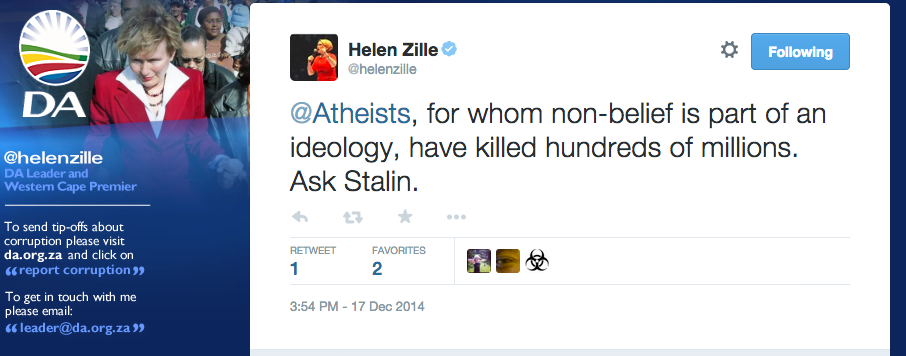
Premier Zille, religious tolerance and atheist “fundamentalism”

Yesterday, the Premier of the Western Cape, Democratic Alliance (DA) Leader Helen Zille said:

Worst kind of fundamentalists

and that’s how the fight got started. For a number of hours after this tweet, Zille was drawn into debate (well, insofar as the medium permits) on the religious views of Hitler, Stalin, Pol Pot etc., the putative moral virtue of Mother Theresa, and various other issues relating to religion and/or the absence of it.

Zille apologised for and retracted the tweet above, and it must be said that many who jumped into the conversation didn’t follow it from the start, and were guilty of some over-reaction themselves. In fact, the over-reaction persists today, where some legitimate criticism is being mixed in with abuse and caracaturing of her views and motivations.

If you read her tweet in the context of the conversation, I think it clear that she was responding to Kevin King’s introduction of the idea of religion-bashing by atheists, albeit in a rather glib and unfortunate way, given that the conversation began with Mandy de Waal offering an example of religious fundamentalism causing deaths.

But given the context of the conversation, it was a foot-in-mouth moment rather than an expression of religious intolerance. Despite this, her defence of the tweet, and a few follow-up tweets, indicate that Premier Zille does appear to hold rather misguided views on what atheism is, and what atheists believe.

First, though, I will agree with her on a central point, and annoy many atheists in the process: it’s entirely possible for atheists to be fundamentalists.

If you understand “fundamentalism” in the classic sense, in other words strict adherence to some set of doctrines, then atheists can’t be fundamentalists, as we have no doctrines. (Atheism being simply, and only, the absence of a belief in a deity or deities.)

But language and usage evolves, and it seems entirely permissible to me for “fundamentalism” to be taken as referring to certain ways of being anti-theist, rather than atheist. One relevant category of action would be to ridicule, mock, or insult; another would be to hold your atheism dogmatically, in the sense that you find it impossible to entertain any claims regarding the potential value of religion.

I’ve read my Dawkins, and know that folk will disagree with me on the first category above, insisting that “passion” gets mistaken for stridency. And on the second, I suspect many will say that there’s nothing to entertain, and that those of us who do are simply being “accommodationists”, weasels or something like that.

I’ll not rehearse those arguments now, but will instead point you to an earlier post which deals with some of these arguments at greater length. Here, I just want to say that I agree with Zille on that point, but nevertheless think that she should reconsider her beliefs with regard to atheism and its role in both history and contemporary society.

Even though she made repeated references to her party being committed to religious freedom, and asserted that she is similarly committed, her expressed thoughts on Twitter indicate prejudice against the non-religious. For example:

Atheists commit mass slaughter

Screen Shot 2014-12-18 at 10.47.24

As my earlier post argues, these sorts of sentiments are thoroughly confused, in that none of these examples were motivated by their atheism (for those who were atheists). The first tweet above should refer to “psychopaths” or “sociopaths” or something rather than atheists, because none of the claims made (commit mass slaughter; believe they are God; have an ideology) are remotely true of atheism in general.

The second tweet again makes the mistake of thinking that atheism is an ideology, or something that informs the lives of atheists in some sort of fundamental way. We’re just like you, Helen, and our atheism is usually as much of an “ideology” as your disbelief in Thor is.

And yes, perhaps people who happen to have been atheists have indeed killed many people, but either that’s coincidental, or you’re making a causal claim about either atheism conducing to evil deeds, or religion conducing to good deeds. Evidence suggests the final option might be what she thinks is the case:

Murder

And here I’ll say “sure, maybe that’s true” – but we’ve got zero reasons for believing it to be true. It’s an empirical question, and someone like Zille, who seems fond of data-driven approaches to things, might perhaps know of some of the ways we can distinguish better and worse answers to the question.

For example, does criminality, gender discrimination, murder and so forth tend to correlate positively with religious or non-religious societies? (The former, i.e. non-religious societies are more pleasant.) Does thinking about morality as necessarily connected to religion make any sense? (No – read your Plato.)

And, does thinking about morality as being intimately connected to religion impede moral understanding and thinking, by infantilising us, and making us unable to resolve moral issues through reason? (I think so.)

Zille does seem entirely sincere in her commitment to religious freedom, but that’s not much comfort when she appears to hold rather unsophisticated views on these matters. She’s endorsing dangerous stereotypes in tweeting these sorts of things, and furthermore, doing damage to the DA’s brand.

We’re living in a world where discrimination against the non-religious is quite a significant problem, and the leader of our only (quasi) liberal party should be expected to stand against discrimination, rather than offer it fuel.

An era of hysteria?

Briefly, and to quote myself:

if you train people to expect sensation instead of subtlety, you should shouldn’t be surprised if they keep expecting more of the same, and eventually, become capable of understanding nothing less.

On Thursday this week, Best Buy found themselves under social media fire for tweeting a joke that referenced Serial, the podcast that everyone (“literally!”) is listening to.

downloadFor those of you who are not part of that “everyone”, Serial is a journalistic treatment of a murder, involving interviews with suspects, with friends of the victim, and also site visits to relevant locations, etc.

The murder in question happened in 1999. It wasn’t Princess Diana who was murdered, but someone that had most likely slipped out of the memories of all but her family and friends in the 15 years since the murder – until Serial came along.

Best Buy referenced one element of the narrative, which was the possible use of a payphone in one of their Maryland stores. They said “We have everything you need. Except if you need a payphone. #Serial”. The outrage on Twitter let to the deletion of that tweet, and this apology:

This is absurd. I have no problem with people being offended, even sometimes outraged. But I do have a problem with what people are choosing to be offended and outraged by, and – mostly – by the extent to which they think anyone else should care about their feelings in cases like this.

If you were offended by the Best Buy tweet, I’d suggest you’re either a family member of friend of the deceased, or you have a pretty bizarre value-system. Corporates are allowed to make jokes, and a joke involving an element of a murder mystery from 15 years ago, and one which makes no reference to the people involved in that mystery – in other words disrespects none of them – should not be able to give rise to the offence it apparently did.

How do we stop this positive feedback loop of hyperbole and hysteria? I’m still of the view (as expressed in another older post) that at some point, a corporate brand, or a popular personal brand, will need to stand their ground and say “no, I don’t need to apologise for this. You’re over-reacting.”

Because each time we do succumb to the wishes of the most easily offended, the bar for what counts as an apology-worthy action gets set a little lower. I’m not a fan of gratuitous offence, but if we never allow ourselves to tolerate being offended at all, a dogmatic, inflexible, and rather entitled attitude towards our own beliefs and values wins the day.

In short, we’re wrong much of the time – or at least some of the time – and we’ll never know when that is, unless we let people tell us.

The @IHEU Freedom of Thought Report 2014

iheu-logo-2013-w300Published today [10 December] by the International Humanist and Ethical Union (IHEU), the third annual Freedom of Thought Report offers a survey of persecution of and discrimination against non-religious people, with an entry for every country across the world.

In 2014, in addition to laws such as those targeting “apostasy” and “blasphemy”, the report shows a marked increase in specific targeting of “atheists” and “humanism” as such, using these terms in a broadly correct way (the users know what they are saying) but with intent clearly borne of ignorance or intolerance toward these groups.

To put it more plainly, nonreligious people are being targeted as a distinct minority group in various countries around the world. The report also indicates that hateful speech against atheists does not come exclusively from reactionary or radical religious leaders, but increasingly from political leaders, including heads of state.

Cases covered in the report include the Malaysian prime minister Najib Razak, who this year labelled “humanism and secularism as well as liberalism” as “deviant” and a threat to Islam and the state itself, in a speech where he also denied that Malaysians had any right to “apostasy” (leaving Islam).

Saudi Arabia is criticised for a new law equating “atheism” with “terrorism”. The very first article of the kingdom’s new terror regulations banned “Calling for atheist thought in any form, or calling into question the fundamentals of the Islamic religion”.

Even the supposedly secular regime of Egypt’s president Sisi was found to target atheists directly, through what the report calls “an organized backlash against young atheists”. Beginning in June, Nuamat Sati of the Ministry of Youth announced a campaign to spread awareness of “the dangers of atheism” and why it is “a threat to society”, so that young atheists in particular, who are increasingly vocal on social media would be given “a chance to reconsider their decisions and go back to their religion.”

In the past few months, Egyptian authorities have detained young atheists who appeared on TV media and Youtube videos talking about their right to express atheist views, and in a worrying an unusual development in November, Christian churches actually “joined forces” with Egypt’s AlAzhar in another anti-atheism campaign, saying that “Society should resist this phenomenon [of atheism]”.

Previous editions of the Freedom of Thought Report, which considers and rates every country in the world for anti-atheist persecution, found that almost all countries discriminate against the nonreligious, in some cases through religious privilege or legal exemption, with the worst countries refusing to issue identity cards to the nonreligious, taking children from atheist parents, or sentencing “apostates” to death.

The 2014 edition of the report notes: “This year will be marked by a surge in this phenomenon of state officials and political leaders agitating specifically against nonreligious people, just because they have no religious beliefs, in terms that would normally be associated with hate speech or social persecution against ethnic or religious minorities.”

Fortunately, the situation in South Africa is nowhere near as serious as the examples given above. However, this does not give South Africans cause for complacency. Our schools routinely violate the National Policy on Religion and Education, to the extent that the organisation OGOD has recently instituted court proceedings against six public schools who assert their “Christian character”, despite our public schools having an obligation to be secular.

It is not only school principals and governing boards who privilege one religion over others, rather than supporting religious freedom through remaining neutral and encouraging a secular approach to religion, whereby religious education is welcome but religious indoctrination precluded.

The MEC for Education in Gauteng, Panyaza Lefusi, boasts of having distributed 50 000 Bibles to schools in his first 100 days in office – with no mention of also having distributed Korans, or books on Humanist ethics and thought. This constitutes not only a violation of the Policy, but if the Bibles were paid for with public funds, also a clear abuse of those funds in that revenue from the taxpayer cannot be used to support what amounts to State-sanctioned religion.

The Freedom of Thought Report is published by the International Humanist and Ethical Union (IHEU) with contributions from independent researchers and IHEU Member Organisations around the world. The South African Member Organisation is the Free Society Institute.

Websites:
freethoughtreport.com and iheu.org; fsi.org.za (South Africa)

For further information, interview or comment please email:
contact@fsi.org.za; (Free Society Institute, for South Africa-specific issues) or the IHEU (report@iheu.org; +44 207 490 8468.

Yet another opinion piece on #Shirtgate (or #Shirtstorm)

shirtgateWhile I realise that there are already hundreds of column-inches devoted to the issue of Rosetta scientist Matt Taylor and his shirt, I’m afraid I’m going to add a few more – mostly because most of those contributions have been in the international media, and 65% of my readership is in South Africa.

And it’s the South African responses that are annoying me, particularly on Facebook. They – like much of the international commentary, to be fair – are setting up an entirely false dichotomy between “feminist rage”, involving allegations of hypocrisy (“first you say we can wear what we like, but Taylor can’t?”); bullying (“Taylor harassed into a tearful apology”) offset against “the things that really matter”, whether it be the science itself, or the real root causes of sexism.

We don’t only have those choices. There are myriad positions available between them, and various combinations of them that are possible too – it’s entirely plausible that someone might, for example, be concerned about the signal that Taylor’s shirt might send (how it might be perceived, rather than how it’s intended), and also be gobsmacked by the scientific achievement of Rosetta.

And then, one can have this conversation without bullying – and talk about both these things at the same time. It’s not well-established that significant amounts of bullying even happened, depending on how you define bullying, of course. But because everyone is saying that’s what happened, it seems folk feel entitled to treat it as fact, even hyperbolising to the extent that Boris Johnson can speak of Taylor’s apology being “like something from the show trials of Stalin”, and his being

subjected to an unrelenting tweetstorm of abuse. He was bombarded across the internet with a hurtling dustcloud of hate, orchestrated by lobby groups and politically correct media organisations.

Of course you can find examples of Taylor being abused. My question is whether that was the typical or common response, or instead whether most commentators – perhaps outside of the filter-bubble of your prejudices (whether they be against “feminazis” or “misogynists”, both of which can be misidentified) – simply used the shirt as a springboard for a broader conversation about sexism in science, without vilifying Taylor?

In other words, is it true that the Left has “turned into Rick Santorum” – and even if it’s true, is this a good example of that, or is this case being misrepresented, meaning that we don’t get to talk about sexism in science for fear of being spoken of in this sort of supercilious tone:

Because you can criticise without “whining”, and you can celebrate the science while still criticising, less or more hyperbolically. When all the conversation is about how everyone who is criticising is “whining” – and everyone who is not is somehow complicit in sexism – then we don’t get to talk about both things (the science as well as sexism). And I’d hate to lose either topic.

To spell out why Dawkins is wrong, above: The problem here is that it sets up a simple false dichotomy, and again demonstrates the limitations of Twitter as a medium for expressing complex thoughts. (Which should make smart people, like Dawkins, more careful of what they say.)

The false dichotomy is in presenting the option of true feminism (whatever that is) in opposition to the “pompous idiots”, without recognising that there are permutations of feminism that are legitimate, and can be nevertheless be concerned about the shirt. (We’ll leave aside whether Dawkins gets to be the arbiter of what feminism is.)

There’s also an obvious straw man, on two counts – one, that everyone is whining (rather than expressing concern); and two, the implication that there’s a zero-sum game between talking about the shirt and talking about the marvellous scientific achievement of Rosetta.

Of course some treatment of Taylor can be over-the-top. But dismissing all concerns as whining from pompous idiots is oblivious, shoddy thinking.

And talking about “feminism” or “feminists” without allowing for these nuances involves painting with far too broad a brush. For me, the shirt is the springboard to a conversation that’s worth keeping going, and some “feminists” (or just humans concerned with fairness and so forth) are simply using it as that.

Other “feminists” are indeed over-reacting to the shirt as a token or instance of sexism, which then does (or can) detract from both the larger and more important issue of sexism in STEM, and can also detract from conversations about Rosetta. As I ask above, it’s legitimate to ask – not simply assert – that they are typical.

The Dawkins tweet, and comments saying that “feminists” are over-reacting, assume that everyone is in the second, hyperbolic and reactionary camp.

That’s a caricature, and to me, it’s a caricature that suggests an anti-feminist bias.

When a muppet takes on a puppet – Steve Hofmeyr vs. @ChesterMissing

downloadForeign readers, if you want a snapshot of how weird and emotive racial politics in South Africa can get, here’s one for you: A man who thinks that “Blacks were the architects of apartheid” has now filed a harassment charge against a ventriloquist’s puppet.

Chester Missing (whose book I previously reviewed) is the puppet of ventriloquist, comedian, anthropologist (and friend), Conrad Koch. The puppet’s Twitter account has recently been quite vocal in denouncing the racist – and bewilderingly contrary-to-reality – statement captured above, in part because it was made by someone with a large audience (on Twitter, but more importantly as an award-winning musician who has sold truckloads of records to people who like Neil Diamond, but in Afrikaans).

Missing has also been asking Steve Hofmeyr’s sponsors whether they are concerned about the negative impact on their brands that might accrue from being associated with Hofmeyr. According to Hofmeyr and some of his followers (from what I’ve seen, mostly folks who are routinely associated with Afriforum and/or Praag, organisations that are overwhelmingly white and Afrikaans, and who are – charitably – tone-deaf and emotionally crippled when it comes to race), this amounts to harassment and defamation.

I don’t think it’s defamatory in principle, as you can see above. However, as I’ve argued in the past, I do think it’s possible for criticism to be sufficiently abusive or misdirected that it should be reined-in. (Having said that, the issue in the piece linked just above, on Mozilla and Eich, was for me more about picking the wrong target – Eich – rather than his religion and religious beliefs.)

In this case, though, I don’t see anything in Missing’s Twitter stream that crosses any kind of threshold into abuse, harassment or defamation. By contrast, I think that Hofmeyr needs to take responsibility for the statement he makes above, and others he’s made over the years, which give clear credence to an interpretation of racism, as commonly understood. (Conrad Koch has explained why he thinks the most recent statement is racist on his website, in case you’re Steve Hofmeyr or Dan Roodt, and need this explained to you.)

I’ll close with an example of a absurdly wrong-headed understanding of free speech and censorship, from the Institute of Race-Relations’ Frans Cronje (their name is misleading, in that you’d think they’re about improving race-relations, but I’ve rarely found that to be the case).

Why I say it’s wrong-headed is that obnoxious opinions need to be tolerated. He agrees with me on that, or so he says in the last (chronologically) of the three Tweets I’ll embed here.

But he gets there via chastising Chester (without naming the puppet) for trying to “silence” Hofmeyr.

Chester is doing exactly that, in challenging Hofmeyr’s idea that black South Africans are the architects of apartheid. If Hofmeyr chooses to fall silent in shame (or whatever), that’s his choice. The only entity that has the power to forcibly silence Hofmeyr are the courts, and guess what – only one of the two parties involved (Hofmeyr) has approached the courts.

Cronje’s argument works entirely contrary to his objectives here, in that this is precisely an argument against Hofmeyr approaching the police or courts to silence Missing.

To close the circle of absurdity with regard to South Africa’s racial politics, remember that Missing, in this case, is the puppet who is reminding others that Hofmeyr thinks blacks designed Apartheid, and Cronje is the CEO of the Institute of Race Relations.

And, he seems to want Missing to stop criticising Hofmeyr, while having no problem with Hofmeyr’s lawsuit. Go figure, indeed.

Ched Evans, rape and rehabilitation

Ched Evans playing for Sheffield UnitedTwo high-profile cases of men who have been convicted of rape, but who are now up for (or in) plum jobs, have been in the news recently. One is Ched Evans, a footballer who formerly played for Sheffield United (and who they are considering letting play for them again), the other is David Mason, who raped a 12 year-old when he was 19, and who is now a 24 year-old apprentice at Jamie Oliver’s “Fifteen” restaurant.

Both were convicted, and both have served some time in prison. You or I might think that they served too short a prison sentence – and maybe some readers might even think one or both of them innocent – but most of us have little option but to trust the court findings, both in respect of the conviction and the sentence. That’s what one needs to do, in cases of relative ignorance, because others have access to more information than we do.

The interesting issues now are the non-legal ones: should Jamie Oliver give Mason this prestigious job, or rather give it to some other person, found guilty of another crime (“Fifteen” was established on the premise of being a rehabilitative opportunity for people with troubled pasts)? Should a prestigious club, in a sport known for its laddish culture, involving countless instances of misogyny and fair numbers of rapes, allow Evans to represent them again?

I don’t believe that any crime is, in principle, something that one should be punished for for the rest of one’s days. This doesn’t mean forgiveness is necessarily merited, but simply that the punishment can be disproportionate to the crime if you end up never being able to ply your trade or hold a prestigious job.

Mason was 19 when he committed the act of child-abuse. He should have known better. But we also know that before the late 20’s, male brains are impulsive, and don’t assess risk well. I say this not to excuse him, but simply to make the point that I’m not sure how good a predictor a single act of child-abuse by a 19 year-old is of his future behaviour.

Because if we are not going to punish someone forever, and we reach some sort of agreement on how long they should be punished for, the most important issue seems to be whether he’s a continuing threat, or someone who regrets what he has done, and appears to be rehabilitated. If he does, then I can understand Oliver making the decision to employ him.

If we’re not going to allow people to resume normal lives after serving an appropriate sentence, we shouldn’t let them out of jail. There’s no comfort here for their victims, to be sure, but I don’t think that we should encourage victims, and society at large, to understand perpetual retribution as “comfort” either.

Evans is more problematic. According to The Telegraph, the “woman said throughout the trial that she had no memory of the incident. Evans maintains his innocence, claiming that the sex was consensual.” Yet, the court found him guilty, so as I say above, that’s the basis on which we need to proceed.

That’s also the basis on which Evans, his family, and Sheffield United need to proceed. And unfortunately, friends and one family member of Evans were among those to name the woman he raped, on social media, resulting in such abuse by supporters of Evans that she had to move home and change her identity.

In light of this, Evans certainly has something to apologise for, even if he thinks he’s innocent of rape. He should apologise for his role in having caused the abuse, and he should certainly urge his supporters to stop abusing the woman in question, who was certainly harmed after being outed, regardless of how much she was harmed on the night in question.

Yet Evans has apparently not apologised for anything, nor shown any remorse. Hadley Freeman tells us that he’s due to release a “profound and personal” statement next week – but even if this does amount to an apology, I’d imagine that many of us will consider it somewhat forced by circumstance and opportunity, rather than sincere.

Sheffield United are perhaps waiting to see what he says. But in the case of Evans, with the absence of any contrition, and in the context of football’s apparent misogyny (or at least its trivialising of a culture of fairly crude masculinity), I do think it’s inappropriate for him to resume business as usual, and that neither the club, nor the Football Association, should be perceived as supporting him in doing so.

We do need to hear what he says next week, though – and as I said at the top, I do think that we can’t justify punishing someone for ever.

John Lennox and @Eusebius McKaiser debate: does morality need God?

eusebiusMckaisercroppedA trip to Johannesburg last week (for the unlikely purpose of presenting a paper at a nutrition conference!) was well-timed, in that I had the opportunity to both attend a debate between Christian apologist John Lennox and Eusebius McKaiser, as well as to join Eusebius in studio the next day for a chat on religion and its place in state-run schools.

You can find the embedded stream of my interview with Eusebius at the bottom of this post. But while it’s still relatively fresh in memory, I thought I should capture a few thoughts on the debate for those of you who could not attend. A recording of debate will appear on YouTube at some point too, I’m told.

The topic of the debate was “Morality and God: is there a connection?”, although the conversation also ended up touching on other issues including the role of God in generating significance in life, and whether atheists are at all handicapped with regard to understanding science.

In his opening remarks, Lennox made the claim that science and atheism were essentially in conflict, as atheism undermines rationality. This was the first of many occasions where I had the clear sense that Lennox was failing to extend himself beyond certain premises that he considered to be axiomatic.

For him, God generates meaning, in that God creates the syntax and grammar of science – the order of things, the directions in which they flow, how they fit together. So without grasping God, you’re handicapped in your capacity to understand science at all. (This is my analogy, but I think it captures what he was saying.)

This question of mine (above) was put to him later in the evening, and he responded by professing ignorance regarding the state of Islamic science. This evaded my question, in that the dilemma I tried to make him grapple with was the possibility that his religion was interchangeable with any other for the purposes of generating this scientific foundation.

If it was not, he’d have to argue that his was superior – an easy thing to assert, but not easy to make a case for, and one of those occasions where the fundamentalism of the axiomatic premises I spoke of above would be exposed.

Another moment of disappointment to me was when he described evolution as a “mindless unguided process”, which reveals a rather caricatured and false view of evolution. Evolution is strongly guided by natural selection – but if one equivocates around what “guided” means, or rather, stacks the deck in favour of only one sort of guided (by a conscious agent, like God), then Lennox can certainly win the day, but only at the expense of making a plainly circular argument.

And that’s the problem with these debates. I’ve debated a couple of apologists over the years also, and besides the opportunity these debates present for showing an audience how arguments work (or don’t work), there’s pretty much zero prospect of productive argument between the antagonists.

Even strong critiques have little impact, such as when McKaiser exposed the inconsistency of Lennox (and all religious folk, to an extent) happily living in the empirical world of cause and effect when it comes to their day to day lives, but then bringing what is (to an atheist) essentially magic into the conversation when speaking of the souls, free will, morality and so forth.

We have a number of compelling (and competing) accounts for how morality evolves or is generated in animals that demonstrate moral instincts – and many of these are more plausible than an account requiring the sort of leap of faith that religion does (and, never mind the difficulty of then making a principled choice between the various religious accounts).

Again, it would only be if you’re predisposed to be sympathetic to the religious (and Christian) account of these things that they have any chance of gaining traction. In a fair fight, as it were, the religious account would be dropped from the list of plausible hypotheses fairly early on.

Similar tactics (and results) were in evidence with questions around the significance of life – a question that only becomes interesting if you grant that life needs some grand metaphysical meaning. There’s no reason to grant that premise, though – it’s a challenge that only has any force because it’s the product of centuries of religious privilege.

The conversation was fair-minded for the most part, although there were a number of sly digs from each debater towards his opponent. I thought Lennox more guilty of this, but my count might be unreliable, thanks both to my epistemic framework and the fact that Eusebius is a friend.

I suspect that Eusebius and I don’t agree on the morality question, although that requires that I hear his view outside of a context in which he was mostly attempting to rebut Lennox, rather than offer his full explanation of how moral principles are generated.

From what I heard on Thursday, Eusebius is a moral realist, which I’m not, but then, at other times, he seemed to speak as if his account of the objectivity of moral truths was one grounded in something like rationality, reciprocal altruism and the social contract, which together make certain moral principles binding on any rational agent.

If that’s true, we’d agree in substance, but I’d object that this doesn’t mean objectivity or moral realism, but rather that we’d converge on the same principles for pragmatic and contingent reasons – certain moral principles would be akin to conclusions in science, in that they are the best-evidenced, rather than being true by necessity.

Were you there? If so, feel free to let me know what you thought, below.

[soundcloud url=”https://api.soundcloud.com/tracks/168418882″ params=”auto_play=false&hide_related=false&show_comments=true&show_user=true&show_reposts=false&visual=true” width=”100%” height=”450″ iframe=”true” /]