Lessons in bad science – Tim Noakes and the SAMJ

As I’ve said before, Professor Tim Noakes might well be right in his advocacy for a low carb, high fat diet. Whether he is right or wrong is however – to some extent, at least – a separate issue from whether he’s providing an example of sound scientific reasoning in reaching the conclusions he does.

It’s understandable that people outside of science, academia, or any overtly evidence-based work might confuse personal experience, anecdotes and badly drawn samples for good evidence. However, the principles of scientific reasoning (even as taught to first-year students, as I’ve done for years), remind us of these and other common errors. Once you know about confirmation bias, you shouldn’t flaunt the fact that you deploy it, but rather regret that you (like everyone) are prone to quite typical errors.

As a practitioner of evidence-based something-or-other, you’d know and understand counter-intuitive things, for example that a conclusion can sometimes be the correct one, regardless of how poor the argument for that conclusion is. And, that a good argument can sometimes result in a false conclusion.

Most important, perhaps, is that you’d know of the various resources we have for making it more likely that we reach the correct conclusion, and you’d know of the sorts of errors to avoid because they tend to lead us to false conclusions. And given that you care most of all for getting closer to the truth of the matter, you’d be aware of your responsibilities to set an example to others of sound reasoning about science – especially if you are perceived to be an authority figure.

When a scientist like Noakes seems willing to ignore most of these principles in favour of promoting a conclusion – through whatever support comes along – he doesn’t sound passionate, committed, maverick and so forth. He sounds like a quack (and sometimes, even a conspiracy theorist, at least when citing some of the reasons why his “obvious” (to him) truths are somehow not adopted by everyone). To Noakes, all research that disagrees with him is “industry-funded” or otherwise tainted, but never treated as counter-evidence.

Among those that Noakes has quoted in support of either his view or his approach to science are the evolution-denier and proponent of scientific racism that is Louis Agassiz, and the anti-vaccine Weston Price Foundation. He’ll tweet links to pieces arguing that carbohydrates might have played a role in the Newtown shootings. And when challenged on whether his approach is sound, he says things like this:

Worst of all, he doesn’t seem to really understand what the stakes are, even as he speaks of a decades-old diet lie that is apparently killing us all. He’s embraced the false dichotomy that we have a choice between the “orthodox” dietary advice (that is harming us) and his model (that will make us thin, cure diabetes and so forth). On his model, choosing option B (his model) has no risks, even though we have no long-term data regarding the possible harmful consequences of a high-fat diet.

This doesn’t mean people won’t be persuaded by Noakes. They will be and are being persuaded in their droves, thanks partly to positive short-term results on the diet, and also to some very engaged PR on Twitter, radio, magazines and television. But they’re also being persuaded because – like most people – they are prone to overstating the value of anecdotes in supporting a conclusion.

The fact that they are persuaded is not, however, further evidence for your conclusion.

Yet, according to Noakes, perhaps it is. And sadly, South Africa’s flagship medical journal, the SAMJ, has published a Noakes paper that is a textbook example of bad science in this and other ways. Somehow, this paper got through peer-review, but I can pretty much guarantee you that if we did a Sokal-type experiment, submitting this under fictitious names, it would never get published. It’s solely on the basis of the authority of the “name” of an acclaimed scientist that it was published as a study, rather than on the letters pages or somewhere less notable.

Here’s the 140-character summary of why this shouldn’t have been published as a study, or made it through peer review:

Basically, the “study” is confirmation bias run amok. If I were a UFO conspiracy theorist, and led a society dedicated to discussing our abduction experiences, the letters I might receive from prospective members might appear to me to be further evidence that UFOs exist. But I’d be wrong. They’re not, because my letter-writing audience are self-selected (we can predict, in advance, that they are likely to share my conclusion) and unreliable (they are offering anecdotes, and we have no idea how reliable their testimony is).

People who try the “Noakes diet” to no effect will not write letters to him saying so. And as for those who do write, we have no knowledge (or control) over any other factors relevant to their weight-loss experiences. It’s plausible that someone trying a new diet will, for example, also be motivated to exercise more – but we can’t control for that.

In response to these and other criticisms on Twitter, Noakes asked his critics why we were focusing on the anecdotes, rather than the controlled trials that agreed with the anecdotes. But this again misses the point – one wouldn’t need the anecdotes to make the case if the data did so already. To include the anecdotes means that you see them as adding some value, and you shouldn’t do so.

It’s not everyone else’s job to defeat your anecdotal evidence (that should never even be presented). It’s your job to gather non-anecdotal evidence. And if you don’t have that as yet, it’s not someone else’s responsibility to get it for you, as in comments like

(This, because of another elementary principle of scientific reasoning, namely the burden of proof.)

To wrap this up: I agree that a trial is needed. But there’s a different issue at stake also, and this is that Noakes is encouraging incompetent and pseudoscientific thinking on matters of science, and encouraging a cultish adherence to a model that hasn’t yet been scrutinised in full, and for which we have no long-term data. This is irresponsible, and an abrogation of his responsibility as a scientist and an educator.

But these are no doubt all irrelevances to Noakes, even perhaps evidence of bias or conspiracy. After all, at the end of the day, the ultimate evidence is remarkably elegant: the thinnest person in the argument wins, and obese people can’t be right.

P.S. Prof Noakes has left a substantial comment below. Unfortunately, it does his cause absolutely no good, as I explain in this follow-up post.

Does white privilege also cause plagiarism?

When I saw the 10th or so “you must read this” tweet, linking to Gillian Schutte’s latest piece on the Mail&Guardian’s Thought Leader blog, I finally caved in and read it. With some trepidation, mind you, seeing as I’ve not read anything of Schutte’s since her “Dear white people” tried to tell everyone with low melanin levels what they were supposed to think. If you’ve been here before, you probably know why I reject that form of identity politics, and Schutte seems to be quite heavily invested in it.

But here we were, 10 months later, and given that so many people were endorsing the most recent piece (including a few people whose judgements I trust), I thought I’d give it a try. The piece itself was typical of the Schutte pieces I’ve read – too crude and generalising for my tastes, but all the while making some points certainly worthy of reflection.

Then I looked at the comments, and saw this:

Screen Shot 2013-10-14 at 3.04.51 PM

A quick skim of the post linked to there reveals significant overlap in style and content with Schutte’s piece. Compare, for instance, points 31 and 32 in Schutte’s piece with 14 and 15 in the other post. As an occasional member of the opinionista class, I didn’t want to leap to conclusions or make unnecessary trouble for a fellow writer, so I reached out to a senior person at the Mail&Guardian, asking him to look at this possible plagiarism.

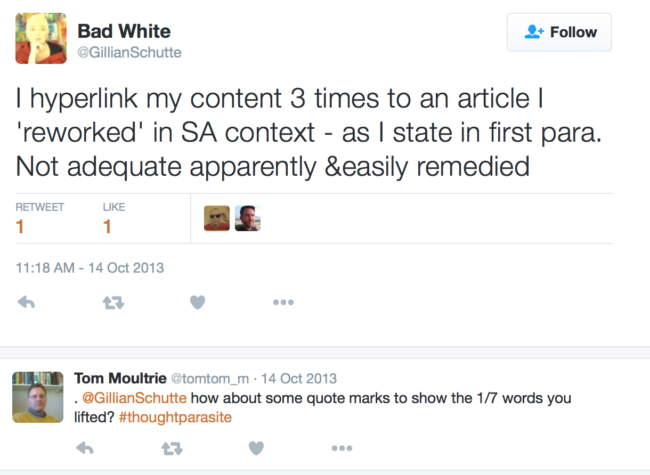
It’s 3 days later, and nothing in the post has been edited to reflect the extent to which it’s derivative of the other piece (which seems to be an extract from a published book, Richard Dyer’s “White: essays on race and culture”). Schutte does link to the essay in question (twice, in fact), but simply linking to something falls far short of acknowledging that you’ve borrowed extensively from it. Especially given that there is no indication in the piece that the two links are any different to the other links in the piece – most readers would assume that the links are to additional or supplementary, rather than source, material.

Even worse, what you see in this case is not simply paraphrasing, such that would require something like “as Richard Dyer explains,…”, but rather, verbatim lifting from the source without any quotation marks whatsoever.

In short, Gillian Schutte’s Thought Leader piece is plagiarised, and amounts to Thought Parasitism rather than Thought Leadership (with credit to a friend for that phrase). The extent of the parasitism? 15% of Schutte’s piece is word-for-word the same as Dyer’s. And this, in a piece that takes the moral high-ground, lecturing others on the positions they should take. And if you’re wondering, yes, the problem was pointed out to her, both in the comment above, as well as in two tweets that were cc’ed to her.

If this were a student submission, I’d award 0%, and remind the student of the conventions of citation, which are there so that we can give credit to those who inform our thinking. These conventions are a vital part of intellectual activity, in that they are one of a writers’ vehicles for claiming ideas or phrases as our own. They are a safeguard of originality, and make your achievements in getting a good mark for an essay, or getting your book published, the achievements that they are.

When we don’t respect intellectual honesty and the academic conventions that support that honesty, we devalue everybody’s achievements in this area, because the currency for determining value is being undermined. Yes, you’d explain this to a 1st-year student, and maybe give them a chance to re-submit. I normally wouldn’t refer a 1st-year student to the University’s disciplinary tribunal for this sort of offence, especially a 1st-timer.

Schutte might well be a 1st-timer in this regard. However, she has a Master’s degree. What she doesn’t have is an excuse. And when you think back to the consequences that a Darrel Bristow-Bovey, for example, had to endure for his plagiarism, you’d know that there was a time when South African media consumers and producers took this seriously.

Let’s see if they still do, and let’s see if Schutte does.

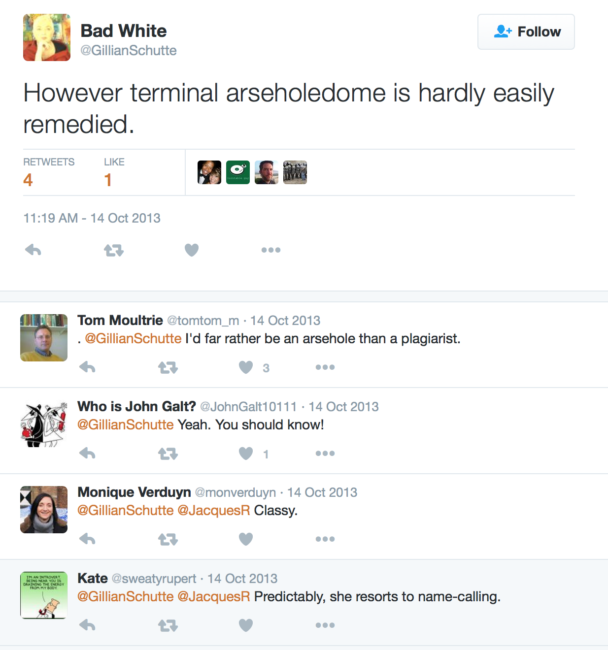
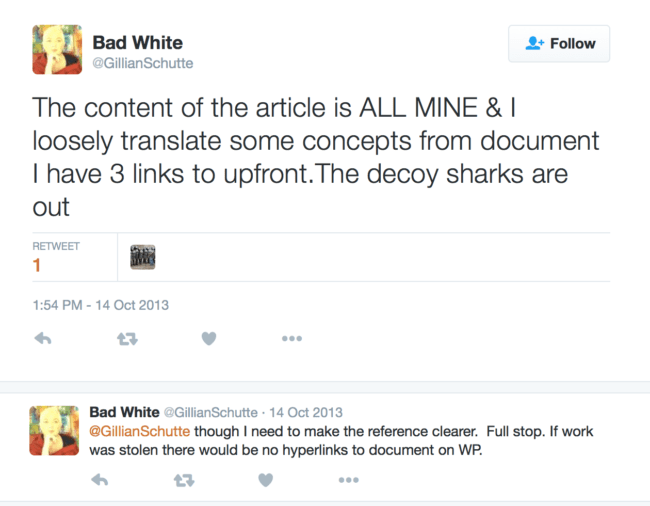
Edit: Schutte’s response?

Screen Shot 2016-05-17 at 17.26.34
Screen Shot 2016-05-17 at 17.30.37

A further edit, seeing as Schutte is accusing me of ‘lying’, never mind being an arsehole. As I say above, those hyperlinks give you no reason to believe they are references to a source. Plus, Schutte doesn’t seem to understand that quotation marks are necessary when you use someone else’s content, word-for-word.

She says:

Screen Shot 2016-05-17 at 17.32.18

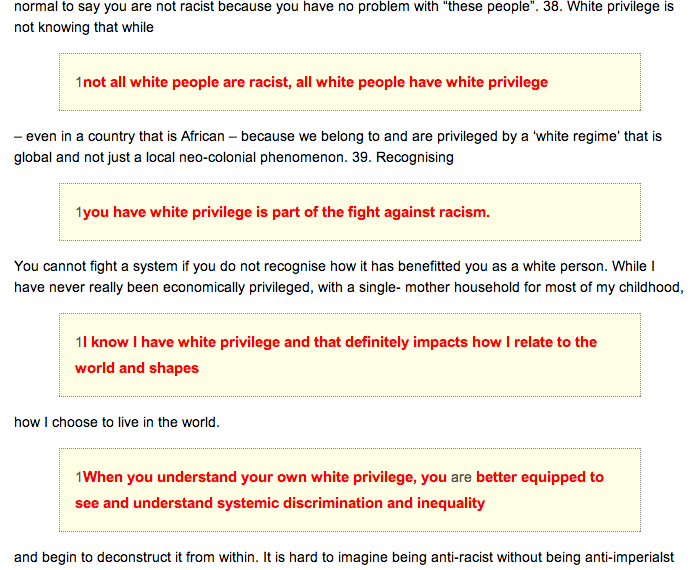
And that simply cannot be squared with, for example, this (with the red bits being verbatim stolen text):

Screen Shot 2013-10-15 at 6.39.30 AM

Respect to this Muslim on International Blasphemy Day

It’s perhaps an index of the level of ‘debate’ on religion and its place in society that September 30 each year is commemorated (by some) as International Blasphemy Day. Even four years ago, when my own atheism was far more assertive than it is today, I argued that Blasphemy Day was for the most part a bad idea, mostly because even though it certainly gets the attention of theists,

I don’t care about getting the attention of theists, so much as changing their minds. And I can’t recall many times that I’ve changed someone’s mind through teasing them – usually I’ve just made them more intractable.

Of course, Blasphemy Day does commemorate something worth remembering, in that it’s the anniversary of the original publication of the infamous “Danish cartoons” – which, whether or not you think they should have been published, certainly shouldn’t have been met with the violent reaction they encountered, causing (to mention one example) more than a 100 deaths in Nigerian protests.

But when you mock someone’s god (which you have every right to do), there’s no way to target only those followers of that god that do bad things as a consequence of their faith. Your offense is delivered by shotgun, causing emotional harm to anyone who feels strongly about that faith, regardless of how that faith plays out in their day-to-day lives.

So it is justified to think about the costs versus the benefits of this sort of offence – you assert your freedoms, yes, and you might also remind people that there’s no obligation on the rest of us to take what you do, seriously. And, Muslims who are peace-loving, kind, trustworthy and so forth must be rather saddened, in that it would strike them as perhaps gratuitous, but certainly the (indirect) fault of Muslims who seem nothing like them, except for the fact that they both identify with the same (roughly) religious tradition.

Making the distinction between Muslims who regard their faith as a motivation to do evil, or for whom the faith is at least an inseparable passenger to the evil done for political reasons, is not made easy when moderate, sensible, peaceful etc. Muslims don’t join in with the condemnatory voices of something like last week’s Westgate Mall terrorism in Kenya. Likewise with less tragic sorts of religion-related harms, such as the homophobic rhetoric of the Christian Errol Naidoo. Christians should be first to condemn him, just as all who want to claim that “we’re not all like that” should always be first to condemn the exemplars of their faith who are a discredit to it.

It is with this in mind that I must commend to you Kalim Rajab’s piece in the Daily Maverick today, titled “A perversion of my faith“. Others can fight about the accuracy or not of his interpretation of various scriptures. I won’t, not only because I don’t know enough, but mostly because that misses the point entirely.

We know that religion is more and more something quite different from what it was in centuries (even decades) gone by. Yes, there are literalists out there, who insist on some reading of a religious text, and do harm to promote and defend that reading. But outside of certain (increasingly easy to identify) regions, for example Saudi Arabia, to say that both person X and person Y are Muslims, or Christians, is to say very little.

I’m of course aware of the arguments of Harris and others who speak of the moderates giving shelter, or credence, to the views of the extremists. Making a view “mainstream” does allow for a range of expressions of those views, and this mainstreaming is part of the motivation for a counter-movement like Blasphemy Day. But if the moderates speak out against the extremists – just like non-theists often do – Harris’s argument becomes more difficult to sustain.

It remains true that Rajab’s god doesn’t exist (at least, if by “exist” we mean really exist as a consciousness of some sort). One day, I’d hope that this would be self-evident to everyone. But in the meanwhile, even if it is true that Islam tends to cause more violence than other religions, and even if it’s true that this violence is in the service of a fiction, surely we can nevertheless be happy, and supportive, when someone from inside that tradition denounces the harms done in its name?

The point is not always whether god exists. Sometimes – perhaps most of the time – it’s also worth focusing on what you do with that belief, or lack of belief.

Does Zuma read? Does it matter?

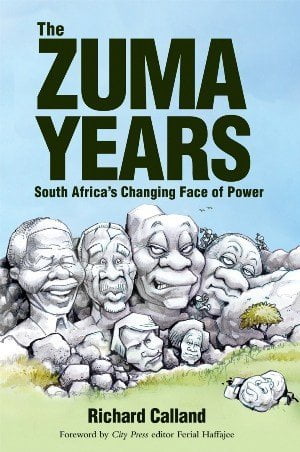
JZIt’s slightly amusing that it wasn’t his book, The Zuma Years, but rather Richard Calland’s comments to the Cape Town Press Club last week that drew fire from Mac Maharaj, President Zuma’s spokesperson. Maharaj says that Calland claiming Zuma “doesn’t read” is “incorrect, unfortunate, and misleading”, and also “serves to perpetuate stereotypes”.

Amusing, because when I read Calland’s book on August 17 and 18 this year, I noticed that chapter 3 opens with one of Zuma’s cabinet ministers being quoted as saying “Zuma doesn’t read”. So, I suppose we can conclude that regardless of how much Zuma or Maharaj might read, they at least hadn’t read this book. Or, they didn’t feel it necessary to comment on this outrage until they had heard it reported by the press, rather than having seen it in its original printed form – attributed not to Calland, but to Zuma’s anonymous minister.

So, you might say that this becomes further evidence for Calland’s claim, in that the details of a case like this matter, and the details can’t be conveyed by selective quotes from a Sapa newsfeed. Calland could be accused of fabricating the quote if you like – but that’s a different matter to chastising him as if he had made the claim himself.

Also, the claim crops up in chapter 3, after Calland begins the book with Mbeki. Mbeki is fairly uncontroversially known as an intellectual (whether pseudo or legit is up to your definitions, but he was certainly bookish). The detail regarding Zuma not being a reader is inserted by way of contrast, and by way of presenting Zuma as an entirely different sort of political operator to Mbeki (specifically, one who engages mostly with practical details rather than philosophical nuances).

Accusing Calland of making an “incorrect, unfortunate and misleading” statement is, therefore, an instance of a non-intellectual engagement (which isn’t necessarily meant to mean an incompetent, or incorrect engagement) with the situation, akin to what Calland describes as being the “house style” in the chapter on Zuma.

However, discussion about the Calland speech at the Press Club and Maharaj’s reaction have raised the question of whether it matters if Zuma reads or not, and if it does, whether it matters what he reads.

When Brooks Spector, Associate Editor of the Daily Maverick (disclosure in case you didn’t know: I wrote for them for three years) asked for recommendations for JZ’s reading list, I was quick to suggest Kahneman’s Thinking Fast and Slow. Not because I thought Zuma in particular needed to read it, but because I think most people would benefit from reading it (someone who I won’t name here can confirm that I also suggested it as a gift to all the members of the Western Cape Provincial Cabinet).

So that makes my bias quite clear, I suspect – I would like for our political leadership to be readers, and to be thinkers. If I were an American, I’d be one of those Americans wishing I could have the West Wing’s Jed Bartlet as my President. But I’d also like to resist insisting on being a reader as a requirement, because it’s a) not too surprising that someone who has been in a university for 22 years would like an intellectual president, and people like me are hardly representative; and b) because being an intellectual force is only one way of leading, and not necessarily the best one in all circumstances.

Don’t get me wrong: if you’re not an intellectual president/leader yourself, you sure as hell should be smart enough to surround yourself with people who are. Decisions need to be made regarding allocation of scarce resources, managing crises and the like, and you can only get so far with a smile and a handshake, or even with some backroom-backstabbing. But so long as you inspire confidence in those you are charged with leading, and meet some basic standard of competence (while stocking your cabinet with people who can do the things you can’t do), it would be inappropriate for us to demand that JZ, or any president, be a thinker themselves.

Zuma’s life didn’t allow for decades in a university. It didn’t allow for a day at a university, and if I recall correctly, he didn’t finish secondary school. But there are different ways of being smart, or capable, or inspirational. When we criticise Zuma, or anyone else, we should be careful to not assume the priority of any one of those particular ways, leading us to reject someone’s efforts simply because they don’t fit our template of one sort of ideal leader.

In Zuma’s case, my lack of confidence in his leadership is not because he doesn’t read. It’s mostly thanks to the fact that he doesn’t seem to have stocked his cabinet (or elsewhere) with people who make up for the skills and knowledge he lacks. Instead, he appears to stock the relevant bodies with whomever will serve to keep him in place and out of prison, all the while displaying the sort of superficiality and vanity more akin to a 3rd-world dictator (think Zapiro, Daryl Peense, or Brett Murray, or Chumani Maxwele) than to a credible and respect-worthy statesman.

In short, it’s not that he doesn’t read, but that he doesn’t lead.

Homophobia and the politics of outrage

The morning has brought one of those Twitter Groundhog days, where everyone is making the same points about Heritage Day/Braai Day as they did last year – mostly complaining about how offensive it is that someone else is telling us that it should be about X, and how offensive it is that someone else has co-opted it to make it about Y. Because liberty on these particular terms is the only liberty that matters, or something.

Another Twitter war that’s raging today is around homophobia, and can be traced back to the advertisement below (subsequently pulled, and also the subject of an apology from the agency concerned).

Flora ad

The ad was part of a sequence. The (only?) two other ads in the sequence involved the idea of Malema becoming president; and a Kama Sutra reference – in all cases, the idea was presumably that you need to protect your heart from excessive strain or shock, and that Flora margarine could give you added protection.

I’ll link to the opinion pieces that are being fought over at the end of this post, because the squabble between their respective authors is not the point of this blog post.

I want to go back to the ad, and the question of whether it is homophobic at all.

A literal understanding of homophobia would involve fear, but more colloquially judgement, prejudice and so forth against gay persons or communities. This definition is difficult to sustain here, because the judgement being expressed is against the holder of the “fragile” heart depicted in the ad – that person is weak, unable to deal with reality, and so forth. They need external assistance from the margarine to strengthen their (naturally weak) defences against some information (or exertion, in the Kama Sutra case).

This analysis of how the ad is supposed to work is consistent with all three versions of it. You can criticise such a campaign on various grounds, one of which would (and I think, should) be the choice of examples meant to serve as the “bullet”. If you want to highlight the things that some folk are hypersensitive, prejudiced or bigoted about, then the campaign should make that element clear – otherwise it runs the risk of being perceived as being particularly insensitive to those examples it does choose to use (with the ones left out being given a free pass). In fact, if you don’t make this element clear enough, the stereotypes you leave out are defined as normal by their exclusion.

So, the campaign I would have run (easy in retrospect, I know) would have involved “uh, Dad, I’m an atheist”. Or “uh, Dad, my boyfriend/girlfriend is black/white/Christian/Muslim/French”, or whatever.

Alternatively, you leave out the one ad that deals with a social prejudice at all, and replace it with “it’s about your child”, or “uh, Dad, I took your car keys”. The point is that in only including gay folk as an example of the sort of child that a parent might have a prejudice towards, you certainly take the risk of disproportionately offending gay people in this campaign.

One logically defensible stance here is that the ad uses the example of a homophobic person (the father) to make its point, rather than being homophobic itself. Critics will argue – not entirely without merit – that this is too narrow a definition of homophobia, in that we should also count as homophobic language and images that treat (technical, in the first sense above) homophobia as “normal”, or expected.

This broader understanding of homophobia certainly accords with what I perceive and see reported as being the experience of many homosexual people. Rebecca Davis (of the Daily Maverick) pointed out in a comment to one of the pieces that gay teens disproportionately commit suicide, partly (presumably) for fear of being othered, marginalised, cast out by parents and so forth – and that these fears are immediately prompted by an ad such as this. If, like me, you listen to the fabulous Dan Savage podcast, Savage Love, you’ll not go a week without hearing some heartbreaking story of parental or societal prejudice of this sort.

I’m sympathetic to the view that the ad is homophobic in this broader way, but only because of the failure of execution highlighted above. If the ad had consistently focused on prejudice of other sorts too, the campaign could easily have been read as affirming ways of living and being that some considered (and sadly, still consider) to be marginal, immoral or taboo. The ad might even be trying to do that now, and failing – so I can understand why it’s caused the outrage it has.

Here’s something else that I’d hope we can consider, though, even while saying it’s a bad ad, that an apology is merited, or even that the ad should be pulled. And that is that we do our language, argument and political battles a long-term disservice by calling an insensitive, poorly-executed ad concept homophobic instead of calling it “offensive”, “insensitive” or somesuch, including whatever qualifiers necessary (mildly, extremely, and so forth).

Our reactions to offence need to be proportional, because language and the words we choose to use signal the degree to which things are regarded as wrong. If anything that offends on the grounds of sexual orientation is homophobic, and anything that offends on the grounds of race, racist, then we are leaving no room for mistakes, or for implicit cultural biases to be recognised as unfortunate (and needing remedy) while not being wilful (and thus, more wrong). There are degrees of moral failing, and our language needs to take those degrees into account.

Lowe and Partners (the agency who made the ad in question) are not homophobic in the sense that Jon Qwelane or President Zuma are. Using the same language to describe them all is not only lazy, but also counts against a long-term project of getting people to think about the nuances of their language and behaviour. I’d wager that shouting at someone for their homophobia will not encourage as much reflection as explaining to them why gay folk might find the ad offensive would.

The point is that there’s an arms-race of hyperbole going on, especially on the Left, and therefore especially in matters pertaining to social justice. This is understandable, especially because the Right has bombarded the world with similar hyperbole for long enough. But the trend is not a good one, and we should resist it.

It’s not good, partly because we denude language through doing so. More importantly, though, it’s not good because it gives an intrinsic advantage in argument to those who shout the loudest, and who are willing to claim that they are most fundamentally or critically hurt. And in the long run, it’s not good because the only rational (or sadly, so it might seem) way to respond to a climate of hypersensitivity is to shut up, and not say anything at all, for fear of offending someone.

The Daily Maverick columns, in order of appearance:

Homosexuality is more African than Christianity

PinkWeekLater today, I’ll be taking part in a panel discussion on the topic “Homosexuality is more African than Christianity”, as part of UCT’s Pink Week. Seeing as no less an authority than Errol Naidoo has previously described me as a “homosexual activist“, I guess I’m qualified, and the topic should make for a fun discussion.

Even though I tend to never stick to the remarks I’ve prepared, here are some thoughts on the topic for those of you who weren’t (or aren’t, depending on when I publish this) able to attend.

First, of course the topic is meant to be provocative – in fact, it seems pretty clear that this is its primary purpose, seeing as it’s incoherent on a number of levels. Off top of head, you’d ask what “African” means; how it’s measured (how can one thing be more “African” than another?); whether Christianity or homosexuality are plausibly or potentially “African” at all (rather than human, animal, natural, unnatural, good, bad, etc.) – i.e. is that the correct category for the thing you’re describing.

And of course, you can ask whether any of this matters.

The sorts of things I intend to address are:

  • Homosexuality predates any established, mainstream religion. It must do so, because it predates language, in that we find homosexuality all around in the animal kingdom, never mind only in humans. Cats, dogs, rats, foxes, bears, dragonflies… just some of the species in which homosexuality has been observed.
  • We also know that Christianity only gets to Africa (Egypt, in particular) in the middle of the 1st Century. So, unless we want to claim that for all the centuries before that, Africans weren’t really African, you’re left with a bit of a dilemma if you want to deny the question as posed. Of course – in terms of when they started, at least – homosexuality has to be more “African” than Christianity.
  • What does it mean to be “African”? As I argue in the first link in the opening paragraph, I’m not at all keen on identity politics of this sort. If we want to define “more African” as “observed first”, then (as described above), homosexuality beats Jesus. But if we want to define African as having a certain character or attributes, then it’s of course possible (very hypothetically) for someone to make a case that homosexuality is some sort of aberration, and Christianity the more “natural”, or “normal” way of being.
  • But then, you simply sound like someone who wants to use religion as a vehicle to prescribe sexually permissible and impermissible behaviour – and in this case, to justify your homophobia. The burden of proof would then be on you to demonstrate why those religions, and those rules, are the ones we need to subscribe to.
  • In doing so, you’re of course forbidden from arguing that your religion shows that homosexuality is “immoral” because God says so. Because that’s circular, in that it’s exactly the identity and authority of your alleged God that is in dispute here, and it’s your God that tells you it’s immoral.
  • Lastly, some might want to say that there’s something normal or “natural” about seeking god(s), and that homosexuality is “unnatural” in some sense that makes Christianity more fitting for Africans. But what does is mean for something to be unnatural in any event? Do you mean:
    1. statistically rare? If so, then left-handedness is inappropriate/immoral also.
    2. not conducive to procreation? Then, no sex with contraceptives, after menopause, etc.
    3. not using your body as God intended (i.e. “the Lego doesn’t fit” argument) – well then, wearing spectacles is inappropriate, seeing as your nose wasn’t designed to hold up spectacles.

And of course, as highlighted above, homosexuality exists in nature long before any religion – never mind Christianity – does.

As a last consideration – whether something is African or not, and whether something is natural or not (regardless of how we define those terms) – so what? What relevance does that have to right/wrong? That case still has to be made, even if we are able to make a case that something is “unnatural” or “un-African” in some coherent sense.

To raise a related, but a different issue: There is one thing that’s quite likely to be both more African, and more Christian, than homosexuality is – at least in terms of prevalence. That thing, unfortunately, is homophobia.

In summary, stop telling people how they need to live, and let them live as they like, so long as they aren’t harming each other. The known harmful thing, in the meanwhile, is the judgement and prejudice of homophobes.

Dawkins on “mild paedophilia”

RDRichard Dawkins has – again – demonstrated that he doesn’t know or doesn’t care about public relations. As I’ve argued before, the fact that you might be speaking the truth isn’t always the only relevant thing. Messages can get lost in their delivery, and in the perceptions of their audience – and we can therefore have a debate about the efficacy of a message that is, to some extent, separate from its truth-value.

The outrage on this occasion is his reference to “mild paedophilia” in an interview for The Times (paywalled), that was written up on Religion News Service and then (to my mind, at least) mischaracterised on Pharyngula (commenters, this is not a blog on which to rant about PZ, please – I think he’s being uncharitable in his interpretation of Dawkins, but Dawkins nevertheless said something very ill-advised and insensitive). [EDIT: here’s the full text, from the RDFS site.]

First, an important clarification: what Dawkins reports is not paedophilia, but child abuse. Paedophilia does not necessarily entail any physical contact, but simply the attraction – and many paedophiles hate the fact that they have this attraction at all. We all make it more difficult for them to get help through demonising paedophiles as child abusers.

Second, this is not a new story. At least, the fact that Dawkins was abused is not a new story. He’s referred to it in interviews, as well as in The God Delusion. His comment that “it is at least possible for psychological abuse of children to outclass physical abuse” has previously been the subject of willful misinterpretation by the physicist Peter Higgs, and others.

In this new interview, Dawkins repeats his claim that he doesn’t think he has suffered lasting harm, and suggests that neither would his peers have. That’s a problem already, of course, in that while he’s free to speak for himself, it’s rather risky – not to mention grossly insensitive, and likely harmful to some who do feel harmed – to assert that other victims of child abuse haven’t suffered harm. Then he says:

I am very conscious that you can’t condemn people of an earlier era by the standards of ours. Just as we don’t look back at the 18th and 19th centuries and condemn people for racism in the same way as we would condemn a modern person for racism, I look back a few decades to my childhood and see things like caning, like mild pedophilia, and can’t find it in me to condemn it by the same standards as I or anyone would today.

This is the key passage, in which Dawkins again says something which is arguably true, yet an utterly stupid – and pointless – thing to say. To my mind, what he’s trying to say is:

  • That child abusers were living in a culture and time where the wrongness of their actions wasn’t as obvious to them as it would be now.
  • That the victims of child abuse were living in a culture and time where the wrongness of what was being done to them wasn’t as obvious to them as it would be now.
  • Our understanding of what actors did and felt within a particular historical time and context must be informed by the norms applicable at the time.

The fact that child abuse (and racism, and sexism, etc.) were always wrong is a separate issue to how people felt about those things, and their awareness of the wrongfulness of those things. And, how people felt about things (in fact, how they perceive things today) will obviously have an effect on whether people feel harmed, abused or whatever the case might be. That’s all that Dawkins seems to be saying. And the fact that it will appear to be an insensitive thing to say doesn’t make him wrong on those facts. What makes him wrong is arguably that it’s an excessively, and unproductively, insensitive thing to say.

So it’s not fair, or accurate, to say (as PZ Myers does), that he “can think of some lasting harm [to Dawkins]: [Dawkins] seems to have developed a callous indifference to the sexual abuse of children”. Not at all – this is a completely needless, and unfair, swipe at Dawkins, in that it asserts that he’s persistently, and currently, indifferent to the sexual abuse of children in general.

As discussed above, Dawkins thinks that some abuse, at a particular time, was not regarded as seriously (regardless of its actual seriousness) as it would be today. These are very different claims, and PZ Myers is simply picking the most uncharitable interpretation possible in order to discredit Dawkins.

Later in the post, PZ Myers says

We do not excuse harm to others because some prior barbaric age was indifferent to that harm. Furthermore, the excuse doesn’t even work: are we supposed to believe that a child-fondling teacher would have been permissible in the 1950s? Seriously? Was that ever socially acceptable? And even if it was, in some weird version of British history, it does not excuse it. It means British schools were vile nests of child abuse, just like Catholic churches.

Again, to call it an “excuse” creates the impression that Dawkins condones child abuse. And the use of the word “permissible” implies a binary state, where either all teachers are going around abusing children, then sharing tales over tea, or one where all abusers are caught and punished to the full extent of the law. It was never permissible, not even in the 1950s. Yet, it’s still possible that people didn’t report it as often, or follow up on it as often, or perceive it in the same ways then, as they do now.

This doesn’t alter the fact that it was wrong then, as it’s wrong now. It doesn’t “excuse” it, as per Myers’ words above. All that it does is explain that people might respond to it differently then than they do now.

Sweet baby Jesus

This story is a few weeks old now, so you might have heard it already. But in case not, a Tennessee judge has ordered the parents of a seven-month-old baby to change their child’s name from Messiah to Martin because

“The word Messiah is a title and it’s a title that has only been earned by one person and that one person is Jesus Christ,” Judge Ballew said.

Jaleesa Martin responded saying, “I was shocked. I never intended on naming my son Messiah because it means God and I didn’t think a judge could make me change my baby’s name because of her religious beliefs.”

She has since said she will appeal against the ruling adding that Messiah is unique and she liked how it sounded alongside the boy’s two siblings – Micah and Mason.

“Everybody believes what they want so I think I should be able to name my child what I want to name him, not someone else,” Ms Martin said.

Ms Ballew said the name Messiah could cause problems if the child grows up in Cocke County, which has a large Christian population.

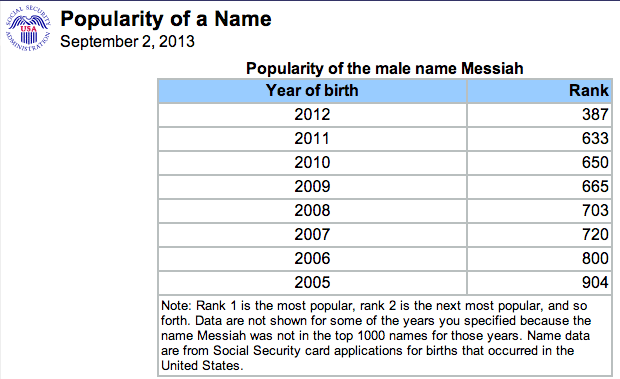
The ACLU came out in defense of Martin, pointing out that the Judge did not have the right to impose her religious beliefs on others. Judging from the fact that Messiah seems to be an increasingly popular name for boys born in the USA, many parents don’t seem to share that concern – but parents can get away with it, of course, as Richard Dawkins has often pointed out in referring to enforced religion as a form of child abuse.

Screen Shot 2013-09-02 at 8.48.39 AM

There seem to be at least two distinct issues here. First, the Judge should certainly not get to enforce her religious beliefs on a parent, or a child. And it’s fairly clear that this is what she’s doing, in referring to a “title” that has only been “earned by one person”. She thinks of Messiah as an honorific, and one that cannot be earned by a regular human – which means that she believes in the divinity of Jesus, and that this is what informed her judgement.

The second issue is far more tricky, though, in that it’s undoubtedly true that calling a child “Messiah could cause problems if the child grows up in Cocke County, which has a large Christian population”. This more legitimate reason is unfortunately obscured by the first, illegitimate reason.

The reason that this issue is more tricky is because it highlights the dilemma of just how much control parents should have over their infant’s lives, and how much of it should be delegated to the state. Your name impacts your chances of success in life, if we’re to believe the folks at Freakonomics, and it certainly impacts how much or how little you’re going to be teased. I’d bet that Messiah would be teased a fair amount – and the question is, do (or rather, should) parents have the right to subject a child to that teasing?

In case you don’t know of it, the title of this post is a reference to a funny prayer around the dinner table, in Talladega Nights, embedded below. For more exploration of the ethical issues here, Mark Oppenheimer’s New York Times column is worth reading.

Twitter, where obnoxious guests can gatecrash any party

twitter-bird-white-on-blueOne of the alleged sorts of “troll” that has been taxonomised on the Interwebs is the “tone troll” – someone who, lacking an argument, counters their opponent’s claims through pointing out that said opponent is being obnoxious, rude, or shrill (etc.). While I agree that tone can’t invalidate an argument, it certainly can make the argument difficult to hear. Also, it can make the speaker come across as either a reasonable person or not, depending on what sort of tone they employ.

There’s the risk of a false choice here, in other words, in that some invocations of the idea of tone trolling like to suggest that tone should never be relevant, and others like to suggest that we should never be rude or aggressive. The truth lies somewhere in between, as is so often the case. Ideally, we’d be such high-minded creatures that we’d be able to hear the argument, and assess it on its own merits, regardless of tone. And ideally, we’d perhaps be able to restrain ourselves from being rude or aggressive, except in truly exceptional circumstances.

(Of course, the problem with rude or aggressive folk is sometimes exactly that they think most situations are exceptional, and that you are exactly that sort of idiot that they should be able to yell at, most of the time.)

The false choice obscures the fact that tone matters on a psychological and political level, regardless of the truth or falsity of what someone might be saying. Consider an analogy, outside of social media and the web: when considering our circle of friends, or when drawing up a guest list for a party, I’d think it a common experience for all of us to know of someone who, while interesting, is a boorish character.

Perhaps they are too self-important, too loud, too sweary, etc. And perhaps they simply don’t fit the context under consideration, in that while you might invite them to one sort of party, you wouldn’t invite them to another sort (the loud, drunken occasion for dance, versus the dinner table, for example).

There’s no logical obstacle that I can see for wanting your Facebook or Twitter conversations, and your website comment spaces, to have a certain character. You might imagine yourself to be part of some sort of libertine Internet community, where people can do as they please, or perhaps you’re on a particular space because you value interesting – and even potentially civil – discussion with people you’ve never met in (physical) person.

If you’re of the latter sort, and you (politely) point out that that’s the sort of conversation you prefer, then people who ignore that request or signal are surely simply rude, lacking in certain basic social graces? And (here’s the conservative bit, I guess) surely that is still something we’d like to describe as wrong? Even in this world of virtual people and micro-opinions on Twitter, surely having basic manners can still be a thing?

Instead, it sometimes seems the case that on Twitter, you can gatecrash any party, and be as boorish a guest as you like. At some point you might be asked to leave, sure – but by the time that happens, you’ll often already have compromised the party for the rest of us. I’m not talking about simply seeing people in your timeline that annoy you – you’re of course free to unfollow, and thus not see that which annoys you. I’m talking more about the people who butt into your conversations with others, or who simply butt in, to say their piece, giving little thought to whether what they are saying is at all relevant to you.

One can ignore these interjections, yes. But a) that’s a (minimal, to be sure) burden I shouldn’t have to endure. I could ignore them, but I shouldn’t have to. More and more, it seems to me that we define our moral standards by reference to the lowest common denominator. So, people troll you on Twitter – toughen up! So, you encounter sexist abuse – come on, they aren’t serious! Despite the fact that we can sometimes be oversensitive, the fact remains that the basic wrongness lies with the troll or the rude gatecrasher – regardless of what we do to cope with them, they can’t be allowed to forget that we’d like them to learn some manners.

There was an (a) up there. The (b) is about how persistent they can be. It’s sometimes not just one interjection when you and someone else are talking about something, but an incessant expressing of a view on a conversation that you’re both not part of, and where you’ve been given every indication (in this case, consisting of the indication that nobody has replied to you, ever) that you should gracefully exit, closing the door behind you.

During a quite therapeutic rant with a friend over private message the other day, he confessed that Twitter was radicalising him, in that the endless stream of often vacuous pronouncements on things sometimes makes one want to disagree on principle, even if you’d ordinarily be inclined to sympathy with the cause or issue. This is simply because the sentiment you’re rebelling against is expressed in such a mindless or reactionary way, and so often by the same people.

In South Africa, it’s often around racial politics, and party politics, where a chorus of knees jerk at every instance of the Democratic Alliance doing something which (could, at an uninformed stretch of the imagination) be construed as exclusively anti-poor (thus, anti-black), with no prospect of it being part of some longer-term strategy that might or might not be defensible, in the minds of people who have spend many hours/days/weeks debating it. Likewise, a chorus of knees jerk at every instance of the ANC doing something which fits (however spuriously) a narrative of corruption or incompetence.

A larger problem, and not the point of this post, is that the deck is stacked against one set of critics, of course, in that criticising the DA is relatively safe, in that you can’t easily be accused of racism. So, a whole cottage industry of banal criticism has sprung up, where indignant opinionistas turn their postmodern attentions to the latest sins committed by the demonic DA.

The critics are often right – but they are never told that (or when) they are wrong, because to do so opens you up to various accusations (chief among these, the charge of racism) that make it easy for the opinionista to slide off the hook. And because these opinionistas are too rarely told that they are wrong, they have little opportunity to improve their arguments, and confirmation bias rules supreme.

So as you can see, Twitter is perhaps radicalizing me also, but perhaps also inducing a sort of bemused smugness, which doesn’t seem very healthy either. I had meant to offer some examples of the sorts of Twitter folk that I’m now starting to block, rather than ignore, but this post has gone on long enough. So I’ll get to that in future, and in the meanwhile, point you to something that makes similar points to those I had intended to make, namely Daniel Fincke talking about how he enforces civility on Facebook.

Caroline Criado-Perez, #ReportAbuse and Twitter

In a 2010 column on abusive comments posted below online articles, I wrote:

As Theodore Dalrymple reminds us in his “Thank you for not expressing yourself”, “The immediacy of the response which the internet makes possible also means that people are able to vent their spleen in a way which was not possible, or likely, before. The putting of pen to paper, to say nothing of the act of posting the resultant letter, requires more deliberation than sitting at a computer and firing off an angry e-mail or posting on a website.”

This, I believe, captures the essence of when it is permissible rather than gratuitously offensive to resort to abuse: Would you have said the same things in an old-fashioned letter to the editor? Would you say the same thing to the columnist in person, if you were to meet him at a dinner party? If yes, I say go ahead. But if not, perhaps you should do yourself and all of us a favour, and simply shut up.

But there’s no chance, or a vanishingly small chance, that the trolls will do us that favour. After all, their purpose is to (at least) provoke and offend, and telling them to shut up will do little but invite them to send some abuse your way. So what can we do?

imagesThousands of people have now signed a petition for Twitter to introduce a “report abuse” button, where this petition was precipitated by the numerous rape threats that Caroline Criado-Perez received after her campaign to have more women feature on UK banknotes. Notung has highlighted some of the issues in a recent post on SkepticInk, and I agree with his skepticism regarding implementing such a reporting mechanism efficiently.

For all the properly abusive Tweets and Internet comments that people somehow think it appropriate to send, this reporting mechanism will surely be exploited by those who want to simply censor things/people they don’t like – or just for mischief (think 4Chan or similar). So whatever else happens, I’d hope for there to be a human or team of humans assessing reports of abuse – carefully – before implementing any bannings or account terminations.

But it’s not as simply as a mere free speech issue for me, because asking the victims of abuse to simply “deal with it” doesn’t acknowledge the fact that some of us are more equipped to deal with abuse than others are – and that those who are less equipped to deal with abuse tend to attract more of it (getting a reaction being, after all, part of the point of being a troll).

It’s also not as simple as saying “don’t feed the trolls”, partly because that smacks a little of victim-blaming, and also because – thanks to the ubiquity of the Internet and a postmodern rejection of authority – everyone thinks that they are an expert on everything, and aren’t afraid to express their views, no matter how ill-considered those views might be. There’s seems to be an intolerance of ambiguity and uncertainty, which results in a default stance of dogmatism and hostility on many corners of the Internet.

Furthermore, as Notung points out, an unintended consequence of a “report abuse” button might be that those who are calling for the button get reported for abuse themselves. Not only because some “social justice warriors” can be rather brutal (in terms of using abusive language) in response to anyone who questions their point of view, thus perhaps meriting being reported, but also simply in retribution for perceived slights. (I don’t mean to generalise about social justice warriors, by the way. I’m referring to the subset of those concerned with social justice issues that appear to be ideologues, brooking little or no dissent).

Like Notung, I don’t have any answers here. But my two suggestions are:

  1. That more jurisdictions think carefully about implementing legal frameworks that are updated for the digital age, where every abusive twit has access to the means to cause distress to people like Criado-Perez. New Zealand is currently investigating how to go about this, and I think it’s important to work from first principles here. Existing laws on libel, defamation and the like would usually not take 21st-Century communicative possibilities into account, but if we did so, it might well be possible to eliminate much of the abuse without threatening free speech unduly.
  2. That we continue playing what part we can in discouraging trolls. I’ve written extensively about this before, in these two columns as well as numerous others – and a persistent fear for me is that if we don’t continue actively trying to provide quality content and commentary, blocking and banning trolls on our respective websites, the environment will become unattractive enough that some folk won’t even bother to read, let alone comment. Yes, the Internet is a free-speech zone, and should remain so – but you don’t have an obligation to allow any content on your corner of it. Just like you’d kick an abusive ass out of your house, do so on your blog, or your Twitter feed.