Censors, sex and the age of consent

imagesSouth African readers have most likely heard that Jahmil X.T. Qubeka’s “Of Good Report” could not be screened at the Durban International Film Festival, after the Film & Publication Board’s (FPB) refusal to classify it. Not giving the film an age-restriction means that the FPB has made it a criminal offence to show or watch the film, so a refusal to classify has the same effect as a ban. Their stated reason for this is that they believe the film to contain child pornography, in that it contains a scene of a woman receiving oral sex, closely followed by that woman being revealed as a 16 year-old schoolgirl.

I mentioned on Twitter that it was odd for us to have 16 as the legal age of consent, while sex acts could not be recorded or screened unless the participants were both 18. There are no doubt a lot of criminal 16 and 17 year-olds out there, thanks to the ubiquity of cellphone cameras and sexting. And this commend led to a rather fruitless exchange of views with the cartoonist Jerm (or, Jeremy Nell), on the appropriateness of age restrictions. You can read more about the movie ‘banning’ on Daily Maverick or Africa is a country. The rest of this post will focus on the general issue of age restrictions.

https://twitter.com/mynameisjerm/status/359230229773955072

In response to the Tweet posted above, I agreed that any particular age of consent was arbitrary, just as age limits on driving or drinking are, but said that there was no efficient and also principled way to do it without imposing an arbitrary age. In a future world where we can track capacity for factors like reason and consent in real-time, we’d perhaps not need these arbitrary limits, and particularly co-ordinated, willing and fearless 13 year-olds could get emancipated and go fight wars if they like.

But in the meanwhile, we need to work on expected or probable capacity to perform the function in question, whether it be drinking, driving, voting or consenting to sex. And yes, while it’s true that sex used to be legal at an earlier age (as Jerm points out), it’s partly because of predation that it was increased. An age of consent makes it easier to prosecute sex offenders, on the assumption that in general, people either aren’t consenting, or aren’t sure what they are consenting to (so, not consenting) below the age stipulated.

https://twitter.com/mynameisjerm/status/359231394045624320

While we can get these various ages wrong, and various jurisdictions disagree on where to set them (or so do inconsistently), I can’t see any merit in the suggestion that this should be a family matter, rather than a state matter. In fact, I find the suggestion even less principled than a state-imposed limit, because we have no reason to trust the family’s entirely subjective judgement in these matters more than we should trust the aggregate gaze that a state could apply.

https://twitter.com/mynameisjerm/status/359231995563765760

As I said above, the precise age is always going to be arbitrary, because there is no age that guarantees “full” maturity or competence. What we’re aiming for is “adequate” maturity or competence, such that we limit as little freedom as possible while protecting the largest proportion of various vulnerable populations that we can. And here’s the thing: it is possible to triangulate on the appropriate age in general, even if individuals might not fit the norm. But as I’ve previously argued, the exceptional cases should not be the basis for policy:

laws or insurance premiums can’t be tailored to individuals. As much as we are individuals to ourselves, interventions intended to work on aggregate have to treat us as belonging to a category – and the question then becomes how those categories are defined. And here, we need to start thinking about the least wrong way of doing this, and perhaps being more willing to tolerate principled ways of treating us simply as a number.

If we can find the approximately appropriate age, then we know that we’d be making fewer mistakes (in terms of restricting freedom) the closer someone is to that age, and doing more good (in terms of protecting more people from harm) the further away (younger) someone is from that age. Jerm seems to think that the law shouldn’t be about morality at all, though,

https://twitter.com/mynameisjerm/status/359234687882887168

which seems rather odd, seeing as we couldn’t have any laws against theft or torture if that were the case. But let’s assume he’s talking about only sexual morality – even then, I’d not be comfortable with the absence of a legal prohibition against incest with toddlers. The point is that laws shouldn’t impose arbitrary morality – that I agree with. Again, if we know that in general, consent is likely to be absent, we’re taking pragmatic steps to protect people from harm rather than imposing a moral standard when we say that it’s illegal to have sex with a 15 year-old.

So while we can debate what an appropriate age is, I don’t see room for discarding the concept of establishing and maintaining a guideline. And, as for how to set these guidelines in the least arbitrary way possible, we do have relevant knowledge. It would be a simple matter to track road accidents, for example, and do some analysis of factors like the age of drivers, and their levels of intoxication. (One might even suggest that insurance companies have cottoned on to these arcana.)

If it turns out that 16 year-old drivers look to be as safe as 20 year-old drivers, we know that we should either a) let 16 year-olds apply for licensing or b) not let 20 year-olds do so. And if a blood alcohol level of X gives you the same risk profile as a level of 0, we know that X is safe, etc. The fact that states might take shortcuts in figuring this stuff out and making the laws doesn’t mean there aren’t sound principles by which to do so, if we had the time and desire to.

Then, more generally – we know that it’s only at age 25 or so (for men) and 23 or so (for women) that the prefrontal cortex (PFC) reaches maturity. The PFC is the last part of the brain to develop, and (unfortunately for parents) is the part of the brain that governs impulse control, risk-seeking/aversion, and that encourages hyperbolic discounting (in short, we need a developed PFC to balance short-term rewards against long term goals). Putting that together, what we have is a brain that conduces to driving too fast, on too many drugs or too much booze, to get to a place where you’ll enjoy lots of sex with too many strangers and too few condoms.

In other words, it wouldn’t be at all arbitrary to say that 24 (to pick the mid-point) would be an efficient and justified way to limit all sorts of activities. But asking people to wait a third of their lives before driving or having a drink seems excessive, so we pick a younger age (exactly how young can vary, depending on the severity of risk in question) where most people are likely to be competent, even if some mistakes will be made. It’s a question of pragmatism, not of morality.

Does atheism entail anti-discrimination?

No_discrimination_signI recently discovered Betteridge’s Law, which is a rather cool adage that states “any headline which ends in a question mark can be answered by the word no“. And that’s the point of view many of you might have with regard to the headline I chose for this blog post. You might say, atheism is simply a lack of belief in god(s) – it entails no other propositions.

If we mean the strict logical sense of entail, i.e. that atheism necessarily leads to anti-sexism, anti-racism and so forth, you’re right. But you’re perhaps also evading a more important point, which is that if you’re an atheist who isn’t opposed to sexism, racism and so forth, the fact that you happen to be an atheist does little or nothing to combat the possibility that the viewpoints are at least in tension with each other, or even in direct opposition.

Two ideas don’t need to form a contradiction to be in opposition. And to my mind, atheism will (and, should) typically entail anti-sexism, anti-racism and so forth. And this is because prejudice of these forms is not only an manifestation of irrationality, but also more specifically a form of irrationality that is typically buttressed by moral codes that rank certain values or characteristics above others on largely arbitrary grounds.

Whether it be wearing a certain funny hat, belonging to a certain tribe, uttering certain sacred words, eating a particular food and not another – all of these are tokens that would normally be arbitrary, but are granted significance via a system of belief. They aren’t justified by evidence and reason, but rather become justified by the positive feedback loop of religious practice.

Without those forms of thinking, any idea that people with a certain level of melanin in their skin are superior or inferior to others, or that people with penises are better/worse than people without them, would struggle to get off the ground. We’d be far more inclined to say “that makes no sense – we’ve no reason to treat x worse than y”, because we’d have fewer psychological frameworks in place allowing for arbitrary discrimination.

So, while atheism might not necessarily lead to being anti-discrimination (of arbitrary sorts), I do think it’s not only compatible with anti-discrimination, but more than that – it’s more likely to lead to it than not. And for clarity, and to avoid needless argument, I am not making the claim that religion always, or necessarily, does lead to these forms of discrimination. I’m making the far more limited claim that it’s one way in which some people prop up their prejudices.

EU Guidelines on religion and belief

P010346001The EU Foreign Affairs Council recently adopted a report with 71 Guidelines on freedom of religion and belief. And while the guidelines don’t have legal force (EU guidelines that end up being legally enforceable are “regulations”), they nevertheless offer a clue as to the direction that particular councils are hoping for legislation to go. Furthermore, they send a strong political signal, especially with regard to emotive issues like religious freedom. In that context, these particular guidelines make for heartening reading.

There are 71 guidelines, and if you’ve got a moment to read them all, you’ll find plenty to applaud there. Some of the ones I’m most pleased to see are these (my emphasis):

  • “All persons have the right to manifest their religion or belief either individually or in community with others and in public or private in worship, observance, practice and teaching, without fear of intimidation, discrimination, violence or attack. Persons who change or leave their religion or belief, as well as persons holding non-theistic or atheistic beliefs should be equally protected, as well as people who do not profess any religion or belief.”
  • “The right to freedom of religion or belief, as enshrined in relevant international standards, does not include the right to have a religion or a belief that is free from criticism or ridicule.”
  • “The EU does not consider the merits of the different religions or beliefs, or the lack thereof, but ensures that the right to believe or not to believe is upheld. The EU is impartial and is not aligned with any specific religion or belief.”
  • “Coercion to change, recant or reveal one’s religion or belief is equally prohibited. Holding or not holding a religion or belief is an absolute right and may not be limited under any circumstances”.
  • “Freedom of religion or belief protects every human being’s right to believe or to hold an atheistic or non-theistic belief, and to change religion or belief. It does not protect a religion or belief as such. Freedom of religion or belief applies to individuals, as right-holders, who may exercise this right either individually or in community with others and in public or private. Its exercise may thus also have a collective aspect. This includes rights for communities to perform “acts integral to the conduct by religious groups of their basic affairs”. These rights include, but are not limited to, legal personality and non-interference in internal affairs, including the right to establish and maintain freely accessible places of worship or assembly, the freedom to select and train leaders or the right to carry out social, cultural, educational and charitable activities.”
  • Certain practices associated with the manifestation of a religion or belief, or perceived as such, may constitute violations of international human rights standards. The right to freedom of religion or belief is sometimes invoked to justify such violations. The EU firmly opposes such justification, whilst remaining fully committed to the robust protection and promotion of freedom of religion or belief in all parts of the world. Violations often affect women, members of religious minorities, as well as persons on the basis of their sexual orientation or gender identity. In dealing with possible violations, use will be made of existing EU human rights guidelines, notably the guidelines on the promotion and protection of rights of the child, on violence against woman and girls and combating all forms of discrimination against them, on human rights defenders, on torture and on the death penalty, as well as the forthcoming EU guidelines on the enjoyment of all human rights by LGBTI persons, and on freedom of expression on line and off line.”

To summarise a common thread in some of these guidelines, and a common-sense point: believe whatever the hell you like, and let others do the same. But your beliefs can never be used as an excuse to harm, oppress, impugn or otherwise malign someone who happens to not share that belief, or who has no religious beliefs at all. The EU Foreign Affairs Council should be applauded for this sober-minded and useful document, which will no doubt attract plenty of outrage from those who feel the grip of religion loosening its hold on the minds of increasing numbers of people all over the world.

Parliament – where dead sheep savage one another

Originally published in the Daily Maverick

tumblr_lt41l0pGYC1qdhgq4o1_500When insults are traded amongst groups of friends, we can get away with being more abusive than we would with strangers. If your name is Dorothy Parker or Oscar Wilde, your insults are perhaps easier to forgive because they’re funny, or because we must admire your wit, even as it makes us wince.

But if insults are a substitute for argument – if they are all we have to contribute – then we should rather consider the option of remaining silent, lest we make a fool of ourselves, while exposing all those who support our insults as fools themselves. We should consider the option of silence – or of diplomacy – even if the insult serves the short-term goal of a rhetorical victory.

There are many things that work towards achieving a desired goal, but at a cost. You could silence your child through administering a mild sedative, but don’t be surprised if you’re condemned for doing so. And even where some of our means toward a goal might not be illegal, the standard of the law is not the only relevant one. It’s society’s job to help regulate conduct more generally, and to generate the sort of society that we can enjoy living in.

This holds true for standards of conduct (for example, trying to avoid drowning out all other conversations in a restaurant with your excessively-loud banter) as well as the content of our speech. If we don’t demand sense, interpretive charity, and a certain amount of civility from each other, the absence of those things can increasingly become the norm.

To appropriate a passage from John Stuart Mill’s “On Liberty”, if society lets “any considerable number of its members” think that insult should succeed as well as argument, rendering them “incapable of being acted on by rational consideration of distant motives, society has itself to blame for the consequences”.

So it is in Parliament, or perhaps in politics more broadly. When insults start coming in the form of excrement, as was recently the case in the Western Cape, we get a clear signal of one of two things: either that people are sufficiently disgusted by how they are being looked after that faeces are in fact most apposite to their anger, or that they don’t have the knowledge or arguments necessary to express that anger.

There are many permutations between those extremes, and the extremes are both crude. My point is merely to say that a form of protest that offends our sensibilities could (in a logically possible sense of “could”) nevertheless be appropriate, under the right circumstances. However, there are other circumstances in which it’s clear that offending our sensibilities is a simple substitute for having nothing useful to say, or not having the words to say anything useful.

Consider ANC MP John Jeffrey, who said of DA Parliamentary Leader Lindiwe Mazibuko last week: “While the honourable Mazibuko may be a person of substantial weight, her stature is questionable”. It’s not the possible sexism of this comment that’s the only notable thing. It’s also the fact that some people seem to think these insults the height of wit, judging from the television footage. Tell a fat joke and have MPs rolling in the aisles? I can’t imagine how they manage to keep breathing during a Leon Shuster movie, if that’s the level of humour that works on them.

I say “possible sexism” above because I don’t intend to make the case that it necessarily is sexism, although that does seem likely given the relative infrequency of comments regarding the girth of male MPs. Besides, the comment doesn’t need to be sexist to be ad hominem.

And yes, it’s true that members of the DA have levelled the same sort of abuse at ANC MPs. Helen Zille is reported to have commented to Zodwa Magwazao that there “is only one elephant in the room” (although this remark was, I think, ambiguous enough to be a problematic example for this column’s purposes) and Theuns Botha once likened the ANC’s Lynne Brown to a hippopotamus.

It’s also true that the same sort of thing happens in the UK Parliament, although my impression is that the calibre of the wit on display there typically exceeds that of the examples here. But even when it doesn’t, there remains a crucial difference between the House of Commons and the South African Parliament: a constituency-based system.

If an MP has nothing to offer but insult – or if their insults are insufficiently entertaining – voters can remove them from office at the next election. MPs are accountable to citizens, and not only to party leadership. Sometimes, accountability itself seems an impossible dream for us in South Africa, when the ANC Chief Whip’s response to Jeffrey’s remark is to excuse it as a pun, while simultaneously criticising Mazibuko’s fashion sense.

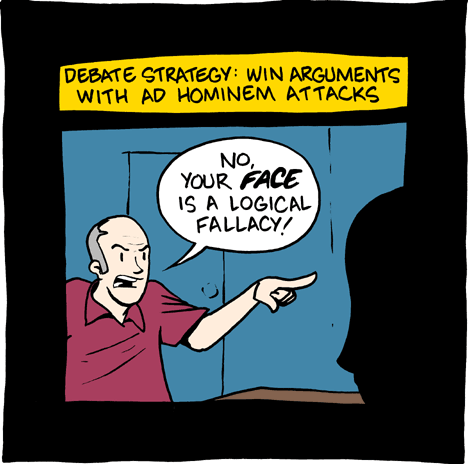
If I didn’t know better, I might call that victim-blaming. But it’s not – it’s simply a distraction and another ad hominem attack. And even though it’s true that Zille and Botha have been guilty of similar offences to Jeffrey’s, it remains possible to point this out in a way that nevertheless apologises – sincerely – for Jeffrey’s remark. A retort of “you too” (known to some as the logical fallacy tu quoque) is also evasion, and a juvenile one at that.

I’m not arguing that MPs shouldn’t be allowed to say the things they do, regardless of how juvenile their retorts might sometimes be. Robust debate must allow for offence, not only because we sometimes need reminding that our own standards of acceptable conduct aren’t sacrosanct, but also because without it, we’ll never get to know which MPs tend to believe and say offensive things.

Beyond the rules governing what is and is not appropriate language in Parliament, there’s also a market for what’s “unparliamentary” or not. Our market could be improved through a constituency system, but it nevertheless exists, and the Whips and other party leaders run it.

Ultimately, of course, the voters run it too. So if you want to appear to be a sexist windbag, you’re free to do so. And if your Chief Whip wants to inform us of your upcoming fauxpology while adding another insult, he should be free to do so – just as we’re free to punish your party at the ballot box if we so choose.

Having said that, I’d think it an over-reaction to punish a party for the conduct of individuals inside that party. I mention the possibility simply because the individuals in question sometimes don’t seem to care about substance rather than rhetoric, and could perhaps do with a reminder that we do care for substance.

The problem, in short, is that these rhetorical tricks and insults are the best that many of them have got – and I’d still like to believe that we deserve better.

FSI conference 2013

fsi-glass-squareI heard today that the secular humanist NPO that I’m chair of (the Free Society Institute, or FSI) has been awarded a substantial grant by the International Humanist and Ethical Union and HIVOS to host a conference later this year (or perhaps early 2014). So I’m in the early stages of planning. The event will most likely be in Johannesburg, simply because I can guarantee more substantial media coverage there, and because it’s easier to get to (I’ll be trying to persuade an international speaker or two to make the trip).

While I’m probably familiar with 90% of South Africans who are interested in these issues, and who might be interested in participating, please feel free to make suggestions for local speakers on this form. I can’t give any details about dates and venue yet, but want to make sure that anyone I don’t already know about gets ample time to bubble to the surface.

Also note that the proposal that got me the grant involves a conference on a Saturday, and a workshop on scientific reasoning and skepticism on the Sunday (ideally for schoolkids). So, you can put names forward for either component (or both).

Freedom of speech doesn’t come with a guaranteed audience

Originally published in the Daily Maverick

Phumlani-Mfeka-e1369903581366-250x250During one of Dara Ó Briain’s stand-up shows, he ridicules the way that panel discussions sometimes include lunatic views “for balance” (watch the clip below). His target in this skit is homeopathy and pseudoscience more broadly, but the general point he makes is that we aren’t obliged to offer a platform to any opposing view, no matter how entitled the holder of that view might be to believing what they do.

We can distinguish between your moral right to believing in something, rights to free expression of that belief, and then any obligations that others might have to listen to or even publish that belief. Crucially, defenders of free speech are not inconsistent in refusing to entertain any given view – they would need to actually attempt to stop you from expressing it.

What this means is that censorship, or violations of your freedom of expression, would typically only be something that a government could do. But when we speak of controversial things in the media – for example racism – there seems to be a view that not publishing racist rants constitutes censorship.

The City Press generated a debate on exactly this issue last week, when they chose to publish an anti-Indian screed by Phumlani Mfeka in which he reminds Indian citizens that they have never been comrades, and that they should “realise that Africans in this province [KZN] do not regard Indians as their brethren and thus the ticking time bomb of a deadly confrontation between the two communities is inevitable”.

Some of us were quick to denounce the publication of this piece as an instance of editorial failure, for reasons that I hope to make clear here. I also want to argue that refusing to publish a piece such as the one in question violates nobody’s rights to free expression, and is certainly no betrayal of your covenant with readers.

To start at the end: a newspaper can’t be obliged to publish everything. Someone on Twitter told me that “media must reflect all opinion to allow rebuttal”, but this is quite clearly nonsensical. If all opinions must be included, all publications would need to be infinite in length (and could never in fact go to print, since you’d have to spend an infinity looking for the nth variation of any given opinion).

Secondly, that view is nonsensical because editorial decisions to include or exclude content are are made all the time, for various reasons. One piece might be cut due to space considerations, another because it’s dated, and yet another because it’s too poorly written. And then, we can also choose to not publish something because it’s rubbish.

In whose view is it rubbish, I imagine some asking? The editor’s view is the answer – for that is his or her job. The editor has a certain vision for what the newspaper should carry, and for what sorts of ideals or ideas it is intended to highlight. Neither the City Press – nor, fortunately, most of our newspapers – carries horoscopes. Yet we would not humour an astrologer’s claims that his (I use the masculine because I’m reminded of Primedia’s CapeTalk567, who give stargazer Rod Suskin a full hour every week) right to free speech is being violated as a result.

So the City Press could have chosen to not publish the piece in question, without violating anyone’s rights. While it’s true that we sometimes want to hear what the racists are saying – both as a safeguard against soporific versions of the Rainbow Nation narrative, and in order to expose and rebut them, no particular newspaper is obliged to give space to particular types of bigotry.

Choosing to include content like this signals either inconsistency (why anti-Indian racism, and not homophobia, blasphemy, or articles advocating incest – they all raise “debate”, after all) or a willingness to enter the tabloid space, where you stop pretending to have editorial standards at all, and just pander to sensation.

The column has become a springboard for debate, in that we’ve already seen responses from the editor, Ferial Haffajee, and others. But while debate can be constructive and even sometimes necessary, let’s not make the mistake of assuming that it’s always any of these, nor that you can’t have this debate without publishing the likes of Mfeka.

While we know that racism exists and is even fairly prevalent, it nevertheless comes in different degrees of sophistication. This is true for all views, and we – as editors, publishers or simply conversationalists – indicate what our minimum standards of coherence and sense are through which of those views we decide to engage with.

If there are sophisticated racists out there, and we imagine ourselves to be a sophisticated discussant, we’ll talk to them rather than to Hendrik Verwoerd. Likewise, we might discuss same-sex marriage with someone other than the leader of Westboro Baptist Church, and evolution with someone who at least agrees that the earth is more than 6000 years old.

What we might prefer not to do is talk to, or publish, views that are so simple-minded that the only function they can serve is as a springboard for ridicule (if you’re feeling uncharitable) or sympathy (if you’re not). This has no bearing on anyone’s right to hold that view, or your right to publish it.

But those rights don’t come with the obligation to publish. And as a superb recent essay by Mark Rowlands puts it, the reader has the right “to be completely uninterested in views that you find stupid or abhorrent”.

It is of course up to those who manage content to decide what to publish. But just as readers can and will ignore some views, it’s a small step from ignoring views to ignoring platforms for those views. The racist, misogynistic or homophobic trolls have enough places to congregate already – let’s not give them the City Press too?

City Press Editor-in-Chief, Ferial Haffajee, has subsequently commented on the reasoning behind publishing Mfeka’s piece.

UCT vs the Twitterati

This post represents my personal views. Any factual claims made herein are not approved or endorsed by the University, and I speak as a member of the UCT community, broadly speaking, rather than as a member or representative of any structures at the University.

KhohlokoaneSo, with that out the way, I told some folk on Twitter yesterday that I’d blog about Joseph Khohlokoane, who graduated yesterday – after completing his social sciences degree 17 years ago. As is sadly typical in South Africa media, a South African Press Association (SAPA) release was uncritically reproduced by nearly all the other media outlets, with none of them bothering to check any of the relevant facts with UCT first.

What the SAPA story told us was that:

  1. Khohlokoane finished his degree with around R30 000 of study debt in 1996
  2. he worked as a petrol attendant to try and pay his debt
  3. he would not be formally awarded his degree until he had settled his account.
  4. he was not allowed to pay his debt off at R100 per month, because UCT said that wasn’t enough
  5. accumulated interest had swelled the debt to R100 000

The Twitter outrage was immediate, and mostly focused on how shameful it was that this man was refused graduation for 17 years, and that UCT had allowed his debt to inflate to such a frightening figure. When UCT initially responded to say that students with outstanding debt don’t graduate, and that UCT has a comprehensive financial aid system in place, this sort of response resulted:

Various popular tweeters, including the account of the very well-trafficked Africa is a Country blog united in expressing their shame at UCT, with some asserting that the Vice Chancellor should apologise. Before getting to the later UCT response, which included further details regarding Mr. Khohlokoane’s debt, let’s pause and ask what UCT might need to apologise for.

https://twitter.com/JoziGoddess/status/342930261983502336

Zama Ndlovu is right. It is a shame that affordability serves as an obstacle to South African’s getting a university education. It would be tremendous if university study could be government funded, but I’m sure you’d agree with me that it’s not UCT’s fault that it isn’t. UCT can only be held to account for doing less than other universities do (or, less than you reasonably think they should).

But UCT has a very generous financial aid system. In fact, as things stand in 2013, the University has committed to the proposition that no otherwise qualified student will be denied entrance on financial grounds. Not that this could have helped Mr. Khohlokoane in 1996, of course. He did however receive plenty of financial aid, as I’ll get to in a moment. The pool of money is not bottomless, however, and any funding to one student comes at the expense of something else. The level at which one sets support can of course be debated, but wherever you set it has implications for something else.

We cannot protest that one student could have – or should have – been bailed out of a debt of X Rands because their story happens to be sympathetic, or in the news. Because that student is potentially 1000 students, or more, all of whom might be in similar circumstances. We have no principled way of further assisting a Mr. Khohlokoane, and can’t assist everyone, because doing so would mean trading off on something else. Perhaps transport, housing or food, or perhaps building maintenance or salaries. Even though the budget is huge, managing it responsibly involves doing so on principle, and the principle can’t be “forgive student debt” – because student fees make up roughly half of UCT’s income.

And UCT’s only way of ensuring that they receive that income is to use the only bargaining chip they have – to deny graduation until the debt is paid, as they did in Mr. Khohlokoane’s case. But even though they do that, they still attempt to make it possible for students to exploit the potential value of that degree, by informing prospective employers that a student has completed the degree (even though they have not been awarded it). So, if Mr. Khohlokoane had found a job for which his social sciences degree was an advantage, UCT would have attested to his qualifications.

Some have suggested that UCT should somehow find other sources of income to fund cases like this. But that’s too simplistic a response. First, because UCT already finds all the money it can, whether through donations, fees or government subsidy. A huge proportion of that is allocated to assisting students already, but it would be nonsensical to ring-fence some portion for cases like Mr. Khohlokoane’s, because there’s no objective reason why they – and not other cases – deserve that sort of ring-fencing. And you can’t ring-fence them all, because the money supply isn’t infinite.

What students often don’t get – and what many of the Twitterati aren’t getting – is that it’s sometimes contrary to justice and fairness to make policy based on exceptional cases. Fairness involves having a clear set of rules, and applying them consistently, to try to maximise the welfare or interests of all stakeholders. Bailing out Mr. Khohlokoane would have come at the expense of some other interest – in other words, someone else would perhaps have been wronged (although, an aggregate interest would probably have been wronged, so we would not have noticed it).

The financial aid policies and packages are designed to help as many students as possible. Top-slicing some money from that pool to help a Mr. Khohlokoane, or someone else, means that another student doesn’t get that money. Yes, it’s sad that Mr. Khohlokoane had to wait 17 years to graduate. But assuming SAPA’s figures are correct, if UCT had forgiven the R30 000 student debt that he left UCT with, that would be R30 000 that was not allocated to students who have attended classes (and hopefully graduated) from UCT since then. Or do their interests count less than Mr. Khohlokoane’s?

And finally, one reason you might want to be a little more cautious about unbridled sympathy for Mr. Khohlokoane’s case is that the details of the case seem partly fabricated, in crucial aspects. Let’s reprise my list from above, but using the details from UCT’s second response, once they had time to check the facts:

What UCT later told us was that:

  1. Khohlokoane finished his degree with around R5 196 of study debt in 1996 (not R30 000)
  2. he worked as a petrol attendant to try and pay his debt (as above – left to maintain symmetry)
  3. he would not be formally awarded his degree until he had settled his account (as per policy, and as argued for above)
  4. he was not allowed to pay his debt off at R100 per month, because UCT said that wasn’t enough (in fact, UCT accepted small amounts like this from him, but he stopped paying them. UCT then spend two years trying to contact him with no success).
  5. accumulated interest and debt collection charges had swelled the debt to R8 342 (not R100 000)

To this, some Twitterati responded with a “yeah, so the total owing was somewhat exaggerated by SAPA. Still, shame on UCT”. But no – it’s the initial debt, the fact that he was paying (then stopped), the fact that he could have pursued a higher-paying job than he did (on the strength of his “qualification”), and the final debt that are inaccurately reported (and we of course don’t know whether Mr. Khohlokoane is responsible for this, or not).

In short, someone left UCT with a debt of R5 196, after receiving around R69 000 in financial assistance from UCT over his four years here. Seventeen years later, a generous donor settled the R8 342 now owing, and the student graduated. Thanks to poor information, poor reporting and the pitchfork-wielding mob on Twitter, UCT is made to look like it’s betrayed some sort of social justice imperative.

But given that a) educations can’t be free; b) the money supply isn’t infinite; and c) every Rand spent comes at the expense of something else, please tell me what makes you certain that Mr. Khohlokoane was uniquely hard done-by, or that UCT has committed evil here?

Edit: For posterity, here’s one of the things the self-described left have to say in response –

So atheists are people too?

Originally published in the Daily Maverick

imagesContext is often a key factor in determining what something might mean. Not only what someone might have meant in saying something, but also what it might end up meaning – in other words, what its likely effects might be. We forget this all too easily in a short-attention span world of headlines and attendant hyperbole.

Whatever you might think, for example, about Democratic Alliance policy, any analysis of their “Know Your DA” campaign is incomplete – and potentially incoherent – if it fails to address the campaign’s effects on its intended audience. Analysis of how the campaign is received on Twitter, Facebook, or even the Daily Maverick are likely to tell a small part of the story. So small, in fact, that it might not be worth telling.

Every week offers examples of columnists, presenters, editors and presidents taking individual cases out of one context and placing them into another, to make a point that might bear little relation to the point you might have wanted to make, or to the point someone else might take away from the same event.

Another example worthy of far more attention than I’ll give it here is the Woolwich murder last week, where a British soldier named Lee Rigby was hacked to death by two machete-wielding Islamists. Some responses treated this as justifying instance for Islamophobia, while others couldn’t see beyond a “chickens coming home to roost” analysis, arguing that Britain (and the US, of course) deserve all the terror they might get.

A more plausible analysis than either of those extremes casts the murder as an instance of “degenerate nihilism“, largely unconnected to Islam. Or, if you don’t think that analysis more plausible, you’d nevertheless hopefully agree that it might prove more useful for understanding why these things happen, and (perhaps) for minimising the chances of more of them happening in future.

The truth often – even usually – lies in-between the extremes, despite how much we struggle to see it that way. This struggle is precisely because of the competition for attention, and the limited time that we have to win that competition amongst our readers, listeners or dinner-table companions. So instead of nuance, we offer caricatures that are more likely to tap into the existing prejudices of the audience.

We can also fail to see outside of our own caricatured manifestations of the subject in question. Objectivity is neither something we’re very good at, nor arguably something that we’ve often got time for in the attention economy, where earning a moment of your time is such a significant return on investment that it feels like achievement enough.

A more trivial failure of objectivity than reactions to Rigby’s murder occurred last week, after the Pope dared to suggest that atheists might find their way to heaven, or at least be capable of being good people. The church was quick off the mark with damage control regarding the heaven bit (insisting that it’s still only via Christ that you can be issued with a visa), but that was never the interesting bit of Pope Francis’s sermon in any event.

Francis is quoted as saying: “The Lord has redeemed all of us, all of us, with the Blood of Christ: all of us, not just Catholics. Everyone! ‘Father, the atheists?’ Even the atheists. Everyone!”. We must meet one another doing good. ‘But I don’t believe, Father, I am an atheist!’ But do good: we will meet one another there.”

It’s not plausible to read Francis as claiming that faith is now optional for salvation. Besides the obvious point that atheists could hypothetically be redeemed once they become believers, the important thing in the sermon is the fact that he explicitly allows for atheists to be, and to do, good.

Most atheists I discussed this with were dismissive, asserting that they don’t need the Pope’s endorsement of their moral virtue, or questioning what the Pope might even mean by “good”. In other words, most reactions missed the point by a mile.

We know, from Gallup polls and other research in the US that atheists are distrusted and thought to have no foundation for moral principles. We see that politicians constantly name-check faith, and that Julia Gillard is an exceptional case in being an atheist who has managed to become elected to the Presidency (of Australia). In other words, we know that in the PR battle around moral issues such as trust, integrity, charity and the like, atheists struggle to compete with religion.

We don’t struggle to compete in reality, of course – but exploring that is not the point of this column. The point of this column is to say that when the leader of the Catholic Church tells adherents of that religion – one of the largest in the world – that they don’t have a monopoly on virtue, that message directly contradicts an existing and powerful stereotype.

You don’t have to like the Pope, or respect him and his Church, to regard it as a good thing that this influential person makes a statement undermining the idea that you can’t be morally decent without religion. That idea keeps atheists from speaking out, declaring their non-belief to family, friends, or the electorate. It is used as a form of pressure to get people into faiths in the first place, because who would want to be perceived as an immoral (even evil) person?

In other words, there’s a big picture here, beyond our egos. There are in fact various big pictures, competing with the ones describing child abuse in the church, or the sexism of Catholicism. Progress is possible at various rates, at various times and through various forms of strategy – but to deny that this is progress of any sort is as blinkered a reaction as we like to accuse religious folk of falling prey to.

As Steve Zara remarked on Facebook, “change in the views of those who are opposed to ours is, after all, a vital part of progress. It doesn’t mean that the Pope isn’t still part of the opposition to reason, and he continues to promote hateful and dangerous views, but we can be happy about a change for the better without needing to like the person who has changed.”

Amen to that.

A culture of dying

Originally published in the Daily Maverick

623156_314164Kabelo Mokgweetse ran away from his initiation school in Pampierstad in November last year, to look for food. He was tracked down and thrashed with a sjambok, before having his feet burnt as further punishment. Then, he was left for dead at the side of the road, where a passing motorist happened to spot him.

Initially only his toes were amputated, but the nerve damage eventually required further surgery, where his right foot was removed in its entirety, along with most of the left. The question that’s difficult to ask – never mind answer – is whether he might prefer to instead be one of the 23 youth who recently died as a result of initiation ceremonies in Mpumalanga.

Mokgweetse and thousands of boys like him are sent (and often willingly go) to initiation schools to mark the transition between boyhood and manhood, undergoing ritual circumcision and being instructed about their social responsibilities. And in most years, children die in the course of “becoming men”. It’s so typical, in fact, that a government news agency can use a headline like “Traditional leaders welcome no initiation deaths”.

That headline was for a story about Limpopo in particular, and dealt with the 2010 season, where attendance at initiation schools was reportedly down by 75% thanks to the World Cup. Limpopo does seem to be a province that has taken the health of initiates particularly seriously, with deaths in the low single-figures for the past few years.

The key question that arises for outsiders like myself is this: do the children who go to initiation schools, the parents who send them there, and the Ramophato (initiation school owner) think that this is a fair price for preserving these cultural practices? And if one death is a fair price, how many would be too costly?

Part of the reason for the continued survival of poorly regulated initiation schools is surely that they provide a narrative to life – a structure, and a reinforcement of community and communal values. But if those goods can be acquired at a lower price – and they undoubtedly can be – then the dozens of deaths we’ve seen so far this year are surely not only too many, but also reason for widespread outrage as well as legal action against those responsible.

Because this is a matter of culture, though, people prefer to tread lightly, tempering their criticisms with politically correct noises about tolerance and respect. But isn’t this in itself condescending, perhaps even racist? Could we instead wonder whether, if the average adolescent in Mpumalanga knew that they had a decent prospect of a good education, a good job and so forth, they’d rather be joining protests against such schools – opting for medical circumcision at the very least, if not entirely rejecting cultural instruction of this sort?

But it’s been – and will continue to be – a long wait for more people to have a better shot at a good life through adequate healthcare, education, and those goods many of us take for granted. And what we put in place as substitutes to give meaning to life – namely cultural practices such as these – result in initiation schools, genital mutilation, corrective rape, culturally embedded homophobia, sexism and so forth.

“Culture” is used as an excuse for all sorts of things (in South Africa, often as a simple vote-getter). But it’s only when you get to choose what your “culture” is – and not have it forced upon you – that it stands a chance of being respectable. And even then, it should never be a stand-alone justification for doing or believing something.

Culture can explain why we do things, even if they appear to be irrational to outsiders. Justification is a different matter, though – if not, how could we complain if a Eugene Terre’Blanche, for example, cites culture as a reason to keep black slaves? Culture cannot serve alone as a reason for doing something.

Equally, culture should not serve as a reason to avoid intervening when needless deaths can be avoided. Last week, a caller to Radio702 recounted his experience of an initiation school (where a close friend of his happened to have died). The caller, Sam, explained that deaths were common thanks to initiates being deprived of water until the last week of proceedings, and also poorly fed – meaning that they had few physical reserves to cope with the gruelling nature of the rituals.

Furthermore, they would also be less able to fight off infection, more common as a result of the lack of qualifications of many who perform the circumcisions. All of these factors can be managed, and to some extent have been managed in Limpopo. This is clearly not the case in Mpumalanga.

Interviewed on eNCA, the MEC for Health in Mpumalanga said that, as a woman, she couldn’t get involved. Her precise words were: “This is a tradition. This is a tradition. So in other tradition whether there are deaths or what but a woman can’t come closer to that”. A competing tradition here involves avoiding needless death, and doing your job. Someone who chooses the tradition of turning a blind eye to death deserves to lose her job, at the very least, and seems at least partly responsible for any future deaths.

Appeals to culture, tradition and the like have causality entirely back-to-front: things could become cultural norms because they are good norms; but the fact that something is a cultural norm has no bearing on whether it’s a good or respectable norm or not. And a cultural practice in which there is no age of consent, poor or no medical oversight, and wilful ignorance on the part of government officials is problematic, to say the least.

“Only God knows who’s going to die, when” was Msebenzi Masombuka’s (a representative of King Mabhoko) comment following the deaths in Mpumalanga. Even if one does believe that, we’d still present ourselves as candidates for earlier or later deaths, through our actions or inactions.

Or sometimes, it’s others we present as candidates for an earlier death. And we sacrifice them on the altar of “culture”. In May 2013, culture killed at least 23 boys – yet we should respect it, just … because.