Should you give to people on the street?

A guest post by Greg Andrews, following my asking him for his thoughts on this article in Cape Town Magazine. Greg has worked with vulnerable people in South Africa for the past 20 years. He is currently the Operations Manager of The Service Dining Rooms and Convenor of the Street People’s Forum in Cape Town.

Should you give to people on the street? In general I would discourage giving, but a simple “no” cannot do justice to the complexities inherent in this issue. Here’s why:

Euthanasia and the permissibility of moral debate

One should, in general, be able to discuss controversial moral topics without it being assumed that you support the worst possible consequences of the topic under debate. I add the “in general” because it’s rather difficult to imagine someone arguing in good faith when they ask that we debate whether one race is superior to the next, or some similarly prejudiced proposition.

And, there’s a distinction worth retaining between stating that something is right or wrong, and having sympathy for someone who is placed in the position of having to make a difficult or controversial moral choice – whether or not that person ends up making the choice that you’d make, or hope that they would have made.

On Pew’s Global report on morality (including South Africa)

PG_14.04.11_MoralityHomePage_260x2601The Pew Research Center recently released their 2013 Global Attitudes Survey, summarising responses from 40 117 respondents in 40 countries to various moral issues. A local journalist called me for comment this morning, but as usual, only soundbites will survive and besides, many readers of Synapses might never spot the resulting article in any event. So, here are some thoughts on the Pew results as they relate to South Africa.

Liberal bullying can still be bullying

To quote a September 2013 version of me,

there’s an arms-race of hyperbole going on, especially on the Left, and therefore especially in matters pertaining to social justice. This is understandable, especially because the Right has bombarded the world with similar hyperbole for long enough. But the trend is not a good one, and we should resist it.

It’s not good, partly because we denude language through doing so. More importantly, though, it’s not good because it gives an intrinsic advantage in argument to those who shout the loudest, and who are willing to claim that they are most fundamentally or critically hurt. And in the long run, it’s not good because the only rational (or sadly, so it might seem) way to respond to a climate of hypersensitivity is to shut up, and not say anything at all, for fear of offending someone.

EichI’m not at all sure where the dividing line is between expressing justified grievances and bullying someone out of a debate – or out of a job, as happened to Brendan Eich, ex-CEO of Mozilla, yesterday. While it’s true that some viewpoints are not worth entertaining, that doesn’t necessarily mean that someone who holds those viewpoints shouldn’t be allowed to, and shouldn’t be allowed to campaign for them without fear of reprisals.

Homophobia is wrong, and harmful – you’ll find plenty of posts over the years highlighting the offence, hurt, injustice and sometimes even murders that can be attributed to homophobia, from the relatively trivial cases of Error Naidoo to the properly odious Scott Lively, who had a part in inspiring the criminalisation of homophobia in Uganda.

However, it’s not at all clear to what extent Brendan Eich is a homophobe at all, unless we define homophobia simply as the belief that certain legal entitlements should be reserved for heterosexual people. Again, I must stress that I personally reject that belief – discrimination based on sexuality is premised on an entirely arbitrary characteristic, and is thus unjust and should be unlawful.

Usually.

Because as usual, there’s a background issue that needs to influence our reading of a case like this, and that issue is that Eich is a Christian, who believes that marriage is something ordained by God, and reserved for a man and a woman. And for as long as we (or in this case, the USA) respects freedom of religion, that’s not only a legitimate belief to hold, but also a legitimate position to campaign for, and to donate money to defending.

Perhaps we should weaken our respect for freedom of religion, and insist that a church or a minister who wanted to marry anyone should also be willing to officiate marriages for gay couples. If you won’t marry a gay couple, you can’t marry anyone. Perhaps we should argue that if you get tax breaks from government, you should lose them if you discriminate on arbitrary grounds such as sexuality, or race, or gender.

But that’s not where we are, yet, and (some) churches are still operating in a grey zone where their archaic morality is grudgingly accommodated, even in progressive democracies. Maybe it shouldn’t be – but for as long as it is, Eich has a warrant for believing (on his, archaic, standards) that it’s not unjust to deny homosexual couples the right to marry, and that it should be unlawful for them to marry.

This is the cause that Eich was supporting, in that he gave a $1000 donation, in his personal capacity, to a campaign in support of Proposition 8 (that sought to outlaw gay marriage) in California. He wasn’t alone – Proposition 8 passed, meaning that over 50% of voters voted in favour of it, before it was later overturned by the courts.

All of those people who voted for Prop 8 were – and no doubt, still are – wrong. But of those thousands of people, Eich might be the only one who was hounded out of his job, after his donation came to be public knowledge. The dating website, OKCupid, displayed a banner to Mozilla Firefox users, telling them  to change their browsers because of Eich’s position. This and similar moves (e.g. Rarebit apps, who pulled their apps from Firefox), as well as sustained criticism on social media, led Eich to resign (or so we’re told – he might well have been pushed, judging by the Mozilla chairperson’s statement that “We failed to listen, to engage, and to be guided by our community”).

So, in essence, Eich lost his job for being a Christian (of a certain sort). One of my closest friends would (I think – I haven’t checked this detail) hold the same view regarding gay marriage, and is certainly no homophobe in any other sense. I think he’s wrong about marriage and who it should be reserved for – but I would think it even more wrong if he were not able to hold the view he does, for fear of losing his job.

Yet, of course we should be able to express our dissatisfaction, even sometimes outrage, at the things people do and support. As I said at the top, I don’t know where we draw the line. But Eich operating in his personal capacity is a separate thing to his role at Mozilla, and his personal democratic choices are legitimate ones until the law says they are not. He was acting in accordance with his religious beliefs, which are constitutionally protected.

If you think that’s wrong, you need to campaign against freedom of religion, not against Eich.

(Related – an earlier piece on the Chick-fil-A homophobia.)

I have a drug problem

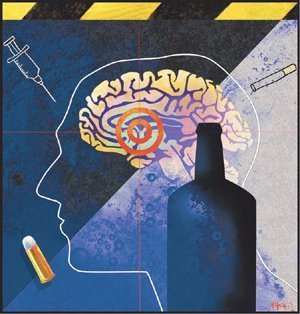
addictionAnd that problem is stigma. Addiction is a biological mechanism, where the desire for a certain stimulus is reinforced through (among other mechanisms) a dopamine “hit” in the nucleus accumbens. It’s a chronic brain “disease” of sorts, influencing your reward system and your motivations. Despite this, many folk continue to think and talk about it primarily as a moral failing, or – on another end of the spectrum of unhelpful interventions – dilute the significance of addiction by using the term to refer to the fact that we enjoy certain foods as evidence of “sugar addiction” or “carbohydrate addiction”.

As Salon puts it in a piece on why addiction carries such a stigma, “the idea that those with addictive disorders are weak, deserving of their fate and less worthy of care is so inextricably tied to our zeitgeist that it’s impossible to separate addiction from shame and guilt”. And that shame and guilt, in turn can sometimes stop people from seeking out treatment while there’s still time to do so.

In Cape Town, we have a significant drug problem – from tik and its association with poverty and gangsterism, to the alcohol abuse that helps to fuel road death statistics. Besides taking responsibility for your own substance-use and (perhaps) abuse, there is one other simple thing we can all consider doing to contribute to alleviating Cape Town’s drug problem. Even if each individual contribution is slight, the collective contribution could be significant.

That contribution is in helping to end the stigma, thereby encouraging people to seek treatment and support. A wider public understanding of what addiction is can remind us to not be unnecessarily judgmental, nor to be overly simplistic about it in referring to social media or sugar addictions as if they are in the same league as a tik addiction. We can also inform ourselves about what the Government is doing (which includes a rapidly-expanding outpatient programme for opiate detox, an emergency helpline, and a significant annual spend on treatment and rehab.

This post was part of a City of Cape Town substance abuse awareness campaign.

If you’d like to add your voice to the Cape Town community and help deal with the substance abuse problem that affects the city, you are invited to share your own story. Post your story of how drug abuse affected your life in The City of Cape Town, and share it on Twitter by using the hashtag #ihaveadrugproblem. If you or someone you know needs help with substance abuse, phone the free 24hr helpline on 0800 435 748.

Trigger warnings – Internet civility and the risk of infantilization

Those of you who frequent corners of the Internet that discuss prejudice against other human beings on the grounds of things like race, sex, sexual orientation, physical disability and the like would no doubt have come across the term “trigger warning”. For those who haven’t, a “trigger warning” is essentially an alert that the text that follows might contain words or ideas that “trigger” some negative reaction in the reader. For example, a victim of violent crime might be prompted to re-live their terror on reading a descriptive piece about an armed home invasion.

There’s no doubt that some of us can be insensitive to the needs and interests of others, some of the time. In fact, some people seem to take pleasure in being wilfully offensive, and might deliberately taunt others for some or other manifested difference (or even an imagined difference). Trolls are one example on the most egregious end of the spectrum, but more commonplace is the problem that for those of us – like me – who fit into the categories that have long been considered “normal”, it’s easy to find yourself offending others without realising it, and without intending to.

More worrying for us “normals” is the possibility that this social-baseline existence makes you blind (or contributes to blindness) regarding the privileged status you might occupy in life and social discourse. The relevant catchphrase here is “check your privilege”, and as I’ve previously argued, demands to “check your privilege” can sometimes be a complete nonsense, used to evade the responsibility of making and engaging with arguments, even if it is sometimes true that “privilege” can blind one to other ways of being.

But it can also sometimes be accurate, just as there might be – and are – situations in which we’d want to warn a potential audience that something they are about to read and/or hear could unsettle them. The concept isn’t an alien one – age-appropriate warnings for visual media rely on it, and news inserts are often preceded by a warning regarding graphic content.

Yet, we surely need to take some responsibility for ourselves, in that it would be unreasonably demanding to expect, for example, a support group for war veterans to precede every recollection of some event they witnessed with a “Trigger warning: violence” alert. Instead, the most obviously suitable place for trigger warnings (if we are to agree that they should be more prevalent, that is) would be on content or platforms where a responsible consumer of that content would be justifiably surprised to encounter that which they find triggering.

Take an unmoderated Internet discussion forum, for example – you cannot expect such a place to contain only things that don’t upset you. But you might more reasonably expect a discussion forum on how to raise children to not contain accounts of children or parents dying in labour – an unwritten social contract has arguably been violated in the latter case.

The broad point is that it’s impossible to protect people from all harms, and it’s also only morally expected of us to avoid causing foreseeable harms to others, and even then, it’s unreasonably demanding to expect that we take all such harms into account. I don’t want to explore the issue of which harms we’re obliged to take into account and which not (not today, at least), but for example, I know it might harm the feelings of a religious person to tell them that God is a fiction, but that shouldn’t prevent me from being able to say so.

In other words, both because the Internet is an unregulated place, and second because we can’t reliably predict what people might or might not be harmed by reading, the traditional distinction between what’s morally expected and what’s “nice to have” – supererogatory in philosopher-speak – needs to be maintained here. We might prefer for people to create a environment of type X, but might only be able to expect an environment of type Y.

Because the alternative – of always and only saying things that are guaranteed to not harm anyone – creates such a sanitised environment that it would run a serious risk of infantilizing us. We need to be able to tolerate different points of view, and that which we might find offensive, because that’s part of the way that we learn to cope with the slings and arrows of fortune.

Of course, this approach does advantage those whose points of view, or who – as people, are subjected to fewer of those slings and arrows. But at the same time, there are people who have endured traumas that prefer to talk about them openly, to not have them treated as a “special” topic that needs to be preceded by warnings, or confirmation that a certain conversation is permissible.

Striking a balance here requires empathy – and there’s no question that far more can and should be done by “normals” to be sensitive to the fact that they frequently win at life simply because they wrote the rules. But the solution isn’t to be found in swinging completely to the other end of the spectrum, and attempting to rule out all possibility that people might find themselves challenged, even hurt, by the things they encounter in the world.

The thoughts above were prompted by a worrying trend described in this New Republic article, namely that of college classes now carrying trigger warnings on class syllabi. If a class called “Histories of the Present: Violence” is expected to carry a trigger warning, then it seems clear that we’ve over-corrected – even if there’s a real problem at the heart of the motivation for that correction.

Ugandan homophobia and those “mercenary” gays

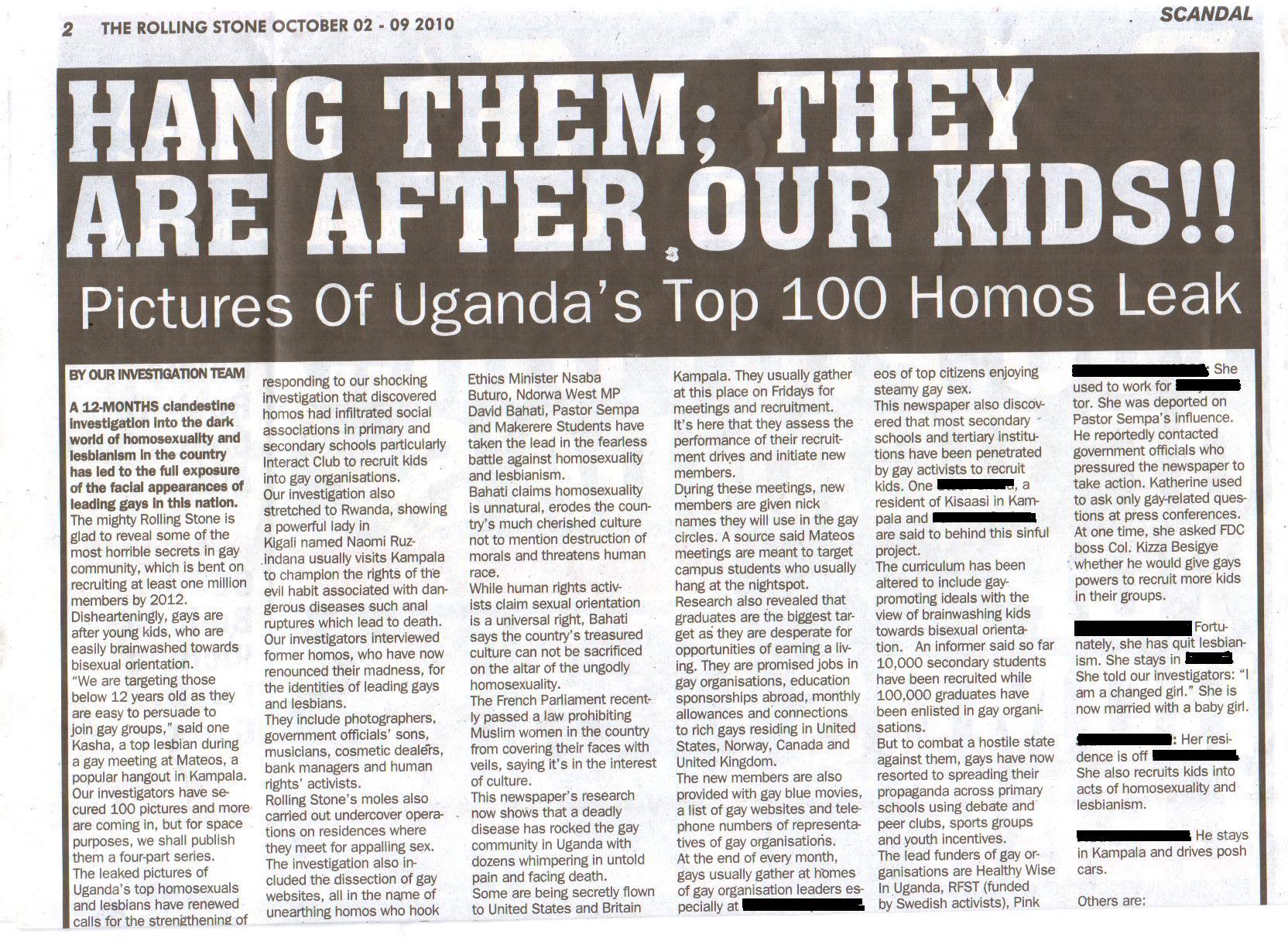
Three years ago, Uganda’s Ethics and Integrity Minister Nsaba Buturo observed that “killing them [gay people] might not be helpful“. The death sentence was indeed dropped from the bill that now awaits President Yoweri Museveni’s signature, after having been passed by their lawmakers in December.

hangthemprotectedBut that’s cold comfort to those persecuted for their sexuality – a sentence of life imprisonment can be imposed not only for gay sex, but also for “all behaviour, including touching, that might lead to or show an intention to have homosexual sex”. It gets worse, though – at least in terms of how much prejudice the Ugandan Members of Parliament are willing to flaunt: the ministerial task team advising the President on the bill “falsified the information contained in the report given by medical and psychological experts, twisting it to show that homosexuality should indeed be further criminalised“.

A concern for truth has never been a hallmark of this sort of bigotry, as you no doubt know. From claiming that homosexuality isn’t “African” (even though there’s plenty of evidence for pre-colonial same-sex sex) to Museveni’s own recent statements that people might become gay for “‘mercenary reasons’ or, in the case of lesbians, a lack of sex with men.”

In part, the blame for these fabrications and the attendant persecution can be laid at the door of American evangelical Christians, in particular Scott Lively, president of “Defend The Family International”, who thinks that homosexuality caused the Holocaust. But he’s also tapping into a rich wellspring of hatred and confusion – from David Bahati’s contempt for homosexuality (he’s the first-term MP who drafted the death-penalty version of the bill), to the current “Ethics and Integrity” Minister, who talks about “the right kind of child rape” (the heterosexual kind, of course – watch the interview starting at 35m40s in the video embedded below).

It’s laws and lawmakers like these that remind one of how far we still have to go as a species, before being remotely respectable.

http://www.youtube.com/watch?v=L9ytwGW9eO0

DignitySA on Belgium’s child euthanasia decision

This is too interesting an issue to be posted on Facebook alone, so I’d like to share Prof. Sean Davison’s (of DignitySA) comment on Belgium’s recent Parliamentary vote to approve (voluntary) euthanasia for children. As many readers will know, I support voluntary euthanasia, and in a local context, support Davison and DignitySA’s efforts in campaigning for a right to die in South Africa. You can “like” DignitySA on Facebook, and/or become a member via the DignitySA website.

What the Belgian Parliament has voted to allow is unprecedented, in the sense that it will allow for voluntary euthanasia (in short, you choose to die – we’re not talking about “pulling the plug” on a comatose person) for a child of any age, rather than only children of a certain age (in the Netherlands, voluntary euthanasia is permitted for children 12 and older).

On their Facebook page, Davison offered this comment:

I can understand that the Belgian law makers were motivated by compassion when passing this law but it is hard to believe that a child has the capacity to make an informed decision about whether to live or die when adults struggle with the concept. So often an adult who has chosen to end their life when terminally ill will cling on and cling on, unable to follow through with their decision. How can a young child be expected to make such a decision?

Our culture and humanity has determined the age when a person is responsible and mature enough to be able to vote, to join the army and die for the country, and to get married.

It is this same responsibility and maturity a person needs to be able to make a decision on whether to live or die. This is not a choice that should be given to a child.”

I can understand a conservative stance on this, but don’t agree with it. Ages of maturity are convenient fictions that correlate with competencies of various sorts, yes – but we use those convenient fictions only because it’s too time and labour-intensive (or, practically impossible) to determine whether the competencies actually exist in individuals.

At the age of (roughly) 16 (or 18), we know that most humans will be safe enough drivers, or responsible enough drinkers, etc. If we had the means, money and time, we’d want to be able to test 15 year-olds to see whether they were capable of these things, just as we’d want to test 19 year-olds and deny them these rights, if they aren’t capable of using them responsibly. At least, that’s my view.

Assisted suicide is one of those issues where the demand is so low, and infrequent, that the relevant competencies can arguably be tested directly, allowing us to do away with the convenient fictions.

In this case, the Belgian Parliament has ruled that “Children, just as adults do now, will need to go through extensive psychological evaluations with multiple doctors. Parental consent will be required as well as a written request by the patient.” For comparative purposes, consider that in the Netherlands (for children 12 and older), only 5 children have met these criteria and chosen suicide since 2002, so there’s no reason to believe this is creating a slippery slope.

As difficult as these decisions are – even more so for people we regard as more vulnerable – the Belgian stance seems logically consistent, and reasonable. Having said that, I’m sympathetic to the caution. It’s just that we’re not going to fix all our our anachronistic moral standards without some moral courage.

@Women24, sexism and @6000

One of yesterday’s social media flare-ups (the rule, I think, is that we need at least 3 per day) was caused by a post at 6000.co.za, in which Mr. 6K highlighted what he regarded as mixed messages emanating from the media outlet Women24.

The mixed messages, according to 6K, result from the fact that Jana Joubert of Women24 had asserted that it’s wrong to criticise Members of Parliament for what they wear, and that we should instead focus on how well they do their jobs. This standard – with which 6K agreed (as do I) – was highlighted as being in conflict with previous Women24 posts like this one:

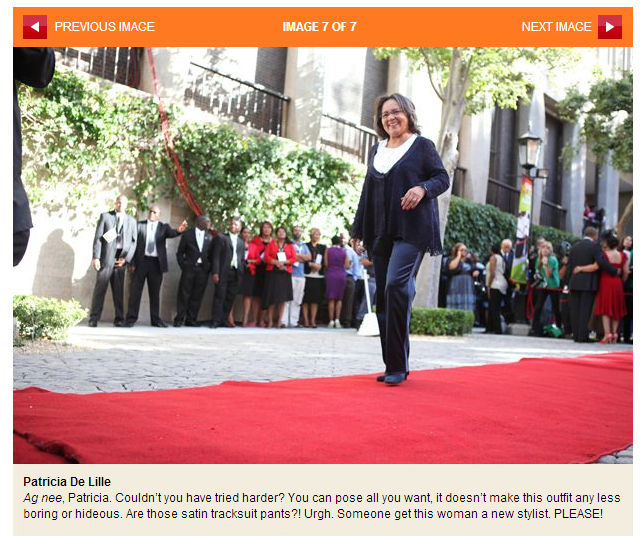
De Lille at SONA2013, image via 6K

For those who can’t see the caption, the text under this photograph of Patricia de Lille reads: “Ag nee, Patricia. Couldn’t you have tried harder? You can pose all you want, it doesn’t make this outfit any less boring or hideous. Are those satin tracksuit pants?! Urgh. Someone get this woman a new stylist. PLEASE!”

Highlighting this and a few other examples, 6K says:

But before women24.com go out of their way to tell us what we should or shouldn’t be saying about the fashion on the red carpet at SONA or anywhere else, maybe they need to get their own house in order.

So, is the accusation of “mixed messages” justified, and fair? I don’t think it’s fair, and I think that the justification available is weak – so weak, in fact, that the point didn’t merit making. But, I also think that Women24 – and specifically their editor, Lili Radloff – are avoiding a real issue in the way they chose to respond to 6K.

(An aside: the fact that there is arguably fault on both sides has nothing to do with the relative severity of the faults in question. I’m making no suggestion of equivalence, and as you’ll hopefully see, I think 6K was undoubtedly in the wrong – on aggregate – in this case.)

I don’t think the criticism of Women24 was fair because the image of de Lille (and the other examples used) were from the same event last year, while Joubert’s comment regarding shaming women for their outfits was made this week. Not only do times change and editorial policies change, but 6K and Radloff are also Twitter ‘friends’, so he could easily have sought comment or clarity from her on whether she sees a mixed message or contradiction, before making that accusation in public.

Doing so would be required of a journalist, and I can hear 6K (he’s a friend, in case that matters to anyone) telling me off, in that he’s “just a blogger”. I don’t think that matters – new media and old have blurred these distinctions, and when a flare-up like this ends up being discussed on radio (as this one was), we can be sure that there’s a chance for reputational harm – which incurs some responsibility, even if not the high levels of it we’d demand of a ‘real journalist’.

So, I’m claiming that 6K didn’t do sufficient homework before posting what he did. For those of you who don’t read his blog, he’s not averse to being controversial, and I think that impulse got in the way of common sense in this instance.

The reason his critique was only weakly (and insufficiently) justified is that a year isn’t that long a time, and that – to the best of my knowledge – the editorship have not made this policy change clear. In fact, Radloff’s early Tweets in response to 6K (“we might have botched it a bit this time“, or “I hear what you’re saying“) – posted before Radloff realised the images were from last year – make no mention of a policy change, which would seem to have been the strongest available response. Instead, we saw what amounted to an apologetic response at first, before 6K’s use of old images became apparent.

But make no mistake about it – in an environment where everyday sexism occurs, well, every day, Radloff and Women24 – a large, feminist-driven website – are obviously going to be aggrieved by being told that they are inconsistent, and unfortunately (but also, in reality) the sex of the critic will always come in to play in situations like these.

Arguments should stand or fall on their own merits, but given the lunacy of identity politics, they don’t. 6K could – and should – have anticipated that his post was going to read as an attack on the politics of Women24, which in turn could – and should – have made him ultra-attentive to getting his facts right.

In closing, where Women24 are erring is arguably in thinking that the market is able to separate individual voices from the overall brand, as Radloff asserted on Twitter (again, in an early defence before it became clear that 6K had used last year’s images). “Different opinions”, she said, are not the same as “mixed messages”, which was the phrase 6K used in his post title.

I don’t agree with that. A readership would perceive it as mixed messaging if a website set up (at least in part) to serve a cause spoke of the wrongness of mocking attire with one voice, and then did that mocking with another. The early rebuttals to 6K, which included the “different opinions” claim, didn’t strike me as indicative of having thought through this aspect of brand identity sufficiently.

But these are matters for another day, as is the unfortunate presence of pseudoscience on the pages of Women24 (both astrology and multivitamins feature strongly).

When we get around to engaging each other – on these and other issues – let’s try not to assume the worst, though. It’s getting more and more difficult to talk about issues without presumptions of guilt or virtue, and we all play a part in creating – but if we care to be more careful, undermining – a culture in which blaming, judging, and shouting are valued more than understanding is.

Gender-based violence and apophenia

Earlier today, my friend @kelltrill said

https://twitter.com/kelltrill/status/434275566293090304

and this led to a little bit of to-and-fro between her and some others who seemed to think it somehow obvious that if Oscar Pistorius had intentionally killed Reeva Steenkamp, it would have to be classified as gender-based violence. Now, that might be typical usage of the phrase gender-based violence. But if it is, I’d like to suggest to you that it’s wrong, and lazy, to speak of cases like this (i.e. a man killing a woman) as axiomatically gender-based.

Steenkamp & PistoriusNone of what I say here is intended to minimise or trivialise the fact that women are overwhelmingly more likely to be the victims of domestic assault by their partners than men are. There are hundreds of things I could link you to, but the evidence is so overwhelming that there’s no need – you can easily find something yourself. (And in case any MRA’s happen to wander past here, no, I’m not saying that men aren’t sometimes victims of various forms of discrimination themselves.)

Furthermore, I’m quite happy to regard this case as at least in part an instance of gender-based violence (on the assumption, for the sake of argument, that Pistorius intended to shoot Steenkamp). I’m happy to do so because Pistorius fits a classic alpha-male stereotype – proud, strong, with a history of short-temperedness and violence. The stereotype might not fit or be fair, but I’m disclosing it to wall it off, in that this case in particular is not my focus – I want to instead address the use of that generalisation (gender-based violence), with the case as a springboard for doing so.

The mere fact that a victim is female (or whatever) does not mean that the violence can be described as whatever-based. If Pistorius knew that he was shooting Steenkamp, then – obviously – the most fitting label for this action is Steenkamp-based violence, where Steenkamp is also a woman.

Even if it’s true (as it is) that more men abuse and kill their female partners than vice-versa, Pistorius can’t be known to have been more likely to shoot Steenkamp than he would be to shoot anyone else who he was ill-disposed to, or where he could benefit from doing so.

If a person had a history of violence against a certain sex, race, nationality or whatever, the generalisation has more merit – but before establishing whether those facts hold, we shouldn’t jump from a) the existence of a general culture of violence against X to b) the conclusion that a particular instance of violence against X fits that pattern.

I’ve argued something similar in a post about “Satanic” killings, where while it’s easy to generalise, doing so can obscure important details about motivation and how we should respond (for example, that psychiatrists might be more useful commentators than ghostbusters like Kobus Jonker).

The same danger of over-generalising in a confounding sort of way could occur with a murder or assault that is perpetrated across races – in South Africa, entrenched distrust between races could (more in some parts of the country than others) explain the motivations behind a murder, but they can’t be assumed to do so.

Take Eugene Terre’Blanche as an example: yes, he was a white supremacist, but the farmworkers who murdered him might have done so because he was also an abusive employer, or a rapist (as the murderers alleged). So while you could call that an instance of race-based violence, doing so would (or, could) distract from more pertinent details.

In short, what I’m arguing is that we should be careful of affixing convenient labels to events or people, even if they are often true. Harriet Hall has a review of an interesting-looking new book on critical thinking on Science-based Medicine, where I was introduced to a useful idea I hadn’t encountered before. It’s called apophenia, and

It means the spontaneous perception of connections and meaningfulness of unrelated phenomena, the tendency to find personal information in noise, seeing patterns where there are none, the kind of subjective validation that cold reading exploits.

To recap: I don’t dispute that gender-based violence is a real thing, and a real problem. But to call every instance of violence across genders (usually male on female) an example of gender-based violence is hyperbolic, in that it might be a judgement that claims more than what the evidence tells us.

This, in turn, could be problematic, not only because it’s a simple instance of laziness in not making fine discriminations regarding what data can tell us, but also because the more things you fit into a category, the more diluted that category might become.

It’s precisely because gender-based violence is such a real thing, and is such a problem, that we might want to be more cautious about affixing that label to cases that it might not fit.