The ANC’s election strategy: Blackmail

As submitted to The Daily Maverick.

One way of thinking about the upcoming local government elections is as a session of couples’ therapy. While some disaffected voters are frequenting their local singles bar, either genuinely unattached or maybe ‘just looking’, and others are actively fleeing a situation they quickly realised they simply couldn’t cope with, many voters are still trying to make their current relationship work.

The ANC might hope that the (roughly) 66% of votes it attracted in the municipal elections of 2006 came from South Africans who remain committed to that particular relationship. But from the outside, where I find myself, it is sometimes difficult to understand why that might be the case, as the relationship seems increasingly one-sided, and sometimes even abusive.

This is not to say that it can’t be fixed, if both parties put the effort in. And perhaps the relationship is simply undergoing a short-term wobble – a 17-year itch of sorts. But when one party in a relationship – the voter – is treated with the sort of contempt occasionally displayed by people representing the ANC, it seems entirely appropriate to question whether both remain equally committed to making the relationship work.

In February, President Zuma told us that when “you vote for the ANC, you are also choosing to go to heaven. When you don’t vote for the ANC you should know that you are choosing that man who carries a fork … who cooks people”. As Sipho Hlongwane correctly pointed out, statements like these seem little more than diversionary tactics, intended to distract attention from dysfunctional local municipalities, corruption and the like. As per those oft-misunderstood and abused lines from Marx, religion is here meant to serve as the resigned ‘sigh of the oppressed creature’, and an opiate for the masses.

Beyond the cynicism of exploiting the religious beliefs of your citizens to retain votes, Zuma’s statement was also a lie. Not only a lie from within the belief system he was appealing to (for where in the Christian Bible does one find God’s endorsement of the ANC?), but also a lie from outside of those beliefs, in that it is telling voters that factors besides government performance should determine which boxes you cross on May 18.

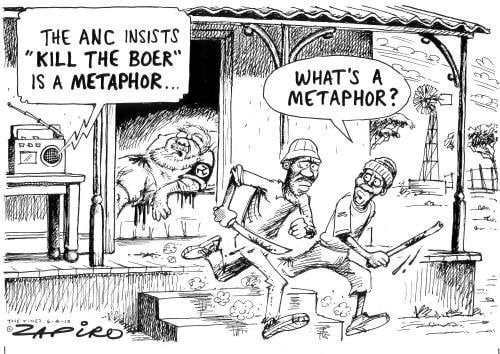
Jackson Mthembu responded to the criticism resulting from Zuma’s statement by telling us that it was neither blasphemous, nor to be taken seriously. “South Africans – both black and white – fully understand the use of figurative expressions”, Mthembu said, after which he pointed out that those perturbed by this statement “are probably driven by jealousy for not having thought of the expression themselves”.

© 2010 Zapiro (All rights reserved)
Printed with permission from www.zapiro.com
For more Zapiro cartoons visit www.zapiro.com

These are probably also lies. With approximately 73% of South Africans self-identifying as Christians, and in a country where many outside of the middle and upper classes still take sangomas seriously, the claim that we all fully understand the distinction between literal and figurative speech is difficult to read as anything but an attempt at damage-limitation, where an apology and a retraction would have been more appropriate.

It’s also worth pointing out that the majority of eligible voters in the upcoming elections still came through a system where educational resources were unequally deployed, and – regardless of how well or how poorly you think we’re being educated today – would probably not have been taught that references to eternal damnation by Presidents should not be taken seriously.

Mthembu’s jealousy statement is also likely to either be dishonest (or simply naïve), in that we can well imagine other political parties as being capable of imagining ways to threaten voters into supporting them. The difference, of course, is that they would usually choose to spend their time more productively, or failing that, to not deploy those threats at all. The ACDP is of course the exception here, given that they seem to think that God wants to micro-manage all aspects of our lives.

Tony Ehrenreich, the likely mayoral candidate for the ANC in Cape Town, also exploited voters with a similar lie on March 6, when he told a community meeting that they needed to choose whether they wanted to be “on the side of justice” (by voting ANC), or “on the side of the devil”, which is what a vote for the DA (specifically Helen Zille) would apparently amount to. Zille must therefore be a satanic monkey, if you put Ehrenreich’s statement alongside one of Malema’s recent outbursts, in which he asserted that Zille would not be out of place in a simian dancing troupe.

But just in case not all voters are Christians, and therefore aren’t fearful of Satan or his monkey-minions, Malema recently upped the ante by telling us that not only would a vote for anyone other than the ANC send you to hell, it would also contribute to the death of a flesh-and-blood icon, Nelson Mandela. You would, in effect, be committing murder – perhaps even something like patricide – by voting for the for an opposition party.

Last week, Malema told the crowd at a Port Elizabeth rally that “President Mandela is sick and you don’t want to contribute to a worsening condition of Mandela by not voting ANC. President Mandela will never endure if the ANC is out of power”. Just as with Zuma and Ehrenreich’s statements (and, probably, similar ones made at smaller and unreported gatherings), no apologies or retractions are forthcoming, even though these statements amount to treating voters with utter contempt.

Contempt, because they don’t treat voters as capable of making choices based on genuine political issues, such as service delivery or which up-and-coming dictators we plan to supply weapons to next. Instead, voters are simply treated as a means to the end of retaining power – which is why this relationship is dysfunctional.

If you find yourself in a relationship where persuasion occurs through emotional blackmail rather than appeal to evidence or mutual interest, then the chances are good that the relationship is an abusive one. Emotional blackmail uses fear or guilt to create the impression that you have no choice but to go along with the abusers’ wishes – yet elections are meant to be all about choice, not about threats and intimidation.

At a certain point in such a relationship, friends and family would no doubt counsel you to cut your losses, and end things before more harm is done. We’re often reluctant to do so – not only because of genuine commitment or affection, but also because of cognitive biases involving escalation of commitment (in extremis, as typified in Stockholm syndrome). So instead, we might try to make it work, and give the abuser one more chance.

And this is of course our choice, and our right. We should however remember to try and not be distracted by threats and accusations. Perhaps, we should also remember how it works in other relationships, where claims of contrition and a desire to change require evidence – or at least an acknowledgement of wrongdoing.

Postscript: On the day this column was published, ANC secretary-general Gwede Mantashe announced that they would not be announcing the names of mayoral candidates until after the election (except in Cape Town, where Cosatu has forced their hand. It’s a question of trust, I guess they might say. Others might say it’s evidence of confusion and disorganisation, and disregard for the interests of voters.

Stephen Watson, RIP.

Stephen Watson died yesterday morning, after a short battle with a very determined cancer. Tributes from some who knew and/or studied under him are being posted on the BookSA site, and more will be forthcoming as the news spreads, and as people realise what a loss this is – most obviously to his wife Tanya and their two children, but also to all of us who are interested in or part of the SA literary scene. In the mid-to-late 90’s, I completed my MA in Creative Writing, with Stephen acting as my supervisor. While he was never the best supervisor when it came to practical details like arranging meetings or signing forms, he more than made up for that in the quality of his insight, and his clear devotion to helping his students wring the best lines out of the loose thoughts and fragments they brought to him.

It was not only in his dedication to his students’ writing that his commitment proved invaluable, but also in the texts, and the ideas, that he exposed all of us to. He introduced me to Czeslaw Milosz, and to Bertold Brecht, and countless other writers who helped inform what I was trying to think, and say. Our shared appreciation of Leonard Cohen, and his attempts to find the numinous in the mundane, led to many a conversation which left a lasting impression on how I went about trying to find the lines I needed, or wanted, at the time.

He has left us with many books of poetry and essays, all of which have something to offer to most – and usually, quite a lot to offer to all willing to spend some time reading and thinking about the intersections between time, place and the person struggling to locate herself within the noise. For stripping down, and getting through, the noise was one of his most obvious talents – and one we could all benefit from spending some time trying to emulate.

One book that hasn’t been mentioned in the tributes I’ve seen to date is his 1997 book, a writer’s diary. Opening it now, I see that my bookmark is probably still where I left it 10 or so years ago, when I last re-read it, on a paragraph that sticks in the memory. Part of his entry for 16 March, 1996 reads:

The writer belongs to the world; but only by belonging to himself first of all. (In some cases, doubtless, last of all as well.) And this is, in good part, his ethical problem as a human being, as well as a writer.

Judging by the few times I’ve been in his company along with Tanya and the children, I don’t doubt that he resolved this ethical problem, as he seemed to belong to them, and them to him, in a way which made it clear that he’d found a place of peace, but also of inspiration, and of happiness. All sympathies to them, for what they have lost, and to all others who will miss him.

While I haven’t written any poetry for as long as I can remember, looking over those files now, I can remember how valuable his input was – and wish that I could show you a before-and-after version of the same poem in order to demonstrate my debt. While I can’t do that, there is one that I know was strongly influenced by his patient guidance, and it’s pasted below. Thank you, Stephen.

Nailed to our dreaming

Again we watch the sun climb
the tree to your window, and then again
we sleep, nailed to our dreaming
of something other than neglect,
the comfort of paralysis.

Again we shed our city skin,
and travel these parched roads
in search of a fragment of promise,
the quieting of fear. We know
that there is always more to say –

Other ways to define our solitude,
diverse shapes for our desires.
But the words are unkind, are lost
in your gaze, in my imagining
of a love that is liberty.

And though this may be filled
with the end of summer’s song,
over here is a smile.
Over there is my hate and moonlight,
my rainbow with sleep;
wishes from days slipped quietly past,

when I felt my lives begin to unravel,
but then gentled them all back;
for too many years have been lost
on these narrow streets,
edged by dirty snowbanks twice-melted,
of our wishing a poorer future than our past.

They say that all we can rely on
are those things we despise,
and that may be why
I have been frozen here so long,
a mute witness to my body.
Yet we somehow speak, finding new tongues,

until you wake me at dawn,
talk of the roads we must navigate
to find our way home. Still mute,
I wonder if you recognise me only now,
or if you even knew whose hand
you held in your sleep.

Floyd Shivambu and ‘hate speech’ against Carien du Plessis

As published in Daily Maverick

The Equality Court has postponed the hate speech case against African National Congress Youth League spokesperson Floyd Shivambu. They should not however be hearing this case at all – regardless of the fact that Shivambu appears to be a sexist and a racist, and that his speech might be hurtful towards Carien du Plessis or other journalists he has targeted in the past.

Why we should reject the Bill of Responsibilities

As submitted to The Daily Maverick

If you’ve been wondering how schools will fill the space left vacant by the dropping of grammar from the curriculum, wonder no more. Instead of grammar, it seems they’ll now be teaching students how to be nice people. On Wednesday and Friday last week, the Department of Education, in association with LeadSA and the National Religious Leaders’ Forum (NRLF), launched “A Bill of Responsibilities for the Youth of South Africa” which aims to do just that.

LeadSA responds (sort of) to Bill of Responsibilities criticism

Since the launch of the Bill of Responsibilities last week, debate on its merits and demerits has continued – mostly on Twitter, but also via two columns worth reading in the Daily Maverick (by Khadija Patel and Ivo Vegter). I’ve also written a follow-up to my previous post, which you can read in the Daily Maverick tomorrow (or here, a day or two later).

But some of you might not follow me or the other participants on Twitter, so might have missed this response from Yusuf Abramjee, published today in the Pretoria News. Mr Abramjee is the Head of News and Current Affairs at Primedia, Chairperson of the National Press Club, and a spokesperson for LeadSA. And he’s also apparently eager to embody the sentiments of the Bill of Responsibilities through allowing general hand-waving in the general direction of serious issues to replace critical and useful engagement.

And he’s not the only one. In a brief interview with John Maytham on CapeTalk567 last week, some of the questions directed at me also implied that there’s something wrong with criticising this Bill, which after all aims at something most consider good – moral regeneration and so forth. But there’s no reason to buy into this false dichotomy – I can be committed to moral regeneration, but think that it isn’t best served by a prescriptive, nanny-ish and illiberal document, which is what this Bill amounts to (see Ivo’s column, linked above).

Then, there are some on Twitter who also accuse the Bill’s critics of over-reacting. You can decide for yourself if that’s the case, but none of these critics are engaging with any of the arguments – they are simply asserting that we’re wrong, or at worst, not committed to a country in which people are aware that they have an impact on the lives of others, and on the country’s direction, and who therefore might want to think about rights and responsibilities in a non-superficial way. As Sipho Hlongwane pointed out, “there’s a whiff of ‘I was a prefect at school'” to their criticisms – and we’re all just being disobedient children.

As is the case with Yusuf Abramjee’s response (Facebook link), pasted below (without the stuff about our obligation to support SA cricket, and to switch our lights off for an hour every year):

Last week, Lead SA launched the Bill of Responsibilities for the Youth. We have a Bill of Rights in our Constitution. But with rights come responsibilities. This document is also aimed at moral regeneration.

The majority of people were positive about it. But some immediately started criticizing the Bill of Responsibilities and – without studying the contents properly -found fault with it.

We have to promote good morals and ethics. We have to address the many social ills, especially among our youth. But, the constant negativity from some quarters is worrying and it can become destructive.

Let’s not forget that with freedom of speech and expression comes responsibility. We must not open our mouths simply for the sake of it.

We have many problems in our country and if the culture of just finding fault and becoming armchair critics is going to continue, it is not going to hold our country in good stead.

We all have to work together and find solutions. We all have to roll up our sleeves. We all have to make a difference. It’s about you. It’s about our future and our country.

What a wonderful democracy we have. We are quick to point fingers but we are sometimes slow to find solutions. All South Africans need to take the negativity and turn into something positive. With every problem comes a solution.

Let’s not become a nation which embraces gloom and doom. As citizens we have rights, but that means responsibility, too.

Notice that the criticisms are simply a result of our “not reading the Bill properly”. Will we have read it properly only once we agree with it, I wonder? All the critical treatments of the Bill that I have read ask specific questions about it, and criticise clauses of it that demonstrate quite a thorough reading. It’s not a long document, after all, and seeing as it’s aimed at kids, it would be quite odd for it to present a comprehension challenge to the various smart people I read and follow on Twitter. Unless we’re all just thick, I suppose.

And besides ignoring any arguments and accusing us of not paying attention (where we actually engage with substance, rather than simply dismissing the opposing view), Abramjee also plays the negativity card in saying that the “constant negativity from some quarters is worrying and it can become destructive”. This linking of criticism with pessimism is an illegitimate way of privileging optimism – it makes critical enquiry morally coloured, and suggests that those who criticise are being unfair, or perhaps even unpatriotic.

And of course there can be criticism which is uncharitable, unfair, or motivated by an agenda other than reasoning our way to the most justified position. But if that’s the case, it needs to be demonstrated, not simply asserted. Critical enquiry – criticism – is our best resource for sorting sense from nonsense, and to discourage it is certainly not leading SA in any direction we should wish for it to go. As I’ve said before (and will expand on in tomorrow’s column), a key part of the freedoms that were secured in this country is the right to not accept someone else’s vision of life, or truth, as being compulsory for all of us. We have the right to think for ourselves, even though a consequence of that can sometimes be that we get things horribly wrong.

Finally, in a shameless finger-wagging moralising moment, Mr Abramjee tells us that “We have many problems in our country and if the culture of just finding fault and becoming armchair critics is going to continue, it is not going to hold our country in good stead”. Well, I’m not sure who he’s addressing here, but the majority of the people I’ve been engaging with on this issue get out of their armchairs all the time. They are teachers, critics, politicians, columnists and so forth, who spend the bulk of their lives engaging in various efforts to stimulate debate and thinking on the problems facing South Africa and the world in general.

Again, whether they do so well or not is not the issue. Whether they do it in the way Yusuf Abramjee or LeadSA would prefer or not is not the issue. But LeadSA and Yusuf Abramjee don’t get to decide that, and this is the point of the criticism. And we’d happily be proved wrong (speaking for myself, but a plausible assumption for the others). But proving us wrong would require engaging with the arguments – and that’s not something we’re seeing much of from some parties to this debate.

So what if prejudice is ‘natural’?

As published in Daily Maverick

Only a very brave or a very foolish person would be prepared to claim that they had no prejudices. I’m not talking about the conscious decisions we make to discriminate, for these are often justified, but the relatively thoughtless, perhaps instinctive, preference for one sort of thing over another, whether that thing be a type of animal, a football team or a variety of insect.

The Bill of Responsibilities for the youth of South Africa

If you tune in to Cape Talk or Radio702 right now, you can listen to the launch of the “Bill of Responsibilities for the youth of South Africa“, and hear the Minister of Basic Education and representatives from LeadSA explain why they think this is a great initiative.

They would think so, of course, seeing as the Bill is the creation of the Department of Education and LeadSA. It’s also sanctified by the National Religious Leaders Forum. But they are all wrong, and this is a counter-productive move.

The limits of our language

As submitted to The Daily Maverick

Curricular revisions in the area of religious instruction in South African schools have been the subject of a previous column, in which I argued that political expediency could compromise Constitutional freedoms, as well as handicap the development of a citizenry which is capable of significant intellectual engagement with policy. A related trend, with the same negative consequences, can also be observed in our universities. More recently, the teaching of the most basic foundation of language – grammar – is being threatened. And so, another potential blow is landed against clarity of thought and expression.

Someone’s serious business, my frivolity

While the bulk of material on Synapses is rather serious in nature, I must confess that I sometimes engage in trivial pursuits. Like laughing at the way in which people sometimes take themselves far too seriously, and flying to London for 4 days, simply to watch a FA Cup Quarter-Final match between Manchester United and Arsenal. Below, I offer a brief account of these two activities, in the hope that readers will sometimes be less critical of the more serious things I have to say, now that they have confirmation that I’m just like them (well, sort of).

So, as to how people can take themselves far too seriously: Yesterday, after having pledged to make dinner for myself and The Doctor, a trip to Gardens Centre was required in order to procure ingredients. Walking past the MTN store, I remembered that I had had difficulty with roaming while in London, and I therefore walked in to make enquiries. While chatting to the clerk, a woman came in, and started addressing the customer in line behind me (the only one). She asked him how long he’d been waiting, emphasising that she was short on time.

Not long, he said, but this was insufficiently reassuring. “I don’t have time to twiddle my thumbs”, she said. She then asserted that she would get on with other business, and that this customer should ensure that her place in the queue was preserved. In a somewhat bemused fashion, he offered an ambiguous mumble, and she departed. Upon returning, and finding herself next in line, she forcefully dropped her phone on the counter, and started loudly complaining that it was misbehaving.

The staff tinkered, at one point plugging it in to check that it was charged. Big mistake. “I charged it this morning! Do you think I’m stupid?”, she yelled. But the problem had something to do with turning off/on, and they were unable to diagnose the fault right there. So they offered to take it in for repairs. No – “it’s not worth repairing. It only cost me R100”, she said. “Well, is it under guarantee? We can take it in for repairs, and offer you a loan phone in the meanwhile”, the staff offered.

“No! You must replace it”. She pointed to the MTN branding on the phone, and said, waving her arms around to gesture at the store walls, “all of this here made this phone, and is responsible for it!”. They then dared to ask if she had bought it there. But she had not – she had bought it at the Waterfront CNA. Well then, ma’am, we can’t help you – you must take it there, and I imagine if you have your receipt, they will be able to help. “Who keeps receipts!”, she yelled. “And do you mean I have to traipse all the way to the Waterfront? I don’t have time for that!”. “We can’t help you, ma’am – you didn’t buy it here, and even if you did, we’d need your receipt to be able to help”.

So she storms out. About ten minutes later (I was having a long geeky conversation with a clerk), she appeared in the doorway and announced: “I have bought a phone from Vodacom!”. Then, she steps in, throws the phone on the floor, and starts stomping on it and crushing it with her heel, shrieking things like “this is what I think of MTN!”. She kicks pieces of phone in the direction of the helpdesk, and storms out again. But – she had forgotten something. Seconds later, she re-appears, throws the charger into the store, and yells “and you can hang yourselves on THIS!”.

We all had a good laugh, and one store clerk had some good fortune, as it appears the phone, once reassembled, was now in better working order.

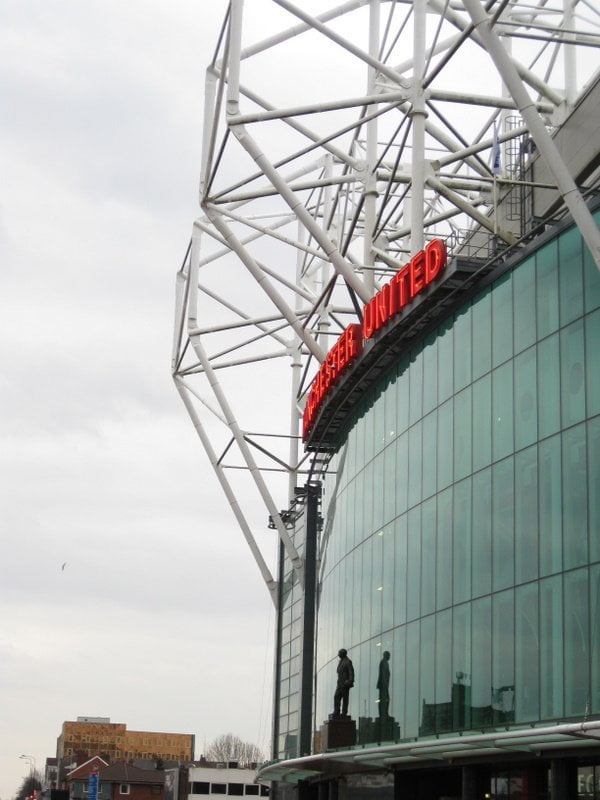
The other frivolity involved my friend, the occasional celebrity “After-dinner mint” (at least according to a P4 radio billboard that once bore his mugshot), calling me last Sunday to suggest the audacious plan of flying to London to watch football. So we did, because the game was at Old Trafford, home of the best football team (and the ugliest footballer). And seeing as he is an Arsenal fan, and they were “our” opposition, I could look forward to plenty of gloating at his expense once we secured our inevitable victory (2-0 to Manchester United was the eventual score. As the crowd kept reminding the MintMan, his team “is just a shit Barcelona”).

And London was fun. We went to pubs, ate at fat-lip Jamie’s Italian (and, with another friend, at Heston Blumenthal’s Hinds Head, where I enjoyed a 52-hour cooked pork belly). We hung with Simon Pegg at a bar in Covent Garden (no, not really, but he was there), and took lots of Tube rides and a train to Manchester. We learnt that orang-utans use tree bark for sexual pleasure (so the poster said – not empirically verified by us), and that strange fox-like creatures in London steal stuff from your car, if you’re not sufficiently watchful. We saw a famous (I imagine) mouldy wall outside our hotel room. It became known to us that the disabled have access to an “ability suite” at Old Trafford. And also, I discovered that Eton has a “Porny School”, which might be useful information to some of you.

Patrick Holford’s feel-good quackery

As submitted to The Daily Maverick.

At times it appears alarmingly easy to be considered an expert in any given field. This is sometimes the case even when objective criteria for expertise are available, and you manifestly fail to meet them. Granted, there are some fields of knowledge where consensus is difficult to reach, and where equally qualified people can have opposing viewpoints. But this is rare, and (thankfully) becoming steadily more rare.