Start saving for Norway

Not necessarily because you want to come here. It’s just that, if you do, you’d need to have started saving for it quite a while in advance. The pint of Heineken sitting alongside me, for example, cost around R80. The cheapest food at this pub is a margarita pizza for R170, and even your most basic Burger King combo meal will set you back around R110. Anyway – I’m here, and thus my complaints would most likely sound hollow. So just FYI, start saving.

Curiosities/Observations

  • The mad rush for duty-free as the sardines exited customs at the airport was a certain clue that you don’t want to buy booze or cigarettes in the city, unless you can help it. The queue there involved a far longer wait than customs itself, and the rationality of spending time in this queue was confirmed while browsing a wine shop. Not just a wine shop, mind you, but a “Wine Monopoly”. That is in fact its name. All wine and spirits are sold exclusively by the state, with prices partly determined by alcohol content, in a clear attempt to legislate morality. Which is of course fine if you’re a rich banker or lawyer, but not so good for the average geezer sunning himself in the park at 8pm. (These long summer nights are rather pleasant.)
  • Chatting to a local on the night I arrived, I was told something odd about schooling here. Basically, children are not evaluated in any substantive way before the age of 14 (or maybe 16 – he was plying me with drink). This is of course in service of their manic egalitarianism, which dictates that kids shouldn’t be made to feel special, or inferior, before adults believe they can deal with it. So instead of exams, tests and report cards, teachers can only offer nebulous advice such as “maybe you should take a look at that maths textbook sometime? I hear it has lots of cool pictures.” Or something – I haven’t spoken to a teacher to see how this plays out.
  • You need to be an active member of a church to become a gravedigger.
  • The most commonly-found food is the polser, which is a hot dog, and raisin buns (whose Scandiwegian name I cannot recall). The polser will set you back around R35, as will the buns, with 3 of them in a portion. But if it’s polser you’re after, rather go to Denmark, where they serve them with crispy fried onions and rémoulade. These Norwegian ones (at least the ones I’ve found), have neither, and are thus crap. Denmark wins, and I have no biases to disclose.
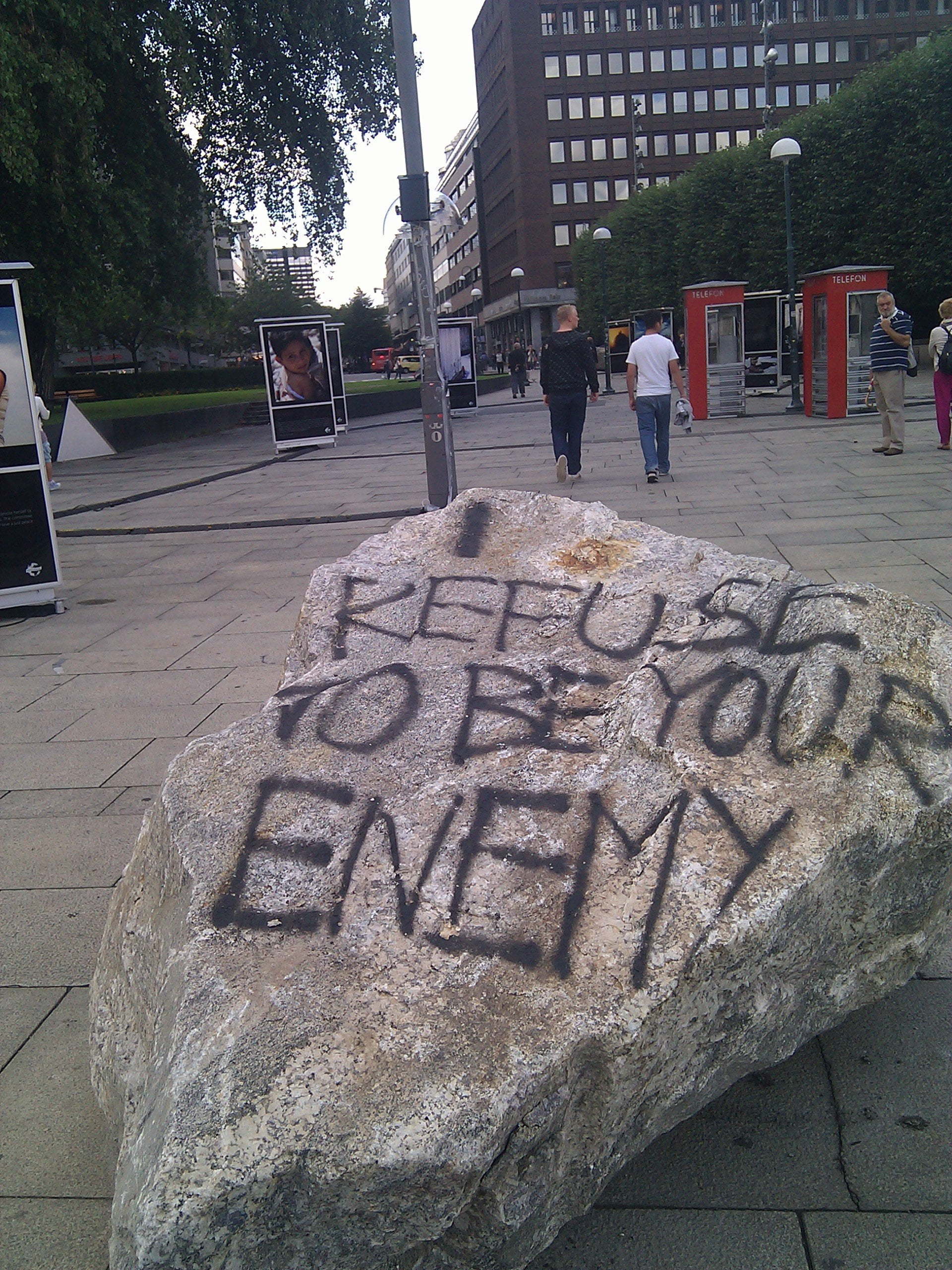
  • They are into peace, especially in the vicinity of the Nobel Center. I’m here for a humanist conference, and – recent events in Norway notwithstanding – it’s quite striking how the content and tone of dialogue with locals converges on trying to reconcile misunderstandings and resolve tensions. There is far less ego, or at least a different sort of ego. This congress of the International Humanist and Ethical Union is being hosted at a reception by the Crown Prince tomorrow night, and the Mayor is also making an appearance at the conference dinner on Saturday. There are flags advertising our conference in the streets. Basically, they take this stuff seriously.

And then, outside of observations on Norway, there’s an embarrassing and (hopefully) humorous anecdote, which involved the Irish. But before I get to that: South African readers, if you think you have a drinking problem, you probably don’t. Because you’re not Irish. The one Irish delegate (implicated in the story I’m getting to) told me about how she and her friends drank vodka all day at school at the age of 16, from their ‘water’ bottles. And this was a head girl, from a middle-upper class background.

Anyway, I was chatting to Annie and her partner Aaron about God, Roy Keane (is that tautologous?) and assorted matters. Aaron wandered off to scrounge for coins to buy another beer. And then, while talking to Annie, I’m pretty darn sure I saw her raise her hand to the side of her face, wiggle her fingers and say “I’m up here”. That sequence of gestures is difficult to interpret as something else, one would think, and also difficult to misinterpret – it usually means “stop objectifying me by staring at my cleavage, you sexist boor”. Except I wasn’t, and hadn’t been.

This freaked me out. If you’ve watched Curb your Enthusiasm (the new series is great, by the way), you might have a sense of how utterly strange, and socially awkward, the next half-hour or so was. Because Aaron had returned, and it was another half-hour before he left, and I finally had the opportunity to resolve whether I was going to live with this misunderstanding, or “put it out there”.

I chose the latter path, and asked her whether she had wiggled her fingers, saying “I’m up here”. She looked at me as if I was alien, insane or both. I repeated the question, mimicking the gesture. Now she seemed convinced I was insane, which I might have exacerbated by saying “look, I realise I probably sound creepy now, but this is quite awkward and needs clarifying”. But she had no idea what I was talking about. And now there was this enormous elephant in the room, and I felt compelled to explain, again, what I thought I had seen – and of course what I perceived it to mean (the thing I may or may not have seen).

But bless the Irish – her quite straightforward response was “Ah, no. If you’d been doing that, I would just have slapped you or stormed off.” So then we got on with talking about Roy Keane, potatoes and so forth, with the discomfort slowly dissipating.

And now it’s Thursday, and the first phase of the visit (leadership training for secular humanist groups, at the IHEU) is over, with the conference proper starting tomorrow. I’ll be sending occasional updates on proceedings through the FSI Twitter account, and the usual motley collection of links and provocations via my account. Be careful out there.
Sam Harris, ‘new atheism’ and alleged Islamophobia

As submitted to The Daily Maverick

André Gide remarked that “everything that needs to be said has already been said. But since no one was listening, everything must be said again”. So it is with the recent article by Mandy de Waal, who took Sam Harris (and the ‘new atheists’ in general) to task for ‘hate speech’, ‘bigotry’ and encouraging so-called Islamophobia. It’s difficult to know just where to begin in responding, as I find the content of de Waal’s piece disagreeable in almost every aspect.

John Edward is coming to eat your brain

As submitted to The Daily Maverick

Somewhere out there, a reader named Sally has just suffered a terrible loss. Or maybe it’s Samantha, or Sarah – anyway, something that has an “s” sound in it. Her husband – actually, perhaps only a family member, or … well, someone close to her has recently passed. His name was John, or maybe Joseph? It’s something starting with “J”, anyhow, although that might be his nickname.

Breivik, terror and Islamophobia

Of course it is unfortunate, and prejudiced, for many commentators to have assumed that Breivik was a Muslim – and for those who assumed this, the bias is clear in how they concocted quite torturous narratives to explain why a Muslim would target kids at a Labour Party camp. It made little sense that he would (from those motives), yet the perceived equivalence between terrorism and Islam were too strong for some to resist.

And now that we know he was not a Muslim, but that he was instead perhaps a Christian, probably a Mason, and certainly an ethnic nationalist, much outrage has resulted from the selective use of words like “terrorist”, or “fundamentalist” – once he was revealed to not be Muslim, some columns and Tweets stopped referring to Breivik as a terrorist. This again exposes a bias, whereby something that is the subject of extreme fear and emotive reaction is illegitimately associated with a particular religion.

But this is the problem with stereotypes – they are blunt instruments, which even when grounded in something true, can be so broad as to capture many cases that are not true. And this one is founded in something true, despite how impolitic it might be to say so. The fact that Breivik might be a “Christian fundamentalist” cannot obscure the fact that much of what we describe as “terror” in the recent past has come from those that we caricature as “Islamic fundamentalists”.

The fact that some Muslims will say that Muslim terrorists are “not real Muslims”, and that Christians will say that Breivik is not a “real Christian” is irrelevant. People who commit acts of terror get their mandate from something or other – and if a belief system can be interpreted to provide that mandate, this is a reality (and a problem) that that religion has to deal with. And as Sam Harris pointed out, it is an unfortunate fact that as far as religious belief systems go, Islam is correlated with a disproportionately large amount of oppression and intolerance of competing world-views, including secular world views such as those that promote gender equality.

The violence in Oslo is no excuse for Islamophobia. But we don’t need (another) one – as with all religions, Islam teaches you that propositions with no (or poor) evidence can be regarded as fact. Religions allow you to engage in metaphysical Ponzi schemes, whereby debts can be paid later down the line – rather than you being accountable right now, for what you do in this life. Again, it doesn’t matter that this might be a poor reading of whatever scripture, from whatever tradition, you want to thrust in my face – these traditions are open to such interpretations in ways that others are not, and they have to take responsibility for that.

Breivik’s problem – or our problem, that is presented by people like Breivik – is that he is perhaps insane, and that he believes nonsense so strongly that he is prepared to kill for it. Any of us – and any religions – that encourage belief in nonsense is at least partly culpable. If a particular religion has a larger component of such nonsense than another – such as routinely allowing rights violations and perpetuating gender inequality – it is proportionally more culpable.

This remains true, no matter how many Muslims, or Christians, are appalled by the actions taken in the name of their chosen fictions.

Racial nationalism and white guilt

Originally published in the Daily Maverick.

Samantha Vice argues (pdf) that whites should feel guilt over apartheid, and also that “blacks must be left to remake the country in their own way”, while whites should live as “quietly and decently as possible”, refraining from offering our views on the racial fractures in the South African experience. Her arguments merit a fuller discussion than I’ll offer here, but those readers who are sympathetic to my views on racism and identity politics will most likely agree that some intuitive opposition to these conclusions can be expected.

First, because framing a complicated situation in terms of clumsy (and in my view, uninformative nearly to the point of meaninglessness) categories such as “white” and “black” encourages an association between people who have nothing in common besides the arbitrary concentration of melanin in their skin. And second, because even if Vice is right that white people should feel guilt, how will anyone know that we feel this guilt, and how can we move past this guilt, unless we express it – thereby violating her preference for us to be silent?

Guilt, shame and regret are certainly part of a spectrum of appropriate responses to having done wrong, and it’s undeniable that a political and economic ruling class – exclusively white – treated black South Africans as a resource to be exploited, rather than as fellow human beings. But even during the worst days of apartheid, some people who were white in appearance were not white in beliefs or behaviour, and I can see little reason to insist that a person like Joe Slovo, for example, should be (or have been) required to feel guilty about his whiteness.

He could feel regret at being associated with other whites, of course. And more to the point, he could feel regret at the ease with which we fall into these binary oppositions of white shame and black anger, whereby the reality of individuals living in a system of economic asymmetry – with class divisions defined by race – is obscured via treating the proxy for class (here, race) as being the route to resolving inequality.

People are angry because they are poor and marginalised. They are not angry because they are black. And those who should feel shame are those who contribute to that inequality and oppression. Many of those people – most of those people – were white, but that’s no longer obviously the case, in that people like Julius Malema are currently doing a fine job of opportunistically exploiting the poor for personal gain.

This is not to say that an awareness of privilege is unimportant. But an awareness of the benefits one might have had (and perhaps in some sectors, continues to have) as a white person, or a male, does not have to invoke shame. What it can do is to inform your outlook and judgements, in that you can be more or less aware of how your assumptions are coloured by that privilege. Someone who is unaware of these biases could, for example, think that it’s (somehow) blackness that causes crime or lower pass-rates at school, rather than poverty or a legacy of unequal education.

Racial nationalism is not a route to eliminating racism. It perpetuates the notion that we are defined by arbitrary characteristics, and imprisons us in worldviews that prop up that notion. And of course, a rise in black nationalism will correlate with a rise in white nationalism, as evidenced by the lionisation of General de la Rey, the prominence of Afriforum, and last week, the assault on Professor Anton van Niekerk in his office at Stellenbosch University.

Prof. van Niekerk wrote an op-ed (in Afrikaans) discussing the musical “Tree Aan!”, which revolves around the lives of soldiers in the South African Border War of 1966 to 1989. His concern related to the Afrikaner nationalism expressed by the musical, and in particular, the way in which the Border War itself is being re-cast as a heroic battle against a communist onslaught rather than a battle to perpetuate white supremacy.

Abel Malan, a member of the Volksraad Selection Committee (VVK), an organisation that hopes to establish an Afrikaner homeland, arranged a meeting with van Niekerk on Tuesday morning. The meeting was ostensibly to discuss the article, but what ensued seems to have been less of a discussion, and more a violent reminder to van Niekerk of the consequences of betraying “his people”. Van Niekerk ended up with several bruises to his face, broken spectacles, and a fair amount of unsolicited interior decorating in his office.

The VVK and other sympathetic groups interpret the events differently. A spokesperson for the Verkenner (Pathfinder) movement claims that Malan was provoked by van Niekerk’s “patronising and insulting words about the Afrikaner”, and the VVK’s Ben Geldenhuys also suspects that van Niekerk “started yelling” at Malan, described as a “reasonable man”. But seeing as Malan apparently told SAPS officers that he “did the job” and an unnamed VVK member apparently said that “Stellenbosch doesn’t have enough security to protect Anton van Niekerk”, it doesn’t seem implausible that Malan was somewhat eager to consider himself provoked.

In one of the more peculiar responses, the website Praag tells us that the “fistfight … can be directly attributed to the division and intolerance which the Naspers monopoly has sown among Afrikaners”. It seems more likely that the assault is the result of Malan and his sympathisers being unwilling to live in a world in which – at least by their lights – their interests and culture are under threat. But this assault exposes the problem with racial nationalism and the politics of identity in general, in that it inclines toward intolerance and extremism.

As any of us who were around during all or some of the decades when the Border War was fought can attest, there was certainly no shortage of hysterical rhetoric regarding the “rooi gevaar”, and the possibility of their being a Communist behind every bush. However, this can’t be allowed to obscure the fact that legislated apartheid began two decades before the war in question, and that the war was precipitated by South Africa’s refusal to withdraw from South-West Africa (Namibia) as well as their implementation of apartheid legislation in that country.

So regardless of the good intentions of some soldiers in this conflict, it cannot easily – or perhaps even plausibly – be characterised as a noble battle to defend democracy and constitutionality from a Communist threat. This is because South Africa was no democracy at the time, and because it was fighting to keep imposing something equally undemocratic on South-West Africa. The fact that Cuba and the Soviets were involved in opposition to South Africa’s goals doesn’t transform those goals into noble ones. This is the message that van Niekerk was trying to convey, and the message that resulted in his attack.

Reading some of the responses to this incident leaves one quite despondent regarding the willingness of some South Africans to even attempt admission of past wrongdoings, or to participate in building a non-racial democratic country. Van Niekerk is a “Lippy Liberal” who has “met his match”, and “hopefully many more will follow”. The Pathfinder movement is “proud of the valour shown by its leaders”. The implausibly named Jéan-Paul Jéan-Jacques Louis-Pierre (which does turn out to be a pseudonym for Mattheus Lötter) asks whether any steps are going to be taken against van Niekerk, seeing as his letter is an “attack on the history of white students”.

Well, sure, it’s is an attack on your history, but that’s only because it’s “your” history rather than simply “history”. And while the actual history can be told in various ways, any honest retelling will expose shameful details regarding the actions of all the nations and political bodies involved. These honest retellings and the conversations that might ensue cannot be silenced, for doing so leaves us unable to move beyond racial nationalism. If anything, it moves us closer to dividing the country into various categories of “us” and “them”, each of those categories no more principled than the last.

So I think white people like Malan certainly should feel shame. Not because of anything to do with their being white, but because they feel compelled to shut their ears to civilised disagreement, and because they are willing to do harm to others upon hearing competing narratives regarding South Africa’s history. It is of course unlikely that he or his sympathisers are capable of shame in this regard, at least for the moment, and there’s little that I – a lippy liberal, no doubt, with Afrikaans heritage to boot – can say to make this point to them.

Except perhaps to say that I understand their fear of black nationalism, but only because I fear racial nationalism in all its forms. We are in the end only – and all – mere people, afraid that our futures might not meet our expectations. But any attempt to secure a prosperous and healthy future that begins with forcing others into silence is likely to fail, and to make us see enemies where they might not exist. There’s no shortage of real enemies, after all – and we find out who they are by talking to each other.

Elevatorgate and the power of words

As published in The Daily Maverick

Comment facilities on blog posts and online newspapers can be enormously valuable to both readers and writers, in that they allow for prompt corrections and clarifications of points of view. As all readers will know, they can also conduce to venting of spleen or expressions of odious viewpoints, as I’ve discussed in a previous column. But what they also allow for is a detachment from the arguments of the piece in question, where the comment thread rapidly takes on a life of its own, completely divorced from the ideas the author intended to explore.

What is the point of feminism?

As submitted to The Daily Maverick

I used to consider myself a feminist. Then I read Andrea Dworkin, and realised that a concern for credibility made it prudent to not identify with any of the summary terms she did, at least insofar as this was possible (terms like ‘human’ being a somewhat insurmountable problem). And now that we’re in the seventh (I think) wave of feminism, it’s perhaps time to consider this the terminal wave, and to consign this particular version of identity politics to the dustbin of history.

On Grayling’s New College of the Humanities

As submitted to The Daily Maverick

AC Grayling, Oxford professor of philosophy – and the author of a recently-published “secular Bible”, The Good Book – has recently announced his intention of establishing the New College of the Humanities (NCH), an elite tertiary education institution. He’ll be joined in this endeavour by a number of intellectual luminaries, including Richard Dawkins, Niall Ferguson and Steven Pinker, many of whom will be shareholders in the College.

News of these plans broke while I was writing a previous column on the value of intellectuals and defending the idea of elitism at institutions of higher education, and in the two weeks subsequent to that, the opinion pages of most British newspapers have been littered with responses. Some of these have been favourable, but the majority of them create the impression that Grayling is determined to destroy the notion of education as a public good, and that he and his partners should be defeated at all costs.

Conveniently for many of the critics, Grayling and Dawkins are prominent atheists, so some of the criticism simply accuses them of wanting to institutionalise secularism and then stops there, thinking that some worthwhile point has been made. But outside of a religious university, a secular approach can mostly be assumed – exposing this particular criticism of the NCH as a straightforward attack on the characters of its founders.

More significantly, the matter of the fees charged and the structure of the college have been raised as issues. These are closely related issues, in that the NCH is not a university at all, but instead a provider of tutoring and lectures to assist students in succeeding with their registration for degrees via the University of London International Programmes.

These international programmes have over 50 000 students spread across 180 countries, and around 70% of these students pay independent teaching institutions for tuition towards attaining their University of London degrees. The NCH intends to be one of these independent institutions, and students attending classes at NCH will still pay approximately £1500 in fees to the University of London, as well as a smaller fee of £20 for associate membership of the UL libraries.

On top of this, they will pay £18 000 per year to NCH – double the £9000 cap imposed by government on public universities. And this is where the trouble really starts, in that critics allege that only the rich will be able to afford to attend NCH, and that Grayling and his compatriots are therefore entrenching class privilege.

But this isn’t a public institution. The NCH will receive no state funding, and will offer a service to those who want it, and who can afford it. If it is the UK government’s view that anyone should have access to the best possible education at the lowest possible price, then it is their task to provide that. Disparities in the quality of any good – including education – should not be remedied by simply excising the top end of the market, eliminating healthy competition.

Two other relevant considerations should be born in mind. First, that this is an attempt to introduce a US-style private institution to the UK, and that a fee-comparison with those sorts of institutions might be more relevant than the £9000 public university fee cap. At Harvard, an undergraduate degree costs you £21 500 in tuition fees per year, leaving the NCH looking far less of an outlier.

Second, Grayling intends to offer scholarships to 20% of students at launch, and hopes to increase this to 30% over the first few years of the NCH’s existence. It is his intention that financial means will be no bar to the best students being able to attend classes at the College, thanks to endowments that are currently being solicited. Given the networks that the academics in question have access to, there are some grounds for optimism that sufficient funding will be forthcoming. But even if the endowment scheme does not prove fruitful, the stated wrongfulness of this elite institution remains somewhat mystifying.

Better staff command higher salaries, and well-equipped universities cost more to run than less well-equipped ones. If every student and every curriculum looked exactly the same, we’d eventually see similar rates being charged across the board. But this homogeneity does not exist, and if the NCH offers a superior product, they should be able to charge a higher price.

The notion of tertiary education being a right rather than a privilege underpins these complaints. But that misguided notion does not support restraint of trade – or even charges of moral turpitude – in the case of the NCH. If it did, we should just as readily be complaining about the discrimination of charging R 10 000 a year more at one institution compared to another, in that some potential student will thereby be barred from studying where she wants to thanks to her available means.

At the forefront of the attack on the NCH we find Terry Eagleton, who speaks of the “nausea which wells to the throat at the thought of this disgustingly elitist outfit”. One of his concerns relates to how frequently students at the NCH will even come into contact with Pinker, Dawkins and the other notables, given their teaching, public speaking and other commitments. It’s unclear how their potentially irregular appearances in class differs from Eagleton’s own 3-week per year residency at the (private) University of Notre Dame (annual tuition fee? £ 25 400 p/a), but the extent to which the ‘names’ will and won’t be available is known to students in advance, and they can make an informed and free choice regarding whether they think they are getting their money’s worth or not.

Eagleton’s primary concern is the matter of what he calls “educational apartheid”. He says that if “a system of US-type private liberal arts colleges like this one gains ground in Britain, the result will be to relegate an already impoverished state university system to second-class status”, where we could expect poor students to go to (poor) state universities, while privilege is amplified through rich students being able to access elite institutions such as the NCH.

And yes, this could happen. But people will continue striving to become wealthy in order to afford the sorts of things that (more) money buys, and one of the ways that they do that is through inventing and selling things that rich people want. An elite education is one of those things rich people want, and if it’s being created and sold in a manner which involves no deceit or compulsion, they should be allowed to buy it.

Class divisions and poverty might well be with us forever. But to the extent that we can minimise social ills such as these, the argument that we should do so through forcibly impoverishing any person’s education makes little sense. Disguising historical advantage through not allowing initiatives like the NCH to compete in the educational market does nothing to flatten out that advantage. If we want to get to a world in which every student enjoys an NCH-quality education, starting by denying that privilege to any particular student doesn’t seem the most sensible strategy.

Tuning out (and in)

Since Sunday morning, the Doctor and I have slowly been making our way from the Chesapeake Bay to New Bern, North Carolina, in a boat ably piloted by the pater familias. I must confess that I was worried about sporadic Internet access – not only dreading a backlog of emails to digest and respond to, but also knowing that I would be missing out on all sorts of interesting chatter on Twitter.
But being away from the Internet – and perhaps especially from Twitter – can be a good thing. Now that I’m catching up on a few day’s worth of timeline in a few hours, I can see that I might have become involved in various wars, in ways that might later be regretted. The forced remove conduces to slower consideration.

It also starkly reveals how little there is worth paying attention to – among the gems of insightful links and stimulating conversations, there is still so much wasted time, and so many pointless moments of narcissism on a platform like Twitter. And of course, we can all be guilty of those, and I know I sometimes am – but we should try to make those funny, at least, so that some value can be extracted from them.

The one thing I regret having missed is the conversation around Business Day’s publishing the 2008 Sunday Times report, which occupied many SA Twitter timelines on June 15. If you know nothing about this story, read this (see links to earlier articles at the bottom), this and this (especially this last one, where the editor of Business Day, Peter Bruce, summarises why BD published the report, and his views on the controversy that resulted from doing so).

Sure, I can read all the virtual column-inches now, but the conversation has now slowed – the real-time exchanging of views between interested parties has concluded, and opinions are most likely entrenched. You get a chance to influence what people think, and have them influence what you think, on a platform such as Twitter, and this often happens before the columns, op-eds and articles are written. And we don’t often go back to revise our views, especially once we have committed them to ‘paper’. So these conversations are a pity to miss, and one clear advantage that the social web has over books and paper.

But despite having missed a few such conversations, it has been wonderful to get a chance to do some serious reading. If you’re interested in the conversation around what effects social media and the Internet are having on us, read Jaron Lanier’s wonderfully contrarian You are not a gadget. If you are interested in debates around personhood – what makes you you, and are you the same you as you were 20 years ago – Julian Baggini’s The Ego Trick is very good.

Both sorts of interacting (ie. the immediate and the traditional) with words, and with ideas, are valuable. We shouldn’t neglect or demonize either of them – but rather make sure we take full advantage of both. But having said that, until our small boating crew gets back to terra firma next weekend, I quite look forward to reading a few more books.

Remedial teaching at universities

As submitted to The Daily Maverick

While my focus in last week’s column was on the question of universities as elite institutions, Dlamini’s column, and Molefe’s response to it, addressed the issue of whether universities should be engaged in remedial education and if so, to what extent they should do so.