Regardless of all else, Christmas is still a holiday

And for that, we can give a little bit of thanks. Thanks, to the conventions of calendars, and ostensibly secular states who continue to pay their respects to religious traditions. I don’t mind – as I’ve said before, this atheist thinks it entirely justified that our public holidays are mostly on religious holy days. But mostly, I can’t mind times like this, because the holiday offers a most welcome break not only from work, but also from the never-ending human stupidity that is reported in the news.

The stupidity goes on, of course – it’s just that less of it is reported. Here’s a lovely example, from IOL (today), explaining how the police in Swaziland are making victim-blaming in cases of rape their official policy. Yep, it’s true – police spokesperson Wendy Hleta

said the use of the 19th century law would be applied to anyone wearing revealing and indecent clothes. Women wearing revealing clothes were responsible for assaults or rapes committed against them.

“We do not encourage that women should be harmed, but at the same time people should note acceptable conduct of behaviour,” she said. The act of the rapist is made easy because it would be easy to remove the half-cloth worn by the women. I have read from the social networks that men and even other women have a tendency of ‘undressing people with their eyes’. That becomes easier when the clothes are hugging or are more revealing.”

2012 had good bits too, of course. Plenty of good company, good food and wine, and an exciting and productive year of work, both at the university and on the Daily Maverick (which you should of course be reading, if you aren’t already doing so). And on the secular activism/atheist etc. front, the unremitting infighting, misunderstanding and so forth shouldn’t be allowed to obscure the fact that it seems we are making progress. The 2011 UK census results, released earlier this month, contain some quite interesting data. You can read the key stats here, but the piece of information that leapt out for me was this:

Between 2001 and 2011 there has been a decrease in people who identify as Christian (from 71.7 per cent to 59.3 per cent) and an increase in those reporting no religion (from 14.8 per cent to 25.1 per cent).

Also, remember that even among those who self-identify as Christian, being a Christian no longer seems to mean much of significance – at least in terms of where you get moral guidance, which metaphysics you subscribe to, and so forth. The Richard Dawkins Foundation data, released earlier this year, revealed that (for Christians in England):

  • 15% of them have never read the Bible
  • 32% believe in the physical resurrection of Jesus
  • 24% say that the Bible is inferior to other sources of moral guidance
  • 54% look to their own “inner moral sense” for guidance on morality, and only
  • 10% seek moral guidance from “religious teachings and beliefs”
  • 50% do not consider themselves to be religious

So that’s good. Here at home, I’d be lying if I reported that there seems to be any decrease in irrational beliefs. The churches seem to be going along strongly, and we’ve got a possible 7 more years of the buffoonish Jacob Zuma – a strong ally of theirs – as President. Besides religious belief, the continued dearth of good science journalism (with the occasional and honourable exception of the Mail & Guardian) isn’t helping to limit the growth of quackery, of late most prominently visible in the form of the formerly respectable scientist, Tim Noakes.

Yep, I’m also tired of all the medical journals banging on about the Bible. And Louis Agassiz himself still seems to be waiting for people to agree with his purported “great scientific truths” of a) the falsity of the theory of evolution, and b) scientific racism. I don’t know about you, but I’d be a little more wary of citing someone like that as an authority on how hypotheses gain acceptance. I guess that’s mostly because I eat too many carbs, though. I should be careful, in case I end up developing homicidal urges:

Anyway – merry Christmas to you all, whatever Christmas might mean to you. See you next year. And if you don’t know Tim Minchin, take a listen to his Christmas song, below.

Labelling Jews with a “mark of shame”?

Dr Ivor Blumenthal - one Jew one jobWhile on campus for what I hope will prove to be the last meeting of 2012, a clear-out of the mailbox revealed a holiday-themed, ambiguously Christmassy card from the Cape Jewish Board of Deputies. The card reminded me of earlier this year, when I appeared on a panel with Khaya Dlanga and Brenda Stern at the Board of Deputies CENSOR/TIVITY conference. During the session I participated in, I was rather pleased to observe what appeared to be a fairly consistent and principled commitment to both free speech as well as the benefits of being sensitive to the emotional harms speech acts can cause.

Even though various contentious matters were under discussion (there’s a podcast at the link above, if you want to listen) – Zapiro’s cartoons, the Labia not screening Roadmap to Apartheid – most of the audience, as well as the executive members I chatted with, seemed to realise that demonising your opposition and their point of view would usually have to entail being fairly liberal with the truth. But also, and unsurprisingly, many people spoke of their deep and continuing hurt at being stereotyped or the subject of religious or other slurs. Zapiro’s cartoons were held out as an example of caricatures against Jewish folk, especially in Israel, that served no purpose but to harm.

Sadly, this sensitivity to offence turns out to be mono-directional. When a member of the Jewish community calls for Jews who are anti-Israel to wear a “mark of shame” – and expresses regret that stoning them is not possibile – the Board of Deputies declined comment. Here’s an extract from the blog post in question, written by Ivor Blumenthal:

We have to “out” them, their families, their children, their businesses and their friends. We have to make it as politically incorrect to be associated with them as they, with their BDS mates are making it for the majority of the Jewish Community in South Africa. We need to name them. We need to shame them. We need to make sure that their ability to make a living dries up. We need to label them and their families with the “mark of shame”. They are traitors and must be painted on as such. There is no space or place for half measures here. This is not something that can be negotiated. It is absolute casting into the wilderness which is required so that the next “humanitarian” will think four times before taking the same steps to attack the Jewish people, our values and our beliefs.

The question however is whether we have the courage as a community to do this?

You might think these words were written a number of decades ago, if it were not for the reference to the BDS (boycott, divestment and sanctions) movement. But no – these are the words Ivor Blumenthal, a Jewish man himself, published on his blog yesterday, in reference to Jewish folk who are anti-Israel. For more on Blumenthal and his history of controversy, read this post by Nathan Geffen and Mary-Anne Gontsana. In a response typified by complete tone-deafness to history, the Cape Town Jewish Board of Deputies said:

Dr Ivan Blumenthal expresses a personal opinion in his blog titled “You cannot fight it darling – a Jew is a Zionist. By birth, not by choice.” The Cape SA Jewish Board of Deputies feels no need to comment on the opinions of an individual within the Jewish Community who is not speaking on behalf of any Jewish communal organisation.

But offering any response at all (ie. acknowledging the existence of the case) without expressing judgement is already a comment of sorts, because the response entails the Board of Deputies declining a clear opportunity to say something even as benign as “obviously, we don’t share his views, but he has the right to hold and express them”. The Board of Deputies might well think Blumenthal’s position correct, even if they would not go as far in expressing it (through a “mark of shame”, for example) – but through not condemning his excesses, they align themselves with the sort (regardless of degree) of intolerance and prejudice I was led to believe they were vehemently opposed to.

Blumenthal also says:

Centuries ago we would have stoned people like this to death. Death is today not an option because, it just so happens that in South Africa we have some of the most stringent Human Rights legislation, ironically developed and forced through Parliament by – Jews, most of them who are the turncoat, ant-semetic (sic), self-hating, treacherous Jews.

While this (for me) stops short of a call to violence, it’s still reprehensible – and whether or not it counts as hate speech under South African law, it’s nevertheless worth denouncing, loudly and wherever possible. Including by the Cape Jewish Board of Deputies, who you’d think would be more sensitive to the potential that words hold to cause harm.

A free market in false choices

Originally published in the Daily Maverick

Leon Louw, Exec Director of the Free Market FoundationEarlier this month, Business Day published a quite peculiar column by Leon Louw, executive director of the Free Market Foundation. It’s peculiar in a number of ways, ranging from its poorly motivated hostility towards “most journalists”, academics and the Right2Know Campaign; its engagement with a straw-man version of arguments against the Protection of State Information Bill (PoSIB); some failures of logic; and finally, the apparent assumption that because he’s a libertarian, the rest of us must also be.

The column starts with a non sequitur: because “most journalists salivate with glee at every state intervention”, they should be delighted that the National Council of Provinces (NCOP) have passed the Bill. Instead, they are “squealing like stuck pigs”. But it doesn’t require the sort of special pleading Louw alleges for journalists to be particularly concerned about PoSIB by comparison to other threats to freedom (if they even are – Louw provides no evidence for the journalistic bias he alleges). Their jobs hinge on being able to disseminate information, and it thus stands to reason that state intervention in that domain is objectively more important to them than state intervention in other domains.

Louw thinks it a problem that some journalists, academics and the folk at R2K repeat the mantra that “people have the right to know” as if it settles the matter. That is true – any mantra that isn’t backed up by some argument is a problem, which is why it’s useful that the R2K campaign have provided this guide as to how the Bill still fails their “freedom test”.

Personally, I find some of the R2K arguments overly scaremongering, and have on occasion taken issue with their strategic choices (the timing and implementation of vigils, sit-ins and the like). But their role is precisely to be the flag-bearer of freedom as it pertains to PoSIB, and it makes little sense to criticise them for not being concerned with other freedoms.

Louw also accuses “the media” of being inconsistent, saying: “But people also have the right to food, clothes, healthcare, insurance, liquor, banking, jobs, cigarettes, energy and much more. By logical extension, the media should demand unregulated retailing, medical schemes, insurance, alcohol, banking, labour, tobacco and electricity with comparable conviction. But they don’t.”

I don’t need to find my copy of the Constitution to establish that Louw is (hopefully) engaging in hyperbole with regard to some of those rights, such as to cigarettes or liquor. I’d imagine that Louw and I might even be in agreement that positive rights are in general best avoided – and we have enough difficulty providing the more sensible ones (education) to start to try to provide cigarettes for all.

So let’s assume he’s talking about our “rights” to smoke where we like, when we like. I’ve written before about how our current legislation consists of a gross violation of liberty, but that doesn’t mean that all restrictions on where smokers can smoke are equally unreasonable. “Logical extension” does not require that “the media” should demand unregulated freedoms in other areas, for two simple reasons: those other areas might not be analogous; and Louw’s “logical extension” is a blatant straw- man.

“They” (the media) don’t demand unregulated freedom of information, but rather, more sensibly regulated freedom of information. What they (whomever they might be) consider sensible or not can of course be debated, but I’ve seen few in the media, few academics, and nobody in R2K demanding that we all get to be Julian Assange.

Louw seems to regard PoSIB as far less threatening than many others do, describing it as “comparatively benign”. This is of course a matter of interpretation and of our varying appetites for trusting the judgement of state bureaucrats. I agree with Louw that it’s not as threatening as some seem to think – especially in my main area of concern, academic freedom.

And Louw is certainly correct in pointing out that similar sorts of legislation exist most elsewhere in the world, where they typically haven’t led to some form of police state. But just because the R2K campaign and others argue that the Bill gets various things wrong does not mean that they have to subscribe to the same general philosophy with regard to freedom that Louw does. In other words, they are not being inconsistent when arguing against PoSIB while remaining silent on other intrusions on freedom.

This is most obviously the case for the reason I state above – they were formed in opposition to PoSIB. As for the media, information is a necessary good, so it makes perfect sense that they be more concerned about restrictions on that than any other restrictions. And, for both these groups, excessive rhetoric can be expected (and, can be effective) in trying to rally a largely apathetic public to support their causes.

But there’s also no obligation on the media or R2K to defend the same freedoms that Mr Louw and his organisation do. They are not being inconsistent through not taking a libertarian stance on freedom in general. Sure, they might be wrong to not do so, but that’s a separate matter. Louw needs to judge them on their own ideological stances, and not on his (while trying to change their ideologies, if he so chooses).

“Unlike people who espouse self-serving freedoms, lovers of liberty espouse freedom for all”, says Louw, followed by the hopeful observation that the debate might serve as a “wake-up call for those journalists who have never internalised the immortal observation that freedom is indivisible”.

Freedom is indeed indivisible. But that doesn’t mean we can’t disagree on how to define freedom, or on how to campaign towards those definitions of freedom that we find most coherent and pragmatically feasible to attain. In the unlikely event that we ever do reach agreement on those matters, it will still be possible for different people and different groups to campaign for various aspects of that freedom. Louw, by contrast, seems to be arguing that those who want to save the rhinos must simultaneously want to nuke the rest of the environment and its residents.

But if Louw is indeed correct in his definitions of what freedom is and how best we can protect it, it is his job to make that case. But he shouldn’t be surprised to find that those who are “squealing like stuck pigs” over PoSIB might not be all that receptive to hearing someone, ostensibly campaigning for freedom, telling them that this means becoming a “praise singer for government intervention against everyone else”.

In this season of gifting, I can’t help but think that for the Free Market Foundation, free markets seem to mean that each shelf should be stocked with the same false choice as the next one.

IHEU report on social media and discrimination against the non-religious

The IHEU is today releasing a report on discrimination against non-religious people, with examples drawn from all over the world. It makes for interesting reading, because in addition to all the cases that get widespread media attention, the problem of discrimination against the non-religious is perhaps a larger one than many people realise. The report offers many examples of such discrimination, sometimes in the expected places, but also in jurisdictions where you’d hope for freedom from persecution on grounds of non-belief.

_________________________________________________________

Blasphemy prosecutions rise with social media

New report highlights persecution of atheists

The International Humanist and Ethical Union (IHEU) has produced the first report focusing on how countries around the world discriminate against non-religious people. Freedom of Thought 2012: A Global Report on Discrimination Against Humanists, Atheists and the Non-religious (pdf) has been published to mark Human Rights Day, Monday 10 December.

Freedom of Thought 2012 covers laws affecting freedom of conscience in 60 countries and lists numerous individual cases where atheists have been prosecuted for their beliefs in 2012. It reports on laws that deny atheists’ right to exist, curtail their freedom of belief and expression, revoke their right to citizenship, restrict their right to marry, obstruct their access to public education, prohibit them from holding public office, prevent them from working for the state, criminalize their criticism of religion, and execute them for leaving the religion of their parents.

The report highlights a sharp increase in arrests for “blasphemy” on social media this year. The previous three years saw just three such cases, but in 2012 more than a dozen people in ten countries have been prosecuted for “blasphemy” on Facebook or Twitter, including:

  • In Indonesia, Alexander Aan was jailed for two-and-a-half years for Facebook posts on atheism.
  • In Tunisia, two young atheists, Jabeur Mejri and Ghazi Beji, were sentenced to seven-and-a-half years in prison for Facebook postings that were judged blasphemous.
  • In Turkey, pianist and atheist Fazil Say faces jail for “blasphemous” tweets.
  • In Greece, Phillipos Loizos created a Facebook page that poked fun at Greeks’ belief in miracles and is now charged with insulting religion.
  • In Egypt, 17-year-old Gamal Abdou Massoud was sentenced to three years in jail, and Bishoy Kamel was imprisoned for six years, both for posting “blasphemous” cartoons on Facebook.
  • The founder of Egypt’s Facebook Atheists, Alber Saber, faces jail time (he will be sentenced on 12 December).

“When 21st century technology collides with medieval blasphemy laws, it seems to be atheists who are getting hurt, as more of them go to prison for sharing their personal beliefs via social media,” said Matt Cherry, the report’s editor. “Across the world the reactionary impulse to punish new ideas, or in some cases the merest expression of disbelief, recurs again and again. We even have a case in Tunisia of a journalist arrested for daring to criticize a proposed blasphemy law!”

The United Nations Special Rapporteur for Freedom of Religion or Belief, Professor Heiner Bielefeldt, welcomed the research. In a foreword to the report Bielefeldt notes that there is often “little awareness” that international human rights treaties mean freedom of conscience applies equally to “atheists, humanists and freethinkers and their convictions, practices and organizations. I am therefore delighted that for the first time the Humanist community has produced a global report on discrimination against atheists. I hope it will be given careful consideration by everyone concerned with freedom of religion or belief.”

Notes

An advance copy of the Freedom of Thought 2012 report is available from:

http://www.iheu.org/files/IHEU Freedom of Thought 2012.pdf

The International Humanist and Ethical Union (IHEU) is the world umbrella group bringing together more than 100 Humanist, atheist, rationalist, secularist, and freethought organizations from 40 countries.

For more information contact:

Bob Churchill, +44 207 636 4797, comms@iheu.org

Or Matt Cherry, +1 518 632 1040, Matt@IHEU.org

Welcome, robot overlords

Originally published in the Daily Maverick

On a flight back from somewhere, earlier this year, the pilot announced to us that we’d just been treated to a fully automated landing. While nobody expressed any concern, there were a few thoughtful or confused looks around the cabin, of people not quite sure how to respond to this news.

My first thought was regarding the timing of the announcement. Just in case anyone would be concerned at being landed by an algorithm, the SAA (I think it was) management (yes, I know) presumably decided to only let us know once the deed had successfully been done. But I also wondered how many others were, like me, thinking something along the lines of “it’s about time”.

It’s about time, I mean, that we acknowledge that humans are inferior to computers at making some decisions, and that we should therefore remove humans from the equation. And not just some – in areas where decisions are made by reference to a multitude of factors, and the intended outcome (such as landing a plane safely) is unambiguous, I’d be tempted to up that to “most”.

Pilots are of course well trained, and no doubt need to pass regular checks for things that might impair judgement, like drugs, alcohol or sleep-deprivation. That’s one of the reasons that far fewer people die from accidents involving planes than die from accidents involving cars. But another reason is that we think far too highly of ourselves, and our own competence at performing routine tasks in adverse circumstances – like driving home after one too many drinks.

We’re reluctant to understand ourselves as a simple statistical data-point, far more likely to conform to the mean than not. Anecdotes trump data every time for most of us, which is why we can think that we’re superb drivers while under the influence of something, until that day when we’re just a drunk driver, like all the other drunk drivers who have caused accidents since booze first got behind the wheel of a large metal object.

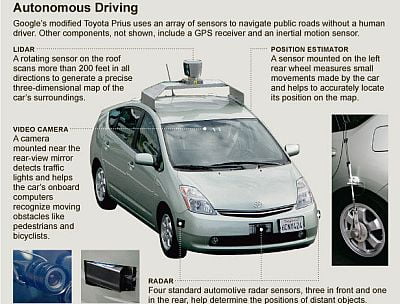
But despite our occasional incompetence in this regard – and note, also an incompetence that we can to some extent control – is it time to hand everyday driving over to computers also? I’d say it might well be, for those of us who can afford to. Because even if you’re as alert as you could possibly be, you’re still not able to simultaneously engage with as many variables as a computer can, and nor are you able to react to the outputs of that engagement as quickly.

Computers – or robots – pose questions beyond whether they or a human would be superior at performing a given task, like getting you to the church on time or destroying an enemy installation during war. In war, proportionality of response is a key issue for determining whether a drone attack is legal or not, and as soon as a drone is fully autonomous, we’d need to be able to trust that its software got those judgements right.

Or would we? The standards that we set for human beings allows for mistakes, so it would be inconsistent to refuse the possibility of error for robots, even if they were unable to express contrition, or to make amends. As with many encroachments of technology into our existence, robotics is an area where we need to be careful of privileging the way that humans have always done things, just because we are human.

Cloned or genetically modified food, in vitro fertilisation, surrogate motherhood, stem-cell research (to list but a few examples) are all areas where either a sort of naturalistic fallacy (thinking something morally superior or inferior depending on whether it’s natural or not) or some sort of emotive revulsion (the “yuk factor”) get in the way of a clear assessment of costs versus benefits. When speaking of robots driving our children home from school, a similarly emotive reaction can also cloud our thinking.

Just as with any data point in an set, you and me and everyone we know more often feels superior in whatever skill set than actually is better at that skill than the mean. The mean describes something: in this case, it describes the level of performance of the average person. And if we were all better than average, the average would be higher. For driving, it’s not, or we wouldn’t have an average of over 700 road fatalities every month.

So the question to ask is: when can we be confident that – on average – fewer people will die on the roads if cars are robotic than if the drivers are human? If we’ve reached the point of being confident about that, then the moral calculus shifts against human drivers. If you have the means and opportunity, you’d be acting less morally to drive your kids to school than have a computer do so – regardless of how this feels.

In the New Yorker, Gary Marcus recently invited us to consider this scenario:

Your car is speeding along a bridge at 50mph when [an] errant school bus carrying 40 innocent children crosses its path. Should your car swerve, possibly risking the life of its owner (you), in order to save the children, or keep going, putting all 40 kids at risk? If the decision must be made in milliseconds, the computer will have to make the call.

As Sarah Wild and others have pointed out in response, this sort of scenario does raise question about which rules we would like the car to follow, who makes those rules, and who is to blame when some unfortunate accident or death occurs. But where I think most comment on this issue gets it wrong is in labelling the moral dilemmas “tricky”, as Wild does.

If we can, on average, save many more lives by using robotic cars instead of human-controlled ones, the greater good would at some point certainly be maximised. Yes, there will be circumstances where the “wrong” person dies, because a maximise-life-saving algorithm will not be adaptable to very idiosyncratic circumstances, like the one described by Marcus.

In general, though, the robotic car will not speed, will never run a red light, and will never exceed the threshold for maintaining traction around a corner. It will never drive drunk, and will be far better at anticipating the movements of other vehicles (even if they’re not robots, on the same information grid themselves), thanks to a larger data-set than ours and an objective assessment of that data.

So it’s not that there is a tricky moral dilemma here. What’s tricky is that we aren’t able to view it – and ourselves – as a simply economic problem, where the outcome that would be best for all of us would be to set things up in a way that maximises life, on aggregate.

Any solution that prioritises human agency or building in mechanisms to know who to blame when things go wrong is understandable. But, once the driverless car is sophisticated enough, it would also be a solution that operates contrary to a clear moral good.

Setting aside our differences

Originally published at the Daily Maverick

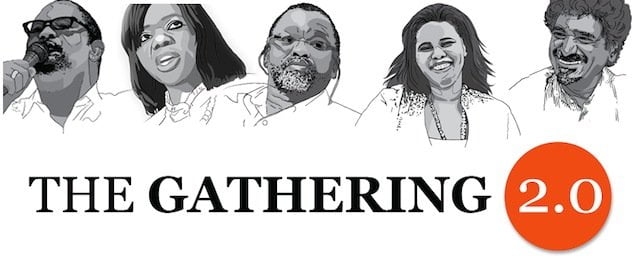
Daily Maverick readers will no doubt have noticed that last week, many of this community of opinionistas, editors and journalists congregated for The Gathering 2.0. A fair number of you were there too, and those I spoke with – readers and contributors alike – confirmed that they got as much value out of it as I did.

One key factor in its success, at least as far as I’m concerned, had to do with the value of community, shared goals and aspirations. Finding common ground and room for collaboration has always been difficult, and it has perhaps become increasingly difficult in a world of sharply divided identities and rather loud disagreements.

As was the case at the first Gathering two years ago, I was struck by the sense of a common purpose and shared commitment to finding solutions for South Africa and its developmental and political troubles. Sure, we sometimes disagreed on what those solutions should be, but there was little doubting our sincerity in looking for them.

It’s rare, though, to get to have these conversations in rooms without hostile commenters, and where a combination of ticket prices, self-selection and invitations extended pretty much ensured that people were going to be respectful, even when they disagreed. Out there on the Internet, or in more typical gatherings, civility and respect are not so easily guaranteed.

One thing that has certainly changed for me in the time between these two gatherings is my desire to attempt to be more sympathetic to the reasons why people disagree on goals and strategy – especially in the area of religion, where most of my attempted interventions take place.

Those of you who follow the endless squabbles in the secular, sceptical, or atheist community will know that fighting with each other is as much a part of the game as combating religious dogma is. And this isn’t only because there can be dogmatism and unreason on the non-religious side too – which there certainly can be – but also because everyone is sometimes guilty of being more interested in being right than in making progress.

Making progress – whether it be finding a political solution to a seemingly intractable problem, or persuading the rank-and-file Catholic to join you in publicly denouncing a child-abuse-enabling Cardinal – sometimes requires collaboration rather than antagonism. And, the former is more often appropriate than the latter is, as far as I’m concerned.

Don’t get me wrong – there is room for anger, and there is room for the sharpest criticism. Not only because the sharp criticism can inspire others to break with a tradition or belief, or serve as a lightning rod for debate, but also because it’s sometimes deserved.

The column I abandoned writing this week was going to amount to an extended insult (on issues, rather than ad hominem) directed at Blade Nzimande, and (leaving aside the fact that he would probably never have noticed it) attacking him seems permissible because he is presumably capable of brushing it off.

Likewise, I can feel more comfortable attacking Ray MacCauley rather than his parishioners, or the quack Professor or Doctor rather than those that change their diets or medical regimes on his or her advice. Because we all make mistakes, and while we should all sometimes know better, those of us in authority or with the expertise required to make the judgement in question should know best of all.

But as with any area of contestation – and especially in what I’m confident is an Internet-fuelled tribalism and hyperbole – caricatures so often win out over trying to find common ground. On the pro-science and secular side (and note the false dichotomy there – as if the religious can’t be pro-science, just like pro-life invites the caricature of “anti-life”), what community there is is partly premised on a caricature of the “other”, just like religious folk can easily point to some obnoxious atheist they know and use that person as their baseline for understanding non-believers.

What I worry about in these cartoonish versions of reality is firstly the possibility that we’re forsaking opportunities to learn things – about each other, about difference, about persuasion; and second that we’re impeding progress towards what could in many instances be common goals.

A significant proportion of secular activism – at least on the web – currently consists of people mindlessly (or so it appears) sharing photographs of a Hitchens or Sagan looking thoughtful, and accompanied by an inspirational (or blasphemous) quote. Often, these imagines will come from Facebook groups such as “I fu**ing love science” – as if saying so makes it true.

It doesn’t make it true. Mostly, we love the false impression of community that’s gained through imagining that the other – whether it be the unscientific, Bronze Age-mythology believing monotheist, or the dogmatic, immoral and cruel New Atheist – through the eyes of our respective prejudices.

I’m currently (too slowly) working on a review of Chris Stedman’s provocative new book “Faitheist” (edit: review now posted here), in which he makes the case for atheists “reaching across the aisle” and getting involved in interfaith efforts aimed at bettering lives. As he puts it somewhere in the book: “Do we simply want to eradicate religion, or do we want to change the world?”

These goals are of course not mutually exclusive, but in our eagerness to caricature each other, I worry that we lose sight of the possibility that focusing on the latter could contribute to achieving the former. More to the point, it could do so at a lower cost than encouraging divisiveness does, because the partisan outlook obscures the fact that we probably have more in common than what divides us.

Of course we need to keep asking whether beliefs are true or not, while encouraging people to discard untrue beliefs where possible, even if they are comforting. But no matter how often we ask those questions, they will have no effect unless someone is listening. And why should anyone listen, when it’s clear that the person asking you to listen has no interest in conversation?

Chris Stedman’s “Faitheist” – a review

ContentImage-7471-124608-about_faitheistEven though unreason of various forms can be a dangerous thing, there are few of us who don’t occasionally take comfort in some sort of convenient fiction (or potential fiction) – whether it be that our sports team is the best, or that that the look we received was innocent, rather than evidence that the people across the room were saying nasty things about us.

There’s a range of significance to fictions, of course. If you don’t much care about what people think of you, you might simply note that look, and think little more on it. You might engage in some casual banter with a supporter of another football team, but not be the sort to have heated arguments about something as inconsequential as sports are.

That’s clearly a different level of importance by comparison to a fiction that allows you to sweep child molestation under the rug, to justify misogyny, or causes you to pray over a child while she dies, instead of rushing her to hospital. And beneath all of this, I consider it indisputable that whether something is true or not matters. It matters profoundly, because the more false things we believe, the more likely it is that we’ll make mistakes of various kinds, ranging from the trivial to the profound.

Despite the fact that organised religion is premised on mistakes of various sorts, sometimes involving social and political ones related to power and authority, and often metaphysical ones to do with what is or should be considered significant, it would be an error to ignore the value it brings to those who do participate. It would also be an error to ignore all the things that we (as nonreligious folk) might have in common with them, regardless of those core disagreements.

But when any common ground is obscured by antagonism, stereotypes and caricatures, it’s easy to forget that we most likely have more in common than not. The average religious person lives a similar life to the non-religious person – caring about their family and friends, trying to be competent or excellent at what they do, whether it’s a job or a hobby.

Much of the time, we’d be aiming for similar outcomes – less poverty, more justice, less sexism and racism, more happiness. Of course there are exceptions, and some are notable – the institutionalised “war on women’s bodies” is one, where holding life to be sacred results in opposition to abortion for many Christians. The widespread prohibition on assisted dying is another, and in both these cases the religious view can conflict with the nonreligious one. The point remains that the average religious person is less like the extremist Mullah, or the child-molester-enabling Cardinal, than she is like you and me.

So why is it, then, that the public perception of atheists is that of them being overwhelmingly anti-religious? Well, I suppose because atheism – in and of itself – does not need to concern itself with any of these other goals. It’s precisely (and only) about a lack of belief in gods. So it’s perhaps unsurprising that what people associate with atheism is merely (and repeatedly) making the point that gods don’t exist.

And, it’s often not possible to make that point without causing offence. Which means that whether they intend to come across as offensive, antagonistic, strident and so forth or not, that’s the way that atheists will often be perceived.

There’s limited value in simply making the point that gods don’t exist, though. Or rather, there are only so many ways of saying it, and saying it is only one way of changing the world for the better. And this is why most of us are more than simply atheists – some of us are also campaigners for secularism, or for science education, or for humanism.

And again, campaigning for all those things rarely involves a necessary conflict of interest with the religious. But we can – and perhaps sometimes do – assume that a necessary conflict exists, especially in the pressure-cooker atmosphere of social media and the Internet, where mass-communication in real-time seems to encourage people to be the first to say something, rather than being the first to say something considered.

We pick fights, and occasionally also pick examples to justify those fights, ignoring the possibility that the examples might be unrepresentative. The careful work of constructing a science of the sacred – what religion means to the religious, and how best to engage with it – is by and large left to the academic endeavours of a Scott Atran or Pascal Boyer, while the blogosphere happily continues picking fights with their favourite straw men.

I generalise, of course. But those of you who follow the seemingly-endless squabbles in the secular, sceptical, or atheist community will know that fighting with each other is as much a part of the game as combating religious dogma is. And this isn’t only because there can be dogmatism and unreason on the non-religious side too – which there certainly can be – but also because everyone is sometimes guilty of being more interested in being right than in making progress.

Making progress – whether it be finding a political solution to a seemingly intractable problem, or persuading the rank-and-file Catholic to join you in publicly denouncing a child-abuse-enabling Cardinal – sometimes requires collaboration rather than antagonism. And, the former is more often appropriate than the latter is, as far as I’m concerned.

Don’t get me wrong – there is room for anger, and there is room for the sharpest criticism. Not only because the sharp criticism can inspire others to break with a tradition or belief, or serve as a lightning rod for debate, but also because it’s sometimes deserved. So nothing that I say here should be understood to mean that harsh criticism is always out of order. I’m just not so sure that it should be the default strategy for so many of us, so much of the time.

In any area of contestation, caricatures often win out over trying to find common ground. On the pro-science and secular side (and note the false dichotomy there – as if the religious can’t be pro-science, just like pro-life invites the caricature of “anti-life”), what community there is is partly premised on a caricature of the “other”, just like religious folk can easily point to some obnoxious atheist they know and use that person as their baseline for understanding non-believers.

What I worry about in these cartoonish versions of reality is firstly the possibility that we’re forsaking opportunities to learn things – about each other, about difference, about persuasion; and second that we’re impeding progress towards what could in many instances be common goals.

A significant proportion of secular activism – at least on the web – currently consists of people mindlessly (or so it appears) sharing photographs of a Hitchens or Sagan looking thoughtful, and accompanied by an inspirational (or blasphemous) quote. Often, these images will come from Facebook groups such as “I fu**ing love science” – as if saying so makes it true.

But many (is it perhaps most?) of the folk doing the recycling of these images don’t have a much clearer grasp on the science than the average religious person. Sure, religious folk can have some gaping holes in their understanding of some aspects of science, such as evolution – but in most areas that actually impact on day-to-day existence, they are not quantifiable less well-equipped than atheists like myself are.

What sharing photographs of Sagan does, though, is to create a (false) impression of community through imagining that “the other” is an unscientific, Bronze Age-mythology believing monotheist. That “other” in turn is encouraged to construct a shibboleth of the dogmatic, immoral and cruel New Atheist. And we’re all sometimes looking through the eyes of our respective prejudices, rather than engaging with the typical believer or nonbeliever.

The reinforcing and recycling of prejudices strikes me as quite an anti-humanist activity. And for every Hitchens, who was able to marshal a hundred quotes for every occasion in the service of cutting some religious windbag down to size, there are dozens of ordinary atheists who don’t have Hitch’s intellect or breadth of knowledge. But they are nevertheless inspired towards a similar strategy, and the problem is that in less competent hands, that sort of strategy amounts to simply being maximally offensive, and trying to bully your opponent into submission.

I’ve been working with skeptics and atheists in South Africa for the last 15 or so years, and given that I teach at a university, many of the people who seek me out to talk about these issues are relatively young. And it’s fairly consistently the case that what attracts them to the atheist movement is a fair amount of anger, and a desire to express it. They feel lied to or betrayed, and feel like they have wasted much time in service of a lie.

To be honest, they sometimes even put me off, because pomposity and arrogance – especially in your average 20 year-old – is rarely pretty. But because there is a ready-made community of people out there who will validate the anger, and encourage the blasphemy, that arrogance is planted in some very fertile soil, and some atheists seem to never get past it. Which means that they can never realise that as comforting as it might be to belong to the community of those who are right, it also isn’t changing as many minds as possible, and it’s also not contributing much to changing the world.

Young atheists are to my mind given a false choice between a hard, antagonistic approach and being some sort of a sell-out or traitor if you decline opportunities to mock people of faith. Those of us who have been in the game for a while can perhaps forget what it’s like to discover this community for the first time, especially at a time of life when many of us were insecure, and therefore quite happy to find an outlet for frustrations and disappointments.

So it’s the politics, or the messaging, that I’m most concerned with here. Calling someone an accommodationist or faitheist is also a way of mocking, and serves to disincentivise that behaviour (or to make sure that people who have those views shut up about them). Yet a middle ground does exist, because of the fact that we have so many shared interests despite our disagreements on religion.

It’s a worthwhile question to ask, as Chris Stedman does in “Faitheist”, “Do we simply want to eradicate religion, or do we want to change the world?” These goals are of course not mutually exclusive, but in our eagerness to caricature each other, I worry that we lose sight of the possibility that focusing on the latter could contribute to achieving the former. More to the point, it could do so at a lower cost than entertaining caricatures of each other does, because those caricatures prevent working together towards those goals we do have in common.

That Stedman indulges in some caricaturing of his own is one of the criticisms that has been levelled at the book. From details regarding parties attended, community activism, to the tone and messages of “new atheism”, critics have protested that Stedman gets them wrong, and wilfully so. I can’t judge much of this, but nor do I think it matters as much as some reviews would have me believe.

An uncharitable reader could even assume that Stedman is lying about a significant part of the biographical detail if they chose to. This would undermine his authority, but it wouldn’t speak for or against the book’s call for more co-operation between the religious and the nonreligious, nor his claim that atheism has become more publicly known at the cost of public goodwill.

Those two propositions are the heart of chapters 7 and 8. Much of the chapters before these are biographical, and serve to provide the reader with an understanding of why Stedman turned to, then away from religion, before finding a middle ground that allowed for cooperation with the religious even while disagreeing with some of their core beliefs.

Stedman clearly doesn’t approve of how some atheists engage with religion. While he himself only mentions PZ Myers disapprovingly, he seems to endorse the Reza Aslan quote criticising the “four horsemen”, Dennett, Dawkins, Hitchens and Harris. Another strong attack on the horsemen can be found in the introduction, where Eboo Patel finds it unlikely that they would perform an act of compassion Stedman later describes himself engaging in, where he reads a prayer to a friend. But that was Patel speaking, rather than Stedman.

And what Patel says there is simplistic, misleading and to my mind somewhat offensive. Having met all three surviving horsemen, and having spent many hours in the company of one of them, I’m fairly confident that if in that situation they would either do just as Stedman did, or find some compassionate way of achieving the same result without having to read a prayer. Patel reinforces the stereotype of new atheists being nasty and uncompassionate, and seeing as Stedman never disagrees with his friend Patel, perhaps we’re entitled to assume that he agrees with this caricature.

So I think Stedman is wrong to help prop this particular stereotype up – first because it’s false, and second because it’s one of the items of anti-atheist propaganda used by some religious folk. And as I’ve said above, there is room for anger and antagonism in any case. But where I’m sympathetic to Stedman’s thesis is with respect to the example that is set for young atheists, where the relative loudness of the angry voices can sometimes seem to drown out the more subdued tones of something like an interfaith movement.

But just as Stedman wrongly buys in to a certain caricature of new atheism, I’d suggest that some dismissals of the position sketched by Stedman are also based on somewhat ad hominem caricatures of the author, rather than his position. There is room for various strategies, but there shouldn’t be room – in a sceptical community – for caricaturing the proponents of any of these strategies. Regardless of whether we think Stedman disingenuous, or PZ Myers obnoxious, we can independently of that make the case for shifting our engagement with the religious more towards compassion and understanding, and less towards ridicule and mockery.

The problem is of course that we have no counterfactuals allowing for the assessment of different strategies. I was, like Stedman, mortified by David Silverman and American Atheists protestations regarding the World Trade Center “cross”. But my delicate sensibilities in this regard don’t mean that the consciousness-raising effect of those campaigns is eliminated. They might, on balance, do more good than harm. I don’t know – but I do know that they don’t speak to some atheists, and therefore that other sorts of (more moderate) messages will certainly have an audience too.

I’m sympathetic to the substance of Stedman’s argument, which depends on the idea that community and a shared narrative of some sort can be helpful for combating inequality, and fighting various social justice causes. I do think that many religious people would welcome certain kinds of support from the nonreligious, and that support starts with understanding. But understanding Stedman’s book as making some novel claim, or telling us something we didn’t know, is a mistake – and I think that criticism or praise premised on that understanding is mistaken also.

Many atheists already work with religious folk in various social justice fields, and the topic of religion seldom comes up. When it does, some of us will be hostile to religious ideas, some of us not – and what I see Faitheist doing is simply offering a corrective to the fact that the hostile sort of response seems to get more attention (inside the atheist movement) than the more accommodating one does.

Of course, the role I see Faitheist playing is not necessarily the same as the role Chris Stedman sees it playing. He seems to genuinely disapprove of some atheist bloggers, and seems to genuinely want us to all engage in interfaith collaboration far more than is currently the case. And I think he over-reaches in some respects, and that he contributes to caricatures – even as the book is an extended appeal to not engage in caricaturing the religious.

Stedman himself raises the issue, in chapter 8, as to whether 24 year-olds should write memoirs. While I don’t see that as a problem in principle, I think it becomes a problem when a memoir written by a 24 year-old risks telling others that they are doing it wrong, and that they should learn from the author how to do it right.

This precociousness is part of what has resulted in some of the negative reaction, I think, but some of that reaction has gone too far in choosing to attack Stedman’s sincerity rather than try to understand that the book can be read as an inspirational call to reflection and action (of a different sort than many atheists are used to).

It is important to understand each other, so that our dialogue can be more meaningful and productive. Of course, it’s important to allow room for that dialogue itself. As atheists, we are outnumbered – and not working across “party lines”, as it were, can perhaps mean that we don’t see the opportunities to collaborate as environmentalists, feminists, or whatever-ists – regardless of our religious views.

More generally, though, Faitheist reminds us that we perhaps have more shared values than differences. And for me, it’s also a reminder that persuasion is more difficult when people don’t want to listen to you, and therefore that there is some merit in combating a negative reputation, whether it’s a deserved one or not.

None of this means we should stop asking whether beliefs are true, nor that we should stop asking people to discard untrue beliefs where possible, even if they are comforting. But no matter how often we ask those questions, they will have no effect unless someone is listening. And why should anyone listen, when it’s clear that the person asking you to listen is far more interesting in telling you you’re wrong than in conversation?

Chris Stedman’s Faitheist is imperfect, as all books are. It’s imperfect in a quite regrettable way, though, in that it seems to have antagonised exactly some of the people Stedman was presumably trying to persuade. The argument for faitheism could have been made without propping up stereotypes around new atheism, and the title does Stedman no favours either.

Despite these and other flaws, though, I think it worth reading. It’s provocative, and it’s a call to action – and even if you don’t think interfaith work is the sort of action required, I’m in agreement with Stedman that there’s plenty of common ground between the faithful and the atheists that we’re not yet fully exploiting. And, even though this isn’t quite his claim, Faitheist reminds me that for all the good that can come of making people uncomfortable with their rituals and beliefs, much good can perhaps also come from us becoming better at understanding our similarities, as well as our differences.


I’d bookmarked a whole bunch of posts on this – mostly reactions from when an excerpt from Faitheist was published at Salon – but when sitting down to write this, I realised that there was far too much there to re-read. So, if you want to get a sense of the negative reaction to date, some of these posts are good examples – but I couldn’t tell you which, or why.

Just a shy kid with holes in his socks – Butterflies and Wheels

Stedman being Stedman – Pharyngula

Chris Stedman defends accommodationism – Sandwalk

How is religion like delicious yummy corn? – Crommunist Manifesto

Chris Stedman’s toxic atheism – Temple of the Future

Why atheists don’t respect faitheists – and you shouldn’t either – Butterflies and Wheels

Bruce Gorton’s Bollocks: More Straw Stedman – Temple of the future (a response to the link above)

Thoughts on Chris Stedman’s Faitheist – Skepticblog

I benefit(ed) from apartheid

Originally published in the Daily Maverick

I certainly benefited from apartheid. And I’ve bought the t-shirt that says so – two of them, in fact – even though I might never wear them except in the company of other 40-something white liberals, with whom I share enough history that misinterpretation is unlikely.

Misinterpretation is unlikely, even as we agree on how many different things the t-shirt could be saying, and often also agree on what it should and should not be saying. It does not need to say that because I’m white, I should feel guilt. It should certainly not be saying that white people should withdraw from political comment, as Samantha Vice once argued.

But outside of the shared space of those of us who – to a lesser or greater degree – participated in some form of protest or activism in the 80s or earlier, this shirt’s message is perhaps a little too ambiguous, and too open to misinterpretation. Two reactions illustrate the problem, and even though these reactions are both far too simplistic, they nevertheless serve as useful examples of two possible extremes.

First, there’s the contribution that “Frank” made to MyNews24, headlined “I benefited from apartheid and other fairy tales”. Frank’s column discussed the “new liberal buzz concept that we as whites … have hugely benefited from a system that has been dead and buried for 18 odd years”. There’s no value in linking to this, as it starts out wrong-headed and quickly ramps up to triumphalist – but completely unreflective – smugness.

While the fact that he thinks this concept “new” might reveal that he’s only started thinking about this recently, more worrying is the fact that he’s bought into a premise that I can’t help but associate with someone who’s unwilling to engage with South Africa’s past (and therefore, present and future) in an honest way. As I’ve argued before, the first democratic elections didn’t somehow flip a magical switch, whereby after 1994 we could be sure that everyone succeeds or fails entirely on merit.

Now, I might like to wear the t-shirt in Frank’s company too, so that he can know he’s alone in wanting to bury his head in the sand, or to engage in acts of “whataboutery” wherein you boycott SAA, or self-righteously stalk the aisles of Pick ‘n Pay rather than Woolworths for a week or two, to say “what about this new-fangled form of racism, eh? Is this what ‘we’ struggled to achieve?”

But then, maybe Frank will think I’m wearing the t-shirt ironically, and never think about the message it’s intended to convey. Or maybe he’ll think, “well, perhaps you did, but my life was hard, and now my kids can’t get into UCT Medical School. And you call this justice?” In other words, maybe Frank will make the mistake we all (white, black, female, male, poor, rich) sometimes do, of thinking that anecdotes count as data.

And then, there’s the other sort of extreme reaction, this time a comment left at the Mail&Guardian (excerpted):

sickening…how self rightous some white south africans can be…so you think a sorry is good enough..a woolies t-shirt with those words is good enough. for me it simply shows the depth at which white people think black people are stupid. How lowly they regard black people’s pain. Will this t-shirt wipe away the memories of apatheid, will it give me the land they took away from my family. will it educate me, will it take away the shame and inferiority complex I have that was passes down to me due to the whites manipulating black people’s minds.

The fact that this reaction is a straw man of the worst order is besides the point, as is the fact that the author of this comment seems to believe that white people are in general insensitive, manipulative, and of the view that black people are stupid. To put it plainly, it’s besides the point that the author of the comment appears to have racist attitudes towards whites.

The reason it’s besides the point is that whether (many or most) whites are like that or not is a separate issue from whether a wearer of this t-shirt in fact benefited from apartheid (which, in general, they certainly would have), what they are trying to say in wearing it and most importantly, whether they think that wearing a t-shirt is all they need to do to wipe the slate clean.

My answers to those questions are not going to be the same as yours. But the key point here is that regardless of what my or your answers might be, those answers aren’t going to necessarily overlap at all with how the t-shirt is perceived by others, and what they think you mean. Intentions aren’t transparent to those who pass us on the street, and the performative role of this t-shirt is a fundamentally ambiguous thing – not to mention potentially a rather offensive thing.

And lastly, there are two quite general problems with this t-shirt, which further decrease the likelihood of my ever wearing one, despite now owning two. First, because as much as it’s true that whites benefited from apartheid, apartheid – or at least its legacy – is increasingly becoming the narrative by which some tenderpreneurs and politicians (even Presidents) enrich themselves at the expense of people who are currently, not previously, disadvantaged.

As much as the t-shirt would speak the truth if I were to wear it, would it be any less true if worn by President Zuma, even though the benefits might be of a very different form? If apartheid didn’t provide Zuma and the ANC with a narrative of being essential to the liberation from apartheid, would he and others not perhaps be in jail?

The other general problem is that what the t-shirt says is partly false. Yes, I did benefit from apartheid, as (on aggregate) all whites did. But I still benefit, because of the cultural capital, the confidence, and from the fact that the vast majority of people in power at my institution are white liberal males, just like me. How could I not have benefited and continue to benefit? After all, isn’t that what apartheid was designed for?

Brands vs. personal identity on Twitter

Originally published in the Daily Maverick

Should people be suspended for having a terrible sense of humour? Or were Lance Witten and McIntosh Polela suspended because of terrible judgement instead? Both their own, in terms of what they found humorous, as well as on the part of their respective employers, who allowed themselves to be forced into action by the moralistic masses on social media.

Terrible judgement seems the more likely option, but it’s perhaps not only Polela and Witten who are guilty of it. They know that they are public figures, and they know that this makes them a target for the sort of finger wagging we seldom direct at our own behaviour. But do we – and their employers – have to enforce groupthink, or can we separate the brand from the individual?

In case you don’t know what these two did to deserve suspension (in the eyes of their employers, at least), Polela made a joke about prison rape on Twitter after Molemo “Jub Jub” Maarohanye was sentenced to prison for murder, and Witten made a joke (also on Twitter) about people “dying to see Linkin Park”.

Given that prison rape is reportedly a significant problem in South African jails, and that Florentina Heaven-Popa died after scaffolding collapsed on her and others at the Cape Town Linkin Park concert last week, these jokes were certainly in very poor taste.

However, having poor taste is something that’s only directly relevant to people who work in fashion, food, or whatever areas involve being an authority on discerning what the most desirable product on offer might be in a given situation. Suspending someone for having poor taste in humour – for saying something that many would find offensive – makes the statement that we must all have the same values, and that dissenting from those values is not permissible.

It also makes the statement that we (as a company) don’t trust our customers to be able to distinguish between our employees as people and the company as a whole. This is where one has to consider the possibility that their respective employers are also guilty of poor judgement, in that they’ve played a part in letting hyperbole win, and in helping to feed an appetite for sensation that we should instead be doing our best to quell.

One reason that social media policies are necessary is that people seem incapable of realising that what you say on Twitter or Facebook can reflect negatively on your employers. Another reason that social media policies are necessary is because employers are willing to bow to the demands of the pitchfork-wielding public, who make threats of boycotts over every perceived slight. And then, forget about it the next week, when some new offence is paraded in front of them through a hyperbolic headline.

Seriously – how often have you heard of someone who was not killed “execution style”? When last was a person or a report “criticised” or “challenged” rather than “slammed”? And why can’t eNCA have the option of saying, “Lance Witten might be a tosspot, sure, and he really shouldn’t have made that joke. So ‘unfriend’ him if you like, but he works for us as a sports anchor, and he’s good enough at that that we see no reason to suspend him”.

They can’t have that option because we don’t allow them that option. Our thirst for sensation, and our inability to separate the various roles that people perform in professional and private lives, makes it impossible for a company to say that perfection is an unreasonable standard to expect from our employees, and that there are other ways of distancing yourself from comments or from employees than by suspending or firing those employees.

All that we are doing is satisfying the desire for some public flogging, after all. The idea that anyone learns any sort of lesson here (besides the lesson of “keep your views to yourself”) is implausible. Because we always forget, and because all that’s necessary to speed up our forgetting is a brief period of suspension, a public apology, and some new distraction – which is usefully always around the corner.

And so it goes, again and again, and the main loser is our sense of perspective. Yes, jokes can be offensive. But Witten, Polela – or you, or me – won’t stop making offensive jokes, or come to agree with each other on which jokes are permissible or not as a result of suspensions like these. We’ll just tell the same jokes, more privately, while our public spaces become more homogenised, and thus (one suspects the thinking goes) “safer”.

Companies must, of necessity, have an interest in their brand and how the market perceives it. This would certainly entail avoiding any real scandals, especially those perpetrated by senior figures in that company. But if reputational harm comes to implicate every tweet of every employee, there’s little chance of preserving reputation.

It’s become a truism to say that the brand and the person can’t be separated – but that isn’t necessarily because it’s true. One possible social media policy doesn’t seem to attract the attention it seems to deserve, and it would go something like this:

Our company values are x. While we try to hire people who share those values, there are also other job requirements that sometimes have an equal or higher priority. So, unless informed otherwise, please assume that individuals are responsible for their own comments on social media, and that none of their comments should be understood as expressing the company’s views.

We don’t believe that we are the best judges of what should be a universal morality. We respect our customers enough to want to avoid the paternalism of assuming that they are incapable of telling difference between individual employees and us. And finally, we respect our customers too much to think that they need our protection from things they might find offensive.  Have a nice day.

Postscript: Via 6000, here’s an example of sanity prevailing in this area. The Christian whose case is discussed in the article is of course a homophobe and a bigot, and that’s not good. But he’s allowed to be those things, especially on his own time.

Body Worlds – a collision of materialism with dignity?

Originally published in Daily Maverick

Respect should not be granted unreservedly. Not to people, because they need to be reminded that they aren’t gods. Nor to ideas, because we stand little chance of discovering that we are wrong if we don’t ask questions. It can be impolite and for some, perhaps even offensive to talk ill of the dead. But even so, we’re less likely to cause offence when remembering the misdeeds of a Stalin and more so with a Mandela, because of the difference degrees to which they merit our respect.