University of Cape Town march: #WeSayEnough

Originally published in the Daily Maverick.

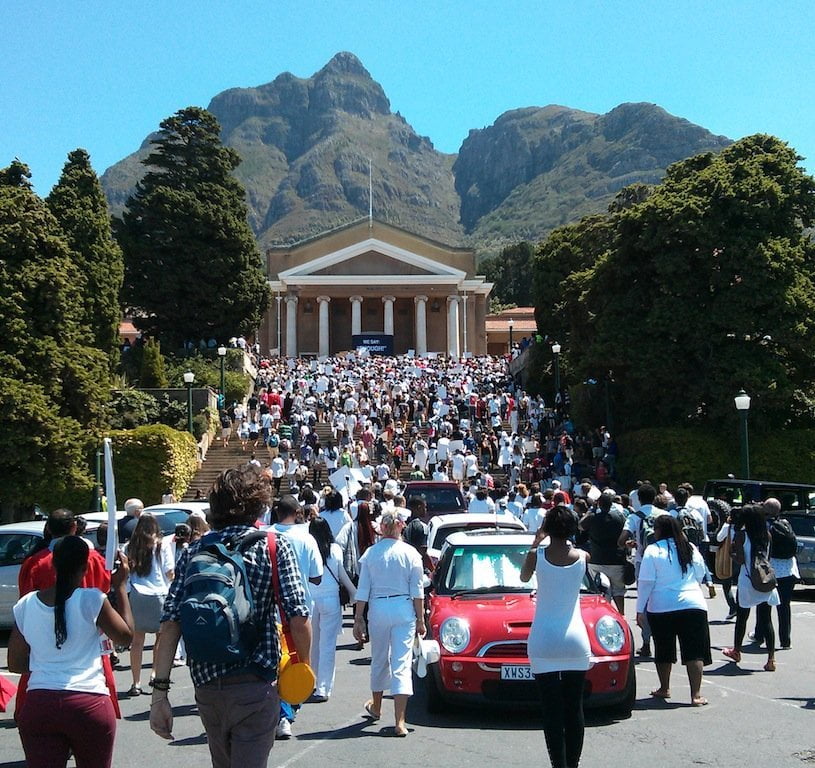
Last week, an estimated 3000 members of the University of Cape Town community marched under the banner of #WeSayEnough. The march was a protest march, as these things typically are – in this case, a protest against the sexual and other violence against (particularly) women in South Africa. I joined the march, and I suppose this column is my attempt to explain why I did so.

Some of you might think this needs no explanation. Perhaps you routinely engage in the spectrum of activities that range from voting in online polls, signing petitions, putting plastic rhino noses on your cars, or donating time or money to some cause or other. But my starting point would be (or, perhaps “would have been”) to point out that the last two are different sorts of interventions than the first three. Giving time and money seems easier to categorise under “doing something”, rather than being simple liberal breast-beating.

Those who, like me, do think it needs an explanation might talk of slacktivism, desktop activism, or clicktivism. Even though this protest took place on foot instead of behind a desk, in academic garb or white t-shirts with protest slogans, one could ask what it might accomplish for all of us to assemble to say “enough”. Sure, we’ve all had enough, you might say, and everyone already knows it.

You might even say, as I did in my last column last week, that these actions aren’t likely to change the minds of the perpetrators of violence. But even if that’s true, I’m glad that we marched.

First, because the signal of solidarity that 3000 marchers with placards and songs send is a far stronger signal than a progress bar on a website, indicating that you want to save a rhino. I’d like to think that at least some victims of sexual violence participated in or were aware of the march, and saw that they aren’t forgotten.

This show of solidarity might comfort, which is only a trivial thing if you think our emotional states irrelevant. I remember thinking during the march that critics of these sorts of protests would most likely not also boycott funerals. Of course, funerals are not typically protests, but they are largely symbolic events, just as this march was. For someone to ask at a funeral “what’s the point? What is this going to change?” would not, I’d imagine, go down too well. We understand that the point it solidarity, and so it was with the march on February 20, 2013.

Second, as our Vice-Chancellor noted in his address to the marchers, we marched to insist that we’re not happy with this level of violence becoming expected or normalised. We marched to say that we won’t be silent as new (and ever lower) expectations of security are spoken of as if they were an acceptable consequences of living in South Africa. Or, more specifically, of living as a woman in South Africa.

We marched because it should concern us that the Oscar Pistorius media extravaganza has allowed us to forget Anene Booysen, and that during the four days of courtroom action in the Pistorius bail hearing last week, it’s likely that more than 400 women would have been raped (if the one-every-four-minutes statistic is accurate).

So much for our Delhi moment, then, as many South Africans seem to have moved on to having an O.J. Simpson moment – with the focus again on a compromised hero than on another dead woman. We marched, in other words, to remind each other that this is not normal, and should never be treated as if it is.

Third – again, as noted by Dr. Price, we marched to tell the government that they have betrayed the social contract. The criminal justice system can be improved, and NGO’s like Rape Crisis better supported. Funding could be made available to universities so as to train social workers, and also to support research in areas that could help us better understand and address this toxic masculinity and patriarchy that allows for the normalisation of sexual violence.

But mostly, and finally, I marched because of the energy that a crowd can generate. Columns, petitions and speeches can reach people, sure – but thousands of singing and chanting people, united in common purpose, generate a passion that might have a lasting effect on a larger number of people. And before anyone accuses me of an unreasonable level of idealism, I’m talking about the people who were there, rather than those who heard about it.

The people who were there were receptive to what Dr. Price and the other speakers had to say, and they were committed to doing what they could to minimise sexual violence, and to help the victims of it. And what they – especially the students – heard did offer strategies that will be effective, even if each of us can only make a small difference. Each of them, in this case, were the majority of the crowd, and these students were given some challenging assignments.

They were reminded that they need to criticise and ostracise their friends who commit even the slightest violence against their partners. They were reminded that sex is not the guaranteed outcome of a date, and that they should not let their friends believe it is, because that belief is likely to contribute to date rape. They were reminded that men of integrity need to be completely sure that their partner consents to sex, and that the language of boasting about “conquests” after the fact constitutes an unacceptable objectification of their sexual partners.

I think that solidarity is important, and that refusing to treat sexual violence as normal is important. The fact that the continent’s premier university takes this stand sends a message to government, and I think that’s important. Lastly, words like those above, in the context of a receptive audience such as the one we generated, can make a difference. And that is why I marched.

(Strange arguments for) An African Pope

Ratzinger on DrugsVia Jonathan Faull, I learn that if the next Pope were to be African, he’d in fact be the fourth African Pope, “following in the footsteps of Victor I (AD 189-199), Miltiades (311-314), and Gelasius (492-496)”. And it might make good marketing sense to elect an African Pope – religiosity is still very strong and rising, in many parts of the continent. Even in countries like South Africa, arguably more in tune with global trends than most other African countries, we’ve got 70% or more who claim religious faith (a recent poll showing a sharp decline is unfortunately, not at all convincing).

Of course, people who think the Pope an essential and useful figure are not only concerned about who their largest audience might be. They also care – perhaps even more than demographic representivity – about whether the next Pope can defend the traditions of this archaic system of belief. It takes a certain strong character to defend “traditional” marriage and oppose any other unions, or to oppose contraception, in the 21st century. But when you read some arguments for why the next Pope should be African, it becomes easier to see how Popes (and lesser religious authorities) get away with talking nonsense, decade after decade.

Here’s a prime example: Richard Dowden begins an article arguing for an African Pope with: “Over the decades that I have travelled in Africa I have met only four African atheists”. A claim like this is astonishing, for various reasons. First, because as a look at something like the IHEU member organisations will show, we have a growing number of secular humanist organisations on the continent. We have atheist conferences – in Malawi, Nigeria, South Africa and elsewhere, and some of us attend and speak at international conferences too. In other words, the myopia of Dowden’s claim is the first notable thing.

One suspects, though, that he’s not looking very hard. It’s implausible to imagine that he starts every conversation with “say, are you perchance an atheist?”. And because we are a religious continent, a lack of belief would not typically be the sort of thing you’d advertise. Then, Dowden – who appears to be religious himself – might well tend to congregate with other religious folk in any case, making his (tiny already, as why should “who I meet” be your criterion) sample one that has a strong self-selection bias.

Then there’s this “no true Scotsman” paragraph, in which he claims that:

African history is largely untroubled by religious wars. Wherever religious wars are reported in Africa the cause is usually a dispute over land rights involving two communities that happen to be of different faiths. Religion per se is rarely the cause. That traditional tolerance however is now under pressure – not from atheism – but from externally-funded, exclusive fundamentalist religions in the form of Wahabi Islam exported from Saudi Arabia and evangelical Christian fundamentalism funded from the United States.

I’m sympathetic to the idea that religion and religious practices aren’t equally dangerous. But the extreme forms – even if he identifies their influence accurately in that paragraph – feed off a base of people who are already sympathetic to strange metaphysical claims. The fundamentalist religions could not gain traction without people finding the idea of gods plausible in the first instance, and the evangelical churches would remain empty, despite the funding, if rescuing your soul from hellfire was never a plausible offer in the first place. Just like in any market, competition emerges and can become aggressive. This competition is certainly premised in religion more broadly, and Dowden needs to acknowledge the role of the “traditional tolerance” for religion as a factor.

Worst of all, for me, are these two sentences:

Would an African pope change the Church’s attitude to homosexuality? Highly unlikely but on social justice, both local and international, expect a far more forthright and vigorous voice.

“Highly unlikely, but on social justice…”? One must hope that the opposition set up here is entirely accidental, because in implying that homophobia is not a social justice issue, Dowden would be making it clear that he knows as little about religion in Africa as he apparently knows about atheism in Africa. It’s in Uganda, after all, that we’ve had years of debate around whether homosexuality should be subject to the death penalty (there’s no debate around whether it should be illegal – of cours it should, according to Ugandan lawmakers).

Speaking in 2009, Ethics and Integrity Minister Nsaba Buturo was by contrast a model of tolerance, saying that life imprisonment for homosexual men might be better, as “killing them would not be helpful“. In a context like this, with homophobia prevalent across the continent, one does not get to carve homosexuality out of any bundle of social justice issues. After patriarchy, and the consequent and frequent abuse of women, it might well be the largest social justice issue.

It’s thanks to columns and arguments like these that it becomes ever clearer that the debate should ideally not be around whether the next Pope should be African or other, but rather around how long the Papacy – and Catholicism in this form – can survive at all.

Talking about risk-mitigation is not (always) victim-blaming

Originally published in the Daily Maverick

7cca959a9b6a4e5cad27293a135a06f6

On the afternoon of this column’s publication, I engaged in brief debate with Michelle Solomon, a local anti-rape activist, on radio. You can listen to that here if you like.

Even since Anene Booysen’s rape and, later, death last weekend, much of South African society has been engaged in a sustained period of reflection regarding the staggeringly high incidence of sexual violence in our country. Alongside the reflection, there has also been much furious Tweeting and Facebooking, as the slacktivists all rise up to say “something must be done” – without ever telling us what it is that we might do.

Rapists aren’t going to read a Tweet and realise the error of their ways. So, for all the solidarity that these public shows of support provide, we need to do more. I don’t know what that could be, except for the obvious things everyone knows about – better resourced police and rape-crisis centres, for example.

It’s not that public debates can serve no purpose – Lindiwe Mazibuko’s suggestion to debate this in Parliament, for example, could actually be useful. The more often that patriarchs like Patekile Holomisa and Jacob Zuma get to hear that women aren’t chattel, the better. Because that is the root of the problem, is it not – that women aren’t treated with respect, but rather as objects for male exploitation of various forms?

How do you fix that, even as you try to improve policing and offer increased support to victims of crimes such as these (and certainly, those involving male rape also)? Some of us can certainly set a better example, whether in the copywriting contained in our advertisements, or in the lessons we teach to our children. But in a community riddled with drugs and gang violence like Bredasdorp apparently is, perhaps the best that many children could hope for – at least in the short-term – is to somehow escape their hometown, and their families.

In the longer-term, though, I’d like to offer a more modest proposal relating to our arguments and our language around rape. Simply put, I’d ask that we guard against sacrificing common sense on the altar of politically-correct principle, because if we’re not having a full (and fully-informed) discussion about the causes of rape, we’re handicapping the search for solutions to rape. One area in which discussion is becoming impossible is risk-mitigation with regard to rape, where every mention of it earns you little more than a reprimand for “victim blaming”.

The vast majority of rapes have nothing at all to do with the situation and conduct of the victim, meaning that victim blaming would not only be offensive, but also factually confused. But, if even 5% of rapes do have something to do with those factors – and are thus potentially avoidable through some form of risk-mitigation strategy – we have to be allowed to talk about those strategies. Currently, we can’t, because any suggestion that potential future victims should consider risks (and thus perhaps not experienced the crime in question) is shut down with a refrain of “victim blaming”.

Note the first confusion alluded to above – we can distinguish between existing victims and potential future victims. If you were to quiz an existing victim of a theft on whether he was counting his bankroll in public, he’d probably feel justified in asking  why you were paying attention to his behaviour, rather than that of the perpetrator. But if you offer tourists the pre-emptive advice to not count their bankrolls in public, the advice seems perfectly sensible and inoffensive.

Sentiments don’t become true through repetition. We just stop thinking about them, or start pretending they are true through fear or experience of being bullied. Why accusations of “victim blaming” are not always appropriate or true is because the moral and statistical aspects of rape are entirely different matters.

The moral aspect of rape – put simply, who committed a wrong, who should feel guilt, and who should be punished – is easy to resolve. In all cases, the rapist is the answer, and his victim has committed no moral wrong. But rape, like other crimes, occurs in a context. Or rather, it occurs in many contexts, and this allows for a purely scientific assessment of whether any particular aspects of those contexts correlate with a higher or lower incidence of rape.

This is how we respond to every other crime. If you were to be involved in a car accident involving a drunk driver running a red light, it’s that driver’s fault – entirely. But if this accident happened at an intersection where everybody knows drag racing takes place, you chose to expose yourself to a higher-risk situation than you could have (assuming there were other routes home). The fact that you shouldn’t need to take another route home is an entirely separate issue from how sensible it might be to take this particular route home.

What we say in situations like that is something like “watch out for that intersection”, and provincial authorities might feel inclined to put up one of those red spot “high fatality” road signs. What we say to children is things like “I don’t want you hanging out with Seamus” (at least, that’s what I was told). If you’re involved in an accident, or if Seamus introduces you to cigarettes, we could always have known that this was more likely than could otherwise have been the case. Risk-mitigation is, in other words, a standard component of our hardware.

As you all know, correlation doesn’t by itself indicate causation, but it can certainly act as a clue that there is some causal factor at play. More to the point, if it turns out that situation x tends to correlate with a higher incidence of rape than situation y, we never criticise someone for choosing situation y. And when someone knowingly choses situation x, you wouldn’t apply moral blame, because the blame belongs only with the criminal. But you could certainly feel entitled to ask potential future victims whether they are sure they want to visit the neighbourhood in question.

If you’re a policeman, you’re not doing your job through asking that question or questions about clothing after the fact, as the Toronto policemen who inspired Slutwalk did. Because only one person has committed a crime and that person is the rapist. But you’d also not be doing your job if you didn’t keep a detailed record of crime hotspots, and use that record to advise people of which areas they might want to avoid, for which reasons.

Of course it’s obscene that risk-mitigation with regard to rape asks women to voluntarily imprison themselves, only go out accompanied by chaperone, not walk alone at night, or to be constantly vigilant against someone spiking their drinks. These sorts of realities are an outrage, and the disproportionality of the burden carried by woman is likewise an outrage. Men are afforded the privilege of mostly being oblivious to these realities – and in many ways, it is men being oblivious to their privilege that allows gender-based violence to flourish.

Unfortunately, most situations that correlate with a higher incidence of rape can’t be avoided. The 2012 Victims of Crime survey (pdf) indicates that 17% of sexual assaults are perpetrated by family members, and a further 58% by someone known to the victim. 22% of sexual assaults took place in the victim’s home, and a further 25% in someone else’s home – areas we’d normally hope are safe.

Over this past weekend, City Press editor Ferial Haffajee published an editorial  in which she raised questions about risk-mitigation. A full day of criticism for “victim-blaming” ensued, because Haffajee asked whether firmer, or different, parenting, perhaps including a curfew, would have made a difference in Anene Booysen’s case. It probably wouldn’t have, at least not in any particular case. But we make a mistake when only thinking about Booysen’s rape, or any other instance of rape, while not also thinking about the rapes that don’t fit the pattern of the one under discussion.

For those (mostly) girls who live with a rapist uncle, cousin or brother, of course a curfew won’t help. But not all victims of rape can add that particular misfortune to the other misfortunes they have had to endure. So even though it’s true that most rapes happen in the home, and are perpetrated by someone known to the victim, that doesn’t mean curfews or parental interventions of other sorts can’t help avoid rapes that don’t fit this pattern.

People should be allowed to say that, because even though it’s wrong to have to limit your choices in the face of a dysfunctional society, doing so could save lives or prevent at least some of these crimes from occurring. That’s surely worth doing, even if it does nothing to address the root causes. If you insist that there is only one thing worth talking about – and one language to use when talking about it – the conversation quickly seems to be more about you than about Anene Booysen. And she can’t hear you anymore.

Fetish, Mercury Live, 15 February 2013

Just a brief note to say “wow”. And to say that if you’re a fan of Fetish, or more generally a fan of smart rock music and talented performers of it, you should get yourself to one of the gigs on their current South African tour. Tonight it’s Stellenbosch, and then (from the 20th, successive nights in) Bloemfontein, Johannesburg, Pretoria and Durban.

My advancing years led to a departure at the first encore, but I left wishing I was 20 years younger – which would have pretty much been when I first went to a Fetish gig, perhaps even in the same venue (but no, that’s too convenient – those early gigs were in skanky Observatory dives). Some highlights:

1. The tracks they played off the new album, Little Heart, were made to be played live. The album – even though I claimed it should win SA music awards – doesn’t do justice to their raw power.
2. Ross Campbell (drums) was fantastic last night. Connected to point 1, the drive and energy of these tracks requires a steady hand on percussion, as well as a heavy one where necessary, and Ross gave us both in spades.
3. You have to hear their cover of Springsteen’s “Dancing in the Dark”. It was wonderful.

So yes, go if you can. And buy some albums on Bandcamp.

IMG_20130215_231018

Can frankensalmon triumph over uninformed ad-hoc opinions?

Originally published in the Daily Maverick

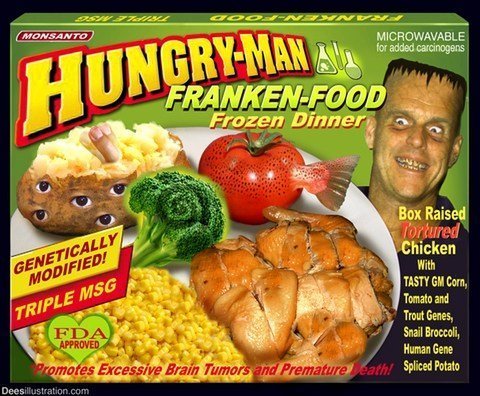
tumblr_lys10lmgnS1qdm7sdo1_500Consumers have a history of caution in adopting technological innovations in food. Pasteurised milk took years to gain acceptance, and words like “Frankenfood” are used to describe food that is produced in a lab. But what starts out frightening can rapidly become commonplace. Nearly two decades ago, genetically modified soy beans were Frankenfood, and today they account for 85% of soy bean production in the US.

Labels like “Frankenfood” are emotive, and imply that a wrong has been committed. Unfortunately, the debate often ends here, as moral claims – no matter how un-articulated – are frequently treated as privileged or even as trump-cards, in that if you find something morally objectionable, your objection is typically afforded respect regardless of its merit.

So it is with Frankensalmon, or to give this delectable fish its proper name, AquAdvantage salmon, fresh from the labs of AquaBounty Technologies, Inc. A combination of Atlantic Salmon, Chinook, and Ocean Eel Pout. The Chinook salmon provides a growth hormone gene, while the Ocean Eel Pout contributes an antifreeze protein gene. What we end up with is a salmon that reaches market age twice as fast as the one you’d normally find on your plate.

What we also end up with, at least according to some commenters on the FDA’s website, is either something that will make you fat directly (“Pls don’t allow ge salmon. Please. Usa is obese enough”, says Vera) or play a part in destroying regular salmon, a food which apparently keeps you thin. According to Sandra, that is, who says “I am finally finding out why i have had a problem with my weight and health for the last few decades. Now you are prepared to take one of the healthiest foods away”.

Comments also include the predictable lamentations regarding Monsanto (who have nothing to do with AquAdvantage), big pharma, government and assorted other (also big, I imagine) villains. Mostly, though, it’s sheer hysteria and the occasional attempt at something that looks like a threat (“my family will never buy this!”) – albeit not a threat you’d imagine at all efficacious.

“It’s not nice to fool mother nature”, and “we need to stick with the basics and consume food in the form in which it has been consumed by human beings for millions of years” is the common sentiment, repeated over 24 pages with various degrees of anger. But as I noted in a previous column on doping in sport, the appeal to nature is often nothing but simple prejudice dressed up as argument.

There are arguments that could be had here, and evidence that would be relevant to whether this GM salmon should be approved or not. One concern would be whether these fish would be reproductively superior to traditional salmon, threatening their existence in the long run.

Even though AquaBounty claim that they are bred to be sterile, a Change.org petition reports that 5% of them are in fact fertile. Other issues are raised in the petition, such as the fish causing increased allergic reactions, and apparently also (at one production site) having been “infected with a new strain of infectious Salmon Anaemia, a deadly fish flu which has been devastating fish stocks around the world”.

It’s that sort of language – on the petition and on the FDA site – that should give cause for decreased concern, rather than the escalated hysteria that hysteria tends to breed. Salmon anaemia has been observed since 1984 – before this fish existed – and also seems to be something that salmon are prone to, whether or not they are GM. And seeing as viruses mutate, speaking of salmon being “infected with a new strain” can only result in readers imagining Dr. Strangelove cackling as he plots to hand Karl Rove the keys to the world.

It’s difficult to find examples of scientists, rather than frightened laypeople or environmental activists, urging caution about this fish. It might certainly be unsafe, but if it’s evidence and argument that should inform choices like these, we’ve got very little, if any, reason to be concerned.

What I’m more concerned about is the increasing trend of mistaking the popular voice for an opinion worth taking seriously. Christopher Hitchens coined a wonderful phrase in referring to conspiracy theories, dubbing them “exhaust fumes of democracy”, and one could say something similar about calls for public participation, like this one from the FDA (closing on February 25, if you want to get a rant in).

A checkbox which asks something like “is there any particular reason to take your viewpoint seriously” should perhaps be added to any such website, poll or evaluation, with an upload facility for your credentials. As Mitchell and Webb put it, a frequent response to the feedback we get could be something like “thank you for sharing with us the full majesty of your uninformed ad-hoc reckon”.

In summary, the problem seems to be that the democratising of, well, just about everything has resulted in too many of us thinking we have something worthwhile to say on anything, where sometimes, the most valuable contribution we could make might be our silence.

Tiny dead baby corpses

Did you perhaps think that right-wing talk show hosts couldn’t say anything more absurd than you’ve already heard? Not even the homeschooled ones? Well, you’d be wrong if you did. In a novel (at least it has that) argument against birth control pills, Kevin Swanson has the following to say (audio here):

I’m beginning to get some evidence from certain doctors and certain scientists that have done research on women’s wombs after they’ve gone through the surgery, and they’ve compared the wombs of women who were on the birth control pill to those who were not on the birth control pill. And they have found that with women who are on the birth control pill, there are these little tiny fetuses, these little babies, that are embedded into the womb. They’re just like dead babies. They’re on the inside of the womb. And these wombs of women who have been on the birth control pill effectively have become graveyards for lots and lots of little babies.

As Robin Marty succinctly points out,

even if somehow there were tiny mini babies stuck in your uterus, they would come out when you menstruate since THAT’S THE WHOLE POINT OF MENSTRUATION. Because obviously, whatever school Swanson attended must have not only skipped over the entirety of sex ed, but likely a full spectrum of basic science classes as well.

There’s also some weird stuff in there about Hitler, and more. Pat Robertson had better up his game.

Alain de Botton: 10 virtues for atheists

I really can’t make my mind up about Alain de Botton. Part of me finds him insufferable, thanks to what appears to be his perpetual smugness, as well as his fondness for translating complex ideas into aphorisms that could fit on a chewing-gum wrapper. But then, much as the equally (to me, at least) annoying Jostein Gaarder’s Sophie’s World brought philosophy to people who otherwise wouldn’t read or think about it, perhaps de Botton does more good than harm. Nobody expects more from him than vaguely inspirational “deep thoughts”, so it’s entirely possible that part of my annoyance is mere jealousy at how he’s cornered the atheist version of the Deepak Chopra market. And that, in doing so, he’s getting people to think about worthwhile and interesting things.

But at a time when some really interesting conversations are being had between Loxton, Myers, Novella and others on the delimitations of skepticism, it’s particularly annoying that de Botton’s recent list of what are variously described as “virtues”, “commandments” or “guidelines” are being marketed as “for atheists”. First, because it plays into the hands of those who think atheists need such a list – ie. that we are any more value-deficient than any other “group” of people; and second because it seems to assume we are a “group” of people in any relevant sense, besides simply sharing disbelief in gods as part of our mental furniture. (I realise that this could open conversations about “dictionary atheists” and the like, but I really hope it doesn’t.)

So, in the midst of an interesting discussion regarding how to define a particular shared interest and those who hold that interest, here were have a lazy demarcation of “atheists” and “other” – and when you see the list, you’ll no doubt observe that there seems little that is specific to atheism, and little that can’t simply be described as “guidelines for conscious creatures”, or somesuch.

De Botton has previous form in the game of oversimplification, of course – in Religion for Atheists, he straw-manned new atheism in support of his creation, atheism 2.0, and then in 2012 he suggested the erection of a “temple to atheism“. There are many good ideas hidden in both of these initiatives, but also plenty of platitudes. As I said at the time, “de Botton is dressing up the obvious as if it’s insightful. And his further explanation of how he thinks these are good ideas don’t make them appear any more so”. So it is with the 10 virtues for atheists, which are:

  1. Resilience. Keeping going even when things are looking dark.
  2. Empathy. The capacity to connect imaginatively with the sufferings and unique experiences of another person.
  3. Patience. We should grow calmer and more forgiving by getting more realistic about how things actually tend to go.
  4. Sacrifice. We won’t ever manage to raise a family, love someone else or save the planet if we don’t keep up with the art of sacrifice.
  5. Politeness. Politeness is very linked to tolerance, the capacity to live alongside people whom one will never agree with, but at the same time, can’t avoid.
  6. Humour. Like anger, humour springs from disappointment, but it’s disappointment optimally channelled.
  7. Self-Awareness. To know oneself is to try not to blame others for one’s troubles and moods; to have a sense of what’s going on inside oneself, and what actually belongs to the world.
  8. Forgiveness. It’s recognising that living with others isn’t possible without excusing errors.
  9. Hope. Pessimism isn’t necessarily deep, nor optimism shallow.
  10. Confidence. Confidence isn’t arrogance, it’s based on a constant awareness of how short life is and how little we ultimately lose from risking everything.

It’s fairly obvious what’s going on here. He intends this list as a substitute for the Biblical 10 commandments – but doesn’t want to call them “commandments” (note, some newspapers have called them that, but he doesn’t), because that will too obviously invite ridicule from atheists telling him things like “atheism is not a religion”, as well as glee from theists saying “look, atheism is like a religion!” So, he loses the rhetorical force being able to call them “commandments” would have provided through superseding the Biblical commandments and making them redundant.

But they are already redundant to atheists, and superseded by a non-belief in gods and their hypothetical commandments. Furthermore, these are values most of us – whether religious or not – already have. So, he’s trading on an existing set of commandments – but only indirectly – and then doing so in a way which highlights the false distinction he’s making between atheists and everybody else. As a result, the list appears ever more opportunistic, and simplistic. And, of course, annoying – even though there’s very little wrong with the list itself.

Liberalism, the Democratic Alliance and identity

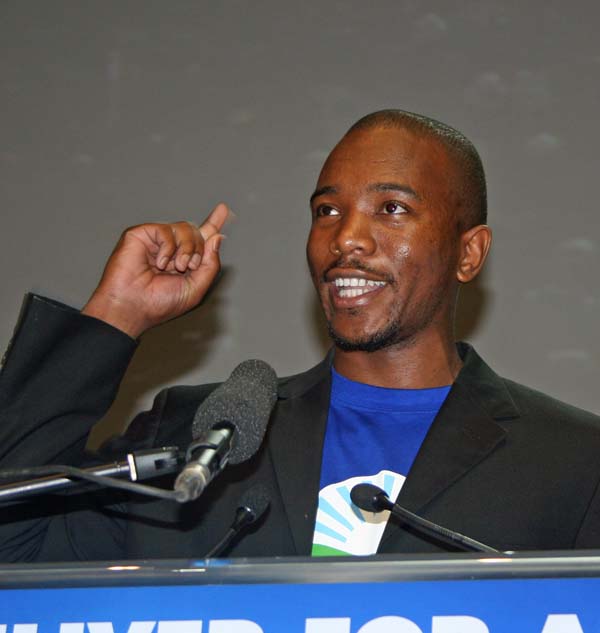
Mmusi-MaimaneThere’s perhaps an argument for saying this about any election, but to my mind, the upcoming national elections in 2014 will be South Africa’s most interesting since our first (democratic) election in 1994. Various factors align to make it so – the ANC’s corrupt leadership, and President Zuma’s apparent inability or unwillingness to do anything but enrich himself; the untested effects of Ramaphosa’s re-emergence as a political force; the reaction of a nation to scandals (Limpopo textbooks) and murderous police (Marikana); and whether these (and other) factors will lead to mass apathy and a low voter turnout, or to more votes being cast for the official opposition.

And that’s where another complication can be introduced – one that I intend to be the topic of this post – namely the identity of the Democratic Alliance, and whether liberalism can accommodate concepts like ubuntu, or be sympathetic to “African-ness” (whatever either of those terms might mean). In her Sunday column for the City Press, Carien du Plessis asked:

Rather than splitting hairs on whether its leaders are true blue liberals or not, the party would do well to think about how its version of liberalism could include rather than reject Africanness and concepts that are a hot sell among a South African electorate craving some feel-good ubuntu.

Otherwise the DA could be wandering in an elitist wilderness forever.

The “splitting hairs” she refers to is contained in a sequence of op-ed’s and blog posts by Mmusi Maimane (DA national spokesperson), Gareth van Onselen (previously communications head at the DA, then executive director for innovation and projects, and now resigned from party leadership) and Gavin Davis (current communications director for the DA, but writing in his personal capacity). If you want to read them, go here, here and here.

I don’t think it’s splitting hairs to contest whether or not leaders are true blue liberals, if we believe that there’s something important about being one, and can agree on what liberalism is. Van Onselen has strong views on what liberalism is, and on how the DA should compete for the flourishing of liberal ideas in South African politics. Du Plessis, in saying that the party should think about how it could include African-ness and ubuntu, is making the implicit claim that liberalism can include those concepts. Well, the DA’s “version” of liberalism can, at least – and it’s exactly what this version should be that van Onselen is concerned with, arguing that these are essentially illiberal ideas.

So, I think a legitimate case can be made that if we were to foreground (or “include”, however we end up defining that) these concepts, this would involve some sort of betrayal of classical liberal values. For some, that would be a good thing, for others a bad one. And we can argue about whether that makes the party no longer liberal, or liberal-lite, or whatever.

But let’s be careful of thinking this a crucial step in defining the nature of the party, or rather, let’s acknowledge the fact that the party hasn’t been a classically liberal one for quite some time now. To pick only some recent examples, some would say that a liberal party should not bow to religious pressure and act as a respondent in a court case aimed at the revocation of a liquor license on the grounds that booze would be sold next to a mosque. Some would say that our provincial transport MEC didn’t sound very liberal when threatening to confiscate the car keys of sleepy drivers, and when asked if this was legal, saying “I have no idea, but I don’t care either”. There was Helen Zille’s suggestion that she’d like to make the wearing of condoms law in non-monogamous sexual intercourse, or Jack Bloom’s claim that “maybe if we all prayed more the social change we desire will happen” – which, while not obviously illiberal, certainly makes human agency and freedom seem subservient to some powerful force in the clouds.

So in summary, this might in the end be hair-splitting, because the party might have stopped being liberal a while back now. And perhaps van Onselen knows this, and is now saying things (at least, publicly) that he’s been thinking for some time. And, maybe, we can understand his concern at what Maimane had to say, in that Maimane is likely to be an increasingly influential force within the party, and thus serves as a bellwether for the ideological stance of the party in 2014 and beyond, where the party might start openly embracing illiberal ideas, rather than having to suffer through occasional bouts of illiberality from one of more of its leaders.

Maimane’s comments do matter, as do any prominent DA official’s comments on topics like these, because they indicate not only ideological direction, but also the extent to which a party is willing to compromise, and how honestly it’s willing to do so. For instance, Maimane could have chosen to say: “liberalism cannot include collectivist ideas like ubuntu, and in this respect, I consider liberalism flawed”. Or, he could argue that this version (to go back to du Plessis’ suggestion) of liberalism is more suited to a people who do have strong collectivist tendencies – or even that freedom has to include the freedom to be part of a collective, even if that seems counterintuitive to some.

But van Onselen is right in pointing out that Maimane does himself seem to believe in the idea that “being African” means something, and he also seems to think it should mean something – not just to him, but to “Africans”. And that is illiberal, because if Maimane restricted himself to the purely descriptive claim that “many people in Africa seem to believe X” or the more personal “I happen to believe or feel X” there would be less of an issue, in that self-identification is part of what liberalism is about. Prescribing versions of identity, or (at least) presenting them as normative, runs counter to self-identification, and thus to liberalism.

The problem, though, is that as much as you’d be free to think of yourself as an African, or to subscribe to something like ubuntu (on Inside Politics, van Onselen and I have previously discussed what that concept means) within a broad liberal framework, the DA don’t create the impression of welcoming those sorts of self-identification – and this is the real problem, and has been since the party came into existence (and before – I remember having the same debates at PFP Youth meetings in the 1980’s, and I’m sure they were discussed long before then too).

(An aside: on Twitter, van Onselen stated that the “ideas themselves are illiberal“, so he’d presumably dispute the paragraph above. I’d argue that whether African-ness was illiberal or not would depend entirely on what it meant, for you, seeing as we’re now talking about self-identification rather than someone else’s label. If African-ness means some sort of sentimental attachment to the continent, for example, calling that illiberal seems to me as false as it would be to call my identification as a Manchester United fan illiberal”.)

As I was saying, these debates have gone on for some time. To my mind, this is the same debate that Ryan Coetzee (former and current all sorts of things, but at the time, writing as CEO of the DA) was talking about in a 2006 strategy document where he noted (in a passage explicitly framed as generalisation) that:

all South Africans don’t share the same concerns about what might be called “identity issues” … white South Africans don’t have the same attachment to the cultural heritage of black South Africans – indeed black South Africans have always felt that their culture is regarded as inferior by whites, and that by extension they themselves are regarded as inferior.

The DA in 2013 looks vastly different to the DA of 2006, partly because it has taken the lead on initiatives (street renaming) and policy (basic income grant) that demonstrate a commitment to redressing history’s injustices rather than reinforcing some “neoliberal” caricature of wiping the slate clean, and letting people compete in some Darwinian pure market economy.

But if we say things like “ubuntu and African-ness are illiberal”, or  that Mmusi Maimane is being unfaithful to the tenets of liberalism in trying to define those concepts, an impression of hostility to that “cultural heritage” would be created. You might think it wrong that people perceive it as hostile – perhaps preferring that the argument be had on the facts, rather than on the emotive impact of pointing out those facts – and I would agree that it’s not ideal that we can’t dispassionately consider the merits of these competing views.

Unfortunately, humans – and politics – have never been only about the facts, or about rationality. Many of you might think the facts have even less to do with political argument than rhetoric does, and I’d be reluctant to disagree. So, when we ask if liberalism can “accommodate” these concepts, even if the answer turns out to be “no”, we should be concerned about how we get to that answer.

Asserting that it is the correct answer in a way that dismisses competing views as a nonsense can do little but feed in to a stereotype about liberals and liberalism, namely that they are and it is un-African. The concept is flawed, and it’s to my mind a nonsense, especially when prescribed to others.

But nobody will listen to your arguments as to why that might be the case if they think you’re insulting them, or even worse, telling them what they should believe – or ironically, even perhaps who they should be.

Inconsistency and intolerance

As you no doubt know, in April 2011 France introduced legislation barring women from wearing the niqab. There’s some immediate irony in that, in the sense of telling women what they aren’t allowed to wear, in an ostensible effort to liberate them.

I’m conflicted about that particular ban, because as much as the niqab seems such a powerful symbol of subjugation, it’s impossible to rule out the possibility that some women wear it out of genuine choice, rather than because it’s the only choice they have, or the obvious choice thanks to years of programming. And if these women exist, a ban certainly violates their freedom, even if you might disagree with the ways in which that freedom is used.

As much as I – and all of us, I imagine – want to find ways in which we can maximise the freedom of others, it challenges preconceptions about the oppressive nature of the niqab to see headlines talking about French Muslim women effectively being “under house arrest” as a result of this bans. It also doesn’t seem to be winning any public relations points – not only is this sort of thing fuel to extremists, it’s also fuel to those who want to cast secularism as intolerance.

But the niqab is an extreme example, because of the way it seems to eliminate the person wearing it. You, as a Muslim women, are represented entirely by the item of faith, with only your eyes visible to the external world. You could be anyone, at least to those of us on the outside, who might not be able to pick up the subtler clues of identity that no doubt exist.

So I can at least have the conversation around whether this should be permitted or banned, because it is at least plausible that something so extreme can’t be a matter of free choice. But when it comes to other, less extreme statements of faith like the fez, kuffiya or hijab, it seems immediately false to me that we should prohibit Muslims from wearing them.

These thoughts are prompted by a South African example from a couple of weeks ago, where two children were sent home from high school for wearing a hijab and a fez, and told that they could not come back wearing their respective headgear. They were allowed back a week later, but only after intervention from the provincial school board. Meanwhile, talk radio had a field day, with one person making the absurd suggestion that religious clothing is good, because then we’d know who all the atheists are (they wear black, you see).

And then, there were some callers and letter-writers who we can be quite confident in thinking would be happy for children to wear a crucifix to school, because it’s Islam that’s the problem, not religion. One even spoke of the Muslim “infiltration and indoctrination”!

A confounder in this case is of course that the children in question are 13 and 16. As Dawkins often points out, it’s an error to referr to Muslim children, Christian children, or [insert any other religion] children. Until a child is old enough to choose for itself, it is the parents who are religious rather than the children. Indeed, this particular case is notable for the fact that it’s the mother who is quoted as saying “I can’t allow them to take it off because it is against our Islamic beliefs.”

She’s then quoted as saying “It is very sad. It is very disturbing” – and while she clearly means the actions of the school, those words could easily apply to some cases of children who are given no option but to believe what their parents do – and thus also easily apply to her previous quoted sentence.

As I wrote in a recent column on this case,

a 13 and a 16 year-old could also be Muslim by choice, even if we think the choice flawed. Unfortunately, we often only get to know how much volition is possible when people try to change their minds (through observing how their families and community react), but it’s certainly possible that these two children are contented in this particular faith, and proud of being identified as members of it.

We can’t guarantee that these sorts of choices are made freely. But we can help to create a climate that encourages free and rational choice, and also taking responsibility for choices. Forbidding the hijab while permitting the cross encourages inconsistency and bigotry. Permitting them both – as well as any other outward signs of religious affiliation – can be done alongside restrictions that encourage civic virtues such as understanding and compassion.

I mean two things: first, that allowing the hijab, but insisting that it be in the colours of the school uniform, reminds the scholar that a plurality of values are competing, and that none should be assumed to have priority until the relevant debate has been held. And second, allowing religious headgear avoids sending a signal of prejudice, which will hopefully result in an increased chance for people like me to argue against the choice to ever want to wear the headgear or the crucifix.

The system of thought – or sometimes lack of thought, to be more honest about some forms of religious indoctrination – that forces some women to cover themselves near-completely does merit opposition, as does a tradition that won’t allow women to be priests, or to have abortions, or whatever the case might be.

But expressions of those ideologies are not equally thoughtless, and treating them all as if they are – or not allowing them at all – runs the risk of acting no differently to that which you’re protesting. If you don’t think children should wear a hijab or a fez, persuade them and their parents that they shouldn’t. As David Mitchell puts it, “It bears restating that it’s not bigoted to disagree vociferously with people’s choices, as long as you’re even more vociferous in defending their right to make them”.

A final thought takes me back to inconsistency, though – can such neat distinctions be made between the niqab and the hijab? If I’m happy to allow the latter, am I inconsistent to think the former permissible? And if this inconsistency needs resolution, should it be through banning both or permitting both?

On the too-large pile of unread books, which probably looks similar to your too-large pile, my SkepticInk colleague Russell Blackford’s Freedom of Religion and the Secular State awaits. Perhaps it will contain a clue or two.

You can leave your hat on

Originally published in the Daily Maverick.

this-hijabIn a phone call to Redi Tlhabi’s Radio 702 show last Wednesday, Caroline (or something) from Claremont was outraged. Children should not be allowed to wear Muslim headscarves, she said, because headscarves are a sign of Muslim “infiltration and indoctrination”. Furthermore, she repeatedly asked, if kids can go to school wearing a hijab, why can’t they also (or rather, alternatively) go to school naked?

Another caller agreed that religious garb should be outlawed at school, on the grounds that this would somehow curb the (presumable) infiltration and indoctrination of atheists, who wear black. Apparently. In other words, just another day in the parallel universe of talk radio, where common sense goes to die.

But beyond the hysteria, there are some issues worth addressing here. Not Caroline’s apparent racism (in this case Islamophobia, although that remains a word we should use sparingly, because that’s clearly inadequate grounds for policy. Neither need we address the non-analogous case of nakedness, nor the various other failed attempts at analogy (why is my child forbidden from wearing cowbells!). Whether what currently counts as legitimate religion is right or wrong, our current legislative framework is the one by which the Eben Dönges case needs to be assessed.

For those unaware of this case, the nutshell version is that two children were sent home from Eben Dönges, a high school in the Western Cape, for wearing religious headgear. Sakeenah Dramat (16) was asked to remove her hijab, and her brother Bilaal (13) was asked to remove his fez, and they were told that they could not come back wearing their respective headgear. This was on the first day of the new term, and the children were only able to return to school a week later, after the Western Cape Educational Department intervened.

The first issue worth addressing is the error of referring to Muslim children, Christian children, or [insert any other religion] children. Until a child is old enough to choose for itself, it is the parents who are religious rather than the children. Indeed, this particular case is notable for the fact that it’s the mother who is quoted as saying “I can’t allow them to take it off because it is against our Islamic beliefs.”

She’s then quoted as saying “It is very sad. It is very disturbing” – and while she clearly means the actions of the school, those words could easily apply to some cases of children who are given no option but to believe what their parents do – and thus also easily apply to her previous quoted sentence.

But a 13 and a 16 year-old could also be Muslim by choice. Unfortunately, we often only get to know how much volition is possible when people try to change their minds (through observing how their families and community react), but it’s certainly possible that these two children are contented in this particular faith, and proud of being identified as members of it.

To go back to our caller to Redi Tlhabi, though: that account of how much choice was involved ignores the issue of how early indoctrination can start, and how powerful it can be. By the time one is 13 or 16, it can be difficult to see any other choice than the one your family made as being the appropriate or sensible one. You might never think of changing your mind, and we would then never get to see how unwelcome doing so might be.

These concerns need to be applied consistently, though. Given the high proportion of Christians in South Africa, the chances are good that many anti-hijab callers (and many of the hundreds who have expressed anti-hijab sentiments on the poll IOL is running) would see no problem with a child wearing a crucifix necklace. Because your indoctrination is evil and mine not, I suppose.

We can’t guarantee that these sorts of choices are made freely. But we can help to create a climate that encourages free and rational choice, and also taking responsibility for choices. Forbidding the hijab while permitting the cross encourages inconsistency and bigotry. Permitting them both – as well as any other outward signs of religious affiliation – can be done alongside restrictions that encourage civic virtues such as understanding and compassion.

I mean two things: first, that allowing the hijab, but insisting that it be in the colours of the school uniform, reminds the scholar that a plurality of values are competing, and that none should be assumed to have priority until the relevant debate has been held. And second, allowing religious headgear avoids sending a signal of prejudice, which will hopefully result in an increased chance for people like me to argue against the choice to ever want to wear the headgear or the crucifix.

The system of thought – or sometimes lack of thought, to be more honest about some forms of religious indoctrination – that forces some women to cover themselves near-completely does merit opposition, as does a tradition that won’t allow women to be priests, or to have abortions, or whatever the case might be.

But expressions of those ideologies are not equally thoughtless, and treating them all as if they are – or not allowing them at all – runs the risk of acting no differently to that which you’re protesting. If you don’t think children should wear a hijab or a fez, persuade them and their parents that they shouldn’t. As David Mitchell puts it, “It bears restating that it’s not bigoted to disagree vociferously with people’s choices, as long as you’re even more vociferous in defending their right to make them”.

And finally, if a public school doesn’t allow for the expression of alternative religious views (including the non-religious view), please report them to your local education board.