On that “most attractive race” thing in the UCT student newspaper

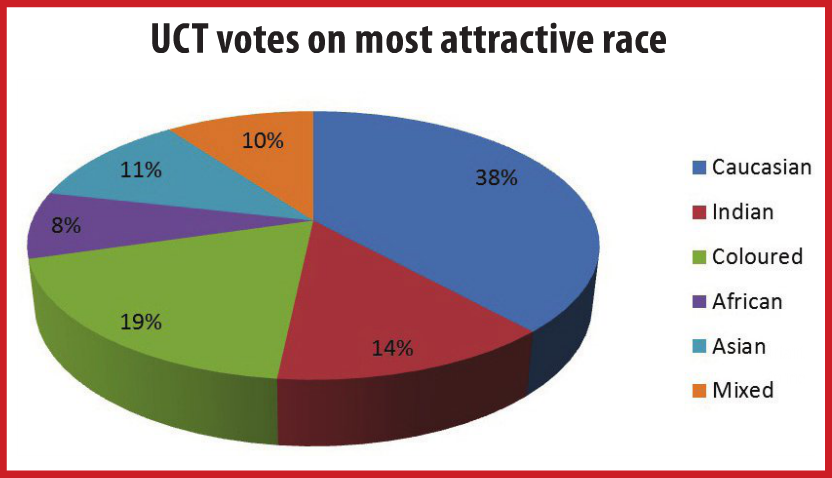
So, this peculiar thing appeared in the UCT student newspaper, Varsity, earlier in the week:

Screen Shot 2013-04-05 at 9.46.51 AM

A couple of people have asked whether I’d be writing about it. To one, I replied that it was “too silly”. Which it is. But even sillier than this is the news that the Young Communist League are apparently going to report Varsity to the Human Rights Commission (they are “shocked and disgusted“, you see).

For context, a couple of details: To repeat, this is a student newspaper, and it is not edited or subject to any pre-publication controls by any official agents of the University administration or staff. Second, it was published in the opinion pages, and third, it was an accompaniment to this article – in fact, it’s a graphical representation of the results of Qamran Tabo’s straw poll of 60 students.

Yes, 60 students. So, Varsity chose a stupid headline for the graphic, in that “UCT” haven’t voted on anything. Varsity no doubt chose the headline to attract attention, seeing as that is what headlines are for. But an attention-grabbing headline on such a sensitive topic should perhaps be chosen with more care.

As, of course, should be what you choose to publish in the first place, or how much you edit what’s been submitted. Presenting this as quasi-scientific was an error, as the editor concedes.  It’s not just the sample size, it’s also the peculiar way in which the sample was drawn. Tabo chose to survey 10 individuals from each of the following “racial groups”: “white, coloured (culturally), Indian, East Asian, biracial and African”. Now, Tabo doesn’t define how she knew who was who here, and whether they are all self-identified (as “culturally coloured” surely must be). Anyway – let’s leave it at that, agreeing that the pie-chart is a reflection of what these students reported, and nothing to do with UCT as a whole.

But even if it was about UCT as a whole, it’s still possible that – for whatever reason, but mostly for a reason Tabo cites (the preponderance of white people presented as attractive in popular media) – a larger group of people would report this same preference. And this would be a reflection of racism in popular culture, yes, where certain appearances are normalised as attractive, and others not. Furthermore, it’s a great shame that this is so prevalent, and so persuasive, that it’s probably the case that a large number of students (and others) have “fallen for it”, as it were.

It wouldn’t necessarily be racist to point this out, though. Saying “students report that they find race x more attractive than race y” (and please, throughout this blog post, assume the quotation marks around “race”) can simply be reporting a fact. The idea that humans might “rank” races on any characteristic is of course offensive, particularly in South Africa or anywhere (okay, everywhere then) where people have been oppressed as a result of their race. But the author knows this, and starts by reports the fact (for the 60 students) of these preferences, before going on to conclude:

Of course everyone has the right to choose who they want as a romantic partner, but it is interesting to observe how race, which is really just a collection of arbitrary physical features, acts as a barrier when it comes to who we choose to love.

Having been at UCT and in South Africa long enough, I have come to realise that we would have better luck creating a research wing at Med School dedicated to cloning white people to feed the demand than trying to understand the origins of some our supposed “preferences”. Hopefully one day, when the world’s entire population becomes creolised, characters will be the only deciding factor for who we want to date.

And that’s just right, surely? The author decries the fact that these students use an arbitrary characteristic, rather than someone’s character, to determine who they would like to date. There’s nothing racist about the conclusion, and it can’t be racist to report that people do have these (potentially racist) preferences. This really does seem a storm in a tea-cup, caused by little more than a poor headline and social media hysteria.

Furthermore, as I’ve previously argued with regard to the dos Santos and Tshidi cases, even real racist speech should perhaps not be reported to the HRC, and we certainly shouldn’t feed the pitchfork-wielding mobs of outraged folk on social media, because they’ll simply start feeling more entitled to bully us into silence the more they succeed in doing so. I confess I fell for it too, yesterday, when I described this as “embarrassing” for UCT on Twitter.

It is embarrassing, sure – but it’s also embarrassing that our knees jerk so quickly, and so violently, when anyone mentions the fact that people do still think in racial terms, regardless of the fact that we wish they wouldn’t. Outrage won’t make the problem go away, and neither will pretending that people don’t have attitudes we wish they didn’t.

[Edit]Related: I thought it was a mistake for UCT (the Vice-Chancellor, in fact) to apologise for the “blasphemous” Sax Appeal in 2009. They certainly shouldn’t apologise for this.[/edit]

Burn the witch!

Originally published in the Daily Maverick.

witch1Gauteng education MEC Barbara Creecy recently did a superb job of name-checking existing policy while simultaneously ignoring it. On March 18, a new element of the Department of Education’s partnership with faith-based organisations (FBO) was announced: the development of an “Anti-Harmful Religious Practices strategy”.

The policy I refer to is the National Policy on Religion Education, a mostly superb document that appears to be routinely ignored, judging from the dozens of emails I’ve received from parents across the country, whose children are pressured to participate in religious (usually Christian) activities at public schools.

Kader Asmal’s foreword to that policy reminds public schools that they are obliged to be “neither negative nor hostile towards any religion or faith and … not discriminate against anyone”, and calls for “a profound appreciation of spirituality and religion in its many manifestations, …  but does not impose these”.

What, then, is an MEC for education doing endorsing a FBO initiative to “guide and protect learners from spiritual attacks”, making specific reference to the “harmful aspects of the occult and Satanism”? Three fundamental blunders are evident here, two of which constitute violations of the policy. The third is simple mindless populism, which no policy currently prohibits.

First, if we’re going to address the harmful aspects of religion – an initiative I’d wholeheartedly endorse – we shouldn’t do so by rigging the game in favour of one religion or a handful of religions over others. Regardless of the fact that South Africa is estimated to contain a (significant) majority of Christians, freedom of religion means that we should treat them all with an equally critical mindset, at least as far as government is concerned.

So, if we are to look at the harmful aspects of religion, it would be incumbent on us to consider not only possibly harms emanating from “the occult”, but also possible harms emanating from the two religions Creecy is partnering with.  Some Muslims might, after all, interpret An-Nisa, verse 34 to legitimise domestic violence: “As to those women on whose part ye fear disloyalty and ill-conduct, admonish them (first), (Next), refuse to share their beds, (And last) beat them (lightly); but if they return to obedience, seek not against them Means (of annoyance): For Allah is Most High, great (above you all).”

As for the Christian FBO’s, we can easily find examples of scriptures encouraging slavery or homophobia, the latter of which is a clear – and prevalent – example of a harm emanating from religion. I’d hope that the focus on Satanism and the occult doesn’t prevent Creecy and her FBO’s from reminding pupils to avoid those evils too. If your response to this is that the more mainstream religions are somehow different, you’re falling prey to the same mindless populist impulse Creecy is, as I’ll get to in a moment.

A broader inconsistency in how these harms (or alleged harms, in some cases) are being addressed is the legitimising of the concept of “spiritual attacks” at all. There are those of us who think the mere idea of a spiritual dimension to life (by which I mean a non-physical element to personal identity, rather than anything to do with meaning, wonder, transcendence and so forth) potentially harmful.

This is because of at least two reasons: first in giving young folk a very early and very seductive introduction to magic; and second in giving humans in general an excuse to treat each other and themselves less well than they could otherwise do. In believing that this mortal life is the only time I have, I feel motivated to make the most of it, and that certainly can’t include pleasing metaphysical creatures, seeing as there are more than enough creatures around me whose lives I can impact for better or worse.

These sorts of issues involve debating what the various religions believe, not only around aspects such as souls, but also in terms of their attitudes towards gender equality, sexual orientation and the like. This brings me to the second apparent violation of the policy – evident in the fact that neither is it the case that any representatives of Satanism or “the occult” were ever consulted, and nor is it the case that they form part of the FBO grouping tasked with developing a strategy that “should be aligned with department’s Education Religion Policy in Public Schools”.

I agree with Creecy that it should be aligned, which is why it’s peculiar for the representation she’s implicitly endorsed to have picked sides in favour of the mainstream religions, and specifically excluded the religions identified as presenting the largest threats to spiritual and other welfare.

Not being given the chance to defend yourself, while simultaneously being singled out as a threat, hardly seems in accord with the National Policy’s instruction that the state “must maintain parity of esteem with respect to religion, religious or secular beliefs in all of its public institutions, including its public schools”. Trash-talking someone, or in this case some religious beliefs, without giving them a chance to defend themselves provides evidence of something quite contrary to “parity of esteem”.

And third, Creecy and the FBO’s are talking trash. Some occult practitioners (and here I include those who speak to gods in prayer) engage in harmful behaviour, but it is untrue and unfair for us to generalise from a small sample, picked mostly in an effort to justify our prejudices, and to conclude that the entire religion was harmful.

If I were to assert that Christians are homophobes or that Muslims are misogynists by reference to various scriptures, I’d expect responses of the sort that claim texts are being misinterpreted, or that things have changed, or that “we’re not all like that”. This is because some folk pick one (plausible) interpretation and others pick another (plausible) interpretation of a text.

Well, let’s extend the same courtesy to other religions as you’d like extended to your own. The next time you hear about Kobus Jonker being hauled out to nod knowingly at a pentagram and a headless rabbit, perhaps try to remember rule 10 of the Satanic version of the 10 Commandments, which reads “Do not kill non-human animals unless you are attacked or for your food”.

The caricatures that atheists like myself are sometimes guilty of when it comes to the mainstream religions should not serve as an excuse for those mainstream religions to caricature the marginal ones. Instructions against things like rape and murder are prominent in the Satanic Bible, and just as Christians feel justified in disowning Pat Robertson or Errol Naidoo, we should grant Satanists the same privilege.

I’m not disputing that religion can cause harm, and more importantly in this context, that religions like Satanism can (indirectly) cause severe harms, through confused or alienated schoolchildren like Morne Harmse picking up on them as a vehicle for rebellion. So an anti-harmful strategy for religion is to my mind a sensible thing.

But in developing such a strategy, there’s no need to add to the harms by misrepresenting other religions, just because that fits into the caricature confirming the biases of the mainstream ones, and more notably, the biases towards the mainstream ones.

And, when we speak of spiritual harms – especially when we speak as government officials – we need to also keep in mind those of us who think it is the mere idea of spirits that gets this trouble started in the first place.

The naked truth about porn on television

Originally published in the Mail & Guardian, 22 March 2013

When TopTV announced that they were planning to launch a fresh bid to screen adult content, a number of the self-appointed guardians of South Africa’s moral fibre rushed to our aid. The usual suspects (like African Christian Action or the Family Policy Institute) spoke of the “flood of filth” that would destroy our families, corrupt our children, and in general violate more rights than I was aware we even had.

The Icasa hearings on these adult content channels took place on March 14, and I was one of only two people who presented in favour of TopTV’s application (besides the applicants themselves, of course). The written submissions received by Icasa were overwhelmingly disapproving (440 against, with only 16 in favour), while at the hearings the ratio shifted to a more balanced two in favour and six against.

That’s where the impression of greater balance began and ended, for the most part. If you were keen on getting examples of how to marshall anecdotes, logical fallacies and statistical innumeracy in favour of a moralistic conclusion, the Icasa offices were the place to be on that day. As I said in my submission, porn seems to reliably increase only two things: arousal and religious outrage, but perhaps negative causality in relation to common sense needs to be added to that list.

It is not true, as some might think, that you need to think pornography entirely unproblematic to defend the right of a broadcaster to screen it, or viewers to watch it. Personally, I’m quite convinced that pornography can alter expectations in the bedroom, or in relationships more generally. But so can just about any entertainment product you can imagine, and pornography only becomes particularly interesting if it causes harms by necessity, or harms that are more severe or of a distinct type.

For some, pornography does seem to be particularly interesting by virtue of simply being pornography. It’s about sex, and sex is about families, and families involve children and healthy societies. We don’t like to talk about sex, or watch it – especially not the kind of sex they show in pornography. Ergo, porn harms children and families.

Except, we don’t have any compelling reasons to believe that it does, in ways attributable to the pornography rather than to other variables such as poverty, communication breakdowns, or the pressures of fulfilling Calvinist, heteronormative, nuclear family-related social expectations that are increasingly ill-suited to the various interests and desires of the 21st-century human.

Introducing one or more pieces of research here will mostly only serve to stoke up a cherry-picking contest in the comments and letters, so I’ll say only this: the past few decades have allowed for a global social science experiment involving being able to compare class, income, race, gender, religion and whatever else you like with porn and sexual violence. And when you look at that data, it requires a fair amount of contortion to avoid the conclusion that people who are educated and living in a functioning and responsive state commit fewer crimes of all sorts, regardless of porn access.

Pornography is a red herring in this argument, particularly with regard to the anecdotes regarding the effects of porn that the Icasa commissioners got to hear about. There’s no question that South Africa is experiencing obscenely high levels of rape (not that any level is not obscene), but it’s not possible to blame pornography for this, given that the sexual violence clusters in areas that are poor, and have less access to pornography than the average reader of this column does. The middle and upper classes should be doing most of the raping, and they are not.

Yes, of course there may be a correlation between pornography and sexual violence – just as they may be a correlation between hours spent on church pews and lower-back ache. But correlation does not imply causation. It’s easy to use correlation and “science-y” language to contribute to a moral panic – but less easy (although far more useful) to demonstrate a clear causal link.

It adds no evidence of causation to wheel out a young man to testify that his cousin’s consumption of Etv pornography led to his rape, at age 13. For every example of this type, we could find thousands of South Africans who watched Emmanuelle without resorting to sexual violence. Note also the apparent contradiction between the “rape is about power, not sex” narrative and the “porn on your TV screen causes rape” narratives.

Then, asserting that porn is as addictive as heroin or cocaine, and that it takes only 5 minutes exposure for a child to be irreparably harmed, doesn’t make it so. The editors of the DSM-V chose not to include pornography as an addition – evidence that it’s at least a contested claim, rather than something to be bandied about as fact.

The real, and honest, narrative here is simply one of a contest between various moral preferences, where pornography, sex worker trafficking and rape start being treated as inter-related just because people say they are so. But the facts of the matter can never be settled by shouting, by our (legitimate) fears for our safety, or by anecdotes involving claims like Ted Bundy “got started in porn” – as if porn should now be understood as likely to turn all kids into Ted Bundy’s.

The joy (albeit one experienced all too rarely) of living in a constitutional democracy that is mostly secular is that you don’t have to watch consume porn if you don’t want to. There are risks in allowing people choice, yes: it’s difficult to predict or control what choices people make, and therefore what you – or your children – might be exposed to.

This means that the task of parenting, or of providing moral guidance in other contexts, is a difficult one. This is as it has always been, and as it should be. But none of us has the right to prescribe morality for others, especially not on the basis of cherry-picked data and moral hysteria.

Not even Madiba can turn anecdotes into data

Originally published in the Daily Maverick

b4fe7c9b0dba486dbca05103ef5b7445One of the documents that awaited my return from the Icasa headings on TopTV’s application to screen adult content channels was a medical certificate, in support of a student’s application for an extension on a deadline. The certificate bore the logo of a naturopath-slash-homeopath, though, and made no reference to the student’s ailment, or her date of her expected return to full health. (Edit: I’ve subsequently submitted a complaint to the Allied Health Professions Registrar about this.)

The subject material in the previous week of the course was pseudoscience, making the submission of this particular certificate all the more ironic. Needless to say, the extension was not granted. But the fact that a student could submit it at all – to me, who makes no secret of my lack of respect for imaginary medicines – was another reminder of how strongly the will to believe can make us immune to changing our minds, or to seeing things from perspectives other than the one we’re currently committed to.

The hearings on TopTV’s channels were certainly interesting. They were also somewhat disappointing, in that any of the stronger cases that could be made against granting permission to screen these channels were entirely absent. To put it plainly, some of those who commented on my column last week would have done a better job than those who made submissions and presented to Icasa.

However, even stronger cases – perhaps from a gender rights perspective, but without the religious moralising and paternalistic bias – should fail to persuade Icasa, because the legal case for being allowed to screen the channels is to my mind irrefutable. But the cases that were presented testified mostly to hysteria’s dominion over reason.

And testimony there was, of the sort that those of you who have been to certain sorts of churches would remember. At one point, the commissioners gave permission for the one of the presenters to introduce another speaker, a 23 year-old man who shared his story of having been raped by his cousin at the age of 13, after said cousin had developed an “addiction” to E-Tv’s adult programming.

This happened after the speaker in question had reminded us that she herself “knows” that pornography causes rape, because of evidence including the piles of pornographic magazines found at rape scenes x and y. This speaker was an authority, she reminded us, because she herself had been raped.

Other authorities we heard from included Nelson Mandela, because quotes from the Long Walk to Freedom are somehow relevant, and also Jesus, because Icasa should heed the words of one particular religion in interpreting laws and a Constitution that are premised on freedom of religion, and freedom from religion as a defining characteristic of the law.

There was no stage, but we were seeing theatre. Not only in the powerful anecdotes from sympathetic figures, but in the rhetorical force of emotive language, the blown-up pictures of brain regions and science-y language (polydrugerototoxins are a thing, according to Doctors for Life) but also in the reaction of the crowd, who were lapping this up. They were receptive to hearing that pornography was as addictive as cocaine and heroin (with the fact that the DSM-V doesn’t list it as one being less important, I guess).

Any mention of “the children” seemed to draw a whoop, and there were sympathetic sighs and murmurs at every mention of moral degeneration of South Africa. The evidence against a moral panic around pornography was pre-emptively discredited with a wealth of statements along the lines of “just yesterday, I spoke to a policeman who told me that pornography is the cause of these problems”.

The people “on the ground” know the truth, we were told, and the “so-called research” indicating that pornography isn’t the cause could not be trusted. It was in fact “rubbish”, which I imagine must be a technical term of some sort. Just four minutes of exposure to pornography can irreparably alter a child, so no safeguards are sufficient – any increase in the availability of pornography is impermissible.

Of course I’m laying it on thick in the text above. This is, after all, part of a competing piece of theatre. But the gravity of a situation (namely the number of incidents of sexual violence, and the struggles of support groups like Rape Crises to even exist, never mind provide support for all) is no excuse for ignoring evidence and basic principles of critical reasoning.

Innumeracy is also a problem. Widespread inability to express and analyse ideas cogently is a problem, not only in that it allows for authorities like Ministers and naturopaths to deceive us, but also in that it prevents them from being able to themselves make sense, even if they cared to do so.

And, if we do want to address the high incidence of rape and other forms of sexual violence, the hysteria gets in the way of our finding the best ways of doing that. For every example of someone who was raped by someone who consumed porn, I can find you thousands of men who consume porn, and don’t rape. But I wouldn’t bother doing so, because these are anecdotes, and good arguments can’t be made from them.

Yes, you might find pornography degrading. And if people who likewise found it degrading were being forced to participate in it, we would have a violation of their consent or their will, which is a legal matter. If the police or the courts are being insufficiently attentive to that, there is an additional problem. But the problem is not the pornography itself, unless that by necessity is degrading.

Some, like the Christian Action Network, think it is and want the entire industry criminalised. But when significant numbers of women search out pornography themselves, it can’t be degrading by necessity – it’s degrading to you, because of your moral standards.

Your moral standards cannot be imposed on others, especially not by the state. It’s a contingent fact only that the state – in South Africa at least – tends to side with the Christian viewpoint in matters such as liquor sales and public holidays.

But let’s imagine the (for example) Christian response if the state was an Islamic one. Then, the same Christian who told me at the hearings “you have no future in this country” would likely be on my side, saying that the evidence alone should dictate policy, and that quotes from the Quran or personal anecdote were no grounds for making decisions.

In other words, they would see the value of a secular state, in which those who are repulsed by pornography shouldn’t have it forced upon them, and where those who wish to consume pornography are free to do so, assuming that it doesn’t cause necessary harms to others. The case for it causing necessary harms to others is far weaker than the case that it does so, as I’ve argued in last week’s and other columns.

As I point out in one of those columns, I’m even of the view that pornography can contribute to social dysfunctions. But I don’t get to choose what sorts of relationships people have with each other, and neither do you – except for those relationships you’re actually in. Meddle with those all you like. But if you want to meddle in mine, you need to motivate doing so with better reasons than your subjective preferences, or the strength of your conviction in them.

Cansa indulges the quacks (and students indulge the homeopaths)

So, as mentioned in a Daily Maverick column, I was recently asked to grant a student an extension on an assignment deadline. Her request was accompanied by the “medical certificate” below:

sicknote

Yes, that is from a naturopath, who also advertises skills related to iridology (your eyes, the iris in particular, being a reliable source of information about your health), herbal tinctures, and homeopathy. And in what you’d hope is a joke, but isn’t, the course in question is explicitly about evidence-based decision-making. Worse still – during the week this particular assignment was due, the lecture topic was pseudoscience, with explicit reference to homeopathy.

A reader encouraged me to submit a complaint to the Registrar of the Allied Health Professions Council, which I’ve done as per the text below:

I would like to formally bring a matter to your attention, as Registrar of the Allied Health Professions Council. The attached note, bearing the letterhead of Renata Zijp (Reg A9803; Prac 0805564) was submitted in support of a student’s application to be granted an extension on an assignment in my course at the University of Cape Town.

While I realise that it’s not within your purview to completely eliminate pseudoscientific professions such as homeopathy, I would hope that legislation and common sense both argue against practitioners in these fields issuing certificates such as the one attached.

The certificate makes no mention of the ailment that was diagnosed, nor does it offer any information as to when the student would be fit to return to her studies. In other words, as a piece of testimony as to the medical condition of the student, it is useless for two reasons: the fact that Zijp is a practitioner of professions of dubious value; and even within those professions, has offered testimony that is useless and even misleading.

It is misleading because, in using the imprimatur of science, a less attentive or more gullible member of the academic community might accept such a certificate as a legitimate reason to grant the student an extension. It is not, and presenting certificates such as these is an insult to those who suffer from genuine ailments, and to the professionals who treat them.

Finally, even though the AHPC must of course concern itself with matters directly related to the professions in question, we arguably all have a responsibility to hold other citizens to account for the contributions played in promoting reason and rationality, or the converse of those. Students (ironically, in this case students in a course teaching evidence-based decision-making) should not be given the impression that these sorts of certificates have any merit, and practitioners should be dissuaded – if not barred – from issuing them.

If you encounter any similar instances, you can get in touch with the Registrar of the Allied Health Professions Council, Dr Louis Mullinder, at registrar@ahpcsa.co.za to officially lodge a complaint.

Incidentally, my complaint might bear some fruit, seeing as I’m reliably informed that the practitioner in question “is registered as a naturopath, but not as a homoeopath. It is a breach of the Regulations to the Act to give the impression that she is registered as a homoeopath. I expect that the Registrar will deal with it harshly – quite apart from the highly problematic wording of the actual certificate.”

While on the subject of quackery: CANSA, the country’s main cancer advocacy organisation, is promoting and marketing an untested supplement. Prof. Roy Jobson of Rhodes University pharmacology dept criticised them, and they responded with a lawyer’s letter threatening to sue.

Pornography is coming to eat your children!

Originally published in the Daily Maverick.

imagesAt some point on the day after this column is published, I’ll be presenting at ICASA’s public hearings, arguing in favour of On Digital Media’s (ODM) application for a licence to screen three pornography channels on TopTV. Besides myself and a colleague, ODM themselves might well be the only people speaking in favour – the submissions received before the January deadline numbered only 16 for, compared to 440 against.

Their previous application was denied, for what I’ve previously described as very poor reasons, but they’ve decided to try again – this time dropping the most hardcore channel (Playboy’s AdultXXX) from the application, and also pledging to appear at the hearings themselves, by contrast to their conspicuous absence at the time of the previous application.

Late last year, ODM applied for business rescue under the Companies Act, and perhaps hope that being allowed to screen the pornography channels will help with their financial survival. I’m sceptical that there’s enough of a market for pornography distributed in this fashion, and therefore whether being given permission to screen these channels can help TopTV to survive.

Whether they survive or not might be thought mostly of concern to their stakeholders, of which I’m not one. They should however be allowed to try any legal and morally defensible strategies available for survival, of which giving paying subscribers access to pornography of a legally permissible sort should surely be included.

Furthermore, we should stand behind them while they try to survive, and especially in this particular matter, because Icasa is not a moral authority, and should not be allowed to take on the authority of one. Their own response to the previous application demonstrated their desire to take on that role, though. Despite explicitly acknowledging that the data don’t demonstrate this to be true, Icasa’s “reasons” document reported that they regard the “consumption of pornography as one contributing factor, amongst others, to the normalisation of violence against women in South Africa”.

Unfortunately, when we stack what appears to be a hunch up against our constitutional freedoms, it’s the hunch that should give way – at least up until the point where there is hard data to turn the hunch into something that should be regarded as fact. But these hearings are of course taking place in a context of extreme – and justified – sensitivity with regard to sexual violence, and Icasa will perhaps be understandably wary of the public response if they were to grant ODM’s application.

They shouldn’t be. Just as it’s condescending to tell every woman that she’s demeaned by pornography – regardless of whether she herself procures, participates in or produces pornography – the South African population at large should be insulted by being told that all it takes is a little airbrushed televised sex to turn them into rapists.

I won’t rehash the practical arguments of my previous column on this topic, linked above, here. In short, though, the children are safe. TopTV’s PIN code protection is robust enough that any child who is able to crack it would most likely be at MIT – or at least surfing the Internet for porn – instead of becoming the putative victim of TopTV’s relatively softcore offerings. So, thinking that allowing this license will somehow increase the availability of porn to the average child is implausible at best, and adults already have access to all the porn they want.

This won’t be perceived as any obstacle to many of the presenters, though, who all (save one) have some version of “Christian”, “God” or some cognate term in their title or description. I point this out not to say that this isn’t a legitimate interest group, but rather to point out that it is a group with particular interests – which is to defend a Christian version of morality regardless of what empirical evidence might say – or not say – about pornography’s effects on society.

They want Icasa, and the Government more generally, to plant their flag in the territory of Christian morality. This is understandable, but for Icasa to do so would be a dereliction of their duties as an independent communications watchdog in a state that bills itself as secular. The data – not the hysteria – needs to support pornography as being a cause of increased sexual violence for TopTV’s opposition to persuade them.

The data do not support that view. As mentioned above, even Icasa are prepared to say that the data are agnostic. I’d go further, and suggest that the USA, Germany and Japan are only a few examples of countries that legalised pornography and saw no resultant increase in sexual violence. As with most social ills, the problem of sexual violence probably involves a nexus of poverty and resultant powerlessness more than anything else.

In South Africa, it is looking increasingly clear that we need to add tik to that causal nexus, thanks to how methamphetamine results in increased sexual arousal and aggression. But perhaps above everything except economic empowerment, I’d argue that what we need to focus on is fostering respect for the choices of others, whether in serious matters such as saying no to sex, or in trivial matters such as watching pornography. Compelling citizens in a secular state to obey the prescriptions of (your interpretation of) Biblical morality does nothing to respect autonomy, but instead treats us as permanent infants.

There’s no question that rape and other forms of violence are a problem, no – but there’s no reason to think that porn has contributed to causing that problem. Without such reason or reasons, all that Icasa would be doing in denying this application would be to award another victory to religious moralisers, and to chalk up another loss to our freedom.

Read a City Press report on the hearings, and listen to my conversation with John Maytham towards the end of the day’s proceedings.

Do you know what’s good for you?

Originally published in Daily Maverick

The sorts of people who complain about a nanny state are often the same sorts of people who know what they want, and have at least a rough idea of how to get it. By contrast, being denied a choice is less notable if it occurs in a context in which you don’t make many choices in any case.

Put another way – politically liberal folk who complain about state intrusion on their choices can be accused of an undue focus on “middle class problems”. When you have choices, it’s annoying to have them restricted. Unfortunately, this can manifest in both positive and negative ways, because for every liberal who wants to minimise state intrusion on private choice, there’s a hippie who doesn’t think they should vaccinate their kids.

The overlap here is with regard to our belief that we are being best placed to make decisions for ourselves and our families, and also sometimes our conviction that our model is the appropriate one for states to adopt.

Because I know what’s best for myself (or so I claim), I should be allowed to do it. And, if there are others out there who don’t know what’s best for themselves, they will over time – even perhaps generations – discover what they want and how to get it. The state’s role is to not get in the way of that self-actualisation.

Some take these arguments further than others. Some libertarians might argue that even prescriptions for medication are an undue restriction on my free choices. If I have consulted Doctor Google, and take responsibility for my choices, why may I not purchase medication without paying a 3rd-party R350 for a permission slip to do so?

I’ll leave the libertarian arguments to Ivo Vegter. For my part, I’m happy to identify as a liberal, but even that more moderate position is becoming increasingly difficult to justify in light of its idealistic underpinnings. I can recall having these debates in tutorial rooms in the early 90’s, where we wondered whether John Stuart Mill’s harm principle could be justified with reference to typical humans, instead of the very atypical sort of human represented by Mill.

Today, behavioural economics motivates for a far more pessimistic attitude towards self-awareness and rational choice for even those middle classes – never mind those for whom simply having choices is a luxury.

For those of you who don’t know it, the harm principle is summarised in this passage from On Liberty:

the only purpose for which power can be rightfully exercised over any member of a civilized community, against his will, is to prevent harm to others. His own good, either physical or mental, is not a sufficient warrant. He cannot rightfully be compelled to do or forbear because it will be better for him to do so, because it will make him happier, because, in the opinion of others, to do so would be wise, or even right.

For Mill, this made sense because we know our own desires and needs better than anyone else does. If others – like the state – were to estimate what those needs might be, they would have to do so by considering the average person’s interests. And of course, none of us think of ourselves as average (even though, as a matter of logic, most of us would have to be). So, to cut a very long and very interesting story short, we should be left alone to make our own mistakes, except in cases where we might cause harm to others.

This is good and well if some of us occasionally smoke ourselves to death or have motorbike accidents without wearing helmets. If reasonable precautions against harms to others are taken while smoking, your only interest in someone else’s smoking is the potential increased costs of your own medical treatment. Similarly with the wearing of a helmet, in that your only interest should be whether accidents without helmet cost more – and how those costs are covered – than accidents with helmets.

But what if we aren’t rational choosers? Or rather – seeing as we already know that we’re not – what if our irrationality is so profound that we typically make sub-optimal choices, or at least make sub-optimal choices reliably enough that something could be done about it?

The reason that this isn’t a traitorous question for a liberal to ask is because when we think of our liberty, there is perhaps a danger of thinking about being impeded in the pursuit of a particular choice, rather than thinking about how we maximise our liberty on aggregate, throughout the course of our lives.

As I mentioned in a previous column on the Western Cape’s “Get Tested” lottery incentive for HIV/AIDS testing, we are all prone to hyperbolic discounting (in short, underestimating the value of later rewards in favour of sooner ones), and interventions which involve telling people – albeit subtly – what’s good for them can have very positive results, as for example in the J-PAL immunisation intervention in rural India.

Imagine that the liberty of your current self is impeded through some government agency making it difficult for you to do something. Or rather don’t imagine, but remember the last time you needed to get a medical prescription. One way of perceiving these events is as violations of your current liberty. Another interpretation is however also possible, in which your future self might be rather grateful that your choices were restricted, seeing as she now gets to enjoy the liberties made possible (in an extreme version of the thought experiment) through still being alive.

There’s no doubt in my mind that a fully competent person should be free to make self-harming choices. The question, though, is whether we are as competent as we think, for the reasons I’ve hinted at above (more fully explored in this book review by Cass Sunstein). Or more important, perhaps, the question of whether we are competent enough, regardless of how competent we think we are.

If we are not competent enough, the focus moves to what we should do about it. One option is to allow for social engineering through natural selection, whereby we make our mistakes and live with the consequences of those mistakes. But even though liberals and libertarians haven’t historically been too concerned with political correctness, embracing this view might be a challenge in that it’s likely to be the poor and the uneducated that suffer most, simply through not having the luxury of the choices many of us take for granted.

And if we don’t go that route, consistency problems soon arise, in that there’s a small step between nudges, or “choice architecture”, and banning certain choices entirely. The Conly book, reviewed in the link above, argues for a strictly utilitarian calculation of which choices should be permitted and which not, with a strong bias towards freedom.

The mechanics of and legislation underpinning those calculations is clearly a source for concern, in that we might justifiably be afraid of a state encroaching ever further on our freedom. At the same time, though, as Sunstein points out: “when people are imposing serious risks on themselves, it is not enough to celebrate freedom of choice and ignore the consequences.”

Why a secular society?

A secular student organisation (re)launched at my university (Cape Town) on Monday this week. Calling themselves the UCT Student FSI, they have partnered with the non-profit that I started here in South Africa, the Free Society Institute. I was invited to give the launch address, an invitation that I was very happy to accept. The quality – especially of the first video – is rather poor, but for those of you who’d like to watch/listen, two videos can be found below (the talk, and the question-and-answer session that followed it). If you’d like to view the slides, you can do so here.

The idea of an afterlife

Of course it can be tempting to believe in the afterlife, because it reassures or comforts – perhaps we’ll see the loved one again, and perhaps (sometimes) we’ll get to shrug off some guilt we’re now left with because of hurtful things we said or did. But notice, especially with that last set of motivations, that selfishness is the governing principle, rather than a tribute to the deceased or the memory of them. If we did want to somehow acknowledge those that have left us, I’d imagine that satisfying the demands of our egos in that fashion would not be what they would recommend or hope for (if able to recommend or hope for anything).

But giving up on the belief in an afterlife does not mean that we have to give up on commemorating the lives of those we’ve lost. Rituals of significance are popular for all of us, even non-believers, and often deservedly so. They provide a narrative force that punctuates our existence, bookmarking our progress or regress, coming into and leaving existence. Weddings, birthdays, and funerals play this role, and we can engage in all of these sorts of things with as much or as little commitment to metaphysics as we like.

ghostFor a while, many decades ago, I used to light a candle on the anniversary of a particular person’s death, because he was such a treasured friend that I felt something was amiss if I didn’t remember him. Of course, that’s close to superstition. But it made me feel better, and that’s surely a respectable motivation, even if it isn’t the strongest one?

There is of course a range of significance to fictions, including the dabbling with the idea of an afterlife that might seem tempting in the immediate days after someone’s death. Fictions that allow you to sweep child molestation under the rug, to justify misogyny, or cause you to pray over a child while she dies instead of rushing her to hospital are clearly deeply significant. In addition to this spectrum of significance, it is to my mind indisputable that whether something is true or not matters.

In many cases, wishing that there were an afterlife is probably trivial. However, if a belief in an afterlife allows you to neglect duties in your “real” life, thinking you have time to make amends later, or allows you to think that your real obligations are in the hereafter rather than now (think, for example, of religiously motivated suicide bombers), then the belief can contribute to serious harms. And, because there aren’t any effective ways of preventing false beliefs from taking on these harmful forms, perhaps it’s better to avoid them as much as possible.

Even then, this shouldn’t mean telling the grieving mother that no, her child is not in heaven. But it does mean that we shouldn’t encourage such beliefs. And, not encouraging them doesn’t mean that we need to treat the deceased as if they never lived, or never meant anything to us at all.

Magical intentions and the principle of charity

Originally published on SkepticInk, and mostly of interest to people who follow the skeptic/atheist debates closely.

10042479-funny-robot-stay-with-headphonesOne of the things I’m struggling with this year is the transformation of a course I teach into an online version. Not a MOOC – a full, for credit course at the University of Cape Town, offered to around 1000 students this semester. In the first 3 weeks, I teach critical thinking, including some work on cognitive biases. The struggle is in getting students to see that things aren’t always easily divisible, because a particular example might share attributes of both the availability heuristic and representativeness, for example. Or, we might be dealing with a post hoc argument that also includes a smattering of something else.

Instead, we need to see things in context, I say to them, and try to justify our answers by reference to what is the most plausible interpretation. Also, we can justifiably be concerned with the politics of a situation, and be looking for a way to resolve an interpretive dilemma rather than being most concerned with defending our own point of view. One of the reasons I typically don’t get involved in what people here at the SkepticInk Network are calling “the drama” is because too much writing on it seems motivated by a desire to be right, rather than a desire to fix the problem. As I wrote a few months back,

when a debate gets heated, we should try to remember that no matter what’s come before, we’re constantly at a new decision-point, where we – and only we – are responsible for what we say in response to something we find provocative. Sure, someone else has committed a wrong, and we can be inflamed by that. But essentially juvenile questions of “who started it”, while diverting, seldom help illuminate the question of how it can be ended.

The détente involving Dr. Harriet Hall and Amy Roth (facilitated by Steven Novella, as described here)  has given rise to the most recent deluge of posts on “the drama”, here and elsewhere. Many of these contributions are making the point that the principle of charity is an important element of productive debate. This is true, but it’s also true that it’s possible to squander the goodwill you’d normally be entitled to, thanks to a track record of causing some form of (unjustified) offense. Some offense is merited, and some is not – and I’m not going to make any pronouncements on that here. The point of the quote above is that we can – at least in principle – separate the matter of whether the offense is justified from how best to respond to it given the desire for a certain outcome.

My presumption is that the outcome we desire is to be able to debate issues of substance from within a common framework of skepticism, atheism and humanism. If we can’t talk about how best to improve the world from within that framework, we’re using the wrong framework. And, if you think that some other value trumps those three and their cognate ideas, then whether you’re right or wrong is less relevant than the fact that you’re addressing a different – even if overlapping – constituency.

So, within that framework, perhaps we can sometimes be reminded that the real world is messy, especially the emotive, political world that we’ve constructed for ourselves within the skeptical community. Intentions are certainly not magical, but they’re certainly not irrelevant either – and deciding how to respond to claims regarding what people intended might require subtle and sensitive judgement. For this reason, I’d have to disagree with Justin Vacula’s post on intentions. Not necessarily because he’s wrong on the facts regarding how we should interpret others – I think I mostly agree with him there – but because his post strikes me as another example of what you could call a tone-deaf response.

It’s wrong to impute negative intentions – that’s where the principle of charity comes in. And while an insistence on people setting aside any pre-existing perceptions regarding your motives might be logically coherent, it’s not sufficient in this world of real insults and (at least psychological) harms. Once again, whether you think the harms as severe as some claim, or whether you think particular examples overblown or not, is only part of the point – and perhaps sometimes a small part. A larger part of the point might be that you’re talking to people who believe they have been harmed – and might even have been harmed – and adopting the blameless view-from-nowhere demeanour is a signal that you aren’t willing to acknowledge that.

Instead, it’s perhaps a signal that you’re willing to talk, but only on your terms, and only once the opposition grows up (or somesuch). A similar sort of tone-deafness is present in Richard Carrier’s post on the Hall/Roth correspondence, where he asserts that Harriet Hall is now “redeemed”. It’s the smugness, and the entitlement (my concern with his atheism+ post, also), that gets to me. As if Carrier is the arbiter on this, as if it’s now axiomatic that Hall needed redemption in the first place.

Both these posts have this in common – they ask you to accept a version of things that’s self-serving. In Vacula’s post, we’re encouraged (albeit subtly) to regard people who use phrases like “intent is not magic” as folk who over-react to criticism. The fact that Vacula doesn’t mention who they are is part of the subtlety here, in that we all know who they are, but it’s now more difficult to call him on it. In Carrier’s post, a version of history is written wherein Harriet Hall was known to be a transgressor of certain norms or rules, but has now been redeemed – and so, a little more authority to be the judge, or arbiter, is assumed.

It’s obviously problematic if we’re all having to constantly second guess what we write or say, because we know it’s going to serve as fodder for the confirmation bias others have with respect to our views. So, ideally, I’d love it if we were all able to operate in the domain of pure logic, clarifying intentions and meaning without making assumptions about the other. But that’s not the world we live in. But while we’re figuring this stuff out, let’s be wary of the tendency to assume that “they” are the ones getting things wrong, and that the truth is always a simple matter.