Religion in schools, religion on your plate

A quick update from a broadband-compromised hotel room in Botswana, on two three four matters that will no doubt be of interest to regular readers.

downloadFirst, you might have noticed that a few of us on social media had renewed cause to be exasperated at the Dawkinsian Twitter presence of Prof. Tim Noakes (for those who don’t follow that link, I’m referring to his predilection for saying outrageous things on Twitter, and then blaming the audience for reacting to those utterances).

Fresh from hinting that Robin Williams’ mental turmoil might have been due to his vegetarianism, and from misrepresenting his own words about LCHF diets and their relationship to cancer, dementia and so forth, Noakes thought to make a point about bad science and potential cover-ups of inconvenient data by posting fodder for the anti-vaccination lot.

Nathan Geffen has said enough on the tweet in question, so I’ll not go into it in detail here, except to make two points: one, Noakes’ first defence, when people (rightly) called him out for tweeting “Dishonest science. Proven link between autism and early immunisation covered up?” (with a link to a video about an alleged CDC cover-up) was to say he was “just asking questions”.

Those are weasel-words of the highest order, in that they absolve the speaker of all responsibility for what they are saying, and place the entire interpretive burden and responsibility on the audience. When you are a prominent healthcare professional, operating in full awareness of a context where pseudoscience is rife – and sometimes manifests in anti-vaxxine conspiracy theories, that kill people – your words should be chosen more carefully.

Also, some of you might remember a certain President Mbeki using the “just asking questions” defence regarding HIV/AIDS. Mbeki actually believed in the “alternative” story regarding HIV, so his weasel-words were an attempt to deflect criticism, and gain support for challenging the mainstream hypothesis.

In the case of Noakes, he seems to believe in the consensus view regarding the safety of vaccines, which is comforting. He might have wanted to say “Dishonest science, as in this CDC coverup, is never acceptable – even if the CDC reached the correct conclusion”. He could perhaps even have chosen to clarify the point on noticing how it was being read, instead of doubling-down on blaming his audience for misinterpreting him.

It’s difficult not to misinterpret him when, at the time he tweeted that video, it was mostly to be found floating around on Natural News (home of David Icke – he who thinks Maggie Thatcher was an alien lizard in human form – and other nutters) and on anti-vaxx conspiracy websites. The only non-tinfoil-hat discussion of it that I could find at the time was that of neurologist oncological surgeon David Gorski, who comprehensively debunked it – before Noakes had tweeted it. (The Gorski links are in Geffen’s piece.)

Normally, it would be far too demanding to ask that someone had found and read potential debunkings such as Gorski’s, in advance of sharing a story. But I’d argue that a higher standard applies when tweeting something of this nature, from an account such as his.

There are examples of bad science and cover-ups that don’t run the risk of reinforcing pseudoscience, which could have served as his example of the same point. If this example was to be used, it was incumbent on Noakes to make sure that he wasn’t perpetrating a hoax. Sloppy, and irresponsible, in other words – and the kind of thing that merited a retraction and an apology.

Instead, he’s now asking Geffen to apologise and retract, yesterday commenting with a link to Dr. Thompson’s (the CDC scientist) statement, which Noakes reads as vindicating his tweet. But again, the statement in question had by that time already been extensively discussed and problematised, and more to the point, the paper that exposes the “conspiracy” had already been retracted 6 days earlier.

The Noakes comment is however oblivious to all this, opening with “Looks like the cover-up is indeed real so what I wrote is correct”, going on to quote extensively from Thompson’s statement, and then closing with “Can we now expect also a retraction of your article, Mr Geffen? And an apology?”.

This is the problem with relying on your Twitter following for breaking science news, which you then retweet: it’s often late, and it’s often uninformed.

The second matter is the paper that was recently published in the Annals of Internal Medicine, and is purported to show that… wait, I’ll let Noakes introduce it:

By the way did you see this scientific paper that made the headlines in New York and Boston on Monday and has become something of a hit on the social media?

Incidentally this is the 24th such scientific study to show the superiority of the low carbohydrate over the low fat diet. The science is outlined in Real Meal Revolution in 20 000 words with 4 pages of references.

But it seems you have not read any of it?

The account of the paper that’s being most widely shared is the one you can read in the New York Times, which indeed shares Noakes’ enthusiastic reading. Others are not as convinced, arguing that it demonstrates nothing of the sort. Here’s Dr. Yoni Freedhoff with a more temperate analysis, and Dr David Katz makes similar points.

As always, my concern is not the diet – it’s the fact that it’s misleading to present things as certain when they are not, and to suggest to a trusting audience that things are “proven” or settled when they are nothing of the sort. It’s also disingenuous, in light of uncertainty, to sneer at your critics in the way that last quoted sentence does.

A scientist should want the lay public to understand that science is complex, and that it’s not a place for ad hominem dismissals or assuming some epistemic high ground without warrant for doing so. To quote a learned professor:

The third matter, in brief: Eusebius McKaiser and I are going to try something that might be good fun on the radio tomorrow – an argument workshop, where we discuss some critical thinking concepts you might find of interest (or at least, entertaining, in light of examples such as the above). Do tune in to PowerTalk (on PowerFM) at 11am if you’re keen to listen or call in.

Apologies, but I have to now mention a fourth thing, or else the post’s title will make no sense. My friend Hans Pietersen has recently brought a case to court, involving schools that violate the secularity provisions of South Africa’s National Policy on Religion in Education. I’ve written about the policy (and this issue) many times before, but myself and others have had little to no joy in getting schools to play ball, despite many letters and calls to principals, district offices and the like.

A lawsuit is a last resort, but unfortunately, one that seems necessary in this case. Hans’s press release regarding the case can be downloaded here, and if you want to keep up with his organisation on Facebook, their group is called OGOD. Marianne Thamm’s Daily Maverick column on this issue is also worth reading, for background as well as some early reaction.

The TB Davie Academic Freedom Lecture 2014 – Max du Preez

mdpEarlier today, I had the privilege of introducing Max du Preez to the audience gathered for the 2014 TB Davie Lecture at UCT. The lecture was recorded, and once the video and podcast are available, I’ll be sure to let you know. In the meanwhile, here are my introductory remarks.


Over the course of a 40-year career in journalism, Max du Preez has earned multiple local and international awards for fearless and principled reporting, including the Nat Nakasa Award for Courageous Journalism, as well as having been named the Yale Globalist International Journalist.

He is the author of numerous books that draw on his long history in South African culture and politics, most recently “A rumour of spring”, in which he reflects on whether South Africa can expect “a long winter or an early spring” in relation to the evolution of our democracy.

In 1992, UCT awarded Max du Preez an honorary Master of Social Science degree, and the citation is worth re-visiting. It speaks of:

his fearless exposition of power corruption in high places, in the face of all kinds of attempts at silencing him, from criminal and civil proceedings in the Courts to extrajudicial strong-arm methods.

Max Du Preez has consistently made it clear that he is not serving any sectional interest, but that of all the people of this country, and his cause is to promote the values that should operate in the new South Africa.

After graduating from Stellenbosch University, he joined Die Burger as a cub reporter, and the Editor sent him to cover the Parliamentary sessions. This proved to be an error of judgement. Max Du Preez’ overall impression of the Parliament was one of moral corruption and intellectual poverty, and he conveyed this in his reports; Die Burger’s impression of Max Du Preez was that they had a problem reporter on their hands.

He was hastily transferred to Die Beeld in Johannesburg. There he reported on the Mozambiquan independence, and the Soweto riots of June 16 1976, but caused so many problems for the Government-supporting Nationale Pers that he was banished to the Siberia of South Africa, the Namibian desk.

In Windhoek, he was quickly branded a Swapo ally, and Du Preez and Nationale Pers soon parted company. In 1980 he joined the Financial Mail in the post of political editor, the only Afrikaner on the staff, and in his own words, “their token boer.”

Later he transferred within the same media group as political correspondent to the Sunday Times and Business Day.

In 1987 Dr Van Zyl Slabbert invited Du Preez to join the delegation of Afrikaner personalities who attended that highly controversial and historic meeting with the then banned African National Congress in Dakar, Senegal.

It was there that the idea of starting an independent Afrikaans language weekly newspaper was born.

That newspaper, launched in 1988, was die Vrye Weekblad- the Independent Weekly. The newspaper was almost immediately in court, thanks to the first few editions having to appear on the street illegally after the Minister of Justice responded to the threat it posed by raising the cost of registering a newspaper from R10 to R30 000.

At this newspaper, it was du Preez and his colleague Jacques Pauw who led the exposure of apartheid-era murder squads at Vlakplaas when other publications wanted no part of the story – or simply denied its truthfulness. Without their hard work and courage, many of these details might well have remained a secret to this day.

The paper was forced to close in February 1994, thanks to the costs incurred in defending its charge that South African Police General Lothar Neethling had supplied poison to security police to kill activists.

Du Preez went on to be the founder and editor of the television programmes Special Report (documenting the Truth and Reconciliation Commission) and Special Assignment.  Du Preez ended up being dismissed from Special Assignment for “gross insubordination towards management”, after objecting to a management decision to bar the screening of a segment on witchcraft.

That same weekend, Special Assignment won six awards at a television prize-giving.

If a more recent sort of threat, by actor and economic freedom fighter Fana Mokoena to “seize his farm” is more typical these days, it’s not because du Preez has slowed down, or toned down, his challenges to political authority and the abuse of power. Nor could it be because he has a farm, as he has none – but accuracy is seldom a primary concern for bullies.

It might instead be exactly because – thanks in part to him and other courageous editors – newspapers in South Africa no longer need fear being bombed, as the Vrye Weekblad offices were in 1991.

To return to the 1992 citation,

Mr Chancellor, the sensational disclosures which struck at the malignant core of apartheid are only part of Max Du Preez’ achievements. He is clearly a non-conformist, an independent thinker, a maverick. Some would use stronger terms. The French noun might be a sansculotte-  ‘without breeches”. In Afrikaans, the expression is earthier – he is hardegat.

Ladies and Gentlemen: please welcome Max du Preez.

The Responsible Believer – my #TAM2014 talk

Earlier this year, I had the opportunity to present a paper at The Amaz!ng Meeting, held in Las Vegas. Here’s the YouTube video of my presentation, with the text pasted below that.

Tuesday miscellany – catching up with Prof Tim Noakes

I had intended to link to and comment on a range of things, but then started out writing with reference to Prof. Tim Noakes. And because it’s now time for me to satisfy my carb addiction, that’s all you’ll get (Noakes, I mean, rather than carbs. Each to their own there.)

First, the planned debate between him and Dr. Jonathan Witt will no longer be going ahead. It’s a pity, this, because at least Prof. Noakes would have had to work a little harder to rebut Dr. Witt than he did in rebutting Dr Anthony Dalby, who recently called the Noakes diet “criminal”.

#WHC2014 – the IHEU World Humanist Congress, 2014

iheu-logo-2013Attending the previous World Humanist Congress in Oslo, weeks after the Breivik killings, gave me the sense that of all the events organised in the loose (and contested) collection of areas captured by terms like humanism, atheism, skepticism and so forth, humanist gatherings might well be my preferred option.

This is not to say that I haven’t greatly enjoyed many atheist conferences, and many skeptic conferences. However, both of those suffer from a tendency on the part of some of the audience, and frequently also speakers, to focus on how right they are, and how wrong someone else is.

There’s no getting around the fact that it is a problem to be wrong, especially when your false beliefs can harm others. But I’ve grown weary of the smugness that can accompany pointing out those false beliefs, and the occasional blindness to our own false beliefs that this smugness can contribute to.

The humanist gatherings, by contrast – well, at least the two World Humanist Congresses I’ve been to – have by and large dealt with positive accounts of how people are changing the bits of the world that surround them, and helping others do the same, rather than with negative sentiment around people who are getting in our way.

It’s thus a pity – and perhaps a little unsurprising – that the lowlights of WHC2014 were two more “atheisty” contributions, namely those of Richard Dawkins and David Silverman. It’s not entirely Dawkins fault that his discussion with Samira Ahmed ended up devoting significant time to his Twitter trolling, seeing as it was a current issue (when is it not, with Dawkins), but it did result in another opportunity for him to sneer at his critics while casually dismissing their criticisms, which didn’t quite fit the sentiment of the rest of the congress.

Silverman was in discussion with PZ Myers, and it ended up being one of those very rare occasions where Myers ends up looking like a moderate, sensible fellow. Silverman was arguing that we all need to be “firebrand” atheists, and he pointed at things like mentions of the word “atheism” in popular media as evidence of the success of their (American Atheists, I mean) firebrand-y campaigns.

Well, a little sentiment analysis is perhaps necessary here. It’s no good if media outlets are saying “atheists keep getting more and more obnoxious” – you don’t get to count that as a success story. Second, I really don’t think “atheists” are the group we need to develop more of, because – in my experience, at least – they seem the most interested in being right, and least interested in helping others develop the resources for bettering their lives.

As I’ve said many a time, atheism is for me a by-product of rational, critical thinking. People will get to start doubting the existence of god(s), or treating the question of god(s) as irrelevant to policy/law, once you convince them of the values of concepts like secularism and liberalism.

And they are arguably more likely to listen to your attempts to persuade them of that if you aren’t telling them how stupid they are.

Which is why many of my favourite sessions involved people unpicking the nuances of topics and ideas that are so prone to hyperbole and prejudice, like Islam and Islamophobia. It was great to meet and spend good time in discussion with Kenan Malik, who is a wonderful example of someone who spends the necessary time to bring clarity to the surface of complex debates.

South African readers would know how obsessed our country is with race, and I’d encourage them to read his Strange Fruit: Why Both Sides are Wrong in the Race Debate for both a fascinating history of racial thinking, but also for some provocative ideas on how to move forward in the race debate. Those interested in morality will appreciate The Quest for a Moral Compass: A Global History of Ethics, in which Malik provides an overview of the history of moral thought – it’s comprehensive, to put it lightly.


Anyway – he was in discussion with Alom Shaha (another whom it was great to finally meet, after years of “knowing” each other), Maryam Namazie, Maajid Nawaz, and Jim Al-Khalili, in a session that I’d strongly encourage you to keep an eye out for, once videos start appearing.

In summary, much of this conversation did a great job of illustrating the occasional myopia of secular liberalism, where our eagerness to undermine the worst sort of abuses of authority (for example, Isis) can lead us to false representations of entire (but heterogenous) categories of people, like “Muslims”.

There was much besides this to commend to you, but I’ll close with thanks to Andrew Copson, the British Humanist Association and the IHEU for arranging such a stimulating event. It was great to see so many old friends there, and to make many new ones, and I look forward to hopefully seeing you all again in Brazil for the 2017 World Humanist Congress.

#Blackface, white noise

Blackface-Sheep-ScotlandSo you might have heard about two female students in Pretoria who recently painted their faces black, dressed up as domestic workers, and padded their behinds with pillows, just in case it wasn’t clear to anyone that they were trying to look like a certain stereotype of a black woman.

Thanks to the provocations of inane commentary on social media, a whole bunch of big names in atheism, humanism and the like now have too, and they’re consistently as bewildered as I am that people want to try and justify this idiocy.

They’re hearing about it because I’m at the World Humanist Congress in Oxford, and whenever someone asks me about South Africa, I’m currently telling them about this incident and what some responses to it tells us about how clueless some South Africans seem to be about race, and how simplistic views on free speech can end up (even if unintentionally) supporting racist attitudes.

The easy thing (for me) about the blackface case is this: I don’t think it should be illegal to be an idiot of this sort. I’m even reluctant to agree that “hate speech” is an easy enough category to recognise, and that – even if it can be recognised – that it should be illegal. This is because I’m broadly in support of J.S. Mill’s famous defence of free speech, and think that hearing hurtful things is often part of the price that individuals have to pay for society to flourish.

That’s no comfort to the person hearing the hurtful things, I know – and I also know that middle-class white males like me are seldom, if ever, the ones hearing the hurtful things. Which is why I want to remind those of you who think that “free speech” is sufficient to excuse, if not condone, the blackface incident of Isiah Berlin’s essay entitled “Two concepts of liberty”, with its reminder that negative liberties – in short, free speech as in your right to be free from my stopping you from speaking – should be contemplated alongside positive liberties.

Again, in summary, positive liberties amount to enabling conditions for being free at all – we can imagine having opportunities to speak: access to media, education, the requisite cultural capital and confidence, the absence of the fear of being mocked or derided for what one might have to say, or for how you’re dressed, or your skin colour, sex, sexual orientation and/or preferences, etc.

In other words, positive liberties amount to a bunch of the things that structural racism has compromised for the vast majority of the South African population (black South Africans), and enhanced for a small proportion of us, the white South Africans.

When someone suggests that white students wearing blackface does not impinge on anyone’s liberty, they aren’t taking the positive liberty aspect into account. They are instead relying on an understanding of rights that is technical, rather than one involving substantive rights.

Because even though we’d (well, at least I’d) like to live on a planet where we don’t have any uncontrolled or instinctive reactions to people based on arbitrary characteristics like race, we don’t live in that world yet – and black South Africans (not only South Africans – black humans) are victims of more discrimination than white ones are.

When you make a “joke” that references that discrimination, it’s likely to hurt. If you point out that “you should just get over it”, that’s likely to hurt too, because it’s callous, and because it ignores how difficult it is to just “get over” hurtful things. We all know this at least on some level, whether it’s the minor sort – perhaps being betrayed by a trusted friend – or something more significant like, say, generations of oppression alongside still living in a world that seems to ignore that oppression.

Freedom of speech isn’t the only thing that matters. It matters enough that I don’t want to ban your offensive speech – enough that I think it would be a very bad idea to do so. But it doesn’t matter enough that we can use it as a way to excuse that fact that some behaviour is inexcusable, even if it is legal.

Whether or not the women in question knew how offensive their actions were, this is no time to be making excuses for them.

Children, religion, and distinguishing fact from fiction

prayOne of the less attractive traits of the non- (and especially, the anti-) religious is that we can sometimes allow confirmation bias to lead us into believing rather uncharitable claims regarding the role of religion in society, or the effect that a religious upbringing can have on children.

Confirmation bias – the tendency to favour information that confirms what you already believe and disfavour contrary evidence – is of course not unique to us heathens. It’s just that as one of them, I’m concerned about the bad PR we (hello, Prof. Dawkins!) sometimes generate. So, I’m inclined to be wary when I read headlines like this, in the HuffPo:

Children Exposed To Religion Have Difficulty Distinguishing Fact From Fiction, Study Finds

The headline creates the impression that children brought up in a religious environment might well think that Harry Potter is real, perhaps lives just up the street, and that maybe there’s a chance that you might become a wizard too if luck shines her light upon you.

What a popular website reports that a “study finds” isn’t always a neat fit to what the study actually says. So if you have access, I’d recommend that you read the paper by Corriveau, Chen and Harris yourself, or alternately at least read the more sober take on it that was published by Vox.

To briefly summarise, the paper describes how 5 and 6 year-old children from religious, parochial and secular backgrounds were presented with Biblical stories in original and modified (one including “magic” but no God; the other a realistic version) forms, and then asked to express a view on whether the protagonists were real or fictional.

Here’s one of the stories (the story of Joseph) in its three forms, quoted from the paper:

Religious
This is Joseph. Joseph was sent to a mean king in a land far away. However, God sent Joseph many dreams warning about terrible storms, and Joseph used those dreams to tell the king how to protect his kingdom from the storms. The king was so amazed by Joseph and they became friends.
Fantastical
This is Joseph. Joseph was sent to a mean king in a land far away where there were terrible storms. Joseph used his magical powers to see into the future, and told the king how to protect his kingdom from the storms. The king was so amazed by Joseph and they became friends.
Realistic
This is Joseph. Joseph was sent to a mean king in a land far away where there were terrible storms. The king realized that Joseph was very good at looking at clouds and predicting when there would be rain. The king was so amazed by Joseph and they became friends.

Vox summarises the lead author’s response as follows:

What was most interesting to Corriveau, however, was how children classified the fantastical story: while secular children classified it as pretend 87 percent of the time, religious children only did so about 40 percent of the time. To Corriveau, this suggests that “religious children have a broader conception of what can actually happen.” In other words, she told me, “religious exposure may influence the way in which children mark the boundary between factual and fictional, allowing for a more likely suspension of disbelief.”

It’s not obviously true that having a broader conception of the range of possibilities is a bad thing – in fact, it seems rather banal to observe that one of the fun things about childhood is being able to engage in flights of fancy. I don’t have data on this, but I’d imagine that most of us did so to varying degrees.

Our imaginations might not have led us all to imagine the same sorts of things, but whatever it was that we imagined, those imaginings were not only enjoyable (well, leaving aside nightmares), but also conducive to creativity both then and in later life.

Fantasy, as with chemical substances, can be good or bad depending on the dose – it’s not yet a problem when we simply observe that 5 or 6 year-olds with exposure to religion are more credulous when hearing tales of people doing magical things. In fact, we can’t rule out the possibility that at that age, and depending on how it progresses, that it’s actually a good thing, and that it’s the secular children who are impoverished.

I’ve said this before, and while I know that many of my heathen friends and colleagues don’t agree, the majority of religiously-educated children who grow up to be religious adults don’t regard their religious texts as literally true. Even Dawkins’ (who has spoken of teaching kids they might go to hell as “child abuse“) own research suggests that to most Christians in the UK, the Bible hardly features in their lives at all, even as moral guidance never mind as a guide to reality.

In other words, we don’t have good reason (from this study) to say that because religiously-educated children are more credulous, we end up with defective adults. I’m not suggesting that it’s impossible that this is the case – just that we don’t yet know that it is.

Using studies like this to make claims like that is perhaps just as fantastical as the thing you’re objecting to – and more to the point, it’s an obnoxious thing to do.

Has #trolleyology gone off the rails?

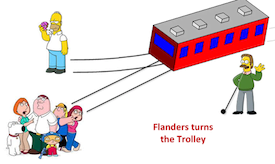
6a00d8342025e153ef01538e3a45b7970b-600wiI first heard about “the trolley problem” as an undergraduate philosophy student in 1991, as one of the countless thought-experiments moral philosophy uses to probe our intuitions regarding right and wrong, and whether we are consistent in our judgements of what is right/wrong. The problem, for those of you who don’t know it, is presented by its creator (Philippa Foot) as follows:

Suppose that a judge or magistrate is faced with rioters demanding that a culprit be found guilty for a certain crime and threatening otherwise to take their own bloody revenge on a particular section of the community. The real culprit being unknown, the judge sees himself as able to prevent the bloodshed only by framing some innocent person and having him executed.

Beside this example is placed another in which a pilot whose aeroplane is about to crash is deciding whether to steer from a more to a less inhabited area. To make the parallel as close as possible it may rather be supposed that he is the driver of a runaway tram which he can only steer from one narrow track on to another; five men are working on one track and one man on the other; anyone on the track he enters is bound to be killed. In the case of the riots the mob have five hostages, so that in both examples the exchange is supposed to be one man’s life for the lives of five.

Day 4 at #TAM2014

downloadThis year’s TAM concluded yesterday, with Randi remarking (during the closing address) that this was the best TAM he’d attended. Seeing as he’s been to all of them (13 in total, I think), that’s a strong statement. All I can say is that it’s the best of the two that I’ve attended, and that’s largely due to the high quality of the majority of the talks.

As usual, there were many good evenings and afternoons with friends old and new, but that was simply a bonus. The panels, talks and informal discussions were tremendously rewarding on an intellectual level, not only in terms of skeptical activism, but also for me as a teacher of critical thinking, in that many of the participants are involved in the same or overlapping fields.

Day 3 at #TAM2014


I’d wager that everybody’s batteries run dry at some point over the four days of TAM. Not their cellphone batteries, I mean (even though this is true also), but rather their ability to remain awake for yet another interesting-looking talk. Yesterday – day 3 – was the day I ran out of juice, so I don’t have all that much to report, given that I missed a fair number of sessions.

Elizabeth Loftus’s talk was the first I attended. If you don’t know her, she’s a psychologist with a special interest in memory and how it can deceive us, and this was indeed the topic of her talk, titled “The memory factory“. She took us through some very interesting examples of how eyewitness reports are far less reliable than one might think (or, hope), and left me thinking that I’d hate to be in a situation where my fate depended on someone else claiming they saw or didn’t see something! She’s published a bunch of books on the topic, so there’s plenty to read if you want to know more about this.

Then next session of note to me was Steven Novella on “How to think like a skeptical neurologist“. Steve Novella has been on quite a few panels this year, but has been consistently worthwhile. This talk was on the difficulties of teaching medical students how to diagnose patients, in light of cognitive shortcomings like the representativeness heuristic. Most people who read my posts would be aware of who Novella is, but if you’re not – and care to listen to podcasts – I’d highly recommend The Skeptics Guide to the Universe, a podcast that pre-dates Facebook, Twitter and the like.

The last two sessions of the day were presented by two of the most effective and inspirational science educators out there. First up, Eugenie Scott, a physical anthropologist, and formerly Executive Director of the National Center for Science Education. One of the things we have her to thank for is her role as one of the scientific advisors to the plaintiffs in the Dover trial, which resulted in the ruling against teaching creationism or intelligent design in public schools.

Her talk focused on hoaxes, pranks, urban legends and frauds. Besides the many humourous examples of pranks that she presented to us, her talk was a sobering reminder of the harms that can sometimes accrue from our not being sufficiently skeptical of stories we circulate via word-of-mouth or the media.

One particularly sad case she related was that of Oliver, the “chimpmanzee” who came to prominence in the 70’s and 80’s as a purported chimp/human hybrid. Unfortunately for Oliver, he ended up appearing more human than he was via abusive treatment such as removing his teeth, and Scott used this to remind us that we need to extend the net of possible victims in hoaxes beyond merely “our” sort of animal, the human sort. This seems an opportune time to remind you, or let some of you know, about sites like Snopes and the Museum of Hoaxes, both of which catalogue ways in which we have been (and continue to be) deceived.

Last up, Bill Nye (“the science guy”), previously a mechanical engineer at Boeing and now a science educator. This is one you simply have to watch when the TAM videos are released in (if history is any guide) 6 or 7 months time. While he did perhaps spend a little too long speaking about the debate he recently had with the nutbag creationist Ken Ham, the talk was nevertheless an inspirational – and highly entertaining – example of how to communicate complex ideas in an accessible fashion. (Though, I must confess that it’s fun hearing about just how strange Ken Ham’s beliefs seem to be!)

Immediately after the Nye talk, we decamped to the speaker’s reception, where we got to hobnob with Randi, Dennett, Tavris, Novella, Gorski and too many others to mention. Some of the magicians who are involved with TAM, or simply hanging around TAM, did some mind-boggling close-up card magic right at the tables too, which was quite the treat.

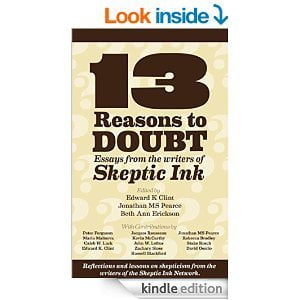
Now, it’s midday on the last day of TAM, and I’ve already concluded my talk, which I’ll most likely right a little something about tomorrow. For now, I’ll close with the news that 13 Reasons To Doubt, a book of essays by myself and other Skeptic Ink writers, was released yesterday, and is available as an e-book from Amazon.