On Grayling’s New College of the Humanities

As submitted to The Daily Maverick

AC Grayling, Oxford professor of philosophy – and the author of a recently-published “secular Bible”, The Good Book – has recently announced his intention of establishing the New College of the Humanities (NCH), an elite tertiary education institution. He’ll be joined in this endeavour by a number of intellectual luminaries, including Richard Dawkins, Niall Ferguson and Steven Pinker, many of whom will be shareholders in the College.

News of these plans broke while I was writing a previous column on the value of intellectuals and defending the idea of elitism at institutions of higher education, and in the two weeks subsequent to that, the opinion pages of most British newspapers have been littered with responses. Some of these have been favourable, but the majority of them create the impression that Grayling is determined to destroy the notion of education as a public good, and that he and his partners should be defeated at all costs.

Conveniently for many of the critics, Grayling and Dawkins are prominent atheists, so some of the criticism simply accuses them of wanting to institutionalise secularism and then stops there, thinking that some worthwhile point has been made. But outside of a religious university, a secular approach can mostly be assumed – exposing this particular criticism of the NCH as a straightforward attack on the characters of its founders.

More significantly, the matter of the fees charged and the structure of the college have been raised as issues. These are closely related issues, in that the NCH is not a university at all, but instead a provider of tutoring and lectures to assist students in succeeding with their registration for degrees via the University of London International Programmes.

These international programmes have over 50 000 students spread across 180 countries, and around 70% of these students pay independent teaching institutions for tuition towards attaining their University of London degrees. The NCH intends to be one of these independent institutions, and students attending classes at NCH will still pay approximately £1500 in fees to the University of London, as well as a smaller fee of £20 for associate membership of the UL libraries.

On top of this, they will pay £18 000 per year to NCH – double the £9000 cap imposed by government on public universities. And this is where the trouble really starts, in that critics allege that only the rich will be able to afford to attend NCH, and that Grayling and his compatriots are therefore entrenching class privilege.

But this isn’t a public institution. The NCH will receive no state funding, and will offer a service to those who want it, and who can afford it. If it is the UK government’s view that anyone should have access to the best possible education at the lowest possible price, then it is their task to provide that. Disparities in the quality of any good – including education – should not be remedied by simply excising the top end of the market, eliminating healthy competition.

Two other relevant considerations should be born in mind. First, that this is an attempt to introduce a US-style private institution to the UK, and that a fee-comparison with those sorts of institutions might be more relevant than the £9000 public university fee cap. At Harvard, an undergraduate degree costs you £21 500 in tuition fees per year, leaving the NCH looking far less of an outlier.

Second, Grayling intends to offer scholarships to 20% of students at launch, and hopes to increase this to 30% over the first few years of the NCH’s existence. It is his intention that financial means will be no bar to the best students being able to attend classes at the College, thanks to endowments that are currently being solicited. Given the networks that the academics in question have access to, there are some grounds for optimism that sufficient funding will be forthcoming. But even if the endowment scheme does not prove fruitful, the stated wrongfulness of this elite institution remains somewhat mystifying.

Better staff command higher salaries, and well-equipped universities cost more to run than less well-equipped ones. If every student and every curriculum looked exactly the same, we’d eventually see similar rates being charged across the board. But this homogeneity does not exist, and if the NCH offers a superior product, they should be able to charge a higher price.

The notion of tertiary education being a right rather than a privilege underpins these complaints. But that misguided notion does not support restraint of trade – or even charges of moral turpitude – in the case of the NCH. If it did, we should just as readily be complaining about the discrimination of charging R 10 000 a year more at one institution compared to another, in that some potential student will thereby be barred from studying where she wants to thanks to her available means.

At the forefront of the attack on the NCH we find Terry Eagleton, who speaks of the “nausea which wells to the throat at the thought of this disgustingly elitist outfit”. One of his concerns relates to how frequently students at the NCH will even come into contact with Pinker, Dawkins and the other notables, given their teaching, public speaking and other commitments. It’s unclear how their potentially irregular appearances in class differs from Eagleton’s own 3-week per year residency at the (private) University of Notre Dame (annual tuition fee? £ 25 400 p/a), but the extent to which the ‘names’ will and won’t be available is known to students in advance, and they can make an informed and free choice regarding whether they think they are getting their money’s worth or not.

Eagleton’s primary concern is the matter of what he calls “educational apartheid”. He says that if “a system of US-type private liberal arts colleges like this one gains ground in Britain, the result will be to relegate an already impoverished state university system to second-class status”, where we could expect poor students to go to (poor) state universities, while privilege is amplified through rich students being able to access elite institutions such as the NCH.

And yes, this could happen. But people will continue striving to become wealthy in order to afford the sorts of things that (more) money buys, and one of the ways that they do that is through inventing and selling things that rich people want. An elite education is one of those things rich people want, and if it’s being created and sold in a manner which involves no deceit or compulsion, they should be allowed to buy it.

Class divisions and poverty might well be with us forever. But to the extent that we can minimise social ills such as these, the argument that we should do so through forcibly impoverishing any person’s education makes little sense. Disguising historical advantage through not allowing initiatives like the NCH to compete in the educational market does nothing to flatten out that advantage. If we want to get to a world in which every student enjoys an NCH-quality education, starting by denying that privilege to any particular student doesn’t seem the most sensible strategy.

Remedial teaching at universities

As submitted to The Daily Maverick

While my focus in last week’s column was on the question of universities as elite institutions, Dlamini’s column, and Molefe’s response to it, addressed the issue of whether universities should be engaged in remedial education and if so, to what extent they should do so.

Elitism and the university

As submitted to The Daily Maverick

In Business Day last week, Jacob Dlamini argued that “universities should not be doing the work of high schools. Universities should not be in the business of remedial education”. TO Molefe has responded to Dlamini’s column, making the case that academic excellence is not the only imperative at universities, and that they do have a role to play in reshaping society through ‘remedial’ education.

Carry on (mocking) Camping

Originally published in The Daily Maverick

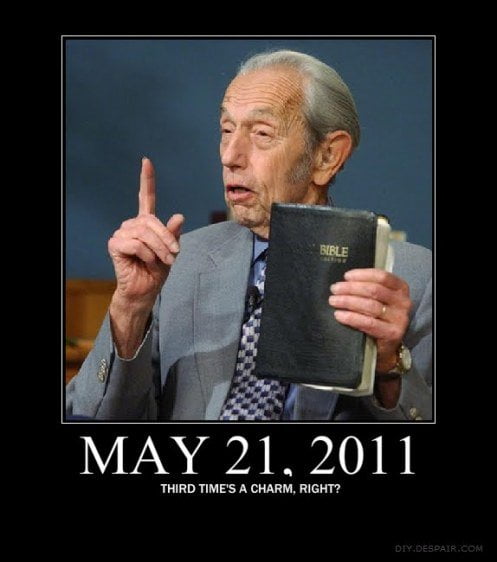
The day after the world didn’t end, Kevin Bloom suggested “the time for cheap shots has passed”. It’s certainly true that some cheap shots would be in poor taste, such as in cases where children suffered as a result of the delusions of their parents. But where people hold laughably confused – and potentially dangerous – views, surely we can and should make those views appear as unattractive as we can, in any way we can? If so, surely the more pressing issue is whether ridicule is effective, rather than whether it’s rude or not?

Racist Cape Town (redux)

Note: Those who have already read my earlier post on this subject might want to skip this column, as there is a significant overlap in content (around 90%). The text below represents an attempt to make my key concerns more evident, and is the version submitted to The Daily Maverick for my column this week.

A few weeks ago, my (occasional) fellow Opinionista Victor Dlamini Tweeted a link to an IOL report describing an instance of apparent racial profiling at the V&A Waterfront in Cape Town. The conversation which resulted should surprise no one at all, in that it consisted of the usual mix of protestation from Capetonians eager to refute the notion of Cape Town being a racist city, alongside various endorsements and examples of such racism.

Now that the local government elections campaigns are behind us, it is perhaps possible to discuss this issue more productively. Whether Cape Town fits the stereotype or not, it’s useful for the ANC to perpetuate the stereotype of Capetonian racism, as they enthusiastically did in the matter of Makhaza, as well as on several other occasions, however slight the opportunity to do so actually was. Well, they at least thought it useful – the election results could well indicate a greater agnosticism on this issue. But the politicisation of the issue tends to polarise opinion, rather than clarify the issue.

So, one could start by pointing out that to say that Cape Town is a racist city does not mean that everyone in Cape Town is racist. It certainly does not mean, as ANC spokesperson Jackson Mthembu alleges, that the governing party of Cape Town and the Western Cape is racist. I don’t believe that they are, and I also don’t agree with interpretations of events like the Makhaza toilet case which are used to support this claim.

Furthermore, it’s also perfectly understandable that the DA would protest claims that Cape Town is inherently racist – pointing to the diversity in the party, service-delivery successes, and Cape Town’s relatively low (compared to the other metro’s) Gini coefficient. Lastly, it could be expected that many white liberal sorts (such as myself) would feel offence as a result of such claims. But as I’ve frequently argued, offence is no guide to the truth, and also shouldn’t be used to drown out noises you don’t like hearing.

While it is of course true that there are racists everywhere, this doesn’t preclude the possibility of Cape Town containing a higher proportion of them, or for some Capetonians to be in denial as to how enlightened they actually are. If so, then it would make sense to say that Cape Town is ‘a racist city’, by comparison to other relevant South African cities.

And of course there are cities that are more racist than Cape Town – Orania would be a possible example. But despite all these disclaimers and qualifications, when compared with our other capitals or other major cities in South Africa, we certainly hear more stories about racist encounters or instances of perceived racism emanating from Cape Town.

Perceptions are not always true. Stereotypes can be perpetuated, sometimes through evidence, and sometimes through prejudice. It’s possible, for example, that the trope of a racist Cape Town is a simple consequence of jealousy, in that Northerners (and the ANC) want to find fault in what seems – on the surface at least, and also to many of those who live here – to be the best place in South Africa to call home.

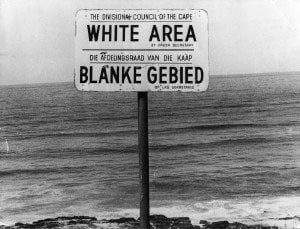
I can understand the anger of those who claim the stereotype of a racist Cape Town to be founded on prejudice, but I’m afraid I’m reluctant to agree with them. We shouldn’t forget that Cape Town’s urban planning was intentionally premised on the maintenance of social order, which in those days meant segregation of the races. Numerous books and papers detail the history of the City as divided on racial lines, such as this paper from Charlotte Spinks at the London School of Economics (pdf). In addition to academic texts, we have semi-regular accounts of discrimination at certain bars and clubs, and first-hand experiences of racism like those described in Xhanti Payi’s column, published last year in The Daily Maverick.

Anecdotal accounts of racism in Cape Town abound, but anecdotes are of course not data. The problem, though, is that we hear far fewer such anecdotes from other cities. And more than anecdotes, existing research such as the Surtee and Hall report (pdf) also appear to corroborate claims regarding racism in Cape Town.

And while some critics (including the DA) reject the findings of that report, one could argue that Helen Zille’s response doesn’t properly address the possibility of racism directed at black South Africans, in that it’s largely focused on the facts of integration and equity in the coloured population (I use this term as per Employment Equity legislation, rather than because I think they are sensible).

Two entirely separate issues could be co-existing here, and should not be conflated: First, it’s entirely possible – even probable – that the ANC uses the ‘racist Cape Town’ card as a political weapon against the DA, and in doing so might exaggerate the extent to which racism is prevalent in Cape Town. But second, it is also possible that black visitors to (and residents of) Cape Town experience racist treatment exceeding the levels found in other parts of the country. We shouldn’t pretend that this possibility doesn’t exist, simply because we don’t like it.

Cape Town does have a higher proportion of whites and coloureds than the other metros. And if racists are everywhere, we could well have more of them here than, for example, in Johannesburg. The facts of this matter could easily be established via a proper survey of attitudes and behaviours across the country, if we cared to do so. Until we do, anecdotes and perceptions are all we have – and the perceptions are real, and no doubt hurtful, to those who have them.

In other words, if it is the case that Cape Town is perceived as being racist, this perception is a problem in itself, regardless of the truth of the allegations themselves. And my opinion – right or wrong – is that this perception is grounded in reality. But whether it’s mere perception or not, we’re not going to fix whatever problems do exist – whether racism or the perception thereof – by being offended, or by insulting those who make such claims.

Defensive reactions such as these forestall debate. And whether prejudice exists equally everywhere or not, we know it at least exists everywhere. Perhaps, then, the real lesson lies in what Sipho Hlongwane Tweeted at the time, “CPT and JHB are often equally prejudiced. Only one city is honest & confronts this”.

Let’s start by making that two cities, and then not stop there.

Train your Muslamic rayguns on the alien overlords

As submitted to The Daily Maverick

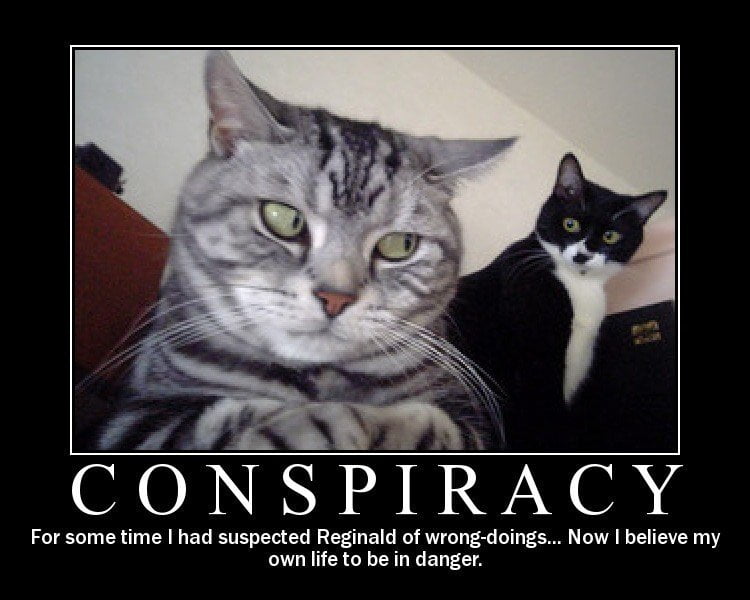
There is no doubt that conspiracies exist. Richard Nixon, for example, seems certain to have attempted to cover up his involvement in the Watergate burglary. But the fact that genuine conspiracies exist is no warrant to believe that they are widespread or to suspend reason in favour of making the implausible appear to be plausible.

As Sipho Hlogwane pointed out last week, the death of Osama bin Laden has resulted in all sorts of theorising regarding potential conspiracies. The common threads linking these conspiracies are firstly doubts as to when and how (and if) Osama bin Laden was actually killed, and second, the fact that most of those claiming conspiracy have as much information about the events as your average newspaper reader does. In other words, very little.

Because conspiracies have existed, and will no doubt do so in the future, we should be wary considering all claims to conspiracy as obviously insane, deluded, or simply the result of a poor analysis of the known facts. We’d be committing the fallacy of guilt by association if we were to treat all proponents of such theories as if they were in the same camp as David Icke, who famously believes that a group of reptilian humanoids (including Dubya and Kris Kristofferson) called the Babylonian Brotherhood rule the world.

Instead, we should treat conspiracy theories just like we treat any other theory, by considering whether they are plausible. Christopher Hitchens is said to have described conspiracy theories as ‘the exhaust fumes of democracy’, which neatly summarises the first problem we encounter in attempting to ascertain their plausibility. Thanks largely to the Internet, vast amounts of information currently circulates between equally vast numbers of people, all of whom feel entitled to an opinion on anything.

While these feelings of entitlement have no bearing on the quality of the opinions held, they do tend to exacerbate a problem presented by the widespread availability of information, whereby if you look hard enough, you can find ‘evidence’ to support whatever claim it is you’re trying to make. Fringe views can appear just as robust as mainstream ones, thanks to the democratisation of knowledge and the attention economy.

But the first problem with conspiracy theories, and what separates them from many more sober accounts of events, is that they are almost always unfalsifiable. Evidence that contradicts the conspiracy can be explained away through assertions that it’s been fabricated or planted, while evidence for the conspiracy can be treated as reliable, leaving sceptics powerless to debunk the theory in question.

A related problem is confirmation bias, which leads proponents to weigh this evidence in a subjective manner, favouring that which supports their hypotheses. In other words, the alleged facts of the matter make it impossible to refute conspiracy theories, while at the same time the psychological dispositions of conspiracy theorists lead them to give undue credence to one side of the story. To put it simply, a conspiracy theorist often sifts clumsily through the data while importing pre-existing prejudices into their analysis.

Confirmation bias is not the only heuristic at play. Consider also the fundamental attribution error, which is frequently observed in our attempts to explain the behavior of others. We tend to give excessive weight to explanations involving dispositions or motivations, while discounting the explanatory role of situational factors. As Micheal Meadon succinctly observed in a comment to the Hlongwane column linked above, ‘Cock-up before conspiracy’.

More broadly, the point is that there are often quite pragmatic – and prosaic – reasons or explanations for what might appear to be a conspiracy. In the Osama bin Laden case, these could include the ‘fog of war’, and they almost certainly include over-enthusiastic attempts to trumpet a perceived success, before making sure that the various spokespersons are in possession of the same facts.

And the facts are vital when assessing whether a conspiracy is likely or not. Those who subscribe to conspiracy theories seldom stop to think about just how difficult it would be to persuade people of a lie. Again, because we all have access to so much information, your chances of being caught out are very high – and that’s even before considering those who are motivated to uncover your darkest secrets, like Julian Assange.

The number of people who would need to be involved in a large-scale conspiracy should also make us sceptical. There is the possibility of an errant word by a conspirator, and where your conspirators would have to include soldiers, or contractors planting explosives in the World Trade Centre, the risks of exposure seem rather high.

It is also in the interests of each conspirator to defect if there is any chance of a conspiracy being uncovered. Not only because she might fear legal punishment, but also because she can become a tabloid millionaire, and an instant hero. Game theory would also imply that the more conspirators there are, the larger each individual conspirator’s incentive is to defect, because somebody is likely to defect, and the rewards for doing so would decrease the further down the line you were.

In the bin Laden case, it is difficult to think of any combination of circumstances that would make a conspiracy a worthwhile gamble for Obama’s administration to take. If bin Laden were alive, we would have heard from him the day after he was ‘killed’, and the chances of Obama being a one-term President would skyrocket. And if Obama did want to fake the assassination of bin Laden, surely he would choose to do so closer to an election, instead of squandering the earned currency at a time of no extraordinary political significance to him?

Occam’s Razor reminds us to make the fewest new or superfluous assumptions when trying to explain events. In this case, explanations involving conspiracy require not only assuming a grand conspiracy, but also an assumption that Obama and his team are unable to compute a quite simple cost/benefit equation. Under the circumstances, there seems very little reason to suppose events didn’t transpire in roughly the way we are told it did.

No matter how unlikely, it remains possible that we are being lied to. But David Hume’s words on miracles might well apply to conspiracy theories also, where he pointed out that

the passion of surprise and wonder, arising from miracles, being an agreeable emotion, gives a sensible tendency towards the belief of those events, from which it is derived. And this goes so far, that even those who cannot enjoy this pleasure immediately, nor can believe those miraculous events, of which they are informed, yet love to partake of the satisfaction at second-hand or by rebound, and place a pride and delight in exciting the admiration of others

So yes, conspiracy theories are cool. And yes, perhaps we’re all gullible fools, and some of you have access to information we don’t, or are simply smarter. But probably not. And as David Mitchell pointed out in his column for The Observer over the weekend, ‘if the lizards can get their shit together to that extent, they probably deserve to be in charge of everything’.

P.S. If you have no idea what the ‘Muslamic rayguns’ of the title refers to, this post by 6000 will enlighten you.

The Erasmus judgement on Makhaza

As submitted to The Daily Maverick

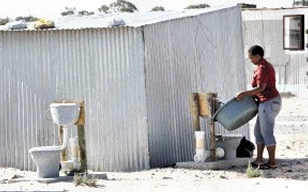
The Erasmus judgement in the Makhaza toilet case, handed down on Friday last week, makes for depressing reading, as would the details of the lives and conditions of most poor South Africans. The judgement itself contains a hint of this, where (in section 136), an affidavit related to the City of Cape Town’s counter application is excerpted, in which Thembisa Princess Sokabo tells us that:

The toilets we have in Nkanini (i.e. the one to five households toilets) are generally in an appalling state, notwithstanding the City’s attempt to maintain same, to the extent that members of the community generally do not use them. They are always blocked and filthy, and are not appropriate for human use. Due to the fact that they are communally owned, people do not take responsibility and personal pride in them. Not only are the toilets filthy and unsafe, but they are a health hazard to people in general and to children in particular as they have burst pipes which are overflowing with faeces.

Despite the fact that many South Africans are forced to live in sub-optimal, unhygienic, and sometimes even degrading conditions, Makhaza has become one of the focal points of debate around service delivery in the Cape. By extension, Erasmus’s Makhaza judgement has rapidly become a stick that Tony Ehrenreich is using to argue that the ANC would do a better job than the DA of defending the interests of the poor.

This could well be true, although we should remember that the ANC has already had a chance to champion the interests of the poor in the Cape. But while the ANC’s return of 45% of the vote in 2004, along with the 11% of votes garnered by their partners (the New National Party) in that election, brought them to power in the Province, their support dwindled to 32% in the 2009 election. If we are to take the notion of democracy seriously, this indicates that voters wanted to give someone else a chance to govern, and exercised their right to vote correspondingly.

That was of course a different time, and the fact that the ANC lost control of the Cape can’t demonstrate that an ANC government in 2011, and Ehrenreich as Mayor of Cape Town, won’t do better than previous incumbents. The chaotic nature of ANC politics in the Western Cape, along with floor-crossing and the death (and now, zombified re-animation) of the NNP – not to mention the short history of democracy in South Africa – make trends difficult to pin down.

None of these complications should however obscure the fact that there is a difference between fact and fiction – and in particular the kind of fiction that emerges in the run-up to elections, when selective factual details are plucked out of context and presented as damning evidence for a fiction. In this case, the fiction in question is that the DA government in the Western Cape is somehow at war with the poor, based on the ‘fact’ that they constructed unenclosed toilets in Makhaza.

Except, they didn’t – or at least didn’t intend to. What they did try to do was to collaborate with the residents of Silvertown to ensure that they all had enclosed toilets, by spending their budget on providing the toilets and plumbing connections, while trusting the assurances of the community that they would build their own enclosures where necessary. This plan failed, and cynics could argue that it was always likely to fail, or that the demands of dignity for the residents required that this detail not be left in the residents’ hands in the first instance.

Of course, we can never know whether the residents would have built their own enclosures, because the City of Cape Town eventually resolved to provide these for the 3% of residents who had not built them for themselves. And then, as we should also remember, they were prevented from doing so by the repeated destruction of the enclosures by the ANC Youth League.

You could argue that the DA has been somewhat naïve in their approach to this issue, as they undoubtedly were in the case involving the delisting of the Sowetan journalist, Anna Majavu. There is evidence of such naïveté, in that this was a relatively predictable PR disaster.

In the context of the South African sensitivity to class divisions and poverty, an approach which involved a relative absence of paternalism (here, in which services are provided in partnership with the community) was clearly risky. Any failure, at any link in the chain leading to enclosed toilets for all, would always have been spun as a failure on the part of the DA, with the roles of other agents ignored or elided. Worse yet, any protestations of good will on the part of the DA can immediately be spun as further evidence of callous neglect.

Sadly, the safest strategy may well be to do the bare minimum – and also to do it in a way which minimises the chances of failure, by swooping in and delivering from on high rather than by attempting to involve communities in their own upliftment. If this is the lesson that Ehrenreich or the ANC want the DA to learn, they might well have succeeded.

But in doing so, they could well have simultaneously built a rod for their own backs, because the inflamed rhetoric surrounding the Makhaza judgement makes it appear no less than a capital crime to leave toilets unenclosed, regardless of the circumstances leading to that eventuality. According to Jackson Mthembu, the unenclosed toilets show a “total disrespect for black dignity”, and demonstrate that the DA “is a racist political party”. In fact, the “Makhaza judgment remains a chilling reminder showing on whose side Zille and his [sic] bunch of racist lackeys are on”.

In light of this strong reaction, as well as the claim from Cooperative Governance and Traditional Affairs Minister Sicelo Shiceka that unenclosed toilets would never be tolerated under ANC governance, what are we to make of the unenclosed toilets in the informal settlement of Rammulotsi, in the ANC-run Moqhaka municipality – some of which have been unenclosed since 2001? Or those in Kwadabeka, outside Pinetown in the eThekwini municipality, where the ANC garnered 67.52% of the vote in 2009?

Perhaps the real lesson here is the reminder that in politics – and especially, in the weeks running up to an election – facts sometimes simply stop mattering. But perhaps it doesn’t need to be this way, and perhaps increasing numbers of citizens are starting to realise that the truth doesn’t always correspond to the claims made in political speeches, especially when those speeches concern the actions of competing political parties.

Let’s hope so, because as with all decisions, those made while voting should be informed by the facts, rather than by faith. And Makhaza is one settlement, in one Province, in one (mostly poor) country. We should ideally cast our votes for who we think will do the best for that country in the long-term, and not simply based on caricature, and misrepresentation of those facts.

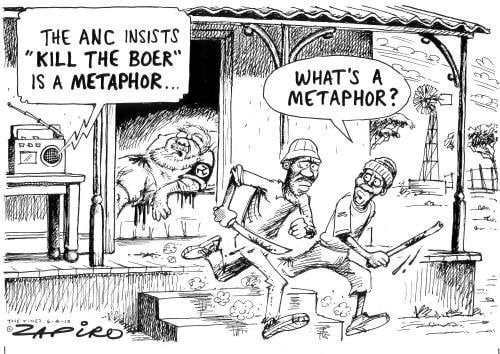
Kill the Boer: Afriforum vs. Malema

As submitted to The Daily Maverick.

It’s easy to demonise those who disagree with us when discussing emotive topics like hydraulic fracturing, or the ongoing Equality Court case involving Afriforum and Julius Malema. But while it is sometimes true that sincerity takes a back seat to ideology or fanaticism – or even kickbacks from corporate lobbyists – it’s far more often the case that demonising an opposing point of view serves merely to reinforce your own confidence that you’re right and everyone else wrong.
The ANC’s election strategy: Blackmail

As submitted to The Daily Maverick.

One way of thinking about the upcoming local government elections is as a session of couples’ therapy. While some disaffected voters are frequenting their local singles bar, either genuinely unattached or maybe ‘just looking’, and others are actively fleeing a situation they quickly realised they simply couldn’t cope with, many voters are still trying to make their current relationship work.

The ANC might hope that the (roughly) 66% of votes it attracted in the municipal elections of 2006 came from South Africans who remain committed to that particular relationship. But from the outside, where I find myself, it is sometimes difficult to understand why that might be the case, as the relationship seems increasingly one-sided, and sometimes even abusive.

This is not to say that it can’t be fixed, if both parties put the effort in. And perhaps the relationship is simply undergoing a short-term wobble – a 17-year itch of sorts. But when one party in a relationship – the voter – is treated with the sort of contempt occasionally displayed by people representing the ANC, it seems entirely appropriate to question whether both remain equally committed to making the relationship work.

In February, President Zuma told us that when “you vote for the ANC, you are also choosing to go to heaven. When you don’t vote for the ANC you should know that you are choosing that man who carries a fork … who cooks people”. As Sipho Hlongwane correctly pointed out, statements like these seem little more than diversionary tactics, intended to distract attention from dysfunctional local municipalities, corruption and the like. As per those oft-misunderstood and abused lines from Marx, religion is here meant to serve as the resigned ‘sigh of the oppressed creature’, and an opiate for the masses.

Beyond the cynicism of exploiting the religious beliefs of your citizens to retain votes, Zuma’s statement was also a lie. Not only a lie from within the belief system he was appealing to (for where in the Christian Bible does one find God’s endorsement of the ANC?), but also a lie from outside of those beliefs, in that it is telling voters that factors besides government performance should determine which boxes you cross on May 18.

Jackson Mthembu responded to the criticism resulting from Zuma’s statement by telling us that it was neither blasphemous, nor to be taken seriously. “South Africans – both black and white – fully understand the use of figurative expressions”, Mthembu said, after which he pointed out that those perturbed by this statement “are probably driven by jealousy for not having thought of the expression themselves”.

© 2010 Zapiro (All rights reserved)
Printed with permission from www.zapiro.com
For more Zapiro cartoons visit www.zapiro.com

These are probably also lies. With approximately 73% of South Africans self-identifying as Christians, and in a country where many outside of the middle and upper classes still take sangomas seriously, the claim that we all fully understand the distinction between literal and figurative speech is difficult to read as anything but an attempt at damage-limitation, where an apology and a retraction would have been more appropriate.

It’s also worth pointing out that the majority of eligible voters in the upcoming elections still came through a system where educational resources were unequally deployed, and – regardless of how well or how poorly you think we’re being educated today – would probably not have been taught that references to eternal damnation by Presidents should not be taken seriously.

Mthembu’s jealousy statement is also likely to either be dishonest (or simply naïve), in that we can well imagine other political parties as being capable of imagining ways to threaten voters into supporting them. The difference, of course, is that they would usually choose to spend their time more productively, or failing that, to not deploy those threats at all. The ACDP is of course the exception here, given that they seem to think that God wants to micro-manage all aspects of our lives.

Tony Ehrenreich, the likely mayoral candidate for the ANC in Cape Town, also exploited voters with a similar lie on March 6, when he told a community meeting that they needed to choose whether they wanted to be “on the side of justice” (by voting ANC), or “on the side of the devil”, which is what a vote for the DA (specifically Helen Zille) would apparently amount to. Zille must therefore be a satanic monkey, if you put Ehrenreich’s statement alongside one of Malema’s recent outbursts, in which he asserted that Zille would not be out of place in a simian dancing troupe.

But just in case not all voters are Christians, and therefore aren’t fearful of Satan or his monkey-minions, Malema recently upped the ante by telling us that not only would a vote for anyone other than the ANC send you to hell, it would also contribute to the death of a flesh-and-blood icon, Nelson Mandela. You would, in effect, be committing murder – perhaps even something like patricide – by voting for the for an opposition party.

Last week, Malema told the crowd at a Port Elizabeth rally that “President Mandela is sick and you don’t want to contribute to a worsening condition of Mandela by not voting ANC. President Mandela will never endure if the ANC is out of power”. Just as with Zuma and Ehrenreich’s statements (and, probably, similar ones made at smaller and unreported gatherings), no apologies or retractions are forthcoming, even though these statements amount to treating voters with utter contempt.

Contempt, because they don’t treat voters as capable of making choices based on genuine political issues, such as service delivery or which up-and-coming dictators we plan to supply weapons to next. Instead, voters are simply treated as a means to the end of retaining power – which is why this relationship is dysfunctional.

If you find yourself in a relationship where persuasion occurs through emotional blackmail rather than appeal to evidence or mutual interest, then the chances are good that the relationship is an abusive one. Emotional blackmail uses fear or guilt to create the impression that you have no choice but to go along with the abusers’ wishes – yet elections are meant to be all about choice, not about threats and intimidation.

At a certain point in such a relationship, friends and family would no doubt counsel you to cut your losses, and end things before more harm is done. We’re often reluctant to do so – not only because of genuine commitment or affection, but also because of cognitive biases involving escalation of commitment (in extremis, as typified in Stockholm syndrome). So instead, we might try to make it work, and give the abuser one more chance.

And this is of course our choice, and our right. We should however remember to try and not be distracted by threats and accusations. Perhaps, we should also remember how it works in other relationships, where claims of contrition and a desire to change require evidence – or at least an acknowledgement of wrongdoing.

Postscript: On the day this column was published, ANC secretary-general Gwede Mantashe announced that they would not be announcing the names of mayoral candidates until after the election (except in Cape Town, where Cosatu has forced their hand. It’s a question of trust, I guess they might say. Others might say it’s evidence of confusion and disorganisation, and disregard for the interests of voters.

Floyd Shivambu and ‘hate speech’ against Carien du Plessis

As published in Daily Maverick

The Equality Court has postponed the hate speech case against African National Congress Youth League spokesperson Floyd Shivambu. They should not however be hearing this case at all – regardless of the fact that Shivambu appears to be a sexist and a racist, and that his speech might be hurtful towards Carien du Plessis or other journalists he has targeted in the past.