Hey, teacher, leave them kids alone!

Originally published in the Daily Maverick
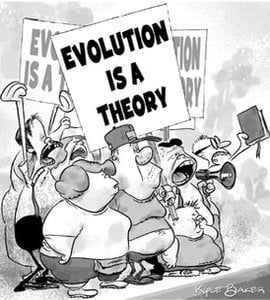
evolutionisatheoryIt’s important for all of us – whether religious or not – to defend the secular viewpoint in public institutions, law and policy. For one, because secularism means that you will never be forced to attend or participate in the ceremonies or practices of religions other than your own.

Defenders of religious expression sometimes forget the fact that often, it’s only contingently the case that you’re defending the expression of a religion you happen to belong to, and that this coincidence can’t be guaranteed. If your neighbourhood school were over time to evolve into one of a different faith, you might suddenly wish for the school to be stubbornly secular.

A second reason to defend secularity, at least in my view, is because a secular environment is well suited to fostering free and rational choice and taking responsibility for our choices, as I argued in this column defending the rights of children to wear religious headgear at public schools. It’s clearer to see the relationship between our beliefs and our actions if we aren’t forced – not matter how implicitly – to perform certain actions.

Secular does not need to mean (in fact, ideally would not mean) hostility towards religious expression. It would mean neutrality, while allowing for the free expression of religious belief so long as that expression accorded with the Constitution and any other relevant law.

South Africa has a mostly superb framework ensuring secularism in our public schools. I’ve written about aspects of this before, but a recent email correspondence with a friend regarding the school her son attends offers an opportunity to highlight what I have reason to believe is a fairly common occurrence – namely, public schools ignoring the explicitly secular (but tolerant) National Policy on Religion in Education.

The case in point is Glenstantia Primary, who approved a new policy on religion in September 2012 (citing the Constitution, the National Policy on Religion and Education and other documents as references). Despite name-checking the National Policy, the “Governing Body of this school decided that Glenstantia Primary shall be a Christian based school” – which can’t avoid but create an impression of bias rather than neutrality towards not only religion, but more importantly, a specific religion.

Pierre de Vos has previously argued that statements like “this school has a Christian character” might well be contraventions of Section 15 of the Constitution, as well as the Schools Act, both of which allow for religious expression, but only on an “equitable basis”. As de Vos points out, our Constitutional Court has shied away from ruffling any feathers in judgements on this issue, partly because some wiggle-room is afforded them through the limitations clause.

However, if a group of parents were to ask the Department of Basic Education to account for their numerous failures to enforce the Policy, I’d expect a similar outcome to the one achieved by Vashti McCollum in 1948, when the US Supreme Court agreed that calling religious observances “voluntary” could cover up a multitude of sins.

As the majority opinion in that case states, “both religion and government can best work to achieve their lofty aims if each is left free from the other within its respective sphere”. At Glenstantia, calling the school “Christian” already makes someone who believes in something else, or nothing, feels like an outsider. But the violations of the policy don’t stop there.

Clause 3.3 insists that the Bible is read at all “assemblies and school gatherings”, and then 3.4 insists that all pupils have to attend these events where hymns are sung and prayers said. You need not participate – but then you need a letter from your parents excusing you.

There are two clear problems in this: first that there’s nothing “equitable” about how religions are treated here, and second, a non-religious child in a religious family is either forced to lie (through participating in a charade) or forced into a very difficult confession of non-faith to a potentially hostile family.

In this sort of situation, who would blame the scholar for not simply taking the easy route, succumbing to peer, school and family pressure through pretending to be religious? For institutions like schools that are meant to teach the ability to think, be independent and so forth, this doesn’t seem a good start. Neither is it a good start in a life of Christian virtue, if you’re attracted to the faith via a subtle form of bullying.

The school has an obligation to support the National Policy, rather than make pupils and parents jump through hoops to ensure that they are not discriminated against. Clause 3.5 says that “other persuasions will be respected”, but when “every school day begins with a prayer and/or a reading of a portion of the Bible” (3.6), it’s difficult to take that pledge of respect seriously.

There is more, but the point is by now clear – one can speak of tolerance and equitable treatment of religions (and the non-religious), but get away with nothing more than paying lip-service to that equitable treatment. This is not only the grouching of an atheist, but a concern that should be shared by every Muslim, or Jewish, or whatever, parent that has a child at a school like Glenstantia.

The point of secular provisions such as the National Policy is that they protect us all from undue influence to toe a particular line, allowing for free expression of whatever beliefs you have, regardless of how fashionable, popular, or government-endorsed they are. We’re all free to believe what we like, and to engage in whatever religious practices we like – or not to, as the case may be.

Either way, it doesn’t have to be anyone else’s business other than yours. If you want to start and end your day with a prayer, go ahead. But why should doing so be forced on other people’s children, or made everyone (anyone) else’s business?
The sound and fury of sanctimony

Originally published in the Daily Maverick

imagesThe Easter holidays got me thinking – again – about what each of us could do to increase the odds of having a conversation on the Internet, thereby potentially changing our minds about something. In particular, changing our minds about how we perceive each other’s views on faith and religion. After all, changing our minds is what reading and writing should be about: discovering how we are wrong, rather than reinforcing to ourselves the ways in which we are right.

Easter brought these thoughts back because of the predictable squabbles that flared up between religious believers (well, Christians in this case) and those of us who don’t believe. Both of these groups can take themselves far too seriously: the non-religious through going out of their way to also be anti-religious, and the religious through taking offence at any slight, no matter how minor.

Some people did seem to go out of their way to be blasphemous, especially on Twitter, but jokes like the one that got me into brief trouble when I re-tweeted it (say Jesus backwards. Now say God backwards. Now say them together), or Barry Bateman’s quip about this being a day all about “caramel centered chocolate eggs” (which attracted a full day of judgement) are surely of the sort that can (and should) simply be laughed off as a difference of opinion.

Most of the time, a commitment to secular values would allow for both “sides” to leave each other alone, because their actions and beliefs, kept private, have no impact on others. But for both of these groups, the nuances of how (and why) people believe or disbelieve can get lost in convenient caricatures. In fact, sometimes even the truth is hostage to the will to (dis)believe. Two brief examples aren’t conclusive, but hopefully serve to make the point.

On the Christian side, the Church of England did themselves no favours through being caught out in what appears to be a blatant lie. In the run-up to Easter, they released the results of a poll indicating that 4 out of 5 people believe in the power of prayer – and gratifyingly for them, that belief in the power of prayer seemed to be on the rise in the youth.

The only problem is that the poll shows nothing of the sort. The 4 out of 5 figure is derived from the fact that when asked the question “Irrespective of whether you currently pray or not, if you were to pray for something at the moment, what would it be for?”, 80% of people gave a response instead of saying “I don’t know” or “I would never pray for anything”.

The desire to have a good-news story about the church, especially in the run-up to Easter, is understandable. And in light of 2011’s Dawkins’ foundation research indicating that fewer people seem to believe in the power of prayer than ever, this particular good-news story would no doubt be particularly welcome. But when your brand is built on virtue, and is in competition with others that claim you’re simply making stuff up, it does no good to make stuff up.

On the atheist side, I’m rather grateful to the majority of religious folk who are either disinterested enough or kind enough to not make more of an issue out of the continued civil wars around the role of social justice causes inside atheism, in particular the widespread allegations of misogyny. Instead, the focus continues to be on some of the more prominent voices for non-belief, and in particular, Dawkins himself.

And he seldom fails to disappoint those looking for a soundbite purportedly demonstrating the tone-deafness and hostility of atheists. While I do think most of the examples chosen to make this case are cherry-picked or misinterpreted, it remains true that doing our own cherry-picking or misinterpretation in response is no evidence of virtue.

Furthermore, he really does put his foot in it sometimes, like last week when he told his 660 000 Twitter followers:

He’s right on the logic, sure – but it would have been easy to be right while simultaneously not being maximally offensive.

I’ve addressed questions of strategy before, for example in relation to someone who does actually try to be the lightning-rod that Dawkins is perceived as being – David Silverman of American Atheists. While I haven’t changed my mind that we need people like him to expand the polarities of the debate, and perhaps to stretch the middle-ground for more moderate strategies, they do sometimes make the PR job difficult for those of us who think of religious people as mostly harmless, most of the time.

Likewise, the overly sanctimonious believers who seem to have sacrificed their sense of humour do the majority of believers no favours. Nor, of course, do those who argue against equal rights for gay couples or availability of contraceptives; or those who condone (through inaction, at least) child abuse or the stoning of adulterers and rape victims.

In short, there are all sorts of obstacles to being understood and to having a dialogue. Eliminating some of these require getting our own houses in order, rather than looking outward. But when we do look outward, let’s try to look at what’s in front of us, rather than being distracted by the convenient fiction of the stereotype.

Burn the witch!

Originally published in the Daily Maverick.

witch1Gauteng education MEC Barbara Creecy recently did a superb job of name-checking existing policy while simultaneously ignoring it. On March 18, a new element of the Department of Education’s partnership with faith-based organisations (FBO) was announced: the development of an “Anti-Harmful Religious Practices strategy”.

The policy I refer to is the National Policy on Religion Education, a mostly superb document that appears to be routinely ignored, judging from the dozens of emails I’ve received from parents across the country, whose children are pressured to participate in religious (usually Christian) activities at public schools.

Kader Asmal’s foreword to that policy reminds public schools that they are obliged to be “neither negative nor hostile towards any religion or faith and … not discriminate against anyone”, and calls for “a profound appreciation of spirituality and religion in its many manifestations, …  but does not impose these”.

What, then, is an MEC for education doing endorsing a FBO initiative to “guide and protect learners from spiritual attacks”, making specific reference to the “harmful aspects of the occult and Satanism”? Three fundamental blunders are evident here, two of which constitute violations of the policy. The third is simple mindless populism, which no policy currently prohibits.

First, if we’re going to address the harmful aspects of religion – an initiative I’d wholeheartedly endorse – we shouldn’t do so by rigging the game in favour of one religion or a handful of religions over others. Regardless of the fact that South Africa is estimated to contain a (significant) majority of Christians, freedom of religion means that we should treat them all with an equally critical mindset, at least as far as government is concerned.

So, if we are to look at the harmful aspects of religion, it would be incumbent on us to consider not only possibly harms emanating from “the occult”, but also possible harms emanating from the two religions Creecy is partnering with.  Some Muslims might, after all, interpret An-Nisa, verse 34 to legitimise domestic violence: “As to those women on whose part ye fear disloyalty and ill-conduct, admonish them (first), (Next), refuse to share their beds, (And last) beat them (lightly); but if they return to obedience, seek not against them Means (of annoyance): For Allah is Most High, great (above you all).”

As for the Christian FBO’s, we can easily find examples of scriptures encouraging slavery or homophobia, the latter of which is a clear – and prevalent – example of a harm emanating from religion. I’d hope that the focus on Satanism and the occult doesn’t prevent Creecy and her FBO’s from reminding pupils to avoid those evils too. If your response to this is that the more mainstream religions are somehow different, you’re falling prey to the same mindless populist impulse Creecy is, as I’ll get to in a moment.

A broader inconsistency in how these harms (or alleged harms, in some cases) are being addressed is the legitimising of the concept of “spiritual attacks” at all. There are those of us who think the mere idea of a spiritual dimension to life (by which I mean a non-physical element to personal identity, rather than anything to do with meaning, wonder, transcendence and so forth) potentially harmful.

This is because of at least two reasons: first in giving young folk a very early and very seductive introduction to magic; and second in giving humans in general an excuse to treat each other and themselves less well than they could otherwise do. In believing that this mortal life is the only time I have, I feel motivated to make the most of it, and that certainly can’t include pleasing metaphysical creatures, seeing as there are more than enough creatures around me whose lives I can impact for better or worse.

These sorts of issues involve debating what the various religions believe, not only around aspects such as souls, but also in terms of their attitudes towards gender equality, sexual orientation and the like. This brings me to the second apparent violation of the policy – evident in the fact that neither is it the case that any representatives of Satanism or “the occult” were ever consulted, and nor is it the case that they form part of the FBO grouping tasked with developing a strategy that “should be aligned with department’s Education Religion Policy in Public Schools”.

I agree with Creecy that it should be aligned, which is why it’s peculiar for the representation she’s implicitly endorsed to have picked sides in favour of the mainstream religions, and specifically excluded the religions identified as presenting the largest threats to spiritual and other welfare.

Not being given the chance to defend yourself, while simultaneously being singled out as a threat, hardly seems in accord with the National Policy’s instruction that the state “must maintain parity of esteem with respect to religion, religious or secular beliefs in all of its public institutions, including its public schools”. Trash-talking someone, or in this case some religious beliefs, without giving them a chance to defend themselves provides evidence of something quite contrary to “parity of esteem”.

And third, Creecy and the FBO’s are talking trash. Some occult practitioners (and here I include those who speak to gods in prayer) engage in harmful behaviour, but it is untrue and unfair for us to generalise from a small sample, picked mostly in an effort to justify our prejudices, and to conclude that the entire religion was harmful.

If I were to assert that Christians are homophobes or that Muslims are misogynists by reference to various scriptures, I’d expect responses of the sort that claim texts are being misinterpreted, or that things have changed, or that “we’re not all like that”. This is because some folk pick one (plausible) interpretation and others pick another (plausible) interpretation of a text.

Well, let’s extend the same courtesy to other religions as you’d like extended to your own. The next time you hear about Kobus Jonker being hauled out to nod knowingly at a pentagram and a headless rabbit, perhaps try to remember rule 10 of the Satanic version of the 10 Commandments, which reads “Do not kill non-human animals unless you are attacked or for your food”.

The caricatures that atheists like myself are sometimes guilty of when it comes to the mainstream religions should not serve as an excuse for those mainstream religions to caricature the marginal ones. Instructions against things like rape and murder are prominent in the Satanic Bible, and just as Christians feel justified in disowning Pat Robertson or Errol Naidoo, we should grant Satanists the same privilege.

I’m not disputing that religion can cause harm, and more importantly in this context, that religions like Satanism can (indirectly) cause severe harms, through confused or alienated schoolchildren like Morne Harmse picking up on them as a vehicle for rebellion. So an anti-harmful strategy for religion is to my mind a sensible thing.

But in developing such a strategy, there’s no need to add to the harms by misrepresenting other religions, just because that fits into the caricature confirming the biases of the mainstream ones, and more notably, the biases towards the mainstream ones.

And, when we speak of spiritual harms – especially when we speak as government officials – we need to also keep in mind those of us who think it is the mere idea of spirits that gets this trouble started in the first place.

The naked truth about porn on television

Originally published in the Mail & Guardian, 22 March 2013

When TopTV announced that they were planning to launch a fresh bid to screen adult content, a number of the self-appointed guardians of South Africa’s moral fibre rushed to our aid. The usual suspects (like African Christian Action or the Family Policy Institute) spoke of the “flood of filth” that would destroy our families, corrupt our children, and in general violate more rights than I was aware we even had.

The Icasa hearings on these adult content channels took place on March 14, and I was one of only two people who presented in favour of TopTV’s application (besides the applicants themselves, of course). The written submissions received by Icasa were overwhelmingly disapproving (440 against, with only 16 in favour), while at the hearings the ratio shifted to a more balanced two in favour and six against.

That’s where the impression of greater balance began and ended, for the most part. If you were keen on getting examples of how to marshall anecdotes, logical fallacies and statistical innumeracy in favour of a moralistic conclusion, the Icasa offices were the place to be on that day. As I said in my submission, porn seems to reliably increase only two things: arousal and religious outrage, but perhaps negative causality in relation to common sense needs to be added to that list.

It is not true, as some might think, that you need to think pornography entirely unproblematic to defend the right of a broadcaster to screen it, or viewers to watch it. Personally, I’m quite convinced that pornography can alter expectations in the bedroom, or in relationships more generally. But so can just about any entertainment product you can imagine, and pornography only becomes particularly interesting if it causes harms by necessity, or harms that are more severe or of a distinct type.

For some, pornography does seem to be particularly interesting by virtue of simply being pornography. It’s about sex, and sex is about families, and families involve children and healthy societies. We don’t like to talk about sex, or watch it – especially not the kind of sex they show in pornography. Ergo, porn harms children and families.

Except, we don’t have any compelling reasons to believe that it does, in ways attributable to the pornography rather than to other variables such as poverty, communication breakdowns, or the pressures of fulfilling Calvinist, heteronormative, nuclear family-related social expectations that are increasingly ill-suited to the various interests and desires of the 21st-century human.

Introducing one or more pieces of research here will mostly only serve to stoke up a cherry-picking contest in the comments and letters, so I’ll say only this: the past few decades have allowed for a global social science experiment involving being able to compare class, income, race, gender, religion and whatever else you like with porn and sexual violence. And when you look at that data, it requires a fair amount of contortion to avoid the conclusion that people who are educated and living in a functioning and responsive state commit fewer crimes of all sorts, regardless of porn access.

Pornography is a red herring in this argument, particularly with regard to the anecdotes regarding the effects of porn that the Icasa commissioners got to hear about. There’s no question that South Africa is experiencing obscenely high levels of rape (not that any level is not obscene), but it’s not possible to blame pornography for this, given that the sexual violence clusters in areas that are poor, and have less access to pornography than the average reader of this column does. The middle and upper classes should be doing most of the raping, and they are not.

Yes, of course there may be a correlation between pornography and sexual violence – just as they may be a correlation between hours spent on church pews and lower-back ache. But correlation does not imply causation. It’s easy to use correlation and “science-y” language to contribute to a moral panic – but less easy (although far more useful) to demonstrate a clear causal link.

It adds no evidence of causation to wheel out a young man to testify that his cousin’s consumption of Etv pornography led to his rape, at age 13. For every example of this type, we could find thousands of South Africans who watched Emmanuelle without resorting to sexual violence. Note also the apparent contradiction between the “rape is about power, not sex” narrative and the “porn on your TV screen causes rape” narratives.

Then, asserting that porn is as addictive as heroin or cocaine, and that it takes only 5 minutes exposure for a child to be irreparably harmed, doesn’t make it so. The editors of the DSM-V chose not to include pornography as an addition – evidence that it’s at least a contested claim, rather than something to be bandied about as fact.

The real, and honest, narrative here is simply one of a contest between various moral preferences, where pornography, sex worker trafficking and rape start being treated as inter-related just because people say they are so. But the facts of the matter can never be settled by shouting, by our (legitimate) fears for our safety, or by anecdotes involving claims like Ted Bundy “got started in porn” – as if porn should now be understood as likely to turn all kids into Ted Bundy’s.

The joy (albeit one experienced all too rarely) of living in a constitutional democracy that is mostly secular is that you don’t have to watch consume porn if you don’t want to. There are risks in allowing people choice, yes: it’s difficult to predict or control what choices people make, and therefore what you – or your children – might be exposed to.

This means that the task of parenting, or of providing moral guidance in other contexts, is a difficult one. This is as it has always been, and as it should be. But none of us has the right to prescribe morality for others, especially not on the basis of cherry-picked data and moral hysteria.

Not even Madiba can turn anecdotes into data

Originally published in the Daily Maverick

b4fe7c9b0dba486dbca05103ef5b7445One of the documents that awaited my return from the Icasa headings on TopTV’s application to screen adult content channels was a medical certificate, in support of a student’s application for an extension on a deadline. The certificate bore the logo of a naturopath-slash-homeopath, though, and made no reference to the student’s ailment, or her date of her expected return to full health. (Edit: I’ve subsequently submitted a complaint to the Allied Health Professions Registrar about this.)

The subject material in the previous week of the course was pseudoscience, making the submission of this particular certificate all the more ironic. Needless to say, the extension was not granted. But the fact that a student could submit it at all – to me, who makes no secret of my lack of respect for imaginary medicines – was another reminder of how strongly the will to believe can make us immune to changing our minds, or to seeing things from perspectives other than the one we’re currently committed to.

The hearings on TopTV’s channels were certainly interesting. They were also somewhat disappointing, in that any of the stronger cases that could be made against granting permission to screen these channels were entirely absent. To put it plainly, some of those who commented on my column last week would have done a better job than those who made submissions and presented to Icasa.

However, even stronger cases – perhaps from a gender rights perspective, but without the religious moralising and paternalistic bias – should fail to persuade Icasa, because the legal case for being allowed to screen the channels is to my mind irrefutable. But the cases that were presented testified mostly to hysteria’s dominion over reason.

And testimony there was, of the sort that those of you who have been to certain sorts of churches would remember. At one point, the commissioners gave permission for the one of the presenters to introduce another speaker, a 23 year-old man who shared his story of having been raped by his cousin at the age of 13, after said cousin had developed an “addiction” to E-Tv’s adult programming.

This happened after the speaker in question had reminded us that she herself “knows” that pornography causes rape, because of evidence including the piles of pornographic magazines found at rape scenes x and y. This speaker was an authority, she reminded us, because she herself had been raped.

Other authorities we heard from included Nelson Mandela, because quotes from the Long Walk to Freedom are somehow relevant, and also Jesus, because Icasa should heed the words of one particular religion in interpreting laws and a Constitution that are premised on freedom of religion, and freedom from religion as a defining characteristic of the law.

There was no stage, but we were seeing theatre. Not only in the powerful anecdotes from sympathetic figures, but in the rhetorical force of emotive language, the blown-up pictures of brain regions and science-y language (polydrugerototoxins are a thing, according to Doctors for Life) but also in the reaction of the crowd, who were lapping this up. They were receptive to hearing that pornography was as addictive as cocaine and heroin (with the fact that the DSM-V doesn’t list it as one being less important, I guess).

Any mention of “the children” seemed to draw a whoop, and there were sympathetic sighs and murmurs at every mention of moral degeneration of South Africa. The evidence against a moral panic around pornography was pre-emptively discredited with a wealth of statements along the lines of “just yesterday, I spoke to a policeman who told me that pornography is the cause of these problems”.

The people “on the ground” know the truth, we were told, and the “so-called research” indicating that pornography isn’t the cause could not be trusted. It was in fact “rubbish”, which I imagine must be a technical term of some sort. Just four minutes of exposure to pornography can irreparably alter a child, so no safeguards are sufficient – any increase in the availability of pornography is impermissible.

Of course I’m laying it on thick in the text above. This is, after all, part of a competing piece of theatre. But the gravity of a situation (namely the number of incidents of sexual violence, and the struggles of support groups like Rape Crises to even exist, never mind provide support for all) is no excuse for ignoring evidence and basic principles of critical reasoning.

Innumeracy is also a problem. Widespread inability to express and analyse ideas cogently is a problem, not only in that it allows for authorities like Ministers and naturopaths to deceive us, but also in that it prevents them from being able to themselves make sense, even if they cared to do so.

And, if we do want to address the high incidence of rape and other forms of sexual violence, the hysteria gets in the way of our finding the best ways of doing that. For every example of someone who was raped by someone who consumed porn, I can find you thousands of men who consume porn, and don’t rape. But I wouldn’t bother doing so, because these are anecdotes, and good arguments can’t be made from them.

Yes, you might find pornography degrading. And if people who likewise found it degrading were being forced to participate in it, we would have a violation of their consent or their will, which is a legal matter. If the police or the courts are being insufficiently attentive to that, there is an additional problem. But the problem is not the pornography itself, unless that by necessity is degrading.

Some, like the Christian Action Network, think it is and want the entire industry criminalised. But when significant numbers of women search out pornography themselves, it can’t be degrading by necessity – it’s degrading to you, because of your moral standards.

Your moral standards cannot be imposed on others, especially not by the state. It’s a contingent fact only that the state – in South Africa at least – tends to side with the Christian viewpoint in matters such as liquor sales and public holidays.

But let’s imagine the (for example) Christian response if the state was an Islamic one. Then, the same Christian who told me at the hearings “you have no future in this country” would likely be on my side, saying that the evidence alone should dictate policy, and that quotes from the Quran or personal anecdote were no grounds for making decisions.

In other words, they would see the value of a secular state, in which those who are repulsed by pornography shouldn’t have it forced upon them, and where those who wish to consume pornography are free to do so, assuming that it doesn’t cause necessary harms to others. The case for it causing necessary harms to others is far weaker than the case that it does so, as I’ve argued in last week’s and other columns.

As I point out in one of those columns, I’m even of the view that pornography can contribute to social dysfunctions. But I don’t get to choose what sorts of relationships people have with each other, and neither do you – except for those relationships you’re actually in. Meddle with those all you like. But if you want to meddle in mine, you need to motivate doing so with better reasons than your subjective preferences, or the strength of your conviction in them.

Why a secular society?

A secular student organisation (re)launched at my university (Cape Town) on Monday this week. Calling themselves the UCT Student FSI, they have partnered with the non-profit that I started here in South Africa, the Free Society Institute. I was invited to give the launch address, an invitation that I was very happy to accept. The quality – especially of the first video – is rather poor, but for those of you who’d like to watch/listen, two videos can be found below (the talk, and the question-and-answer session that followed it). If you’d like to view the slides, you can do so here.

The idea of an afterlife

Of course it can be tempting to believe in the afterlife, because it reassures or comforts – perhaps we’ll see the loved one again, and perhaps (sometimes) we’ll get to shrug off some guilt we’re now left with because of hurtful things we said or did. But notice, especially with that last set of motivations, that selfishness is the governing principle, rather than a tribute to the deceased or the memory of them. If we did want to somehow acknowledge those that have left us, I’d imagine that satisfying the demands of our egos in that fashion would not be what they would recommend or hope for (if able to recommend or hope for anything).

But giving up on the belief in an afterlife does not mean that we have to give up on commemorating the lives of those we’ve lost. Rituals of significance are popular for all of us, even non-believers, and often deservedly so. They provide a narrative force that punctuates our existence, bookmarking our progress or regress, coming into and leaving existence. Weddings, birthdays, and funerals play this role, and we can engage in all of these sorts of things with as much or as little commitment to metaphysics as we like.

ghostFor a while, many decades ago, I used to light a candle on the anniversary of a particular person’s death, because he was such a treasured friend that I felt something was amiss if I didn’t remember him. Of course, that’s close to superstition. But it made me feel better, and that’s surely a respectable motivation, even if it isn’t the strongest one?

There is of course a range of significance to fictions, including the dabbling with the idea of an afterlife that might seem tempting in the immediate days after someone’s death. Fictions that allow you to sweep child molestation under the rug, to justify misogyny, or cause you to pray over a child while she dies instead of rushing her to hospital are clearly deeply significant. In addition to this spectrum of significance, it is to my mind indisputable that whether something is true or not matters.

In many cases, wishing that there were an afterlife is probably trivial. However, if a belief in an afterlife allows you to neglect duties in your “real” life, thinking you have time to make amends later, or allows you to think that your real obligations are in the hereafter rather than now (think, for example, of religiously motivated suicide bombers), then the belief can contribute to serious harms. And, because there aren’t any effective ways of preventing false beliefs from taking on these harmful forms, perhaps it’s better to avoid them as much as possible.

Even then, this shouldn’t mean telling the grieving mother that no, her child is not in heaven. But it does mean that we shouldn’t encourage such beliefs. And, not encouraging them doesn’t mean that we need to treat the deceased as if they never lived, or never meant anything to us at all.

(Strange arguments for) An African Pope

Ratzinger on DrugsVia Jonathan Faull, I learn that if the next Pope were to be African, he’d in fact be the fourth African Pope, “following in the footsteps of Victor I (AD 189-199), Miltiades (311-314), and Gelasius (492-496)”. And it might make good marketing sense to elect an African Pope – religiosity is still very strong and rising, in many parts of the continent. Even in countries like South Africa, arguably more in tune with global trends than most other African countries, we’ve got 70% or more who claim religious faith (a recent poll showing a sharp decline is unfortunately, not at all convincing).

Of course, people who think the Pope an essential and useful figure are not only concerned about who their largest audience might be. They also care – perhaps even more than demographic representivity – about whether the next Pope can defend the traditions of this archaic system of belief. It takes a certain strong character to defend “traditional” marriage and oppose any other unions, or to oppose contraception, in the 21st century. But when you read some arguments for why the next Pope should be African, it becomes easier to see how Popes (and lesser religious authorities) get away with talking nonsense, decade after decade.

Here’s a prime example: Richard Dowden begins an article arguing for an African Pope with: “Over the decades that I have travelled in Africa I have met only four African atheists”. A claim like this is astonishing, for various reasons. First, because as a look at something like the IHEU member organisations will show, we have a growing number of secular humanist organisations on the continent. We have atheist conferences – in Malawi, Nigeria, South Africa and elsewhere, and some of us attend and speak at international conferences too. In other words, the myopia of Dowden’s claim is the first notable thing.

One suspects, though, that he’s not looking very hard. It’s implausible to imagine that he starts every conversation with “say, are you perchance an atheist?”. And because we are a religious continent, a lack of belief would not typically be the sort of thing you’d advertise. Then, Dowden – who appears to be religious himself – might well tend to congregate with other religious folk in any case, making his (tiny already, as why should “who I meet” be your criterion) sample one that has a strong self-selection bias.

Then there’s this “no true Scotsman” paragraph, in which he claims that:

African history is largely untroubled by religious wars. Wherever religious wars are reported in Africa the cause is usually a dispute over land rights involving two communities that happen to be of different faiths. Religion per se is rarely the cause. That traditional tolerance however is now under pressure – not from atheism – but from externally-funded, exclusive fundamentalist religions in the form of Wahabi Islam exported from Saudi Arabia and evangelical Christian fundamentalism funded from the United States.

I’m sympathetic to the idea that religion and religious practices aren’t equally dangerous. But the extreme forms – even if he identifies their influence accurately in that paragraph – feed off a base of people who are already sympathetic to strange metaphysical claims. The fundamentalist religions could not gain traction without people finding the idea of gods plausible in the first instance, and the evangelical churches would remain empty, despite the funding, if rescuing your soul from hellfire was never a plausible offer in the first place. Just like in any market, competition emerges and can become aggressive. This competition is certainly premised in religion more broadly, and Dowden needs to acknowledge the role of the “traditional tolerance” for religion as a factor.

Worst of all, for me, are these two sentences:

Would an African pope change the Church’s attitude to homosexuality? Highly unlikely but on social justice, both local and international, expect a far more forthright and vigorous voice.

“Highly unlikely, but on social justice…”? One must hope that the opposition set up here is entirely accidental, because in implying that homophobia is not a social justice issue, Dowden would be making it clear that he knows as little about religion in Africa as he apparently knows about atheism in Africa. It’s in Uganda, after all, that we’ve had years of debate around whether homosexuality should be subject to the death penalty (there’s no debate around whether it should be illegal – of cours it should, according to Ugandan lawmakers).

Speaking in 2009, Ethics and Integrity Minister Nsaba Buturo was by contrast a model of tolerance, saying that life imprisonment for homosexual men might be better, as “killing them would not be helpful“. In a context like this, with homophobia prevalent across the continent, one does not get to carve homosexuality out of any bundle of social justice issues. After patriarchy, and the consequent and frequent abuse of women, it might well be the largest social justice issue.

It’s thanks to columns and arguments like these that it becomes ever clearer that the debate should ideally not be around whether the next Pope should be African or other, but rather around how long the Papacy – and Catholicism in this form – can survive at all.

Tiny dead baby corpses

Did you perhaps think that right-wing talk show hosts couldn’t say anything more absurd than you’ve already heard? Not even the homeschooled ones? Well, you’d be wrong if you did. In a novel (at least it has that) argument against birth control pills, Kevin Swanson has the following to say (audio here):

I’m beginning to get some evidence from certain doctors and certain scientists that have done research on women’s wombs after they’ve gone through the surgery, and they’ve compared the wombs of women who were on the birth control pill to those who were not on the birth control pill. And they have found that with women who are on the birth control pill, there are these little tiny fetuses, these little babies, that are embedded into the womb. They’re just like dead babies. They’re on the inside of the womb. And these wombs of women who have been on the birth control pill effectively have become graveyards for lots and lots of little babies.

As Robin Marty succinctly points out,

even if somehow there were tiny mini babies stuck in your uterus, they would come out when you menstruate since THAT’S THE WHOLE POINT OF MENSTRUATION. Because obviously, whatever school Swanson attended must have not only skipped over the entirety of sex ed, but likely a full spectrum of basic science classes as well.

There’s also some weird stuff in there about Hitler, and more. Pat Robertson had better up his game.

Inconsistency and intolerance

As you no doubt know, in April 2011 France introduced legislation barring women from wearing the niqab. There’s some immediate irony in that, in the sense of telling women what they aren’t allowed to wear, in an ostensible effort to liberate them.

I’m conflicted about that particular ban, because as much as the niqab seems such a powerful symbol of subjugation, it’s impossible to rule out the possibility that some women wear it out of genuine choice, rather than because it’s the only choice they have, or the obvious choice thanks to years of programming. And if these women exist, a ban certainly violates their freedom, even if you might disagree with the ways in which that freedom is used.

As much as I – and all of us, I imagine – want to find ways in which we can maximise the freedom of others, it challenges preconceptions about the oppressive nature of the niqab to see headlines talking about French Muslim women effectively being “under house arrest” as a result of this bans. It also doesn’t seem to be winning any public relations points – not only is this sort of thing fuel to extremists, it’s also fuel to those who want to cast secularism as intolerance.

But the niqab is an extreme example, because of the way it seems to eliminate the person wearing it. You, as a Muslim women, are represented entirely by the item of faith, with only your eyes visible to the external world. You could be anyone, at least to those of us on the outside, who might not be able to pick up the subtler clues of identity that no doubt exist.

So I can at least have the conversation around whether this should be permitted or banned, because it is at least plausible that something so extreme can’t be a matter of free choice. But when it comes to other, less extreme statements of faith like the fez, kuffiya or hijab, it seems immediately false to me that we should prohibit Muslims from wearing them.

These thoughts are prompted by a South African example from a couple of weeks ago, where two children were sent home from high school for wearing a hijab and a fez, and told that they could not come back wearing their respective headgear. They were allowed back a week later, but only after intervention from the provincial school board. Meanwhile, talk radio had a field day, with one person making the absurd suggestion that religious clothing is good, because then we’d know who all the atheists are (they wear black, you see).

And then, there were some callers and letter-writers who we can be quite confident in thinking would be happy for children to wear a crucifix to school, because it’s Islam that’s the problem, not religion. One even spoke of the Muslim “infiltration and indoctrination”!

A confounder in this case is of course that the children in question are 13 and 16. As Dawkins often points out, it’s an error to referr to Muslim children, Christian children, or [insert any other religion] children. Until a child is old enough to choose for itself, it is the parents who are religious rather than the children. Indeed, this particular case is notable for the fact that it’s the mother who is quoted as saying “I can’t allow them to take it off because it is against our Islamic beliefs.”

She’s then quoted as saying “It is very sad. It is very disturbing” – and while she clearly means the actions of the school, those words could easily apply to some cases of children who are given no option but to believe what their parents do – and thus also easily apply to her previous quoted sentence.

As I wrote in a recent column on this case,

a 13 and a 16 year-old could also be Muslim by choice, even if we think the choice flawed. Unfortunately, we often only get to know how much volition is possible when people try to change their minds (through observing how their families and community react), but it’s certainly possible that these two children are contented in this particular faith, and proud of being identified as members of it.

We can’t guarantee that these sorts of choices are made freely. But we can help to create a climate that encourages free and rational choice, and also taking responsibility for choices. Forbidding the hijab while permitting the cross encourages inconsistency and bigotry. Permitting them both – as well as any other outward signs of religious affiliation – can be done alongside restrictions that encourage civic virtues such as understanding and compassion.

I mean two things: first, that allowing the hijab, but insisting that it be in the colours of the school uniform, reminds the scholar that a plurality of values are competing, and that none should be assumed to have priority until the relevant debate has been held. And second, allowing religious headgear avoids sending a signal of prejudice, which will hopefully result in an increased chance for people like me to argue against the choice to ever want to wear the headgear or the crucifix.

The system of thought – or sometimes lack of thought, to be more honest about some forms of religious indoctrination – that forces some women to cover themselves near-completely does merit opposition, as does a tradition that won’t allow women to be priests, or to have abortions, or whatever the case might be.

But expressions of those ideologies are not equally thoughtless, and treating them all as if they are – or not allowing them at all – runs the risk of acting no differently to that which you’re protesting. If you don’t think children should wear a hijab or a fez, persuade them and their parents that they shouldn’t. As David Mitchell puts it, “It bears restating that it’s not bigoted to disagree vociferously with people’s choices, as long as you’re even more vociferous in defending their right to make them”.

A final thought takes me back to inconsistency, though – can such neat distinctions be made between the niqab and the hijab? If I’m happy to allow the latter, am I inconsistent to think the former permissible? And if this inconsistency needs resolution, should it be through banning both or permitting both?

On the too-large pile of unread books, which probably looks similar to your too-large pile, my SkepticInk colleague Russell Blackford’s Freedom of Religion and the Secular State awaits. Perhaps it will contain a clue or two.