Homosexuality is more African than Christianity

PinkWeekLater today, I’ll be taking part in a panel discussion on the topic “Homosexuality is more African than Christianity”, as part of UCT’s Pink Week. Seeing as no less an authority than Errol Naidoo has previously described me as a “homosexual activist“, I guess I’m qualified, and the topic should make for a fun discussion.

Even though I tend to never stick to the remarks I’ve prepared, here are some thoughts on the topic for those of you who weren’t (or aren’t, depending on when I publish this) able to attend.

First, of course the topic is meant to be provocative – in fact, it seems pretty clear that this is its primary purpose, seeing as it’s incoherent on a number of levels. Off top of head, you’d ask what “African” means; how it’s measured (how can one thing be more “African” than another?); whether Christianity or homosexuality are plausibly or potentially “African” at all (rather than human, animal, natural, unnatural, good, bad, etc.) – i.e. is that the correct category for the thing you’re describing.

And of course, you can ask whether any of this matters.

The sorts of things I intend to address are:

  • Homosexuality predates any established, mainstream religion. It must do so, because it predates language, in that we find homosexuality all around in the animal kingdom, never mind only in humans. Cats, dogs, rats, foxes, bears, dragonflies… just some of the species in which homosexuality has been observed.
  • We also know that Christianity only gets to Africa (Egypt, in particular) in the middle of the 1st Century. So, unless we want to claim that for all the centuries before that, Africans weren’t really African, you’re left with a bit of a dilemma if you want to deny the question as posed. Of course – in terms of when they started, at least – homosexuality has to be more “African” than Christianity.
  • What does it mean to be “African”? As I argue in the first link in the opening paragraph, I’m not at all keen on identity politics of this sort. If we want to define “more African” as “observed first”, then (as described above), homosexuality beats Jesus. But if we want to define African as having a certain character or attributes, then it’s of course possible (very hypothetically) for someone to make a case that homosexuality is some sort of aberration, and Christianity the more “natural”, or “normal” way of being.
  • But then, you simply sound like someone who wants to use religion as a vehicle to prescribe sexually permissible and impermissible behaviour – and in this case, to justify your homophobia. The burden of proof would then be on you to demonstrate why those religions, and those rules, are the ones we need to subscribe to.
  • In doing so, you’re of course forbidden from arguing that your religion shows that homosexuality is “immoral” because God says so. Because that’s circular, in that it’s exactly the identity and authority of your alleged God that is in dispute here, and it’s your God that tells you it’s immoral.
  • Lastly, some might want to say that there’s something normal or “natural” about seeking god(s), and that homosexuality is “unnatural” in some sense that makes Christianity more fitting for Africans. But what does is mean for something to be unnatural in any event? Do you mean:
    1. statistically rare? If so, then left-handedness is inappropriate/immoral also.
    2. not conducive to procreation? Then, no sex with contraceptives, after menopause, etc.
    3. not using your body as God intended (i.e. “the Lego doesn’t fit” argument) – well then, wearing spectacles is inappropriate, seeing as your nose wasn’t designed to hold up spectacles.

And of course, as highlighted above, homosexuality exists in nature long before any religion – never mind Christianity – does.

As a last consideration – whether something is African or not, and whether something is natural or not (regardless of how we define those terms) – so what? What relevance does that have to right/wrong? That case still has to be made, even if we are able to make a case that something is “unnatural” or “un-African” in some coherent sense.

To raise a related, but a different issue: There is one thing that’s quite likely to be both more African, and more Christian, than homosexuality is – at least in terms of prevalence. That thing, unfortunately, is homophobia.

In summary, stop telling people how they need to live, and let them live as they like, so long as they aren’t harming each other. The known harmful thing, in the meanwhile, is the judgement and prejudice of homophobes.

Atheist religiphobia, or, what to call yourself?

Dan Finke has posted a long and interesting piece titled Atheist Religiphobia #1: Fear of Believing Anything At All About Gods, which I’d encourage anyone interested in the different interpretation of “atheist” and “agnostic” to read. It also looks like it will be part of a series (judging by the #1), and I’ll certainly be keeping an eye on where he takes the series from here.

One thing I hope he’ll address is a concern I’ve had for some time, and one that has led me to (since a couple of years ago) to move from calling myself an “atheist” to calling myself an “agnostic”. It’s not because I’m any less convinced of the non-existence of gods that I’ve done so, but more because of the signalling, or the political role, of those words.

Those of you who’ve been reading this blog for a while would know that the politics of these engagements (between faiths, between faithless and faith, etc.) are of great concern to me, because I’m firmly of the view that there’s too little listening going on, at a severe cost to the possibility of anyone persuading anyone else. We stack our caricatures up against each other, and then start the yelling (in serious cases, the fighting).

Yelling is sometimes effective, and sometimes necessary, and I’ve got no principled beef with those who do the yelling. I simply think that there are too many of them, and too few who carefully unpick the nuances of these debates, and attempt to persuade via slower, more deliberate dialogue, where people are inclined to listen due to the fact that you are.

Dan’s concern in his post is that unbelievers are so concerned about appearing to be fundamentalists regarding their unbelief that they make a basic epistemological error, leading them to shy away from saying that they “know” that there is no god (and by extension, saying that they are atheists rather than agnostics).

He correctly points out that this error can be traced back to a confusion around how knowledge in general, including scientific knowledge, actually works. When we say that “we know that smoking causes cancer” we aren’t claiming 100% certainty. We’re claiming a sufficient degree of justification in the proposition that smoking causes cancer that we have a warrant to use the word “know”. It’s still possible, in a very theoretical sense, that some third cause, perhaps even one strongly correlated with smoking, causes cancer. Possible, but unlikely enough that we don’t bother thinking about it.

In other words, knowledge doesn’t entail certainty, or logical necessity.

And on that epistemological level, I agree with Dan entirely. And if these conversation were only ever held between fellow philosophers, I’d be quite happy to say “I know that there is no god, and I am an atheist”. But people who are theists, or who are genuinely unsure of what to believe, also enter these conversations, and read these blogs – and my goal is to persuade them, rather than to talk to the choir. So here, as ever, I’m again concerned by the political dimensions of these words, regardless of their epistemological connotations.

I don’t think it’s the case that the typical person on the street thinks that knowledge means something like “justified to such an extent that it’s irrational to believe something else”. Instead, I think that they think it means “we are sure, or certain, that X is the case”. And here’s my key concern – regardless of the god discussion, I care about getting people to believe that all knowledge is, to some extent, provisional, contingent, or consisting in a high degree of justification, rather than certainty.

I care about this because to my mind, it focuses the conversation on the evidence and the reasoning, rather than the conclusion. It focuses our attention on epistemic humility, and on how it’s less important what we believe than how we believe. And when I say “I’m an atheist”, it sounds (to believe who believe that “know” means “certain”) like I’m expressing an attitude or disposition towards knowledge that allows for certainty, and I think that’s a bad signal to send (again, regardless of the god question).

My disbelief in gods is exactly like my belief in some scientific proposition being true or false, in other words. I’m as convinced that there is no god as I am that it isn’t something other than smoking that is responsible for apparently smoking-related cancer. But in both those cases, know does not mean certain. So I call myself an agnostic atheist to make the political point that I reject a dogmatic assertion of certainty, and to nudge the conversation towards the reasoning and evidence, and away from the conclusion – just like I would do in matters of science.

I see value in this approach not only because I’ve found that it tends to draw theists in to the conversation more than would otherwise be the case, but also because – especially among the many young unbelievers I talk to – I sometimes get the sense that some who call themselves “atheists” seem to fully understand the contingent, probabilistic nature of scientific beliefs, yet speak as if they can be more certain about the falsity of metaphysical beliefs. It’s this attitude that the idea of agnosticism serves as a corrective to, at least in my vocabulary.

Sweet baby Jesus

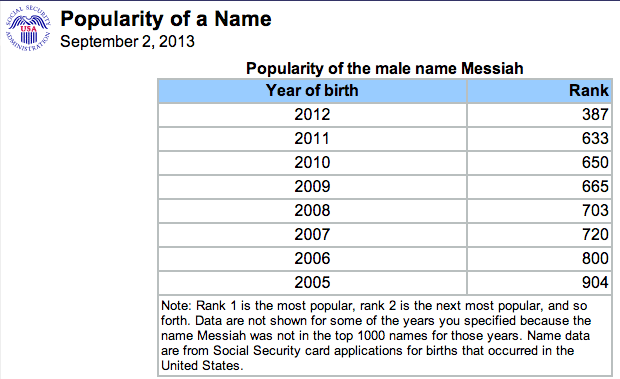
This story is a few weeks old now, so you might have heard it already. But in case not, a Tennessee judge has ordered the parents of a seven-month-old baby to change their child’s name from Messiah to Martin because

“The word Messiah is a title and it’s a title that has only been earned by one person and that one person is Jesus Christ,” Judge Ballew said.

Jaleesa Martin responded saying, “I was shocked. I never intended on naming my son Messiah because it means God and I didn’t think a judge could make me change my baby’s name because of her religious beliefs.”

She has since said she will appeal against the ruling adding that Messiah is unique and she liked how it sounded alongside the boy’s two siblings – Micah and Mason.

“Everybody believes what they want so I think I should be able to name my child what I want to name him, not someone else,” Ms Martin said.

Ms Ballew said the name Messiah could cause problems if the child grows up in Cocke County, which has a large Christian population.

The ACLU came out in defense of Martin, pointing out that the Judge did not have the right to impose her religious beliefs on others. Judging from the fact that Messiah seems to be an increasingly popular name for boys born in the USA, many parents don’t seem to share that concern – but parents can get away with it, of course, as Richard Dawkins has often pointed out in referring to enforced religion as a form of child abuse.

Screen Shot 2013-09-02 at 8.48.39 AM

There seem to be at least two distinct issues here. First, the Judge should certainly not get to enforce her religious beliefs on a parent, or a child. And it’s fairly clear that this is what she’s doing, in referring to a “title” that has only been “earned by one person”. She thinks of Messiah as an honorific, and one that cannot be earned by a regular human – which means that she believes in the divinity of Jesus, and that this is what informed her judgement.

The second issue is far more tricky, though, in that it’s undoubtedly true that calling a child “Messiah could cause problems if the child grows up in Cocke County, which has a large Christian population”. This more legitimate reason is unfortunately obscured by the first, illegitimate reason.

The reason that this issue is more tricky is because it highlights the dilemma of just how much control parents should have over their infant’s lives, and how much of it should be delegated to the state. Your name impacts your chances of success in life, if we’re to believe the folks at Freakonomics, and it certainly impacts how much or how little you’re going to be teased. I’d bet that Messiah would be teased a fair amount – and the question is, do (or rather, should) parents have the right to subject a child to that teasing?

In case you don’t know of it, the title of this post is a reference to a funny prayer around the dinner table, in Talladega Nights, embedded below. For more exploration of the ethical issues here, Mark Oppenheimer’s New York Times column is worth reading.

Dawkins, Muslims and trolling on Twitter

I had intended to write a post on Richard Dawkins’ most recent provocations on Twitter, which he kicked off with

RDbut a couple of people have gotten there before me – particularly Nelson Jones, who seems to have read my mind. As Jones points out, Trinity College has more Nobels than the Chinese, or than women, or any number of groups you might care to name (regardless of how carefully or accurately those groups were defined).

Yes, what he said was “a fact”, and in fact true. On Twitter, a few people have reminded me of this when I accused Dawkins of dickishness in the Tweet embedded above. I know that it’s a fact – but there are two ways of making the point that this isn’t the only relevant thing in this case. The one way is to say that facts aren’t all that matter – that there is a world of politics, and emotion, and strategy that might mean it’s sensible to point out certain facts at certain times, in certain contexts.

The other way of making the point is to agree that facts are all that matter, and to say that therefore, Dawkins should be wary of letting utterly predictable reactions get in the way of people seeing the facts that he’s attempting to highlight. As Jones writes, something in Islam (and this could easily be true for any other religion too) has gotten in the way of there being proportional representation of Muslims amongst Nobel Prize winners (and a number of other equally arbitrary metrics).

What that something is, is an interesting question – as is the question of whether atheists are disproportionately well-represented. But you can ask that question in less or more abrasive ways, and asking them in the way that Dawkins did will almost certainly result in making fewer, not more, people think about what the answer might be.

I’m not making the claim that it’s always wrong to ask questions abrasively – I’m making the claim that it’s disingenuous to say “I’m simply pointing out a fact”, or “everyone is over-reacting” when you have various options for how to express something, and you choose the one which a) doesn’t do any better a job of making the point and b) is likely to provoke more than alternatives would.

Twitter is not the place for nuanced debate. We (in general) broadcast, entertain, and often provoke. Dawkins is doing all of those, and he surely knows it. I don’t object, as I’ve said many times – it’s not a strategy that I want to employ for myself, but we need people to act as the lightning-rods. But that doesn’t mean it’s impermissible to ever say hold on, even on your strategy, that message is going to be lost in the quite predictable outrage. If people aren’t listening, you can’t do anything to budge their beliefs.

Read the Jones piece, as well as this one by Nesrine Malik. As Jones rightly points out, this is a pattern for Dawkins, and even (especially?) those of us who support his goals should be able to see how characteristic it is:

Dawkins’ well-honed technique (it often amounts to trolling) is to say something pointlessly provocative, wait for the inevitable backlash (the traditional response, playing on his well-known love of grammar, is “Your a dick”) and then express innocent bafflement that anyone could possibly object.

Another example from earlier this year compelled me to respond, because it seemed to indicate quite plainly how Dawkins’ Twitter behaviour is often more about provoking, than facilitating debate:

In case it’s not clear to you what’s going on there, Continental and Analytic (to use the traditional, and contested, definitions) are different approaches to academic philosophy. It’s a summary term of a style of philosophy practiced in those regions, like (as my tweet highlighted) French vs. Greek food. These are both different routes to getting fed, and the styles of philosophy are similarly both routes to understanding the world. There is no necessary distinction between them, though – and therefore, nothing to deride by asking “what sort of a search for truth is region-specific?”

But absurdly, social media are so intemperate that we only seem to have two options in response to Tweets like the one that the post begins with: either to denounce Dawkins as an Islamophobe, or to support him vociferously, telling anyone who criticises him that what he says “is a fact” and that everyone is “over-reacting”. The middle-ground is, as ever, squeezed out of the picture – because on social media, we’re all shouting, all the time.

And I suppose it’s quite reasonable to worry about who might hear you, if you’re saying something like “hold on, it’s not that simple”?

Does atheism entail anti-discrimination?

No_discrimination_signI recently discovered Betteridge’s Law, which is a rather cool adage that states “any headline which ends in a question mark can be answered by the word no“. And that’s the point of view many of you might have with regard to the headline I chose for this blog post. You might say, atheism is simply a lack of belief in god(s) – it entails no other propositions.

If we mean the strict logical sense of entail, i.e. that atheism necessarily leads to anti-sexism, anti-racism and so forth, you’re right. But you’re perhaps also evading a more important point, which is that if you’re an atheist who isn’t opposed to sexism, racism and so forth, the fact that you happen to be an atheist does little or nothing to combat the possibility that the viewpoints are at least in tension with each other, or even in direct opposition.

Two ideas don’t need to form a contradiction to be in opposition. And to my mind, atheism will (and, should) typically entail anti-sexism, anti-racism and so forth. And this is because prejudice of these forms is not only an manifestation of irrationality, but also more specifically a form of irrationality that is typically buttressed by moral codes that rank certain values or characteristics above others on largely arbitrary grounds.

Whether it be wearing a certain funny hat, belonging to a certain tribe, uttering certain sacred words, eating a particular food and not another – all of these are tokens that would normally be arbitrary, but are granted significance via a system of belief. They aren’t justified by evidence and reason, but rather become justified by the positive feedback loop of religious practice.

Without those forms of thinking, any idea that people with a certain level of melanin in their skin are superior or inferior to others, or that people with penises are better/worse than people without them, would struggle to get off the ground. We’d be far more inclined to say “that makes no sense – we’ve no reason to treat x worse than y”, because we’d have fewer psychological frameworks in place allowing for arbitrary discrimination.

So, while atheism might not necessarily lead to being anti-discrimination (of arbitrary sorts), I do think it’s not only compatible with anti-discrimination, but more than that – it’s more likely to lead to it than not. And for clarity, and to avoid needless argument, I am not making the claim that religion always, or necessarily, does lead to these forms of discrimination. I’m making the far more limited claim that it’s one way in which some people prop up their prejudices.

EU Guidelines on religion and belief

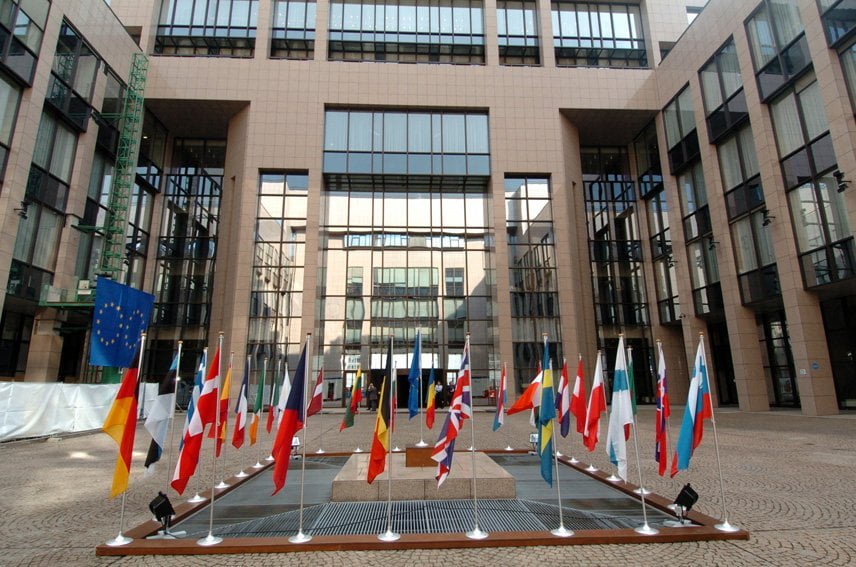
P010346001The EU Foreign Affairs Council recently adopted a report with 71 Guidelines on freedom of religion and belief. And while the guidelines don’t have legal force (EU guidelines that end up being legally enforceable are “regulations”), they nevertheless offer a clue as to the direction that particular councils are hoping for legislation to go. Furthermore, they send a strong political signal, especially with regard to emotive issues like religious freedom. In that context, these particular guidelines make for heartening reading.

There are 71 guidelines, and if you’ve got a moment to read them all, you’ll find plenty to applaud there. Some of the ones I’m most pleased to see are these (my emphasis):

  • “All persons have the right to manifest their religion or belief either individually or in community with others and in public or private in worship, observance, practice and teaching, without fear of intimidation, discrimination, violence or attack. Persons who change or leave their religion or belief, as well as persons holding non-theistic or atheistic beliefs should be equally protected, as well as people who do not profess any religion or belief.”
  • “The right to freedom of religion or belief, as enshrined in relevant international standards, does not include the right to have a religion or a belief that is free from criticism or ridicule.”
  • “The EU does not consider the merits of the different religions or beliefs, or the lack thereof, but ensures that the right to believe or not to believe is upheld. The EU is impartial and is not aligned with any specific religion or belief.”
  • “Coercion to change, recant or reveal one’s religion or belief is equally prohibited. Holding or not holding a religion or belief is an absolute right and may not be limited under any circumstances”.
  • “Freedom of religion or belief protects every human being’s right to believe or to hold an atheistic or non-theistic belief, and to change religion or belief. It does not protect a religion or belief as such. Freedom of religion or belief applies to individuals, as right-holders, who may exercise this right either individually or in community with others and in public or private. Its exercise may thus also have a collective aspect. This includes rights for communities to perform “acts integral to the conduct by religious groups of their basic affairs”. These rights include, but are not limited to, legal personality and non-interference in internal affairs, including the right to establish and maintain freely accessible places of worship or assembly, the freedom to select and train leaders or the right to carry out social, cultural, educational and charitable activities.”
  • Certain practices associated with the manifestation of a religion or belief, or perceived as such, may constitute violations of international human rights standards. The right to freedom of religion or belief is sometimes invoked to justify such violations. The EU firmly opposes such justification, whilst remaining fully committed to the robust protection and promotion of freedom of religion or belief in all parts of the world. Violations often affect women, members of religious minorities, as well as persons on the basis of their sexual orientation or gender identity. In dealing with possible violations, use will be made of existing EU human rights guidelines, notably the guidelines on the promotion and protection of rights of the child, on violence against woman and girls and combating all forms of discrimination against them, on human rights defenders, on torture and on the death penalty, as well as the forthcoming EU guidelines on the enjoyment of all human rights by LGBTI persons, and on freedom of expression on line and off line.”

To summarise a common thread in some of these guidelines, and a common-sense point: believe whatever the hell you like, and let others do the same. But your beliefs can never be used as an excuse to harm, oppress, impugn or otherwise malign someone who happens to not share that belief, or who has no religious beliefs at all. The EU Foreign Affairs Council should be applauded for this sober-minded and useful document, which will no doubt attract plenty of outrage from those who feel the grip of religion loosening its hold on the minds of increasing numbers of people all over the world.

FSI conference 2013

fsi-glass-squareI heard today that the secular humanist NPO that I’m chair of (the Free Society Institute, or FSI) has been awarded a substantial grant by the International Humanist and Ethical Union and HIVOS to host a conference later this year (or perhaps early 2014). So I’m in the early stages of planning. The event will most likely be in Johannesburg, simply because I can guarantee more substantial media coverage there, and because it’s easier to get to (I’ll be trying to persuade an international speaker or two to make the trip).

While I’m probably familiar with 90% of South Africans who are interested in these issues, and who might be interested in participating, please feel free to make suggestions for local speakers on this form. I can’t give any details about dates and venue yet, but want to make sure that anyone I don’t already know about gets ample time to bubble to the surface.

Also note that the proposal that got me the grant involves a conference on a Saturday, and a workshop on scientific reasoning and skepticism on the Sunday (ideally for schoolkids). So, you can put names forward for either component (or both).

So atheists are people too?

Originally published in the Daily Maverick

imagesContext is often a key factor in determining what something might mean. Not only what someone might have meant in saying something, but also what it might end up meaning – in other words, what its likely effects might be. We forget this all too easily in a short-attention span world of headlines and attendant hyperbole.

Whatever you might think, for example, about Democratic Alliance policy, any analysis of their “Know Your DA” campaign is incomplete – and potentially incoherent – if it fails to address the campaign’s effects on its intended audience. Analysis of how the campaign is received on Twitter, Facebook, or even the Daily Maverick are likely to tell a small part of the story. So small, in fact, that it might not be worth telling.

Every week offers examples of columnists, presenters, editors and presidents taking individual cases out of one context and placing them into another, to make a point that might bear little relation to the point you might have wanted to make, or to the point someone else might take away from the same event.

Another example worthy of far more attention than I’ll give it here is the Woolwich murder last week, where a British soldier named Lee Rigby was hacked to death by two machete-wielding Islamists. Some responses treated this as justifying instance for Islamophobia, while others couldn’t see beyond a “chickens coming home to roost” analysis, arguing that Britain (and the US, of course) deserve all the terror they might get.

A more plausible analysis than either of those extremes casts the murder as an instance of “degenerate nihilism“, largely unconnected to Islam. Or, if you don’t think that analysis more plausible, you’d nevertheless hopefully agree that it might prove more useful for understanding why these things happen, and (perhaps) for minimising the chances of more of them happening in future.

The truth often – even usually – lies in-between the extremes, despite how much we struggle to see it that way. This struggle is precisely because of the competition for attention, and the limited time that we have to win that competition amongst our readers, listeners or dinner-table companions. So instead of nuance, we offer caricatures that are more likely to tap into the existing prejudices of the audience.

We can also fail to see outside of our own caricatured manifestations of the subject in question. Objectivity is neither something we’re very good at, nor arguably something that we’ve often got time for in the attention economy, where earning a moment of your time is such a significant return on investment that it feels like achievement enough.

A more trivial failure of objectivity than reactions to Rigby’s murder occurred last week, after the Pope dared to suggest that atheists might find their way to heaven, or at least be capable of being good people. The church was quick off the mark with damage control regarding the heaven bit (insisting that it’s still only via Christ that you can be issued with a visa), but that was never the interesting bit of Pope Francis’s sermon in any event.

Francis is quoted as saying: “The Lord has redeemed all of us, all of us, with the Blood of Christ: all of us, not just Catholics. Everyone! ‘Father, the atheists?’ Even the atheists. Everyone!”. We must meet one another doing good. ‘But I don’t believe, Father, I am an atheist!’ But do good: we will meet one another there.”

It’s not plausible to read Francis as claiming that faith is now optional for salvation. Besides the obvious point that atheists could hypothetically be redeemed once they become believers, the important thing in the sermon is the fact that he explicitly allows for atheists to be, and to do, good.

Most atheists I discussed this with were dismissive, asserting that they don’t need the Pope’s endorsement of their moral virtue, or questioning what the Pope might even mean by “good”. In other words, most reactions missed the point by a mile.

We know, from Gallup polls and other research in the US that atheists are distrusted and thought to have no foundation for moral principles. We see that politicians constantly name-check faith, and that Julia Gillard is an exceptional case in being an atheist who has managed to become elected to the Presidency (of Australia). In other words, we know that in the PR battle around moral issues such as trust, integrity, charity and the like, atheists struggle to compete with religion.

We don’t struggle to compete in reality, of course – but exploring that is not the point of this column. The point of this column is to say that when the leader of the Catholic Church tells adherents of that religion – one of the largest in the world – that they don’t have a monopoly on virtue, that message directly contradicts an existing and powerful stereotype.

You don’t have to like the Pope, or respect him and his Church, to regard it as a good thing that this influential person makes a statement undermining the idea that you can’t be morally decent without religion. That idea keeps atheists from speaking out, declaring their non-belief to family, friends, or the electorate. It is used as a form of pressure to get people into faiths in the first place, because who would want to be perceived as an immoral (even evil) person?

In other words, there’s a big picture here, beyond our egos. There are in fact various big pictures, competing with the ones describing child abuse in the church, or the sexism of Catholicism. Progress is possible at various rates, at various times and through various forms of strategy – but to deny that this is progress of any sort is as blinkered a reaction as we like to accuse religious folk of falling prey to.

As Steve Zara remarked on Facebook, “change in the views of those who are opposed to ours is, after all, a vital part of progress. It doesn’t mean that the Pope isn’t still part of the opposition to reason, and he continues to promote hateful and dangerous views, but we can be happy about a change for the better without needing to like the person who has changed.”

Amen to that.

Deciding when to die

Originally published in Daily Maverick

There are at least two ways of maintaining or enhancing the significance of death. First, you could attend to death, in the manner that many of us have – sharing the final days, months or years with someone you love. Second, you could remember to take life seriously. So seriously, that when it’s time for the life to end, we can make that decision carry all the significance typically found in protracted, often painful dying.