Responsible reporting: At what cost?

As submitted to The Daily Maverick

Free speech is not the only value that democratic societies subscribe to. Nor does, or should, our commitment to free speech always have to trump competing values such as national security or personal dignity. But the principle of free speech nevertheless stands in need of exceptional, and exceptionally strong, counterarguments in cases where we are told that it is not permissible to broadcast or publish any particular point of view.

This commitment to an open marketplace of ideas rests on the belief that each person should have access to the points of view in circulation, so that he or she is able to exercise their right to moral independence by considering the ideas themselves. As Mill reminds us, compromising free speech costs us both the opportunity to hear things that are true, which can help to correct errors; and also to hear things that are false, where the truth is strengthened by “its collision with error”.

On rape by deception and state-sanctioned racism

As submitted to The Daily Maverick.

Most social interactions are likely to involve some measure of deception. This could range from feigning interest, or pretending to know more about the topic under discussion than you actually do, to calculated deception involving beliefs, character, or motivation. Many of these lesser deceptions are perhaps not even considered dishonest, but merely part of the everyday bargaining between our own multiple identities (which could vary according to context) and the identities of others.

Some more serious sorts of deception are of course legally actionable, and in many cases involve clear moral wrongs. One example of this is painfully fresh in many people’s memories, and involves entrusting financial investments to people who in the end misrepresented the extent to which they had the client’s best interest at heart.

But what to make of “rape by deception”, and in particular the case of Saber Kushour, recently sentenced to 18 months in prison for this “crime”? (The scare-quotes are of course not intended to indicate that rape is not a crime, or that it shouldn’t be, but rather to indicate that it’s not yet clear whether Kushour is guilty of rape at all.)

Blog awards, and the science & skepticism blogroll

A little housekeeping & paying of temple taxes follows. First, the 15th edition of the Carnival of the Africans is out, consisting of Blaize’s picks of the best scientific and skeptical blogging for the last few months. Second, the 2010 South African blog awards nomination process has begun. While it’s unlikely that anyone other than the usual suspects will win, if you’d like to participate in an attempt to buck that trend, go and nominate a blog (or a particular post) by August 27. Lastly, Michael Meadon kindly maintains a list of African scientific & skeptical blogs over at Ionian Enchantment, and I’ve pasted the current list below. If there’s a blog missing that you believe should be included, let him know (his email address is on his website).

To ask for evidence is not (necessarily) scientism

As submitted to The Daily Maverick

Respect is due to people, rather than to ideas. While it may be politically incorrect to say so, there is no contradiction between saying that someone has a misguided, uninformed or laughable point of view, and at the same time recognising that person’s worth or dignity in general. But our sensitivity to being challenged, and to having the intrinsic merit of our ideas questioned, often leads us to conflate these two different sorts of respect.

Respecting a person is partly a matter of not causing them unnecessary trauma through ridicule or contempt. It also requires not prejudging their arguments or points of view, but rather judging those arguments on their merits. But if it is established that those arguments lack merit (when compared with competing arguments on the same topic), there is no wrong in pointing this out. It is perhaps even a duty to point it out, assuming that we care for having probably true, rather than probably false, beliefs about the world.

On Hitchens and the defense of reason

As submitted to The Daily Maverick.

On hearing that Christopher Hitchens had been diagnosed with oesophageal cancer, one response from a self-proclaimed man of god was the following post on Twitter: “God 1, Hitchens 0”. The motivation for such a callous response to a usually fatal disease (fewer than 5% of sufferers are alive after 5 years) is easy enough to trace: Hitchens, along with Dennett, Dawkins and Sam Harris, is one of the “4 Horsemen” of a groundswell of resistance to the unreason that is exemplified by religious faith, and he is thus a direct threat to the mysterious legitimacy that faith-based claims enjoy.

What our divine scorekeeper does not (of course) dwell on is the fact that according to his beliefs, all deaths are attributable to god, and that he could therefore just as well add another notch to this metaphysical bedpost if his mother, for example, were to die an equally unpleasant death. God’s victory is inevitable, as either she takes a believer “home”, or she smites down an unbeliever. Either way, a civilised response to human trauma is sympathy, rather than gloating.

Pastor Michael returns

And he’s gone from being dishonest to being paranoid, delusional and threatening. Well, the “delusional” part is a given, I suppose, given the nonsense we know he believes in. Despite the fact that the mothership has tried to beam him out of the conflict (see Taryn Hodgson’s apology for the Christian mis-representation of the atheists here), he still insists that it’s the UCT Atheist and Agnostic Society who had intentions that “were not right to [him] at all”, and that the AAS is now “threatening him”.

His grievances are two-fold: first, he’s upset that we (myself on this site, and the AAS on their forum) published his correspondence with us. As I’ve explained previously, we were forced to do so because the reasons for myself and Tauriq withdrawing from the debate were being mis-characterised by Michael, as well as by websites run by Taryn Hodgson and Paintball Hammond. Despite the apology received, the mis-representations have not been removed from some[ref]The ACA website was edited in February to more accurately reflect the events[/ref] websites, so this reason for publishing the correspondence stands, and leads me to publish extracts from the most recent correspondence here also.

Mandela’s Robben Island getaway (and other weirdness)

It isn’t often that I find myself agreeing with the folk at African Christian Action. Perhaps this is because I don’t do enough drugs, or because I like things to make sense – I don’t know. But when I recently came across their review of Invictus, I thought that we could finally agree on something, seeing as their headline of “Invictus Idolatry” made it clear they didn’t like the movie. Don’t be confused by the title tag of the African Christian Action review, which might cause your browser to tell you that the article is titled “PROLIFE: Aborsie – Die Feite”. The article is instead an account of why Invictus is evil. And this is indeed true, as I’ve mentioned before.

But while I thought it was a crap movie on the basis of being a mawkish, poorly scripted, glacially-paced and poorly acted account of a largely imagined period of South African history, the African Christian Action (ACA) reviewer didn’t like it because Mandela was a “terrorist” who didn’t really even have such a hard life while imprisoned.

The Internet and cell phone pornography bill

The original text of this article in The Daily Maverick.

Last Saturday, in an act of flagrant disregard for the faiths of others, Pastor Ray McCauley had planned to promote his brand by exploiting paranoia around tourist safety at the World Cup. Unfortunately for Pastor Ray, a heart attack meant that he could not attend. But while tickets for the “National Day of Prayer” for a safe World Cup might as well have been accompanied by homeopathic remedies for xenophobia (which would be equally effective), the event still raises questions. Firstly, why do we need his god to help out with policing those pesky foreigners and other threats to World Cup harmony, like Ivo Vegter? Is Ray saying that the other gods aren’t up to the task or even – sotto voce – that they may not exist?

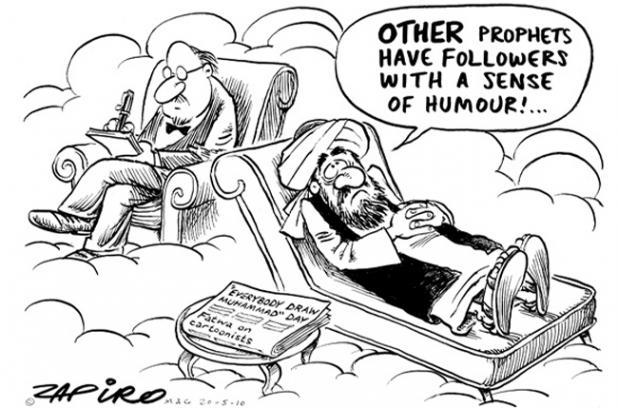
On Zapiro, and Draw Mohammed Day

The original text of this column, first published in Daily Maverick.

We all find something offensive. Many of us might prefer to live in a world which caters to our sensibilities, and limits how much offence we have to tolerate. I would like for everybody to be able to spell, for example, and also for most uses of quotation marks in advertising to be outlawed. Unfortunately, nobody seems willing to offer me any legal assistance towards achieving these outcomes.

Zapiro angers the omnipotent

Jonathan Shapiro (a.k.a. Zapiro) is an equal opportunity offender – that is, if you like to think of what he does as offensive at all. There’s no doubt that some people have been, and are, offended by some of his cartoons, but that is a separate matter from whether they are in fact offensive, objectively speaking.

His role as a social critic and commentator leads him to sometimes poke at open wounds, yes, but almost always in a way that reveals the underlying prejudices that cause significantly more harm than any harms caused by the cartoons themselves.

The cartoons challenge their audience to reflect on whether their feelings of outrage are justified, and also whether others – like Zapiro – may be justified in feeling that there is something worth critiquing, challenging, and even sometimes mocking, in opinions and beliefs that we sometimes take far too seriously.

© 2010 Zapiro
Printed with permission from www.zapiro.com
For more Zapiro cartoons visit www.zapiro.com

Targets of his satire are drawn from a pool which has historically admitted just about anyone, and anything. If he has an axe to grind, that axe is most likely composed of inflated egos, undeserved reputations, malfeasance against the equal treatment and dignity of all – no matter how rich or poor, influential or invisible.

We should remember that critics of this sort, who offer a courageous perspective on current events, and try to point out details that we might be missing, serve an enormous public good. It’s very easy for all of us to end up with our heads buried in the sand, or stuck up our own (or another’s) backsides to the extent that we forget that our outrage may be ill-construed or illegitimate.

Today, Zapiro’s cartoon for the Mail & Guardian was the subject of a last-minute attempt to stifle press freedom. The Twitter feed of the unfolding events makes for interesting reading, in that Molana Bam’s primary argument appears to be the standard one where representations of Muhammad are concerned – namely, threats of violence.

Not directly, but nevertheless, the cartoon is a “threat to harmony”, and “stirs emotion”. A much larger threat to harmony, perhaps, is the struggle involved in reconciling Bronze Age beliefs with the modern world, and the curious tolerance that it requires those of us who try to govern our lives according to knowables. Tolerance, that is, of beliefs that are shared by fanatics who try to kill cartoonists and authors who represent aspects of that belief.

If you are a believer who is not inclined to fanatical – and criminal – action, you certainly should feel aggrieved when cartoons like this are published. But the cause of your aggrievement should be your less civilised brothers and sisters, who make such comment necessary – not those who make the comments.

The points made by Zapiro, as well as by past examples of this same issue, are a reminder to you to get your house in order, so that there is no longer any need to mock or ridicule.

You do this most effectively from the inside, by persuading people who take faith as a way to justify paedophilia, homophobia, oppression, murder, censorship and all sorts of other social ills that they have lost their way, and that surely a god worth taking seriously would not want you to do those things.

Two responses to the issue worth reading: Nic Dawes, Mail & Guardian Editor; Jordan Pickering (a Christian response).