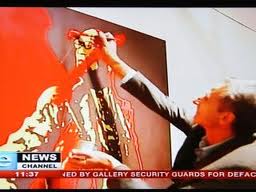
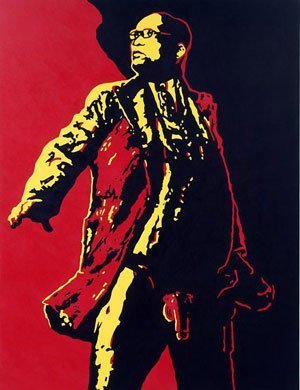
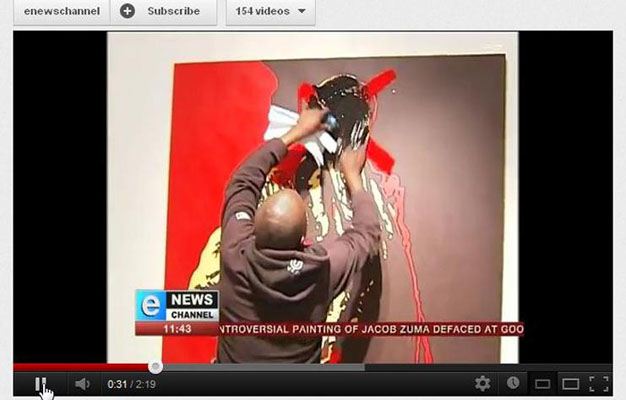
Did the #Zumaspear bullies win?

Here’s Ferial Haffajee explaining why she took the decision to remove images of Zuma’s Spear from the City Press website. Peter Bruce, editor of Business Day, said (on Twitter) that he would never have published it in the first place (on grounds of taste). That I can understand, and even agree with – an editor makes choices as to the character of their publication, and it would be a legitimate choice to never display this painting. (Today, Bruce argued that Haffajee should remove the painting.)

Zuma’s Spear is not obviously in the public interest, it reveals nothing we don’t already know, and it certainly always seemed likely to offend – perhaps for little gain. And causing offence just for the sake of doing so is not (to my mind, at least) a laudable action.

But Haffajee published a photograph of the painting in the course of covering the Murray exhibition – it was one of many paintings reproduced in the City Press. I’d imagine that she knew it would cause offence, even though she indicates (in the first link, above) that she had no idea the rage would be this extreme. She should be free to do so, just as Murray should be free to paint disrespectful images of the President. Having said that, I’d previously argued that the freedom to do something doesn’t necessarily mean that it’s the right thing to do.

Once one has “done it”, though, you’ve chosen to take a stand. In this case, a stand for free speech, and a stand that entails asserting that differences in cultural sensitivities and norms are subject to a Constitutional override which allows for us to offend each other through artworks such as Murray’s. And here’s the problem regarding the decision to take the painting down: it’s impossible, now that that choice has been made, to separate the possibility of it being premised on cultural sensitivity (which can often be a good thing, even though it’s sometimes not), or whether it’s simply another instance of allowing the hypersensitive to win the argument, simply because they shout louder than everyone else, or threaten you with violence.

City Press staff have received death threats. Religious idiots have called for the artist to be stoned. So now, as much as Haffajee was perhaps mistaken in ever choosing to run that image, her self-described “olive branch” is (in part, and perhaps in large part) a reaction to intimidation, and fear of reprisal. Some have asked about the apparent inconsistency of the Goodman Gallery (under different ownership, note) refusing to display an earlier Murray work (pictured above), and Haffajee’s previous decision to not run content that Muslims would find offensive. But  note what’s happened – the inconsistency has been resolved.

In the case of offending the religious, a pre-emptive decision was made that the situation was too volatile, and the physical threats too real, to ever run the offensive material. Haffajee and the Goodman Gallery made the mistake of thinking that our democracy could handle some robust debate around cultural norms, freedom of speech, and whether it’s okay to show disrespect for the President. The reactions to this (by those offended) ended up being entirely consistent, and have forced a consistency in response by those who caused the offence. I guess they’ve all learnt their lesson now – Haffajee and the Gallery now know of yet another topic that isn’t open to debate, and others have learned that it remains true that you can win arguments by threatening violence.

I realise that Haffajee had a difficult choice, both in running the painting and in retracting it. And I can understand why she chose to remove it from the website. An extract from her explanation reads as follows:

I hope we are not crafting a society where we consign artists to still life’s and the deep symbolism of repressed artists like China’s Ai Weiwei in China. A society where we consign journalism to a free expression constrained by the limits of fear. This week society began the path of setting its mores on how we treat presidents in art and journalism; what is acceptable and what is not.

This could be interpreted in various ways – let’s hope that in noting how we’ve begun to set these mores, she realises the role this explanation will play in doing so. I’m sure she does, and that she (and all of us) will continue to probe the boundaries of free expression in light of cultural (including religious) sensitivities – rather than allow the latter to gradually swallow the former. Removing the painting was motivated in large part by threats, and to some extent by wanting to make a contribution to nation-building. Those who issued the threats – including Zuma, Mthembu et al, should think carefully about the nation they’re helping to build through bullying others into silence.
Zuma’s Spear and egalitarian anti-racism

As submitted to Daily Maverick

On Sunday, Zama Ndlovu (@jozigoddess) tweeted “I do hope someone will write something about how whiteness should look at that piece of ‘art’. To be fair and stuff.” I’d hope that nobody does, just as nobody should write about how “blackness” should look at Brett Murray’s “The Spear”. Because both approaches would be prescriptive in dictating that it’s race which should determine one’s attitude to dignity, and which sorts of harms should be taken seriously by our courts.

It’s too late, of course – many pieces were published over the weekend by writers of various races, with some of the writers explicitly foregrounding their blackness or the putative blackness of their analysis. More important, perhaps, is that they foregrounded the whiteness of the artist – and the whiteness of thinking that it’s permissible to depict Jacob Zuma with his penis hanging out of his trousers.

This is the crux of the controversy. Not only freedom of artistic expression competing with a Constitutional right to dignity, but the clash of cultural norms that Murray’s painting has highlighted. As with Yiull Damaso’s painting of Mandela’s autopsy, those who think it inappropriate to depict Zuma’s penis talk about disrespect, and appeal to the communitarian perspective that holds that we are responsible for upholding each others’ dignity. Those who think the painting permissible tend towards the more liberal perspective, arguing that we don’t have the right to not be offended.

These responses are not reliably correlated with race – black columnists have been among those arguing that Zuma has presented himself as a philanderer, and therefore that he shouldn’t be surprised if we end up perceiving and depicting him as one. But I haven’t seen a white columnist arguing that The Spear is insensitive enough to merit an urgent interdict for its removal from the Goodman Gallery and the City Press.

The absence of this sort of critique from white writers feeds into the narrative of racism, whereby Murray’s painting becomes emblematic of a colonial gaze, where black men are savages, ruled by their passions rather than by intellect. That sort of reaction, though, is sometimes self-serving and inconsistent. I can’t dispute that it’s sometimes a justified reaction – there are surely instances of artists and writers who have the view that whiteness has some sort of monopoly on sophistication, with blackness representing some form of primitivism.

But the demand for us to respect cultural preference in these matters is self-serving in the sense that it forestalls any possible debate or reflection on the merits of the artwork. Not the merits in terms of quality and originality, which are a separate matter, but the merits in terms of the discomfort and self-reflection the artwork could inspire. The easiest way to justify poor arguments or mistaken ideas is to refuse to discuss them – and if it is a mistaken idea that presidents, parents, or people in general merit protection from these sorts of insults, playing the race card or the culture card serves to rule that discussion out of order.

Then, the reaction is inconsistent because it frequently expresses a prejudice of its own. Instead of defending the dignity of anyone, from an egalitarian anti-racist or anti-sexist perspective, we mostly hear silence when a Jackson Mthembu or Marius Fransman says abusive things about Helen Zille or Lindiwe Mazibuko. Or, for that matter, when Mazibuko is called a “housenigger”, or Zille is threatened with rape on Twitter – both of which occurred last week (but not for the first time) in social media chatter during the march on Cosatu House.

Is this because they can deal with it, where Zuma cannot? Or because they’ve earned it, where he has not? An answer to either question will expose deep prejudice on the part of those who think these things – so, better not to think about it. Or is it simply the case that because Zille and Mazibuko aren’t of a communitarian mindset themselves, this cultural norm of defending each other against insult doesn’t apply in their favour?

If the latter is the unconscious motivation for this inconsistency in what results in outrage and what doesn’t, we can ask a follow-up question: exactly which categories of human does identity politics grant special protection to, and on what grounds is this discrimination justified? I’m not talking about recognising that certain groups of people might have certain sorts of sensitivities – that they do, and sometimes for very good reason – but rather about whether we’re comfortable with certain sensitivities receiving preferential treatment in law or public opinion.

I don’t know how whiteness should look at Murray’s painting. But I do know that I could imagine a person being offended by a similar portrayal of their father. And I do know that a black person might not object in the slightest to Zuma being disrespected by this painting, because of the belief that Zuma has done little to merit that level of respect. Among this range of responses, though, it’s unclear whether we’re acting out of principle, out of prejudice, or out of reaction to prejudice – whether perceived or actual.

Zuma can by all means test, in court, whether Murray’s aesthetics and cultural norms should bow to his. For Zuma to win, though, would require demonstrating that his dignity has actually been impaired, and not just that his feelings were hurt. And I don’t know about you, but I already had the impression that Zuma was a rather sexual creature. Not because of some identity politics claptrap, but simply because he has “four wives, two exes and 22 children by ten different women”, as The Economist succinctly put it.

As for the painting itself, of course it’s disrespectful – I’d imagine that’s the point of the painting. You might think the painting in unacceptably bad taste, but your aesthetic preferences and cultural norms are of no more consequence than anyone else’s – at least in theory. In this case, where the ANC has joined Zuma’s case as second applicant, it seems that theory will soon (and, again) be tested – leaving us with one more reason to respect them both less.

Zuma’s Spear and the distractions of “culture”

An op-ed first published in the print edition of the Cape Argus, 22 May 2012

It’s always a mistake to think any particular source a reliable barometer of South African opinion. Each of them represents a self-selected audience, and evolve in ways that tend towards privileging certain voices, and certain points of view. Which is all just as well, because the conversations that have taken place on social media, and especially Twitter, over the past few days are cause for deep despair regarding cross-cultural communication in South Africa.

The conversation that’s dominated social media, radio, and the opinion pages of our newspapers is of course Brett Murray’s painting “The Spear”, which features a stylised image of President Jacob Zuma. More crucially, Zuma’s penis features rather prominently, in that Murray has chosen to depict a quite honourable member.

The Economist carried a column on The Spear which contained mention of Zuma’s “four wives, two exes and 22 children by ten different women”, and these simple facts could easily account for why an artist might think it appropriate to depict the President’s penis, regardless of the artistic merit in doing so. His public persona is already sexualised, in that he’s provided us with evidence of a sexual appetite.

Some might think that and artwork pointing this out is juvenile or in bad taste. But even if so, these would be reasons to not want the painting on your own wall, rather than thinking the painting should not be allowed to hang on anyone wall. The latter, more conservative reaction is premised on arguments about cultural norms, and the inappropriateness of depicting Jacob Zuma in this fashion.

The responses I received when posting that sentence from The Economist on Twitter made this cultural divide rather stark: from being accused of “negrophobia” for not also mentioning that King David had many wives, to being accused of inconsistency in not being a “pristine virgin” myself, it rapidly became clear that even though we know that Zuma is no stranger to sex, we aren’t allowed to talk about it.

At least, someone from my putative “culture” isn’t allowed to talk about it. For culture, we should of course read “race” here, because Tselane Tambo and Mondli Makhanya do seem to have permission to talk about it. And we can derive a simple, but very important lesson from this – no individual should be assumed to speak from or represent any particular “culture”, and that we are free to determine our individual point of view without being hamstrung by the cultural identity that others assign to us.

There is no “we” that has “a culture”, except to the extent that we choose to self-identify as members of it. The notion of “we” is itself something flexible, pragmatic and entirely contingent on circumstance. It is an accident of geography and politics, and massively open to abuse – especially when an audience pre-selects for a speaker which culture they happen to represent.

Arguments about the merits of individual cases get lost in the noise of identity politics, and the fact that identity politics is itself usually mere noise also gets lost. If it is true that it’s culturally inappropriate to depict Zuma’s penis (as I believe it is), why is that where the line gets drawn in terms of the sorts of cultural norms we respect?

Because the same culture contains elements that we (most of us, I hope) no longer want to respect, like homophobia and a patriarchy that is sometimes difficult to distinguish from misogyny. To put it simply, if we should respect Zuma’s wishes here, why should we not respect Patekile Holomisa’s views when he claims that gays and lesbians are enemies of their culture, and why should we not be silent when the Traditional Courts Bill tries to legislate a retrograde and sexist set of legal structures?

We’re not silent in these cases because we recognise that a monolithic interpretation of “culture” doesn’t address the reality of a contested political and moral landscape, and because we’ve decided to mutually address South Africa’s challenges through discussion and negotiation, framed by the liberties secured in 1994. Our Bill of Rights respects culture, yes, but it frees us to think outside of it also.

The relevant manner in which it frees us is through guarantees of free speech and free thought, including via artistic expression. Any one of us might not like Murray’s painting, and might think him grossly insensitive for painting it. We have that option, just as he has the option to ignore whatever offense might be caused in creating and exhibiting the artwork.

If one of these sets of options is to win out over others, it can’t do so through asserting cultural privilege. Cultural norms can be an explanation for why one feels offended, but they can’t serve as an argument for why others should feel constrained by the offense that you feel. The only sorts of freedoms (in terms of speech) worth taking seriously have to allow for harms to be caused, because it is often the harmful truths that the powerful don’t want us to hear.

Cultural norms can also be an explanation for why certain responses to The Spear are wrong for a different reason, in that they revel in Zuma’s discomfort. It’s undeniable that some of the responses to Murray’s painting have viewed the painting through a colonial gaze, where black men are savages, ruled by their passions rather than by intellect.

However, the fact that these racist reactions exist cannot mean that any argument in favour of the rights of the Goodman Gallery to hang the painting are racist. It’s not necessarily Zuma’s “blackness” or “Zulu-ness” that motivates the mockery – it’s also quite plausibly (for some) the fact that they perceive him as a philanderer, who happens to be our President (and further, happens to be black and Zulu). To some extent, Zuma has created this perception with his multiple wives and children, and it should come as no surprise that his critics will exploit this perception, no matter how insensitive doing so might be.

Idiotic opinions on Zuma’s penis

There are of course plenty of examples to choose from, but here’s one instance of the sort of idiocy which has resulted from the Goodman Gallery’s display of the Brett Murray painting featuring Jacob Zuma’s penis (and the subsequent publication of the artwork by the City Press and others).

Ignoring the royal “we” of Qunta’s tweet below, as well as the (perhaps 140-character induced) spelling, there’s still enough here to ask why anyone would this an opinion worth expressing.


Legality isn’t the only thing that mediates art and speech. Legality is, though, the thing that ‘mediates’ (or rather, dictates) whether something is legally permissible or not. Beyond that, it’s a matter of taste whether you approve of something or not. But the point of a roughly free country is that your subjective preferences need have no bearing on what I’m allowed to see. Zuma, his daughters, his wives or whomever can say “we don’t like that” (the artwork, that is, rather than the penis. They could think that of the penis too, but that’s again a matter of taste. For the wives, at least) – but they can’t say “that’s not allowed”.

So, we have norms and values to inform (or mediate) the debate outside of law – to make the case for thinking something praiseworthy or blameworthy and so forth. But all this within a framework of recognising that it’s allowed, even if we don’t like it. And we have norms and values to guide us in areas that aren’t covered by law, and also to influence law via democratic processes, where you can vote according to those norms and values, and in doing so, hope to eventually influence the law.

But you can’t expect your norms and values to simply be the law. Because they are yours, not ours, and they’re not obviously the ones “we”should adopt. Because no matter how royal the “we” in your mind might be, it doesn’t include me – I see a portrait of a man who can’t be taken seriously for well-documented reasons, where that impaired moral standing is being highlighted through a certain form of artistic insult, and where the insult has been earned.

Of course this is insensitive to “culture”. But in this matter, where “culture” demands respect for a buffoon, or asks us to endorse the subjugation of women, it’s the culture that’s the problem rather than those who are disrespectful of it.

Freedom of (hate) speech

As published in Daily Maverick

George Orwell’s novel Nineteen Eighty-Four introduced the fictional language of Newspeak, promoted by the state in order to make “thoughtcrime” impossible. Newspeak was intended to do so by eliminating words describing freedom or rebellion. If you can’t speak a word, the thinking went, you’d eventually not be able to imagine the concept that word might denote.

Racist models: apparently worse than homophobes in the legislature.

As submitted to Daily Maverick

In May 2011, a 13 year old lesbian was raped in Atteridgeville, Pretoria. We can’t say for sure whether this rape was an attempt to cure her of her lesbianism. But in June of that same year, Noxolo Nkosana was given a clear signal that her lesbianism was part of the motivation for her assault by two men, who reportedly taunted her with shouts of “Hey you lesbian, you tomboy, we’ll show you”. Then they did “show her”, stabbing her twice with a knife.

Nkosana was not raped, but Noxolo Nogwaza from KwaThema township near Johannesburg was less fortunate in being stoned, stabbed and raped by eight men in April 2011. She died as a result of these injuries. Many similar stories could be told, and have motivated increasing pressure on the government to consider recognising corrective rape as a hate crime.

Corrective rape is of course not the only threat faced by lesbian and gay people in South Africa. The Out LGBT Well-Being (Out) and UNISA Centre for Applied Psychology (UCAP) community survey (pdf) conducted in 2003 revealed widespread verbal and physical abuse motivated by homophobia, but also the finding that 62% of those who encountered such victimisation did not report their experience to the police.

In her 2004 paper Arranging Prejudice: Exploring Hate Crime in post-apartheid South Africa, Bronwyn Harris suggested that “Institutionalised heterosexism and homophobia, combined with negative social attitudes towards lesbian and gay people, create the conditions for hate crime and the reluctance to report it to the authorities. An important reason for this is the tendency towards the sensational, dramatic and exceptional, by the media. This selective bias in media coverage contributes to a tendency not to notice or report ordinary everyday experiences of hate victimisation”.

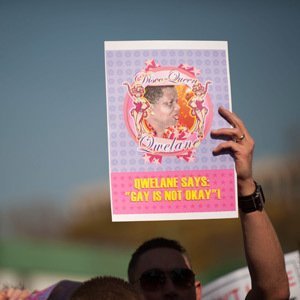
I doubt that the situation has changed much since then. After all, why would you think the police would care when those higher up the food chain include a homophobic Chief Justice, and a President who believes that “same-sex marriage is a disgrace to the nation and to God” – so much so that he’s willing to appoint a homophobic ambassador (Jon Qwelane) to a country (Uganda) that considered a bill legislating the imposition of the death penalty or life sentences on homosexuals?

Meanwhile, The House of Traditional Leaders have submitted a proposal to the Constitutional Review Committee, suggesting an amendment to section 9 (3) of the Constitution, which reads “The state may not unfairly discriminate directly or indirectly against anyone on one or more grounds, including race, gender, sex … colour, sexual orientation, age, disability, religion, conscience, belief, culture, language and birth”.

It might come as no surprise that The House of Traditional Leaders is well-stocked with members of the Congress of Traditional Leaders of South Africa (Contralesa). The Constitutional Review Committee of the National Assembly, who will consider the proposed amendment, is chaired by ANC MP Patekile Holomisa – president of Contralesa.

For a little insight into Holomisa’s attitude towards social justice issues, consider his response to the Traditional Courts Bill, currently the subject of a public participation process. The bill, he says “is being rammed down our throats by a government that is half-hearted on the issue of traditional leadership and a government that is half-hearted in its support of traditional authority”.

An assortment of 20 or so civil society groups and individual activists also don’t like the bill, and stand in support of the UCT Law, Race and Gender Research Unit’s submission to Parliament. As their submission makes clear, the proposed bill “overtly privileges the interests of traditional leaders over those of other rural residents, in particular rural women”.

The bill removes checks and balances on the power of traditional leaders, eliminates women from decision-making, and allows forced labour as punishment. You can never ask for legal representation in matters before a traditional court, and there is no mechanism for opting-out of the system. Clearly half-hearted in its support of traditional authority, then, in that it stops way short of the public floggings that one might imagine Holomisa to think a minimally acceptable power to be enjoyed by himself and his fellow Neanderthals.

Over the last 17 years, the Constitutional Review Committee has rejected every proposal made to it for amending the Constitution. This one – to remove sexual orientation as grounds for protection against discrimination – has somehow made it through to being put forward for deliberation in the National Assembly. Simultaneously, the protection offered by the Bill of Rights on the grounds of sex or gender would seemingly be ignored in traditional courts.

It is surely beyond the realms of possibility that either the Traditional Courts Bill or the Constitutional amendment in question will be passed. But the fact that it’s possible for anyone to think it reasonable to propose them, or to defend them, is cause for shame on the part of those that do, and anger in the rest of us.

And we do get angry – the people of Twitter, for example, spent an entire day being angry about a racist airhead, many going so far as to report her to the Human Rights Commission. Somehow, though, what’s trending on Twitter seldom gives one the impression that human rights are at stake when women, gays or lesbians are told they’re less human than the rest of us.

Thinking fast and slow

As submitted to Daily Maverick

Two quite peculiar experiences stand out after returning from the Global Atheist Convention, held in Melbourne earlier this month. The first was at the instigation of Sam Harris, who guided the roughly 4000 atheists present in a session of mindfulness meditation. The second was watching our news cycle (or rather, social media commentary on it) from afar and at 8 hours remove.

The latter experience had the effect of highlighting the perception that little seems to change – that the same people kept saying the same things and the same entrenched positions kept leading to the same misinterpretations and squabbles. But in light of the quite alien – and for some, alienating – exercise in mindfulness, I couldn’t help but wonder whether we can do better and if so, how we’d go about it.

Harris’s talk was about death. The inevitability of death, and the absence of some sort of way of cheating it via an immortal soul, was used as a vehicle to ask us to reflect on wasted time and effort. We sometimes appear to live as if we might be immortal, deferring important decisions to quit smoking or patch up some relationship.

More crucially, some of us could be accused of not realising the full implications of our mortality – if this is the only life we have, it falls to us to improve our world, and we’ve neither unlimited time nor supernatural help to do so. An obvious, yet powerful, comment made by Harris was that it’s quite likely that many of us will spend our last months or years in regret for what we failed to achieve – but that being able to anticipate this regret seems to have little motivational force in the present.

The disjunction between thoughts of mortality and the significance of life, versus noticing that South Africans were again, and still, talking about whether Cape Town was racist or whether respect for cultural norms precluded criticism of polygamy was quite stark. I’m not suggesting that these conversations are unimportant. I’m rather observing that in having these conversations nobody ever seems to change their minds, or admit that they don’t have a well-justified position. And the debates never seem to take place with a greater degree of mutual understanding than in their previous iterations.

Part of the problem might be that we forget how young we are, and therefore how little experience we have of making sense of each other. While modern humans originated around 200 000 years ago, most of us still lived as nomadic hunter-gatherers until around 10 000 years ago, when agriculture started allowing for the formation of permanent settlements, trade, cooperation and the formation of complex societies.

If you start the clock those 200 000 years ago, we’ve only lived in societies for 5% of our existence, and in complex societies for less than 2%. The skills most useful for flourishing during the other 95% of our history aren’t equally useful today, yet they continue to determine many of our responses to modern challenges. Essentially, we’re pattern-making creatures, who survived through being able to do things like predict the movements of animals and the changes of seasons. We look for structure, and we’re so well-trained and efficient at this that it happens without thinking – and perhaps often in ways that are entirely inappropriate to a more complex modern world.

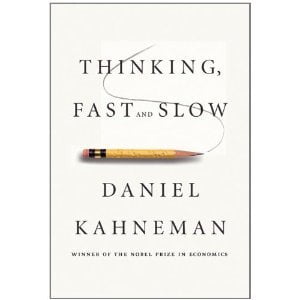
Daniel Kahneman’s recent book Thinking fast and slow details many of the ways in which our cognitive habits let us down through placing undue weight on surface over substance. He refers to System 1 and System 2 thinking to explain this, where System 1 sees patterns, and generates an “obvious” (and time-saving) answer.

But this answer is often wrong, because it’s mostly designed by humans who lived during that other 95% of our existence, and not by us. We need to remind ourselves to think more slowly and to be suspicious of the first, intuitive response. System 2 isn’t as easily fooled by misleading patterns because it’s a more careful judge of available evidence rather than impressions, and we can force it into action simply by being a little more patient and a little more cautious.

Besides reminding ourselves to think a little slower, I’d also suggest that there’s room for improvement in the way we talk. Tallyrand said that “language was invented so that people could conceal their thoughts from each other”, and while that might often be true, it also seems true that our language often serves to preclude rather than encourage debate, whether through the use of lazy, stereotypical categories or through moralistic outrage.

If we want to get better at understanding ourselves and cooperating to improve our world, we need to realise that we constantly make mistakes. Not only mistakes related to particular choices, but mistakes that involve how we choose, because they’re a feature of how we think. And we perhaps give too little thought to training the mind versus simply acquiring information.

This was the point of the meditation exercise described above. As Harris pointed out, while most accounts of practices such as these are contaminated by metaphysics, that shouldn’t prevent us from recognising that it’s possible for us to weigh evidence less subjectively and to do a better job of distinguishing between the significant battles and the petty squabbles.

A joke sometimes told about philosophers is that we’re inclined to say things like “we know it’s possible in practice, but is it possible in principle?” While watching the Groundhog Day-debates take place from my hotel room in Melbourne, I couldn’t shake the feeling that sometimes our principles seem immune to revision, regardless of the evidence. And that maybe, we should start by throwing them away – or at least by remembering that they are products of brains that were evolved to cope with a different world to the one we actually live in.

“New atheists”, stridency and fundamentalism

As submitted to the Daily Maverick.

During the Easter period we had the usual opportunity to read and hear plenty of content on religion and atheism, including ongoing debate around “New atheists” and their alleged stridency or militancy. But regardless of how particular individuals in this debate might choose to engage, we shouldn’t forget that it’s not automatically strident or militant to assert a point of view, no matter how much any participant might disagree with the view being expressed. More importantly, we shouldn’t forget that tone has absolutely nothing to do with the truth or falsity of what is being said.

Yes, atheists can be dogmatic. Anyone can be dogmatic, but while Catholics (for example) have little choice but to consider the Pope as at least broadly representative of their world-view, atheists have no obligation to fall into line behind a Dawkins or anybody else. One key advantage of an evidence-based worldview is that you can be persuaded by good arguments, and not persuaded by weak ones, regardless of who makes those arguments.

This isn’t to say that some atheists aren’t fundamentalist, nor that some aren’t uncritical disciples of some bestselling celebrity atheist. Both sides of these culture wars make the mistake of over-generalising, and both sides make the mistake of being unwilling to pick and choose between various potential points of view, based on the quality of the arguments for those points of view.

As I’ve argued previously, there are better and worse ways to encourage reflection on these issues – one way that certainly seems unhelpful to me is to caricature a point of view into labels such as “Islamophobic”, or to lump an incredibly disparate group of people together into a collective of “New atheists”. Some atheists are frequent offenders in this regard in asserting that “Muslims” or “Christians” believe one thing or another.

We should all stop doing this, but it might sometimes be slightly more difficult than atheists like to think it is. If you start from a position of thinking that a naturalistic worldview (in other words, one that can’t accommodate at least gods or souls, but often – and certainly for me – even things like free will) is our best guide to the truth, it’s easy to fool yourself into thinking you have an epistemological advantage over others, more generally.

Atheists can be fundamentalists, not only in their atheism, but also on other emotive topics like climate change or fracking. They might also be fundamentalist in their blanket rejection of any possible good coming out of religion, which can lead them to be hostile and demeaning towards people who don’t share their views.

But fundamentalist atheists typically only cause offence and irritation, while fundamentalist religious folk have been known to cause significantly worse outcomes – although these are becoming increasingly rare, at least outside of theocracies. (Lest someone feel inclined to yell out “Hitler” here, let the man speak for himself: “My feelings as a Christian points me to my Lord and Saviour as a fighter.”)

The Kim’s of North Korea are themselves gods, so their misdeeds clearly can’t count as evidence of evil atheism. Stalin was a fanatical Marxist, possibly a psychopath, and while he was certainly strongly opposed to religion, his potential atheism hardly seems the most plausible explanation for his atrocities. One could problematise any such example, and just as atheists shouldn’t cite the Reverend Fred Phelps as representative of Christians, Christians shouldn’t think of these murderous dictators as representative of atheism. Fanaticism, not only belief, kills – and the only question of importance is whether one type of belief (broadly metaphysical) is more likely to lead to fanaticism than the other (broadly naturalistic).

Of those readers that are Christian, few – hopefully none – will read the Bible as a literally true handbook on science, history or morality. Instead, it’s a sounding board for debate against the backdrop of a commitment to a certain sort of life, exemplified in the figure of the Biblical Jesus. That this is a better route to peace, economic equality and so forth than a fundamentalist reading of any religious text goes without saying, and critics of religion who don’t recognise this are certainly not playing fair.

But that this route is better doesn’t mean it’s the best route, and this is the point that is often emphasised by more sympathetic critics of religion. If we were to imagine starting afresh, disregarding the centuries of privilege that religious viewpoints have enjoyed, we’d arrive at a different understanding of religion.

When faced with the choice between centuries-old texts that includes a bunch of weird injunctions, bad science and so forth, but which also contains passages that are inspirational, we’d be far less inclined to take them seriously today if they were not so embedded in our cultures. They might well continue to serve a powerful role in our lives, but they wouldn’t lead to wars or to children dying while having demons cast out of them.

There are of course also more recent books that can serve the purpose of inspiration or guidance without including false or outdated claims, capable of interpretations that allow for misery. And while it’s true that many, perhaps even most, religious believers don’t reach for those interpretations, others do find them plausible – and it’s this ongoing possibility that is at issue for many atheists, particularly of the non-fundamentalist sort.

The believers of the type highlighted by the recent Dawkins survey are of little concern to me, because they aren’t the sort to bomb abortion clinics or fly planes into buildings. But those who are inclined to do such things could count the moderate believers as being among their number (even while recognising their relative lack of commitment), and that larger number is the one generally cited in censuses or when a politician says that we are a “Christian” country.

As I often remark to my religious friends, if they were more active in denouncing Errol Naidoo, Fred Phelps, or Boko Haram’s Abubakar Shekau (not equivalently evil people, of course), many atheists would be left with little to do – at least in the supposed “name” of atheism. The (majority) of religious believers share many of the goals that non-believers do, and I do think it an obstacle to these shared goals that stereotype and caricature are so prevalent in the language of both the faithful and the faithless.

Leaving aside these regular misrepresentations of religious believers, it nevertheless remains true that atheists have things to legitimately be angry about – and also that it’s sometimes difficult to express these concerns without appearing to be dogmatic and hostile. While concerns around winning a public-relations battle shouldn’t lead us to forget those things that motivate the anger, persuasion remains impossible unless people are willing to communicate.

I don’t believe that encouraging communication needs to (or should) entail things like Alain de Botton’s “Atheism 2.0”, but it at least needs to involve dealing with real people and their sincere beliefs instead of preconceived versions of these, designed for ridicule. But those sincere beliefs can be criticised, and doing so isn’t necessarily shrill, strident or militant. Labelling them as such can be a way of simply ignoring them, just as labelling a religious person as a superstitious fool can be a way of ruling them out of (a conception of) rational discourse.

We should all care about eliminating unfounded or dangerous beliefs, whether ours or our opponents’. At root, this is a key premise of naturalistic or atheist positions, and it’s indeed a pity that many who hold those positions sometimes appear as dogmatic as those they criticise. But how ideas are expressed only makes a difference to how they are received – not to their truth. All of us could sometimes do with a reminder of this, whether we celebrated Easter or just a few days off work.

President Zuma on religion and “humanity”

As submitted to the Daily Maverick.

It’s always a surprise to find oneself agreeing with Floyd Shivambu, but if President Jacob Zuma really did say what he’s reported to have said at a church service on Sunday, he should certainly face his day in court. Not only a court involving advocates and charges of corruption, but also the court of public opinion, where he should be found guilty of a gross lack of judgement in using intolerant and divisive rhetoric to divert attention from the ANC Youth League’s criticism of him.

If a Helen Zille tweet speaking of “education refugees” can result in a week of widespread outrage, how is it the case that Zuma can effectively say that the non-religious have no humanity without (at least) equivalent levels of outrage? In fact, he should not only face criticism from the public and censure from the party, but if you support the hate speech provisions in our law, this should perhaps also be a matter for the courts.

“We need to build our nation because presently we have a nation of thugs. This is a task faced by the church. Fear of God has vanished and that means that humanity has vanished”, is what Zuma is reported to have said to the United Congregational Church of Southern Africa. We do indeed need to build our nation, but as I’ve previously argued, when it comes to moral leadership Zuma is hardly the man for the job.

The church can certainly play a part – a large and possibly effective part, seeing as the majority of South Africans are members of some church or another. And when the church focuses on respect, love, compassion and other sorts of virtuous qualities, I wish them all possible success. But when the church that our new Chief Justice belongs to endorses the view that homosexuality is a sickness that can be “cured”, it should be immediately clear that churches have no monopoly on morality.

My previous columns have frequently discussed the absence of a positive correlation between religious belief and moral virtue, but this is not the point here. Whether it’s true or not that religion can encourage those virtues, the fact remains that non-believers are in no way handicapped when it comes to discerning right from wrong. We use different standards to do so, yet mostly end up with the same conclusions as the religious do.

This is obviously so, because most of these conclusions are obvious ones that anyone living amongst others would reach. We all have an equal investment in social cohesion and freedom from fear, and shared rules make those goods possible, regardless of how we reason our way to them. In South Africa, as in many poor countries, humanity “vanishes” largely because people are materially insecure, and resort to opportunism to address those insecurities.

If your life is miserable, you’re less invested in the future, and more invested in seizing opportunities where you find them. The narrative of a harmonious “rainbow nation” only gains traction if you have reason to care for the welfare of others, and it’s not always the case that we do. The church can provide reasons of this sort, yes – but stronger and more universally respected reasons are secured when people have jobs and food, perhaps along with a government they can trust to not exploit them.

If it’s only fear of God that keeps religious people from breaking laws or harming others – or even from having humanity – then we should be seeing far worse moral crises in secular countries than we do in religious ones such as ours. And what does lacking humanity mean? Are secular folk simply lacking some moral property, or are we somehow not even human on Zuma’s reckoning? And what does it say about the moral character of the religious when the implicit claim is made that without religion, they’d suddenly discover or rediscover the impulse to rape, rob and murder?

Whether you call it “humanity” or not, President Zuma, many of us don’t do these immoral things due to the belief that it’s wrong to do them. As much as I’m willing to say that your religious beliefs are false, I’ll only start saying that you lack humanity when you act like you lack humanity – not only because you have a different worldview to mine.

Like perhaps now, where you essentially tell me and all other non-believers that we are qualitatively inferior to you and other believers. You – the man who hasn’t gone more than a couple of months without some press coverage on things like rape trials, dodgy arms-deal allegations, shady friends, financial mismanagement, corruption or reckless sexual behaviour.

I get that you need to defend yourself against the current round of attacks from Shivambu and others, and that you’re heading into a delicate situation in Mangaung later this year. You’re entitled, and would be expected to, defend yourself by rallying religious support. But you can do so without calling my humanity into question. Choosing to do so is divisive, inflammatory, and intolerant of any worldview that doesn’t accord with your belief in God.

And it certainly seems to lack humanity to me. But then, perhaps I lack the necessary qualifications to speak as a human at all.

Jackson Mthembu and the Twittering revolutionaries

While there’s a truckload of recent religious batshittery I had planned to note here (sick people dying at faith-healing rallies, and so forth), Jackson Mthembu and a couple of other idiots are presently too difficult to ignore. First, there was yesterday’s ruling by the Supreme Court of Appeal (SCA) that recognised the Democratic Alliance as a legal person, and one which furthermore has the right to call for a review of the decision to drop corruption charges against President Jacob Zuma.

Section 45 of the SCA judgement reads (excerpted):

It clearly is in the public interest that the issues raised in the review application be adjudicated and, in my view, on the papers before us, it cannot seriously be contended that the DA is not acting, genuinely and in good faith, in the public interest.

The ANC press release, penned by dear Jackson, wants

to highlight the following: The continued attempt by the DA to use the Courts to undermine and paralyse government

Significant respect for the judiciary there. And of course, no attempt at political point-scoring. Which is good, seeing as Mac Maharaj had also remarked on the ruling and was quoted as saying “anyone who wishes to use Zuma SCA judgment for party political point-scoring would be doing a disservice to our country”. Good thing Jackson didn’t do that, then.

The other idiots are those intent on seeing malice or racism in anything that Helen Zille, Western Cape Premier, might have to say on Twitter. And, of course, to accuse anyone who dares to defend her as some sort of mindless zombie. Zille is a loose cannon on Twitter, no doubt. And as I’ve argued before, I think she’s got some strange and silly ideas. Today, she caused her regular round of outrage as a result of a tweet from yesterday which spoke of the Western Cape accommodating “ECape education refugees”.

If you can’t see why this is racist, then apparently you are a racist. Or so goes logic on Twitter (and also for Jackson, but more on him in a moment). Perhaps we should start at the beginning, by consulting a dictionary. One definition of a refugee could be “one who flees in search of refuge, as in times of war, political oppression, or religious persecution”. Of course, usually refugees flee a country, not failing education systems in the Eastern Cape. But Helen Zille was presumably using the word metaphorically. As I said on Twitter, her usage could certainly be described as hyperbolic, but racist? How does that work?

The way it works is simply that the pupils fleeing the Eastern Cape happen to be black. Hence, describing them as refugees is racist. Now, many refugees everywhere in the world are black. And the cause of this involved a fair amount of racism, in economics, in politics, in every aspect of the way some countries have operated (and some continue to). In this country, with our demographics and our history of social inequality, it stands to reason that most people who have something to flee would be black. Note that Zille never referred to race – she described them as refugees, which seems to have been intended as a description (while hyperbolic, as I mentioned) of the situation they faced themselves in, and which they decided to flee.

It’s a contingent detail that they are black, and that’s not a detail that’s relevant here – the material circumstance of a bunch of pupils (who happen to be black) is the issue, and the one Zille was presumably referring to in describing them as refugees. That they came to be refugees would undoubtedly involve racism, yes – but that’s not the issue here. Once they experience conditions that are worth fleeing from, how they got into that position is a matter for historians – describing them as being in that position doesn’t endorse it, or make the claim that they are there because of their race.

And now, let’s welcome Jackson back into the conversation:

The ANC is vindicated by the statement made by Helen Zille. This is typical of the erstwhile apartheid government’s mentality that resorted to influx control measures to restrict black people from the so-called white areas. (eh? These “refugees” are coming into the Western Cape – Zille’s made no effort to keep them out. Bit of an apartheid-Godwin, methinks.)

Zille’s racist statement underpins the DA’s policy of exclusionism of blacks. She will never say the same thing about whites who relocate from one area of the country to the Western Cape or even those who relocate from other countries to the Western Cape. To reduce South Africans who have free movement in their own country as refugees is tantamount to… labelling them with a tag associated with foreigners.

Zille’s reference to the Eastern Cape pupils as refugees is motivated by political opportunism, to be sure – it’s a chance to highlight how much better the Western Cape primary education system seems to be when compared to that of the Eastern Cape. But it also indicates sympathy, or at least an awareness (back to the definition of the word) that they are fleeing from an unpleasant situation. Any other sort of relocation, such as the examples Jackson uses, would only be of relevance as counterexamples or evidence of Zille “reducing” these pupils to anything if the situations were comparable.

Typical migration – whether for economic reasons, or to get an education – is driven by preference, not by need. Or rather, the needs are less severe. A word like “refugee” makes sense in the context of a systemic failure of some market, not simply someone moving to Gauteng because they find it difficult to find a job in the Cape. The point is that these pupils have been “reduced” to leaving their home-towns because the Eastern Cape education system has failed them – not because of anything Helen Zille has done.

But as is sadly so often the case, outrage and race-baiting are winning the day, both on Twitter and in the hypothetical mind of Jackson Mthembu. I agree that Zille’s Tweet was poorly-considered, as many of them are. And I think she’s said many unfortunate (and in the case of HIV/AIDS, appalling) things. But in this case, all she’s been is hyperbolic – and the racism exists only in the minds of those who see it in her use of the word “refugee”.

P.S. From the Kieno Kammies show in CapeTalk567, a 10 minute conversation on this between Jackson Mthembu and Helen Zille.