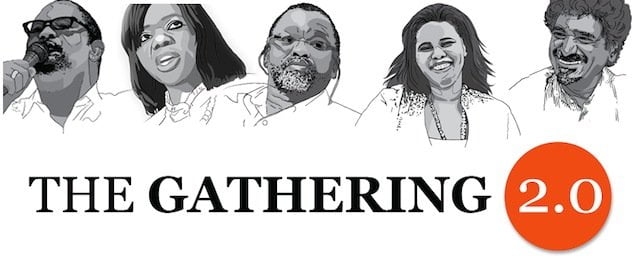
Setting aside our differences

Originally published at the Daily Maverick

Daily Maverick readers will no doubt have noticed that last week, many of this community of opinionistas, editors and journalists congregated for The Gathering 2.0. A fair number of you were there too, and those I spoke with – readers and contributors alike – confirmed that they got as much value out of it as I did.

One key factor in its success, at least as far as I’m concerned, had to do with the value of community, shared goals and aspirations. Finding common ground and room for collaboration has always been difficult, and it has perhaps become increasingly difficult in a world of sharply divided identities and rather loud disagreements.

As was the case at the first Gathering two years ago, I was struck by the sense of a common purpose and shared commitment to finding solutions for South Africa and its developmental and political troubles. Sure, we sometimes disagreed on what those solutions should be, but there was little doubting our sincerity in looking for them.

It’s rare, though, to get to have these conversations in rooms without hostile commenters, and where a combination of ticket prices, self-selection and invitations extended pretty much ensured that people were going to be respectful, even when they disagreed. Out there on the Internet, or in more typical gatherings, civility and respect are not so easily guaranteed.

One thing that has certainly changed for me in the time between these two gatherings is my desire to attempt to be more sympathetic to the reasons why people disagree on goals and strategy – especially in the area of religion, where most of my attempted interventions take place.

Those of you who follow the endless squabbles in the secular, sceptical, or atheist community will know that fighting with each other is as much a part of the game as combating religious dogma is. And this isn’t only because there can be dogmatism and unreason on the non-religious side too – which there certainly can be – but also because everyone is sometimes guilty of being more interested in being right than in making progress.

Making progress – whether it be finding a political solution to a seemingly intractable problem, or persuading the rank-and-file Catholic to join you in publicly denouncing a child-abuse-enabling Cardinal – sometimes requires collaboration rather than antagonism. And, the former is more often appropriate than the latter is, as far as I’m concerned.

Don’t get me wrong – there is room for anger, and there is room for the sharpest criticism. Not only because the sharp criticism can inspire others to break with a tradition or belief, or serve as a lightning rod for debate, but also because it’s sometimes deserved.

The column I abandoned writing this week was going to amount to an extended insult (on issues, rather than ad hominem) directed at Blade Nzimande, and (leaving aside the fact that he would probably never have noticed it) attacking him seems permissible because he is presumably capable of brushing it off.

Likewise, I can feel more comfortable attacking Ray MacCauley rather than his parishioners, or the quack Professor or Doctor rather than those that change their diets or medical regimes on his or her advice. Because we all make mistakes, and while we should all sometimes know better, those of us in authority or with the expertise required to make the judgement in question should know best of all.

But as with any area of contestation – and especially in what I’m confident is an Internet-fuelled tribalism and hyperbole – caricatures so often win out over trying to find common ground. On the pro-science and secular side (and note the false dichotomy there – as if the religious can’t be pro-science, just like pro-life invites the caricature of “anti-life”), what community there is is partly premised on a caricature of the “other”, just like religious folk can easily point to some obnoxious atheist they know and use that person as their baseline for understanding non-believers.

What I worry about in these cartoonish versions of reality is firstly the possibility that we’re forsaking opportunities to learn things – about each other, about difference, about persuasion; and second that we’re impeding progress towards what could in many instances be common goals.

A significant proportion of secular activism – at least on the web – currently consists of people mindlessly (or so it appears) sharing photographs of a Hitchens or Sagan looking thoughtful, and accompanied by an inspirational (or blasphemous) quote. Often, these imagines will come from Facebook groups such as “I fu**ing love science” – as if saying so makes it true.

It doesn’t make it true. Mostly, we love the false impression of community that’s gained through imagining that the other – whether it be the unscientific, Bronze Age-mythology believing monotheist, or the dogmatic, immoral and cruel New Atheist – through the eyes of our respective prejudices.

I’m currently (too slowly) working on a review of Chris Stedman’s provocative new book “Faitheist” (edit: review now posted here), in which he makes the case for atheists “reaching across the aisle” and getting involved in interfaith efforts aimed at bettering lives. As he puts it somewhere in the book: “Do we simply want to eradicate religion, or do we want to change the world?”

These goals are of course not mutually exclusive, but in our eagerness to caricature each other, I worry that we lose sight of the possibility that focusing on the latter could contribute to achieving the former. More to the point, it could do so at a lower cost than encouraging divisiveness does, because the partisan outlook obscures the fact that we probably have more in common than what divides us.

Of course we need to keep asking whether beliefs are true or not, while encouraging people to discard untrue beliefs where possible, even if they are comforting. But no matter how often we ask those questions, they will have no effect unless someone is listening. And why should anyone listen, when it’s clear that the person asking you to listen has no interest in conversation?

I benefit(ed) from apartheid

Originally published in the Daily Maverick

I certainly benefited from apartheid. And I’ve bought the t-shirt that says so – two of them, in fact – even though I might never wear them except in the company of other 40-something white liberals, with whom I share enough history that misinterpretation is unlikely.

Misinterpretation is unlikely, even as we agree on how many different things the t-shirt could be saying, and often also agree on what it should and should not be saying. It does not need to say that because I’m white, I should feel guilt. It should certainly not be saying that white people should withdraw from political comment, as Samantha Vice once argued.

But outside of the shared space of those of us who – to a lesser or greater degree – participated in some form of protest or activism in the 80s or earlier, this shirt’s message is perhaps a little too ambiguous, and too open to misinterpretation. Two reactions illustrate the problem, and even though these reactions are both far too simplistic, they nevertheless serve as useful examples of two possible extremes.

First, there’s the contribution that “Frank” made to MyNews24, headlined “I benefited from apartheid and other fairy tales”. Frank’s column discussed the “new liberal buzz concept that we as whites … have hugely benefited from a system that has been dead and buried for 18 odd years”. There’s no value in linking to this, as it starts out wrong-headed and quickly ramps up to triumphalist – but completely unreflective – smugness.

While the fact that he thinks this concept “new” might reveal that he’s only started thinking about this recently, more worrying is the fact that he’s bought into a premise that I can’t help but associate with someone who’s unwilling to engage with South Africa’s past (and therefore, present and future) in an honest way. As I’ve argued before, the first democratic elections didn’t somehow flip a magical switch, whereby after 1994 we could be sure that everyone succeeds or fails entirely on merit.

Now, I might like to wear the t-shirt in Frank’s company too, so that he can know he’s alone in wanting to bury his head in the sand, or to engage in acts of “whataboutery” wherein you boycott SAA, or self-righteously stalk the aisles of Pick ‘n Pay rather than Woolworths for a week or two, to say “what about this new-fangled form of racism, eh? Is this what ‘we’ struggled to achieve?”

But then, maybe Frank will think I’m wearing the t-shirt ironically, and never think about the message it’s intended to convey. Or maybe he’ll think, “well, perhaps you did, but my life was hard, and now my kids can’t get into UCT Medical School. And you call this justice?” In other words, maybe Frank will make the mistake we all (white, black, female, male, poor, rich) sometimes do, of thinking that anecdotes count as data.

And then, there’s the other sort of extreme reaction, this time a comment left at the Mail&Guardian (excerpted):

sickening…how self rightous some white south africans can be…so you think a sorry is good enough..a woolies t-shirt with those words is good enough. for me it simply shows the depth at which white people think black people are stupid. How lowly they regard black people’s pain. Will this t-shirt wipe away the memories of apatheid, will it give me the land they took away from my family. will it educate me, will it take away the shame and inferiority complex I have that was passes down to me due to the whites manipulating black people’s minds.

The fact that this reaction is a straw man of the worst order is besides the point, as is the fact that the author of this comment seems to believe that white people are in general insensitive, manipulative, and of the view that black people are stupid. To put it plainly, it’s besides the point that the author of the comment appears to have racist attitudes towards whites.

The reason it’s besides the point is that whether (many or most) whites are like that or not is a separate issue from whether a wearer of this t-shirt in fact benefited from apartheid (which, in general, they certainly would have), what they are trying to say in wearing it and most importantly, whether they think that wearing a t-shirt is all they need to do to wipe the slate clean.

My answers to those questions are not going to be the same as yours. But the key point here is that regardless of what my or your answers might be, those answers aren’t going to necessarily overlap at all with how the t-shirt is perceived by others, and what they think you mean. Intentions aren’t transparent to those who pass us on the street, and the performative role of this t-shirt is a fundamentally ambiguous thing – not to mention potentially a rather offensive thing.

And lastly, there are two quite general problems with this t-shirt, which further decrease the likelihood of my ever wearing one, despite now owning two. First, because as much as it’s true that whites benefited from apartheid, apartheid – or at least its legacy – is increasingly becoming the narrative by which some tenderpreneurs and politicians (even Presidents) enrich themselves at the expense of people who are currently, not previously, disadvantaged.

As much as the t-shirt would speak the truth if I were to wear it, would it be any less true if worn by President Zuma, even though the benefits might be of a very different form? If apartheid didn’t provide Zuma and the ANC with a narrative of being essential to the liberation from apartheid, would he and others not perhaps be in jail?

The other general problem is that what the t-shirt says is partly false. Yes, I did benefit from apartheid, as (on aggregate) all whites did. But I still benefit, because of the cultural capital, the confidence, and from the fact that the vast majority of people in power at my institution are white liberal males, just like me. How could I not have benefited and continue to benefit? After all, isn’t that what apartheid was designed for?

Brands vs. personal identity on Twitter

Originally published in the Daily Maverick

Should people be suspended for having a terrible sense of humour? Or were Lance Witten and McIntosh Polela suspended because of terrible judgement instead? Both their own, in terms of what they found humorous, as well as on the part of their respective employers, who allowed themselves to be forced into action by the moralistic masses on social media.

Terrible judgement seems the more likely option, but it’s perhaps not only Polela and Witten who are guilty of it. They know that they are public figures, and they know that this makes them a target for the sort of finger wagging we seldom direct at our own behaviour. But do we – and their employers – have to enforce groupthink, or can we separate the brand from the individual?

In case you don’t know what these two did to deserve suspension (in the eyes of their employers, at least), Polela made a joke about prison rape on Twitter after Molemo “Jub Jub” Maarohanye was sentenced to prison for murder, and Witten made a joke (also on Twitter) about people “dying to see Linkin Park”.

Given that prison rape is reportedly a significant problem in South African jails, and that Florentina Heaven-Popa died after scaffolding collapsed on her and others at the Cape Town Linkin Park concert last week, these jokes were certainly in very poor taste.

However, having poor taste is something that’s only directly relevant to people who work in fashion, food, or whatever areas involve being an authority on discerning what the most desirable product on offer might be in a given situation. Suspending someone for having poor taste in humour – for saying something that many would find offensive – makes the statement that we must all have the same values, and that dissenting from those values is not permissible.

It also makes the statement that we (as a company) don’t trust our customers to be able to distinguish between our employees as people and the company as a whole. This is where one has to consider the possibility that their respective employers are also guilty of poor judgement, in that they’ve played a part in letting hyperbole win, and in helping to feed an appetite for sensation that we should instead be doing our best to quell.

One reason that social media policies are necessary is that people seem incapable of realising that what you say on Twitter or Facebook can reflect negatively on your employers. Another reason that social media policies are necessary is because employers are willing to bow to the demands of the pitchfork-wielding public, who make threats of boycotts over every perceived slight. And then, forget about it the next week, when some new offence is paraded in front of them through a hyperbolic headline.

Seriously – how often have you heard of someone who was not killed “execution style”? When last was a person or a report “criticised” or “challenged” rather than “slammed”? And why can’t eNCA have the option of saying, “Lance Witten might be a tosspot, sure, and he really shouldn’t have made that joke. So ‘unfriend’ him if you like, but he works for us as a sports anchor, and he’s good enough at that that we see no reason to suspend him”.

They can’t have that option because we don’t allow them that option. Our thirst for sensation, and our inability to separate the various roles that people perform in professional and private lives, makes it impossible for a company to say that perfection is an unreasonable standard to expect from our employees, and that there are other ways of distancing yourself from comments or from employees than by suspending or firing those employees.

All that we are doing is satisfying the desire for some public flogging, after all. The idea that anyone learns any sort of lesson here (besides the lesson of “keep your views to yourself”) is implausible. Because we always forget, and because all that’s necessary to speed up our forgetting is a brief period of suspension, a public apology, and some new distraction – which is usefully always around the corner.

And so it goes, again and again, and the main loser is our sense of perspective. Yes, jokes can be offensive. But Witten, Polela – or you, or me – won’t stop making offensive jokes, or come to agree with each other on which jokes are permissible or not as a result of suspensions like these. We’ll just tell the same jokes, more privately, while our public spaces become more homogenised, and thus (one suspects the thinking goes) “safer”.

Companies must, of necessity, have an interest in their brand and how the market perceives it. This would certainly entail avoiding any real scandals, especially those perpetrated by senior figures in that company. But if reputational harm comes to implicate every tweet of every employee, there’s little chance of preserving reputation.

It’s become a truism to say that the brand and the person can’t be separated – but that isn’t necessarily because it’s true. One possible social media policy doesn’t seem to attract the attention it seems to deserve, and it would go something like this:

Our company values are x. While we try to hire people who share those values, there are also other job requirements that sometimes have an equal or higher priority. So, unless informed otherwise, please assume that individuals are responsible for their own comments on social media, and that none of their comments should be understood as expressing the company’s views.

We don’t believe that we are the best judges of what should be a universal morality. We respect our customers enough to want to avoid the paternalism of assuming that they are incapable of telling difference between individual employees and us. And finally, we respect our customers too much to think that they need our protection from things they might find offensive.  Have a nice day.

Postscript: Via 6000, here’s an example of sanity prevailing in this area. The Christian whose case is discussed in the article is of course a homophobe and a bigot, and that’s not good. But he’s allowed to be those things, especially on his own time.

Do liberals misrepresent Mourdock?

As submitted to Daily Maverick

It’s not easy to be objective. In fact, it’s close to impossible – and it might not even be desirable. But being objective is not the same thing as being fair to the evidence, which is something we should always strive for. No matter what perspective you think the evidence justifies, you’re not going to get anywhere in persuading someone else of that perspective if they discover that you’re wrong about the facts.

Being right about the facts is itself difficult. Not only because the data we have can sometimes be contradictory, but because our datasets are always incomplete. The facts that contradict any given interpretation might not be known, and worse still, might not even be knowable at a given point in time.

What we can do, though, is to try to acknowledge the biases we do know of, and try to not allow those biases to lead to misrepresentation. Unless you care more about persuasion than being fair, that is. And in politics being fair often seems to take a back seat, because the stakes are high and people might pay attention for just long enough for you to plant some impression in their minds, but rarely for long enough that you could actually engage them in debate.

So, you won’t try talking theology or in this case, theodicy, with regard to Richard Mourdock. Far better to simply assert that he thinks God intends for rape to happen, and for that rape to result in an unwanted pregnancy (which, by his lights, it’s naturally immoral to terminate). That assertion is of course one interpretation of what he said at a recent Indiana Senate debate (see video below), and it’s an interpretation that fits neatly with a stereotype of Mourdock belonging to some disreputable group (whether this means Republicans, men, Christians, or whatever).

But shouldn’t we expect more from ourselves, and from our media? It’s invigorating to have cartoon villains roaming about, to be sure, because it allows for those impassioned speeches at the dinner table, and for us to cast some opposing force as the one who will save us from the approaching menace.

There’s no question that many Republican candidates (most, if you only count the ones we’ve been hearing from) are intent on rolling back the current permissive legal framework around termination of pregnancy. They go further than that in what’s been called the “war on women”, with suggestions for mandating invasive procedures like transvaginal ultrasounds rather than allowing women to choose other ultrasound methods.

As I’ve argued in previous columns (on Obama’s rejection of the FDA recommendations on the morning-after pill, and the Republican ‘Personhood Pledge’), the conservative moral voice does seem to hold a significant influence in American politics, and this influence tends to be exerted to the detriment of reproductive rights. I’ve firmly stated that to my mind the Republican view on this is wrong, and that voters (especially female ones, of course) should oppose these attempts at curtailing their freedom.

But this is because I don’t think a foetus morally significant. If you do – and perhaps especially if you do for reasons such as the sanctity of life – it would be unsurprising for you to think that abortions are immoral. And if you did think they were, this attitude would have to be expressed at the cost of women, because women are the ones who bear the full burden of bringing a child to term. So yes, you could cast this as a “war on women”. Or, you could cast abortion rights as a “war on unborn children” – and both would be hyperbolic, false, and eliminate a whole lot of potentially interesting conversation in favour of being able to hurl epithets at each other.

Just in case this column is triggering anybody’s confirmation bias, I’ll repeat that reproductive freedoms should not be curtailed (in fact, I’d wish for us to be able to discuss extending those freedoms, whether we choose to or not). Regardless of this, it simplifies the conversation to an unfair extent when opponents of abortion, like Mourdock, are cast as claiming that God desired for a woman to be raped.

http://www.youtube.com/watch?v=626VKRScETI

Listen to the recording for yourselves. Most of you would disagree with him, just as I do. But what he says is that God intends for the life to happen, and he makes it clear that he’s struggled with this issue, and that rape is “terrible”. Sure, this doesn’t go as far as we might want it to. And yes, he wants to take away a women’s right to choose whether to terminate a pregnancy or not, except in situations where her life would be endangered by bringing the child to term (which, we should note, makes him more progressive than some of them).

If what you hear, though, is a Republican candidate saying “God wanted you to be raped”, then the villain you see in front of you is at least partly a projection of your own moral outrage. I believe he he’s wrong, yes – but that he’s wrong for exactly the same reason that millions of Christians around the world are, in believing that one value (the preservation of life) trumps another (the woman’s right to choose). And, in believing that he can pick and choose when to attribute something to God’s plan (the pregnancy yes, the rape no), while simultaneously asserting that God’s ways and plans are ineffable.

So, if you want to pick a fight here, give some thought to whether you’re picking the right one. The same people who complain about Mourdock and the Republican war on women don’t seem to picket traditional Christian churches, where this same message on abortion is conveyed every week. We don’t see op-eds lambasting the one survivor of a bus crash for saying it was God’s plan for everyone else to die.

The outrage regarding Mourdock, in other words, is selective, unprincipled, and born of exactly the same cherry-picking that allows Mourdock to say the sorts of things he does.

Rebecca Watson on Slate

Re-posted from SkepticInk for archival purposes.
 
I’ve now read the Rebecca Watson article that Slate published on October 24 five times. Not because I’m particularly dim-witted, but because I wanted to try to understand what was causing the fresh outpouring of ridicule towards her in the comments there, as well as on my Twitter and Facebook timelines. Was it just as simple as people rising to the same bait as always, or were there some fresh provocations to be discovered? And more importantly, when will this nonsense stop, and how can we collaborate in getting to that point?
 
In a post addressing one of WoolyBumblebee’s posts about Jen McCreight, I concluded by saying the following:

…we can sometimes be accused of placing too little or too much emphasis on history, and not enough on our own conduct. Too little, in the sense of the tweet I quote above where zero effort was made to see if an interpretation is the correct one. And then too much, in the sense that we sometimes expect new entrants to a conversation to know minute and technical historical details of that conversation – and then abuse them when they get a detail wrong. There’s sometimes too little patience for any kind of induction period, and so-called “newbies” need the thickest skins of all.
 
To remedy this problem, I offer one suggestion: that when a debate gets heated, we should try to remember that no matter what’s come before, we’re constantly at a new decision-point, where we – and only we – are responsible for what we say in response to something we find provocative. Sure, someone else has committed a wrong, and we can be inflamed by that. But essentially juvenile questions of “who started it”, while diverting, seldom help illuminate the question of how it can be ended. In other words, I’m suggesting that we learn (or remember) some manners.

What I think Watson gets wrong in the Slate post is that she doesn’t take into account that she’s addressing an audience who won’t necessarily know the minute and technical details involved in the various incidents since that morning in the elevator. So I think that she should have made a greater effort to point out the positive work that’s being done in addressing discrimination in “the community”. There are only two sentences that I can see that acknowledge that some organisations are aware and trying to address the problem. The article paints what I think is an uncharitably gloomy picture, and as such will provide fodder for both anti-Watsonites as well as anti-secular folk. People on the fence, tempted to get involved the secular or skeptical community, might well say “I’m not going near that – sounds like all they do is hate each other”.
 
So, in terms of outreach and the like, I think Watson could have made better use of the opportunity presented by such a public platform. But in terms of everything else she said, I have no complaints, and nor should I feel entitled to. She’s telling her story, and unless I had the temerity to accuse her of lying about her own story, the fact that other people have competing (or supplementary) stories isn’t necessarily relevant. She’s not your spokesperson, or a historian of the skeptical movement. She’s telling her story, and reporting threats and the like that she felt significant enough to bring to the community’s attention, along with reporting the lack of sympathy she experienced in reaction to that. If you want to call her a liar, that’s your prerogative – but I don’t see any good reason to join in that game.
 
Because even if she is exaggerating – and even if she, or people in her corner – have done their own bad things – that’s not the only thing that matters. If you want to keep a scorecard, and constantly remind others of who is “most bad”, knock yourself out. But this nonsense has got to end. And there’s no chance of a cease-fire until people see the possibility of saying something like “damn, that sounds awful, and I’m sorry that I didn’t support you when you experienced that” or whatever, without following up with a sentence like “but you did this other bad thing, so quit whining/looking for attention”. Yes, it’s true that you can find fault and over-reaction on all sides of this divide (and sorry folks, but it is possible to say this without claiming a false equivalence – without keeping a scorecard at all, in fact). If people treat each other like crap, of course we’ll retaliate in some fashion, some of the time.
 
All of us need to remember that we have another option, which is to not assume the worst of each other, and to focus a little more on what we have in common rather than our differences. Yes, some differences shouldn’t be tolerated. But in all the hysteria and hyperbole, it’s unclear to me how many folks have considered whether this really is one of those occasions.

Should identity politics dictate beliefs?

As published in Daily Maverick

Arguments with self-described liberals, feminists and various other sorts of people were part of the motivation for my column last week, in which I argued that it’s always illegitimate to dismiss an argument simply because it’s expressed by someone you regard as speaking from privilege. In summary, the person whose view you’re dismissing might be simultaneously privileged as well as correct.

The privilege of avoiding arguments?

Originally published in Daily Maverick

One of the chapters in Bertrand Russell’s “Unpopular Essays” (1950) is “The Superior Virtue of the Oppressed”. In the essay, Russell criticises the tendency of those who marched with him in support of various social justice issues to not simply stand against oppression, but also to insist that the oppressed are somehow epistemically privileged. They were wiser, more experienced, perhaps even more objective than those who were not oppressed. An uncharitable reading (Russell’s) would be that it’s actually good for you to be oppressed.

On liberal bullying

The Guardian recently re-posted a column by Ariel Stallings (originally published in Offbeat Empire), under the title “Online bullying – a new and ugly sport for liberal commenters“. It’s a quite interesting read, and deals with a concern that I can relate to – namely another variant of an ad hominem dismissal of someone’s arguments, in this case on the grounds of their race, gender, privilege and so forth. But as with all difficult topics, and perhaps especially the emotive ones, it’s all to easy to read this piece as confirming whatever bias you started out with.

It would be a mistake to interpret Stallings as providing you with an excuse to dismiss criticisms based on secondary factors like privilege. As I’ve argued in a more lengthy piece on this topic (which pre-dates reading the Stallings piece), we can separate the epistemic issues from the political ones. With regard to the epistemic virtue of dismissing arguments about (for example) race and related oppression when those arguments are presented by a middle-class white male such as myself, it seems straightforward that it would be ludicrous to think my arguments false of necessity. Then, it would perhaps simply be uncharitable to think my arguments more likely to be false than those of someone who experiences oppression based on race.

Because ideally, we’d always judge arguments on their merits and nothing more. But because of limited time (and other elements of bounded rationality), the heuristics of assuming that group x has some authoritative view on topic y are attractive, and seem to easily take hold. And they almost certainly have merit – at least in the limited application of giving you a reason to think that (on average) a middle-class white male has less chance of understanding the context of a person oppressed on racial grounds.

Of course, you might want to counter by saying that there’s no reason to think that oppression brings objectivity with it, which is one of the points made in this Jeremy Stangroom post. This is where the political, rather than the epistemological, takes centre-stage: those of us who speak from positions of whatever privilege should be cognisant of the fact that – no matter the strength of our arguments – we’ll easily be interpreted as speaking from that position (in other words, be biased by that position), and that this might be one of the factors that results in miscommunication.

Sure, you can argue that it’s an unfair hurdle to jump over in order to be heard. But communication is full of these annoyances, and we don’t do it any favours by simply donning our superhero-logician outfits and insisting that the rest of the world sees things just as we do. Perhaps we’d like them to, and perhaps they even should. But it’s unlikely that you’ll successfully convince someone of that when you sound just like either a stereotype they hold dear, or a sort of person they are justifiably antipathetic to.

And most importantly: the fact that it’s always fallacious to dismiss your argument simply because of who you are does not mean that your argument isn’t fallacious via who you are – because who you are would be a product of education, circumstance, privilege, race, and so forth. Sometimes – even perhaps frequently – we can become blinded to various ways in which we see the world in a partisan fashion. When someone reminds you of that, take the reminder seriously. Because it might well be true.

On a different note, if you’ve perhaps not heard the sad news of Greta Christina’s endometrial cancer diagnosis, go and read what she has to say. And if you’re willing and able to help, she has a few suggestions there as to how you can do so.

On dealing with trolls

As submitted to Daily Maverick

One of the things that the Internet has been good for is broadening the range of perspectives in any given conversation. Of course certain barriers need to be overcome: to participate, you need an Internet connection and a suitable gadget. Nevertheless, conversations have been democratised, thanks at least in part to being able to more easily discover who is interested in talking about the same things as you, and the fact that it’s relatively inexpensive to join in.

However, the filter-bubble remains a problem. Not only do the personalisation features of search engines like Google give you results that reinforce existing prejudices; we also like it that way – it’s called confirmation bias, and too few of us take active steps to combat its negative implications (if we’re even aware of the potential need to do so). There’s another concern though, one that I’ve mentioned in the past but would like to explore a little further today: the question of online abuse and the extent to which it might cause some voices to withdraw from the conversation entirely.

An example from a few minutes ago will serve to illustrate: “screw u, u doos, first of 90% of big business in S.A is owned by whites and top man is white, so cry me a river!!!” is what someone just told me on Twitter after I repeated an overheard joke about members of the UCT Senate’s prospects of employability at Woolworths.

Now, seeing as some folk have been calling me a racist for a few weeks now, thanks to my defending  Woolworths and SAA’s affirmative action policies, we can be sure that the grammar-impaired person who tweeted that at me is clearly unaware of this context. That’s fine – I’d expect most people to be. However, just in case there is some context, one might think a little tempering of the hostility is merited when (over)hearing something that offends you.

Not so for this person, it seems, and increasingly not so for those who comment in these pages and elsewhere. And then there’s the next layer of trouble, which is where the filter-bubble ends up resulting in a congregation of these hair-trigger folks into one “room”, as it were. At some point, all possibility for debate ceases to exist because of the mutually-assured idiocy of a collection of angry people, each paying less attention than the next.

Because there seems to be no chance of changing anyone’s mind, some of those who might otherwise try to do so eventually resort to measures like turning off comment functionality, stop engaging in comment threads, and eventually – stop engaging with certain pockets of the Internet at all. This has two consequences: the collection of trolls and angry folk are made more homogenous, and thus apparently stronger, and likewise, the collection of those who consider themselves “virtuous” is furnished with another example of why they are special, and right – and their homogeneity increases too.

So, one day we’ll end up with half the Internet grunting angrily at each other, while the other half recites passages from Plato. Unless we find some way to arrest this escalation of hostilities, or unless I’m wrong about the trend (and I hope I am). In a future column I hope to explore potential legal remedies for online bullying, such as those currently being considered in New Zealand and elsewhere. But because less regulation is always preferable to more, we should also consider what each of us could or should do, simply in our capacity as members of the Internet community.

First, I’d argue that we can sometimes be accused of placing too little or too much emphasis on history, and not enough on our own conduct. Too little, in the sense of the tweet I quote above where zero effort was made to see if an interpretation is the correct one. And then too much, in the sense that we sometimes expect new entrants to a conversation to know minute and technical historical details of that conversation – and then abuse them when they get a detail wrong. There’s sometimes too little patience for any kind of induction period, and so-called “newbies” need the thickest skins of all.

To remedy this problem, I offer one suggestion: that when a debate gets heated, we should try to remember that no matter what’s come before, we’re constantly at a new decision-point, where we – and only we – are responsible for what we say in response to something we find provocative. Sure, someone else has committed a wrong, and we can be inflamed by that. But essentially juvenile questions of “who started it”, while diverting, seldom help illuminate the question of how it can be ended. In other words, I’m suggesting that we learn (or remember) some manners.

Democracy doesn’t magic us into equality

As submitted to Daily Maverick

When you call for a boycott of Woolworth or SAA it’s not in my name, Solidarity. Not in those terms, where you misinterpret legislation, or at the very least stick your fingers in your ears and stamp your feet when you’re offered alternative interpretations. And not in the indignant tones of a group that wants to claim disadvantage in a country where the 10% of us who are white still seem to control just about everything except for the government.

I get that you are frustrated – judging from the comments on some recent Daily Maverick columns, many white folk are at least frustrated, if not angry. It’s even fair to say that you might have a point, because if it’s true that BBBEE is handicapping business and holding back otherwise qualified white employment candidates while only benefiting black tenderpreneurs, then BBEEE is broken. An unemployed black person might even be quick to agree with you, if it was that obviously broken.

Another way in which you certainly have a point is that we shouldn’t be reserving jobs, or positions at universities, according to race. As I argued last year during the crisis-talks around who was allowed to call themselves “African”, Patrice Motsepe and Anton Rupert have far more in common than Steve Hofmeyr and I do. Both black and white refer to something meaningless, or are shorthand for something else that is deeply meaningful.

That meaningful thing is privilege and power, and whether one has it or not. It is whose numbers you have on your cellphone, and whose you do not. It is how many books you read as a child, and therefore how ready you were for school and maybe university, and it is about whether your parents had time to spend weekends with you instead of go to work – or even sometimes about whether you knew your parents at all. It is about all these things, and many more that I can’t imagine.

That meaningful thing tends to correlate with race. We can perhaps summarise it by using the descriptor of “class”, even though that would need further definition. And no, melanin levels play no direct causal role in assigning you to a class. But they have played an indirect one for centuries, thanks to those of us with a lighter skin using race as a proxy for identifying those who stand ready to be exploited.

Not willing, of course, but ready. Sometimes ready thanks to not knowing any better, or through trusting the wrong people. Eventually, as you all know, the exploitation was codified in law, and it was ensured that the vast majority of our population would have less access to the privileges of good educations, safe neighbourhoods, running water and the like.

Those laws changed one generation ago. So it is true that many entering the job market today grew up in a racially neutral democracy. But very few of those job-seekers have parents who can advise on appropriate water-cooler conversation, or on which tie goes best with that suit, or on what to do when you’re the subject of sexist jokes in the workplace.

1994 – or whatever date you choose to identify the start of freedom – did not constitute an act of magic, despite the exuberant rhetoric we so long to believe in. Disadvantage can at some point in history be considered self-inflicted, or an instance of bad luck that has no systemic cause such as racial prejudice. But we’re not there yet, because it remains unreasonable to question the fact that a white kid – in general – enjoys advantages that a black kid does not.

Ideally, this conversation shouldn’t be about race. It should be about identifying which South Africans are underprivileged due to some or other injustice, and then providing redress where possible. If we could find a better way of detecting this lack of privilege than race we should use it, or at least open the discussion about using it – affirmative action based on something as meaningless as skin colour does need a sunset clause, or some sort of trigger condition for its demise.

And yes, it is also true that there are poor white folk, some very rich black folk, and therefore easy examples of inefficiencies and injustice you could point to as being caused by affirmative action. But when you do so, you sound like a racist. Because those exceptional cases don’t alter the fact that cultural capital – Pierre Bourdieu’s term for the knowledge, access and other advantages that allow white people, in general, to still enjoy a higher status in society – is not built over a single generation.

So by all means, Solidarity, question whether we should substitute class for race and explain to us how we should do so. Introduce the idea of a sunset clause – it would be improper for you to be accused of racism simply for doing that. As far as I’m concerned, you could even ask whether it’s appropriate for a job to be targeted at a certain race group, if it’s true that doing so would constitute unfair discrimination.

But as I tried to point out in my column on SAA’s cadet scheme, when one race – or one class – is under-represented in certain job categories, it’s pretty easy to guess what race and class they are, and why they are under-represented. And it’s perfectly justifiable to try to find qualified candidates from that group, before expanding your search to include looking for more people of the sort you already have.

We should all hope to one day not need affirmative action of any sort. But if you claim we don’t need it now, simply because no child was born into a South Africa where they were deprived of a vote thanks to their skin colour, you’re really missing the point that you can’t simply vote your way into a better life for all. Securing a better life involves education, employment and a host of other goods – all of which remain easier to access if your skin happens to be pale.