Talking about risk-mitigation is not (always) victim-blaming

Originally published in the Daily Maverick

7cca959a9b6a4e5cad27293a135a06f6

On the afternoon of this column’s publication, I engaged in brief debate with Michelle Solomon, a local anti-rape activist, on radio. You can listen to that here if you like.

Even since Anene Booysen’s rape and, later, death last weekend, much of South African society has been engaged in a sustained period of reflection regarding the staggeringly high incidence of sexual violence in our country. Alongside the reflection, there has also been much furious Tweeting and Facebooking, as the slacktivists all rise up to say “something must be done” – without ever telling us what it is that we might do.

Rapists aren’t going to read a Tweet and realise the error of their ways. So, for all the solidarity that these public shows of support provide, we need to do more. I don’t know what that could be, except for the obvious things everyone knows about – better resourced police and rape-crisis centres, for example.

It’s not that public debates can serve no purpose – Lindiwe Mazibuko’s suggestion to debate this in Parliament, for example, could actually be useful. The more often that patriarchs like Patekile Holomisa and Jacob Zuma get to hear that women aren’t chattel, the better. Because that is the root of the problem, is it not – that women aren’t treated with respect, but rather as objects for male exploitation of various forms?

How do you fix that, even as you try to improve policing and offer increased support to victims of crimes such as these (and certainly, those involving male rape also)? Some of us can certainly set a better example, whether in the copywriting contained in our advertisements, or in the lessons we teach to our children. But in a community riddled with drugs and gang violence like Bredasdorp apparently is, perhaps the best that many children could hope for – at least in the short-term – is to somehow escape their hometown, and their families.

In the longer-term, though, I’d like to offer a more modest proposal relating to our arguments and our language around rape. Simply put, I’d ask that we guard against sacrificing common sense on the altar of politically-correct principle, because if we’re not having a full (and fully-informed) discussion about the causes of rape, we’re handicapping the search for solutions to rape. One area in which discussion is becoming impossible is risk-mitigation with regard to rape, where every mention of it earns you little more than a reprimand for “victim blaming”.

The vast majority of rapes have nothing at all to do with the situation and conduct of the victim, meaning that victim blaming would not only be offensive, but also factually confused. But, if even 5% of rapes do have something to do with those factors – and are thus potentially avoidable through some form of risk-mitigation strategy – we have to be allowed to talk about those strategies. Currently, we can’t, because any suggestion that potential future victims should consider risks (and thus perhaps not experienced the crime in question) is shut down with a refrain of “victim blaming”.

Note the first confusion alluded to above – we can distinguish between existing victims and potential future victims. If you were to quiz an existing victim of a theft on whether he was counting his bankroll in public, he’d probably feel justified in asking  why you were paying attention to his behaviour, rather than that of the perpetrator. But if you offer tourists the pre-emptive advice to not count their bankrolls in public, the advice seems perfectly sensible and inoffensive.

Sentiments don’t become true through repetition. We just stop thinking about them, or start pretending they are true through fear or experience of being bullied. Why accusations of “victim blaming” are not always appropriate or true is because the moral and statistical aspects of rape are entirely different matters.

The moral aspect of rape – put simply, who committed a wrong, who should feel guilt, and who should be punished – is easy to resolve. In all cases, the rapist is the answer, and his victim has committed no moral wrong. But rape, like other crimes, occurs in a context. Or rather, it occurs in many contexts, and this allows for a purely scientific assessment of whether any particular aspects of those contexts correlate with a higher or lower incidence of rape.

This is how we respond to every other crime. If you were to be involved in a car accident involving a drunk driver running a red light, it’s that driver’s fault – entirely. But if this accident happened at an intersection where everybody knows drag racing takes place, you chose to expose yourself to a higher-risk situation than you could have (assuming there were other routes home). The fact that you shouldn’t need to take another route home is an entirely separate issue from how sensible it might be to take this particular route home.

What we say in situations like that is something like “watch out for that intersection”, and provincial authorities might feel inclined to put up one of those red spot “high fatality” road signs. What we say to children is things like “I don’t want you hanging out with Seamus” (at least, that’s what I was told). If you’re involved in an accident, or if Seamus introduces you to cigarettes, we could always have known that this was more likely than could otherwise have been the case. Risk-mitigation is, in other words, a standard component of our hardware.

As you all know, correlation doesn’t by itself indicate causation, but it can certainly act as a clue that there is some causal factor at play. More to the point, if it turns out that situation x tends to correlate with a higher incidence of rape than situation y, we never criticise someone for choosing situation y. And when someone knowingly choses situation x, you wouldn’t apply moral blame, because the blame belongs only with the criminal. But you could certainly feel entitled to ask potential future victims whether they are sure they want to visit the neighbourhood in question.

If you’re a policeman, you’re not doing your job through asking that question or questions about clothing after the fact, as the Toronto policemen who inspired Slutwalk did. Because only one person has committed a crime and that person is the rapist. But you’d also not be doing your job if you didn’t keep a detailed record of crime hotspots, and use that record to advise people of which areas they might want to avoid, for which reasons.

Of course it’s obscene that risk-mitigation with regard to rape asks women to voluntarily imprison themselves, only go out accompanied by chaperone, not walk alone at night, or to be constantly vigilant against someone spiking their drinks. These sorts of realities are an outrage, and the disproportionality of the burden carried by woman is likewise an outrage. Men are afforded the privilege of mostly being oblivious to these realities – and in many ways, it is men being oblivious to their privilege that allows gender-based violence to flourish.

Unfortunately, most situations that correlate with a higher incidence of rape can’t be avoided. The 2012 Victims of Crime survey (pdf) indicates that 17% of sexual assaults are perpetrated by family members, and a further 58% by someone known to the victim. 22% of sexual assaults took place in the victim’s home, and a further 25% in someone else’s home – areas we’d normally hope are safe.

Over this past weekend, City Press editor Ferial Haffajee published an editorial  in which she raised questions about risk-mitigation. A full day of criticism for “victim-blaming” ensued, because Haffajee asked whether firmer, or different, parenting, perhaps including a curfew, would have made a difference in Anene Booysen’s case. It probably wouldn’t have, at least not in any particular case. But we make a mistake when only thinking about Booysen’s rape, or any other instance of rape, while not also thinking about the rapes that don’t fit the pattern of the one under discussion.

For those (mostly) girls who live with a rapist uncle, cousin or brother, of course a curfew won’t help. But not all victims of rape can add that particular misfortune to the other misfortunes they have had to endure. So even though it’s true that most rapes happen in the home, and are perpetrated by someone known to the victim, that doesn’t mean curfews or parental interventions of other sorts can’t help avoid rapes that don’t fit this pattern.

People should be allowed to say that, because even though it’s wrong to have to limit your choices in the face of a dysfunctional society, doing so could save lives or prevent at least some of these crimes from occurring. That’s surely worth doing, even if it does nothing to address the root causes. If you insist that there is only one thing worth talking about – and one language to use when talking about it – the conversation quickly seems to be more about you than about Anene Booysen. And she can’t hear you anymore.
Can frankensalmon triumph over uninformed ad-hoc opinions?

Originally published in the Daily Maverick

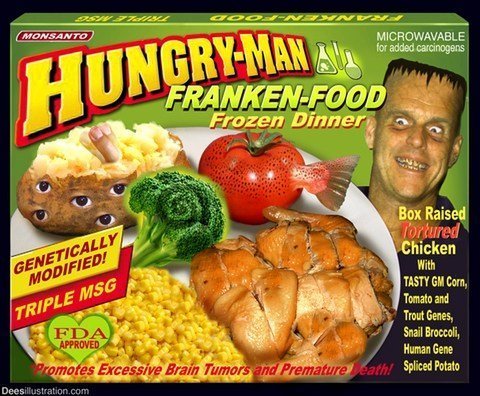
tumblr_lys10lmgnS1qdm7sdo1_500Consumers have a history of caution in adopting technological innovations in food. Pasteurised milk took years to gain acceptance, and words like “Frankenfood” are used to describe food that is produced in a lab. But what starts out frightening can rapidly become commonplace. Nearly two decades ago, genetically modified soy beans were Frankenfood, and today they account for 85% of soy bean production in the US.

Labels like “Frankenfood” are emotive, and imply that a wrong has been committed. Unfortunately, the debate often ends here, as moral claims – no matter how un-articulated – are frequently treated as privileged or even as trump-cards, in that if you find something morally objectionable, your objection is typically afforded respect regardless of its merit.

So it is with Frankensalmon, or to give this delectable fish its proper name, AquAdvantage salmon, fresh from the labs of AquaBounty Technologies, Inc. A combination of Atlantic Salmon, Chinook, and Ocean Eel Pout. The Chinook salmon provides a growth hormone gene, while the Ocean Eel Pout contributes an antifreeze protein gene. What we end up with is a salmon that reaches market age twice as fast as the one you’d normally find on your plate.

What we also end up with, at least according to some commenters on the FDA’s website, is either something that will make you fat directly (“Pls don’t allow ge salmon. Please. Usa is obese enough”, says Vera) or play a part in destroying regular salmon, a food which apparently keeps you thin. According to Sandra, that is, who says “I am finally finding out why i have had a problem with my weight and health for the last few decades. Now you are prepared to take one of the healthiest foods away”.

Comments also include the predictable lamentations regarding Monsanto (who have nothing to do with AquAdvantage), big pharma, government and assorted other (also big, I imagine) villains. Mostly, though, it’s sheer hysteria and the occasional attempt at something that looks like a threat (“my family will never buy this!”) – albeit not a threat you’d imagine at all efficacious.

“It’s not nice to fool mother nature”, and “we need to stick with the basics and consume food in the form in which it has been consumed by human beings for millions of years” is the common sentiment, repeated over 24 pages with various degrees of anger. But as I noted in a previous column on doping in sport, the appeal to nature is often nothing but simple prejudice dressed up as argument.

There are arguments that could be had here, and evidence that would be relevant to whether this GM salmon should be approved or not. One concern would be whether these fish would be reproductively superior to traditional salmon, threatening their existence in the long run.

Even though AquaBounty claim that they are bred to be sterile, a Change.org petition reports that 5% of them are in fact fertile. Other issues are raised in the petition, such as the fish causing increased allergic reactions, and apparently also (at one production site) having been “infected with a new strain of infectious Salmon Anaemia, a deadly fish flu which has been devastating fish stocks around the world”.

It’s that sort of language – on the petition and on the FDA site – that should give cause for decreased concern, rather than the escalated hysteria that hysteria tends to breed. Salmon anaemia has been observed since 1984 – before this fish existed – and also seems to be something that salmon are prone to, whether or not they are GM. And seeing as viruses mutate, speaking of salmon being “infected with a new strain” can only result in readers imagining Dr. Strangelove cackling as he plots to hand Karl Rove the keys to the world.

It’s difficult to find examples of scientists, rather than frightened laypeople or environmental activists, urging caution about this fish. It might certainly be unsafe, but if it’s evidence and argument that should inform choices like these, we’ve got very little, if any, reason to be concerned.

What I’m more concerned about is the increasing trend of mistaking the popular voice for an opinion worth taking seriously. Christopher Hitchens coined a wonderful phrase in referring to conspiracy theories, dubbing them “exhaust fumes of democracy”, and one could say something similar about calls for public participation, like this one from the FDA (closing on February 25, if you want to get a rant in).

A checkbox which asks something like “is there any particular reason to take your viewpoint seriously” should perhaps be added to any such website, poll or evaluation, with an upload facility for your credentials. As Mitchell and Webb put it, a frequent response to the feedback we get could be something like “thank you for sharing with us the full majesty of your uninformed ad-hoc reckon”.

In summary, the problem seems to be that the democratising of, well, just about everything has resulted in too many of us thinking we have something worthwhile to say on anything, where sometimes, the most valuable contribution we could make might be our silence.

Tiny dead baby corpses

Did you perhaps think that right-wing talk show hosts couldn’t say anything more absurd than you’ve already heard? Not even the homeschooled ones? Well, you’d be wrong if you did. In a novel (at least it has that) argument against birth control pills, Kevin Swanson has the following to say (audio here):

I’m beginning to get some evidence from certain doctors and certain scientists that have done research on women’s wombs after they’ve gone through the surgery, and they’ve compared the wombs of women who were on the birth control pill to those who were not on the birth control pill. And they have found that with women who are on the birth control pill, there are these little tiny fetuses, these little babies, that are embedded into the womb. They’re just like dead babies. They’re on the inside of the womb. And these wombs of women who have been on the birth control pill effectively have become graveyards for lots and lots of little babies.

As Robin Marty succinctly points out,

even if somehow there were tiny mini babies stuck in your uterus, they would come out when you menstruate since THAT’S THE WHOLE POINT OF MENSTRUATION. Because obviously, whatever school Swanson attended must have not only skipped over the entirety of sex ed, but likely a full spectrum of basic science classes as well.

There’s also some weird stuff in there about Hitler, and more. Pat Robertson had better up his game.

Alain de Botton: 10 virtues for atheists

I really can’t make my mind up about Alain de Botton. Part of me finds him insufferable, thanks to what appears to be his perpetual smugness, as well as his fondness for translating complex ideas into aphorisms that could fit on a chewing-gum wrapper. But then, much as the equally (to me, at least) annoying Jostein Gaarder’s Sophie’s World brought philosophy to people who otherwise wouldn’t read or think about it, perhaps de Botton does more good than harm. Nobody expects more from him than vaguely inspirational “deep thoughts”, so it’s entirely possible that part of my annoyance is mere jealousy at how he’s cornered the atheist version of the Deepak Chopra market. And that, in doing so, he’s getting people to think about worthwhile and interesting things.

But at a time when some really interesting conversations are being had between Loxton, Myers, Novella and others on the delimitations of skepticism, it’s particularly annoying that de Botton’s recent list of what are variously described as “virtues”, “commandments” or “guidelines” are being marketed as “for atheists”. First, because it plays into the hands of those who think atheists need such a list – ie. that we are any more value-deficient than any other “group” of people; and second because it seems to assume we are a “group” of people in any relevant sense, besides simply sharing disbelief in gods as part of our mental furniture. (I realise that this could open conversations about “dictionary atheists” and the like, but I really hope it doesn’t.)

So, in the midst of an interesting discussion regarding how to define a particular shared interest and those who hold that interest, here were have a lazy demarcation of “atheists” and “other” – and when you see the list, you’ll no doubt observe that there seems little that is specific to atheism, and little that can’t simply be described as “guidelines for conscious creatures”, or somesuch.

De Botton has previous form in the game of oversimplification, of course – in Religion for Atheists, he straw-manned new atheism in support of his creation, atheism 2.0, and then in 2012 he suggested the erection of a “temple to atheism“. There are many good ideas hidden in both of these initiatives, but also plenty of platitudes. As I said at the time, “de Botton is dressing up the obvious as if it’s insightful. And his further explanation of how he thinks these are good ideas don’t make them appear any more so”. So it is with the 10 virtues for atheists, which are:

  1. Resilience. Keeping going even when things are looking dark.
  2. Empathy. The capacity to connect imaginatively with the sufferings and unique experiences of another person.
  3. Patience. We should grow calmer and more forgiving by getting more realistic about how things actually tend to go.
  4. Sacrifice. We won’t ever manage to raise a family, love someone else or save the planet if we don’t keep up with the art of sacrifice.
  5. Politeness. Politeness is very linked to tolerance, the capacity to live alongside people whom one will never agree with, but at the same time, can’t avoid.
  6. Humour. Like anger, humour springs from disappointment, but it’s disappointment optimally channelled.
  7. Self-Awareness. To know oneself is to try not to blame others for one’s troubles and moods; to have a sense of what’s going on inside oneself, and what actually belongs to the world.
  8. Forgiveness. It’s recognising that living with others isn’t possible without excusing errors.
  9. Hope. Pessimism isn’t necessarily deep, nor optimism shallow.
  10. Confidence. Confidence isn’t arrogance, it’s based on a constant awareness of how short life is and how little we ultimately lose from risking everything.

It’s fairly obvious what’s going on here. He intends this list as a substitute for the Biblical 10 commandments – but doesn’t want to call them “commandments” (note, some newspapers have called them that, but he doesn’t), because that will too obviously invite ridicule from atheists telling him things like “atheism is not a religion”, as well as glee from theists saying “look, atheism is like a religion!” So, he loses the rhetorical force being able to call them “commandments” would have provided through superseding the Biblical commandments and making them redundant.

But they are already redundant to atheists, and superseded by a non-belief in gods and their hypothetical commandments. Furthermore, these are values most of us – whether religious or not – already have. So, he’s trading on an existing set of commandments – but only indirectly – and then doing so in a way which highlights the false distinction he’s making between atheists and everybody else. As a result, the list appears ever more opportunistic, and simplistic. And, of course, annoying – even though there’s very little wrong with the list itself.

You can leave your hat on

Originally published in the Daily Maverick.

this-hijabIn a phone call to Redi Tlhabi’s Radio 702 show last Wednesday, Caroline (or something) from Claremont was outraged. Children should not be allowed to wear Muslim headscarves, she said, because headscarves are a sign of Muslim “infiltration and indoctrination”. Furthermore, she repeatedly asked, if kids can go to school wearing a hijab, why can’t they also (or rather, alternatively) go to school naked?

Another caller agreed that religious garb should be outlawed at school, on the grounds that this would somehow curb the (presumable) infiltration and indoctrination of atheists, who wear black. Apparently. In other words, just another day in the parallel universe of talk radio, where common sense goes to die.

But beyond the hysteria, there are some issues worth addressing here. Not Caroline’s apparent racism (in this case Islamophobia, although that remains a word we should use sparingly, because that’s clearly inadequate grounds for policy. Neither need we address the non-analogous case of nakedness, nor the various other failed attempts at analogy (why is my child forbidden from wearing cowbells!). Whether what currently counts as legitimate religion is right or wrong, our current legislative framework is the one by which the Eben Dönges case needs to be assessed.

For those unaware of this case, the nutshell version is that two children were sent home from Eben Dönges, a high school in the Western Cape, for wearing religious headgear. Sakeenah Dramat (16) was asked to remove her hijab, and her brother Bilaal (13) was asked to remove his fez, and they were told that they could not come back wearing their respective headgear. This was on the first day of the new term, and the children were only able to return to school a week later, after the Western Cape Educational Department intervened.

The first issue worth addressing is the error of referring to Muslim children, Christian children, or [insert any other religion] children. Until a child is old enough to choose for itself, it is the parents who are religious rather than the children. Indeed, this particular case is notable for the fact that it’s the mother who is quoted as saying “I can’t allow them to take it off because it is against our Islamic beliefs.”

She’s then quoted as saying “It is very sad. It is very disturbing” – and while she clearly means the actions of the school, those words could easily apply to some cases of children who are given no option but to believe what their parents do – and thus also easily apply to her previous quoted sentence.

But a 13 and a 16 year-old could also be Muslim by choice. Unfortunately, we often only get to know how much volition is possible when people try to change their minds (through observing how their families and community react), but it’s certainly possible that these two children are contented in this particular faith, and proud of being identified as members of it.

To go back to our caller to Redi Tlhabi, though: that account of how much choice was involved ignores the issue of how early indoctrination can start, and how powerful it can be. By the time one is 13 or 16, it can be difficult to see any other choice than the one your family made as being the appropriate or sensible one. You might never think of changing your mind, and we would then never get to see how unwelcome doing so might be.

These concerns need to be applied consistently, though. Given the high proportion of Christians in South Africa, the chances are good that many anti-hijab callers (and many of the hundreds who have expressed anti-hijab sentiments on the poll IOL is running) would see no problem with a child wearing a crucifix necklace. Because your indoctrination is evil and mine not, I suppose.

We can’t guarantee that these sorts of choices are made freely. But we can help to create a climate that encourages free and rational choice, and also taking responsibility for choices. Forbidding the hijab while permitting the cross encourages inconsistency and bigotry. Permitting them both – as well as any other outward signs of religious affiliation – can be done alongside restrictions that encourage civic virtues such as understanding and compassion.

I mean two things: first, that allowing the hijab, but insisting that it be in the colours of the school uniform, reminds the scholar that a plurality of values are competing, and that none should be assumed to have priority until the relevant debate has been held. And second, allowing religious headgear avoids sending a signal of prejudice, which will hopefully result in an increased chance for people like me to argue against the choice to ever want to wear the headgear or the crucifix.

The system of thought – or sometimes lack of thought, to be more honest about some forms of religious indoctrination – that forces some women to cover themselves near-completely does merit opposition, as does a tradition that won’t allow women to be priests, or to have abortions, or whatever the case might be.

But expressions of those ideologies are not equally thoughtless, and treating them all as if they are – or not allowing them at all – runs the risk of acting no differently to that which you’re protesting. If you don’t think children should wear a hijab or a fez, persuade them and their parents that they shouldn’t. As David Mitchell puts it, “It bears restating that it’s not bigoted to disagree vociferously with people’s choices, as long as you’re even more vociferous in defending their right to make them”.

And finally, if a public school doesn’t allow for the expression of alternative religious views (including the non-religious view), please report them to your local education board.

Let them have EPO!

Originally published in the Daily Maverick. Sports scientist Ross Tucker and I had a brief debate/exchange of views on this topic on CapeTalk567 on the day of publication, and you can listen to that here.

120824060051-lance-armstrong-2-single-image-cut

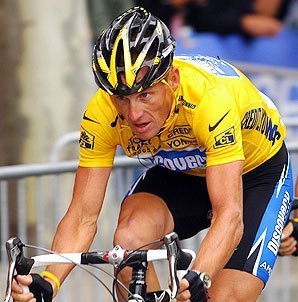
Lance Armstrong certainly lied, and by most people’s standards, acted unethically in doing so. We’ll also find broad agreement that it was an moral failing for him to retaliate against whistle-blowers, attempting to destroy credibility and careers in an effort to keep his multiple deceptions a secret.

It is likewise true that he broke the rules in taking performance-enhancing substances, and in that sense deserves whatever punishment is laid down for those rule-violations. But the rules in question are inconsistent or even incoherent, and Armstrong’s fall from grace will hopefully lead to their revision.

The problem is this: for those of us who can only admire sporting prowess from afar rather than exhibit it ourselves, the narrative of purity is a compelling one. There we see a beautifully sculpted physique, capable of feats we can only imagine, that has been nurtured and honed in order to perform those feats. Or sometimes, someone more ordinary has perfected a skill through years of dedicated effort.

In both cases, though, we can imagine the sacrifices and dedication – the purity of purpose, and the fact that they achieved these goals through natural ability, exploiting the gifts bestowed on them by nature.

The immediate problem with this, though, is that it’s a complete fabrication. Some of us will always be advantaged in some respect and others disadvantaged, and anyone’s “natural” state will already include those asymmetries. You could fill a library with books on the philosophical concept of “moral luck”, Bernard Williams’ phrase for the inconsistent ways in which we attribute praise and blame for things that might or might not be in the agent’s control.

It’s not only that you might be born into a family that has the material means to buy you a bicycle or some running shoes, or send you to training camps. Your natural advantages might rest in the fact that you grew up at high altitude, or near a beach so that you built strength by running in the sand. For every Mfuneko Ngam, whose international cricket career was (arguably) curtailed by the dietary deficiencies he experienced growing up, and which later led to frequent injuries, you could point to someone whose body developed to be stronger or faster thanks to environmental factors.

And what are performance-enhancing drugs but simply one more factor like these, available to some and not to others by virtue of nothing more than simple luck? Once we discard the illusion of the Athenian athlete, running naked save for a loincloth (perhaps alongside Bambi), it should become clear that drawing the line at drugs is as arbitrary as drawing it at any other point, and that the issue of whether or not someone broke the rules is an entirely separate one to whether the rules are sensible.

In the case of professional sport and drugs, the line-drawing currently seems to rest on a version of the naturalistic fallacy, namely the mistake of thinking that natural is good and unnatural bad. In morality, people (mistakenly) use this fallacy against homosexuality, and in medicine perhaps in support of homeopathy instead of chemotherapy (if you’ll forgive that very loose usage of the word “medicine”).

But these examples are cherry-picked, and easily refuted by pointing to cancer (natural) or the wearing of spectacles (unnatural, in that the nose and ears were not evolved for the purpose of supporting spectacles). So our moral judgements – including our attributions of praise and blame – should not rest on a conception of the natural.

What about fairness? If we are to allow drugs in professional sport, some argue, then it will be doctors who win races, rather than athletes. As I point out above, though, this is already the case – not only for doctors, who might prescribe better drugs to some of us than others while growing up, leading to healthier starts to life, but also to parents who have unequal means to support us. It’s already parents who win races, not athletes, so why not let doctors also win a few medals?

Yes, there will be some who can exploit the chemical resources better than others can, but we need a good reason to treat this sort of resource differently to any other. Currently, our reason seems to be an interpretation of the “spirit” of sport that allows for the manipulation of all sorts of parameters (diet, lifestyle, training regimen) excepting one, namely your drug intake.

Even this exception is applied inconsistently, in that it seems entirely arbitrary to say that paracetamol is permitted (as it is for Olympic athletes) and another drug not, seeing as a splitting headache would surely impact on performance in something like a game of tennis. These are matters of degree, not of kind, and operate on a spectrum ranging from whether you were breast-fed to whether you take EPO.

I would offer a similar response to those who are concerned about pressures on young athletes, who might do themselves long-term health damage through taking drugs from an early age. Again, this sort of objection doesn’t seem to operate in the real world, where professional athletes already do themselves significant damage through obsessive training at a young age. We need to account for the possibility that taking drugs would allow for fewer, not more, cases of retired 35 year-olds’ with various permanent aches and pains thanks to aptitude for some professional sport.

The drugs will only get better the more we are allowed to take them. They will also get cheaper, and safer, if the user-base is expanded. And just as technologies at the high end of motorsport make our road cards safer, perhaps the non-athlete will also benefit from improved medication at the end of the day.

But first, we need to recognise that professional sport is not pure, and never has been. More importantly, we need to recognise that one sort of corrupting influence might not be as easily distinguishable from another as we might think, or hope. Within the lifetimes of most of us, biological enhancements will most likely be the norm, and it will be even clearer that our obsession with some sort of pastoral narrative in sport is increasingly naïve.

Tiger Woods is allowed to compete after having laser surgery that by some accounts left his eyesight at 20/15, compared to the normal 20/20, which would mean that he could see at 20 feet what a normal person could see at 15 feet. Golf returns to the Olympics in 2016, and I’ve heard nothing suggesting that he (and many others) will be disqualified, even though this would surely advantage him on the golf course.

Thinking ahead: if corrective eye surgery of this sort is permitted, as is the wearing of contact lenses to make your vision 20/15 or even 20/10, as for baseball’s Mark McGwire, what will we do when our poor vision can be corrected through the replacement of the eye with something off a robotics assembly line? Or would we just claim that that’s somehow “different”, and ignore all the ways in which sport is already not the pure contest we imagine it to be?

Read more:

Maiming, killing and dying for “culture”

Originally published on SkepticInk

Parts of a 17-year-old boy’s feet from Bonita Park, in Hartswater had to be amputated, after he ran away from an initiation school in Pampierstad in search of food.

After he was tracked down, he was thrashed with a sjambok, while his feet were burnt with fire. He was later abandoned along the side of the road, where he was left for dead, naked and bleeding, until a passing motorist noticed him and alerted the police.

Due to extensive nerve and muscle damage, his toes had to be surgically removed.

667532_612441This boy, and thousands like him, are sent (and often willingly go) to initiation schools to mark the transition between boyhood and manhood, “through ritual circumcision and cultural instruction regarding their social responsibilities and their conduct”. Ever year, children die in the course of “becoming men” – and in South African society, being a man correlates quite positively with thinking you can dictate the course of the lives of women.

Part of the reason for the continued survival of poorly regulated initiation schools, with poor hygiene and cultural instruction from previous centuries, is that they provide a narrative to life – a structure, and a community. If the average adolescent knew that they had a decent prospect of a good education, a good job and so forth, they’d probably be joining protests against such schools – opting for medical circumcision at the very least, if not entirely rejecting cultural indoctrination.

But it’s been – and will continue to be – a long wait for more people to have a better shot at a good life through adequate healthcare, education, and those goods many of us take for granted. And what we put in place as substitutes to give meaning to life – namely cultural practices such as these – result in initiation schools, genital mutilation, corrective rape, culturally embedded homophobia, sexism and so forth.

“Culture” is used as an excuse of all sorts of things (in South Africa, often as a simple vote-getter). But it’s only when you get to choose what your “culture” is – and not have it forced upon you – that it becomes remotely respectable. And even then, it should never be an explanation or justification for doing or believing something. As I tell students, appeals to culture, tradition and the like get the causality entirely backwards: things could become cultural norms because they are good norms; but the fact that something is a cultural norm has no bearing on whether it’s a good or respectable one or not.

Blood deferrals – too important to take personally

Originally published in the Daily Maverick

14983260-blood-donation-medical-buttonOne of the things that allowed this species to survive into the 21st century is our ability to detect patterns, and to make predictions based on those patterns. If you were a hunter, you’d have needed to be able to predict the movement of the beasts you hunt with some degree of accuracy. If you were a farmer, some rough understanding of seasons would have been rather useful, lest you waste all your seed, your water, and all your effort.

We’re here and it’s 2013, which means that our forebears got these sorts of things right with reasonable regularity. Sufficient numbers of them managed to feed themselves, and avoided walking off the edges of cliffs or getting eaten by carnivores. But all of that pattern-recognition and the accompanying storytelling can be a liability, in that it gets in the way of our realising that we are simply one data point, usually interesting only to ourselves and our immediate circle.

And, it gets in the way of seeing other potential stories. Not just the stories of others (helping us to escape our subjectivities), but also the story the data tells by itself, without our fears, hopes, and histories being allowed to corrupt it.

You know your own examples, but the sorts of corruption I mean would include our thinking that problem gambling is significantly prevalent in South Africa just because Aunt Sally has a problem. It’s not, at least not by international standards. Or, when your cold goes away a couple of days after taking some homeopathic remedy, when your confirmation bias allows you to ignore the fact that a cold typically only lasts for a couple of days in any case.

The storytelling I speak of is not just in ascribing patterns to potentially unconnected events, but also in finding intentionality or causality where none might exist. Intentionality, such as that we imagine when describing a tragedy as part of “God’s plan”, because doing so helps to shield us from the fact that we are meaningless. Causality, of the sort we might think we’ve found when some sort of “lucky” token or behaviour correlates with a random moment of good fortune.

The cognitive rules of thumb (or heuristics) that we use in developing these responses served a purpose in allowing us to get this far, and still serve a purpose today. But we no longer need to be as reliant on them, and are increasingly irrational when we do so, because the volume of data available to us is mostly far better suited to analysis by machines than by humans.

The South African National Blood Service illustrates the problem well, introducing all sorts of moral complications at the same time. As reported in the Cape Argus, a gay couple recently had their blood donation deferred (or rejected), thanks to the SANBS policy of deferring donations from men who have had sex with other men in the last six months.

One narrative that fits this policy is that the SANBS is homophobic, and this narrative has enjoyed strong support on social media for the last few days. But as I wrote in a 2011 column, deferring blood from this category of donor isn’t atypical, and South Africa’s blood service is in fact fairly liberal in this regard. In the UK, the deferral period is one year, while in the US a lifetime restriction applies for men who have had any sexual encounter with another man at any time since 1977.

Now, there’s no principled reason why we should think the US or UK a good guide to policy in this or any other instance. But there’s also no reason to be guided by the perception of discrimination based on moral judgement, where the discrimination might instead be based on cold, impersonal data.

As I note above, this is exactly the problem: we struggle to think of ourselves as mere data points, and instead wish for the world to bend to shape our anecdotal experiences (or anecdata). I have little reason to doubt the statistics reported – across various international jurisdictions – on the Centers for Disease Control website, or the FDA’s reasoning for why they defer blood donations from men who have sex with other men.

The statistics show that this group are “at increased risk for HIV, hepatitis B and certain other infections that can be transmitted by transfusion”. This claim is either true or false, and whether it is true or false is not a matter of morality or preference – just like it’s either true or false that tattoos and body piercings lead to increased risk of hepatitis C (the current motivation for a 6-month deferral period in Canada).

So, we can either contest the claim on empirical grounds, and refute the claim of increased risk from blood donations from men who have sex with other men, or we can claim inconsistency, saying that if this is true, that there is also increased risk from heterosexual couples who have anal sex.

In a recent interview on CapeTalk567, a representative of the SANBS seemed to concede the possibility of this sort of inconsistency, saying that they would be considering this in the upcoming revisions to their donation forms.

But even if this inconsistency is borne out by the data – in other words, if other categories of donor exist whose blood donations are, in general, at least as (or more) dangerous than this category is – this wouldn’t mean that more gay men should donate blood. It would mean that they still shouldn’t, and that neither should some other people. So the complaints to the SANBS regarding discrimination are never likely to bear the fruit that some potential gay donors are hoping it does, unless it’s empirically false that this category of donated blood is more risky.

My use of the word “shouldn’t” (as opposed to couldn’t) in the previous paragraph alludes to an important point. As much as we’d all like to give blood, another aspect of treating ourselves as a data point – at least when thinking about public policy – is that we’ve got very strong reasons for wanting to be able to trust that we could receive donated blood safely. So the issue of which deferrals are legitimate, and which are not, is important enough to merit resolution by careful reflection and analysis, rather than to simply be the subject of this week’s bout of righteous indignation.

Labelling Jews with a “mark of shame”?

Dr Ivor Blumenthal - one Jew one jobWhile on campus for what I hope will prove to be the last meeting of 2012, a clear-out of the mailbox revealed a holiday-themed, ambiguously Christmassy card from the Cape Jewish Board of Deputies. The card reminded me of earlier this year, when I appeared on a panel with Khaya Dlanga and Brenda Stern at the Board of Deputies CENSOR/TIVITY conference. During the session I participated in, I was rather pleased to observe what appeared to be a fairly consistent and principled commitment to both free speech as well as the benefits of being sensitive to the emotional harms speech acts can cause.

Even though various contentious matters were under discussion (there’s a podcast at the link above, if you want to listen) – Zapiro’s cartoons, the Labia not screening Roadmap to Apartheid – most of the audience, as well as the executive members I chatted with, seemed to realise that demonising your opposition and their point of view would usually have to entail being fairly liberal with the truth. But also, and unsurprisingly, many people spoke of their deep and continuing hurt at being stereotyped or the subject of religious or other slurs. Zapiro’s cartoons were held out as an example of caricatures against Jewish folk, especially in Israel, that served no purpose but to harm.

Sadly, this sensitivity to offence turns out to be mono-directional. When a member of the Jewish community calls for Jews who are anti-Israel to wear a “mark of shame” – and expresses regret that stoning them is not possibile – the Board of Deputies declined comment. Here’s an extract from the blog post in question, written by Ivor Blumenthal:

We have to “out” them, their families, their children, their businesses and their friends. We have to make it as politically incorrect to be associated with them as they, with their BDS mates are making it for the majority of the Jewish Community in South Africa. We need to name them. We need to shame them. We need to make sure that their ability to make a living dries up. We need to label them and their families with the “mark of shame”. They are traitors and must be painted on as such. There is no space or place for half measures here. This is not something that can be negotiated. It is absolute casting into the wilderness which is required so that the next “humanitarian” will think four times before taking the same steps to attack the Jewish people, our values and our beliefs.

The question however is whether we have the courage as a community to do this?

You might think these words were written a number of decades ago, if it were not for the reference to the BDS (boycott, divestment and sanctions) movement. But no – these are the words Ivor Blumenthal, a Jewish man himself, published on his blog yesterday, in reference to Jewish folk who are anti-Israel. For more on Blumenthal and his history of controversy, read this post by Nathan Geffen and Mary-Anne Gontsana. In a response typified by complete tone-deafness to history, the Cape Town Jewish Board of Deputies said:

Dr Ivan Blumenthal expresses a personal opinion in his blog titled “You cannot fight it darling – a Jew is a Zionist. By birth, not by choice.” The Cape SA Jewish Board of Deputies feels no need to comment on the opinions of an individual within the Jewish Community who is not speaking on behalf of any Jewish communal organisation.

But offering any response at all (ie. acknowledging the existence of the case) without expressing judgement is already a comment of sorts, because the response entails the Board of Deputies declining a clear opportunity to say something even as benign as “obviously, we don’t share his views, but he has the right to hold and express them”. The Board of Deputies might well think Blumenthal’s position correct, even if they would not go as far in expressing it (through a “mark of shame”, for example) – but through not condemning his excesses, they align themselves with the sort (regardless of degree) of intolerance and prejudice I was led to believe they were vehemently opposed to.

Blumenthal also says:

Centuries ago we would have stoned people like this to death. Death is today not an option because, it just so happens that in South Africa we have some of the most stringent Human Rights legislation, ironically developed and forced through Parliament by – Jews, most of them who are the turncoat, ant-semetic (sic), self-hating, treacherous Jews.

While this (for me) stops short of a call to violence, it’s still reprehensible – and whether or not it counts as hate speech under South African law, it’s nevertheless worth denouncing, loudly and wherever possible. Including by the Cape Jewish Board of Deputies, who you’d think would be more sensitive to the potential that words hold to cause harm.

Welcome, robot overlords

Originally published in the Daily Maverick

On a flight back from somewhere, earlier this year, the pilot announced to us that we’d just been treated to a fully automated landing. While nobody expressed any concern, there were a few thoughtful or confused looks around the cabin, of people not quite sure how to respond to this news.

My first thought was regarding the timing of the announcement. Just in case anyone would be concerned at being landed by an algorithm, the SAA (I think it was) management (yes, I know) presumably decided to only let us know once the deed had successfully been done. But I also wondered how many others were, like me, thinking something along the lines of “it’s about time”.

It’s about time, I mean, that we acknowledge that humans are inferior to computers at making some decisions, and that we should therefore remove humans from the equation. And not just some – in areas where decisions are made by reference to a multitude of factors, and the intended outcome (such as landing a plane safely) is unambiguous, I’d be tempted to up that to “most”.

Pilots are of course well trained, and no doubt need to pass regular checks for things that might impair judgement, like drugs, alcohol or sleep-deprivation. That’s one of the reasons that far fewer people die from accidents involving planes than die from accidents involving cars. But another reason is that we think far too highly of ourselves, and our own competence at performing routine tasks in adverse circumstances – like driving home after one too many drinks.

We’re reluctant to understand ourselves as a simple statistical data-point, far more likely to conform to the mean than not. Anecdotes trump data every time for most of us, which is why we can think that we’re superb drivers while under the influence of something, until that day when we’re just a drunk driver, like all the other drunk drivers who have caused accidents since booze first got behind the wheel of a large metal object.

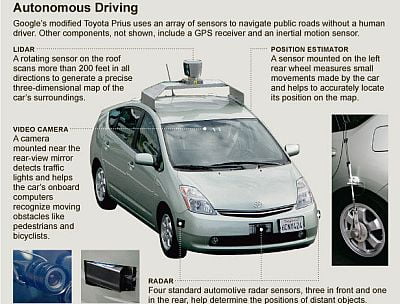
But despite our occasional incompetence in this regard – and note, also an incompetence that we can to some extent control – is it time to hand everyday driving over to computers also? I’d say it might well be, for those of us who can afford to. Because even if you’re as alert as you could possibly be, you’re still not able to simultaneously engage with as many variables as a computer can, and nor are you able to react to the outputs of that engagement as quickly.

Computers – or robots – pose questions beyond whether they or a human would be superior at performing a given task, like getting you to the church on time or destroying an enemy installation during war. In war, proportionality of response is a key issue for determining whether a drone attack is legal or not, and as soon as a drone is fully autonomous, we’d need to be able to trust that its software got those judgements right.

Or would we? The standards that we set for human beings allows for mistakes, so it would be inconsistent to refuse the possibility of error for robots, even if they were unable to express contrition, or to make amends. As with many encroachments of technology into our existence, robotics is an area where we need to be careful of privileging the way that humans have always done things, just because we are human.

Cloned or genetically modified food, in vitro fertilisation, surrogate motherhood, stem-cell research (to list but a few examples) are all areas where either a sort of naturalistic fallacy (thinking something morally superior or inferior depending on whether it’s natural or not) or some sort of emotive revulsion (the “yuk factor”) get in the way of a clear assessment of costs versus benefits. When speaking of robots driving our children home from school, a similarly emotive reaction can also cloud our thinking.

Just as with any data point in an set, you and me and everyone we know more often feels superior in whatever skill set than actually is better at that skill than the mean. The mean describes something: in this case, it describes the level of performance of the average person. And if we were all better than average, the average would be higher. For driving, it’s not, or we wouldn’t have an average of over 700 road fatalities every month.

So the question to ask is: when can we be confident that – on average – fewer people will die on the roads if cars are robotic than if the drivers are human? If we’ve reached the point of being confident about that, then the moral calculus shifts against human drivers. If you have the means and opportunity, you’d be acting less morally to drive your kids to school than have a computer do so – regardless of how this feels.

In the New Yorker, Gary Marcus recently invited us to consider this scenario:

Your car is speeding along a bridge at 50mph when [an] errant school bus carrying 40 innocent children crosses its path. Should your car swerve, possibly risking the life of its owner (you), in order to save the children, or keep going, putting all 40 kids at risk? If the decision must be made in milliseconds, the computer will have to make the call.

As Sarah Wild and others have pointed out in response, this sort of scenario does raise question about which rules we would like the car to follow, who makes those rules, and who is to blame when some unfortunate accident or death occurs. But where I think most comment on this issue gets it wrong is in labelling the moral dilemmas “tricky”, as Wild does.

If we can, on average, save many more lives by using robotic cars instead of human-controlled ones, the greater good would at some point certainly be maximised. Yes, there will be circumstances where the “wrong” person dies, because a maximise-life-saving algorithm will not be adaptable to very idiosyncratic circumstances, like the one described by Marcus.

In general, though, the robotic car will not speed, will never run a red light, and will never exceed the threshold for maintaining traction around a corner. It will never drive drunk, and will be far better at anticipating the movements of other vehicles (even if they’re not robots, on the same information grid themselves), thanks to a larger data-set than ours and an objective assessment of that data.

So it’s not that there is a tricky moral dilemma here. What’s tricky is that we aren’t able to view it – and ourselves – as a simply economic problem, where the outcome that would be best for all of us would be to set things up in a way that maximises life, on aggregate.

Any solution that prioritises human agency or building in mechanisms to know who to blame when things go wrong is understandable. But, once the driverless car is sophisticated enough, it would also be a solution that operates contrary to a clear moral good.