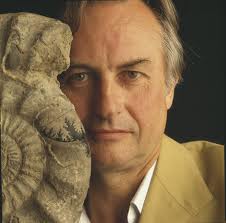
Slavemaster Dawkins and declining religious belief

As submitted to Daily Maverick.

Richard Dawkins’ recent failure to recall the full title of Charles Darwin’s “Origin of the species” served as a useful distraction from what many Christians would like to forget. Namely, that very few of them – at least according to recent research on Christians in the UK – are religious believers in any substantive sense of the word “belief”.

Dawkins certainly chose a poor example to demonstrate this in pointing out that an “astonishing number [of Christians] couldn’t identify the first book in the New Testament”. Remembering the title of a book is no indication of how little or how much of its contents you regard as significant, or of how much an influence it’s had on your life.

But using this example allowed the Rev Giles Fraser to ask Dawkins, on live radio, if he could remember the title of Darwin’s book. Dawkins asserted that of course he could, but then proceeded to be unable to do so. In case you’ve also forgotten, the full title is “On the Origin of Species by Means of Natural Selection, or the Preservation of Favoured Races in the Struggle for Life”.

While this is a longer title than “Matthew”, making these challenges asymmetrical, this is beside the point. Also beside the point is that remembering the order of four books isn’t the same sort of challenge as remembering the title of one. Dawkins was in error to use the example, and Fraser likewise misguided in thinking that Dawkins’ lapse demonstrated anything of significance.

What is of significance are the data collected in the survey of religious attitudes conducted by the Richard Dawkins Foundation for Reason and Science (RDFS). Because while not remembering the title of a book says nothing about what you believe, what you say you believe certainly does. And in terms of reported belief as well as reported practice among the 1136 people recorded as Christian in the 2011 census, you’d struggle to find much difference between some of them and most atheists.

Nearly half of the respondents had not attended any religious services or meetings in the last year. Of the group who hadn’t attended a service in the past year, 32% hadn’t done so in the past ten years either. Of course, attending services isn’t a prerequisite for being a believer. More interesting, perhaps, is the fact that only 28% of self-identified Christians surveyed reported that they believe in Christian teachings, and that 37% say that they “never, or almost never” pray. Other interesting details include:

  • 15% of them have never read the Bible
  • 32% believe in the physical resurrection of Jesus
  • 24% say that the Bible is inferior to other sources of moral guidance
  • 54% look to their own “inner moral sense” for guidance on morality, and only
  • 10% seek moral guidance from “religious teachings and beliefs”
  • 50% do not consider themselves to be religious

Looking at these results, it’s difficult to fathom what these respondents mean when they say they are Christian. When asked that question, 40% report that being Christian means “I try to be a good person”. As do most of us, I hope. But for being a Christian to mean as little as this must be rather alarming to any “real” Christians out there who take verses like John 15:14 seriously, where Jesus is reported to say that “you are my friends if you do what I command”.

It might come as a surprise to you that this is somewhat worrisome to atheists also. Well, at last for this atheist. Because it’s far more important to me that all of us think carefully about what we believe, and know our reasons for believing what we do. Whether or not Christians who read (and follow) the Bible and pray are right or wrong, they’re at least consistent. That consistency allows for more productive debate, in that if any of us can be persuaded that we’re wrong on some foundational principle, it’s possible for us to change our minds more generally.

By contrast, if your belief system is filled with instances of cognitive dissonance – often accompanied by the epistemological disposition known as “making it up as you go along” – debate tends towards pointless. Your mind can’t be changed, because in terms of some of your beliefs, you don’t really have one. Furthermore, the fact that you aren’t quite sure what or why you believe is rarely an impediment to simulating firm conviction in matters of public policy.

One-third of the respondents, for example, are sympathetic to the UK having an official state religion, and more than half want state-funded religious schools. In non-religious schools, 40% of respondents think that children should be obliged by law “to take part in a daily act of broadly Christian worship”. But then, 78% of respondents say that religion “should be a private matter and governments should not interfere in it”.

It’s clear that most of these respondents don’t really know what to think, and perhaps aren’t quite sure what they in fact do think. And some of their responses are clear indications of religion simply being a matter of culture rather than belief, where the culture in question revolves around some general notion of “being nice”. On this model, even God appears to be nice – twice as many of the respondents believe in heaven as do in hell, which is rather handy for the 38% (of Christians, remember) who report that Christianity is “not very” or “not at all” important in their lives.

Dawkins’ memory-lapse is simply a distraction from what amounts to a crisis for Christianity in the UK. Those who think that crisis merits attention will make little headway by focusing on that lapse, or indeed by attempting to discredit Dawkins through alleging that he is descended from slave owners.

Likewise, Dawkins’ argument isn’t strengthened by pointing out that many Christians don’t know which book is first in the New Testament. The more pertinent point is that many of them don’t know what that book (or any of the others) says – and that they don’t care.

A follow-up post to this (of sorts) can be read here.

Links:

Freedom’s just another word for “not allowed to choose”

As submitted to the Daily Maverick

Stronger evidence makes for stronger arguments. We all know this, and also know that it’s often difficult to discard our belief in some supposed facts that aren’t as well justified as we might think. Where this becomes an acute problem is with regard to moral claims, notably those that involve human equality and are aimed at eliminating discrimination.

Consider two examples. First, I’d imagine that most of us believe there is no scientific basis for discriminating on the grounds of race. Some of us might say that is too weak a claim, and that there is no scientific basis for even the idea of race. Second, it appears to be a widely-held notion that rape is about power, and not about sex.

For both of these examples, consensus serves a powerful rhetorical and political function. If we agree on the substance of these claims, we are able to construct arguments against racial discrimination and against victim-blaming (for instance, that  what a victim of rape was wearing or doing can be disregarded as irrelevant to the perpetrator’s crime). But what if we’re wrong?

It’s not good enough to simply assert that we cannot be wrong, or to hurl some academic paper or book in the direction of someone who dares to question an orthodox view. In the case of these two examples, dissenting voices exist, and you can often tell that they’d really prefer to not be dissenting. Treating propositions like these as axiomatic serves a useful function, whether or not they are true.

On both of these topics, there is ongoing research activity – lacking any obvious bad faith – which brings the consensus view into question. While we might prefer for both research projects to fail, we should also be prepared for their success. And if they do reveal that our common wisdom is faulty, my concern is that we’ll be ill-prepared to continue being able to mount robust defences against these forms of discrimination.

In other words, perhaps our most strident campaign against the wrongness of generalised discrimination should not be premised on facts (insofar as we know them), but rather on other aspects of the wrongness of discrimination. For race, we could say that even if racial differences exist, they are immaterial to the wrongness of generalising when it comes to individuals. For rape, we can say that regardless of the balance between the competing causes of sexual desire and asserting power, violation of consent is always the worst sin.

This is not to say that the evidence we have isn’t important, or worth emphasising. Instead, I’m arguing against exclusive reliance on it, carried by a form of evangelical zeal that assumes the facts to be fixed, and assumes those facts to be sufficient to carry the argument. Not only because our zeal could be misguided, but also because it can come with independent costs.

A recent example demonstrating this is provided by Cynthia Nixon, who you might know from all those Sex and the City episodes you didn’t watch. In Slate, she’s quoted as saying “I gave a speech recently, an empowerment speech to a gay audience, and it included the line ‘I’ve been straight and I’ve been gay, and gay is better.’ And they tried to get me to change it, because they said it implies that homosexuality can be a choice.”

It’s true that the scientific consensus is that homosexuality has a biological basis. But the other relevant fact is that the fight for social and legal equality for homosexuals has been premised on the “fact” that your sexual orientation is not a choice. It’s the latter detail that means Cynthia Nixon, in revealing her preference for women as sexual partners, can somehow be construed as an enemy of the gay-rights cause. And this is because a genuine scientific fact is not treated as merely that, but rather also, and arguably mostly, as an ideology or statement of evangelical faith.

In Brian Earp’s superb analysis of the Nixon issue, he points out that various factors influence sexual attraction, and that we can usefully separate the question of who or what you’re programmed to find attractive, in general, from who you happen to find attractive in reality. For many people, attraction operates on a continuum in any case, making labels such as ‘gay’ and ‘straight’ unhelpfully crude.

For Nixon to point out that in her case she’s decided to tend towards one end of that continuum says nothing about the extent to which others can make similar choices. If LGBT activists choose to make a dogma out of lacking choice they’ve picked a short-sighted strategy, and Nixon can hardly be blamed for not toeing the orthodox line.

There is a significant emotive context to this, not to mention a reality in which people are assaulted – whether physically or emotionally – as a result of a sexual orientation they have no control over. So it’s an important message that we send by saying that for most people, sexual orientation seems to involve little to no choice. But we also send a message when we say something like “you’re not allowed to call yourself gay, because we’ve decided that it can only mean one thing”.

The root of our concerns regarding discrimination in all of its forms could arguably be described as a conviction that people should be free to express themselves and pursue their good in whatever way they please, without society imposing any limiting generalisations on them. How sadly ironic it is, then, that a gay woman finds herself criticised by defenders of equality and freedom for daring to have an independent opinion.

The South African Charter on Religious Rights and Freedoms

Originally published in Daily Maverick.

While lacking the high-profile support and marketing opportunities that Primedia and others lent to the Bill of Responsibilities, there’s another document doing the rounds that is even more wrong-headed – if such a thing is at all possible. It’s called the “South African Charter of Religious Rights and Freedoms”, and according to one of its drafters, Rassie Malherbe, is intended to “flesh out the right to freedom of religion in the Constitution”.

This fleshing-out is apparently required due to the fact that “constitutional rights are described in cryptic, vague and general terms” (pdf). Sections 9, 15, 31, 185 and 186 seem fairly clear to me, and when read in conjunction with sections 10 and 12 of the Promotion of Equality and Prevention of Unfair Discrimination Act, it’s quite difficult to understand how religious belief could be better protected.

Of course, I’m assuming that religious beliefs should be treated as merely one form of belief competing with others on the ostensibly level playing-field provided by an impartial state. As matters stand, I’m already a candidate for appearing before the Equality Court for communicating words “that could reasonably be construed to demonstrate a clear intention to be hurtful” when speaking of religion.

Churches already enjoy preferential treatment from the taxman, while non-theistic organisations do not. The religious voice carries a disproportionate weight in debates around whether TopTV can screen pornography. On a more trivial note, for those who suffer from unpredictable thirsts for alcohol or who struggle to plan ahead, moral standards set by religion dictate the terms of liquor licences. One could go on, but the upshot of these facts is that many claims for religion requiring more protection are tenuous at best.

More worryingly, these sorts of charters have a history of allowing for discrimination against the non-religious, rather than simply proving equal protection for all. The UN resolutions on “Combating Defamation of Religions” that have made regular (and sometimes successful) appearances before various UN commissions and councils bear notable similarity to blasphemy laws such as those enforced in Ireland.

Under such laws it’s not only the case that you can (somehow) defame an idea or ideology rather than a person, but you can also go to jail for doing so. Presumably, the South African Charter would hope for such a future also. One of its clauses (6.4) states: “Every person has the right to religious dignity, which includes not to be victimised, ridiculed or slandered on the ground of their faith, religion, convictions or religious activities. No person may advocate hatred that is based on religion, and that constitutes incitement to violence or to cause physical harm.”

While the second sentence of the clause quoted above might be controversial for some, it’s nevertheless already entrenched in the Bill of Rights and Equality Act. So the Charter adds no protection by repeating it, assuming the Charter becomes law as intended by its drafters. But to demand protection from victimisation or ridicule is surely a step too far, especially when read in conjunction with something like 2.2: “Every person has the right to have their convictions reasonably accommodated”.

If reasonable accommodation comes to mean immunity from criticism – which it certainly could, with a broad notion like “victimisation” being very much an eye-of-the-beholder sort of thing – it would only be the religious that truly enjoy the rights to freedom of thought and expression afforded to us in the Bill of Rights. Those who want to express negative sentiment with regard to religion (and other categories like culture, which are also included) are of course not victimised as a result of having these protections withheld.

It goes further, as these things often tend to. On the grounds of religious belief, you can refuse to deliver “certain services, including medical or related (including pharmaceutical) services or procedures” (2.3b). And “no person may be subjected to any form of force or indoctrination that may destroy, change or compromise their religion, beliefs or worldview” (2.5) – but the same would of course not apply to that kid in the classroom who has doubts that women were magicked into existence from the rib of a man.

Furthermore, the state, including the judiciary, must “respect the authority of every religious institution over its own affairs” (9.3), and parents “may withdraw their children from school activities or programs inconsistent with their religious or philosophical convictions” (7.1). For a document that’s drafted partly in response to constitutional rights that are allegedly “cryptic, vague and general”, you’d hope for some more specificity in this charter. There is little to none of that, and I’ve only highlighted six of the thirteen clauses that are obviously problematic.

At the launch of this charter in October 2010, Deputy Chief Justice Dikgang Moseneke stopped short of endorsing it, saying that it might one day be a matter before the Constitutional Court. He nevertheless welcomed the initiative, and it seems likely that our new Chief Justice would be similarly inclined. As yet, though, there’s been little progress, and the charter has yet to be presented to even a parliamentary committee. But there are signs of life – a January article in Beeld spoke of it in positive terms, and callers to Radio Sonder Grense later that month seemed particularly enthused.

Perhaps most troubling, last week the Commonwealth Advisory Bureau issued an invitation for applications to write a paper on the right to religious freedom and belief in Commonwealth countries, in order to inform the proposed Commonwealth Charter. In this invitation, the South African charter is highlighted as an example of best practice. So even if it never reaches our parliament, there’s now a chance that other parts of the world will have the sensibilities of Malherbe and others imposed on them.

There’s no question that we need to tolerate diverse and dissenting views, and I’m sympathetic to the reality of many religious people feeling persecuted or victimised for their beliefs. Some instances of such victimisation are clearly unjust and immoral – but they are also usually already illegal and not meriting further legislation. This is part of the point of a broadly secular set of laws: that once we start creating special protections for one interest group, we have no principle by which to refuse doing so for all others.

Instead, ideas compete on their merits within a framework that attempts to give everyone an equal chance to air their views. Charters like this one hark back to a world in which a default privilege was afforded to the dominant view, and where that dominant view was a religious one. While that view is still dominant in this country as in many others, that dominance results at least in part from peoples choices and their freedom to make those choices. Let’s not entertain the nonsense that this freedom is threatened to such an extent that it can – or needs to – be protected through granting one view the sorts of protections all others lack.

And Rasool (allegedly) bribing journalists is okay

In January, I was quite pleased to read reports of ANC sources claiming that Ebrahim Rasool might be recalled from his ambassadorship in the US. Not simply because of a lack of fondness for him, but rather because it’s not outlandish to suggest he should never have been appointed as ambassador to the US until the investigation regarding the Brown Envelope scandal was completed.

For those who aren’t familiar with the case, the issue is this: Rasool was alleged to have indirectly used public funds to help incentivise two Cape Argus journalists to write stories that favoured him, and that presented his Western Cape ANC opponents in a negative light. These bribes were (if these stories are true) paid in cash, placed in brown envelopes.

The internal ANC investigation into these allegations was terminated in 2006, but the matter was nevertheless considered serious enough for ANC secretary-general Gwede Mantashe to confirm that Rasool was fired as Western Cape Premier in 2008 partly as a result of the allegations: “Rasool was removed as premier of the Western Cape all because of this case, among other things”.

Now, it’s true that Ashley Smith never appeared to be the most credible of witnesses. Perhaps Rasool was indeed falsely accused. But some within his party seemed to think the allegations true. They are also serious enough that it’s welcome news that Gasant Abader’s (current editor of the Cape Argus) access-to-information application to compel the ANC to release their report on their investigations has been successful.

The relevant parties are still studying the report, and we’ll no doubt hear more on this as time passes. But in the meanwhile, Rasool continues in a high-profile ambassadorial post, despite not only the Brown Envelope scandal, but also further allegations of corruption made in 2010 to the police commercial crimes unit. You’d like to think that allegations of significant corruption matter – not only in party deployments, but also with regard to our international representatives abroad.

Some ANC leaders agree that these matters are serious. In 2011, one of them said:

One issue that constantly cropped up in the elections research, even among our staunchest supporters, is that the ANC is soft on corruption and looks after their own. This requires a system for processing such allegations that will send a message of an ANC that is intolerant of corruption.

Today, an ANC leader is quoted in the Cape Times as saying that he didn’t think the Brown Envelope investigation needed to be completed, because “Ebrahim (Rasool) is no longer premier, he has gone on with his life”.

The first quote is from ANC secretary-general Gwede Mantashe. The second? Also Gwede Mantashe. I suppose that’s another allegation “processed”, then.

#TwitterBlackout

As submitted to Daily Maverick.

It’s sometimes difficult to escape the feeling that we’re living under the tyranny of the perpetually indignant. Taking the time to think things through and developing a measured response to some hot-button issue is a luxury we’re infrequently allowed. Not only do media outlets thrive on sensation, but readers are also often eager to be the first to express outrage at some new conspiracy, malfeasance or instance of ineptitude.

And so those hot-button issues can get generated out of thin air, then recycled and amplified in the echo-chamber of Twitter and other social media. Last week, Twitter itself became the latest subject of hysterical misinterpretation when they announced their new policies for blocking tweets. As of January 26, tweets (or Twitter accounts) can be blocked on a country-by-country basis rather than globally, as was the case before software refinements made selective blocking possible.

The Forbes’ headline “Twitter commits social suicide” summed up many of the responses, which made accusations of charges of censorship and complicity in killing free speech trend under the hashtag #TwitterBlackout. Some even suggested that the once-plucky underdog had now sold out, and was caving to the (purported) illiberal demands of their new investor, Saudi Prince Al-Waleed bin Talal.

But bin Talal only purchased a 3% stake in Twitter, and we have no evidence that he has any interest in dictating policy. We also have no evidence that Twitter’s policy change is a bad thing for free speech. In fact the opposite seems a far more plausible reading, which makes it more the shame that most of the indignant seem to not have bothered to read the policy itself.

It is not the case that Twitter will be monitoring your delight at having found your car keys (in the last place you looked!) or your #occupation of some patch of suburban scrubland. Any blocking (or censorship, for that is what it amounts to) will be reactive rather than proactive, where a party with legal grounds for requesting a takedown of tweets or an account lodges an application with Twitter to do so.

This has always been Twitter’s policy. For example, evidenced claims by film studios of copyright infringement have led to tweets being deleted. The difference between the old policy and the new is that, instead of those tweets being deleted globally, they will only be blocked in the country where that tweet violated the law. If you tweet some pro-Nazi sentiment in Germany (where doing so is illegal), Germans won’t be able to see the tweet but the rest of the world will.

In other words, more people can now see the tweet than was the case before. And if you’re planning a revolution on Twitter, you could always tell your fellow Bolsheviks to simply follow Twitter’s own instructions for changing your country settings to “worldwide”, thereby allowing you to see any tweets, no matter how repressive your situation might be.

What’s more, users in countries where tweets have been blocked will be able to see that something or someone has been blocked. And here Twitter has again done its best to increase rather than decrease transparency, by committing to posting the details of who requested the censorship at Chilling Effects. The “Streisand effect” shows us how exposing attempts at censorship will tend to increase the dissemination of the undesirable material – here made easy not only by changing your Twitter settings, but also by the fact that the same undesirable material, if originating outside the censoring country, will not be blocked by Twitter.

In short, then, Twitter has done nothing to increase the likelihood or frequency of censorship, but instead attempted to obey the laws pertaining in certain jurisdictions without affecting information flow in others. It’s a positive move, and is being conducted in a fully transparent and defensible way. On balance, there’s good reason to suppose it could result in increased protection of free speech.

But for the #TwitterBlackout crowd, evidence takes a back-seat to indignation. Some indignation is of course justified – it shouldn’t be the case that governments attempt to censor speech (arguably, outside of some narrowly-defined cases). That they do so is not Twitter’s fault, and there is nothing that Twitter can do about it. Taking a stand against censorship by refusing to obey local laws would simply result in the complete unavailability of the service, as is the case in China.

Us advocates of free speech, and those campaigning for other causes, can forget that our idealised version of the world collides with the real worlds of politics and pragmatism. It’s not Twitter’s job to share your or my ideological commitments, and to run the risk of being shut down in more places than only China. Here, it’s governments that are censoring, and Twitter is doing is best to minimise the effects of that censorship while spreading its global reach for the sake of profit. That’s their job.

A ‘temple to atheism’

Alain de Botton’s “atheism 2.0” comes with a temple in London – or at least it will, if his plans come to fruition. According to an article in the Guardian, de Botton has already raised half of the £1m this project is likely to cost, with the rest of the money to come from public donations (if things go according to plan). Regardless of the fact that £1m could fund all sorts of unarguably worthwhile things – schools, hospitals, vaccinations – instead of one arguably worthless thing, I’m not going to complain if private citizens want to waste their money. They’re entitled to do so, even if we might sometimes like to hope some public good can accrue.

But of course, de Botton thinks that this project is in the public good. The Guardian reports that he sees this as an example of those “awe-inspiring buildings that give people a better sense of perspective on life”. As many critics have already pointed out, though, a sense of perspective – whatever that might mean to you – can be attained from various sources other than temples. Andrew Copson (chief executive of the British Humanist Society) is quoted as saying, “the things religious people get from religion – awe, wonder, meaning and perspective – non-religious people get them from other places like art, nature, human relationships and the narratives we give our lives in other ways”.

Richard Dawkins (whose “destructive” atheism de Botton envisages atheism 2.0 as combating) has also spoken of finding awe and wonder in the natural world – see, for examples, his wonderful book Unweaving the Rainbow. (As an aside, with the exception of some passages in The God Delusion, it seems to me entirely false that Dawkins fits this “destructive” caricature that de Botton, Eagleton and others like to present.)

But de Botton has responded to some of the concerns regarding this building, and in particular the idea that atheism needs a “temple”. An emailed statement from de Botton can be read at Hanna Thomas’ blog, where he states that

contemporary architecture [should] look more closely at the examples of religious architecture, in order to give their buildings some of the qualities that are most appealling in religious buildings; to put it bluntly, in order that these effects not reside heretofore only in the cul-de-sac of religious architecture.

As is sometimes the case with jokes – where explaining them tends to deepen embarrassment, or further highlight the weakness of the joke – this statement (you should read the whole thing) doesn’t make the idea of atheist temples any more sensible, or any less facile. Architects are surely already aware of the majesty of many cathedrals and religious buildings, and are already borrowing the elements they find worthwhile. This process doesn’t need formalisation, or a new name, or to be roped into the service of presenting atheism as a unifying creed/society/club of any sort.

Atheists are connected, or similar, in not being theistic. Beyond that, we’re just like everyone else. For some, cathedrals remain awe-inspiring, as do beautiful parts of the natural landscape. If I was inclined to gaze at things while pondering meaning or mortality, there’s no shortage of impressive things to look at while doing so. The fact that some of them were built in the service of religion makes no difference to me, except for the fact that I’ll tend to not enter them when people are praying, singing hymns or delivering sermons (as examples from one set of traditions).

Then there are some who don’t care much for architecture or natural beauty. I’m more in this camp than in the former one, but this doesn’t mean that I lack triggers or reasons for being taken “out of the everyday”, “encourag[ing] contemplation, perspective and (at times) a pleasing terror”. Books and films do that, as do people, the tribal loyalties of being a football fan, and so forth.

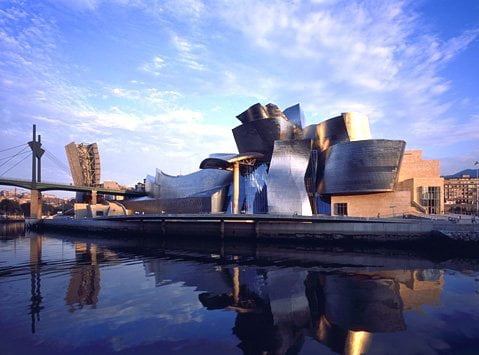
For some, shopping malls could do it too – who knows. But if it’s buildings as works of art, or fulcrums of inspiration that you’re after, it’s not only the case that (as I mention above) I’d be very surprised if architects aren’t already aware that features from religious buildings do the trick. Second, there’s no shortage of ostensibly “secular buildings” that are pretty darn awe-inspiring in their own right. Consider, for example, the work of Frank Lloyd Wright, or the Guggenheim museum in Bilbao.

As with the very idea of atheism 2.0, de Botton is dressing up the obvious as if it’s insightful. And his further explanation of how he thinks these are good ideas don’t make them appear any more so.

[EDIT]: de Botton’s statement was also sent to Richard Wiseman (and others), and is attracting some good comments on Wiseman’s blog.

The privilege in not finding things offensive

As submitted to the Daily Maverick.

It’s easy to forget that arguments in favour of unfettered free speech often come from positions of privilege. That privilege could be economic, social or educational, but whatever its origin, the result can be a bewilderment at the thought that anybody could find mere words offensive enough to censure.

I’ve made this sort of case before, defending various people and a wide range of utterances – from Floyd Shivambu and Kuli Roberts to Annelie Botes. A consistent thread in those columns has been that we learn nothing by silencing odious voices – that it’s only through being exposed to opinions that make us uncomfortable that we develop defences against them.

Again, it’s easy for some of us to say these sorts of things. It’s easy for me. For others it’s less so, especially if you might have been subjected to years or generations of abuse. So the idealism of a position – mine, broadly speaking – which entails hoping that society will at some point grow up and learn to deal with offence can easily seem rather smug – not to mention condescending.

However, it remains paternalistic to impose constraints on what we’re allowed to read and hear when those constraints are intended to protect us from offence. We don’t have the right to be shielded from all potential offence, even if there may be cases where the offence is simply gratuitous rather than potentially instructive (even if not instructive to the target of the offensive claim, then to the wider audience that is exposed to it).

But conclusions regarding whether a particular case intends gratuitous offence or not are subjective ones, also complicated by the emotive nature of many such cases. A recent case involved an Advertising Standards Authority (ASA) decision against River’s Church, who were instructed to take a billboard down following a complaint by Eugene Gerber.

Gerber is reported as saying that the “billboard offends him as an atheist as he does not consider his existence to be an accident. Secondly, the depiction of a man with an empty head communicates that atheists are stupid”. In comments to an article addressing the judgement and the apparent contradiction of an atheist (where atheists often defend their right to offend the religious), Gerber clarified his motivation for the complaint, saying:

During our darker apartheid years, it was ultimately the reaction and pressure from the international community that allowed us to move into a democratic society. And now, as our free speech rights are dying a slow death in South Africa, we once again need the world to take note and join our outcry.

So one atheist in South Africa gets a Christian billboard taken down, and blogs all over the world (atheist and Christian alike) are up in arms about my infringement on free speech. Yet, about a month ago, a Christian had a television commercial taken off air for exactly the same reason, and not even a peep on the internet about free speech. My options were simple, impede on their free speech but the get the message out there that our country needs help, or let them have their billboard and sit back and watch free speech decline. The latter was simply unacceptable.

So as long as their [sic] are people out there who voice the concern at me being able to have a billboard removed, I think I made the right choice. Hopefully the next headline you read is ‘Atheist tries in vain to have billboard removed’.

Limiting free speech for the sake of protecting it is certainly counter-intuitive, yet not obviously mistaken. Gerber could have been attempting to highlight how easily claims of being offended can result in limitations on freedom of speech, thus gesturing at a broader, perhaps systemic problem. But the evidence for this motivation is sketchy – not only because examples of these sorts of limiting moves are easy to find, but also because he appears to be wrong about the facts.

Assuming that the television commercial Gerber is referring to is Unilever’s Axe Excite advertisement, featuring “super-hot angels crashing to Earth” then smashing their halos in order to (presumably) be able to “know” the man wearing the deodorant in question, it’s simply not true that this ASA decision went unnoticed. My browser bookmarks include five newspaper articles and three blog posts – most of them explicitly concerned with whether the ASA was being overly sensitive towards claims of offence.

Just as with the Axe advertisement, one can ask whether the River’s Church billboard was sufficiently offensive to merit censure. While these are subjective judgements, a broader question is whether the ASA should even be placed in a position of needing to make them – especially if they are placed in this position by those who regularly protest the hypersensitivity of others to criticism.

The ASA ruling on the billboard was at least consistent with the Axe ruling. But if a depiction of an atheist having an “empty head” (itself a subjective reading – I’d be happy to entertain the charitable possibility that this image depicts a head lacking in certain beliefs) or believing that they are accidents now meets a threshold of unacceptable offence, then that threshold is far too low.

Regulation of advertisements that make false claims is certainly merited. But in this case, as a colleague (and atheist) pointed out, many of us might know as fact that we are accidents. As for having empty heads, well, as Psalm 14.1 reminds us “The fool says in his heart, ‘There is no God.’” If a billboard isn’t allowed to call unbelievers fools (on the uncharitable, and more plausible reading), would Gerber now have us petitioning for the Bible to be withdrawn from sale, or edited to remove content offensive to atheists?

Gerber’s complaint to the ASA was hypersensitive and misguided, in that it serves to undermine free speech arguments in more typical cases involving things like blasphemy. But as I’ve indicated, some feel better equipped to shrug off insults than others, and cases like these are thin ends of very thick wedges. Speech (and advertisements are of course a complicated example of speech) can create a climate of hostility, serving as propaganda for encouraging negative attitudes towards certain groups.

I do still hope that we can learn to deal with these insults without feeling the need to run to the courts or the ASA for protection. It remains true that any restrictions on free speech on the basis of offence put us on an unprincipled and very slippery slope. And, as I’ve argued before, freedom to cause offence doesn’t mean that it’s the right thing for us to do. Somehow, though, I wish we could find a mechanism to shut some people up – but only the deserving ones, of course.

So now non-racialism is racist too

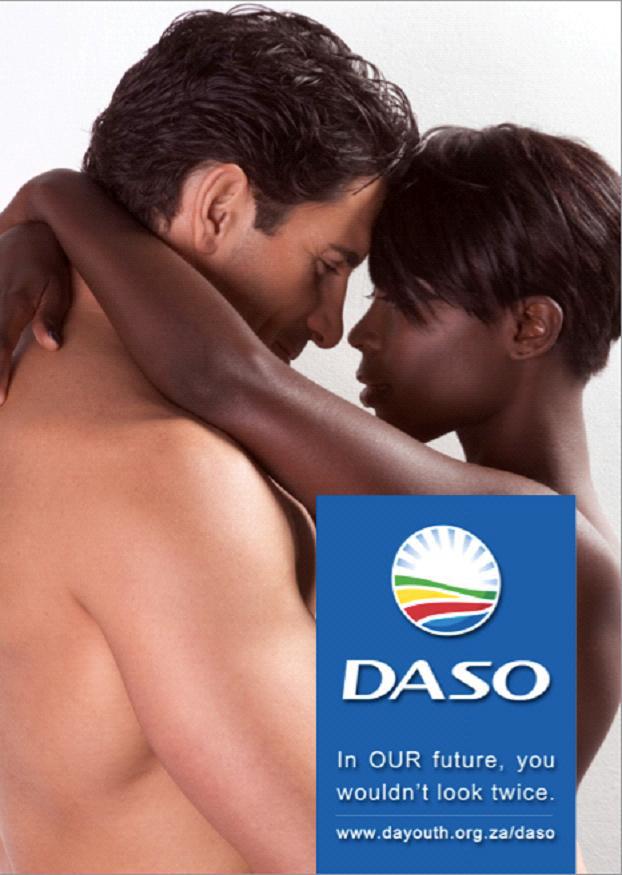
The Democratic Alliance Student Organisation (DASO) have launched a new advertising campaign. Here’s what many South Africans on Twitter and Facebook have been talking about today:

And in the curious place that is South Africa, this poster is somehow racist. It’s one thing to criticise the very idea of non-racialism – you can argue that a political party that is trying to encourage us leave race out of our analysis is naïve, and you can even argue that non-racialism can’t serve as an antidote to racism because we need to focus on race. But if you believe that race shouldn’t matter, as I do, then highlighting the fact that some people are still inclined to see relationships between different races as wrong – or even simply remarkable – is perfectly consistent with a commitment to non-racialism.

That’s what this poster does. It simply highlights the fact that some people would look twice at an inter-racial couple, and reminds viewers of the poster that in the ideal DASO future, this wouldn’t happen. As I pointed out in a Twitter exchange, my regular interactions with students at the University of Cape Town confirm that it’s simply not true that South Africans don’t need to be reminded that inter-racial relationships are okay. Yes, they (they meaning the DASO target audience, ie. youth) might be well aware that the Immorality Act has been repealed, but this doesn’t mean that social pressure to date people with similar pigmentation has disappeared. It’s still a very real pressure, which I hear about (or overhear people talking about) on a regular basis.

This is perhaps again simply an instance of the Twitterati imagining that they are the only arbiters of good sense and reason, imagining that they speak for everyone. And one is sometimes fearful of that possibility, seeing as the Twitterati can say some profoundly stupid things. I was told, for example, that it’s “racist to presume non-racialism is about who you have sex with”. As I said in reply, this poster is but one example of what non-racialism would entail – namely that nobody would care if people were having an inter-racial relationship.

Was the poster meant to include depictions of every possible instance of non-racialism to avoid being racist? It seems that it should have, which would have made for a pretty large poster. And even if it had tried to, someone would still have come up with something that’s wrong with it. Perhaps the art direction was racist, or perhaps it’s somehow sinister that the DASO logo covers the black woman, and not the man (this is not a joke – someone did say that. It does so happen that the black woman has breasts, which is a more likely contender for why the logo was placed where it was).

Should DASO’s poster have featured two white people? Of course not – that would be racist. Should it have featured two black people? Of course not – that would have been described as desperate. Should it have featured a gay couple, whether inter-racial or not? Perhaps (although that would also have been described as desperate) – but one can understand that they did not, partly because the majority of the market is heterosexual, and partly because they might have been cowed by the amount of (obviously unjustified) offence that would have caused.

What this sort of thing goes to show is that if you want to find a problem, you’ll do so – regardless of the intellectual contortions necessary. As I said at the start of this post, it’s entirely possible that non-racialism is misguided, even impossible. But making the claim that this poster is racist – in the context of inter-racial relationships being an actual issue for some – is an entirely unsympathetic, and unjustifiable, analysis.

UPDATE: The stupid doesn’t stop there. The African Christian Democratic Party say the poster is “shocking” and promotes “sexual immorality”. Furthermore, “in a country with high levels of Aids and an overdose of crime, especially the high incidence of farm murders this year, this poster sends the opposite message to the country than needed”. (Apologies to the ACDP for initially mis-attributing these quotes to them.)

Alain de Botton’s Atheism 2.0

Alain de Botton’s talk at the TED Global event last year (Edinburgh, July) spoke of some of the themes explored in his most recent book, Religion for Atheists. The book “suggests that rather than mocking religions, agnostics and atheists should instead steal from them – because they’re packed with good ideas on how we might live and arrange our societies”. I haven’t read the book yet, so can’t comment on whatever virtues it might possess (Terry Eagleton has, and thinks it has few – if any – virtues). But if the TED talk is an accurate reflection of the book’s thesis, I suspect I’d end up agreeing with Eagleton.


The first concern this talk raises is that it starts from a presumption that so-called “new atheism” is the only game in town. It sets up a false dichotomy between “living in a spiritual wasteland” and being a churchgoing zombie, which allows de Botton to swoop in and propose “atheism 2.0” to fill the gap between those extremes. In atheism 2.0, we would develop secular mechanisms akin to religion’s “giant machines, organisations, directed to managing our inner life“. But the “new atheism” trope can quite plausibly be described as a caricature, especially if put in the terms de Botton begins with in the TED talk. Yes, there are lighting-rod type atheists, just as you’ll find more vocal proponents of any contested view. This sort of engagement isn’t compulsory, and it’s to my mind not even typical – it’s simply one element of a strategic interaction with religious believers, in an attempt to persuade them of the wrongness of their views.

Of course it’s true that religions have been very effective in inculcating certain beliefs, habits and dispositions. But they have done so partly by dissuading thought – by creating an impression that certain propositions have the strongest possible truth value, because “God” says they are true, and you can’t argue with that. Any attempt at creating an organised – but secular – form of religion should immediately make atheists wary, because part of the point of a reason-motivated life is that groupthink is in general a poor guide to truth. I can agree with part of what de Botton says, in that he points out the dangers of a potential lack of “moral mentorship” once one escapes from whatever doctrinal understanding of morality your religion brings, or brought. Even here, though, we have all sorts of competing grand narratives already – things like human equality, justice, rights and free speech – which are arguably already as or more entrenched in human minds than any moral notion that results directly from a religion. For better or worse, those sorts of concepts already constitute a kind of groupthink – and if “atheism 2.0” is meant to encourage them, de Botton is offering us an empty box with pretty wrapping.

But that’s not all “atheism 2.0” is good for – we should, according to de Botton, borrow elements of religion to improve things like education, and to find sources of consolation. Listen to the talk yourself – he describes various ways in which elements of religion can be deployed in order to help us to understand “how to live”. Again, the stuff that works has either already been secularised or will be, or was never “owned” by religion in the first place. As for education, PZ Myers is right in dismissing de Botton’s claims that our educational practices can benefit through using sermonising techniques such as repetition. And of course we can be more effective public speakers – but that’s something we can learn through experience, or Toastmasters. We don’t need to study the techniques of the person behind the pulpit.

As for meaning, art, and sources of consolation: Of course we might all get value from ritual, ceremony, community and so forth. Most of us do this already in celebrating birthdays or anniversaries, and even in those regular social interactions with people we know, trust and love. This doesn’t need a label, and doesn’t need any formalising through inventing a new way of being secular.

In summary, here’s the thing: of course we can learn from religion. We can learn from anything, and already do so. But it’s not true – at least in my experience – that there are “so many gaps in secular life”, as de Botton claims. It’s only if you grant that premise, and furthermore claim that religion provides opportunities for learning that aren’t available elsewhere, that religion can be granted any form of privileged status as a source of meaning. The status that it might have is already accommodated in good old-fashioned atheism, and atheism 2.0 seems to be little more than the theme for a book-tour. Which is fine – I wish I could make as much profit from saying so little – but let’s not imagine there’s anything particularly interesting in the idea.

The ‘Protect Life Act’ and Republican conservatism

As submitted to the Daily Maverick.

While President Obama could be accused of trying to curry favour with moral conservatives in rejecting the FDA’s recommendations on the “morning-after pill”, liberals can find some comfort in the fact that he’s at least pro-contraception, and isn’t planning to criminalise abortions just yet.

This puts him at odds with nearly every (plausible) Republican candidate with the exception of Mitt Romney who, while having changed his mind and become pro-life in 2004, is at least not a signatory to the regressive “Personhood Pledge” that has to date been signed by Santorum, Gingrich, Perry and Paul.

Ron Paul’s case is complicated by the addendum to his signing of the pledge, in which he disagrees with the Pledge’s assertion that the 14th amendment (which protects individual liberties from state encroachment) has a role to play in defending the interests of the unborn. While the addendum has led to some questioning of the sincerity of his commitment to the Pledge, he is nevertheless clear that “life begins at conception”, and that “it is the duty of the government to protect life”.

Of those who have not signed the Pledge (Huntsman and Romney), both want to repeal Roe vs. Wade, and Huntsman supports the introduction of a right to life amendment to the Constitution. While Romney thinks that current legislation has “cheapened the value of human life”, his stated intentions are to put abortion legislation in the hands of the state, rather than the Federal government.

Broadly speaking, then – because the details are, well, very detailed – all the candidates are pro-life to varying degrees of commitment. And while Romney and Paul can be credited with at least attempting to introduce a level of sophistication to their positions instead of simply appealing to the emotive fervour of a conservative base, the rest of the contenders speak of pre-born humans in terms that assume that the debate has an obvious conclusion, where a woman’s rights over her own body, and what to do with it, are significantly weakened.

As in most emotive issues, language is important here. A bias is immediately introduced in using terms like “pro-life”, given that it suggests an anti-life stance on the part of those that support abortion. Speaking of “unborn” or “pre-born” children introduces a similar bias, in that it encourages us to think of blastocysts, zygotes, embryos and foetuses as if they already had desires and aspirations capable of being dashed by those callous “anti-life” Democrats.

It is in the Personhood Pledge that these biases come to the fore in all their glory, where “every human being at every stage of development must be recognized as a person possessing the right to life”. While the Pledge’s opposition to assisted suicide and euthanasia increase the intended threats to individual liberty, it’s the language on abortion that is of most concern here.

Because it’s not only this pledge, but also a legislative move that should be seen as a concern. It should be concerning to Americans – most directly American women – but also to the rest of us, in that these sorts of developments can easily serve as example and inspiration to those who want to undermine South African liberties in this regard. It’s not only the ACDP that might want to do so – President Zuma’s visit to the Rhema Church during campaigning in 2009 included a reassurance that he’d be willing to entertain changes to legislation permitting both abortion and same-sex marriages.

The (American) legislation at issue is H.R.358, the Protect Life Act, which passed the House of Representatives in October 2011. The bill is considered unlikely to pass in the Senate, and President Obama intends to veto it even if it does. But in the hypothetical absence of the current Democratic Senate and President, the bill gives a clear insight into the how dedicated the current crop of Republicans in the House are to defend the unborn human, no matter how nebulous its form.

The first version of the bill submitted to the House by Rep. Joe Pitts (R-PA) called for a modification of the Patient Protection and Affordable Care Act to only allow for health plans to cover abortions in cases of “forcible rape or, if a minor, an act of incest”. Women who fall pregnant as a result of gentle rape – or adult victims of incest – must presumably have had it coming.

That language was removed in the bill that passed the House (you can see each version here), which now allows for coverage in the event of “an act of rape or incest”. But this concession to the reality of women sometimes needing an abortion through no fault of their own does not address some of the worst aspects of the bill.

The Protect Life Act, if signed into law, would prevent women from buying even a private insurance plan through a state health care exchange (these are not insurers themselves, but entities that attempt to promote insurance transparency and accountability) if that plan covers abortions – even though most private insurance plans currently cover abortion.

It would require any insurer that operates under an exchange and covers abortion to also offer otherwise identical plans that exclude abortion coverage. The administrative costs of managing two near-identical schemes – where one would do, save this conservative agenda – might well result in many insurers thinking it’s simply not worth the trouble to offer a plan that covers abortion.

Of course, consumers can join a plan that isn’t offered through an exchange. But because of the extra visibility of plans offered under an exchange, and the consumer protections ensured by these exchanges, it seems likely that the only women who would do so are those who are well-informed and financially advantaged – raising the possibility of this bill introducing a bias against the poor, who need more protection than most.

Perhaps worst of all, the bill opens up an avenue for softening current requirements under the Emergency Medical Treatment and Active Labor Act (EMTALA), signed into law by Reagan to protect poor and uninsured patients who need emergency care. The Protect Life Act would allow hospitals that are morally opposed to performing abortions to withhold treatment in cases where a woman requires an emergency abortion in order to save her life.

As Rep. Jackie Speier (D-Calif.) says of her own experience in this regard: “I was pregnant, I was miscarrying, I was bleeding. If I had to go from one hospital to the next trying to find one emergency room that would take me in, who knows if I would even be here today. What my colleagues on the other side of the aisle are trying to do is misogynist”.

Nobody should be required to die for the sake of someone else’s religious beliefs. And while I can understand the desire for abortion to be treated as a non-trivial matter, we shouldn’t satisfy this desire at the cost of eroding an existing and thinking person’s rights over her own body. While life might begin at conception, individual rights do not. This is the sort of case in which we might hope that public representatives attempt to fight the tide of populist sentiment, rather than allowing the most reactionary forms of that sentiment to stand the chance of influencing policy.