The value of comment sections and debates in digital spaces

Regular readers will know that I’ve recently been wondering whether to continue hosting comments here on Synapses, as well as about their value in a more general sense.

downloadI’m not shutting comments down, but will move to moderating them, meaning that it might take up to 24 hours for any comment to appear, and some comments will not appear at all, if I deem them abusive or idiotic. The decision to do so is precipitated by two coincidences, featuring two friends who raised overlapping conversations on Facebook, both of which I engaged with.

The debate on Nathan Geffen’s wall about trolls on GroundUp, and how to deal with them, raised the point that without full-time moderation, comment sections can easily become toxic.

Also, I’ve been led to believe that there’s a potential for legal liability for things posted on one’s own site by commenters, while no such liability exists on Twitter or Facebook (for what other people say, I mean).

Then, Eusebius McKaiser asked for a view on Nick Cowen’s IOL piece arguing that we can’t have productive debate in online spaces, and much of what I say below is a response to that piece (in short, I think we can, but that it takes more work than many of us care to do. In my case, I get few enough comments that the necessary moderation is possible).

Before I get to responding to that IOL piece, just a note on how things will work here with regard to comment and debate. Individual posts will have a moderated comment section, but please also feel free to do one of three things instead, if you prefer:

  1. The old-fashioned “letter to the editor”, where if you’re amenable, and I think your contribution might be of broader interest, I’ll post it as a separate entry.
  2. If you’re on Facebook, there is a page for Synapses. Every entry appears there, and you can comment as much as you like, unmoderated. The same is true for Google+.
  3. Lastly, there’s Twitter, which isn’t ideal for debate, but certainly gives you the opportunity to call me names (if that’s your thing), or to make more friendly noises.

On to the IOL piece, which you don’t have to have read to follow what is about to follow. To quote myself:

it seems to my mind at least plausible that we’re living though an era in which ideas themselves are not that welcome. Where, as Neal Gabler recently put it in a column John Maytham was kind enough to alert me to, the “public intellectual in the general media [has been replaced] by the pundit who substitutes outrageousness for thoughtfulness”.

Despite the demise of postmodernism in academic circles, it still lives and breathes in the popular viewpoint that everybody’s opinion is equally worthy of consideration, and that individuals are under no special obligation to set aside their opinions in favour of what the evidence points to.

The Internet, its potential anonymity, and the sheer volume of both opinions and outrage don’t encourage thoughtful reflection and engagement. I find that the overall quality of discourse and openness to correction is poor on the Internet, and as a result, I tend to only read comment sections to confirm that they are places where people seem unafraid to express their racism, sexism and (other forms of) stupidity.

There are pockets where people do engage earnestly and sincerely, and where there is a chance of shifting peoples’ perspectives. Eusebius’s Facebook wall is itself one small example of that. It’s true that people don’t often say “you’ve changed my mind”, but it’s something that can be intuited from how the tone and content of a conversation shifts.

Second, I’m not sure that the situation is significantly better in meatspace. There, just as on the Internet, people are stubborn, prone to confirmation bias and the backfire effect, etc. It’s partly the fact that there are more participants – with those participants not being carefully selected – in the online space that creates the impression that it’s more chaotic there. In other words, if we were to have an open house in meatspace to discuss something contentious, we might more often have the same impression of shouting past each other.

By contrast, if you do online what you do in meatspace, i.e. carefully select your interlocutors, you’d have the same “civilized” conversations (at least in a relative sense). The problem is that a) you don’t always get to select who talks to you online and b), all the non-verbal cues, such as smiles and body-language, aren’t available to us online.

Complicating this all is my sense of the conversations in both spaces being less civilized than they used to be, because everyone is now an expert in everything. The idea of democracy has been illegitimately expanded into epistemic territory, where the average person has been persuaded that their views are as legitimate as any other person’s view, and where they are somehow attacking you as a person when they criticise your view, rather than us simply having a contestation about the facts or interpretation of them.

We’ve become too personally invested in our beliefs, to put it simply.

Noakes, #LCHF and the Professoriate of the Twitterati

LCHF SummitIn the conclusion of my previous post on Prof. Noakes’ Big Issue column, I mentioned that he had spoken of addressing the malignant influence of scientists via the power of crowdsourcing research findings on Twitter.

Today, I’ll conclude with my description of how much that Big Issue column gets wrong, and also provide a fresh example of shoddy thinking from the LCHF crowd, in the form of a debate topic that is being proposed for the upcoming “First International Low Carb High Fat Summit“.

(I don’t think it’s relevant here, but in case you think it is, I’ve been invited – and have accepted – to attend the LCHF summit as a guest of the organiser, Karen Thomson. So if you see me becoming all soft on LCHF in late February, you’ll know that I’ve either been bought off, lost my senses, or “seen the light”.)

Let’s first return to “The Digital Doctor” (the title of the Noakes column). One of the things he’s right about in the column is that increased availability of information via the Internet has undoubtedly given consumers and patients more power.

You’re able to shop around, whether through using Dr. Google to find out what your fellow sufferers have tried, or for crowdsourcing information about who seems to do good work in a certain area, for what price and so forth.

Patients can enter the consulting room armed with some understanding of what ails them, and I’m sure that can help (and also sometimes hinder, no doubt) the process of diagnosis and treatment. We’re no longer victims of as large an information asymmetry as we once were.

But this doesn’t mean that truth becomes something that is resolved via democratic process. The majority can be wrong, and this is especially the case when we’re dealing with a majority drawn from a select population, and where the audience does further filtering of what they think worth listening to and what worth ignoring.

In short, this is again the problem of the filter bubble, writ large.

To quote Noakes:

But the growth of social media and the internet has changed that reality irrevocably.

Today as a result of these very modern developments, patients now have access to the experiences of hundreds of millions of others producing what has been termed The Wisdom of the Crowds.

Exposing millions of people with common issues to a multitude of different interventions soon determines the relative efficacy of treatments more effectively, cheaply and swiftly than any other testing method yet invented. (Indeed, these crowd-based, uncontrolled experiments will add a new model of “scientific” research that will overcome the weakness of traditional laboratory-based research, which by its very nature is “unnatural”.)

We have access to the millions of anecdotes shared by the population that self-selects to be on Twitter, yes. But we have no way of verifying the (literal) truth of those anecdotes, and we also know that because they are uncontrolled experiments, there is no way of verifying their truth in the sense of having confidence that the right cause for the observed effect has been identified at all.

This is precisely why we have and value the scientific method: to rigorously test hypotheses, in a way that minimises errors that might result from selection bias and so forth. We’d should take care to compensate for – and not celebrate – the fact that all of our case reports come from a demographic (because they are on Twitter) that was perhaps on average wealthier, and with more leisure time, than the typical person.

Why? Because that characteristic might be associated with different dietary choices, or different levels of physical activity, both of which would be relevant to how we interpret the data. So the anecdotes can be useful, in pointing to what we should research, but they are not themselves the research we should treat as conclusive.

(Sidebar before moving to the next quote: I’m leaving the “unnatural” towards the end of that quote alone, but just to briefly note that it’s another example of the paranoid and conspiratorial talk Noakes seems partial to. Sure, lab-based research has flaws, but its lack of being “natural” – whatever that might mean – isn’t one of them.

One can say we can’t replicate some real experiences and effects in a lab, and there it becomes a potential problem, but describing this in terms of “natural” sets up an advantage for the Romantic Paleo argument, and poisons the well against anything positioned as non-natural, which might include GMOs, vaccines, etc.)

Then, we’d want to compensate for our own biases also. Later on in the column, Noakes says:

I soon learnt that Twitter is unquestionably the best way to acquire the most up-to-date information on my particular areas of scientific interest. By following a group of scientists who use Twitter to disseminate information they find interesting, I now have access to new knowledge within minutes of its first appearance in the scientific literature. The result is that acquiring new information is absolutely effortless, and dependent only on my choice of whom I follow on Twitter.

So, if I listen to the people who tell me things I like to hear, I get to hear a lot of things I like to hear. And, just to make certain that things I don’t want to hear don’t intrude on this, I’ll block people who post contrary research from my Twitter feed (he doesn’t say the latter above, but it is something he does, with me being one example of someone whose links to relevant research don’t get through).

The problem with the Big Issue article is that it takes a couple of sound points, and explodes them into such a grand narrative that they lose any sense they had.

Noakes tells us that “now it is only the advice that works that has long-term credibility”, and that is true, up to a point. You’ll get caught out on social media if you spread misinformation. But that doesn’t mean information gains credibility through being widely disseminated (on channels you’ve hand-picked) on social media. Those are separate issues.

It’s also true that professionals – in various spheres – were able to exploit the ignorance of the consumer to peddle quackery or defective goods, and that they are now less able to do so than in the past. But our easier access to information doesn’t mean that (proper) experts don’t often know better than we do. Those are also separate issues.

There’s a tendency in the LCHF narrative, at least how it’s playing out in South Africa, to continually hyperbolise the consequences of choice, and the lack of middle-ground options between one or another extreme.

To conclude, here’s a recent example of that elimination of the middle-ground (in logical terms, a false dichotomy), that comes from the Facebook page of the LCHF summit I spoke of at the top of this post. On that page, Karen Thomson says:

I am desperately trying to find medical professionals willing to debate: ‘Is the low carbohydrate diet the cause of, or the cure for the global epidemic of chronic ill-health?’ with our LCHF team.

Any thoughts? None of my invitations have been met with any success.

Here’s a thought: if a debate topic is framed so that only the pro-LCHF side have any chance of winning it, you’re unlikely to garner any interest from potential opposing speakers. The topic is itself a pithy example of the shoddy reasoning that I’ve written about so often here, in that:

  • The topic sets up a false dichotomy, because the truth might lie somewhere in the middle with LCHF being neither the cure nor the cause.
  • Second, the topic sets the non-LCHF people up for failure, in that it would be impossible to prove that LCHF is the cause of “the global epidemic of ill health”. This is true even on the simple grounds of chronology, where (leaving aside the contentious issue of what pre-social humans ate) modern humans haven’t been eating LCHF for long enough – or in large enough numbers – for LCHF to be identified as the cause of much at all except book sales, never mind a “global epidemic”. You might therefore think the topic indicates bad faith, but even if you don’t want to be uncharitable, the pro-LCHF folks have rigged the game here, by ensuring that they can amass at least some evidence for their position, while the opposition cannot.
  • Third, one can challenge the presumption of the topic that there is a “global epidemic” at all, in that despite diabetes, heart disease and the like, we somehow keep living for longer. So, simply accepting the premise of an epidemic accedes to one of the key claims made by the LCHF folk, namely that humans in the 21st Century are (in general) sick and dying, despite any appearances to the contrary.


Professor Noakes and the Echo Chamber Made of Lard

The 2014 “Collector’s Edition” of The Big Issue contains a number of interesting pieces, but there’s one specific piece that I’ve been looking forward to being able to share with you.

The day for doing so has finally arrived, so here is the first instalment of some thoughts on “The Digital Doctor”, contributed by Prof. Tim Noakes, and freshly uploaded to the Interwebs (thanks to @BigIssueSA on Twitter).

As a framing concept for this post, consider the “echo chamber“, which you can understand as roughly analogous to, or intersecting with, confirmation bias and the “filter bubble“.

Participants in online communities may find their own opinions constantly echoed back to them, which reinforces their individual belief systems. This can create significant barriers to critical discourse within an online medium.

Another emerging term for this echoing and homogenizing effect on the Internet within social communities is cultural tribalism.

What the extract highlights is the problem of “groupthink”: if you surround yourself with people who say the sorts of things that agree with the sorts of things you’d like to believe are true, you all end up reinforcing each others’ beliefs, and opposing views have a difficult time getting heard.

So, it seems fairly obvious – given we know that we’re prone to weighting confirmatory evidence more favourably than disconfirmatory evidence – that someone who cares about keeping their mental furniture nearly arranged would actively seek out ways in which they might be wrong.

Supporters of Prof. Tim Noakes believes that he does exactly that, and that this is why he could famously change his mind on something so fundamental as the value of an entire category of organic compounds (carbohydrates, in case you aren’t aware).

But – and yes, I have said this before – one change of mind, no matter how fundamental or (in)famous, does not indicate anything about a general disposition, and it’s perfectly possible that Noakes (again, regardless of whether his conclusions are correct or not) has adopted (and is encouraging) sloppy thinking in this regard.

Which brings me back to The Big Issue, where it wouldn’t be unfair to describe Noakes’ contribution as a love-letter to confirmation bias, or an attempt to attract companions to occupy an echo chamber made entirely out of lard.

The piece begins with a rejection of expertise, where it turns out (according to Noakes) that an “exclusive clan who have climbed the academic ladder of success” “carefully programmed” Noakes and his fellow students to believe that what the clan professed is the “absolute truth, for now and forever”.

Alien_probeTo help this conspiracy narrative along, these evil people with their degrees and academic credentials are given the sneery nickname of “The Anointed”, which helps to set up the us vs. them dichotomy, where the everyday folk are victims of an intellectual aristocracy, preserving their privilege at our expense.

At this point, some of us are perhaps thinking about how odd it seems that one of the people who has climbed the academic ladder about as high as one can in South Africa thinks he should be trusted, despite his own membership of this shadowy clan.

But by definition, Noakes cannot be part of The Anointed, for he has seen the light, and rejects their gospel. Perhaps he might be part of the New Reformed Anointed or somesuch, because he makes it quite explicit that the outdated dogma he was taught is false, and should be replaced by something else.

The something else, though, is never expressed with qualifications, or room for being wrong – it’s presented as absolute truth. And this is the problem – replacing one dogma with more (albeit different) dogma doesn’t help the argument for being critical of received wisdom. It simply asks you to replace received wisdom with an alternative version of the same.

There’s a problem in this simplistic account of dogma also, in that it’s only unthinking consensus that’s a problem (what we normally call dogma) – consensus isn’t a problem of necessity. So, if “The Anointed” happen to be wrong in this instance, we shouldn’t use that as an excuse for discarding the idea of expertise in general.

Experts do exist, and “common wisdom” is frequently very far from wise. Yes, “experts” can also be wrong – but as ever, we can assess arguments on their merits, rather than throw the epistemic baby of expertise out with the bathwater of a few bad arguments.

Then – crucially – we’re dealing with a complete misrepresentation of what “The Anointed” say. On the Noakes narrative, dieticians and these sneaky academic folk are pushing the line that fats are bad, and carbs at least not as bad as Noakes would have you believe (some might even say that some carbs can be good).

However, the truth doesn’t support these caricatures. It’s (now) common cause that we used to over-emphasise the dangers of fats in general. It’s (now) common cause that refined carbs are bad.

The point is that “The Anointed” have modified their position over the years, in light of the evidence. Noakes might say that they haven’t modified their position enough, or that they are ignoring some evidence or over-valuing other evidence.

But either way, they are not dogmatically pushing one line. Their arguments have evolved (whether rightly or wrong, time will tell), and it’s untrue and uncharitable to present them as inflexible purveyors of eternal “truths”.

There’s only one dogmatic voice in this conversation, and as far as I can tell, it’s not that of The Anointed.

P.S. Noakes’ solution to the problem of The Anointed is to rely on The Wisdom of the Crowds, and especially Twitter, which is “unquestionably the best way to acquire the most up-to-date information on my particular areas of scientific interest” (this is no joke. Well, I mean it’s an accurate quote.) But more on that another day.

The Charlie Hebdo murders

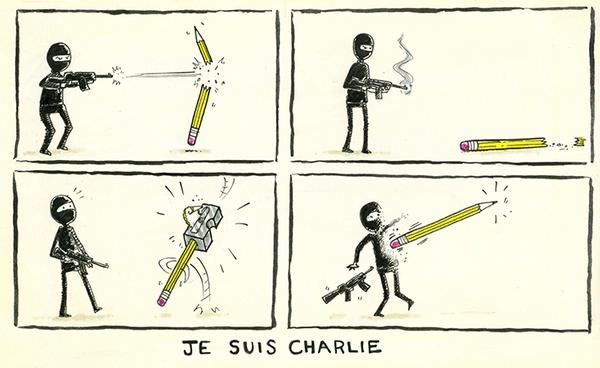
Yesterday, twelve people died for blasphemy.

Be clear about at least one thing: regardless of your views on religion, or on the role that Islam (or monotheism more generally) might play in generating intolerance and violence, nothing justifies murdering people for expressing offensive views.

Be clear on a second thing also: the fact that one is able and allowed to express offensive views is a necessary element of any society that wishes to be considered free, and we should all stand in support of the right to express such views.

James Walmesley - https://twitter.com/RteeFufkin/status/552937192252006400
James Walmesley – https://twitter.com/RteeFufkin/status/552937192252006400

I’ve said before that satire and blasphemy can be “a reminder to members of an identifiable social or religious group to get your house in order, so that there is no longer any need to mock or ridicule.” It serves a valuable role, and a role we should cherish. Joe Randazzo, previously editor of The Onion, is right to say that:

Satire must always accompany any free society. It is an absolute necessity. Even in the most repressive medieval kingdoms, they understood the need for the court jester, the one soul allowed to tell the truth through laughter. It is, in many ways, the most powerful form of free speech because it is aimed at those in power, or those whose ideas would spread hate. It is the canary in the coalmine, a cultural thermometer, and it always has to push, push, push the boundaries of society to see how much it’s grown.

Other issues are perhaps not as easy or unambiguous as we might prefer. For starters, the right to express a view doesn’t always mean it’s a good idea to do so. Take this Tweet from the President of American Atheists as an example:

He’s making a point, yes. I get that. He’s exercising his freedom to blaspheme, and he’s allowed to do so. But the blasphemy in that Tweet adopts a shotgun approach – it will offend all sorts of Muslims, from the ones who are inclined to kill people for blasphemy, all the way through to your next-door neighbour whose birthday party you might have attended a few days ago.

But as I’ve said many a time, these are strategic choices rather than issues of rights – he has the right, should have the right, and we should all defend the right to be as obnoxious as you like, even as we might not like what you say.

A final point, before handing over to a press statement I sent out yesterday in the name of the Free Society Institute. My first Tweet on the murders was to say this:

A predictable flurry of trolling resulted, with some even thinking that I was being an apologist for religious extremism. Apologies (not really) for complicating biases with these nuances, but my sentiment in no way denies that religion, and Islam, can play a causal role in generating violence such as this.

My point was that it’s a glib, and oftentimes lazy, inference to draw that it’s “religion” that causes these things. I would think it rare that religion per se makes you homicidal, but that instead, folk who are capable of such things will find religious inspiration for doing them.

If your religion allows you to be led to such barbarism, there’s barbarism in you to be exploited. That doesn’t mean that religion X (or ideology X) cannot be a causal factor in barbarism more often than religion or ideology Y.

To be clear: Islam should certainly bear some of the blame, in that if your religious texts or traditions are capable of inspiring people to do these barbaric things, they are in that respect toxic, and antithetical to liberty, flourishing and security.

The simple truth is that the gods could have been far clearer. Even if you’re religious, and want to assert that terrorists are misinterpreting the scriptures, you should be struck by the absurdity of your god not having chosen the simple path of saying: “hey there! While you’re having your arguments about what I want you to do and not do, remember that I don’t want you to kill, ever”.

Because she didn’t say that – or because she says things in a way that allows people to read her as saying the opposite, this is religion’s problem and religion’s fault, and people of faith can’t wash their hands of it.

And to a significant extent, they don’t. Which is why, as I said in the Tweet, the most important feature of yesterday’s killers is that they are killers, and not that they are Muslim.

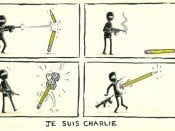
The Free Society Institute stands with Charlie Hebdo and all defenders of free speech and civil liberty in condemning the murder of two police officers, three cartoonists, and eight journalists in Paris on January 7.

As offended as those of the Muslim faith might find blasphemy to be, that offence pales into insignificance compared to the brutality of Islamo-fascist terrorism such as this. Being offended does not grant one warrant for ending the lives of others.

The right to free speech does not, however, say anything about when it is wise to exercise that freedom or not.Neither does the fact that these terrorists were recorded as shouting “Allahu Akbar” and “We have avenged the prophet” during their attack tell us anything incontrovertible about Islam in general.

Tragedies such as these, that shock and confuse, can make easy answers attractive to us, in that they can lend themselves to stereotype and simplistic analysis. This is not the time for either of these.

Instead, this is the time for two simple things: to express our sympathy to all who are affected, and second, to recognise that we are all affected, in that freedom of speech is a cornerstone of civilised society, and is slightly more under threat to us all in the wake of the Charlie Hedbo attack.

Jacques Rousseau
Chairperson – Free Society Institute

Wrong about race in South Africa and UCT

agi_events_010Two snippets, from two quite different sources, raise concerns about self-serving (as opposed to principled) thinking about race in South Africa and at the University of Cape Town, where I teach.

First, we have Douglas Gibson expressing concern that “race is back in fashion” in South African conversation. Gibson is the former Chief Whip of the Democratic Party, which became the Democratic Alliance (DA), South Africa’s official opposition.

I’ve only had a couple of conversations with Gibson, but have read many of his speeches and columns over the years, and regard him as a determinedly old-school liberal, rather than someone who is happy to let pragmatism dominate, as seems to be the case for many in today’s DA.

One character trait of what I describe as an old-school liberal is often an inclination towards idealism, in this case manifesting as a desire that South Africans be race-blind, to want to engineer a South Africa that is nonracial or post-racial. He opens his column with an example of race-blindness, in this case that of his son:

Thirty five years ago a little white boy aged three, standing in his bathing costume next to the pool, stroked the arm of a little black girl, also in a bathing costume, and said, “Ooh, you’ve got a lovely tan.” My son didn’t see race and certainly had no race prejudice. That was at the height of apartheid. He is still not a racist, just as many other whites are not.

There are two distinct points to make about examples like this. The first is that we can agree (or not) that this is an ideal future to try and arrive in. The second is that we can agree (or not) on how to get there.

A concern that I and others have about DA rhetoric is that it seems to want to get there by insisting on it, and by asking us all to just ignore race, because in doing so we’ll discover all sorts of other relevant and interesting things about each other as individuals.

As ever, I think some things are easier to say and support from one point of view rather than another. I don’t experience what it’s like to be black in South Africa, but if what I’ve heard is accurate – and I’ve heard it from black intellectuals far more qualified and socio-economically advantaged than me – they perceive racism far more often than they should (the “should” here would of course be zero times).

I’ve said in the past that the perception of Cape Town as being racist can’t simply be dismissed, and still think that even if we agree on an (eventual) goal of non-racism, we might find (a) that we can never get there or (b) that the way to get there is precisely to acknowledge race and prejudice, rather than pretend people don’t have these experiences.

To put it crudely – columns like Gibson’s, romantically espousing non-racialism, can be read as part of the problem in their denial of the validity of the lived experience of people who feel discriminated against. It can appear like you’re being told to simply “get over it”, and I think that’s condescending.

The other example I want to highlight is from Dr Xolela Mangcu, who is at the furthest remove possible from Gibson in at least two respects, in that he is a black Biko scholar, rather than a white liberal. Mangu has been columning voluminously about UCT’s new admissions policy for the past few months, and some of these columns have attracted responses from our Vice-Chancellor, Dr Max Price.

In Mangcu’s most recent opinion piece on race and transformation at UCT, he says the following:

Numbers matter also because there should be a critical mass of black professors in the University Senate, which is the highest decision-making body when it comes to academic affairs. I just find it difficult to imagine that doing away with race-based affirmative action would have been such a high priority for the Senate, or would have passed so easily, if that august body was populated by a large number of black full professors.

And here’s my problem: even if you think the admissions policy flawed, Mangcu’s words there seem to me to insult the black professoriate, or otherwise to indicate a laziness of thought on this issue, or are otherwise simply mendacious.

To briefly run through the options: the extract could insult black members of Senate, in that it suggests that they cannot be of independent mind regardless of perceived race-interest, and think that a policy might be the correct policy on principle even if it attracts the sorts of controversy it has.

Second, it could indicate a laziness of thought, in that he’s simply assuming that everyone who is a black Senator is somehow going to ineluctably reach the same conclusions about the policy as he did – in other words, that his is the only reasonable interpretation.

The arrogance of this would be one problem, and the second would be that it would make his argument circular, in that he’d be saying “the policy is wrong, and if Senate were black in the majority, they would vote against it, which proves that the policy is wrong”.

Finally, it could well be that Mangcu doesn’t think his analysis is the only defensible one, and it could be that he simultaneously knows that some black Professors support it. If these conditions were both met (and if I haven’t left out other options) then it seems that he’s misrepresenting the case for rhetorical effect – just like Gibson is.

My point, in short, is that given that we recognise how fraught these conversations are, we should be careful to have them honestly, contextually, and objectively, in the sense that the quality of arguments can still matter, even if you think there’s something distinct about how race informs an argument.

Modern challenges with regard to free speech

Below, some notes on three concepts/arguments related to free speech – concepts that I think have become either more relevant (thus important to understand) or more complicated in the last 10 or so years (thanks in large part to the rapid uptake of social media like Twitter).

“Censorship” and the right to free speech

xkcd say pretty much what I’d want to, so let’s start with them (remember to read the mouseover text).
I can't remember where I heard this, but someone once said that defending a position by citing free speech is sort of the ultimate concession; you're saying that the most compelling thing you can say for your position is that it's not literally illegal to express.

Private citizens and companies are perfectly entitled to refuse to broadcast your opinions. It’s no violation of your rights that a comment section gets closed, or that your comment is deleted from a blog.

If someone were to refuse you permission to comment, or delete a comment, this might reveal various unpleasant things about their judgement or character. It might be capricious, it might be rude, it might be cowardly.

But they have a right to publish what they like, whether they make the right choices (in your estimation) or not. You don’t have a right to be published on other people’s platforms.

(On a related note, I suspect I’ll soon be shutting comments down here on Synapses simply because, besides a few reliable folk, there’s little of value that gets added there. If you have anything to say on that topic, this might be your chance to do so.)

Offence & sensitivities

Certain expressions are legally proscribed – here in South Africa, for example, hate speech is going to get you into trouble. If you’re reading this from elsewhere, you might have similar laws.

Those laws could be poorly drafted, and they could even be nonsensical (to you, in that you think that “hate speech” shouldn’t exist as a legal category of speech, or that it shouldn’t be punishable.)

Ignore that issue for the moment. The issue I want to highlight is that there are a range of utterances or ideas that could offend people or simply create discomfort without meeting the threshold for hate speech (or any other relevant legal category of speech).

A recent case was the cancelled Oxford debate on abortion, that was meant to feature Brendan O’Neill and Tim Stanley. You can read their perspective on the cancellation of the debate by following the links in this piece by the President of the Cambridge Union, and I’d also recommend reading Isabel Hardman’s piece, as she makes some of the good points that O’Neill makes, but less hyperbolically and without being Brendan O’Neill.

The issue here is – how can one avoid the slippery slope whereby any claims of offence or sensitivity eventually become grounds for not expressing a view, while still being compassionate towards people who have legitimate sensitivities on various topics?

The one end of the spectrum is the classic Liberal position of asserting that we’re improved by allowing ourselves to hear things that make you uncomfortable – the truth wins out, we develop better arguments against falsehoods, and we might get to “toughen up” along the way.

But these things are all easy to say from a position of intellectual and material comfort, and less so when you’re the threatened group. So, there’s serious room for compassion, especially for Humanists like me. However, there’s a tension between these goals, and it’s one that’s difficult to resolve.

The unfettered free speech argument doesn’t automatically get the win, in my view, because of issue #3, namely:

The corn-dealer’s house is right next-door

Many folk who defend free speech refer to J.S. Mill’s On Liberty, and rightly so, as it makes a superb case for when speech should and shouldn’t be restricted. But it was written in in 1869, and it’s possible that perfectly reasonable arguments for then are not entirely reasonable for now – or that, if they are, they lead to rather different policy conclusions than was the case for Mill’s time. Take this passage from Chapter 3:

An opinion that corn-dealers are starvers of the poor, or that private property is robbery, ought to be unmolested when simply circulated through the press, but may justly incur punishment when delivered orally to an excited mob assembled before the house of a corn-dealer, or when handed about among the same mob in the form of a placard.

There’s the problem in a nutshell: if you agree with Mill’s argument, give some thought to how we should implement the argument in terms of comment policies, Facebook and Twitter terms of use and the like.

Mill is talking about a mob of people who need to be riled up to the extent that they will set aside the time to make a plan, then congregate at someone’s house to protest. It takes serious affront to result in that sort of motivation, because you need to make an investment to lodge your protest.

Today, especially on something like Twitter, a ready-made mob of thousands can be assembled instantly. They might not even know you, or understand what you did “wrong”, because your misstep can get re-tweeted by someone influential, with everyone else simply jumping on a bandwagon.

Reading one abusive Tweet is no problem for most, but imagine reading hundreds of them, from people who would likely never have the courage to stand outside your door, shouting abuse as in Mill’s scenario above. If he thought that the mob outside your house should be controlled, and if you agree, should the social media mob also not be controlled?

The “war on Christmas” and misrepresentations of atheists

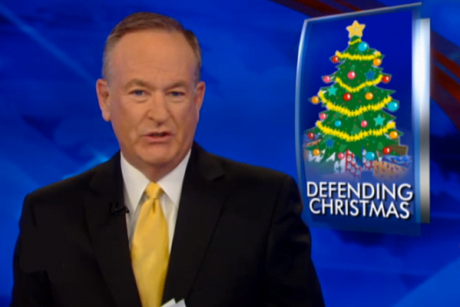
war-on-christmas-460x307Fox News is mostly an American problem, but South African readers will probably have heard of Bill O’Reilly, the conservative political pundit who spends a lot of time being angry about Obama, people who don’t believe in God, and various other issues.

Chris Stedman (here’s my review of his book, Faitheist) has written an interesting post on how the “war on Christmas” is actually a war on atheist voices. The title of the post sets up a false dichotomy, in that it could be both, but the post makes various good points.

O’Reilly exploits every possible opportunity for hyperbole, and Christmas is no exception. The “war on Christmas” is pretty much an O’Reilly invention, and refers to the (alleged) efforts of non-religious folk to keep the Christ out of Christmas.

But as I remarked to a journalist who recently interviewed me on how South African atheists feel about Christmas, Christmas is to all intents and purposes a secular holiday for most folk already. By this I don’t mean that Christians have forgotten about Jesus – just that the bulk of proceedings are a rare and (sometimes) pleasurable opportunity for friends and family to gather.

The Christ-related bits will involve a prayer of thanks, and maybe some reading from the Bible, but my point is that the day is not going to involve excessive religious ceremony, even for Christians. Christ will no doubt be in their thoughts at times, but I will celebrate Christmas just like they do, for the most part.

In this context, there’s nothing to go to war over. If I’m right, and Christmas is secular in any case, Christmas provides an opportunity for two things (not an exclusive list): one, celebrating Christmas and two, being obnoxious towards Christians, and conforming to a certain stereotype of how offensive atheists are.

I choose the first option. And as Stedman points out, most atheists do also, which is why his piece argues that it’s a war on atheism through mischaracterising us, rather than on Christmas (as I said at the top, it could be a war on both, so I think the title poorly chosen).

He links to interesting research that suggests only 15% of atheists in the USA are anti-theist, meaning that they “believe that the obvious fallacies in religion and belief should be aggressively addressed in some form or another”.

The remainder are characterised as academic atheists, agnostic atheists etc., but regardless of whether you disagree with how the authors carve the landscape up, it’s true to say that some atheists are more aggressive than others – and it’s fair to ask whether they should be taken as representative of the whole.

As with all contested topics – or even “all topics” – those who make the most noise, or who say the most outrageous things, will get the attention. In the USA, it’s American Atheists, who use Christmas as an annual opportunity for provoking the religious. American Atheists say that their approach works, and I’m pleased that Massimo Pigliucci has written this post arguing that it doesn’t, because that’s my sense of things too.

The rest of us need to perhaps make more noise. I don’t know – I certainly feel like I make enough of it, but perhaps not in some of the places I should – for example, I’ve left all the Facebook atheist communities I used to belong to, because they were filled with too many obnoxious people.

That’s a problem to resolve another day, though. For now, and until the end of the Newlands cricket test on (theoretically) January 6, I’ll probably be quite quiet here, though still active on Twitter. If you’re celebrating Christmas as a Christian, joy and peace and all that to you.

If you’re doing what I’m doing, which is eating and drinking too much with great friends, have a wonderful day also.

Premier Zille, religious tolerance and atheist “fundamentalism”

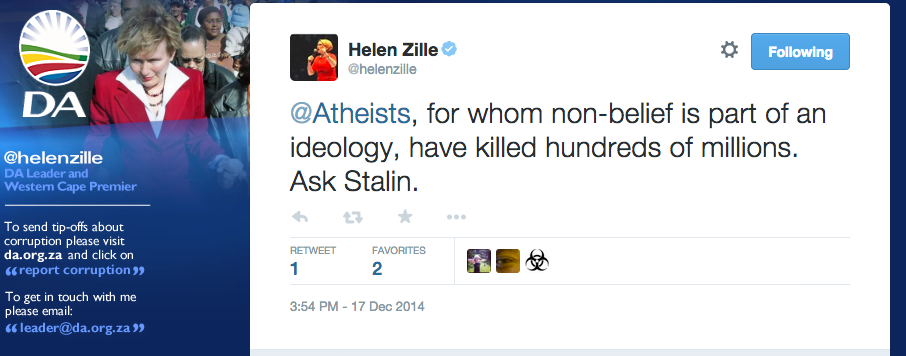
Yesterday, the Premier of the Western Cape, Democratic Alliance (DA) Leader Helen Zille said:

Worst kind of fundamentalists

and that’s how the fight got started. For a number of hours after this tweet, Zille was drawn into debate (well, insofar as the medium permits) on the religious views of Hitler, Stalin, Pol Pot etc., the putative moral virtue of Mother Theresa, and various other issues relating to religion and/or the absence of it.

Zille apologised for and retracted the tweet above, and it must be said that many who jumped into the conversation didn’t follow it from the start, and were guilty of some over-reaction themselves. In fact, the over-reaction persists today, where some legitimate criticism is being mixed in with abuse and caracaturing of her views and motivations.

If you read her tweet in the context of the conversation, I think it clear that she was responding to Kevin King’s introduction of the idea of religion-bashing by atheists, albeit in a rather glib and unfortunate way, given that the conversation began with Mandy de Waal offering an example of religious fundamentalism causing deaths.

But given the context of the conversation, it was a foot-in-mouth moment rather than an expression of religious intolerance. Despite this, her defence of the tweet, and a few follow-up tweets, indicate that Premier Zille does appear to hold rather misguided views on what atheism is, and what atheists believe.

First, though, I will agree with her on a central point, and annoy many atheists in the process: it’s entirely possible for atheists to be fundamentalists.

If you understand “fundamentalism” in the classic sense, in other words strict adherence to some set of doctrines, then atheists can’t be fundamentalists, as we have no doctrines. (Atheism being simply, and only, the absence of a belief in a deity or deities.)

But language and usage evolves, and it seems entirely permissible to me for “fundamentalism” to be taken as referring to certain ways of being anti-theist, rather than atheist. One relevant category of action would be to ridicule, mock, or insult; another would be to hold your atheism dogmatically, in the sense that you find it impossible to entertain any claims regarding the potential value of religion.

I’ve read my Dawkins, and know that folk will disagree with me on the first category above, insisting that “passion” gets mistaken for stridency. And on the second, I suspect many will say that there’s nothing to entertain, and that those of us who do are simply being “accommodationists”, weasels or something like that.

I’ll not rehearse those arguments now, but will instead point you to an earlier post which deals with some of these arguments at greater length. Here, I just want to say that I agree with Zille on that point, but nevertheless think that she should reconsider her beliefs with regard to atheism and its role in both history and contemporary society.

Even though she made repeated references to her party being committed to religious freedom, and asserted that she is similarly committed, her expressed thoughts on Twitter indicate prejudice against the non-religious. For example:

Atheists commit mass slaughter

Screen Shot 2014-12-18 at 10.47.24

As my earlier post argues, these sorts of sentiments are thoroughly confused, in that none of these examples were motivated by their atheism (for those who were atheists). The first tweet above should refer to “psychopaths” or “sociopaths” or something rather than atheists, because none of the claims made (commit mass slaughter; believe they are God; have an ideology) are remotely true of atheism in general.

The second tweet again makes the mistake of thinking that atheism is an ideology, or something that informs the lives of atheists in some sort of fundamental way. We’re just like you, Helen, and our atheism is usually as much of an “ideology” as your disbelief in Thor is.

And yes, perhaps people who happen to have been atheists have indeed killed many people, but either that’s coincidental, or you’re making a causal claim about either atheism conducing to evil deeds, or religion conducing to good deeds. Evidence suggests the final option might be what she thinks is the case:

Murder

And here I’ll say “sure, maybe that’s true” – but we’ve got zero reasons for believing it to be true. It’s an empirical question, and someone like Zille, who seems fond of data-driven approaches to things, might perhaps know of some of the ways we can distinguish better and worse answers to the question.

For example, does criminality, gender discrimination, murder and so forth tend to correlate positively with religious or non-religious societies? (The former, i.e. non-religious societies are more pleasant.) Does thinking about morality as necessarily connected to religion make any sense? (No – read your Plato.)

And, does thinking about morality as being intimately connected to religion impede moral understanding and thinking, by infantilising us, and making us unable to resolve moral issues through reason? (I think so.)

Zille does seem entirely sincere in her commitment to religious freedom, but that’s not much comfort when she appears to hold rather unsophisticated views on these matters. She’s endorsing dangerous stereotypes in tweeting these sorts of things, and furthermore, doing damage to the DA’s brand.

We’re living in a world where discrimination against the non-religious is quite a significant problem, and the leader of our only (quasi) liberal party should be expected to stand against discrimination, rather than offer it fuel.

An era of hysteria?

Briefly, and to quote myself:

if you train people to expect sensation instead of subtlety, you should shouldn’t be surprised if they keep expecting more of the same, and eventually, become capable of understanding nothing less.

On Thursday this week, Best Buy found themselves under social media fire for tweeting a joke that referenced Serial, the podcast that everyone (“literally!”) is listening to.

downloadFor those of you who are not part of that “everyone”, Serial is a journalistic treatment of a murder, involving interviews with suspects, with friends of the victim, and also site visits to relevant locations, etc.

The murder in question happened in 1999. It wasn’t Princess Diana who was murdered, but someone that had most likely slipped out of the memories of all but her family and friends in the 15 years since the murder – until Serial came along.

Best Buy referenced one element of the narrative, which was the possible use of a payphone in one of their Maryland stores. They said “We have everything you need. Except if you need a payphone. #Serial”. The outrage on Twitter let to the deletion of that tweet, and this apology:

This is absurd. I have no problem with people being offended, even sometimes outraged. But I do have a problem with what people are choosing to be offended and outraged by, and – mostly – by the extent to which they think anyone else should care about their feelings in cases like this.

If you were offended by the Best Buy tweet, I’d suggest you’re either a family member of friend of the deceased, or you have a pretty bizarre value-system. Corporates are allowed to make jokes, and a joke involving an element of a murder mystery from 15 years ago, and one which makes no reference to the people involved in that mystery – in other words disrespects none of them – should not be able to give rise to the offence it apparently did.

How do we stop this positive feedback loop of hyperbole and hysteria? I’m still of the view (as expressed in another older post) that at some point, a corporate brand, or a popular personal brand, will need to stand their ground and say “no, I don’t need to apologise for this. You’re over-reacting.”

Because each time we do succumb to the wishes of the most easily offended, the bar for what counts as an apology-worthy action gets set a little lower. I’m not a fan of gratuitous offence, but if we never allow ourselves to tolerate being offended at all, a dogmatic, inflexible, and rather entitled attitude towards our own beliefs and values wins the day.

In short, we’re wrong much of the time – or at least some of the time – and we’ll never know when that is, unless we let people tell us.

The @IHEU Freedom of Thought Report 2014

iheu-logo-2013-w300Published today [10 December] by the International Humanist and Ethical Union (IHEU), the third annual Freedom of Thought Report offers a survey of persecution of and discrimination against non-religious people, with an entry for every country across the world.

In 2014, in addition to laws such as those targeting “apostasy” and “blasphemy”, the report shows a marked increase in specific targeting of “atheists” and “humanism” as such, using these terms in a broadly correct way (the users know what they are saying) but with intent clearly borne of ignorance or intolerance toward these groups.

To put it more plainly, nonreligious people are being targeted as a distinct minority group in various countries around the world. The report also indicates that hateful speech against atheists does not come exclusively from reactionary or radical religious leaders, but increasingly from political leaders, including heads of state.

Cases covered in the report include the Malaysian prime minister Najib Razak, who this year labelled “humanism and secularism as well as liberalism” as “deviant” and a threat to Islam and the state itself, in a speech where he also denied that Malaysians had any right to “apostasy” (leaving Islam).

Saudi Arabia is criticised for a new law equating “atheism” with “terrorism”. The very first article of the kingdom’s new terror regulations banned “Calling for atheist thought in any form, or calling into question the fundamentals of the Islamic religion”.

Even the supposedly secular regime of Egypt’s president Sisi was found to target atheists directly, through what the report calls “an organized backlash against young atheists”. Beginning in June, Nuamat Sati of the Ministry of Youth announced a campaign to spread awareness of “the dangers of atheism” and why it is “a threat to society”, so that young atheists in particular, who are increasingly vocal on social media would be given “a chance to reconsider their decisions and go back to their religion.”

In the past few months, Egyptian authorities have detained young atheists who appeared on TV media and Youtube videos talking about their right to express atheist views, and in a worrying an unusual development in November, Christian churches actually “joined forces” with Egypt’s AlAzhar in another anti-atheism campaign, saying that “Society should resist this phenomenon [of atheism]”.

Previous editions of the Freedom of Thought Report, which considers and rates every country in the world for anti-atheist persecution, found that almost all countries discriminate against the nonreligious, in some cases through religious privilege or legal exemption, with the worst countries refusing to issue identity cards to the nonreligious, taking children from atheist parents, or sentencing “apostates” to death.

The 2014 edition of the report notes: “This year will be marked by a surge in this phenomenon of state officials and political leaders agitating specifically against nonreligious people, just because they have no religious beliefs, in terms that would normally be associated with hate speech or social persecution against ethnic or religious minorities.”

Fortunately, the situation in South Africa is nowhere near as serious as the examples given above. However, this does not give South Africans cause for complacency. Our schools routinely violate the National Policy on Religion and Education, to the extent that the organisation OGOD has recently instituted court proceedings against six public schools who assert their “Christian character”, despite our public schools having an obligation to be secular.

It is not only school principals and governing boards who privilege one religion over others, rather than supporting religious freedom through remaining neutral and encouraging a secular approach to religion, whereby religious education is welcome but religious indoctrination precluded.

The MEC for Education in Gauteng, Panyaza Lefusi, boasts of having distributed 50 000 Bibles to schools in his first 100 days in office – with no mention of also having distributed Korans, or books on Humanist ethics and thought. This constitutes not only a violation of the Policy, but if the Bibles were paid for with public funds, also a clear abuse of those funds in that revenue from the taxpayer cannot be used to support what amounts to State-sanctioned religion.

The Freedom of Thought Report is published by the International Humanist and Ethical Union (IHEU) with contributions from independent researchers and IHEU Member Organisations around the world. The South African Member Organisation is the Free Society Institute.

Websites:
freethoughtreport.com and iheu.org; fsi.org.za (South Africa)

For further information, interview or comment please email:
contact@fsi.org.za; (Free Society Institute, for South Africa-specific issues) or the IHEU (report@iheu.org; +44 207 490 8468.