A few quick bites (on Noakes, diet and celebrity science)

It’s been a few months since I last posted anything about diet and Prof. Tim Noakes, but being reminded of the hearing that’s set to resume next month led me to check in on his Twitter echo chamber, which in turn leads to my presenting these few morsels to you.

First up, Austin Bradford Hill, who (according to Noakes, at least) taught that association only provides evidence for causation when a study’s Hazard Ratio (HR) is above 2.0. With the assistance of this factoid, Noakes has been dismissing inconvenient results with quips about “Bradford Hill turning in his grave” and so forth.

The Hill paper that Noakes cites (the text of a speech in this case) is indeed very good. It cautions us that systematic errors are prevalent enough in our research that we should be wary of placing too much faith in statistical significance as a guarantee of anything, and that health-related interventions need to be thought about carefully, in light of potential costs and benefits (rather than only with reference to what the evidence tells us).

And then, there’s this:

None of my nine viewpoints can bring indisputable evidence for or against the cause-and-effect hypothesis and none can be required as a sine qua non.

In other words, Hill is explicit that he’s not offering a hard-and-fast rule, but rather some useful rules of thumb. Here’s a lovely application of those rules of thumb to chiropractic, for those who don’t want to read the Hill speech itself.

The point, of course, is that Hill is here being misrepresented as a dogmatist, in order to give Noakes another of his stock-phrase putdowns (“cognitive dissonance”, “The Anointed”, “follow the money”, “go ahead, make my day” and so forth).

The misrepresentation is significant also because in this particular case, Hill might not be on Noakes’s side of the argument at all. As argued in this Phillips and Goodman paper, one of Hill’s central points was that “we need to consider more than the degree of certainty that there is some health hazard, and act based on the expected gains and losses, with or without statistical certainty.”

So, if it’s still the consensus view that limiting saturated fat (or rather, replacing it with unsaturated fat or whole grains rather than refined grains) is a good idea to minimise cardiovascular disease risk, it seems to me that Hill would accept the “violation” of his (non) rule for the sake of prudence.

But that exact study linked above (the actual paper is open-access, so you can read it if you like) is one of those that we should “pay no attention to”, “as Bradford Hill taught”.

Don’t get me wrong – of course it’s true that it’s difficult to establish causation from association. But it’s also true that absence of evidence is not evidence of absence – and that we need to apply our standards consistently, and honestly.

Hill didn’t give us a rule (that’s the honesty bit), and even if he had done so, I’m pretty sure that a trawl through Noakes’s timeline would give us many examples of him uncritically linking to pro-Banting literature that violates the rule (that’s the consistency bit).

Speaking of consistency, and the Banting-brigade’s fondness for accusing critics of being in the pockets of Big Potato (or compromised by some nefarious interest), I wonder how they feel about Nina Teicholz, lobbyist extraordinaire, being bankrolled by a billionaire?

I don’t think it necessarily a problem at all – as I’ve said in previous posts, we need to separate the claims from the funding – but if conflict of interest is a problem (as Banters claim), you don’t get to ignore it just because you like what the person is saying.

To repeat a point I’ve now made many times over the years, the issue for me is not the science – that’s evolving, as it tends to do, and there are still many unanswered questions related to diet and its effect on health, weight and so forth. The issue I am concerned with is misrepresentation, cherry-picking, logic and the substitution of soundbites and celebrity for scientific rigour (on that, here’s a good piece by Sarah Wild).

And then, in conclusion: here’s a new systematic review of recent RCTs on low-carbohydrate diets and Type 2 diabetes, which concludes that

Recent studies suggest that low carbohydrate diets appear to be safe and effective over the short term, but show no statistical differences from control diets with higher carbohydrate content and cannot be recommended as the default treatment for people with type 2 diabetes.

The authors also note that “passion in science is an infallible marker of lack of evidence” – and while I think that overstates the matter somewhat, it’s again a useful rule of thumb.

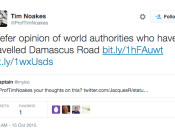
Someone linked my tweet of that study to Noakes earlier today. His response perfectly captures the problem, and that response is a) to ignore it in favour of cherry-picked alternatives; and b) to suggest malice or bias on the part of those who disagree with him.
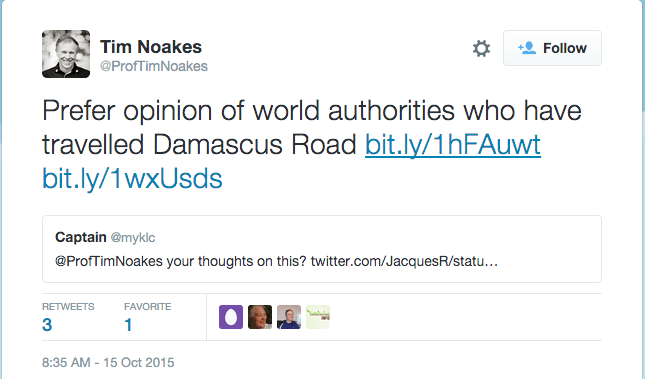
Screen Shot 2015-10-15 at 10.00.03

Screen Shot 2015-10-15 at 10.00.21

To answer the “why” in that last tweet: because I’m linking to the review of RCTs mainly to demonstrate that the evidence is contested, and that there’s no room for dogmatism in this debate (or in any scientific debate that isn’t settled).

If there was as prominent and influential a scientist as Noakes arguing as dogmatically on another topic that I’m interested in, articles on that topic would attract a similar amount of attention, at least from me.

The “why” is of course not sincere at all, but instead simply an opportunity for disciples to dismiss contrary evidence as conspiracy. If you’re looking for a textbook example of motivated reasoning, the Noakes timeline is pure gold.
Zuma, Obama and misreading intentions

You’re all familiar with that asshat driver who speeds up to close a gap you were about to merge into. Maybe you are that driver? If so, you’d also be aware of those occasions where you did so accidentally – perhaps you hadn’t noticed the other car trying to merge, or perhaps you suddenly realised you were late for an appointment, and sped up.

Of course, perhaps you’re just an asshat. But let’s assume not, and instead use this as an example of what is called the “fundamental attribution error” in social psychology. This error describes our habit of assuming intention or motive to explain behaviour, rather than considering external factors like the two listed above.

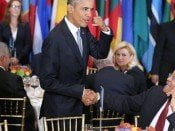
The same error has been in evidence in some reactions – especially in the intemperate world of social media, to this photograph of Presidents Zuma and Barack Obama.

zuma+phoneFor some who distrust or dislike Zuma, whether for good or bad reasons, the photograph is evidence of his arrogance, or simply an opportunity to mock or criticise him (because he was obviously talking to someone more important than Obama, like the Guptas).

But there’s no reason to assume anything sinister, or anything worth mockery or criticism here. A still image, taken out of a context, tells us nothing about what either man was thinking. Obama could have approached Zuma while the latter was already on the phone, as the former was on his way to another table and thought to just quickly say “hello”.

We don’t know. What we do know is that people can reveal their own attitudes, pretty clearly, in how they respond to images such as these. Criticism is good, and necessary – but let’s try to keep it evidence-based.

Choosing to be silent | Being barred from speaking

we-realizeDuring the question-and-answer session following a talk on identity politics at the UCT Philosophy Society earlier this month, a student asked me if I agreed that outsiders to a particular cause should remain silent, in order to let those who are proximate to the issue express themselves.

My answer was, in short, that it’s not that simple. The suggestion – or sometimes, demand – that “outsiders” remain silent is not only sometimes incoherent in terms of how it defines insiders and outsiders, but also incoherent in how it can apply a very peculiar standard to what’s worth listening to and what is not.

In any area of knowledge, we accept that some people know more than others, but it’s rare that we disallow those without expertise to contribute or ask questions. In fact, doing so is part of the way in which they learn, and perhaps become experts themselves.

It would be irrational to say to a philosophy student, for example, that you can’t discuss logic until you’ve learned symbolic notation. Yet, this sort of contraint is sometimes applied in discussions on things like race and gender, where questions from persons who are not-X are declared out of order, because of their not-X’ness.

As I repeatedly emphasised, this is a separate issue from another important issue, namely that the not-X person should often choose to remain silent, because they know that they have dominated a conversation for too long, have set the terms of debate, and have themselves ruled the concerns of the X’s as out of order for as long as the X’s can remember.

To put this crisply: I can imagine that there are times where, for the sake of trying to eliminate historical biases, not-X’s should often shut up, perhaps even for a long time. Or, they should be very selective in terms of how they contribute to conversations.

This is a separate issue from their independent epistemic authority, though, and the device of shutting up is a strategy for getting to a situation where words and arguments can one day matter, rather than who is speaking mattering most of all.

At my university, I’ve heard of a few instances where people have not been allowed to speak because they are not X. That’s usually wrong, even if it’s sometimes right that they choose not to speak. The distinction is important, and is largely forgotten in these emotive debates.

I choose not to speak (publicly) on many of the things that go on at UCT, especially during the current political debates.

And I would be very reluctant to speak on what’s happening at other universities such Rhodes, Stellenbosch, or Wits, exactly because I see how misinformed outsider comment on UCT is – a criticism extending even to some of the more thoughtful commentators in South Africa.

Choosing not to speak can also extend to being careful of what you say, of course – it’s far too often the case that a joke or idle observation gets taken up by people whose politics you don’t support, because they assume you’re on their side.

For example, when I tweeted about this story of Khoisan activists being arrested for smashing a bench, it was to highlight the fact that the bench should in all likelihood never have been built and that, more to the point, the aggrieved parties were probably never consulted on how best to honour the person the bench was meant to honour.

Just like the Rhodes statue at UCT, we now realise it should never have been there in the first place – and any condemnation of action/activism against it has to acknowledge that as the instigating harm, regardless of what follows.

Predictably, the tweet resulted in people whining about destruction of public property, lack of respect for the rule of law and so forth.

Of course it’s in general wrong to destroy public (or private) property, and of course it’s in general right to respect the law.

But sometimes, the failure to do so isn’t the most important part of the story, and you demonstrate your lack of sympathy and understanding for what is the most important part of the story by focusing on that.

As I say, you should be allowed to do so. But it’s an entirely separate issue whether you should or should not choose to do so, and more of us should pay attention to the second issue, more of the time.


Ultimate Sports Nutrition and the harms of quackery

There are at least three clear ways in which pseudoscience or bad science can harm consumers. The first, and most troubling, is that you might come to harm through consuming something that causes effects other than those promised or expected. This harm can be direct, as when herbal preparations result in allergic reactions (for example tea tree oil), or with unexpected drug interactions (thanks to “natural” remedies being regarded as different and non-interacting with conventional medicine).

Or, the harm can be indirect, as is the case with vaccine denialism, which not only exposes the denialist to avoidable risks of serious disease, but also impacts on “herd immunity”, thus threatening his or her entire community. Another form of indirect harm results from not seeking effective treatment, thanks to the false belief that you’ve already found a treatment. Penelope Dingle died of a potentially treatable cancer, after years of being “treated” by a homeopath allowed the cancer to spread beyond real medical science’s capacity to treat it.

The second way in which consumers can be harmed is for many of us fairly trivial, and amounts to our simply wasting money on products that can’t deliver on their promises. This is of course not trivial for the poor, or for people who spend significant amounts of money they can’t afford to on quackery – but if you like to pop an occasional homeopathic sleeping aid, it’s not going to cost you anything other than the price of a latte and perhaps some friendly mockery around the dinner table.

The third set of harms is a broad category, including harm to public understanding of the scientific method, where claims need to be held accountable to evidence; and violations of consumer trust, where you expect manufacturers to not only support but also deliver on the claims made regarding their products.

It is because of the risk of these and other harms that the Medicines Control Council (MCC) have introduced a requirement that complementary and alternative medicines (CAM) need to carry a label stating that the product has not been evaluated by the MCC, and that it is not intended to diagnose, treat or cure any disease. The CAM industry has been slow to respond – understandably so, because who would want their product to carry a label telling you it’s mere placebo?

Another sort of reaction to this risk, and one we as consumers should be grateful for, is the large community of scientific skeptics all over the world who take the time to document pseudoscientific or misleading claims, and then follow up with complaints to advertising regulators and other relevant bodies when they encounter such claims being made. In South Africa, one such individual is Dr Harris Steinman, a medical doctor who runs the site CamCheck, devoted to exposing misleading and unverifiable claims made on behalf of CAMs.

Manufacturers or promoters of CAM – and, as we shall see, nutritional supplements also – don’t appreciate it when they are criticised for selling something on the basis of unverifiable (or, verifiably false) claims. There are numerous examples of bullying via lawsuit, or threats of lawsuit, both locally and internationally in cases of this nature. To briefly return to the Dingle example mentioned above, bloggers who exposed the homeopath were served with cease and desist letters. Locally, Kevin Charleston was sued for R 350 000 by Solal Technologies, who sell and promote “untested remedies for a range of serious illnesses”.

More recently, Dr Steinman and CamCheck were the subject of a takedown notice from Ultimate Sports Nutrition and their founder Albe Geldenhuys, who alleged that “unlawful comments were posted” and that defamatory “remarks and/or comments” were made by Dr Steinman. CamCheck was subsequently moved offshore.

sun-set-psp-usn-004The claims made in the takedown notice are weakly supported or completely unsupported. In South African law, claims of defamation fail (or, should fail) if the purportedly defamatory comments are true, and in the public interest. CamCheck’s claims are certainly in the public interest, as I outline above with reference to the harms that can accrue as a consequence of pseudoscience or bad science.

Furthermore, as Dr Steinman exhaustively documents in response to the takedown notice, USN have a track record of adverse findings at Advertising Standards Authority hearings (locally, as well as in the UK) related to making unsubstantiated claims with regard to their products, as well as for simply changing the names of, and then re-introducing to the market, products that have been the subject of such hearings.

If you do a Google search for “usn rapid fat loss” – as a consumer of their products might plausibly do – the third link (for me, but it will be a prominent link for anyone) leads you to their “12 Week Rapid Fat Loss Plan” (pdf), which promotes “Carb Block” – a product the ASA ruled against in 2014. If you sell a product which doesn’t do what it says, are you a “scam artist”, as Steinman alleges? On balance of probabilities, it certainly seems a defensible claim, at the very least, and a claim that Steinman could reasonably believe to be true.

USN don’t want their customers to know when products are untested, or contain ingredients that aren’t capable of doing what USN claim they do. As unfortunate as that might be, the takedown notice was only the start of their efforts to make sure their customers don’t get to hear these things.

USN and Geldenhuys have now launched a defamation suit against Dr Steinman, claiming R 1 Million in damages for each of Geldenhuys and USN itself.

As with the extended, but ultimately futile, attempts by the British Chiropractic Association to silence Dr Simon Singh’s criticisms, this is little more than an attempt at legal bullying – more obviously so in light of the ludicrous quantum of damages sought.

Some readers might be familiar with the “Streisand Effect”, named after Barbra Streisand’s 2003 efforts to suppress photographs of her Malibu home ended up simply drawing additional attention to those photographs, thanks to Internet sharing. USN want to keep fair criticism underground, but thanks to this lawsuit, perhaps that criticism will end up more Streisand than silent.

First published by GroundUp. Also read this Groundup piece for further context on the USN lawsuit.

(tw) Trigger warnings

As Libby Nelson recently observed, “There are probably more articles on the internet arguing about trigger warnings on college syllabuses than there are actual trigger warnings on college syllabuses”.

Even if their prevalence at universities is often overstated, they are frequently encountered on blogs, Facebook and other social media as a device for warning people that the ensuing discussion might contain distressing content.

fears-and-phobiasAs I’ve argued previously, trigger warnings can serve as a way to infantilise an audience, especially at universities where part of the point is to be exposed to challenging ideas. But they can equally serve a similar role to advisories on films, where an audience is forewarned that they might be exposed to violence, profanity, and so forth.

We’ve become accustomed to these warnings for films, and I’ve never heard of anyone finding them problematic. In fact, I suspect many more of us would be bemused – whether or not offended – to unwittingly purchase tickets for a movie featuring extreme violence without having been forewarned of this.

So one response to the issue of trigger warnings might be to say, why not include a simple (tw: violence) or somesuch before a discussion or link to an article describing the potentially “triggering” thing?

First, because there’s no consensus among psychologists* that this is the best way to handle the issue, even for people who might potentially be “triggered”. In fact, because “trigger warnings emphasize a victim rather than survivor role for the potential reader”, they “potentially increasing distress in the long-term via reinforcement of avoidance behaviors.”

And second, which is my focus here, they can treat us all as unable or unwilling to deal with stumbling upon content that might be distressing, and I worry that over-sensitivity of this sort might dampen expression of and debate on controversial topics.

Anything is potentially distressing for someone, so it’s difficult to see a logical (as in, necessary) end-point for trigger warnings, where there is some content that would never need a warning. And if everything gets a warning, that’s one less thing we need to think about – we don’t need to try and make certain judgments about who the speaker is and the context of the discussion, because that work has been done for us in advance.

The problems are at least two: what if that work has been done poorly, and we’re warned against things we don’t need protecting from? And second, making those judgements might well be a skill worth exercising and preserving.

Of course I’m aware that it’s easier for me to question the value of trigger warnings (to restate, given that I do think they have value: for me to question whether they are sometimes or often overused). And I’m well aware that much questioning of the value of trigger warnings comes from folk who have a profound insensitivity to the distress suffered by the people who often argue for trigger warnings.

But speaking from a position of relative sympathy for selective and thoughtful use of trigger warnings doesn’t mean I’m not concerned at what appears to be thoughtless use of them. To return to threat of over-sensitivity, mentioned above, we have to be able to tolerate occasional, accidental and/or marginal threats to our comfort, because any other world is practically impossible to arrange.

It would be impossible to arrange for even one person, never mind all of us. So the trigger warning conversation, and sensitivity to it, is a bi-directional negotiation: people who are speaking might need to try and avoid certain surprises (what? when? etc. are questions I’ll leave aside), but people who are listening also need to be as fair as possible in not placing undue responsibility or blame on a speaker.

As I say, I don’t know what we need to be sensitive of, or when. Well, that’s not quite true – I know as well as you do that we socially negotiate rules of conduct with the people we encounter, in a dynamic way. And the trigger warning debate does highlight that the game in question isn’t equitable, in that it privileges those of us who find little, if anything, sufficiently distressing to want to be forewarned of it.

But an equal and opposite overreaction isn’t desirable either. Here’s an example of what I mean, to finish this off. Last night, a friend Tweeted a link to an article in the guardian, headlined “Sudan’s security forces killed, raped and burned civilians alive, says rights group”.

He was criticised for not including a trigger warning, and his protestation that this was a headline that served as its own trigger warning for the article that followed didn’t satisfy the critic.

This is an overreaction first because, if the word rape appearing in a headline is triggering to you, it’s difficult to understand how you can survive on the Internet at all – there seems no way to arrange for an Internet that isn’t triggering in this way, and the requirement that we do so seems unduly onerous.

Second, and on another practical note, a Tweet is limited to 140 characters and at that sort of length, most of us would take in the Tweet at once, rather than parsing each word. In other words, there’s little or no time for a (tw) to do any substantive work in a headline like that – I don’t think it’s reasonable to think that anyone can see (tw) and then the word “rape” a few characters later, where that (tw) has had a chance to cause you to stop reading, or prepare yourself for that word in any way.

At this point, the trigger warning becomes less a thoughtful application of sensitivity to the interests of others, and more a thoughtless application of a disputed protocol. If we want our social justice concerns and interventions to be meaningful, I don’t think it sensible for us to turn them into clichés.

*Disclosure of potential bias, and a little shameless promo: the author of that post is a friend and my co-author of the forthcoming book Critical Thinking, Science, and Pseudoscience: Why We Can’t Trust Our Brains.

Charlie Charlie, wherefore art thou?

Ferlon Christians, the Western Cape Leader of the African Christian Democratic Party, would have you believe that the problem with the occult – especially in schools – is that we don’t take it seriously enough. In fact, the problem is the opposite one – we take the occult far too seriously.

“We” take it seriously enough, in fact, that our Department of Basic Education, which sometimes can’t even provide textbooks or toilets to schools, are dispatching “officials to investigate‚ together with school authorities‚ the ‘Charlie Charlie Challenge’”.

For those of you who aren’t Error Naidoo or Harry Potter, you can catch up on what the ‘Charlie Charlie’ challenge is by watching eNCA’s “full investigation”. Alternatively, you can take my word for the fact that it’s a parlour game involving creating a yes/no grid, stacking two pencils on top of each other, and then freaking out when gravity causes the pencils to move.

The freaking out is as a result of the “successful” summoning of a Mexican spirit who is mysteriously called Charlie, in honour of the many thousands of Mexicans who are called Charlie. You ask Charlie a question, and then the pencils move to provide a yes or no answer.

And, the freaking out on the part of Mr Christians, the Department of Basic Education and Bored from Bonteheuwel, that frequent caller to talk-radio, is due to simple superstition and ignorance.

You’d think that schools and national Departments of Education would use this as an opportunity to teach basic physics, as well as truths about human psychology such as confirmation bias. Instead, we read of school principals saying that “any pupil caught playing it will be expelled”, and of school pupils reporting suicides and school walls collapsing as a result of this game.

Well, this is what happens when you take a perfectly explicable phenomenon and add wacko metaphysics involving demons and curses to your explanation of it, just as we used to do with something like the Ouija board.

Seriously, parents, Mr Christians and the Department of Basic Education – if kids kill themselves as a result of playing Charlie Charlie, it’s not a Mexican demon’s fault. It’s the fault of a worldview detached from reality, and an education system that tolerates and even encourages that worldview.

In other words, and to some extent, it’s your fault, and blaming imaginary Mexican demons makes as much sense as blaming Harry Potter would.

Here’s a Whatsapp message a friend forwarded to me, which is apparently being circulated in one school:

Parents, guardians and learners.
This is extremely important.
I have received a letter from a school today encouraging parents to speak to there children about the Demonic Game Charlie Charlie they are playing on the schools nowadays.

A grade 4 boy fainted while playing this game and his pencil started spinning. When he woke up the pencil was still spinning.

Then I received a Whatsapp message of an incident that took place in Tafelsig Mitchells Plain today regarding this Demonic Game Charlie Charlie. Some boys placed two pens across each other and called out Charlie Charlie. The pens started to spin by itself and stopped by pointing at one boy.

This boy just started to bleed from his head profusely. The condition of the boy is still unknown.

According to our Ulama and experts in Jinn, its a demon (very dangerous jinn) from Mexico moving around schools inciting youngsters to play this game in order to harm them. This could even result in their death. Plz inform as many as you can.

And, for more hyperbole, consider this official press statement from the aforementioned ACDP Provincial Leader, Mr Christians:

Screen Shot 2015-09-04 at 10.45.26

Let them eat snakes: CRL Commission and the harms of religion

If part of your spiritual “healing method” involves having your parishioners strip naked, it’s pretty likely that you’re a charlatan. Not only in the sense that you’re selling fake goods – because that’s the case for most religious activity – but more importantly also in the sense that you know you’re doing so.

If you add making your parishioners eat snakes, and trying to have them eat rocks that you’ve transformed into bread to the mix, I think there’s no room left for doubt – you’re not only a charlatan, but you’re also an exploitative one, willing to leverage the desperation of others into personal financial gain.

Your name in this case is Penuel Mnguni, and you appear to have learnt these tricks from Lesego Daniel, who chose to make his followers eat grass and drink gasoline rather than consume snakes and rocks.

Mnguni was arrested for animal cruelty for feeding his congregation live snakes (which would apparently turn into chocolates – praise the Lord!), and later released on bail. But the examples of him and Lesego Daniel are perhaps two among many, and this possibility has led the Commission With An Improbably Long Name to launch an inquiry.

The Chairperson of the commission otherwise known as the Commission for the Promotion and Protection of the Rights of Cultural, Religious and Linguistic Communities (CRL Rights Commission) says:

We’re not saying that the commercialisation of religion is a bad thing, but we want to understand how and what it is,” said commission chairperson Thoko Mkhwanazi-Xaluva.

When churches start selling pap, T-shirts and water after services… or when people stop taking their HIV or blood pressure medicine because traditional healers say ‘drink my water, it will heal you’, and charge people for it, it becomes problematic.

We need to look at these various miracle claims and see what form of legal structure is in place.

And if any of you are wondering how you’re supposed to tell the difference between a miracle claim such as the one “whoever believes in him shall not perish but have eternal life” (John 3.16) and snakes turning into chocolates, the CRL Commission shares your concern.

If you listen to this interview with CRL Councillor Edward Masadza, you’ll hear that they are very aware of the need to “distinguish miracles from magic“, which sounds about as difficult a task as distinguishing acid from LSD to me.

But that’s partly because from a secular and skeptical point of view, all these sorts of claims sound equally implausible to me – and this brings me to the main point of this post. If we are going to investigate the potential harms of religion, “traditional” or “established” forms of it can’t get a pass on scrutiny.

For example, an earlier interview I heard on this topic was very concerned with the agency of the parishioners, and how they might have been duped rather than being willing participants in snake-eating or gasoline-drinking.

Yes, that’s a vital concern, and a concern I share. But if you are going to take that concern seriously, should the investigation not also include thinking about whether we should ban religious circumcision? An 8 day-old can hardly be a consenting party, after all.

Or what about the prosperity gospel of Ray McCauley and others, who encourage people to impoverish themselves in exchange for hypothetical future financial blessings from God?

But I don’t think the establishment churches have any reason to be concerned, no matter whether they endorse genital mutilation or financial exploitation. Because:

Mkhwanazi-Xaluva was at pains to explain that the investigation would be done in accordance with the SA Charter of Religious Rights and Freedom. She said they were not doing this to infringe on the constitutional right to freedom of religion.

Notice that Charter she mentions there? It’s madly conservative, and has absolutely zero legal standing. This is the second time I’ve encountered a government agency thinking that it’s official policy, but last time I was fortunately enough part of the conversation, and able to correct the misconception.

Despite this, the Charter is perceived to have standing, and investigations like the one the CRL is embarking on begins with the premise that religious practices need to be treated with a default attitude of solemnity and respect. And that’s not true – or rather, it shouldn’t be true – they should be as open to criticism, ridicule, and legal action as, for example, a gym should be for throwing out a member who makes a political statement.

At some point, South Africans will need to have a serious and long-overdue conversation about a different sort of privilege to the one we talk about every day – namely white privilege. And that is the privilege of religion, when set against documents like the Bill of Rights.

White privilege is real, even if the concept is itself sometimes abused to drown out criticism. Religious privilege is real also, and manifests in cases like a court allowing a church to fire a gay pastor after she married her same-sex pastor, or in student leaders being able to argue that homophobia isn’t homophobia if that homophobia stems from religious conviction.

Here’s Pierre de Vos with more examples and analysis of religious privilege in the law, in case you’re interested. But to get back to the CRL Commission: here’s hoping that they are objective in their work, and treat all religions with equal respect – but also that they respect agency, common sense, and sound ethical reasoning most of all.

[Postscript: this week’s episode of John Oliver’s “Last Week Tonight” is a natural fit on the theme of the prosperity gospel.]

Virgin Active(ly) embracing incoherence

Virgin Active, the international chain of sports clubs, is in danger of having me boycott them by no longer swiping my card three times a month before walking out (in order to preserve my nearly-free membership).

This is thanks to my outrage bemusement (although outrage is far more fashionable) at their incoherent response to a recent controversy at their Old Eds branch in Johannesburg, where a certain Mr Desai was told that he was not permitted to wear a T-shirt supporting the South African chapter of the Boycott Divestment and Sanctions (BDS) against Israel.

A number of Tweets poked fun at Virgin Active for their stance on this, but what I want to focus on is their press statement, which tells us that they want their clubs to be both neutral spaces and also ones that “accommod[ate] the rights and freedoms of all members”.

One of our freedoms in South Africa is freedom of expression, with the exception of speech that constitutes “propaganda for war; incitement of imminent violence; or advocacy of hatred that is based on race, ethnicity, gender or religion, and that constitutes incitement to cause harm”.

Regardless of how strongly you as reader might feel about who the biggest baddie is between Israel and Palestine, Mr Desai identifying himself as a supporter of the BDS movement does not entail meeting any of the listed grounds for restricting his speech.

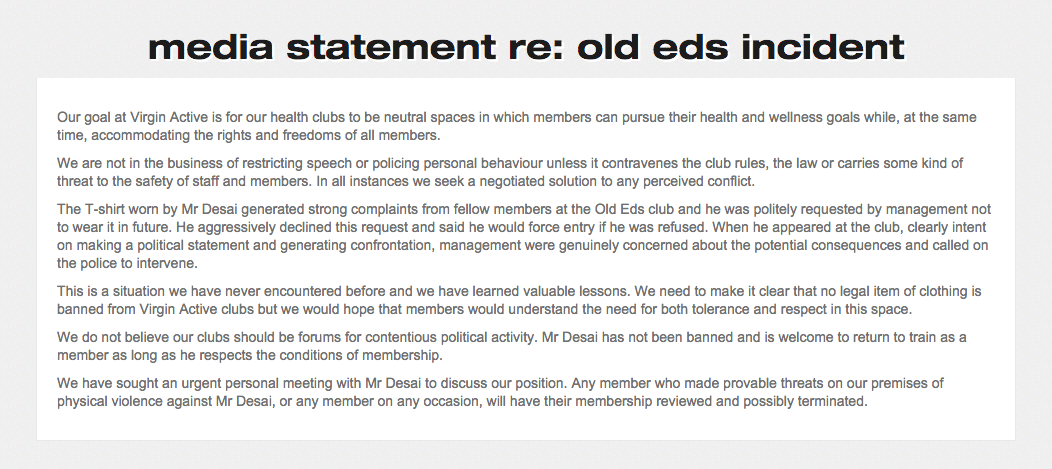
The Virgin Active media statement is screen-grabbed below, in case it gets taken down for some reason. But here are the bits I’d like to draw to your attention:

We are not in the business of restricting speech or policing personal behaviour unless it contravenes the club rules, the law or carries some kind of threat to the safety of staff and members. In all instances we seek a negotiated solution to any perceived conflict.

Lovely. So, as far as sentence one goes, why did you restrict Desai’s speech in this case? If you thought that there was an imminent threat to the “safety of staff and members”, that would surely only have come from people who decided to respond to Desai’s T-shirt with violence – and if they had done so, it would be the perpetrators of violence who should be ejected, seeing as that would presumably violate club rules.

The T-shirt worn by Mr Desai generated strong complaints from fellow members at the Old Eds club and he was politely requested by management not to wear it in future. He aggressively declined this request and said he would force entry if he was refused.

Sure, the complaints are understandable, and perhaps to be expected. And your response should be, “sorry, but he has a right to wear that T-shirt. You have the option of not looking in his direction, if you think that will help, but we have no grounds on which to refuse him permission to exercise.”

And, seeing as barring him from entry would surely be illegal, seeing as there are no club rules involving not wearing political T-shirts, I can understand Desai’s response regarding being barred entry in the future (although he’d of course likely be in trouble himself when “forcing entry”).

When he appeared at the club, clearly intent on making a political statement and generating confrontation, management were genuinely concerned about the potential consequences and called on the police to intervene.

Yes, a political statement that you in part initiated, by telling him that he had no freedom of speech in your club. And again, if confrontation was generated, it wouldn’t necessarily be him that was to blame – a price of admission to adult society is dealing with things that upset you without resorting to violence, and if someone attacked Desai, it’s the attacker who is at fault.

This is a situation we have never encountered before and we have learned valuable lessons. We need to make it clear that no legal item of clothing is banned from Virgin Active clubs but we would hope that members would understand the need for both tolerance and respect in this space.

Sure, it would be lovely if everyone played by your preferred (yet not legally proscribed) rules. But what if they don’t? In saying that no legal item of clothing is banned, you’re saying that Desai may wear the T-shirt. You might hope he doesn’t, but what if he doesn’t care about that hope?

We do not believe our clubs should be forums for contentious political activity. Mr Desai has not been banned and is welcome to return to train as a member as long as he respects the conditions of membership.

And the conditions of membership don’t involve not being able to wear a BDS T-shirt, right? So, what is it you’re saying? That he can wear it? In which case, why isn’t this press statement instead saying something like “we understand that Mr Desai’s T-shirt upset some of you. Sorry about that, but you’ll have to cope”.

We have sought an urgent personal meeting with Mr Desai to discuss our position. Any member who made provable threats on our premises of physical violence against Mr Desai, or any member on any occasion, will have their membership reviewed and possibly terminated.

Well, I hope that your position will emerge with a bit more clarity in that meeting than it does here. And I’m glad to hear you won’t let Mr Desai get beaten up in the meanwhile.

Postscript: Virgin Active have now conceded that they were in error to bar entry to Mr Desai.

Screen Shot 2015-08-14 at 11.24.44

TB Davie Memorial Academic Freedom Lecture 2015 – Kenan Malik

km11The University of Cape Town today welcomed Kenan Malik, who delivered the TB Davie Memorial Academic Freedom Lecture for 2015. As chair of the Academic Freedom Committee, I had the pleasure of welcoming him, and the text of my remarks is pasted below. I’ll link to the podcast of the lecture itself once it becomes available (here’s the transcript in the meanwhile).

Free speech in an age of identity politics – opening remarks

Three recent examples of disagreement regarding identity and its implications are: what is meant by transformation at UCT; what is meant by “black” or “white” in the Rachel Dolezal case; and how should we understand gender and sex, as in discussions sparked by Caitlin Jenner.

Two positions are commonly found when we disagree on issues such as these. First, you’d find a group of people who have borne the brunt of misunderstanding, mockery, prejudice and so forth. Second, you’ll find some who assert that the first group is poorly or incoherently defined, in that they are allied on grounds of purported identity alone, rather than shared arguments or ideas.

Regarding the first group, there’s no question that collectives of people – defined however they would like to define themselves – can mobilize around a shared conception of identity, finding courage, inspiration, ideas, or political heft through association.

And the second group can impede all those goals, often callously. It is surely beyond dispute that glib dismissals of these identities and their concerns can be used to silence, or to entrench existing power structures and so forth.

Consider the idea of “political correctness”, where those who deride the concept are sometimes largely interested either in being abusive, or simply in preserving their ideological positions. You don’t find a discriminated-against group complaining about “political correctness” as much as that complaint occurs amongst heterosexual white males, for example.

Over the weekend, you might have read about a programmer from New Zealand named Byron Clark, who devised a way to illustrate what some folk really mean when they talk about political correctness. He created a web browser script that automatically changed all mentions of the term “political correctness” to instead read “treating people with respect” – with the result that headlines might read “Donald Trump says that treating people with respect is getting out of control”, or somesuch.

But on the other side of the equation, politics premised on identity can also involve a suggestion or demand that those who don’t share the identity remain silent. This last week, in the debate on Amnesty International calling for the decriminalisation of sex work, certain interventions were ruled out of order not because they were necessarily uninformed, but because they came from rich white women, rather than from sex workers.

Of course, the interventions might also have been uninformed – but this feature could itself then serve as sufficient reason to reject them, rather than using the identity of the speaker to do so. In other words, some expressions of identity politics seem to entail that the identity of the speaker either confers – or diminishes – credibility as an independent feature, regardless of what they might be saying.

And yet, the liberal impulse of treating ideas according to their merits can be criticised for assuming the possibility of cultural and value-neutrality – and that possibility might well be a fiction, where it’s simply the case that one set of norms has become the default.

A related question is whether it is politically useful, rather than permissible – in terms of advancing whatever cause is at issue – for people outside of a particular identity to offer comment. If our answer is “no”, then we run the risk of silencing ideas that might be useful. If our answer is “yes”, the consequences would involve hearing at least some uninformed and prejudicial comment, but hopefully also some that adds value.

As a recent article in the New Yorker put it, Mill’s so-called marketplace of ideas is, “just like any other market, imperfect, and could … be improved by careful government intervention”, as in the case of hate speech. One concern raised by identity politics is that the marketplace is sufficiently distorted that not only do the historically advantaged get to define the terms of debate, but also what is worth debating, and that we might therefore want to recognise some self-imposed, socially constructed constraints on speech.

The question in short is: is the classic liberal position regarding free speech simply a way to legitimise existing power dynamics, or is it our best strategy for separating sense from nonsense, and learning which ideas are worth taking seriously?

These and related ideas are among the themes that Kenan Malik has been reflecting on in many of his columns, books, lectures and documentaries for over two decades now. He is the author of 6 books, including “From Fatwa to Jihad: The Rushdie Affair and its Legacy”, which was shortlisted for the 2010 Orwell Prize, and “Strange Fruit: Why Both Sides are Wrong in the Race Debate”, which was on the 2009 Royal Society Science Book Prize longlist. His latest book is The Quest for a Moral Compass: A Global History of Ethics, published last year.

His website, Pandaemonium, is not only a valuable archive of hundreds of thoughtful columns, but also a model of robust and fair debate, where Malik takes time to engage thoughfully with many of his readers – some of whom, as is typical with online comments, seem to have read an entirely different column to the one the author likely thought that they had written!

On Pandaemonium, he tells us that politically, he takes his cue from James Baldwin’s insistence that ‘Freedom is not something that anybody can be given. Freedom is something people take’, before going on to note how the Rushdie affair exposed the left’s partial abandonment of Enlightenment rationalism and secular universalism in favour of identity politics, and how as a result, much of his work is now in defence of free speech, secularism and scientific rationalism. Given his abiding interest in these issues, today’s lecture on Free Speech in the age of Identity Politics will no doubt provide plenty of food for thought and debate. Please join me in welcoming Kenan Malik to the University of Cape Town.

Identity politics, authority and freedom of speech

Originally published in Daily Maverick.

The University of Cape Town’s Academic Freedom Committee (AFC) hosts an annual lecture that explores issues related to academic freedom – the TB Davie Memorial Academic Freedom Lecture. TB Davie led the university as Vice-Chancellor from 1948 until his death in 1955, and is remembered as a fearless defender of academic freedom, including the autonomy of the university.

TB Davie defined academic freedom as the university’s right to determine who shall be taught, who shall teach, what shall be taught and how it should be taught, without regard to any criterion except academic merit. This definition is not without its detractors, with some arguing that the concept of “academic merit” is itself prone to embedding and perpetuating certain biases, in particular biases related to class and race.