Homophobia and free speech at UCT, redux

-t2zWl54The Vice-Chancellor of the University of Cape Town has responded to the controversy provoked by Zizipho Pae’s Facebook remark that legalising gay marriage was “normalising sin”, in a statement that attempts to balance sensitivity to LGBTQIA+ concerns while also affirming Pae’s rights to hold unpopular views.

My previous comments on this issue stand, but I’d like to add a few clarificatory comments. I agree entirely with Dr. Price that a key issue here is the legality of the Student Representative Council (SRC) decision to terminate her membership of the SRC, and also that the abuse and intimidation Pae experienced is inexcusable.

As Nathan Geffen wrote earlier today,

Should the extent of the hatred, misinformation, prejudice or ignorance disentitle the speaker from holding office?

In some cases it may. In others, there’s an opportunity to educate — both the speaker and the general public — rather than respond with fashionable social media fuelled outrage. The same goes for homophobia.

My argument last time was that it was entirely appropriate for the SRC to suspend Pae, pending discussion regarding her fitness to hold office, based on what the SRC constitution says and does not say.

I do not believe that holding homophobic views should automatically disqualify one from office – my claim is the limited one that if this contravenes established and documented values, then you are accountable in accordance with those values.

So, you’re free to be negatively disposed to gay people – but just not when this is associated with your position. This is not a free speech violation, but is instead a restriction on who is eligible to represent a community. The latter (being a SRC member) is not a right, but an earned position, and if that comes with certain requirements, you could rightly lose the position if you don’t fulfil the requirements.

From what I can tell from the SRC constitution and the minutes of the meeting that expelled her, I strongly doubt that her expulsion was legitimate, and I’d expect it to be overturned in time (although, this will likely be a pointless exercise, seeing as the SRC elections for 2016 are about to take place, with the current SRC coming to the end of their term).

Where I don’t agree with Dr. Price’s statement is where he quotes a 1998 Constitutional Court ruling which held that “those persons who for reasons of religious belief disagree with or condemn homosexual conduct are free to hold and articulate such beliefs”, going on to say that

This is especially so when a religious belief is articulated in a way that is not intended to insult, harm or discriminate, and if there is no incitement to taking harmful action against others. On our reading, Ms Pae’s Facebook post was an expression of her sincerely held religious belief, rather than an intervention to insult or hurt those with whom she disagrees.

Yes, they are free to hold and articulate those beliefs, but firstly (and again), not necessarily without consequences. As I say above, one such consequence could be expulsion, if the relevant laws/policies dictate that.

Should that consequence be expulsion? I don’t think so, as long as the person in question was appointed or elected with the rest of us being fully cognisant of their views, at least with regard to our set of ideal values.

So, if Pae campaigned on a platform that included opposition to gay rights, and was elected on that basis, I couldn’t have any complaints. Geffen’s post says that she didn’t hide her Christianity, but that’s a different matter to being openly anti LGBTQIA+ rights.

My view is that if you don’t disclose this, you can reasonably be expected to share the values expressed in various UCT documents, including SRC documents, that support those rights. Once it’s discovered that you don’t, the electorate might justifiably feel deceived, in that these are assumed to be shared values in the community (even if they aren’t actually shared in practice).

And finally, the notion of an expressed prejudice being more excusable if it stems from a “sincerely held religious belief”, rather than being something intended to “insult or hurt” isn’t helpful in this case – it simply passes the buck, and avoids tackling the difficult issue of what to do when people are “sincerely” bigoted, and with good intentions.

As Pierre de Vos noted in a recent column, religious beliefs and practices often get a free pass when it comes to discrimination. If allowing for discrimination based on religious views is a reasonable interpretation of the law, then I’d call the law defective in that regard.

We know, in advance, that some sincerely-held views (such as held by Pae) are not intended to insult or hurt. But we also know that they do insult and hurt.

Secularists (like me) are emphatic on the point that religious precepts should not be permissible premises in debates on policy or law. But more to the point, some of us who lack any belief in god(s) struggle to see any principled difference between your long-standing and scripturally-located version of “proper” marriage and sexual conduct, versus someone who chooses to locate their racist tirades in some long-standing tradition.

Or even, their polite, “sincerely held” racist beliefs, that are not intended to “insult or hurt” anyone, but merely to make things more efficient by letting people know what their proper place in the pecking order is.

Holy Cows – Gareth van Onselen on initiation, Zille and more

Earlier this week I was in conversation with Gareth van Onselen (GvO) at a launch event for his new book, Holy Cows: The ambiguities of being South African.

As far as I can tell, the event wasn’t recorded, which is a pity as I think we had an interesting dialogue on various contentious issues that are raised – either directly or by implication – in the book.

Two of the book’s themes seem to be of particular interest, judging by the conversation at the other launch event I attended, as well as social media and other comment.

Helen Zille is first up, if we address these themes in the sequence they appear in the book. GvO spends two chapters discussing Zille’s Twitter persona, in an exercise that one review (linked immediately above) called “a little creepy and obsessive”.

(There’s a chapter in the book on Pyramid, an obscure quiz show that ran on CCV-TV in 1995 and 1996, and I’d think that GvO having watched every episode of that a fair bit more obsessive.)

DSC_1066The chapters on Zille highlight various themes that recur throughout her Twitter output, and demonstrate that being as engaged as she is (it’s more accurate to say ‘was’, since stepping down as leader) allows us to establish a rather different view on her preoccupations and political dispositions than what you find in carefully-crafted newsletters and speeches.

One of the things that comes through rather strongly is Christian conservatism, in particular her negative attitude towards drugs, alcohol and sex. I’ve written on some of these things myself in the past, and also expressed views on her religious outlook in general, and think that cataloguing the Tweets in the manner than GvO does is useful for making the case.

Furthermore, the case is useful to make, for two related reasons – first, because even if Zille is committed to your liberty, in the sense that a roughly liberal party ought to be – the moralising tone of so many of the Tweets leave one feeling that her liberalism can be rather grudging.

Second (and I’m not attributing these observations to GvO), the hectoring and inflexible message that emerges from quite a few of the Tweets don’t provide enough of a counterpoint to the ANC’s political messaging.

Again, what I’d hope for from a liberal party is a tone and content that encourages critical reflection on issues. I wouldn’t expect that from a nationalist party like the ANC – but tonally, there’s little to pick between them, at least if you regard Zille as representative of the party.

In short, I think the wealth of data collected by GvO in these chapters give us interesting things to think about on the micro issue of a particular person’s political branding, as well as the macro issue of the various South African political brands in the market and how they are differentiated.

The second issue I’ll touch on is ritual circumcision, as discussed in chapter 7. Again, I’ve also written a column on this subject, but mine resulted in nowhere near the abuse that GvO’s shorter treatment (shorter than in his book, I mean) of the issue in his Business Day column did.

According to Xolela Mangcu, GvO’s column was “hate speech“. According to another correspondent, GvO was an “outsider” who also engages in inconsistent reasoning by not discussing all sorts of other cultural practices equally critically.

There’s one politically interesting issue here, and then another issue that is interesting mostly because it demonstrates a moral deficit on the part of these two critics.

The politically interesting issue is the question of who gets to comment on which issues – whether you need to be from a certain “culture” to criticise its practices. I think – and I know GvO does – that the arguments are what matter, not where they come from.

But tone can make people more or less receptive to a message, and this is (partly) why a column like mine led to less abuse, in that I foregrounded my outsider status (for pragmatic reasons only – not because I think it relevant to the argument).

GvO wrote in a certain style (and those of you who are actually interested in the arguments should read the book, not only the short column), and that style might or might not have been maximally productive to reader engagement. But again, that’s a separate point to whether the argument is sound or not.

The second issue is this: if there’s a cultural practice which does, on occasion, result in deaths and injuries, there’s a real problem to address – and it’s a far more significant problem than a “white” man having the temerity to criticise a cultural practice.

Yes, it’s true that this particular practice can be conducted harmlessly (using the word loosely, in that I’m ignoring the reinforcement of patriarchy, etc.). So if anyone says that deaths and maiming are always a necessary consequence of initiation, they are wrong and ignorant.

GvO doesn’t do that. And by all means, correct him or anyone else on particular facts they get wrong – but for as long as there exists a subset of traditional rituals that are open to the sorts of criticisms contained in the article and the book, there’s an argument to respond to.

Because if you don’t respond to the argument, then you’re telling us that according to you, the politics of identity – wherein a “white” man isn’t allowed to criticise something from “black” culture – is more important than deaths.

Or, you’re expressing a logical principle that only insiders can speak on whatever the insider topic is. And if this is the case, follow it to its logical conclusions – men can’t speak about something experienced by women, and vice-versa. The poor can’t talk about the rich. The Spanish can’t talk about the English, and so forth.

Most of the time, though, what it sounds like you’re saying is that this is something you’d simply like to have exempted from any outsider criticism, and that seems inexcusably lazy to me.

You can science too – it’s easy!

mouse-801843_1280If you’ve always wanted a career in science, but never got around to studying biology, physics or whatever it is that you’re interested in, don’t fear – being (treated as) an authority is easier than you might think.

First, find a conclusion you like. Let’s say, for example, the claim that sugar is addictive. Then, find a study that supports that conclusion, and publicise it:

In this study, conducted on rats, we are told that sugar is addictive – a line that Prof. Tim Noakes repeats with some regularity. It’s of course more complicated than that, but let’s not be negative – this is a post about how easy science is, after all.

Next, what you need is a way to discredit studies that say things that don’t support your conclusions. Don’t worry about being consistent at this point – it’s fine if you apply one standard to research that supports your conclusion, and another standard to research that doesn’t.

A mouse model shows that eating high-fat diets during pregnancy might ‘program’ your baby to be fat? Rubbish – mice are not women!

There’s a mouse study that shows high-carb diets lead to as long and healthy a life as any other diet? Rubbish – mice are not men!

(Some of you might, upon reading confounding studies, be tempted to think that science is complicated, and rarely – if ever – suitable for justifying dogmatism. Eliminate that negativity – there’s no place for it in sciencing!)

Now, what do you do when someone praises you as a lifesaver, but in doing so, also endorses avoiding conventional doctors, seeking out naturopaths, regarding “almost all” drugs as “toxic” and vaccines as “highly dangerous”?

natureboyrr_2015-Jul-15

Well, you retweet them, of course (while perhaps reciting your mantra that science is not religion). And if someone calls you out for endorsing vaccine quackery, do not fear – dismiss their question with an insult and an appeal to authority:

Like Ms. Child, I’m also not an expert on immunology. And no, I haven’t read the book, which apparently “needs to be read by everyone with an opinion on vaccination debate”.

But why would one read this book when a cursory Google search results in extensive, well-referenced accounts of (at least) 11 flat-out misrepresentations of data in that book?

Or, when you discover that the only places the author is taken seriously is sites like quack-central Mercola? If you’re still not convinced that you’d be wasting your time reading it, what if you learned that the author is sympathetic to homeopathy?

You’d think of her as a quack herself, I’d wager, and you’d certainly not endorse her as an authority. Unless, of course, you have a conspiracy story to tell about big pharma and the medical establishment colluding to sell you drugs, while hiding “the truth” from you.

But let’s imagine you ignore all that instead. Now, you know that the public are rather upset to hear anti-vaccine messages – after all, didn’t around 170 people get measles just this year (so far) in the USA, mostly thanks to being unvaccinated?

Also, you’ve been in trouble for appearing to endorse anti-vaxx messages before, when tweeting a link to a video featuring Andrew Wakefield on how the CDC arranged a cover-up of evidence relating to vaccines and autism.

(Maybe, you also think of that pesky HPCSA hearing coming up later this year, and how it might complicate things for you to appear to be supporting a viewpoint that is widely believed to indirectly kill people, especially babies.)

So, let’s just deny that the book is anti-vaccination, instead calling it something more grand, like a “unique historical analysis”.

Except, how do you square that with the publisher’s own description of the book, which tells us that the book argues that vaccines are not “responsible for the increase in lifespan and the decline in mortality from infectious diseases”, or accounts of her work like this one, from Dr. David Gorski?

I suppose you just hope that people take your word for it. While, perhaps, reciting your mantra that science is not religion, and calling anyone who disagrees with you a “troll”.

If you are happier and healthier on LCHF, great, I’m happy for you. But you can, and should, expect more from those who you take as your authorities on diet and more importantly, the scientific method.

As I’ve said before, I think the jury is out on the diet questions. It’s not out on vaccinations, and hasn’t been for quite some time now.

It’s shamefully irresponsible to suggest otherwise, and disingenuous to pretend that this isn’t what you’re doing in recommending books like those of Humphries.

Postscript

Noakes is asking “have you read the book?” to anyone challenging him on this on Twitter. You don’t need to read the book – there are many interviews with this author available online, including an outline of the arguments in the book on sites like Mercola’s.

Asking if you’ve read the book is mostly serving Noakes as a way to refuse to contemplate the dereliction of common-sense that is anti-vaccination endorsement on this scale. But even if he refuses to contemplate that, you nevertheless can.

Here’s something else that might interest you, on the author in question, linking to various other strange views she holds.

Bigotry, free speech and student politics at UCT

Zizipho Pae, current UCT Student Representative Council (SRC) Vice President, posted this Facebook status following the US Supreme Court decision to strike down same-sex marriage bans:

We are institutionalising and normalising sin. God have mercy on us.

pae4-592x400I wasn’t planning on saying anything about this, but the most recent rant from Error Errol Naidoo of the Family Policy Institute is mad enough to prompt a quick response, because he – like many others – are confusing the freedom to hold odious views with a (non-existent) obligation on others to not call them out on those views, and freedom from any consequences expressing those views might incur.

Ms. Pae is free to be a homophobe. She implies that she’s not a homophobe in the video embedded below, but the facts are clear: she labels gay people sinners, and suggests that we are “normalising” sin – in other words, that they are a threat to all of our moral welfares. She has a seriously negative disposition towards gay people, in that she doesn’t want them to have the same rights as straight people.

Dress that up in whatever religious sophistry you like, but any non-religious person would regard that as plainly homophobic. Also, any person, regardless of religious persuasion, should realise that Ms. Pae is instead endorsing an (unconstitutional) ban on gay marriage. So, wrong on the morals, wrong on the law.

She can have and express these views, regardless of the fact that we might prefer that she didn’t feel inclined to such prejudice. Her prejudices are also more common than I’d like, which is exactly why we don’t put basic rights to a referendum.

But holding those views does not protect her from criticism, whether or not she thinks she’s doing a bigoted god’s bidding. The university, and the SRC, have chosen to adopt a certain set of values, and homophobia is in contrast to those values.

She was relieved of her duties as Acting President by the SRC, as they are entitled to do. She has not been suspended or disciplined by the university administration, contrary to Mr. Naidoo’s claims.

Her rights to freedom of speech are not being violated – she chose a more demanding standard than “speech without consequences” when she ran for the SRC (before that, in fact, as simply registering as a student here involves committing to promoting certain values). So, free to speak, but then we don’t want you representing us.

So, there is no “anti-Christian discrimination” here, but rather a defending of what the country, and the university, have chosen as their moral foundation, namely non-discrimination on various grounds. She chose to be part of that community, so needs to follow its rules.

Where Naidoo and Pae do have a point is only with regard to the issue of her office being vandalised, and any threats being uttered against her. Those cases need to be investigated and the offenders sanctioned.

In the meanwhile, it would be absurd to think that the SRC should tolerate homophobia in its senior structures, and perfectly reasonable for them to suspend her, pending fuller discussion and investigation.

You don’t get to insult a large proportion of the students you’re meant to represent without consequence, whether you believe in a god or not.

“Witch hunts”, Tim Hunt, and sexism in science

tim-huntAs with “shirtgate”, where Rosetta scientist Matt Taylor was in the news for wearing a shirt depicting naked scantily-clad women, the Tim Hunt case has prominently featured Richard Dawkins, telling us how to understand feminism and the issue of sexism in science.

In his letter to The Times (paywalled, so – sorry – I’m linking to the Daily Mail‘s quotes of the letter), Dawkins says:

Along with many others, I didn’t like Sir Tim Hunt’s joke, but “disproportionate” would be a huge underestimate of the baying witch-hunt that it unleashed among our academic thought police: nothing less than a feeding frenzy of mob-rule self-righteousness.

‘A writer in the Guardian even described it as “a moment to savour”. To “savour” a moment of human misery – to “savour” the hounding of one of our most distinguished scientists – goes beyond schadenfreude and spills over into cruelty.’

One might hope that Dawkins is demonstrating “disproportionateness” via example, but he’s no doubt serious in this one-sided portrayal of events. Not only that, he’s perpetuating a misunderstanding he found in the libertarian Reason.com in his “moment to savour” quote – the Guardian quote, in context, reads:

Yet this is a moment to savour. Hunt has at last made explicit the prejudice that undermines the prospects of everyone born with childbearing capabilities.

In other words, it’s not the Hunt resignation that the author is savouring, but rather the opportunity it provides for discussing the ingrained sexism that is still experienced by women in professional settings such as laboratories (not to mention elsewhere).

When the speaker of the offensive remarks has felt the need to apologise, fully acknowledging that the remarks were inappropriate, seeing a senior male scientist like Dawkins describing reaction to those as a “feeding frenzy of mob-rule self-righteousness” is unlikely to reassure anyone who has concerns regarding perceived or actual sexist treatment of women in the workplace.

Yes, it’s true that some on social media had strong words to say about and to Tim Hunt. I don’t think it clear that this forced his dismissal, though. As usual, one can find evidence to support the case you want to make – Hunt and his wife claim that he was “hung out to dry” by University College London, and UCL say that he resigned (from an honorary, not paid, position) before they had a chance to speak with him about the incident.

He says he was joking when he made the remarks. And it’s true that many of the quotes of his remarks have left out the “now seriously” he utters in the second paragraph below:

It’s strange that such a chauvinist monster like me has been asked to speak to women scientists. Let me tell you about my trouble with girls. Three things happen when they are in the lab: you fall in love with them, they fall in love with you, and when you criticise them they cry. Perhaps we should make separate labs for boys and girls?

Now seriously, I’m impressed by the economic development of Korea. And women scientists played, without doubt an important role in it. Science needs women and you should do science despite all the obstacles, and despite monsters like me.

But the issue is not whether he was joking or not. No reasonable person could doubt that he was intending to make a joke. The issue is what jokes you regard as appropriate or not, in which contexts. In a professional context such as this, addressing a room full of female scientists who have most likely encountered plenty of glass ceilings, this was a stupid and insensitive joke to make.

Furthermore, what Dawkins and others are perhaps not reading is the non-baying-mob part of the Internet, for example these tweets from someone who interviewed Hunt just after he made the remarks in question. Here’s one of the tweets:

Blum goes on to record that Hunt said “he was trying to be honest about the problems” – meaning he perhaps does have the sexist attitudes that the “joke” was purportedly ironising. If so, why should UCL want him in an honorary position?

I don’t know all the facts – very few of us do. And yes, I agree that social media can bring an unreasonable mob to your door. Another speaker at the same event (who confirms Blum’s account) Blum perhaps puts it best, though, in saying:

I do have sympathy for anyone caught in the leading edge of a media storm. But if we are ever to effect change, sometimes we need the winds to howl, to blow us out of our comfort zones. Because the real point here isn’t about individuals, isn’t about Tim Hunt or me.

The real point is our failure, so far, to make science a truly inclusive profession. The real point is that that telling a roomful of female scientists that they aren’t really welcome in a male-run laboratory is the sound of a slamming door. The real point is that to pry that door open means change. And change is hard, uncomfortable, and necessary.

Girl with cake – let them eat oversimplification

Marie Antoinette never said “let them eat cake”. At least, we have no reliable evidence that she did, and reason to think it unlikely. At the time (the other) Rousseau, Jean-Jacques, recorded the words, she would have been 14 years of age and not yet even resident in France.

Nevertheless, the words have come to stand for indifference to suffering, in that as the story goes, when the Queen was alerted to the fact that people were starving thanks to bread shortages, her response was “Then let them eat brioche.”

Given this widely believed historical anecdote, you’d perhaps think it an elaborate (and risky) joke if a privileged white woman were to travel the country giving cake to poor people. Or perhaps you’d assume that she’s not familiar with the anecdote.

I’m going with the latter option in the case of Girl with Cake, which involves a privileged white woman traveling the country giving cake to poor people, because “everyone deserves a cake made with love”.

Not only do they deserve it, the cake also “makes all the bad go away”. Given the Oprah-level powers of said cake, why is it that myself and some other grouches have concerns about this project – and why is it that expressing these concerns is so offensive to some?

poverty-porn

Starting with the first question: neither I, nor anyone I’ve encountered on the “concerned” side, have any objection to charitable giving. But something being charitable and perfectly well-intended does not make it immune to criticism.

In this instance, there’s a long historical context of romanticising poverty and of creating narratives of a white saviour rescuing black people from their miserable existences.

And it’s because of this context that when one engages in charitable giving, it’s usually a good idea to be somewhat discreet about it, rather than having a photographer in tow to capture your beaming white smile and the poor black people to whom you have provided the “joy of cake” (yes, that’s a quote from the website).

cake

The first photograph in this post comes from Robert Pijpers’ essay on stereotyping Africa and romanticising the poor, and I’d encourage you to read that for a fuller explanation of the point I’ve only briefly made here, that “depicting Africa as a place inhabited by helpless people that long for salvation” is a risk inherent in these sorts of endeavours.

The primary purpose of this post is rather to talk about reactions to criticism of Girl with Cake, which – in the case of one friend of mine – have made it clear that self-reflection is forbidden, nuanced discussions of poverty and charity are offensive, and that anyone who dares to do either must be evil.

Here are some quotes from Facebook:

  • All you’ve done is breakdown my faith in humanity – the lil bit that she restored
  • She should be giving them raw liver instead! #Banting (okay, that was me)
  • Because it’s so much more productive to write horrified Facebook posts? C’mon [X], at least she is making an effort and not at a distance, either.
  • Really disappointing that people get slammed for trying to uplift someone’s spirit.
  • What have you done for the poor lately?
  • you are really a sad human being
  • It is easy to sit back and be an acid queen about everything, but to take hand of your cock and stop wanking and start doing something for somebody else is something completely different.
  • do u have no humanity in u or are u just negative because ur life sucks?
  • The world doesn’t need people like you

There’s more, and it’s ongoing, but that’s enough. What these comments miss is that the problem isn’t the giving, but the apparent obliviousness to the impression of narcissism created by the manner in which the giving is promoted.

It’s irrelevant how much or how little the critic him or herself gives – all that could possibly indicate is hypocrisy, but it has no bearing on whether criticism of Girl with Cake is legitimate or not. And of course, it’s deeply ironic that defenders of charity can themselves be so lacking in charity, as demonstrated in these abusive responses.

Another friend asked me whether criticising Girl with Cake amounts to bullying, and I’ll close with a few thoughts on that. Of course it can be bullying, depending on what was said, and who it was said to.

In this case, the comment or criticism amounted to linking to her website, commenting “So here’s someone who literally thinks poor people should eat cake. And then she gives it to them while a poverty voyeur takes photos. AND THEN SHE PUTS IT ON THE INTERNET AND THANKS HER SPONSORS! I…you…WHAT?! WHAT THE FUCK?!”

The beaming white smile and the noble savage is a problematic image, and it’s one that she foregrounds on her website. Transpose her story and the cake with a missionary and a Bible, or somesuch, and we’ll have consensus that there’s an issue here.

Again, this isn’t to question her good intentions, but rather to point out that the optics are pretty unfortunate in how they give an impression of unthinking narcissism. That, albeit in more direct language, is what the Facebook post expresses.

That’s not “bullying”, but rather highlighting a problematic stance or behaviour. Doing so is not only permissible – it’s desirable, in that debate and argument is how we improve.

#NoakesHearing, day 1: Reflections on futility

hpcsaAs anyone who clicked through to this piece probably knows, yesterday saw the start of a Health Professionals Council of South Africa (HPCSA) hearing to assess whether Prof. Tim Noakes is guilty of unprofessional conduct. The charge against Prof. Noakes states:

That you are guilty of unprofessional conduct or conduct which, when regard is had to your profession, in that during the period between January 2014 and February 2014 you acted in a manner that is not in accordance with the norms and standards of your profession in that you provided unconventional advice on breastfeeding babies on social networks (tweet/s).

I attended all of yesterday’s session, and offer some thoughts on what transpired, below. I have not attempted to catalogue everything that happened – if you want a more detailed account, the News24 live-blog offers an accurate summary.

On futility – once more with the distinctions

It continues to exasperate that I can think of only one person a handful of people who understand that there are (at least) two distinct issues at play in the general discussion around Noakes, LCHF and Banting. The first is the set of questions related to diet, and which is healthier for you.

In this set of questions, I’m bundling in long-term vs. short-term, treatment for obesity and diabetes, what proportion of population X are insulin-resistant and so forth. I do not, in general, comment on those issues. They are not a field of expertise for me. As I’ve repeatedly said, Noakes might well end up being a frontrunner in what eventually becomes scientific consensus.

The second set of questions relates to logic and philosophy of science, and to our responsibilities as educators, or journalists, or health professionals to discourage sloppy thinking on matters of significance (well, on all matters, but the stakes are sometimes higher than others).

So, I’ve consistently (with a few lapses, I’m sure) focused on the quality of argument that emerges from the Banting camp, rather than on the superiority of any particular conclusion. If you don’t care about those issues (you of course should), then you shouldn’t be reading my comments on them.

You certainly shouldn’t be asking me to present evidence that low-carb is bad, because that’s not what I’m claiming. You also shouldn’t be telling me that “there’s so much more bad science for the consensus” or somesuch, because maybe there is, and maybe there isn’t, but that’s not what I’m talking about. The fact that someone else (proponents of the consensus view) also does things wrong doesn’t give anyone else a free pass to be sloppy in their reasoning.

On futility II – the hearing that never happened

We spend the entire day hearing arguments about the constitution of the panel that was set to hear the case, and proceedings were eventually terminated at around 15:30 when it was agreed that the panel was improperly constituted. Proceedings will resume on November 23, assuming nothing else interferes with the process.

Should this hearing be happening at all?

I have mixed feelings about this. As with so many of our policies (and even heuristics related to social interaction), there’s a vast difference between what made sense in a pre-digital era and what makes sense now. Noakes is often to be found on Twitter – he’s written an ode to it, in fact, and his fans love him for how much he engages there.

The point of highlighting the pre/post-digital era is of course it would be irresponsible for a physician to encounter you in the street and tell you what your baby should eat, unless your advice is something rather generic and consensus-based. Even if the consensus is wrong, as Noakes thinks it is, it does sit with an advantage here – his job is to create a new consensus, after which he’ll get the same advantages.

But perhaps Twitter is different, in that it’s a broad discussion or sounding board for ideas, in which we shouldn’t expect people to view what Noakes tweets as prescriptions in the medical sense. That’s presumably what he thinks. I think he’s wrong in practice, because people do view them as prescriptions, and he should know that and act accordingly.

However, it’s possible that holding him to account for all possible consequences of his tweets does overstate the importance and role of Twitter, and also paternalise his Twitter following. For example, a non-prejudicial look at the tweet that started all the trouble is consistent with slowly weaning a child onto LCHF, perhaps in a manner that doesn’t run the risk of causing the complications the complainants in this case claim it would.

So, this case is raising very important background issues related to the appropriateness (or not) of how people with positions of influence engage on social media.It’s not going to be a waste of time, but is rather going to force everyone to resolve what I think are important issues.

It’s a great shame that many of Noakes’ supporters are struggling to see anything beyond a vendetta or bad faith here, and also that Noakes himself misses the point that it’s not about freedom of speech, but rather about the responsibilities of healthcare professionals to avoid causing harm.

He’d retort that it’s the Association for Dietetics in South Africa’s (ADSA) advice that causes the harm, but even if true (and even if he’s even representing what their advice is accurately), that’s something you demonstrate in journals, not with other people’s babies.

Is Noakes speaking “outside his field of expertise”?

One of the things that caused a fuss during the hearing was a statement made by the HPCSA’s lawyer that Noakes was operating or speaking as if he were a dietician, and that this is not his field of expertise. To briefly return to my futility theme, this was immediately leapt on by the Noakes-supporters as an attempt to suppress Noakes’ freedom to research and write on nutrition, while it was in fact nothing of the sort.

The argument was simply that because he’s operating outside of the “normal” General Practitioner (GP) set of ideas but rather as a dietician, it makes sense to include a dietician on the panel. Nevertheless, the motivated reasoning in response to this was quite something to behold, as it was immediately taken up as further evidence of the conspiracy against Noakes, who was now “not allowed” to talk about diet.

The clue as to what GPs do is in the name – they consult on a general set of health-related concerns, one of which is diet. But the claim made by the HPCSA lawyer was that Noakes was presenting himself as more than a generalist, but rather as a specialist in this area, and he should thus be assessed by a specialist also.

What was the problem with the panel composition?

The technical problem that (rightly) led to the cessation of the hearing was that the panel was lacking one particular member as per the regulations, where that member needed to be in Noakes’ profession, i.e. a GP. There was one GP on the panel, who was also a pediatrician, as well as a dietician (who I’ll return to in a moment), but there needed to be another Medical and Dental Board-registered GP present for a properly constituted panel.

What was interesting about the debate on the panel composition?

Both sides seemed intent on creating as favourable a panel as they could, which should of course be no surprise. The complainants argued strongly for the presence of a dietician, and Noakes’ lawyers argued strongly against. Noakes, of course, thinks that the dieticians exemplify bad science in this area, and he’d probably argue that they aren’t competent to assess the evidence he’ll present.

However, the problem with ruling them out is two-fold: one, it presents a circular argument, in that it assumes they are incompetent (or rather, cedes the argument regarding their competence) as reason to rule them out as assessors of the evidence; and two, if they are as incompetent as he thinks, surely it would be a simply matter to demonstrate this in the course of the hearing?

There’s the risk of a strategic blunder from the Noakes team here – the more intent they appear on trying to rule a dietician out as a panelist, the more people might wonder what they are so concerned about. If they are as scientifically backward as Noakes would have us believe, why not publicly expose that via the hearings?

And then….

The strange case of Prof. Blaauw

The dietician panelist, Prof. Blaauw, was initially considered a perfectly acceptable member of the panel, until we discovered two things about her (and the second, only rather late in the day). Over lunch, she informed the (superb) Chair of proceedings, Joan Adams, that she had once co-supervised an ethics thesis on the “media implications of Tim Noakes”. This was claimed to not impair her objectivity, and the Noakes legal team seemed happy with her, despite this knowledge.

Later on, though, we discovered that she was also a member of ADSA, whose President in fact laid the complaint against Prof. Noakes. This caused significant dissent around her suitability, as you’d expect it to given the conflict of interest.

Debate then ensued as to whether she was in fact legally part of the panel at all, as given that it had already been ruled that the panel was improperly constituted, she could not officially or automatically be considered part of a future, properly constituted panel either. Noakes’ lawyers went as far as to say that they might consider taking this issue to the High Court, if Prof. Blaauw ended up remaining on that future panel.

Bad faith and Tex bars

In an amusing turn of events, we reconvened after lunch to find that some prankster had placed Tex bars (a chocolate) on the desks in front of each panelist. Some of the Noakes supporters on Twitter immediately assumed that this was ADSA’s doing, which seemed to fit the generally uncharitable attitude on the #NoakesHearing hashtag, which also included some fat-shaming of various members of the complainant’s party.

Yes, these are emotive issues, and I can understand why people feel that someone they respect and admire for standing up to orthodoxy is being unfairly singled-out, but you don’t make an effective case for his virtue by demonstrating a lack of virtue yourselves. Even if “the other side” sometimes do the same, that does not make your doing so more appropriate either.

One of the Noakes supporters seems to have cottoned on to the reality that people like me don’t have a vendetta, but is rather simply interested in the arguments and ethics of how we debate them. But there’s still far too much ad hominem, and accusations of trolling put in terms that are themselves distinctly trollish. This is the problem of the filter bubble, as I’ve argued before, and I’ll again simply suggest that there is a conversation to be had here, and some of us are having it in good faith – whatever you might believe.

In conclusion

The Noakes legal team seem better prepared, and certainly appeared more effective in their rhetoric and argumentation. Now that the hearings have been extended to run for 7 days, I suspect that the complainants are going to have a difficult time competing. And, at the end of the day, Noakes will “win” on any permutation.

If he is (in the extreme scenario) struck off the roll and disallowed from practicing medicine, that’s of little consequence to his main interest, which is research and (mostly public) dissemination of findings related to diet. And, he and his supporters will have further “evidence” of his persecution.

And if he wins, that will of course serve as his – and the Banting diet’s – most significant tipping point towards public acceptance yet…

Screen Shot 2015-06-05 at 09.50.27

P.S.: The screenshot above is from Noakes’ Real Meal Revolution website, and you might find the last bullet-point of interest.

Sugar given Carte Blanche to cause panic

When you (by which I mean, the average person) thinks about something as being “addictive”, I think we mean that the substance or activity in question is particularly likely to cause you to develop some combination of dependence, tolerance, cravings and withdrawal symptoms.

You’d also, if addicted, go to significant lengths to obtain the thing that you are addicted to. On a trivial end of this spectrum, people who smoke cigarettes might walk out into a cold and rainy evening to go and purchase cigarettes, instead of staying under the duvet like any sensible (i.e., non-addicted) person would.

When you think of addiction, in other words, I’d guess that you typically don’t mean that you know this fellow, George, who has become so obsessed with playing Minecraft that you describe Minecraft as addictive, as opposed to acknowledging that people can become “addicted” to Minecraft.

sugarThe distinction is important, and points to one of the significant problems in discourse around sugar “addiction”, as recently portrayed on the South African current affairs show, Carte Blanche. It’s important because the things we like are rewarding at the level of the brain, in that they result in dopamine release – but this does not necessarily mean that they are addictive in the stronger sense that we tend to reserve for things that you can’t help but find rewarding.

In other words, there’s almost zero chance of my becoming addicted to running, because I don’t like doing it, and tend not to do it. But there’s a significant chance – and a similar chance to your chance – of my becoming addicted to heroin, if either of us were to try it.

We’re using the word “addictive” in a very broad sense when we describe the Internet, exercise, and sugar as addictive. In fact, the sense in which it’s being used is broad enough as to mostly lose its meaning, by contrast to the strong sense in which certain substances are very likely to result in the sorts of reactions mentioned above, for many people.

Most of us exercise, use sugar or the Internet, and have sex quite unproblematically (in terms of addiction, Beavis). More of us use things like heroin or cocaine unproblematically than the standard sorts of addiction panics claim also, but that’s a story for another day. The point I’m making here is quite simply that any claim that sugar is “addictive” is using the word “addictive” in a misleading and hyperbolic way.

Long-term addiction is the exception, not the rule – we suffer from a confirmation bias here in the sense that we don’t get to hear about the people who live with addictions that are largely under control and remitting (in other words, most of them). We hear about the horror-stories, of people struggling with a demon, and (sometimes) heroically fighting it off.

And, as the cases and science detailed in Johann Hari’s Chasing the Scream persuasively suggest, the primary vehicle we have for escaping addiction is to give ourselves a sense of purpose and above all, agency – and agency is last thing that panics around things like sugar addiction have time for. Instead, the narrative is all about you being a victim of conspiracy.

You can watch the Carte Blanche insert yourself, in which you’ll be told that “sugar may be as addictive as nicotine and hard drugs”, that sugar can “hijack the brain” and so forth. But what you’ll mostly see is three self-described (and apparently self-diagnosed) sugar addicts telling you how addictive it is.

Their primary scientific resource, Prof. Nicole Avena, doesn’t even herself support the strong addiction claim, saying “a little bit of sugar won’t hurt you. It’s not a bad thing in general, it’s just the way we are consuming it is a bad thing”. The “we” is perhaps too broad there, in the sense that many of us who aren’t on LCHF-type diets have been restricting added sugars for our entire lives already, given that warnings about refined sugars have been a staple of dietary advice for quite some time now.

Nevertheless, I’d agree that people are eating too much sugar. And, people who are prone to compulsive behaviour might well find themselves becoming “addicted” to sugar – and you wouldn’t be surprised to find (as you do in one of the three cases presented in the show) that these people can become “addicted” or even addicted to a range of things over the course of their lives.

The problem, in short, might be with their lives and their circumstances – at least in large part – rather than in the substances or activities. We should not be surprised that our brains find food rewarding, and that we seek it out. We’d be surprised if it was any other way. But if we can (typically, as with most consumers of sugar) control the impulse to eat too much of it, then addicts need to shoulder a large portion of the responsibility themselves, and not hand it over to sugar.

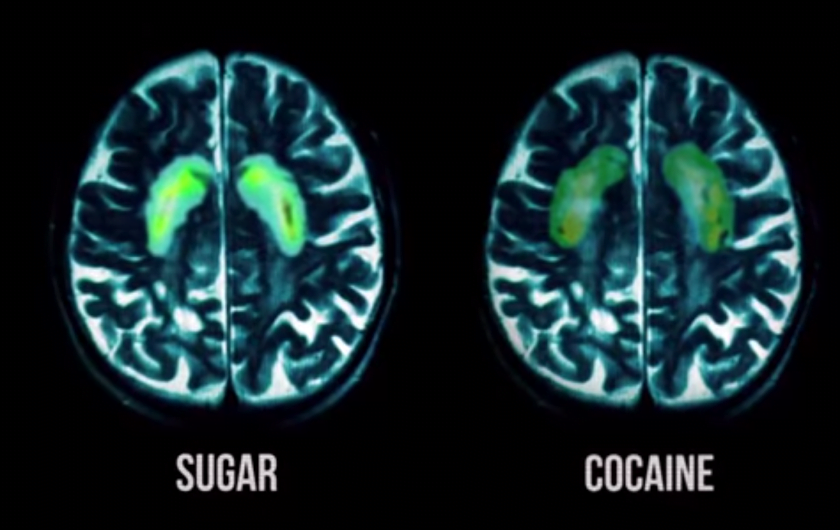
But, say some (and as presented at 2m21s in the video, with an unfortunate reference to quack-central Natural News), studies prove that sugar is more addictive than cocaine. Unfortunately, studies prove what you want them to, depending on which studies you read, and which you ignore.

Plus, of course, how attentively you read them can be an issue – as I’ve noted before, Avena and others are far more circumspect and tentative than they are presented to be by the media and vested interests. Her own oft-cited paper is full of scare-quotes for the word “addiction”, and stresses that “whether or not it is a good idea to call this a “food addiction” in people is both a scientific and societal question that has yet to be answered.”

The hyperbole in blogs and online news sources, never mind repositories of the worst sorts of pseudoscience like Natural News, don’t help resolve these issues. Neither do personal anecdotes, regardless of our compassion for people who struggle with compulsive behaviour of various sorts. Movies like Fed Up are of little use also, in that they simply populate the scaremongering filter-bubble with cherry-picked and misrepresented data.

If you want to read about why the Lenoir et. al. study quoted in Natural News doesn’t resolve my doubts about sugar addiction, not to mention comparing rat data to human experience – especially given the fact that psychological rather than physiological factors seem most relevant to addiction – I’d recommend reading this Scicurious post closely.

That post points out that there’s perhaps a vast difference between the self-administration of drugs in humans compared with rats, who can’t reason about their choices like we can. It also notes that the study doesn’t measure a progressive ratio – in other words, it doesn’t tell us what the rat prefers when it really has to work to get its reward. When things get tough, will it prefer sugar, or will it quit trying?

We don’t yet have good human data for sugar addiction. What we do seem to have is limited evidence for “eating addiction“, but as I’ve stressed above, an addictive behaviour is not the same thing as an addictive substance. People who are addicted to eating might well find foods – including sugar – deeply rewarding, but it’s premature to blame the sugar itself.

To conclude: there’s no problem with saying we find sugar rewarding. Of course we do, as we would exercise and so forth. To say it’s addictive makes a far stronger claim, and that claim is the suggestion that it’s a sinister substance that’s out to get you, rather than something you’re free to enjoy in moderation, just as you can alcohol or any other drug, depending on the legislation where you live, and your own personal risk-tolerance.

One thing I’m quite concerned about, though, and have noted before, is that it seems quite likely to me that your risk-tolerance can only be compromised through being treated like a perpetual victim – and that believing your food is out to kill you seems a wholehearted embracing of that victimhood.

Saturated fat not exonerated in 2015 US dietary guidelines

I’m traveling back from giving a talk to a room full of dieticians about their social responsibilities, in which I emphasised that one of their important tasks is to try to beat back the surge of hyperbole and exaggeration coming out of the Banting and LCHF camps.

There are plenty of posts here on Synapses on the topic, many dealing with Professor Tim Noakes and how his confirmation bias has led him to re-tweeting false and potentially dangerous claims. You’d recall him “just asking questions” on vaccines and autism, or spreading the (false) idea that Sweden had become the first nation to “officially” adopt LCHF as their diet.

imagesAs I’ve said many a time, and repeated at the talk last night, some of the ways in which we can aid the spread of scientific literacy is through simply reminding people of the virtues of not overstating the evidence we have for our claims, and also through encouraging people to be consistent in their judgements – if something is wrong in one case, it’s usually wrong in similar cases also.

A recent example of salesmanship trumping science arrived in time to include in my remarks, and I also want to note it here for folks who have been following the topic. Yesterday morning, Prof. Noakes tweeted

The text of the tweet is a quote from the linked post, so not Noakes’ words, but I am fairly confident that he endorses the sentiment seeing as he’s frequently said similar things. Many times, they have in fact been described as “tipping points”, which makes one wonder how many tipping points are necessary before whatever it is actually gets around to tipping.

Anyway – if you go read the post that is linked to in the Tweet, you’ll find that it’s a smug “I told you so” by Dr Malcolm Kendrick, author of “The Cholesterol Con”. What he wants to gloat about is that he was right all along, and that in short, “cholesterol is healthy, saturated fat is healthy, salt is healthy and sugar is unhealthy”. Speaking of the 2015 Dietary Guidelines Advisory Committee’s (DAG) report, he says:

The entire report, I believe, stretches to about a bazillion pages. However, here are four of the highlights.

Cholesterol is to be dropped from the ‘nutrients of concern’ list. [I love that phrase ‘nutrient of concern’].

Saturated fat will be… ‘de-emphasized’ from nutrients of concern, given the lack of evidence connecting it with cardiovascular disease.’ [Whatever de-emphasizing may be. Pretending you never said it in the first place, I suppose].

There is concern over blanket sodium restriction given the… ‘growing body of research suggesting that the low sodium intake levels recommended by the DGAC (Dietary Guidelines Advisory Committee) are actually associated with increased mortality for healthy individuals.’

And… ‘The identification and recognition of the specific health risks posed by added sugars represents an important step forward for public health.’

The entire report does indeed stretch to a bazillion pages, or close enough at 571 pages. I presume that’s why Kendrick hasn’t read it, and therefore goes on to substantially misrepresent what it says.

To say that “cholesterol is healthy” is misleading because while dietary cholesterol has been de-emphasised, the DAG has not concluded that cholesterol in the blood is unproblematic – contrary to what Noakes’ journalist has reported.

To say that saturated fat will be “de-emphasised” is literally false, as that line comes from the Academy of Nutrition and Dietetics, who (this press release is even pasted in Kendrick’s post) say that they support “the DGAC in its decision to drop dietary cholesterol from the nutrients of concern list and recommends it deemphasize saturated fat from nutrients of concern” (my emphasis).

So, the Academy of Nutrition and Dietetics say to DGAC “good work, but you could do better” (on their model, of course). But the report does not say what Kendrick says it does, and the US Guidelines will continue to warn against overconsumption of saturated fat. If you read it, or even do a simply word-search for “saturated”, you’d know that, because you’d read that they recommend “less than 10 percent of total calories from saturated fat per day”.

I didn’t read up on the sodium commentary, and agree that added sugars are problematic (while not being addictive), so will say nothing about those last two bullet points, except to quote the report in saying “the DGAC also found that two nutrients—sodium and saturated fat—are overconsumed by the U.S. population relative to the Tolerable Upper Intake Level set by the IOM or other maximal standard and that the overconsumption poses health risks.” Go figure.

But before wrapping up by giving you a few quotes from the DGAC report’s conclusions, I’d like to note the double-standards at play in endorsing the Academy of Nutrition and Dietetics’ comment to the report, as Kendrick does and Noakes would likely do also, seeing as he’s explicitly told us that saturated fat is not a concern.

When the Association for Dietetics in South Africa (ADSA) decided to report Noakes to the Health Professions Council for “unprofessional conduct”, he and his supporters had a field day on Twitter looking at ADSA’s list of sponsors, and then dismissing ADSA’s case on the grounds that they had had financial dealings with Kelloggs and other (allegedly) evil corporations.

Why is the same standard not applied to the Academy of Nutrition and Dietetics, who have been the subject of a Senate enquiry thanks to their pharmaceutical connections, and who have a list of sponsors and funders a mile long, including Sarah Lee (makers of evil carb products!), Coca Cola (so very evil!) and evil Monsanto (the Great Satan!).

It can’t simply be because they say the right things, can it? Because that’s not how science works, as the Doctor and Professor surely know.

Lastly, seeing as the Noakes’ echo chamber on Twitter is in full swing with “see, he’s vindicated!” types of comments following the release of the DAG report, I’ll leave you with this quote from it. Make up your own minds as to whether it supports Banting, or whether it’s largely the same advice as ever.

The dietary patterns associated with beneficial outcomes for cardiovascular disease:

Dietary patterns characterized by higher consumption of vegetables, fruits, whole grains, low-fat dairy, and seafood, and lower consumption of red and processed meat, and lower intakes of refined grains, and sugar-sweetened foods and beverages relative to less healthy patterns; regular consumption of nuts and legumes; moderate consumption of alcohol; lower in saturated fat, cholesterol, and sodium and richer in fiber, potassium, and unsaturated fats.

The dietary patterns associated with beneficial outcomes for obesity:

Dietary patterns that are higher in vegetables, fruits, and whole grains; include seafood and legumes; are moderate in dairy products (particularly low and non-fat dairy) and alcohol; lower in meats (including red and processed meats), and low in sugar-sweetened foods and beverages, and refined grains; higher intakes of unsaturated fats and lower intakes of saturated fats, cholesterol, and sodium.

Dietary patterns in childhood or adolescence that are higher in energy-dense and low-fiber foods, such as sweets, refined grains, and processed meats, as well as sugar-sweetened beverages, whole milk, fried potatoes, certain fats and oils, and fast foods are associated with an increased risk.

(But the diet’s not for everyone, only for the insulin resistant!) The dietary patterns associated with beneficial outcomes for Type 2 diabetes:

Dietary patterns higher in vegetables, fruits, and whole grains and lower in red and processed meats, high-fat dairy products, refined grains, and sweets/sugar-sweetened beverages.


Flu vaccines might be ineffective, so try… water (otherwise known as Oscillococcinum)?

A friend forwarded a press release issued by “LeBron Health” to me, and the quackery it contains is too delightful to keep to myself. But because the press release also trades on fear-mongering of a rather pathetic sort, it’s also an reminder of how uninformed or unethical some medical “professionals” are, and of how quackery can harm in scaring people away from effective treatment.

The press release discusses the upcoming flu season in South Africa, and in particular, how to cope with the H3N2 strain of influenza. The H3N2 strain of influenza is indeed deadly, having reportedly killed dozens of children during the most recent US winter. That’s not good, of course – we’d like the number of deaths to either be 0, or much closer to 0 than that.

However, the number of deaths and hospitalisations this winter have not been significantly out of the normal range – the flu is not killing more people than it typically does. Furthermore, it’s also quite routine for the CDC to “issue a health warning to doctors”, as they are reported by the press release to have done. A “health warning” is not an advisory broadcast regarding an impending apocalypse, but (typically) simply information that the CDC thinks practitioners might find useful.

The health warning itself also reports something quite mundane on an aggregate level (though of course not mundane at all if you’re someone who has had flu-related illness or death in the family). It simply says that the current vaccine can’t compete effectively against H3N2, and that everyone should be prepared for a bad flu season.

This is also routine – vaccine developers select flu strains in January to May (for the US), based on which strains they predict will be most prevalent, and vaccination then begins in October. Things can change between those two phases – they are 5 months or more apart, after all – and one of the things that can change is the seriousness with which you could have (with perfect hindsight) regarded the threat of a particular influenza strain.

But you can’t know, 6 months in advance, and so you make the most informed predictions you can. Some years, the vaccine works very well, because you picked the right strains, and other years it works far less well.

And here’s the frustrating thing: in December last year (when the flu season hit the USA), the same scaremongering was prevalent. We read that the CDC had “admitted” that the vaccine doesn’t work, just as in this local press release’s headline, which claims that “flu vaccines may not work”.

Well, the CDC admitted nothing of the sort, and the flu vaccine “works” just fine, within the parameters of how it normally works, where the reasonable standard is never “perfectly”.

Even though this might be a particularly bad year for the vaccine’s efficacy, it’s still going to be better at helping you to avoid influenza than certain other “remedies” would be. It will help more than prayer, it will help more than avoiding cellphone towers, and it will certainly help more than homeopathy (with the caveat that hydration is good, so homeopathy in extreme quantities might help a little bit, because water).

Homeopaths disagree, as you might expect them to. One of those homeopaths is Dr Erika Coertzen, who suggests that we take a “reputable medicine such as Oscillococcinum, the most popular homeopathic product for flu symptoms in France”.

homeopath
This box contains as much medicine as a microscopic box of Oscillococcinum does.

That quote tells us that Dr Coertzen and my understanding of what the word “reputable” means is as orthogonal as our understanding of the word “medicine”. We can also note that a “medicine’s” popularity is only relevant to sales, profit, and analysis of marketing and gullibility – it tells us nothing about efficacy.

As with all homeopathic “remedies”, there is no good clinical data to support the claims made in favour of Oscillococcinum as treatment for influenza. It’s not going to help you to “rebalance and heal”, and even if it is true (no citation is given for this claim) that a “majority of patients who take Oscillococcinum at the onset of flu-like symptoms show improvement or resolution of symptoms after reduced time”, if this is in comparison to patients who take nothing, then the placebo effect is a perfectly good explanation for this observation.

But I suspect that the data is more… what’s the technical term?… made up than that, or that it at the least involves some fairly extravagant inferences being made from a poor data set. Dr Coertzen says that patients “symptoms show improvement or resolution of symptoms after reduced time” – if this is true, the data should support this claim. Unfortunately, they don’t.

As assessed by the Cochrane Collaboration, where trials do show favourable results for Oscillococcinum, “the overall standard of research reporting was poor, and thus many aspects of the trials’ methods and results were at unclear risk of bias. We therefore judged the evidence overall as low quality, preventing clear conclusions from being made about Oscillococcinum® in the prevention or treatment of flu and flu‐like illness.”

Amusingly, the Oscillo.com website – of course not a neutral scientific arbiter – claims that “unlike other flu medicines, Oscillococcinum does not cause drowsiness or interact with other medications”. Given that Oscillococcinum is a homeopathic “remedy”, therefore containing nothing that might cause drowsiness or negative interactions, this claim only gains traction if you’re able to persuade people that homeopathy is at all respectable or efficacious – surely nothing that any “reputable” healthcare practitioner would do?

In her defence, Dr Coertzen isn’t ever quoted as directly suggesting that you not take real medicine also, which might be the only thing that prevents the Health Professions Council (HPCSA) Medicines Control Council (MCC) from chastising her for this batshittery.

However, if she is the “medical expert” quoted in the headline, telling the public that vaccines might not work and that they should consider alternatives does seem to be a direct encouragement to forsake medicine in favour of homeopathy, and I do hope that a complaint is laid so that the MCC HPCSA can then rule against this idiocy.

Briefly, on Oscillococcinum itself, you’d be amused to read up on it, as the story of its origins and composition is quite the catalogue of pseudoscience in action. While there might be nothing that trumps Scientology for batshittery, Oscillococcinum gives it a damn good try…


PRESS RELEASE (source)

Flu vaccines may not work, consider alternatives — medical expert

Global health authorities have cautioned that current flu vaccines may not prevent a severe new strain of influenza, highlighting the need to seek alternative ways to protect against falling ill this winter.

The US Centers for Disease Control and Prevention (CDC) issued a health warning to doctors during the northern hemisphere winter about the severity of the 2015 flu season. It said the current flu vaccination protects against three or four strains but is not a match for the dangerous H3N2 strain which has mutated and has contributed to more deaths and hospitalisations of children and the elderly. (See: http://www.health24.com/Medical/Flu/Preventing-flu/Flu-vaccine-missing-its-mark-20150112)

Nearly 30 children died in one of the worst flu outbreaks in the US over their winter. In SA, a new modified vaccine is now available to match two of three new strains, including H3N2. However flu can still be contracted if other strains are not covered by the vaccine (See: http://www.health24.com/Lifestyle/Winter-Wellness/South-Africans-warned-of-severe-flu-strains-20150420).

SA doctor and homeopath, Dr Erika Coertzen, suggests boosting the immune system naturally by following a healthy, nutritious and balanced diet, getting enough sleep, regular exercise and taking preventative natural or homeopathic medicines to counter the onset of flu symptoms.

“A reputable medicine such as Oscillococcinum, the most popular homeopathic product for flu symptoms in France, has shown to help alleviate flu symptoms such as body aches, pains, chills and fever without drowsiness or the worry of negative interaction with other medication. Oscillococcinum works with the body to help rebalance and heal, and is suitable for all ages. Oscillococcinum’s efficacy in reducing the severity and duration of flu-like symptoms is well-known. A majority of patients who take Oscillococcinum at the onset of flu-like symptoms show improvement or resolution of symptoms after reduced time” she said.

For product info visit http://www.lebron.co.za/, www.oscillo.com or call 021-403-6390.