Atheism + some mission-creep and potential confusion

So, the battle lines are now being drawn – at least according to some. Yesterday, Richard Carrier posted this:

In the meantime, I call everyone now to pick sides (not in comments here, but publicly, via Facebook or other social media): are you with us, or with them; are you now a part of the Atheism+ movement, or are you going to stick with Atheism Less? Then at least we’ll know who to work with. And who to avoid.

There’s much more to his post, and much of it is very good, very thoughtful and not at all disagreeable to me. So I’d encourage you to read it, and not to read this post as a rejection of what Carrier said. But I do want to reject his conclusion, and try to explain why it’s important that we all should reject it. The reason for this rejection is not simply the logical fallacy it seems to contain – namely asking us to embrace a false dichotomy – but more because it’s premature to ask for us to choose between poorly-defined (and potentially undefinable) alternatives.

But first, a backwards step, seeing as many of you might not know what I’m talking about. On August 18, Jen McCreight published a post that called for a new wave of atheism. Three posts since that one have sought to define what Atheism+ is (or should be), and have repeatedly emphasised the communitarian aspect of this definitional process – we are all encouraged to chip in with our ideas and suggestions. There’s plenty to love about all those posts, and I heartily endorse the sentiment of Atheism+.

What is that sentiment? As the name implies, it’s atheism, plus a focus on other things. To quote McCreight’s second post in the series:

We are…
Atheists plus we care about social justice,
Atheists plus we support women’s rights,
Atheists plus we protest racism,
Atheists plus we fight homophobia and transphobia,
Atheists plus we use critical thinking and skepticism.

That’s a good list, as I’d imagine that most readers of this blog would agree. But we wouldn’t necessarily agree on how to care, support or protest those things. We wouldn’t even agree on how to define the things we’re supposed to care about, protest or support. We’d agree about being decent people, in other words, but not necessarily agree on how to do that. And while reaching agreement on how to do that might be an important task, it’s not clear that it’s atheism’s task. To put it more clearly, I’m not sure that all of those (and other) worthy goals can best be accomplished under the banner of “atheism”. Especially not on Carrier’s terms, because – as someone who cares about social justice, for example, I’ll be damned if I’ll let him tell me that I can’t collaborate with a Methodist (not an A+ person, so someone “to avoid”) to address some issue of gender discrimination in a community.

Carrier might of course simply be indulging in a little hyperbole, which is understandable given the battle-ground I recently alluded to. I doubt that he’d have a problem with my collaborating with a Methodist – he’s rather asking us to take a stand against people who are unsympathetic to those goals. Certainly, at least those people described by Jean Kazez as

people who are seized by a desire to attack women when there’s the least hint of a question about male behavior at blogs and conferences. The notion of codes being imposed on their behavior sends them into a rage. These are the people whose existence you have to find surprising … and very disturbing. At the very least, they’re seriously lacking in empathy. Some of them even seem to feel an awful lot of hatred. I don’t know how numerous they are, but too numerous–and their ranks seem to be growing too.

But others also, like the “subtle trolls” I spoke about in my previous post on this topic area. And, those who enable or support the people Kazez describes above, or those who don’t denounce them. There’s a range of people who could be included in those who should be ostracised. But the problem is that it’s not always easy to identify them. One commenter on Stephanie Zvan’s site seems convinced that I’m one of the enemy camp, and I’m of course certain that I’m not. How will these decisions be made? A tribunal, or a democratic vote perhaps? And how does one repent after being exiled, and who gets to do the forgiving?

That’s somewhat facetious, I know. But the terms that this debate is quickly taking on lends itself to that. People are working towards what will quickly become an orthodoxy, and it’s going to happen too rapidly to be carefully thought out. Or, it’s simply going to be forgotten in a few months, as Notung argues here. As mentioned above, I’d have to agree with the 3rd point he makes – that it’s unclear exactly which issues should follow the ‘plus’. As for then deciding how to define those issues, I don’t think we can be complacent or confident (as some commenters at McCreight’s posts seem) about how difficult that might prove to be.

For social justice projects or strategy, we’d need to agree on an economic policy. As polarised as this issue is in an election year in the US, just after/during a global financial meltdown, while #Occupy rhetoric is still fresh in our minds… what chance is there of agreement on this? If we’re going to include a concern for the environment, can we simply throw climate sceptics out of our “circle of trust”, or do they get a chance to make their arguments? For feminism, what about people like me, who support it only as a contingent, necessary evil, because I hope to one day live in a world where race, gender, sex and so forth make absolutely no difference, so am loath to emphasise any such features, even in the short term?

My concern, in short, is that if we’re going to reach agreement on any of these issues, we might only get there through ruling certain question as out of bounds – perhaps even bullying them off the table, a phrase I think I owe to Jean Kazez. And if we’re forced to choose sides, a consequence might well be that all we succeed in doing is to institutionalise the current disagreements in the freethought community, rather than to get closer to solving them. In the meanwhile, there are groups already in existence that support those “plus” goals, or at least most of them, and who can probably be persuaded to support a larger list if a case was made.

I think, for example, of the International Humanist and Ethical Union, or the Council for Secular Humanism. They’ve been working hard for quite some time on a closely overlapping set of goals to those of the “Atheism +” movement. The question I’d urge the A+ supporters to consider is whether they’re not reinventing the wheel to some extent here, and also making life significantly more difficult for organisations like these – who often already struggle for support and funding. Just the sort of organisations, then, which could do with the ideas, energy and insight of all those who are currently enthusiastically talking about starting something new.
South African religiosity in decline? Not likely.

Previously published in the Daily Maverick

Wanting to believe something to be true has no effect on whether it is, or becomes true. We all know this, at least in the abstract (except for Rhonda Byrne and her readers). Nevertheless, in the race to be the first to compress some insight or factoid into a 140 character tweet or a provocative headline, confirmation bias can take over. Instead of suspending judgement until we know all the facts, we sometimes ignore our doubts and regard incomplete, misleading or even false information as persuasive.

Scientific literacy is the biggest loser here, because in the struggle to make sense of things, we forget that our beliefs become better justified through surviving our attempts at falsifying them – not when we confirm them, or think that we’ve done so thanks to unreliable information. A trivial example of this can be found in many of the 330 (at the time of writing) comments to the News24 article describing the results of a recent survey on religious belief.

According to the article, the Win-Gallup International Religiosity and Atheism Index found that the percentage of South African people who consider themselves religious has dropped from 83% in 2005 to 64% in 2012. Now, all the local media houses that covered this simply reproduced the South African Press Association (Sapa) newsfeed, so there isn’t a science journalist or editor that I can call to ask why nobody did any rudimentary fact-checking before reproducing this and other claims.

Because spending merely a couple of minutes on the survey data (pdf) reveals that – by contrast to the claim offered on page six that “in each country a national probability sample of around 1000 men and women” were surveyed, the country-by-country breakdown on page 15 tells us that only 200 South Africans were surveyed.

Assuming that this sample was a representative one, the margin of error now becomes something closer to 7% rather than the 3-5% claimed by Win-Gallup. And if a similarly low number of South Africans were surveyed in 2005 (that data is not publicly available), a pessimistic reading of the data results in a shift from 76% to 73% in the number of people who consider themselves religious.

Alternatively, if the sample was drawn entirely from a certain Province or biased in some other fashion, the results from 200 interviews become virtually meaningless. Unfortunately, although the MD of the Gauteng-based Topline Research Solutions (who are listed as having conducted the survey work in South Africa) responded to my email enquiry, he referred questions regarding the sampling methodology to Gallup’s “Group Head for Opinion Research” – based in Pakistan.

Emails to the other two Topline staffers listed on the Gallup poll bounced with a “user unknown” error – even though one of the two is still listed as being the Sales and Marketing Manager on their website. Make of this what you will, but I can’t say that I’m left feeling confident that the South African sample exists at all, never mind being representative.

There are other reasons to immediately be suspicious of this data. The 2001 census counted 79.77% of South Africans as being Christian, never mind the more general “religious”. The 2011 census data won’t provide any update on this percentage, seeing as the question on religion was dropped, but a drop from 84% (all except the non-religious and “undetermined” in the 2001 census) to 64% seems highly implausible, judging by the frequency with which religious sentiments are uttered and endorsed in popular discussion.

Implausible doesn’t mean untrue, of course – it might well be that the numbers have shifted as described in the survey. But if they have, South Africa would be less religious than the United Kingdom is, at least according to their 2011 census which had the non-religious accounting for 33% of their population. And if you believe that we’re more godless than the UK, your name is probably Errol Naidoo.

Then, the language of the (single) question in the Win-Gallup poll doesn’t allow for quality data. Respondents were asked the following question: “Irrespective of whether you attend a place of worship or not, would you say you are a religious person, not a religious person or a convinced atheist?”

“Religious person” is somewhat ambiguous, as it could imply something formal, whether or not the responded attends a place of worship. If I were one of those New Ager-types who thought I had a personal relationship with something ineffable, whether god or angel, I might say that I’m not religious, while any sane onlooker would assert that I most certainly am. Being “religious” is a label of identity, and is chosen or rejected for a range of idiosyncratic reasons, making this question very difficult to answer or interpret.

Likewise, I’m not even sure that I’d call myself a “convinced atheist”, because while the existence of god(s) might well be the thing that I doubt most, if being “convinced” requires being certain, I’d have to tick the “not a religious person” box. And again, all who know me would most likely have predicted a different selection.

A finer-grained account of what being “religious” means to those who describe themselves as such is a different matter, because it can inform strategy whether you’re on the religious or the non-religious side of the debate. The data from the Win-Gallup poll, on the other hand, simply feeds into our confirmation bias. It allows for the religious to lament and the irreligious to gloat, neither for any good or principled reason.

And speaking of principle and good reason, a concluding note on those non-existent science journalists: we might never again see such a job description, except for the few who still survive at a handful of newspapers. But this isn’t an excuse to simply recycle wire copy, whether you’re a newspaper or a member of the public. The fact that experts are no longer doing the filtering for us means we need to pay more attention – not simply become more gullible.

The tragedy of absurdity – on Holmes and the Batman shootings

As submitted to Daily Maverick

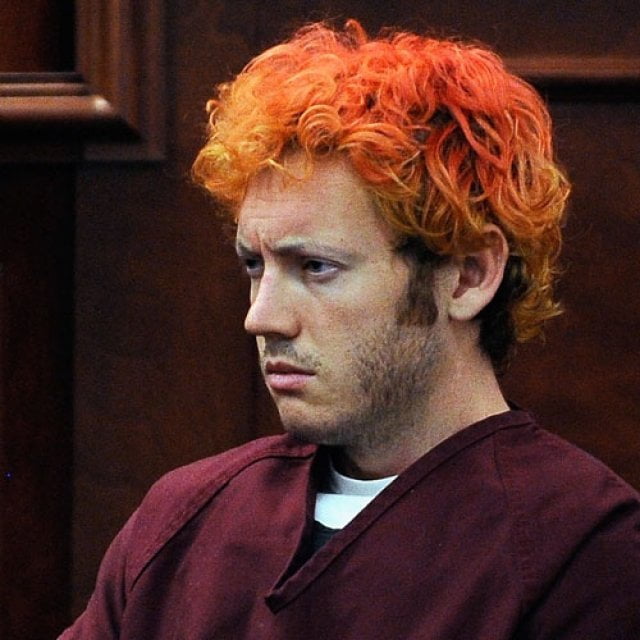
Last week’s shootings in Aurora, Colorado brought to mind the power of absurdity. Amid all the speculation regarding what motivated James Holmes to open fire on a crowd of moviegoers – killing 12 and injuring dozens – we can safely assume that there at least was a motivation or a reason. But it might not be something we can relate to, and in at least one sense, it will be absurd.

Much of the speculation as to Holmes’s potential motive is of course also absurd: from pastor Rick Warren’s claim (edit: he claims misinterpretation) that the teaching of evolution is somehow to blame, to the equally idiotic assertion that the killings are the result of the teachings of Christianity. Most if not all armchair psychologising about cases like this is little more than an opportunity for people on the sidelines to air their fears or prejudices.

Without speculating on his motives, then, we can still say that some set of deliberations led him to plan and execute this attack. And the narrative underpinning those deliberations would have been absurd, because whatever he thought the act would demonstrate, or whomever he thought it would punish, it would inevitably fall short of succeeding in its goals.

To wit: If he intended to kill people of a certain demographic or class, the quality of his targeting was clearly absurd, in that the victims were essentially chosen at random. If he meant to send a message, we’ve not yet been given to clue as to what it is, nor are we inclined to being persuaded by messages delivered in such a fashion.

The only long-term effect on the world from actions such as these is to inconvenience future cinemagoers, who will most likely soon have to pass through security checkpoints to get into the theatre. Minds won’t be changed, whether that of a lover or a god you intended to impress, or those of a set of politicians or bankers you wanted to chastise. In all these cases, the act and the motivation for it will be absurd.

And of course, a heavy price is paid for such a vanishingly small or nonexistent reward. This is the power of absurdity – we define the groups or ideologies we belong to abstractly, to the extent that our political or religious identities become unfalsifiable or irrefutable. Sometimes, we kill, fight and die for ideas, even those that we think will only manifest in an afterlife.

More broadly, communal commitment to the same set of beliefs, whether absurd or not, deepens trust and galvanises group solidarity. We demonstrate our commitment in our actions; and the more elaborate and apparently heartfelt those actions are the more convincing and persuasive they appear to an audience. This can in turn grow the audience or the community, in that they are attracted to the sincerity and solidarity they observe.

When the Pope washes the feet of worshippers, for example, the gesture is costly because it sacrifices power and ego. It’s intended to be a hard-to-fake symbol of commitment to higher powers, or to a shared set of beliefs – this is part of what makes those commitments or beliefs more likely to be adopted by an audience.

Holmes’s gesture was more costly. Clearly so in the case of those who were injured or lost their lives, as well as their families and friends, but also for Holmes himself, who faces certain loss of freedom in one form or another and even potential loss of life (capital punishment is legal in Colorado, even though the last death sentence was handed down in 1987, and then finally executed in 1997). It’s tempting, therefore, to speculate as to some grand motive, because the motive needs to be grand enough to allow us to reconcile these costs.

But perhaps the speculation is always more for our own comfort than anything else, given that you can’t explain the absurd. That is partly the point of these gestures and narratives – they are designed to be un-interpretable and outlandish, because that’s how they perform the task of separating “us” from “them”. We distinguish between cultures not only on the grounds of things like language, but also through ritual, and if the rituals are too easy to fake they become less useful tools for doing so.

To some extent, we now have what one might call universal religions or cultures – things like democracy, human rights and so forth – and various commitment devices that indicate our membership of these religions or cultures. As with all religions, costly gestures indicate greater commitment. If it is inconvenient for you to cast your vote, yet you still do so, you’ll appear to care more for democracy than someone who can’t be bothered to vote. If you spend 27 years in prison, you’ll appear to care even more.

We can’t yet know what religion, culture, or identity Holmes was demonstrating commitment to, and perhaps we never will. Perhaps he was doing nothing of the sort, and we’ll later discover that this (ex) PhD student in neuroscience should himself be a case-study of a certain sort of brain abnormality which predicts this behaviour better than any speculations as to his hypothetical beliefs could do.

Or, more worryingly for those who’d like to take comfort in a narrative – any narrative – that might bring something resembling sense to this tragedy, events like this could simply be a reminder that those universal religions many of us take for granted aren’t yet as firmly rooted in modern cultures as we’d like to believe, and that there’s still plenty of work to be done.

The Cologne ruling on religious circumcision

Originally published in Daily Maverick

In June this year, a court in the German city of Cologne heard a case involving a four-year-old child from a Muslim family who was admitted to hospital with bleeding following a circumcision. The doctor who performed the circumcision did so at the request of the boy’s parents, and was acquitted of the charge of grievous bodily harm for this reason.

While this particular doctor was acquitted, the court made the general observation that circumcision violated a child’s “fundamental right to bodily integrity”, and that this right outweighed the rights of parents. While leaving room for circumcision to be permissible on medical grounds, the court, in other words, ruled that ritual circumcision amounts to impermissible bodily harm and also constituted a violation of the rights of children.

Contrary to the predictable cries of anti-Semitism that have resulted (and how convenient it is for critics that a German court made the ruling), this is a victory for freedom of religion. Yes, one element of one ritual is outlawed, namely that parents can no longer choose to cut flesh from the penis of their non-consenting child. But why should they ever have had that “right”?

The argument that religion, custom and culture – in and of themselves – are insufficient justification for a practice applies across the board, not simply to examples of such practices that are more anachronistic, bizarre or unfashionable than the ones that happen to still be mainstream in modern societies. We wouldn’t endorse foot-binding on grounds of culture, and we certainly don’t endorse female genital cutting.

Foot-binding would of course not be possible at a later age, or it would at least be far less effective. But you can be circumcised at any age, once you determine that you independently desire to identify with a certain culture or religion. That should be a choice, and not the choice of the parents – this is surely what freedom of religion means. An infant might have Muslim or Jewish parents, but we should wait to hear from the child itself before performing irreversible surgery on them.

Informed consent is a fundamental principle of modern medicine. Exceptions do of course exist, such as when consent cannot be given for whatever reason, and an intervention is held to have significant benefits for the patient. But it’s only contingently the case that we happen to accept male circumcision as exempt from this principle – it has a weight of history and privilege (the privilege that is accorded to religion generally) behind it.

If we were to instead engage in the thought experiment of enquiring whether – in the absence of that history and privilege – male circumcision would be considered permissible, the conversation would revolve around costs and benefits, and whether any benefits could be accrued at lower costs.

In the case of female genital mutilation, the answer is clear – the costs far outweigh very dubious benefits. In general, it’s therefore not very useful or justified to compare that practice with male circumcision (except as examples of cultural artefacts, as I do above. Or, if we were to follow the Jewish scholar Maimonides, we might think them comparable in that both are aimed at a “decrease in sexual intercourse and a weakening of the organ in question, so that this activity be diminished and the organ be in as quiet a state as possible”).

For male circumcision, the fact that it comes at a small physical cost (relative to most instances of female circumcision) is presented as part of the justification for why it should be permissible. But any cost is too great, if it doesn’t come with benefits that can’t be accrued more cheaply. What we should not do is make the mistake of asking adult circumcised men whether they think harm was done to them. They’re not in a position to entertain any counterfactuals – both in terms of their physical state, and also because the majority of them would have grown up in a culture where male genital cutting was acceptable. It would be unsurprising that they found it unproblematic, as it would be just as normal as being uncircumcised would be to other men.

The point is that by that time, the opportunity for choice has passed. A non-religious child has had non-essential surgery performed on it by a religious parent, on the assumption that the child will eventually choose to belong to that religion. And of course, they are more likely to make that choice after having (non-volitionally) embraced the commitment-device of circumcision.

How much stronger would their commitment be, one wonders, if they instead choose to get circumcised as a teen or adult? If circumcision involves a sacred covenant with God, that covenant seems strengthened through being voluntary – and parents should not be free to make that covenant on behalf of their infant in cases where doing so involves cutting the infant’s flesh.

Religious parents in the 21st century are surely aware of these concerns, and do appear to struggle to justify what is at least a prima facie rights violation. So, they sometimes turn to information that wouldn’t have been available to Maimonides – the purported health benefits of circumcision. While it’s repeated so frequently as to seem axiomatic, the evidence that circumcision reduces HIV infection is not as clear-cut (pdf) as many think it is.

Likewise, the claim that circumcision reduces cervical cancer is also more suspect than many realise, as the reported headline findings give little indication as to the dearth of quality data underlying those findings. The key trial held to justify that conclusion is a meta-analysis of 7 different studies in 5 countries, where none of the individual studies found any correlation between circumcision and cervical cancer.

That’s not necessarily a problem, as meta-analyses can sometimes reveal data that isn’t clear in individual trials. In this case, though, the meta-analysis only revealed a correlation with human papillomavirus (HPV), a factor in the development of around 90% of cases of cervical cancer. But while HPV is almost always a factor in cervical cancer, it doesn’t necessarily lead to cervical cancer.

You can of course show that it tends to do so, but note that we’re talking about two degrees of separation from circumcision here, so establishing a sufficiently strong correlation (to even suspect that there might be causation) between circumcision and cervical cancer would require a mountain of data. Instead, what we have in this meta-analysis  is a relatively small sample (for the control group), a suspect methodology, and virtually no controlling for other cervical cancer risk-factors, such as smoking or poverty.

In other words, the evidence of benefits from circumcision is not entirely clear. And against these possible benefits, we also need to weigh costs – for example, the cost of reduced penile sensitivity. Or, perhaps the cost of increased rather than decreased HIV infection, seeing as the South African National Communication Survey on HIV/AIDS in 2009 found that 15% of adults thought that circumcision eliminated the need to use condoms.

I don’t necessarily think that all ethical dilemmas can be resolved by empirical evidence, even if many of them can be. But even if circumcision does come with the benefits of reducing HIV infection or instances of cervical cancer, there’s no obstacle to men of a sexually-active age choosing to be circumcised. If the data were clear I’d happily endorse their doing so, because it’s sensible to reduce risk where possible, and where the reduction comes at an acceptable cost.

But it should be a choice. And while surgical interventions can sometimes be approved by someone other than the patient, this should never be the case for non-essential surgery. So to my mind, the Cologne court made what is unquestionably the correct decision on health grounds, and one which also happens to protect freedom of religion. That is, the freedom of the infant to later choose a religion, or to choose to not have one.

Also worth reading:
Religion is no excuse for mutilating your baby’s penis, by Brian D. Earp

And here’s a lunatic rant from Brendan O’Neill:
The rebranding of circumcision as ‘child abuse’ echoes the ugly anti-Semitism of medieval Europe

Religious Public Holidays in a “secular” state

Originally published in the Daily Maverick

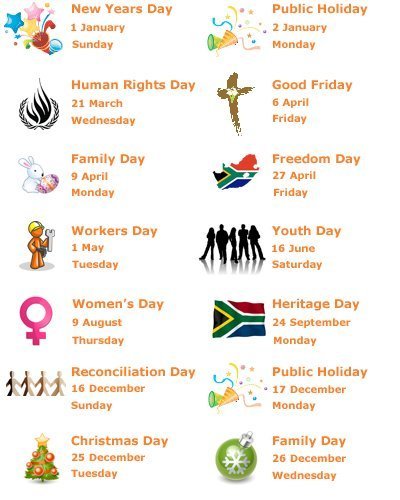
The commission with the improbably long name (more formally known as the Commission for the Promotion and Protection of the Rights of Cultural, Religious and Linguistic Communities, or CRL) is currently holding public hearings on South Africa’s calendar. Following the receipt of four complaints from members of the public, the CRL has set out to determine the extent to which religious bias informs which Public Holidays we get to enjoy, and which we don’t.

On the one hand, the debate seems easy to resolve. We’re not officially a Christian country, so on the face of it, having Good Friday and Christmas Day as 2 of the 12 Public Holidays is surely discriminatory, in that it privileges one religion over others. If you include Family Day – surely Easter Monday in all but name – a full quarter of the holidays are Christian, and none represent other faiths.

If this discrimination is thought unmerited or wrongful, we’d have two options. We could try to represent all faiths, or we could resolve to represent none. Then, it is of course also possible to argue that the discrimination is warranted, seeing as roughly three-quarters of South Africans claim to be Christian.

You might not expect to hear this from an atheist, but I’m rather sympathetic to the claim that it’s not unfairly discriminatory to allocate 2 of the 12 public holidays to the Christian faith. Religion, per se, does not justify public holidays, even if your religion regards certain days as holy. But sometimes tradition, history or heritage does seem to do so, when it can plausibly be argued to represent a significant majority of a population.

In the case of South Africa, three-quarters of the country appear to self-identify as Christian, and therefore three quarters of the country happen to regard the same days as holy. Seeing as many of them won’t be showing up for work on those days in any event, it seems to make perfect economic and moral sense to recognise that day as special. For most of the country, in other words, it is indeed special.

Not recognising those days as special could simply mean that additional (non-official) public holidays would result. If these two (perhaps 3) days are indeed the most holy days in the year for Christians, a possible alternative is of course to let people choose to take these days as part of 12 holiday days everyone is entitled to, on days of their choosing. But why create the logistical nightmare of forcing this large community to co-ordinate their holidays in this way?

Second, if all holidays are a matter of choice, it’s not only the co-ordination of them between family, friends and communities that’s an issue – we might also suspect that some people would end up getting no public holidays at all. It’s one thing for an employer to pressure someone to work on an official Public Holiday – easier still would be for an employer to keep refusing to allow someone to take any self-designated day off. Having 12 pre-identified days makes everyone’s planning easier, and makes it more difficult for employers to exploit their staff.

So however we resolve the public holiday debate, giving everyone 12 days off – on days of their own choosing – seems the worst possible choice we could make. Our alternatives, as mentioned above, are to include all religions or to include none. Including all of them is clearly out of the question, unless by “all” we mean some limited set, rather than all. Deciding on who gets to be included in that limited set would require some discrimination, though, and seems to get us back to square one – who gets to decide which religions are privileged, and why?

If, as suggested above, making these decisions is premised on popularity, then we should bear in mind that we might sometimes need to revise which public holidays are celebrated and which not. If South Africa eventually becomes a majority Muslim or Jewish country, for example, the holidays should change accordingly. This is perhaps the main issue: such a revision will be unpopular and divisive, and therefore unlikely to occur.

So we might want to consider the discrimination to be unjustified, and resolve that public holidays need to be entirely detached from religious holy days. Then, the days would never need changing and would be selected on a more principled basis. They could be arranged in such a way that the impact on the work week – and the economy – is minimised. Public holidays in the middle of the week invariably result in absenteeism on adjacent days, and this problem could be resolved by stipulating holidays on “the third Monday of June”, for example, rather than on a fixed date.

As indicated earlier, though, arguments that the current arrangements are discriminatory (coming from both other faiths and nonbelievers) seem to my mind overstated. Discrimination is not always wrong, though it’s easy to understand a non-Christian religious person feeling more aggrieved in this case, seeing as to all intents and purposes, having two Christian days recognised where no other faith has a day does appear to present Christianity as the de facto national religion.

Debating this issue on the grounds of discrimination seems to result in more heat than light. We’re becoming a nation of complainers, always on the lookout for who is abusing our dignity or denying some putative right. If there is a slight to other faiths and no faith here, it’s a minor one. But if we are to consider whether the current public holidays are the right ones, there are serious issues to debate – most importantly how we can derive maximum public benefit at lowest cost to the economy. Let’s hope the Commission takes the opportunity to consider those issues, rather than being exclusively concerned with religious (and non-religious) sensitivities.

Little evidence of integrity at the Film and Publications Board

As submitted to the Daily Maverick

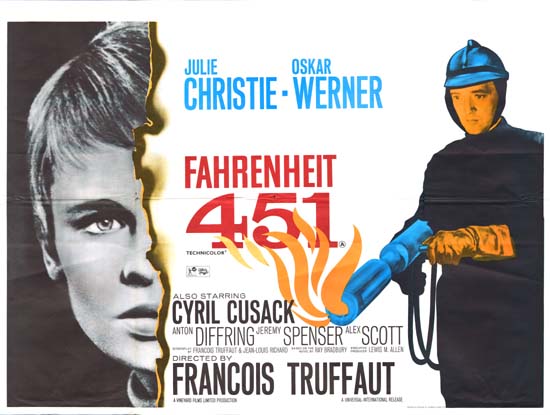
When the Minister of Higher Education calls for a painting to be “destroyed for good”, it’s difficult to not be reminded of Ray Bradbury’s “Fahrenheit 451”. In case you’re unfamiliar with the book, the title describes the temperature at which paper auto-ignites, and the plot addresses the burning of books as a method for suppressing dissenting ideas.

Framed as a method of thought-control, the destruction or censorship of paintings and books should horrify all of us who hope to live in a free society. So instead of framing it in those terms, why not instead make a case based on “protecting the children”? After all, who but a moral monster would be opposed to protecting children?

This is not yet another column about Zuma’s Spear, but rather an attempt to highlight the creeping threat to liberty exemplified in Nzimande’s statement about The Spear, as well as the Film and Publication Board’s (FPB) decision to classify (images of) the painting as 16N. That the former hasn’t attracted significant outrage is a surprise, because even though Nzimande might well have been speaking as the leader of the Communist Party, he also happens to be the man who oversees the country’s higher education system.

As one of the thousands of academics whose professional lives are influenced by this man’s judgement, I have cause to be concerned about a statement like this. As do all of us, not simply through being invested in the country’s future, but because it’s a stark distillation of the level of cynical manipulation of voters that some in the ruling party are willing to deploy. It’s not simply inappropriate for a Minister of Education to call for the destruction of artworks – it’s a complete abrogation of his responsibilities.

But seeing as those he reports to happen to be sympathetic to that view, we should of course expect no censure, apology or retraction. Meanwhile, if the FPB could have their way, images of Murray’s painting would be scrubbed from the Internet lest some under-16 (or sensitive adult) happens to come across it. The danger is of course real, in the sense that a Google search for “South African art” might well highlight the offensive image in question.

The FPB will be engaging with Internet service providers and search engines to “enforce this decision going forward”, which could well mean the dusting off of the Internet and Cell Phone Pornography Bill, Malusi Gigaba’s plan to enforce the moral standards of a few right-wing Christian organisations on all of us. One of the organisations consulted in the drafting of that Bill was the Family Policy Institute (FPI), headed by Errol Naidoo.

You might remember Naidoo from his call to boycott Woolworths for their decision to take Christian magazines off their newsstands (the profitability of a private company obviously being subservient to Naidoo’s interpretation of God’s wishes). Or, perhaps you’d recall his involvement in blocking both Multichoice and TopTV from screening adult content.

But in case all of those campaigns happen to coincide with your preferences, we’re also talking about the person who called the Civil Unions Act a “grossly negligent act of Parliament”, and whose monthly newsletters rarely fail to mention the immoral and unnatural scourge of homosexuality, and the complicity of the “liberal media” in obscuring the imminent downfall of civilization that will be precipitated by consenting adults in their bedrooms.

The reason Naidoo and the FPI are relevant to the discussion around the FPB’s decision to classify The Spear is that the FPB statement laments the “suggestions made that have sought to question the integrity and independence of the FPB”. I’d hope that in this instance, integrity would include being guided by the spirit and letter of the Bill of Rights in matters such as freedom of sexual preference and orientation.

But this hope seems somewhat unfounded when you look at the FPB’s website. On their home page, you’ll find a sidebar element headed “Useful Links” – but you’ll only find one link there, and that link is to the Family Policy Institute. In case my objection is not entirely clear, I’m not making the claim that religion (or Christianity in particular) can have nothing useful to say in matters of morality or in decisions regarding what children should be exposed to.

The claim is instead that the FBP is endorsing an organisation, and a man, who is a proud homophobe, and who has repeatedly demonstrated that his views on sexuality in general seem to be plucked straight from the pages of Leviticus. To describe this link as “useful” seems somewhat at odds with integrity, at least as I understand it.

Perhaps there’s a more innocent explanation, namely that the FPB has no idea who or what they are endorsing. If this is the case, we have no less cause to question their competence in effectively performing the task of deciding what to classify and how to do so. Incompetence – at least from the perspective of those who wish to view artworks or movies – is hardly more reassuring than significant lapses in judgement.

So it’s not just that the FPB have made a ruling that’s likely to survive even internal appeal processes, never mind court challenges. The issue is also that the chilling of free speech or artistic expression can happen by degrees, and can be disguised by the motivation of “protecting the children”. Because, framed in those terms, who would dare complain? If you do complain – at least once protecting the children is understood in the terms of folk like Naidoo – you might as well confess to being a paedophile.

Finally: recognition as a ‘homosexual activist’

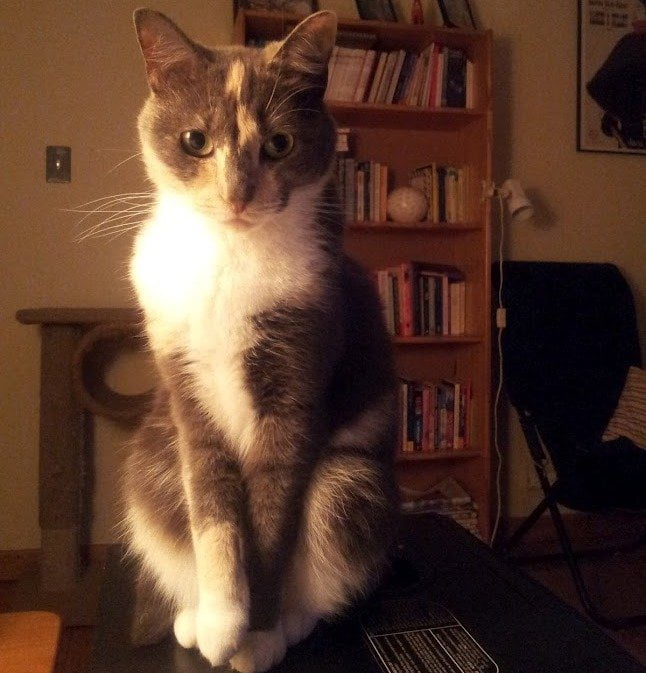
Thank you, thank you. I wouldn’t be here without the help and support of my cats, Mogwai (pictured), Mr Jones and Mot. I must of course also thank the Family Policy Institute, and particularly its leader, Errol Naidoo, for bestowing this honour on me. The reason for Errol bestowing this honour on me is at this stage slightly ambiguous, but for the sake of argument, let’s assume he means “homosexual activist” in both possible senses. Here’s an extract from his latest emailed newsletter:

Homosexual activist, Jacques Rosseau [sic] has slammed the Film & Publication Board for its association with Family Policy Institute. Apparently, my work to protect children from exposure to porn on TV and the internet is considered “censorship” a crime worse than the social degradation of children.

While I’m grateful, Errol, I do need to point out a couple of problems with the reasoning of your selection committee in bestowing this honour on me. First, it’s not quite true that I’m a “homosexual activist” – instead, I try to be an activist against idiocy of various forms, but particularly the sorts of idiocy that results in discrimination. Yours, for example. But also gender or racial discrimination, or giving one particular religious viewpoint undue attention when it comes to deciding on matters of public policy.

Second, the most important reason for mentioning you in that column was to say that the Film and Publications Board shouldn’t be endorsing homophobes. As a state body, you’d think they had a duty to respect the provisions related to equality in the Constitution. So, when some religious creep (not all religious folks count here) calls homosexual behaviour unnatural and immoral, and threatening to “the family” (the families that homosexuals are in don’t count, of course), you’d think they should distance themselves from you. But no – you’re listed as a “useful link” on their website (but without any text saying something along the lines of “This link is useful if you want to know what a bigot looks like”).

Third, I’m fully in support of protecting “the children” from undue harm. But you’ve never (and nor has anyone else) demonstrated that the children will crack the two pin codes required to view porn late at night, nor that there is good reason to swallow your doomsday-ism about the harms that result from pornography in any case. The evidence is inconclusive, and until you can get God to talk to us herself, rather than through folk like yourself, I’ll rather not base public policy decisions on your say-so, thanks.

The rest of the newsletter consists of the usual self-congratulatory detail related to how he’s saving civilization through setting up urgent meetings to discuss stuff. Or sometimes, waiting to see if people are willing to meet with him:

I am waiting on confirmation to meet with the DG of Communications, Ms Rosey Sekese and the CEO of ICASA who are currently in Cape Town to discuss the urgent need to amend legislation to specifically prohibit pornography on TV and to install filters on the internet to block online porn.

It’s a good thing that not even any Christians I know take him, or his organisation, seriously. Except, that’s not quite right: they do take him seriously to the extent that they see him as an embarrassment to their faith, and as very bad PR for Christianity in general. Replace “faith” with “species” in the previous sentence, and the Christians and I are in full agreement.

(A pdf of the full newsletter, in case you want to read more. But there’s no good reason to.)

Errol Naidoo: remove religion as example of unfair discrimination from the Constitution

Errol Naidoo’s latest Family Policy Institute newsletter indicates quite a remarkable change of mind, at least if I’m correctly reading between the lines. In one section of it, he appears to be arguing that religion should not merit any special protection from discrimination under South Africa’s Bill of Rights. Here’s (part of) what he has to say:

There is a proposal to remove the ‘sexual orientation’ clause in the Constitution. This clause in the Bill of Rights serves only to provide homosexuals the power to demand special rights.

Homosexuals are protected as human beings in the Constitution like every other citizen. The sexual orientation clause provides special protections and privileges for their sexual preference and more importantly, provides legal sanction to penalise anyone who disagree with their lifestyle.

The clause in question (9.3) reads as follows:

The state may not unfairly discriminate directly or indirectly against anyone on one or more grounds, including race, gender, sex, pregnancy, marital status, ethnic or social origin, colour, sexual orientation, age, disability, religion, conscience, belief, culture, language and birth.

So, following Naidoo’s logic, if the “sexual orientation” clause only exists to “provide homosexuals the power to demand special rights”, it’s surely also the case that this is true for the “religion” clause (and all the others), and he’d have section 9.3 read something like “The state may not unfairly discriminate directly of indirectly against anyone”.

This might be the first, and only, time that I can say he’s on to something which isn’t completely crazy…

Thinking fast and slow

As submitted to Daily Maverick

Two quite peculiar experiences stand out after returning from the Global Atheist Convention, held in Melbourne earlier this month. The first was at the instigation of Sam Harris, who guided the roughly 4000 atheists present in a session of mindfulness meditation. The second was watching our news cycle (or rather, social media commentary on it) from afar and at 8 hours remove.

The latter experience had the effect of highlighting the perception that little seems to change – that the same people kept saying the same things and the same entrenched positions kept leading to the same misinterpretations and squabbles. But in light of the quite alien – and for some, alienating – exercise in mindfulness, I couldn’t help but wonder whether we can do better and if so, how we’d go about it.

Harris’s talk was about death. The inevitability of death, and the absence of some sort of way of cheating it via an immortal soul, was used as a vehicle to ask us to reflect on wasted time and effort. We sometimes appear to live as if we might be immortal, deferring important decisions to quit smoking or patch up some relationship.

More crucially, some of us could be accused of not realising the full implications of our mortality – if this is the only life we have, it falls to us to improve our world, and we’ve neither unlimited time nor supernatural help to do so. An obvious, yet powerful, comment made by Harris was that it’s quite likely that many of us will spend our last months or years in regret for what we failed to achieve – but that being able to anticipate this regret seems to have little motivational force in the present.

The disjunction between thoughts of mortality and the significance of life, versus noticing that South Africans were again, and still, talking about whether Cape Town was racist or whether respect for cultural norms precluded criticism of polygamy was quite stark. I’m not suggesting that these conversations are unimportant. I’m rather observing that in having these conversations nobody ever seems to change their minds, or admit that they don’t have a well-justified position. And the debates never seem to take place with a greater degree of mutual understanding than in their previous iterations.

Part of the problem might be that we forget how young we are, and therefore how little experience we have of making sense of each other. While modern humans originated around 200 000 years ago, most of us still lived as nomadic hunter-gatherers until around 10 000 years ago, when agriculture started allowing for the formation of permanent settlements, trade, cooperation and the formation of complex societies.

If you start the clock those 200 000 years ago, we’ve only lived in societies for 5% of our existence, and in complex societies for less than 2%. The skills most useful for flourishing during the other 95% of our history aren’t equally useful today, yet they continue to determine many of our responses to modern challenges. Essentially, we’re pattern-making creatures, who survived through being able to do things like predict the movements of animals and the changes of seasons. We look for structure, and we’re so well-trained and efficient at this that it happens without thinking – and perhaps often in ways that are entirely inappropriate to a more complex modern world.

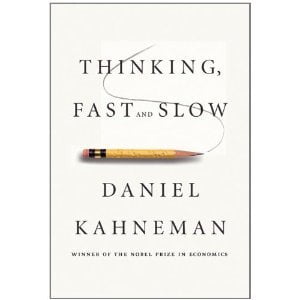
Daniel Kahneman’s recent book Thinking fast and slow details many of the ways in which our cognitive habits let us down through placing undue weight on surface over substance. He refers to System 1 and System 2 thinking to explain this, where System 1 sees patterns, and generates an “obvious” (and time-saving) answer.

But this answer is often wrong, because it’s mostly designed by humans who lived during that other 95% of our existence, and not by us. We need to remind ourselves to think more slowly and to be suspicious of the first, intuitive response. System 2 isn’t as easily fooled by misleading patterns because it’s a more careful judge of available evidence rather than impressions, and we can force it into action simply by being a little more patient and a little more cautious.

Besides reminding ourselves to think a little slower, I’d also suggest that there’s room for improvement in the way we talk. Tallyrand said that “language was invented so that people could conceal their thoughts from each other”, and while that might often be true, it also seems true that our language often serves to preclude rather than encourage debate, whether through the use of lazy, stereotypical categories or through moralistic outrage.

If we want to get better at understanding ourselves and cooperating to improve our world, we need to realise that we constantly make mistakes. Not only mistakes related to particular choices, but mistakes that involve how we choose, because they’re a feature of how we think. And we perhaps give too little thought to training the mind versus simply acquiring information.

This was the point of the meditation exercise described above. As Harris pointed out, while most accounts of practices such as these are contaminated by metaphysics, that shouldn’t prevent us from recognising that it’s possible for us to weigh evidence less subjectively and to do a better job of distinguishing between the significant battles and the petty squabbles.

A joke sometimes told about philosophers is that we’re inclined to say things like “we know it’s possible in practice, but is it possible in principle?” While watching the Groundhog Day-debates take place from my hotel room in Melbourne, I couldn’t shake the feeling that sometimes our principles seem immune to revision, regardless of the evidence. And that maybe, we should start by throwing them away – or at least by remembering that they are products of brains that were evolved to cope with a different world to the one we actually live in.

Brief thoughts on the Global Atheist Convention (#atheistcon)

Earlier today I completed the seemingly endless sequence of flights that brought me back from the Global Atheist Convention, held over this past weekend in Melbourne. Both a feeling of being distinctly sleep-deprived and/or jet-lagged, as well as the fact that I need to write up and reflect on the notes I took during various presentations, mean that all I’d like to offer now are some very general impressions. First, Melbourne was quite charming – well-worth a visit if you get a chance.

But while a large amount of time was spent sitting in the sun eating and drinking with fellow heathens, the conference was what we were all there for. On the whole, it was a great event – certainly the best such gathering that I’ve been to, partly because of the great line-up of speakers, and also because of the organisation. There were no parallel sessions, so you could attend everything, and timekeeping was meticulous (well, except for the fact that some people in post-talk Q&A should have been given far less time, or no time at all in some cases. Like the guy who asked why it is that evolution hasn’t resulted in a brain that’s larger than the universe).

Of the 4000 in attendance, you’ll no doubt find dispute as to what the highlights and disappointments were. One thing I found to be a weaker element was the proportion of time set aside for comedy, where a fair amount of this comedy was geared at the ridicule of religion. Now I don’t mind that per se, but at a conference billed as a “celebration of reason”, it didn’t always seem appropriate to pluck the low-hanging fruits of religious absurdity. In fact, one of the highlights was the contribution made by the one theologian (Marion Maddox) who participated in the official events – she came across as far more strongly in support of secularism in education than the atheists on that panel. Another problem with the comedy was that some of it – Jim Jefferies in particular – didn’t quite manage the balancing act between provocation and offence in his jokes involving gender.

Peter Singer was also disappointing. He gave what amounted to an overview of Steven Pinker’s new book on the decline of violence in modern civilizations. It seemed a lucid and comprehensive overview of Pinker’s book (I haven’t read the book yet), but filled a slot in the programme that could perhaps have been better utilised through Singer presenting some of his own ideas. But the presentations that were good were very good, starting with a Dennett talk on free will on Thursday night (at the University of Melbourne, and not part of the official conference programme). Dennett did a great job of summarising the key elements of his compatibilist position, and it was somewhat of a pity that there wasn’t more discussion of this, especially in light of the new Harris book, and Harris’s explicit disagreement with Dennett on this topic.

In the main programme, I thought Dennett, Krauss and Harris the standout presentations, along with the “3 horsemen” panel, now with Ayaan Hirsi Ali added as a horsewoman (she was always meant to be part of the conversation that resulted in the 4 horsemen DVD, but had to withdraw at the last minute). Hopefully this will all appear on YouTube at some point, and I’ll certainly say more about these later on, once I’ve had a chance to read and think about my notes from those talks. Harris was probably the most provocative, and you can get a sense as to why I say that by reading Martin Pribble’s post about his talk. It was a thoughtful reflection on the inevitability of death and what that means for how we should live, but the thing that made a bunch of us feel rather weirded-out was the session of mindfulness meditation that he decided to get these 4000 atheists (and therefore probably skeptics too) to participate in.

And yes, these sorts of things easily give rise to accusations that we were indulging in some sort of “religious” gathering ourselves. This is also something I hope to write about later, including a confession that I was rather disappointed by the way some of our number responded to the Christian (on Saturday) and Muslim (on Sunday) protesters that gathered. Both of these groups of protesters said things they shouldn’t have – especially the Muslims with their “burn in hell” chants directed at Ali – but there were times when I thought the atheists crossed over from justified retorts into juvenile insult.

Lastly, I’d say there were many who felt deeply moved by the Hitchens tribute that was screened, and then also by the memories of Hitchens recounted by Dawkins and Krauss (especially the latter, as Krauss was a close friend of Hitch). The video of the tribute is below, and is well worth watching. In summary, I’m very glad to have been there, and to have met many great people – see you all again in two years.