The Lord also needs good PR

Church of England logoAn amusing Sunday outrage (not an outrage to equal Cecil the Lion or anything – just a little one) today stems from the three leading cinema chains in the UK refusing to flight an advertisement that features the Lord’s Prayer, on the grounds that it might cause offence.

You can read about the ad (and watch it) on the guardian’s website, but it’s not the ad itself that I want to talk about. My concern here is the Church’s motivation for trying to place the ad, and their reaction to the decision not to flight it. The reaction includes:

The church warned that the move could have a ‘chilling effect on free speech’ and said it was at a loss to understand the logic behind the decision.

The logic behind the decision is quite simple. Sections 2.1.3 and 2.2.2 of Digital Cinema Media’s advertising policy (pdf) read as follows:

To be approved, an Advertisement must:
2.1.3 not in the reasonable opinion of DCM constitute Political or Religious Advertising;

2.2 For the purposes of clause 2.1.3 above, Political or Religious Advertising means:
2.2.2 advertising which wholly or partly advertises any religion, faith or equivalent systems of belief (including any absence of belief)

In other words, the advertisement was always going to be rejected, until the relevant policy is amended. The Church of England might not have known this, but once it was communicated to them, they would clearly have no grounds for complaint regarding the decision (which, per 2.2.2, would also apply to atheist advertising).

They could think the policy wrong, or might find instances of it being applied inconsistently. But that isn’t what they are arguing. They are arguing that “the Lord’s Prayer is prayed by billions of people across the globe every day and in this country has been part of everyday life for centuries” – with the implication being that it can’t possibly be considered offensive.

I wouldn’t find it offensive to find myself watching an ad promoting prayer. Hell, sometimes it might end up being the best part of that day’s cinema experience. But it’s precisely to avoid having to cater for subjective notions of offence that Digital Cinema Media have made a blanket decision to avoid religious (and political) advertising.

But here’s the thing: the Church of England might also have been fully aware of the policy, and be leveraging this outrage for promotional purposes. After all, the guardian reports that “the advert is to promote a new Church of England website, JustPray.uk, encouraging people to pray”.

And what better way of getting great publicity for your website than to have it become a poster-child for a “chilling effect on free speech”?

Choosing to be silent | Being barred from speaking

we-realizeDuring the question-and-answer session following a talk on identity politics at the UCT Philosophy Society earlier this month, a student asked me if I agreed that outsiders to a particular cause should remain silent, in order to let those who are proximate to the issue express themselves.

My answer was, in short, that it’s not that simple. The suggestion – or sometimes, demand – that “outsiders” remain silent is not only sometimes incoherent in terms of how it defines insiders and outsiders, but also incoherent in how it can apply a very peculiar standard to what’s worth listening to and what is not.

In any area of knowledge, we accept that some people know more than others, but it’s rare that we disallow those without expertise to contribute or ask questions. In fact, doing so is part of the way in which they learn, and perhaps become experts themselves.

It would be irrational to say to a philosophy student, for example, that you can’t discuss logic until you’ve learned symbolic notation. Yet, this sort of contraint is sometimes applied in discussions on things like race and gender, where questions from persons who are not-X are declared out of order, because of their not-X’ness.

As I repeatedly emphasised, this is a separate issue from another important issue, namely that the not-X person should often choose to remain silent, because they know that they have dominated a conversation for too long, have set the terms of debate, and have themselves ruled the concerns of the X’s as out of order for as long as the X’s can remember.

To put this crisply: I can imagine that there are times where, for the sake of trying to eliminate historical biases, not-X’s should often shut up, perhaps even for a long time. Or, they should be very selective in terms of how they contribute to conversations.

This is a separate issue from their independent epistemic authority, though, and the device of shutting up is a strategy for getting to a situation where words and arguments can one day matter, rather than who is speaking mattering most of all.

At my university, I’ve heard of a few instances where people have not been allowed to speak because they are not X. That’s usually wrong, even if it’s sometimes right that they choose not to speak. The distinction is important, and is largely forgotten in these emotive debates.

I choose not to speak (publicly) on many of the things that go on at UCT, especially during the current political debates.

And I would be very reluctant to speak on what’s happening at other universities such Rhodes, Stellenbosch, or Wits, exactly because I see how misinformed outsider comment on UCT is – a criticism extending even to some of the more thoughtful commentators in South Africa.

Choosing not to speak can also extend to being careful of what you say, of course – it’s far too often the case that a joke or idle observation gets taken up by people whose politics you don’t support, because they assume you’re on their side.

For example, when I tweeted about this story of Khoisan activists being arrested for smashing a bench, it was to highlight the fact that the bench should in all likelihood never have been built and that, more to the point, the aggrieved parties were probably never consulted on how best to honour the person the bench was meant to honour.

Just like the Rhodes statue at UCT, we now realise it should never have been there in the first place – and any condemnation of action/activism against it has to acknowledge that as the instigating harm, regardless of what follows.

Predictably, the tweet resulted in people whining about destruction of public property, lack of respect for the rule of law and so forth.

Of course it’s in general wrong to destroy public (or private) property, and of course it’s in general right to respect the law.

But sometimes, the failure to do so isn’t the most important part of the story, and you demonstrate your lack of sympathy and understanding for what is the most important part of the story by focusing on that.

As I say, you should be allowed to do so. But it’s an entirely separate issue whether you should or should not choose to do so, and more of us should pay attention to the second issue, more of the time.


Virgin Active(ly) embracing incoherence

Virgin Active, the international chain of sports clubs, is in danger of having me boycott them by no longer swiping my card three times a month before walking out (in order to preserve my nearly-free membership).

This is thanks to my outrage bemusement (although outrage is far more fashionable) at their incoherent response to a recent controversy at their Old Eds branch in Johannesburg, where a certain Mr Desai was told that he was not permitted to wear a T-shirt supporting the South African chapter of the Boycott Divestment and Sanctions (BDS) against Israel.

A number of Tweets poked fun at Virgin Active for their stance on this, but what I want to focus on is their press statement, which tells us that they want their clubs to be both neutral spaces and also ones that “accommod[ate] the rights and freedoms of all members”.

One of our freedoms in South Africa is freedom of expression, with the exception of speech that constitutes “propaganda for war; incitement of imminent violence; or advocacy of hatred that is based on race, ethnicity, gender or religion, and that constitutes incitement to cause harm”.

Regardless of how strongly you as reader might feel about who the biggest baddie is between Israel and Palestine, Mr Desai identifying himself as a supporter of the BDS movement does not entail meeting any of the listed grounds for restricting his speech.

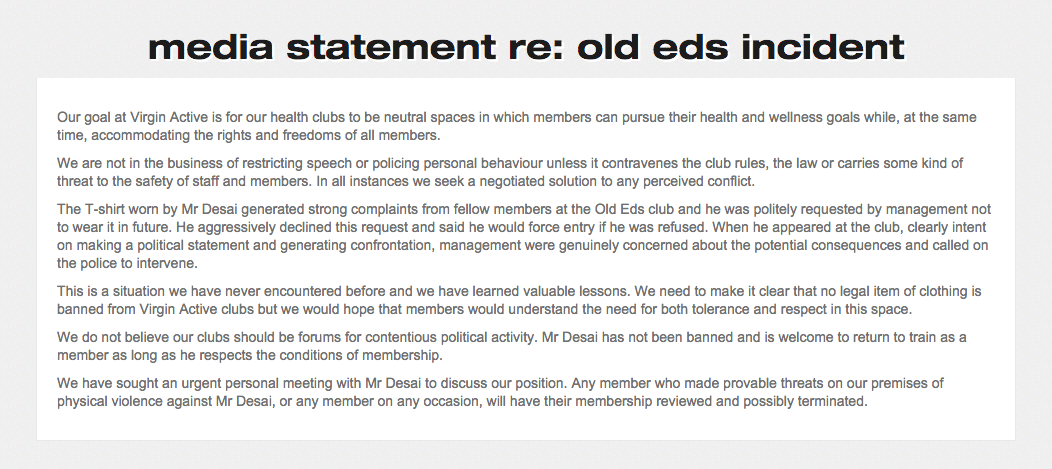
The Virgin Active media statement is screen-grabbed below, in case it gets taken down for some reason. But here are the bits I’d like to draw to your attention:

We are not in the business of restricting speech or policing personal behaviour unless it contravenes the club rules, the law or carries some kind of threat to the safety of staff and members. In all instances we seek a negotiated solution to any perceived conflict.

Lovely. So, as far as sentence one goes, why did you restrict Desai’s speech in this case? If you thought that there was an imminent threat to the “safety of staff and members”, that would surely only have come from people who decided to respond to Desai’s T-shirt with violence – and if they had done so, it would be the perpetrators of violence who should be ejected, seeing as that would presumably violate club rules.

The T-shirt worn by Mr Desai generated strong complaints from fellow members at the Old Eds club and he was politely requested by management not to wear it in future. He aggressively declined this request and said he would force entry if he was refused.

Sure, the complaints are understandable, and perhaps to be expected. And your response should be, “sorry, but he has a right to wear that T-shirt. You have the option of not looking in his direction, if you think that will help, but we have no grounds on which to refuse him permission to exercise.”

And, seeing as barring him from entry would surely be illegal, seeing as there are no club rules involving not wearing political T-shirts, I can understand Desai’s response regarding being barred entry in the future (although he’d of course likely be in trouble himself when “forcing entry”).

When he appeared at the club, clearly intent on making a political statement and generating confrontation, management were genuinely concerned about the potential consequences and called on the police to intervene.

Yes, a political statement that you in part initiated, by telling him that he had no freedom of speech in your club. And again, if confrontation was generated, it wouldn’t necessarily be him that was to blame – a price of admission to adult society is dealing with things that upset you without resorting to violence, and if someone attacked Desai, it’s the attacker who is at fault.

This is a situation we have never encountered before and we have learned valuable lessons. We need to make it clear that no legal item of clothing is banned from Virgin Active clubs but we would hope that members would understand the need for both tolerance and respect in this space.

Sure, it would be lovely if everyone played by your preferred (yet not legally proscribed) rules. But what if they don’t? In saying that no legal item of clothing is banned, you’re saying that Desai may wear the T-shirt. You might hope he doesn’t, but what if he doesn’t care about that hope?

We do not believe our clubs should be forums for contentious political activity. Mr Desai has not been banned and is welcome to return to train as a member as long as he respects the conditions of membership.

And the conditions of membership don’t involve not being able to wear a BDS T-shirt, right? So, what is it you’re saying? That he can wear it? In which case, why isn’t this press statement instead saying something like “we understand that Mr Desai’s T-shirt upset some of you. Sorry about that, but you’ll have to cope”.

We have sought an urgent personal meeting with Mr Desai to discuss our position. Any member who made provable threats on our premises of physical violence against Mr Desai, or any member on any occasion, will have their membership reviewed and possibly terminated.

Well, I hope that your position will emerge with a bit more clarity in that meeting than it does here. And I’m glad to hear you won’t let Mr Desai get beaten up in the meanwhile.

Postscript: Virgin Active have now conceded that they were in error to bar entry to Mr Desai.

Screen Shot 2015-08-14 at 11.24.44

TB Davie Memorial Academic Freedom Lecture 2015 – Kenan Malik

km11The University of Cape Town today welcomed Kenan Malik, who delivered the TB Davie Memorial Academic Freedom Lecture for 2015. As chair of the Academic Freedom Committee, I had the pleasure of welcoming him, and the text of my remarks is pasted below. I’ll link to the podcast of the lecture itself once it becomes available (here’s the transcript in the meanwhile).

Free speech in an age of identity politics – opening remarks

Three recent examples of disagreement regarding identity and its implications are: what is meant by transformation at UCT; what is meant by “black” or “white” in the Rachel Dolezal case; and how should we understand gender and sex, as in discussions sparked by Caitlin Jenner.

Two positions are commonly found when we disagree on issues such as these. First, you’d find a group of people who have borne the brunt of misunderstanding, mockery, prejudice and so forth. Second, you’ll find some who assert that the first group is poorly or incoherently defined, in that they are allied on grounds of purported identity alone, rather than shared arguments or ideas.

Regarding the first group, there’s no question that collectives of people – defined however they would like to define themselves – can mobilize around a shared conception of identity, finding courage, inspiration, ideas, or political heft through association.

And the second group can impede all those goals, often callously. It is surely beyond dispute that glib dismissals of these identities and their concerns can be used to silence, or to entrench existing power structures and so forth.

Consider the idea of “political correctness”, where those who deride the concept are sometimes largely interested either in being abusive, or simply in preserving their ideological positions. You don’t find a discriminated-against group complaining about “political correctness” as much as that complaint occurs amongst heterosexual white males, for example.

Over the weekend, you might have read about a programmer from New Zealand named Byron Clark, who devised a way to illustrate what some folk really mean when they talk about political correctness. He created a web browser script that automatically changed all mentions of the term “political correctness” to instead read “treating people with respect” – with the result that headlines might read “Donald Trump says that treating people with respect is getting out of control”, or somesuch.

But on the other side of the equation, politics premised on identity can also involve a suggestion or demand that those who don’t share the identity remain silent. This last week, in the debate on Amnesty International calling for the decriminalisation of sex work, certain interventions were ruled out of order not because they were necessarily uninformed, but because they came from rich white women, rather than from sex workers.

Of course, the interventions might also have been uninformed – but this feature could itself then serve as sufficient reason to reject them, rather than using the identity of the speaker to do so. In other words, some expressions of identity politics seem to entail that the identity of the speaker either confers – or diminishes – credibility as an independent feature, regardless of what they might be saying.

And yet, the liberal impulse of treating ideas according to their merits can be criticised for assuming the possibility of cultural and value-neutrality – and that possibility might well be a fiction, where it’s simply the case that one set of norms has become the default.

A related question is whether it is politically useful, rather than permissible – in terms of advancing whatever cause is at issue – for people outside of a particular identity to offer comment. If our answer is “no”, then we run the risk of silencing ideas that might be useful. If our answer is “yes”, the consequences would involve hearing at least some uninformed and prejudicial comment, but hopefully also some that adds value.

As a recent article in the New Yorker put it, Mill’s so-called marketplace of ideas is, “just like any other market, imperfect, and could … be improved by careful government intervention”, as in the case of hate speech. One concern raised by identity politics is that the marketplace is sufficiently distorted that not only do the historically advantaged get to define the terms of debate, but also what is worth debating, and that we might therefore want to recognise some self-imposed, socially constructed constraints on speech.

The question in short is: is the classic liberal position regarding free speech simply a way to legitimise existing power dynamics, or is it our best strategy for separating sense from nonsense, and learning which ideas are worth taking seriously?

These and related ideas are among the themes that Kenan Malik has been reflecting on in many of his columns, books, lectures and documentaries for over two decades now. He is the author of 6 books, including “From Fatwa to Jihad: The Rushdie Affair and its Legacy”, which was shortlisted for the 2010 Orwell Prize, and “Strange Fruit: Why Both Sides are Wrong in the Race Debate”, which was on the 2009 Royal Society Science Book Prize longlist. His latest book is The Quest for a Moral Compass: A Global History of Ethics, published last year.

His website, Pandaemonium, is not only a valuable archive of hundreds of thoughtful columns, but also a model of robust and fair debate, where Malik takes time to engage thoughfully with many of his readers – some of whom, as is typical with online comments, seem to have read an entirely different column to the one the author likely thought that they had written!

On Pandaemonium, he tells us that politically, he takes his cue from James Baldwin’s insistence that ‘Freedom is not something that anybody can be given. Freedom is something people take’, before going on to note how the Rushdie affair exposed the left’s partial abandonment of Enlightenment rationalism and secular universalism in favour of identity politics, and how as a result, much of his work is now in defence of free speech, secularism and scientific rationalism. Given his abiding interest in these issues, today’s lecture on Free Speech in the age of Identity Politics will no doubt provide plenty of food for thought and debate. Please join me in welcoming Kenan Malik to the University of Cape Town.

Identity politics, authority and freedom of speech

Originally published in Daily Maverick.

The University of Cape Town’s Academic Freedom Committee (AFC) hosts an annual lecture that explores issues related to academic freedom – the TB Davie Memorial Academic Freedom Lecture. TB Davie led the university as Vice-Chancellor from 1948 until his death in 1955, and is remembered as a fearless defender of academic freedom, including the autonomy of the university.

TB Davie defined academic freedom as the university’s right to determine who shall be taught, who shall teach, what shall be taught and how it should be taught, without regard to any criterion except academic merit. This definition is not without its detractors, with some arguing that the concept of “academic merit” is itself prone to embedding and perpetuating certain biases, in particular biases related to class and race.

Homophobia and free speech at UCT, redux

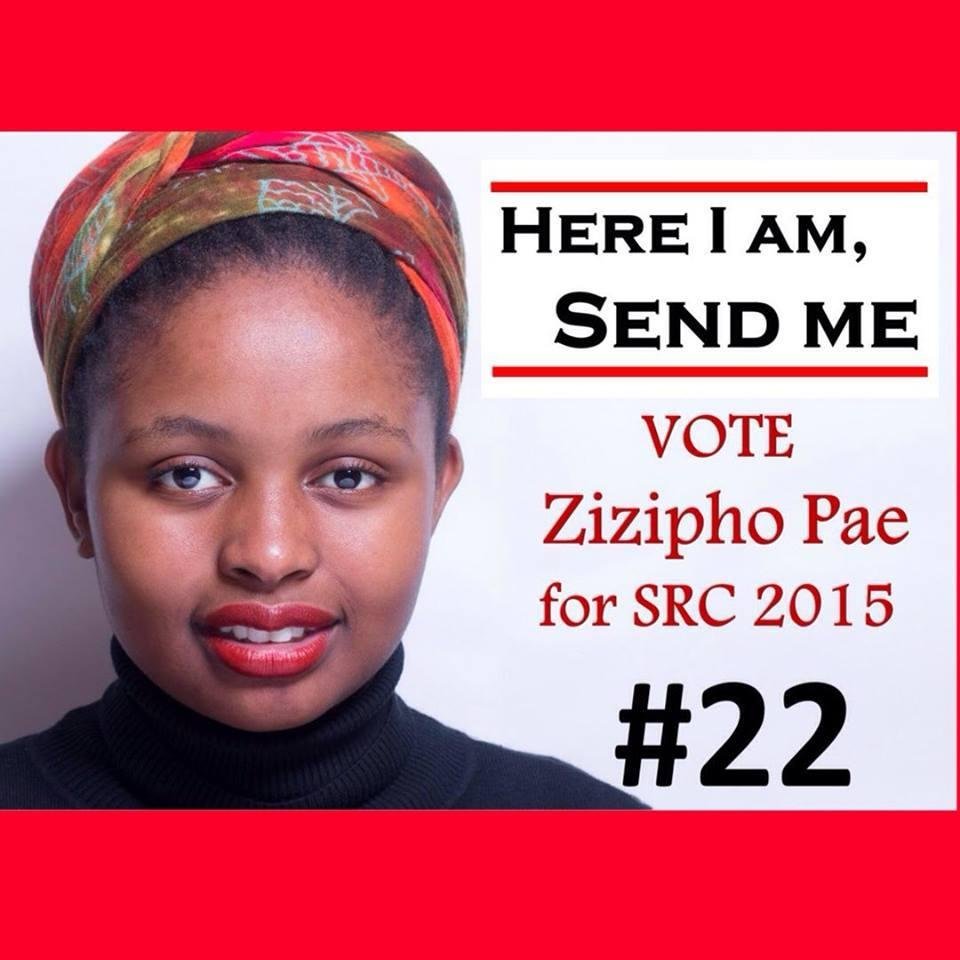
-t2zWl54The Vice-Chancellor of the University of Cape Town has responded to the controversy provoked by Zizipho Pae’s Facebook remark that legalising gay marriage was “normalising sin”, in a statement that attempts to balance sensitivity to LGBTQIA+ concerns while also affirming Pae’s rights to hold unpopular views.

My previous comments on this issue stand, but I’d like to add a few clarificatory comments. I agree entirely with Dr. Price that a key issue here is the legality of the Student Representative Council (SRC) decision to terminate her membership of the SRC, and also that the abuse and intimidation Pae experienced is inexcusable.

As Nathan Geffen wrote earlier today,

Should the extent of the hatred, misinformation, prejudice or ignorance disentitle the speaker from holding office?

In some cases it may. In others, there’s an opportunity to educate — both the speaker and the general public — rather than respond with fashionable social media fuelled outrage. The same goes for homophobia.

My argument last time was that it was entirely appropriate for the SRC to suspend Pae, pending discussion regarding her fitness to hold office, based on what the SRC constitution says and does not say.

I do not believe that holding homophobic views should automatically disqualify one from office – my claim is the limited one that if this contravenes established and documented values, then you are accountable in accordance with those values.

So, you’re free to be negatively disposed to gay people – but just not when this is associated with your position. This is not a free speech violation, but is instead a restriction on who is eligible to represent a community. The latter (being a SRC member) is not a right, but an earned position, and if that comes with certain requirements, you could rightly lose the position if you don’t fulfil the requirements.

From what I can tell from the SRC constitution and the minutes of the meeting that expelled her, I strongly doubt that her expulsion was legitimate, and I’d expect it to be overturned in time (although, this will likely be a pointless exercise, seeing as the SRC elections for 2016 are about to take place, with the current SRC coming to the end of their term).

Where I don’t agree with Dr. Price’s statement is where he quotes a 1998 Constitutional Court ruling which held that “those persons who for reasons of religious belief disagree with or condemn homosexual conduct are free to hold and articulate such beliefs”, going on to say that

This is especially so when a religious belief is articulated in a way that is not intended to insult, harm or discriminate, and if there is no incitement to taking harmful action against others. On our reading, Ms Pae’s Facebook post was an expression of her sincerely held religious belief, rather than an intervention to insult or hurt those with whom she disagrees.

Yes, they are free to hold and articulate those beliefs, but firstly (and again), not necessarily without consequences. As I say above, one such consequence could be expulsion, if the relevant laws/policies dictate that.

Should that consequence be expulsion? I don’t think so, as long as the person in question was appointed or elected with the rest of us being fully cognisant of their views, at least with regard to our set of ideal values.

So, if Pae campaigned on a platform that included opposition to gay rights, and was elected on that basis, I couldn’t have any complaints. Geffen’s post says that she didn’t hide her Christianity, but that’s a different matter to being openly anti LGBTQIA+ rights.

My view is that if you don’t disclose this, you can reasonably be expected to share the values expressed in various UCT documents, including SRC documents, that support those rights. Once it’s discovered that you don’t, the electorate might justifiably feel deceived, in that these are assumed to be shared values in the community (even if they aren’t actually shared in practice).

And finally, the notion of an expressed prejudice being more excusable if it stems from a “sincerely held religious belief”, rather than being something intended to “insult or hurt” isn’t helpful in this case – it simply passes the buck, and avoids tackling the difficult issue of what to do when people are “sincerely” bigoted, and with good intentions.

As Pierre de Vos noted in a recent column, religious beliefs and practices often get a free pass when it comes to discrimination. If allowing for discrimination based on religious views is a reasonable interpretation of the law, then I’d call the law defective in that regard.

We know, in advance, that some sincerely-held views (such as held by Pae) are not intended to insult or hurt. But we also know that they do insult and hurt.

Secularists (like me) are emphatic on the point that religious precepts should not be permissible premises in debates on policy or law. But more to the point, some of us who lack any belief in god(s) struggle to see any principled difference between your long-standing and scripturally-located version of “proper” marriage and sexual conduct, versus someone who chooses to locate their racist tirades in some long-standing tradition.

Or even, their polite, “sincerely held” racist beliefs, that are not intended to “insult or hurt” anyone, but merely to make things more efficient by letting people know what their proper place in the pecking order is.

Moderating or closing comment sections – the Independent Media Advisory Panel report

trollsWhile I would have wanted to submit comment to Independent Media’s panel on what to do about abusive speech on newspaper comment sections, I somehow missed the call for submissions.

Now that their report is out, and on the understanding that this is a continuing conversation, I’ve offered a few comments on the panel’s recommendations – and the underlying issues – below.

TheMediaOnline’s summary of the panel’s findings seems comprehensive and accurate enough to simply quote, instead of doing the work of summarising them myself:

  • In the interests of freedom of expression, it is desirable to host online comments
  • However, the constitutional rights of readers and members of the public should not be infringed by such comments
  • It would be preferable to moderate comments prior to their publication online
  • Online platforms should be staffed with suitably qualified personnel
  • If effective pre-moderation cannot be undertaken for any particular reason, Independent should consider closing its comments section
  • Independent Media should develop guidelines to define unacceptable speech, which take into account legal and ethical considerations, but should not amount to censorship of differing viewpoints

I’ll not be addressing those points sequentially, and might not even get around to addressing all of them. But the free speech issue is one that does have to be addressed, if only to emphasis an important distinction.

Free speech

A commitment to free expression makes it desirable, rather than necessary, to host online comments. In other words, even if you shut comments down entirely, you are not violating anyone’s right to free expression.

The right to free expression means that you’re not barred from saying something. It does not mean being required to provide you with the platform on which to say it. So, for as long as you can make your point on your own blog, Facebook, Twitter or wherever, your rights are not being violated.

Your opportunities are being circumscribed, yes, but a private entity like a media house has no legal or moral obligation to provide you with an opportunity to comment. In fact, an overall commitment to free expression might mean exactly barring some people from commenting, in the grounds that they provide a chilling effect on the comments of others.

A practical example: if you wanted to have a comment-section discussion on what it’s like to be black and poor in Cape Town, you’d naturally get fewer people who are black and poor commenting if you also allowed white racists to comment.

More problematically: you might also get fewer black and poor people commenting if you simply allowed rich people to comment, in that the target audience might feel some measure of alienation or of being typecast or misunderstood.

I use these examples not to recommend these sort of constraints on comment spaces, but in furtherance of the general point that specific restrictions on who can comment where might, in certain instances, enhance freedom overall. The point is that freedom of expression in the aggregate can sometimes be served by restricting limited instances of free expression.

Legality vs. tone/character

The right to free expression and the extent to which it is (or isn’t) violated is a separate matter from the tone or character of a website. As soon as you allow comments at all, you’re encouraging the formation of some sort of community, and with that comes goals as to what the character of that community should be.

What this means is that even if something is not legally proscribed, you might nevertheless want to prevent it from being said. The Independent report makes much play of the right to dignity in the Constitution, but I’d rather not rest on that, because even if you think the Constitution has it wrong on things like hate speech and dignity, you could still justify restrictions on some speech on your news portal.

You could justify them simply via wanting to have a certain level of discourse on your platform, where you hold characteristic X to be non-conducive to that. X could be excessive sarcasm, or whatever – for example, I didn’t publish a comment the other day simply because it was overly pedantic and argumentative, and added no value to the conversation.

What you choose to restrict and why will be a policy matter for each media house to decide on for themselves, and I make the points above to encourage them to be guided by more than just the law when they deliberate on these matters.

The value of comments

The high-minded rhetoric around why we have comments online (free expression, debate etc.) – at least when it comes from the media houses themselves – is only part of the story, and to my mind a very small part of it.

The value that comments have for them is that eyeballs return to their pages, either to watch the slow-motion car crash of someone being schooled or trolled in comments, or to join in the fun themselves. Either way, you’re on my page rather than a competitors, and ad revenue might increase as a result.

And (we need data here) I’m intuitively completely disbelieving of the idea that there will be a significant difference in traffic if you switch from live, unmoderated commenting to some system that involves comments being posted after a delay of some sort. Of course a delay of days might have an impact, but I doubt that 12 hours or less would.

What to do?

The panel’s report recommends pre-publication moderation, where a) the commenters identity is known to the publisher, even if the comment appears anonymously; b) word-filters flag any potentially offensive comments (for containing words likely to correlate with abusive comments); and c) editorial oversight, where “trained and qualified” editors check the comments before publication.

Step (c) is onerous, and unduly so in not taking advantage of existing mechanisms for knowing who is likely to abuse comment sections and who not. But before I get to the disagreement, let me say where I agree.

Identity: I’m a big fan of people “owning” their opinions, and taking responsibility for them. To put it simply, the fear of reputational harm is one of the ways we are kept in check, and keep each other in check.

So I’m supportive of using the “letter to the editor” sort of model where possible – use your real names, which need to be verified in some fashion, unless there’s some compelling reason why you can’t (where the editor must decide on the merits of that reason, remembering, as I said above, that you have no right to comment).

Word-filters: You’ll perhaps get lots of false-positives here, so sifting through the stuff that’s flagged might involve more work than is necessary. But besides this potentially adding unnecessary overhead, I have no principled issue with it.

Editorial oversight: Making this the norm will be far too expensive and time-consuming (of course related issues, but manifesting as two separate problems). It would also be unnecessary, as we already have ways to crowdsource information regarding who can (in general) be trusted to not abuse comment sections.

For example, here on Synapses I use Disqus, as does IOL, Daily Maverick and the Mail&Guardian. I’ve set each post up with fully moderated comments, but I do have the option of specifying that any given commenter be automatically published without going into moderation.

Any of us who dip our toes into comment spaces online know the names of some regulars. Those regulars who are not abusive can be approved pre-publication. Yes, it will take some time and work to determine who is given this privilege, but in the long-run, it would save having to look at their comments each time.

Of course, you’d want some sort of policy for granting this privilege – say, for example, 5 non-abusive comments gives you that status, and the understanding is that it gets stripped from you once you abuse it.

The level of moderation required to afford people the privilege described above is rudimentary – interns, student journalists in university courses, bored college kids etc. could all do it for a nominal fee, and at the same time flag potentially abusive comments for the attention of a “real” editor.

All of the benefits listed in section 7.2 (page 33) of the report can be enjoyed once you have established this sort of “database” of approved commenters. If you wanted to be more liberal about it, and save even more time, someone with a high reputation score on Disqus can automatically be green-lighted.

One could even consider database of trustworthy commenters, shared across media houses that use the same commenting platform.

And as I said above, if someone sins, you simply delete them – here again, the community can be of assistance, in flagging things for an editor’s attention.

The Charlie Hebdo murders

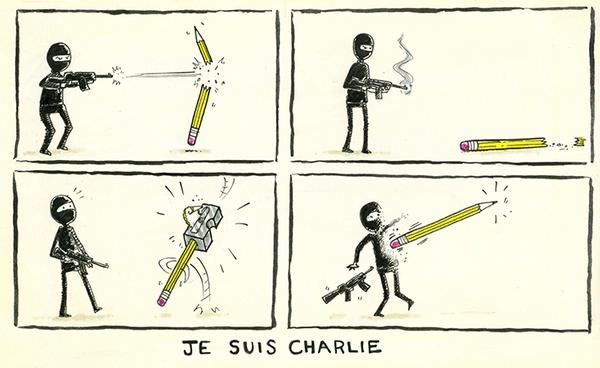
Yesterday, twelve people died for blasphemy.

Be clear about at least one thing: regardless of your views on religion, or on the role that Islam (or monotheism more generally) might play in generating intolerance and violence, nothing justifies murdering people for expressing offensive views.

Be clear on a second thing also: the fact that one is able and allowed to express offensive views is a necessary element of any society that wishes to be considered free, and we should all stand in support of the right to express such views.

James Walmesley - https://twitter.com/RteeFufkin/status/552937192252006400
James Walmesley – https://twitter.com/RteeFufkin/status/552937192252006400

I’ve said before that satire and blasphemy can be “a reminder to members of an identifiable social or religious group to get your house in order, so that there is no longer any need to mock or ridicule.” It serves a valuable role, and a role we should cherish. Joe Randazzo, previously editor of The Onion, is right to say that:

Satire must always accompany any free society. It is an absolute necessity. Even in the most repressive medieval kingdoms, they understood the need for the court jester, the one soul allowed to tell the truth through laughter. It is, in many ways, the most powerful form of free speech because it is aimed at those in power, or those whose ideas would spread hate. It is the canary in the coalmine, a cultural thermometer, and it always has to push, push, push the boundaries of society to see how much it’s grown.

Other issues are perhaps not as easy or unambiguous as we might prefer. For starters, the right to express a view doesn’t always mean it’s a good idea to do so. Take this Tweet from the President of American Atheists as an example:

He’s making a point, yes. I get that. He’s exercising his freedom to blaspheme, and he’s allowed to do so. But the blasphemy in that Tweet adopts a shotgun approach – it will offend all sorts of Muslims, from the ones who are inclined to kill people for blasphemy, all the way through to your next-door neighbour whose birthday party you might have attended a few days ago.

But as I’ve said many a time, these are strategic choices rather than issues of rights – he has the right, should have the right, and we should all defend the right to be as obnoxious as you like, even as we might not like what you say.

A final point, before handing over to a press statement I sent out yesterday in the name of the Free Society Institute. My first Tweet on the murders was to say this:

A predictable flurry of trolling resulted, with some even thinking that I was being an apologist for religious extremism. Apologies (not really) for complicating biases with these nuances, but my sentiment in no way denies that religion, and Islam, can play a causal role in generating violence such as this.

My point was that it’s a glib, and oftentimes lazy, inference to draw that it’s “religion” that causes these things. I would think it rare that religion per se makes you homicidal, but that instead, folk who are capable of such things will find religious inspiration for doing them.

If your religion allows you to be led to such barbarism, there’s barbarism in you to be exploited. That doesn’t mean that religion X (or ideology X) cannot be a causal factor in barbarism more often than religion or ideology Y.

To be clear: Islam should certainly bear some of the blame, in that if your religious texts or traditions are capable of inspiring people to do these barbaric things, they are in that respect toxic, and antithetical to liberty, flourishing and security.

The simple truth is that the gods could have been far clearer. Even if you’re religious, and want to assert that terrorists are misinterpreting the scriptures, you should be struck by the absurdity of your god not having chosen the simple path of saying: “hey there! While you’re having your arguments about what I want you to do and not do, remember that I don’t want you to kill, ever”.

Because she didn’t say that – or because she says things in a way that allows people to read her as saying the opposite, this is religion’s problem and religion’s fault, and people of faith can’t wash their hands of it.

And to a significant extent, they don’t. Which is why, as I said in the Tweet, the most important feature of yesterday’s killers is that they are killers, and not that they are Muslim.

The Free Society Institute stands with Charlie Hebdo and all defenders of free speech and civil liberty in condemning the murder of two police officers, three cartoonists, and eight journalists in Paris on January 7.

As offended as those of the Muslim faith might find blasphemy to be, that offence pales into insignificance compared to the brutality of Islamo-fascist terrorism such as this. Being offended does not grant one warrant for ending the lives of others.

The right to free speech does not, however, say anything about when it is wise to exercise that freedom or not.Neither does the fact that these terrorists were recorded as shouting “Allahu Akbar” and “We have avenged the prophet” during their attack tell us anything incontrovertible about Islam in general.

Tragedies such as these, that shock and confuse, can make easy answers attractive to us, in that they can lend themselves to stereotype and simplistic analysis. This is not the time for either of these.

Instead, this is the time for two simple things: to express our sympathy to all who are affected, and second, to recognise that we are all affected, in that freedom of speech is a cornerstone of civilised society, and is slightly more under threat to us all in the wake of the Charlie Hedbo attack.

Jacques Rousseau
Chairperson – Free Society Institute

Modern challenges with regard to free speech

Below, some notes on three concepts/arguments related to free speech – concepts that I think have become either more relevant (thus important to understand) or more complicated in the last 10 or so years (thanks in large part to the rapid uptake of social media like Twitter).

“Censorship” and the right to free speech

xkcd say pretty much what I’d want to, so let’s start with them (remember to read the mouseover text).
I can't remember where I heard this, but someone once said that defending a position by citing free speech is sort of the ultimate concession; you're saying that the most compelling thing you can say for your position is that it's not literally illegal to express.

Private citizens and companies are perfectly entitled to refuse to broadcast your opinions. It’s no violation of your rights that a comment section gets closed, or that your comment is deleted from a blog.

If someone were to refuse you permission to comment, or delete a comment, this might reveal various unpleasant things about their judgement or character. It might be capricious, it might be rude, it might be cowardly.

But they have a right to publish what they like, whether they make the right choices (in your estimation) or not. You don’t have a right to be published on other people’s platforms.

(On a related note, I suspect I’ll soon be shutting comments down here on Synapses simply because, besides a few reliable folk, there’s little of value that gets added there. If you have anything to say on that topic, this might be your chance to do so.)

Offence & sensitivities

Certain expressions are legally proscribed – here in South Africa, for example, hate speech is going to get you into trouble. If you’re reading this from elsewhere, you might have similar laws.

Those laws could be poorly drafted, and they could even be nonsensical (to you, in that you think that “hate speech” shouldn’t exist as a legal category of speech, or that it shouldn’t be punishable.)

Ignore that issue for the moment. The issue I want to highlight is that there are a range of utterances or ideas that could offend people or simply create discomfort without meeting the threshold for hate speech (or any other relevant legal category of speech).

A recent case was the cancelled Oxford debate on abortion, that was meant to feature Brendan O’Neill and Tim Stanley. You can read their perspective on the cancellation of the debate by following the links in this piece by the President of the Cambridge Union, and I’d also recommend reading Isabel Hardman’s piece, as she makes some of the good points that O’Neill makes, but less hyperbolically and without being Brendan O’Neill.

The issue here is – how can one avoid the slippery slope whereby any claims of offence or sensitivity eventually become grounds for not expressing a view, while still being compassionate towards people who have legitimate sensitivities on various topics?

The one end of the spectrum is the classic Liberal position of asserting that we’re improved by allowing ourselves to hear things that make you uncomfortable – the truth wins out, we develop better arguments against falsehoods, and we might get to “toughen up” along the way.

But these things are all easy to say from a position of intellectual and material comfort, and less so when you’re the threatened group. So, there’s serious room for compassion, especially for Humanists like me. However, there’s a tension between these goals, and it’s one that’s difficult to resolve.

The unfettered free speech argument doesn’t automatically get the win, in my view, because of issue #3, namely:

The corn-dealer’s house is right next-door

Many folk who defend free speech refer to J.S. Mill’s On Liberty, and rightly so, as it makes a superb case for when speech should and shouldn’t be restricted. But it was written in in 1869, and it’s possible that perfectly reasonable arguments for then are not entirely reasonable for now – or that, if they are, they lead to rather different policy conclusions than was the case for Mill’s time. Take this passage from Chapter 3:

An opinion that corn-dealers are starvers of the poor, or that private property is robbery, ought to be unmolested when simply circulated through the press, but may justly incur punishment when delivered orally to an excited mob assembled before the house of a corn-dealer, or when handed about among the same mob in the form of a placard.

There’s the problem in a nutshell: if you agree with Mill’s argument, give some thought to how we should implement the argument in terms of comment policies, Facebook and Twitter terms of use and the like.

Mill is talking about a mob of people who need to be riled up to the extent that they will set aside the time to make a plan, then congregate at someone’s house to protest. It takes serious affront to result in that sort of motivation, because you need to make an investment to lodge your protest.

Today, especially on something like Twitter, a ready-made mob of thousands can be assembled instantly. They might not even know you, or understand what you did “wrong”, because your misstep can get re-tweeted by someone influential, with everyone else simply jumping on a bandwagon.

Reading one abusive Tweet is no problem for most, but imagine reading hundreds of them, from people who would likely never have the courage to stand outside your door, shouting abuse as in Mill’s scenario above. If he thought that the mob outside your house should be controlled, and if you agree, should the social media mob also not be controlled?

An era of hysteria?

Briefly, and to quote myself:

if you train people to expect sensation instead of subtlety, you should shouldn’t be surprised if they keep expecting more of the same, and eventually, become capable of understanding nothing less.

On Thursday this week, Best Buy found themselves under social media fire for tweeting a joke that referenced Serial, the podcast that everyone (“literally!”) is listening to.

downloadFor those of you who are not part of that “everyone”, Serial is a journalistic treatment of a murder, involving interviews with suspects, with friends of the victim, and also site visits to relevant locations, etc.

The murder in question happened in 1999. It wasn’t Princess Diana who was murdered, but someone that had most likely slipped out of the memories of all but her family and friends in the 15 years since the murder – until Serial came along.

Best Buy referenced one element of the narrative, which was the possible use of a payphone in one of their Maryland stores. They said “We have everything you need. Except if you need a payphone. #Serial”. The outrage on Twitter let to the deletion of that tweet, and this apology:

This is absurd. I have no problem with people being offended, even sometimes outraged. But I do have a problem with what people are choosing to be offended and outraged by, and – mostly – by the extent to which they think anyone else should care about their feelings in cases like this.

If you were offended by the Best Buy tweet, I’d suggest you’re either a family member of friend of the deceased, or you have a pretty bizarre value-system. Corporates are allowed to make jokes, and a joke involving an element of a murder mystery from 15 years ago, and one which makes no reference to the people involved in that mystery – in other words disrespects none of them – should not be able to give rise to the offence it apparently did.

How do we stop this positive feedback loop of hyperbole and hysteria? I’m still of the view (as expressed in another older post) that at some point, a corporate brand, or a popular personal brand, will need to stand their ground and say “no, I don’t need to apologise for this. You’re over-reacting.”

Because each time we do succumb to the wishes of the most easily offended, the bar for what counts as an apology-worthy action gets set a little lower. I’m not a fan of gratuitous offence, but if we never allow ourselves to tolerate being offended at all, a dogmatic, inflexible, and rather entitled attitude towards our own beliefs and values wins the day.

In short, we’re wrong much of the time – or at least some of the time – and we’ll never know when that is, unless we let people tell us.