Emancipate yourself from mental snobbery

For many years, I have been a coffee snob. But my entitlement to this snobbery is somewhat questionable, seeing as it stems from a few years spent as a barrista, back in the early 90’s when nobody knew what a barrista was. We did roast our own coffee, though, so were at least marginally authentic. And I could make funky layered drinks, after all. Given that most SA restaurants still today serve a cup worse than the one you can make at home, I certainly felt entitled to some snobbery at the time.

And “the time” lasted for a good 15 years, long after I had desisted from making layered lattes, and had instead begun digging myself  into theoretical holes so deep you needed a heidegger[ref]borrowed from the (absolutely tremendous) novel 36 Arguments for the existence of God: A work of fiction, by Rebecca Goldstein (partner to Steven Pinker)[/ref] to get out of them. But the time is now over, as I have gone and done one of the things that make real coffee snobs roll their eyes, and sometimes snort in disgust.
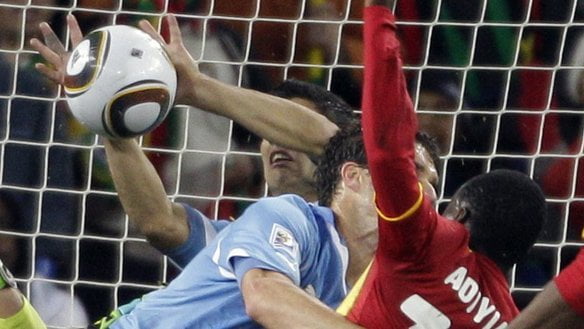
The hand of god, revisited.

Originally published in the Daily Maverick.

Uruguay’s Luis Suarez cheated in order for his team to beat Ghana in the Wold Cup quarter final. Of this there can be no doubt, for Suarez admitted as much in boasting that his was the new “hand of God”. There can also be no doubt that the referee did the right thing, according to the rules of the game. We can however doubt the rules themselves.

But there are some red herrings in the responses I’ve encountered to Suarez’s actions. First, it’s not obvious that he should be cast as a villain in this case. If we were being honest, many of us might admit that we would prefer that members of our own team sacrificed themselves in this way in similar situations. The rules of the game, as they currently stand, reward such sacrifices. If Siphiwe Tshabalala could have won South Africa the game against Uruguay by doing a Suarez, we might admire his honesty, yet perhaps regret it in equal measure.

Is Google making us stupid?

As submitted to The Daily Maverick.

It is not the Internet, or Google, that is making is stupid – it’s our brains. We’ve never been as smart as we’d like to think we are, and the current fashion of looking for reasons why we feel less clever than before partly amounts to a hope to find excuses – someone to blame – for our attention deficits.

It is of course true that there is more information available to us than ever before, and the amount of available information grows exponentially every day. But there has always been more information available than we can comfortably pay attention to, at least since Gutenberg made printed material available to the masses.

What changed are our cultural dispositions in terms of agency and blame – we used to understand that mastering a field took time and effort, and that work was required to filter signal from noise. Now, we blame the noise, even as we no longer invest the time and effort required for mastery of a field.

The vuvuzela discriminates against smokers

More on the vuvuzela, as submitted to The Daily Maverick.

Any claim made repeatedly does not become increasingly true in proportion to the number of repetitions. Yet, according to much of what you read on websites where the vuvuzela is discussed, it is now taken for granted that this musical instrument is “part of our culture”. Furthermore, one gets the impression that many believe it to be a long-standing part of our culture, such that its existence and continued use is beyond criticism. Attempts to raise questions about its cultural status – or more prosaically, about its value – are frequently deflected by accusations of “lacking gees” (on the civilised end of the debate), and of simple racism at the less civilised end.

Something being part of any given culture is, however, not a reason to regard that thing as being good. Instead, we should remember that things become part of cultures because people value them – whether we’d prefer they did so or not. Our culture has come to value democracy, because we regard democracy as having properties that are valuable to us. We don’t simply value democracy because we see it defended in the media every day (or at least, we shouldn’t). To value something simply through habit or programming is a prejudice, which puts it on the same epistemic level as sexism or racism.

The vuvuzela is cooking my gees

I suppose it was predictable enough, but I still can’t help being somewhat disappointed by the fact that the entire nation now appears to believe that the vuvuzela is “part of our culture”, and also that this somehow makes it a good thing. If it’s part of South African culture at all, it’s a relatively recent addition to that culture, with widespread use of it dating back only to the 90’s. Even it’s claimed “invention” by a Kaizer Chiefs fan occurred contemporaneously with the emergence of a similarly annoying trumpet at football games in Latin America – in other words, this is not something that South Africans have been using since Dingaan.

2010 FIFA World Cup guide, part 1

The original text of this column in The Daily Maverick

If you manage to steer clear of the earthquakes, festering animal corpses, and the hordes of disgruntled locals with machetes that the British tabloids warn of, welcome to South Africa. We hope that you will enjoy the FIFA World Cup, and that your favoured team will do well.

Unfortunately, the spectacle has already been somewhat diminished by the absence of some perennial sources of entertainment. In particular, Didier Drogba (assuming that he does not recover from injury in time) and Michael Ballack will be sorely missed. Drogba, mostly because there is no finer exponent of the dark arts of “simulation” (or diving, as it is more commonly known) – not even any member of the Italian team, who basically invented cheating in football.

Corporate Social Responsibility – what’s a company to do?

As published in The Daily Maverick.

KFC’s recent advertising campaign, based around their stated concern to rid Johannesburg streets of potholes, brought to mind Milton Friedman’s claim that “the business of business is business”. Although there is some dispute whether the phrase should be attributed to him, the idea that private companies are there only to make money (within the bounds of the law) has never met with universal agreement. Critics assert that the power which companies wield obliges them to demonstrate social commitment, for example via financial contributions towards pothole-repair. These purported obligations are backed up by policy and legislation, such as triple bottom-line reporting and the three King reports.

But we should always be wary of letting convention, as well as law, dictate our perceptions of what words such as hypocrisy, right and wrong, moral and immoral mean. The fact that we may prefer the world to look a certain way, and for companies and individuals to act in accordance with those preferences, does not mean that they are obliged to do so – or that they are morally negligent when they don’t.

Facebook only half as evil as you think

Most objections to Facebook’s alleged violations of our privacy are somewhat hysterical. Mostly because, instead of explaining

  • why privacy is necessarily inviolable
  • if it’s not inviolable, under what conditions can it be violated
  • what harms accrue from those alleged violations of privacy
  • why Facebook is to blame in any case

people choose to instead simply assert their interpretations of the above, trusting that we all share their indignation. They usually cannot offer arguments in support of their claims that Facebook is evil. And, what they mostly do is forget that they signed up for something called a social network, which is set up for the purposes of connecting people to those they know, might know, and might like to know. So with that as a premise of this service that you voluntarily subscribed to, any future objections to what Facebook does with your “personal” data need to throw a little sprinkling of caveat emptor into the rant.

Insecurity, and the certainty it spawns

As published in The Daily Maverick

The social lottery of seating arrangements at a recent wedding provided numerous examples of the strangeness of our species. The particular sort of strangeness that was most apparent was our desire or need to have an opinion, even in cases where nothing seems to be at stake, or where the opinion-holder stands no chance of affecting the relevant debate. Much conversation revolved around the equally strange South African political landscape, as one might expect, but there was no shortage of discussion around the British election, despite the fact that many attendees had only snippets from the newswires to draw on as evidence.

The honest Swazi nation

The Doctor and I are in Swaziland, attending the wedding of two good friends. It’s my second visit here, and it is no less alien to city-slickers the second time around. Mbabane, the capital city, has a “CBD” that seems to stretch out over many kilometers, encompassing such attractions as the “Mediterranean Restaurant” as well as derelict houses aplenty. And driving involves the skillful avoidance of a fair number of mangy dogs and cows. Everything looks like it needs a paint-job.