
I suppose it was predictable enough, but I still can’t help being somewhat disappointed by the fact that the entire nation now appears to believe that the vuvuzela is “part of our culture”, and also that this somehow makes it a good thing. If it’s part of South African culture at all, it’s a relatively recent addition to that culture, with widespread use of it dating back only to the 90’s. Even it’s claimed “invention” by a Kaizer Chiefs fan occurred contemporaneously with the emergence of a similarly annoying trumpet at football games in Latin America – in other words, this is not something that South Africans have been using since Dingaan.
Author: Jacques Rousseau
Jacques Rousseau teaches critical thinking and ethics at the University of Cape Town, South Africa, and is the founder and director of the Free Society Institute, a non-profit organisation promoting secular humanism and scientific reasoning.
The original text of this column in The Daily Maverick
If you manage to steer clear of the earthquakes, festering animal corpses, and the hordes of disgruntled locals with machetes that the British tabloids warn of, welcome to South Africa. We hope that you will enjoy the FIFA World Cup, and that your favoured team will do well.
Unfortunately, the spectacle has already been somewhat diminished by the absence of some perennial sources of entertainment. In particular, Didier Drogba (assuming that he does not recover from injury in time) and Michael Ballack will be sorely missed. Drogba, mostly because there is no finer exponent of the dark arts of “simulation” (or diving, as it is more commonly known) – not even any member of the Italian team, who basically invented cheating in football.
The original text of this article in The Daily Maverick.
Last Saturday, in an act of flagrant disregard for the faiths of others, Pastor Ray McCauley had planned to promote his brand by exploiting paranoia around tourist safety at the World Cup. Unfortunately for Pastor Ray, a heart attack meant that he could not attend. But while tickets for the “National Day of Prayer” for a safe World Cup might as well have been accompanied by homeopathic remedies for xenophobia (which would be equally effective), the event still raises questions. Firstly, why do we need his god to help out with policing those pesky foreigners and other threats to World Cup harmony, like Ivo Vegter? Is Ray saying that the other gods aren’t up to the task or even – sotto voce – that they may not exist?
The original text of this column, first published in Daily Maverick.
We all find something offensive. Many of us might prefer to live in a world which caters to our sensibilities, and limits how much offence we have to tolerate. I would like for everybody to be able to spell, for example, and also for most uses of quotation marks in advertising to be outlawed. Unfortunately, nobody seems willing to offer me any legal assistance towards achieving these outcomes.
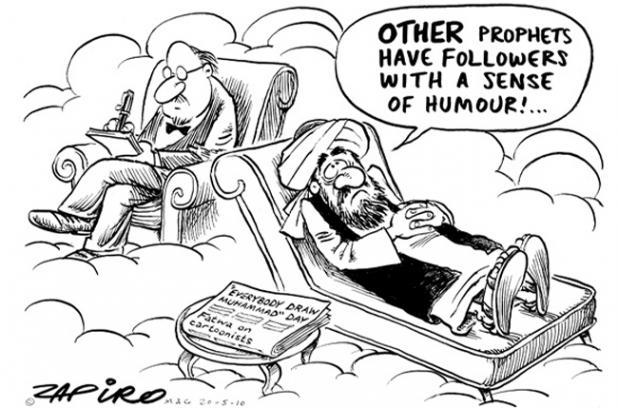
Jonathan Shapiro (a.k.a. Zapiro) is an equal opportunity offender – that is, if you like to think of what he does as offensive at all. There’s no doubt that some people have been, and are, offended by some of his cartoons, but that is a separate matter from whether they are in fact offensive, objectively speaking.
His role as a social critic and commentator leads him to sometimes poke at open wounds, yes, but almost always in a way that reveals the underlying prejudices that cause significantly more harm than any harms caused by the cartoons themselves.
The cartoons challenge their audience to reflect on whether their feelings of outrage are justified, and also whether others – like Zapiro – may be justified in feeling that there is something worth critiquing, challenging, and even sometimes mocking, in opinions and beliefs that we sometimes take far too seriously.

© 2010 Zapiro
Printed with permission from www.zapiro.com
For more Zapiro cartoons visit www.zapiro.com
Targets of his satire are drawn from a pool which has historically admitted just about anyone, and anything. If he has an axe to grind, that axe is most likely composed of inflated egos, undeserved reputations, malfeasance against the equal treatment and dignity of all – no matter how rich or poor, influential or invisible.
We should remember that critics of this sort, who offer a courageous perspective on current events, and try to point out details that we might be missing, serve an enormous public good. It’s very easy for all of us to end up with our heads buried in the sand, or stuck up our own (or another’s) backsides to the extent that we forget that our outrage may be ill-construed or illegitimate.
Today, Zapiro’s cartoon for the Mail & Guardian was the subject of a last-minute attempt to stifle press freedom. The Twitter feed of the unfolding events makes for interesting reading, in that Molana Bam’s primary argument appears to be the standard one where representations of Muhammad are concerned – namely, threats of violence.
Not directly, but nevertheless, the cartoon is a “threat to harmony”, and “stirs emotion”. A much larger threat to harmony, perhaps, is the struggle involved in reconciling Bronze Age beliefs with the modern world, and the curious tolerance that it requires those of us who try to govern our lives according to knowables. Tolerance, that is, of beliefs that are shared by fanatics who try to kill cartoonists and authors who represent aspects of that belief.
If you are a believer who is not inclined to fanatical – and criminal – action, you certainly should feel aggrieved when cartoons like this are published. But the cause of your aggrievement should be your less civilised brothers and sisters, who make such comment necessary – not those who make the comments.
The points made by Zapiro, as well as by past examples of this same issue, are a reminder to you to get your house in order, so that there is no longer any need to mock or ridicule.
You do this most effectively from the inside, by persuading people who take faith as a way to justify paedophilia, homophobia, oppression, murder, censorship and all sorts of other social ills that they have lost their way, and that surely a god worth taking seriously would not want you to do those things.
Two responses to the issue worth reading: Nic Dawes, Mail & Guardian Editor; Jordan Pickering (a Christian response).
As published in The Daily Maverick.
KFC’s recent advertising campaign, based around their stated concern to rid Johannesburg streets of potholes, brought to mind Milton Friedman’s claim that “the business of business is business”. Although there is some dispute whether the phrase should be attributed to him, the idea that private companies are there only to make money (within the bounds of the law) has never met with universal agreement. Critics assert that the power which companies wield obliges them to demonstrate social commitment, for example via financial contributions towards pothole-repair. These purported obligations are backed up by policy and legislation, such as triple bottom-line reporting and the three King reports.
But we should always be wary of letting convention, as well as law, dictate our perceptions of what words such as hypocrisy, right and wrong, moral and immoral mean. The fact that we may prefer the world to look a certain way, and for companies and individuals to act in accordance with those preferences, does not mean that they are obliged to do so – or that they are morally negligent when they don’t.
Most objections to Facebook’s alleged violations of our privacy are somewhat hysterical. Mostly because, instead of explaining
- why privacy is necessarily inviolable
- if it’s not inviolable, under what conditions can it be violated
- what harms accrue from those alleged violations of privacy
- why Facebook is to blame in any case
people choose to instead simply assert their interpretations of the above, trusting that we all share their indignation. They usually cannot offer arguments in support of their claims that Facebook is evil. And, what they mostly do is forget that they signed up for something called a social network, which is set up for the purposes of connecting people to those they know, might know, and might like to know. So with that as a premise of this service that you voluntarily subscribed to, any future objections to what Facebook does with your “personal” data need to throw a little sprinkling of caveat emptor into the rant.
The original text of this column in The Daily Maverick.
In 1968, the biologist Garret Hardin published “The Tragedy of the Commons”, a paper which argued for some unfortunate implications of the unrestricted exploitation of common resources. The primary example used by Hardin is a communal grazing pasture for cattle, where common use presents no problem until the maximum capacity of the pasture has been reached. After this point, overgrazing leads to the pasture becoming worthless to everyone, as it no longer has any capacity to provide food for the cattle. The problem, of course, is that each individual farmer is incentivised to maximise their own good. They therefore keep adding animals to the pasture, with little thought for the future, until the capacity is reached – thus ensuring the eventual destruction of the pasture.
The original text of my most recent column for The Daily Maverick:
As Opinionista Sipho Hlongwane reminded us on World Press Freedom Day, not only is the extent of press freedom a matter for debate, but much also still needs to be done in terms of bringing the benefits of a free press to most South Africans. This is not simply a matter of what goes unreported, or even of the potential stifling of a free press via intimidation of journalists or other forms of political interference. These are important concerns, but ones which presume an interest – as well as the ability – on the part of South Africans to equally engage with the issues discussed.
Our concerns should go deeper, in that for a developing country such as ours, the focus should perhaps more appropriately be on whether most South Africans have anything to say at all.
As published in The Daily Maverick
The social lottery of seating arrangements at a recent wedding provided numerous examples of the strangeness of our species. The particular sort of strangeness that was most apparent was our desire or need to have an opinion, even in cases where nothing seems to be at stake, or where the opinion-holder stands no chance of affecting the relevant debate. Much conversation revolved around the equally strange South African political landscape, as one might expect, but there was no shortage of discussion around the British election, despite the fact that many attendees had only snippets from the newswires to draw on as evidence.