Mandela, atheism and “borrowed interest”

flagAs I remarked in a post on the day after Mr. Mandela’s death, his value to South Africa (in particular) was in the unifying effect that his words, character and narrative offered to us. And while there’s certainly a risk of overdoing the praise-singing and mythologising when an important figure leaves us, it’s arguably more distasteful when such a figure becomes the subject of attempts to illegitimately bask in some reflected glory, through claiming some sort of kinship with them.

In asserting that Mr Mandela’s “atheism” is another reason to celebrate his life, The Freethinker magazine (and, presumably, those who, like Richard Dawkins, retweeted the story in question) seem to be exploiting what I’m told advertising types refer to as “borrowed interest”, but which you might know better as simple opportunistic exploitation of largely irrelevant details about someone’s life.

I say largely irrelevant, because Mandela’s role involved highlighting what we have in common, rather than our differences and antagonisms. If any of the labels we use to describe religion and related issues could fit, the one that would have the best chance would be humanism, because his relationship to the citizens of the world seemed to transcend the quite limited boundaries offered by religion and its explicit opponent, atheism. The focus in religion vs. atheism is on difference, rather than commonality, and hardly seems either a good fit or a fitting thing to bring up while people are still mourning Mandela’s death. It’s crass, and opportunistic.

Furthermore, it also seems largely a fabrication, or at least a fantasy, that he was an atheist at all. The “evidence” offered in The Freethinker consists solely of a birthday wish to Mandela from a South African atheist, urging Mandela to “come out” as an atheist. In another piece, it’s asserted that “the other [after Andrei Sakharov] great moral atheist leader of the 20th century was Nelson Mandela”, but we’re given no reason to believe this assertion to be true.

We do now know that Mandela was a member of the Communist Party, and some might therefore think it follows that he was an atheist. On the other hand, we do know that he was baptised as a Methodist, and we have Wikipedia quoting an interview with Mcebisi Skwatsha, in which Mandela apparently confirmed that he was a Methodist. In Mandela’s book Conversations with Myself, he says “I never abandoned my Christian beliefs”, and a comment on Pharyngula points to a CNN story, where it’s described how Mandela would regularly receive blessings from Chief Rabbi Cyril Harris.

Mandela also spoke at churches on a semi-regular basis, and in short, clearly seemed to have no antipathy to religion. Instead, his attitude to religion seems to have been exactly the right one for the leader of a nation to have – to hold it as a personal issue, and to devote himself to allowing others to exercise their religions, or lacks of religion, in the manner they see fit. In other words, regardless of what his personal beliefs were, he seems to have been fully committed to secularism in government.

When Christians or other religious folk try to claim deathbed conversions, there’s no shortage of voices pointing out how distasteful [it is] to “claim” people for one side or the other. It’s no less distasteful when atheists try to do the same. In this instance, exactly because of Mr Mandela’s apparent reluctance to choose sides in this matter, it’s perhaps even more distasteful than usual.

IHEU Freedom of Thought Report 2013

iheu-logo-2013On International Human Rights Day in 2012, the International Humanist and Ethical Union (IHEU) published their inaugural “Freedom of Thought Report”, which highlighted parts of the world in which being an atheist was at least sometimes inconvenient (thanks to legislation that privileged religion, for example), and often dangerous.  For the 2013 version of the report, coverage has been expanded to include every country on the planet, making this an invaluable resource for those who are seeking data on religious freedom, and in particular the freedom to not be religious.

There are some frightening places to be “found out” as an atheist. The report highlights that

  •  Atheists can face death sentences for apostasy in twelve states
  • In 39 countries the law mandates a prison sentence for blasphemy, including six western countries
  • The non-religious are discriminated against, or outright persecuted, in most countries of the world

For a snapshot view of where things are particularly bad, the IHEU has created an interactive map that offers a quick-read indicator of the situation in each country, but if you want to read how the indicators are justified, you’d need to download and read the full report. For South Africa, the IHEU reports that while we do have significant built-in safeguards for religious freedom, there is nevertheless “systemic discrimination” against the non-religious. As regular readers would know, I’ve often highlighted a lack of respect for the National Policy on Religion in Education (meant to keep public schools secular), as well as other more bizarre instances of religion being afforded too much respect, such as with the South African Police Service’s “Occult” investigative unit,

While there might be room to dispute the interpretations given in particular instances, what is of concern is the extent to which this sort of discrimination can be observed, and also the fact that it can be found in some parts of the world you might not expect. Four western countries earn a rating of “Severe”, thanks to legislation that allows for jailing people for blaspheming or disrespecting religion. To quote from the IHEU’s press release,

Those countries are Iceland (a sentence of jail for up to 3 months), Denmark (up to 4 months), New Zealand (up to a year), Poland (up to two years), Germany (up to three years) and Greece (up to three years). Jail time could be handed to someone who simply “blasphemes God” in the case of Greece, or “insults the content of other’s religious faith” in the case of Germany.

As the editor of the report, Bob Churchill, comments:

It may seem strange to see some of these countries up there with Uzbekistan or Ethiopia (also rated “Severe”) but as Kacem and Alber say in the preface, these laws set a trend.  Failure to abolish them in one place means they’re more likely to stay on the books in another place, where they can be disastrous. And even in the western countries with blasphemy-type laws there is evidence that they chill free expression, and in some countries, like Greece and Germany, people are actually prosecuted and convicted and do jail time under these laws.

I’ve remarked on many occasions that the freedom to blaspheme or to cause offence to those with strongly held religious sentiments is not a good reason for doing so. To have this freedom is important, yes, but we also say something about ourselves when we abuse freedoms such as these to cause gratuitous harm. Not all such harms are gratuitous – there is certainly room for causing religious offence, to remind the most sanctimonious adherents that nobody else is under an obligation to treat their god with any respect.

Yet, if we want to be treated with respect ourselves, these freedoms should be used responsibly. If a point can be made without blasphemy, for example, we should perhaps consider whether including the blasphemy adds enough value to make it worth the risk that you’ll not only be dismissed by your intended audience, but that you’ll also be contributing to bad public relations for atheists in general, but especially in your part of the world.

Blasphemy is only one issue, of course. Arguably of greater importance is the sort of discrimination that goes unnoticed, because it doesn’t attract the same kind of ire, and thus the same attention in the media. It’s evidence of systemic discrimination when your school, or your child’s school, has “a Christian character”, when your university textbook is overly religious, or when your public representatives in government seem more interested in pleasing gods than in doing right by the voters.

The IHEU highlights these and other issues worldwide, and offer us a great resource in this catalogue of discrimination against the non-religious, and something by which to measure progress, year-on-year. For comment from the IHEU, please see the contact details below. South African media are welcome to contact me for a local angle, if you plan on writing something about this.

FOR IHEU COMMENT:

Bob Churchill

Communications Officer
International Humanist and Ethical Union (IHEU)

Office: +44 207 490 8468 | Mobile: +44 7743 97 1937
Skype: bob.churchill | Twitter: @bobchurchill

Thinking Things Through (report-back)

For the interest of those of you who couldn’t attend the FSI conference last weekend, here’s a brief report-back on how the day unfolded. If you were able to attend, feel free to share your thoughts on how it went in comments.

FSI_confThe Free Society Institute (FSI) hopes to avoid the pitfalls of restrictive labels such as “atheist”, “freethinker”, “skeptic” and the like. Not only can those labels be politically problematic, in that they might cause otherwise sympathetic people to ignore what you might say, even before hearing it, but they are also ideologically loaded – people already have a sense of what they mean, and we don’t necessarily mean the same things by them.

Instead, the value proposition of the FSI is captured in the phrase “Thinking Things Through”, where the commitment to doing so will be expressed in thinking not only about religion (as with many atheist and agnostic organisations), but also about science, and social justice, and any other aspect of our lives that might benefit from discarding lazy stereotypes and instead, taking the time to think things (including our own beliefs) through.

This theme is what we intended to emphasise at the FSI’s third national conference (the previous two were held in 2009 and 2010, in Cape Town), held with the support of the International Ethical and Humanist Union (IHEU). This conference also served in part as a re-launch of the FSI, with the value proposition described above.

Our members are of course free to describe themselves as atheists, agnostics or some related term, but the FSI hopes to be an umbrella body for a broad coalition of people who care mostly for minimising the damage we can do to ourselves and society at large through believing things on the basis of poor evidence, whatever the content of those beliefs happens to be.

In short, the FSI is a South African non-profit organisation dedicated to promoting free speech, free thought and scientific reasoning. We are advocates for the values of secular humanism. The FSI hopes to help create a community, both virtual and physical, that collaborates in developing and distributing the knowledge and skills required to foster a free society.

A free society involves not only freedom from false beliefs, but also an environment in which it is easier to recognise and discard false beliefs, thanks to education, the free flow of information, the promotion of scientific literacy, and where possible, eliminating barriers to human flourishing (from the mundane examples such as misleading advertising, to the severe, such as oppressive laws).

2013 Conference: Thinking Things Through
The conference hoped to highlight the value that can be found in careful consideration of issues, and to highlight the costs associated with ignorance, for example in basic reasoning skills. In pursuit of this goal, we made sure to include presentations that spoke more broadly about these and related issues, rather than focusing on hackneyed debates regarding religion and its proper place in society. In fact, the only talk that dealt explicitly with religion was perhaps far more sympathetic to religion than many attendees would have preferred.

The speakers, in order of appearance

Conrad Koch (and occasionally, Chester Missing) was our MC for the day. Koch is a comedian and an anthropologist, while Missing is the star of the Emmy-nominated show, Late Night News, and the world’s most revolutionary puppet. The combination of these speakers and talents provided not only for raucous laughter, but also inspired some serious self-reflection among those present.

It was Koch (or Missing, I can’t recall) who asked some of the more pertinent questions of the day, including why so many of us in the audience were white, male, or both – and why secular humanism seemed to have such a demographically unrepresentative face in a country such as South Africa. International readers will know that this is a problem for all such organisations in just about every part of the world, but unless we’re made to think about it, our chances of remedying it are non-existent.

You can find Missing on Twitter at https://twitter.com/chestermissing

Cecilia Haak was the opening speaker, and offered a presentation titled “The Square Kilometre Array Telescope: Looking back in time”. Haak is eminently qualified to speak on this topic, given that she is currently an infrastructure engineer on the SKA project, working with the team that is building MeerKAT, precursor to the SKA, and the SKA radio telescope — which will be the world’s biggest. Haak was one of the contributors to the submission that secured South Africa the bulk of the hosting rights for the SKA.

Haak explained the significance and scope of the SKA project to a fascinated audience, describing what it is we hope the project will reveal to us in time. The implications for scientific research in South Africa were discussed in a very engaged question and answer session, where it became clear that the audience – even though arguably more informed on these matters than most – might have agreed with the sentiment that we could do with more (and, better) scientific journalism in South Africa. Later in the day, we would hear a presentation from Sarah Wild on exactly this issue.

You can find Haak on Twitter at https://twitter.com/ceciliahaak

David Spurrett, Professor of Philosophy at the University of KwaZulu-Natal, then presented a talk titled “Showing your working: Science, and the collaborative nature of good reasoning”. Spurrett is an active researcher in cognitive science (especially addiction and decision making), philosophy of cognitive science, and philosophy of science.

Spurrett described the method and value of scientific reasoning, emphasising that “it’s like common sense, but better”. In a highly engaging presentation, he used notable figures from the philosophy of science to make it clear how good scientific reasoning was within the average person’s ambit, and to illustrate various principles and strategies for improving our reasoning.

You can find Spurrett on Twitter at https://twitter.com/DoctorSpurt

Eusebius McKaiser, author, TV show host, and currently the host of Power Talk on PowerFM 98.7 was our next speaker. McKaiser is a widely published social commentator and political analyst, who previously studied law and philosophy at both Rhodes and Oxford. McKaiser’s talk was titled “The power of sloppy thinking: turns out Dawkins isn’t an atheist!”

The talk focused on the distinction between the labels “atheist” and “agnostic”, using Dawkins and “The God Delusion” as a springboard into that topic, rather than explicitly focusing on Dawkins himself. McKaiser’s ambition was to inspire the assembled atheists, in particular, to reflect on whether they were guilty of a similar sort of thoughtlessness as they sometimes accuse theists of, in claiming certainty in respect of things they could not be certain of.

You can find McKaiser on Twitter at https://twitter.com/eusebius

Sarah Wild, Science Editor at the Mail & Guardian, spoke next on “Spreading bad science”. The Mail & Guardian appointed Wild as Science Editor in 2013, making her one of only two dedicated science editors in the country (and lamentably, one of only 6 dedicated science journalists). Wild is the 2013 overall winner for the Pan-African Siemens Profile Awards for excellence in science journalism, and also the author of a book titled “Searching African Skies: The Square Kilometre Array and South Africa’s Quest to Hear the Songs of the Stars.”

Given her position at the Mail & Guardian, Wild was perfectly situated to inform this very receptive audience of the difficulties inherent in balancing what the public seem interested in (rather than “the public interest”) with comprehensive and informative communication about scientific research. As she pointed out, any political development always stands a good chance of bumping a science story out of that week’s newspaper, even though the political story might have far more fleeting significance.

You can find Wild on Twitter at https://twitter.com/sarahemilywild

Gareth Cliff, morning host on 5FM, judge on IdolsSA, City Press columnist, and the author of “Gareth Cliff on Everything” spoke to us next on “Sacred or profane: religion and the politics of offence”. Cliff is one of a small group of South Africans who reliably gets people talking, whether or not they agree with what he’s saying, and his presentation at Thinking Things Through was no exception.

Cliff’s presentation was very personal and honest, discussing his relationship with his radio listeners, the regulatory authorities, and generally, the sensitivities of audiences and how much they should be respected. Cliff did make it clear while the truth should never be the handmaiden of political correctness, there was nevertheless a strategic and emotional dimension to communication that could not be ignored.

You can find Cliff on Twitter at https://twitter.com/garethcliff

Jacques Rousseau, founder and chairperson of the Free Society Institute, gave the last presentation of the day, titled “Towards a Free Society: What do we do next?”. Rousseau lectures critical thinking and ethics at the University of Cape Town, South Africa. In 2009, he founded the FSI to promote secular humanism and scientific reasoning in South Africa.

Rousseau’s presentation sought to make the audience think about the large overlap in motivations and desires between religious and non-religious folk, and to ask them to consider whether we spend enough time thinking about similarities, rather than differences. Rousseau argued that the caricatured view many atheists seem to hold regarding religious folk was getting in the way of our recognising that it’s not usually religion that’s the problem, but rather poverty, in both an economic and an educational sense.

You can find Rousseau on Twitter at https://twitter.com/JacquesR

The day’s proceedings concluded with a panel discussion involving all the speakers except for Sarah Wild, who unfortunately had to leave before then. Barry Bateman, Pretoria correspondent for Eyewitness News, hosted the panel discussion, and the conversations he elicited from the speakers offered a very suitable end to an intellectually stimulating day.

You can find Bateman on Twitter at https://twitter.com/barrybateman

All the presentations were recorded, and will be uploaded to YouTube once editing has been completed and permissions obtained from the speakers. To be informed as to when the videos are released, keep an eye on the FSI homepage and/or the Twitter feed of the FSI Chairperson, @JacquesR .

Many thanks all the speakers, and to Anneleigh Jacobsen, Greg Andrews, @Dr_Rousseau and @Jonathan_Witt for some invaluable help behind the scenes. Thanks also to the @IHEU, for their financial support. If you attended, thanks for your support too!

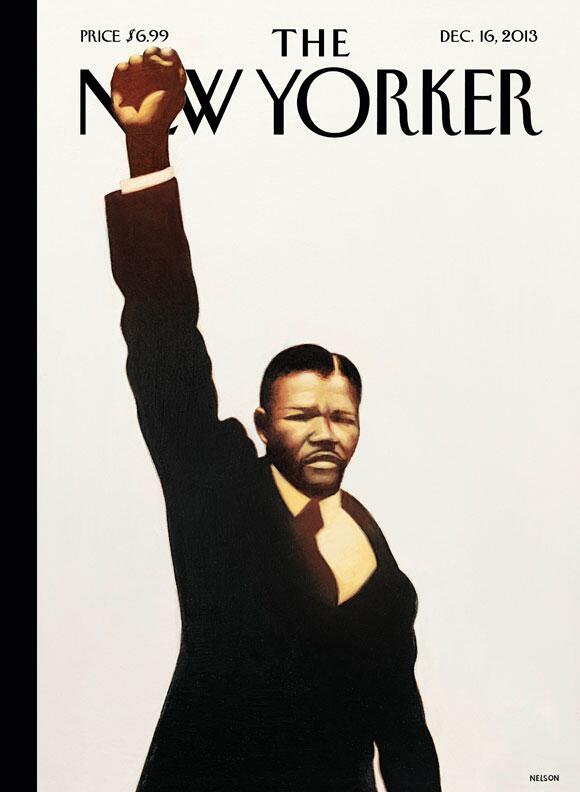
Hamba Kahle, President Mandela

NYorker cover

My friend Jonathan Faull has already written a piece that captures the significance of Mr. Mandela’s death for most of us South Africans, and for many elsewhere in the world, better than I’d be able to. As 6000 remarked, British audiences could perhaps contextualise this as “the equivalent of a hundred – a thousand – Dianas”. Commiserations to all who are feeling somewhat bereft, today and in the coming weeks.

My contribution is simply to briefly state that if you’re concerned about honouring Mandela’s memory, or making his life mean something beyond the significance already captured in history, then remember that the symbolic force he generated was all about understanding why we are in disagreement, and trying to find a way out of that disagreement. It was about reconciliation, and hope, and progress. He offered a genuine source of energy for moral courage, and for effecting change.

Regardless of the details of history, and whether you think certain factual details should be emphasised or de-emphasised, that’s the effect of Mandela the icon rather than Mandela the man. So when idiots like those at the Westboro Baptist Church (WBC) say that they will be coming to picket his funeral (Mandela supported gay marriage, thus will be in hell, thus WBC are happy), the last thing you should do in honouring Mandela is to threaten them with violence.

Some hyperventilating types from the tabloids and Twitter (often indistinguishable, I guess) are worried about the fate of SA now that Mandela is dead. But that’s bollocks – we’re in as good or bad shape as we were yesterday. We’ve been saying goodbye to Mandela for months if not years already, and besides, the South Africa he presided over is not the same one we have today.

Our success, or our failure, rests more in whether democrats (and generally, ethical voices) inside today’s ANC can rescue it from the likes of Jacob Zuma. Jacob Zuma is not my president. I’ve not had one since Mandela, but hopefully I’ll have one again, sometime soon. And if you want Mandela’s death to mean something, then consider using it as a motivation to think about what his life meant, and the legacy he left us, and then to buckle down and renew your efforts towards helping us achieve his vision.

Academic freedom in South Africa

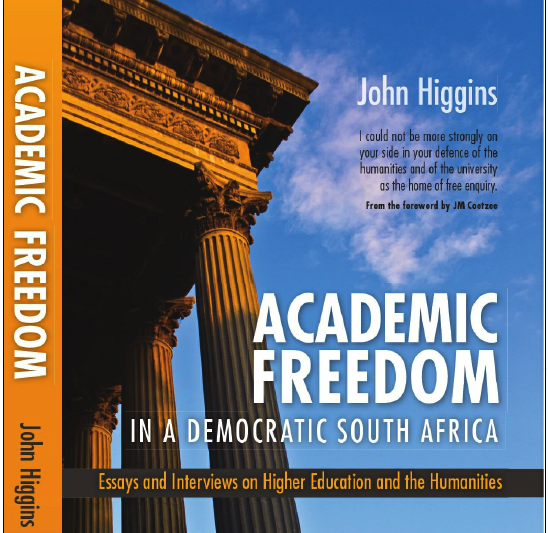
Higgins on academic freedomOn December 11, my University of Cape Town (UCT) colleague Prof John Higgins will be holding the Cape Town launch of his new book, “Academic Freedom in a Democratic South Africa” (click on the picture to enlarge and to get details). I’ll certainly be attending, both to support John (a friend) and also because it’s a subject of great interest to me.

In my capacity as chair of the Academic Freedom Committee at UCT, I was approached by a local journalist for comment on some issues raised in this book. Because only a sentence or two (if anything) might survive the editing process, here’s the full list of questions and my answers, for those of you interested in this topic.

1.Do you think academic freedom is under threat in South Africa?
There are certainly implicit threats to academic freedom, and also explicit ones such as the Higher Education and Training Laws Amendment Act.

2.If yes, kindly give us a few reasons to support your answer
Attempts to control the possession and dissemination of information as in the Protection of State Information Bill is an implicit threat, as is the occasionally hostile reaction of the State to uncomfortable questions being asked of it, for example regarding topics such as the arms deal or Nkandla. The South Africa public might itself present a different sort of threat, in that political and socio-economic preoccupations sometimes appear to create a distinctly anti-intellectual climate, where demands for “ideological purity” can intrude on academic activity. Then, legislation such as the Act – regardless of whether this is the intent or not – allow the Minister to subvert university autonomy for overly vague and broad reasons, thereby putting universities in a state of perpetual probation, hardly conducive to freedom.

3.Do you think that the ANC’s policies on higher education seek to subordinate universities’ important decision making to the policies of government?
Whether they seek to do so is one question, whether they will serve to do so quite another. Regardless of the intentions behind these policies – which some certainly seem to think sinister – the policies (the aforementioned Act, and also potentially the eventual scope and power of the Ministerial Oversight Committee on Transformation) could certainly serve to subvert university autonomy.

4.Does this amount to curtailing “academic Freedom?”.
The State has legitimate interests in the role and functioning of public universities, so the universities cannot demand that academic freedom be defined without any concern for those interests. But the way in which government has developed and seeks to implement these policies – often with little or no discussion or negotiation with the universities – does add up to an intrusion on academic freedom.

5.The ANC has clearly said it wants universities to churn graduates who are competent in dealing with a modern economy. In other words, universities suddenly become instruments to achieve certain policies of government. Does this pose a threat to academic freedom?
Yes, certainly. While the developmental needs of South Africa certainly merit a focus on, for example, STEM disciplines (Science, Technology, Engineering, Mathematics), this should not come at the expense of the long-term goal of producing strategic and creative thinkers of the sort that typically emerge from the liberal arts – history, philosophy and the like. A disproportionate focus on more practical fields might serve our interests in the short-run, but also serve to cripple academic enquiry and progress (and thus, freedom) in disciplines that are more esoteric.

6.Do you think the ANC’ s policies on higher education seek to control universities even more than what the National party did?
The comparison is unnecessary, and a distraction from the more important issue of whether the current government seeks to do so to a troublesome extent. This sort of comparison is perhaps emblematic of exactly the anti-intellectualism described earlier, in that keeping score in this way is good for headlines, rather than inspiring critical thought.

7.Do you think the Higher Education and Training Laws amendment Act is problematic for Academic Freedom? If yes, how so?
It could be problematic, depending on the extent to which the powers it allows for are used or abused. The Act makes it easier for government can place a university under administration, dissolving that university’s Council and assuming its powers. It sanctions more government intervention than is currently the case, and does so on grounds that are broad and poorly defined. We should have no objection to dysfunctional Councils being challenged or replaced, but if the Act allowing for this also allows, for example, Councils that aren’t “ideologically pure” to be replaced, then institutional autonomy and academic freedom are significantly threatened, and to an unacceptable degree. Further cause for concern regarding this Act is that key stakeholders, including Higher Education South Africa (Hesa), which represents the vice-chancellors and the Council on Higher Education (CHE) were not consulted in its drafting.

A manual for creating atheists

RNS-ATHEISTS-MANUALHaving just finished Peter Boghossian’s first book, A Manual for Creating Atheists, I must confess to jealousy in that it’s the most recent example of a book in the category of “books I wish I had written, and should have written, but didn’t buckle down and write”. I’d have picked a different title, but nevertheless – Boghossian’s book is a fine example of how to deploy the principles of good critical thinking towards effecting social and political change, in this case undermining epistemologies based on faith.
I was fortunate to be at The Amaz!ng Meeting (TAM) earlier this year, at which Boghossian spoke, and was at the time impressed by how he was able to distill some quite complex debates in epistemology into very succinct, and actionable, principles. Like him, I’ve spent the last 20-odd years teaching basic critical thinking to young students, and have sometimes struggled to find the language to convey what (from one end of the telescope) seem completely obvious ideas to students who appear completely mystified by both the grounds of – and the motivation for – cynicism around “knowledge” they take for granted.

Boghossian’s book does a great job in describing these contested ideas, and does so in a way that it very charitable to the political dimension of the different points of view – if I were a religious believer, I shouldn’t feel insulted by anything in his book, because it’s painstakingly fair, even when very critical. This is why I’m no big fan of the title – as Boghossian says somewhere in the text, atheism is a byproduct or happenstance result of clear thinking (and seeing as this is something I have said for a while, I reserve the right to wave my timestamped slides around, Pete!), so it’s slightly unfortunate for that, rather than the “street epistemology” the book so cogently argues for, to be highlighted.

In focusing on “street epistemology”. the book’s strength is on things that you and I can do to nudge (usually gently) those who believe strange and unwarranted things away from those beliefs, or more accurately, toward realising how they are applying quite different standards when it comes to the merits of those beliefs than they are to other beliefs they might hold, and why this is a problem.

Besides the content that deals with epistemology, argument and rhetoric, one of the strengths of Boghossian’s book is the sample dialogues he offers of (reconstructed, but real) dialogues he has had with people of faith, in which the virtues of his approach are made clear, and the value of this form of “street epistemology” are brought to life. Also of value to other teachers of philosophy to young students is a handy flowchart at the back of the book, that offers a guide for disabusing students of the relativistic urge – if I’d known how pervasive, and pernicious, that urge was going to be when I got into this all those years ago, I’d have bought the book just for that.

Regrettably, 20 years later, such a flowchart is still useful, perhaps even necessary. Thanks to books like Boghossian’s, this might not be the case another 20 years from now.

Moral hysteria as substitute for thought

Moral hysteria, and a culture of soundbites and headlines, can get in the way of seeing the merits of an alternative point of view, and perhaps changing our minds on an issue. The whole point of intellectual discourse, reading and writing is to discover where we might be wrong, and to change our minds (including sometimes turning to agnosticism) on particular issues where we seem to be wrong.

Instead, we mostly look for evidence that reinforces our existing view, and alarmingly, sometimes allow criticism or contrary evidence to serve to reinforce our existing belief (this mechanism is known as the “backfire effect”).

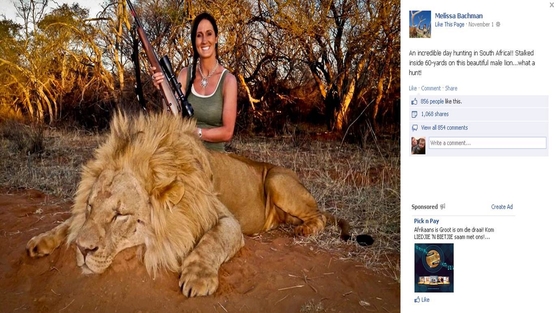
The case is that of Melissa Bachman, who has recently been the subject of large helpings of social media vitriol, including petitions directed at the South African government asking for her to be barred from entering the country in perpetuity. Bachman, in case you didn’t know, is a so-called “trophy killer” who recently shot and killed the lion pictured below.

BYtsMTsxIARCodg-556x313-noPad

Now, whatever you might think of hunting – or even eating meat – there’s absolutely no reason to think that she had done anything illegal, and therefore, anything that merited a request to bar her from the country in perpetuity. But that’s not what the petition is based on. Instead, it asserts that she should be barred from the country for being

an absolute contradiction to the culture of conservation, this country prides itself on. Her latest Facebook post features her with a lion she has just executed and murdered in our country.

The problem, of course, is that the “culture of conservation” operates within a legal framework, and that legal framework currently permits hunting, so long as the necessary licences have been obtained. If you’ve crossed your legal t’s, you can “execute and murder” (in case the execution fails, it’s good to have a backup plan) as many of the creatures you’ve been given permission to execute and murder.

The fact that you are photographed with the non-human animal that you’ve killed should not be regarded as morally salient. Critics have used emotive language such as “bloodthirsty” to describe Bachman’s hunting, even though there’s nothing that’s objectively more bloodthirsty about her photographing the lion that she has killed than there is my photographing of a particularly juicy and tender steak. I could post a steak picture every day for a month, and not be the subject of such a petition – even if I were to not give a damn about how humanely the cows (or whatever) were hunted, a concern that Bachman and other hunters might have, but be unable to reflect in a photograph.

Ivo Vegter, a former colleague at that fine online newspaper, the Daily Maverick, puts it well in the conclusion of his column “In defence of a lion killer“:

South Africa officially considers Bachman a welcome and valued visitor, and rightly so. Even if you disagree, and you arrogantly think you have the moral authority to judge her arrogance, the real story is this. Your smug superiority risks depriving South Africa of tourism revenue and employment. It risks depriving the country of much-needed funding for conservation. It risks reducing the value of our wildlife, which reduces the incentive for private farm owners to breed and protect game. Hypocritical anger is a greater threat to conservation than Bachman’s rifle will ever be.

I’d urge you to read his column, and some of the many comments to it. But in short, whether or not you are opposed to hunting, issues such as these are rarely simple. The vast majority of issues are, in fact, quite complicated. If you care about your country’s economy, you might need to (pragmatically) allow for hunting under certain conditions, for a certain time. If you care about the fate of a particular species, you might need to (pragmatically) allow for hunting under certain conditions, for a certain time. And so on.

The danger, of course, is that a pragmatic concession towards some ultimate goal can sometimes be difficult to rewind, leaving us stuck with the pragmatic concession long after it’s needed. But insofar as that concern is legitimate – and it often is – it’s not the one we typically hear. Instead, we typically hear screaming and stamping of feet, and that inspires little but turning your back and walking away.

Occult crime unit – offensive to common sense and to morality

The following piece was originally published on GroundUp, and is republished here with their permission.

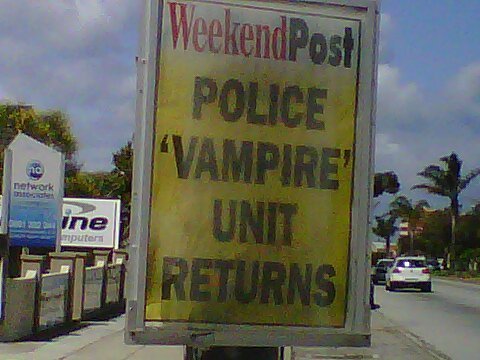
Vampire CopsDecades after its formation, the Occult-Related Crime Unit (ORCU, founded by Kobus “Donker” Jonker in 1992) continues to waste public resources, misdirect police attention, and stigmatise young people who are by and large more misunderstood than malignant.

Amongst all the crimes that we can speculate police in this unit might have seen, there’s one we can be sure of – and it’s one that they are complicit in. The crime in question is against common sense and morality, and is vested in the reinforcing of a Christian evangelical “Satanic Panic”.

In the context of South Africa’s constitutionally-protected freedom of religion, restricting membership of a police unit to only Christians – and dedicating that unit to protecting a Christian version of reality – is itself worthy of special attention as an occult-related crime.

Because a unit can’t investigate itself, I’d ask the Minister of Police to consider funding a new Occult-Related-Related Crimes Unit, which I volunteer to lead. Our mission? To be ruthless in pursuing crimes related to simplistic, moralising, and religiously prejudiced views of crime, society at large, and especially the youth.

Even on the very fuzzy definition of “occult” used by ORCU, too few such crimes occur to merit the existence of a dedicated unit. But it is in the definition of these crimes, as well as the background metaphysics and psychology, that ORCU starts to appear just as spooky as the crimes and motivations ORCU exists to combat.

In response (I presume) to a fairly constant barrage of criticism on social media, the South African Police Service (SAPS) removed the web page that gave us our best insight into how a unit in a 21st-century police force is being guided by ideas from the Dark Ages.

But thanks to the Wayback Machine, we can see not only that “Child has an interest in computer” is a sign that said child might be involved in a cult, but also that this and other equally ridiculous diagnostic advice has remained unchanged since September 2004 (the archived page from then – the earliest date the page was captured – being identical to the one that was removed in November 2013).

I don’t mean to dispute that adolescents, and others, commit crimes in the service of motivations they themselves think of as occult. But when they do so, why is it that this motivation is singled out for special attention? We don’t have a jealousy-related crimes unit, or a greed-related, tender-related, BEE-related, or alien-related unit – even though all of these provide possible motivations to commit crimes, mostly with far greater regularity than the occult would.

Then, if we find that a crime is committed because the guilty party thought themselves under some supernatural instruction, we know full well what to do next: arrange for that person to get the psychological help they clearly need, alongside whatever other sentence is appropriate.

Diagnosis and treatment of this particular confusion is not within the typical police-person’s field of expertise, perhaps especially when that police-person is selected explicitly because they hold a competing – and no less bizarre, to some – set of metaphysical beliefs.

As mentioned above, we have freedom of religion in South Africa. You can be a Satanist if you like, and if you were refused employment on those grounds, the person refusing you would be acting illegally. Hell (sorry), refusing you entry into ORCU would probably be illegal too.

But because of the strongly Christian bias of ORCU, and government in general, you’d of course keep your exercising of freedom of religion to yourself. If you’re a child, though – especially a child unfortunate enough to have parents who take SAPS’s word for these things – you might find yourself described as a Satanist or cult member through no fault of your own.

The warning signs for parents include your using a computer, engaging in sexual activity, watching horror movies, losing your sense of humour and “rejecting parental values”. In other words, being a teenager is a warning sign. Make sure to only part your hair to the right, because “draping hair across the left eye” is another dead giveaway.

It’s also important that you avoid getting a nickname at school, because “phone calls from persons requesting to speak with someone other than your child’s name” is apparently a warning sign for parents that you’re being contacted by your “satanic/demonic name”.

The document also speaks of cults, that come in “religion-based, personality, or secular” versions. I can’t imagine what a secular cult might be, but suspect it has something to do with Idols, or MasterChef, given that cults can involve “unique games”, “dress codes” and “chanting and singing”.

More seriously: these attempted analyses of occult motive are premised in an occult view themselves, namely that of Christianity. The occult, and what is problematic about it, is being defined in a completely partisan way, by an agency of a Government committed to freedom of religion.

It is undeniable that some practitioners of any given occult view engage in harmful behaviour. It would nevertheless be untrue and unfair for us to generalise from those cases, concluding that the entire set of occult practises should be criminalised – especially if we do so from a position of known bias.

Lastly, the vulnerable group here is the youth, who are already besieged by insecurity around their identities. The ORCU document told parents – in a country where homophobia is virtually endorsed by the President, and corrective rapes a scourge – that “child experiences sudden gender confusion” is a warning sign of the occult.

It’s therefore not simply the case that ORCU is a waste of resources that could better be deployed elsewhere. The unit, and its core beliefs, are themselves so offensive to common sense and morality that one might call it a crime.

“Addicted” to hyperbole

Some of you might have noticed that recent blog posts here have earned me some antagonism from defenders of the low-carb, high fat (LCHF) diet. In their defence, they of course think that I’m being needlessly antagonistic, especially towards someone (Prof. Tim Noakes) who they think of as doing pioneering – and very important – work in nutrition.

I’d like to try and approach the topic from a slightly different angle here, in the hopes of illustrating what I mean when I say that my criticisms are premised on a concern for exaggerating the quality and consequences of data, in a context of great uncertainty. In the same way as my language and arguments around religion have tempered significantly over the past 3 or so years, in science I’m equally concerned with the example we set as to how to think, where the claims we make should be proportional to the quality and amount of evidence we have.

A comment on one of my previous posts led me to this blog post by Prof. Grant Schofield, in which he responds to a press release from health professionals in New Zealand, decrying low-carb high-fat advocacy. Schofield’s post seems happy to embrace nuance and to acknowledge the limitations in what we can know right now about the long-term effects of LCHF diets, and is to me a great example of how to argue for an outlier position in a way that lures people into serious consideration of your case, rather than giving the impression that you’re being asked to join a religious cult.

As I wrote earlier in the week, the language of science should embrace uncertainty. We should not offer people dogma, both because it dumbs down the process of scientific reasoning, and second (an extension of the first, though) because it encourages people to think in terms of false dichotomies or other poorly defined and crude categories. What’s right is often about nuance, and doesn’t fit in a tweet or headline – and those of us who know better should not encourage a simplistic “X is right/wrong/healthy/good/bad”, especially when we know that’s what the market wants to hear.

The Doctor just tweeted a link to a great piece about “food fearmongering” that makes this point via examples of diet advice and promotions for books and movies about diet that are almost comical in their hyperbole. Food, basically, is trying to kill you – and unfortunately, you’re also addicted to it.

Until fairly recently, I was involved with a multi-disciplinary research team working in the field of pathological gambling, and as a result got to spend five years working with leading international addiction scholars, neuropsychologists, clinicians in the field of addiction, and so forth. In national prevalence studies and other research, I also got to spend a fair bit of time with people who describe themselves as addicts.

The simple takeaway, if I were to distill five years into one sentence, is that addiction is complex, and not a word to be used glibly. Today, anything we happen to like is often described as addictive, and people will talk about “brain scans show that area X lights up” when you eat a Snickers bar, while not thinking that perhaps area X happens to light up when you do stuff you enjoy. Or, that people who are inclined to addiction will find things to get addicted to, but that this doesn’t always mean that the thing in question is intrinsically addictive.

Today, people are variously addicted to sex, love, the Internet, cocaine, carbohydrates, sugar, crystal meth and so forth. But using the same word to describe all these things is profoundly misleading, and is also potentially insulting to people who suffer from the sort of unambiguous addiction that costs you your savings, your family, your health and so forth. To put a mild lack of self-control alongside heroin seems somewhat glib.

Cocaine, for example, often has no physical withdrawal effects. Psychotherapist Marty Klein says that, in 31 years of practice in the field, he’s never seen “sex addiction”, and describes it as a myth. Internet addiction was invented as a hoax in 1995, when Dr Ivan Goldberg took the diagnostic criteria for pathological gambling and adapted them to the Internet.

Internet addiction wasn’t included in the 2013 revision of the Diagnostic and Statistical Manual of Mental Disorders (DSM-5) – not even in the “Conditions for Further Study” chapter, that highlights things thought worthy of continued attention. “Internet gaming disorder” can be found in “Conditions for Further Study”, and “gambling disorder” does appear, in a new category for “behavioral addictions”. As I say, it’s complex.

Then, as I’ve written in the past, we might even want to be wary of treating the DSM as authoritative, perhaps especially with regard to the class of behavioural addictions, accused of making a “mental disorder of everything we like to do a lot”. My point is simply that this one word, “addiction”, is being made to do a lot of work – and a term that broad can sometimes appear rather meaningless in consequence.

It’s of course not meaningless for people who do suffer with an addiction of their own. The question I’m asking here: if we start speaking of anything that people struggle with as an “addiction”, what are the consequences of that? I fear that we’re not only encouraging shoddy thinking about addiction (and science, in general), but we’re also encouraging victimhood in that my lack of self-control can now simply be ascribed to the fact that I’ve been snared by the evil Internet, or the seductive candy bar.

And finally, there’s the danger of insensitivity – almost insult – to people who struggle with addictions that destroy lives. While being badgered by a LCHF devotee on Twitter, I was asked “do you have ANY experience with addiction that is not related to some scientific study? So much more to it than that.” In other words, I was being asked if I was an addict.

Now, this was Twitter, so you might say that this sort of thing comes with the territory. But what if I was an addict, really struggling with something, perhaps have just lost a job, or a spouse, or somesuch? Might one not think the question rude, crude, inappropriate – even indefensible? (Regardless, of course, of whether it was relevant or not, in that I was being asked “never mind the data, but do you have an anecdote?”)

I’d certainly think it inappropriate, perhaps even “triggering“, in the contemporary language of social justice. When it comes from someone who works at an addiction clinic, of all places, I’d be even more convinced.

And in this case, that’s exactly where it came from – a person offering treatment for “sugar and carbohydrate addiction”. The field of addiction – and addicts themselves – could do with us being a little more careful about the language we employ, and the categories we use to describe the things we enjoy.

Russell Brand, celebrity and imputed authority

As you no doubt know, Russell Brand has recently been calling for revolution. The revolution will most likely be televised (younger readers, that’s a reference to a Gil Scott-Heron song/poem that’s worth listening to, regardless of how you feel about Brand or revolutions), but that’s pretty much all we know about it. Things are broken, politics doesn’t matter, and you shouldn’t vote.

You can read Nick Cohen or even another comedian, Robert Webb, for arguments as to why Brand’s comments – even if well-intended – are wrong-headed. What I’m interested in adding to the conversation is the observation (not a unique one, of course) that while Brand’s interview on Paxman and subsequent columns have certainly been entertaining, and certainly deal with important issues, that doesn’t make them interesting or worthwhile as political commentary.