Ugandan homophobia and those “mercenary” gays

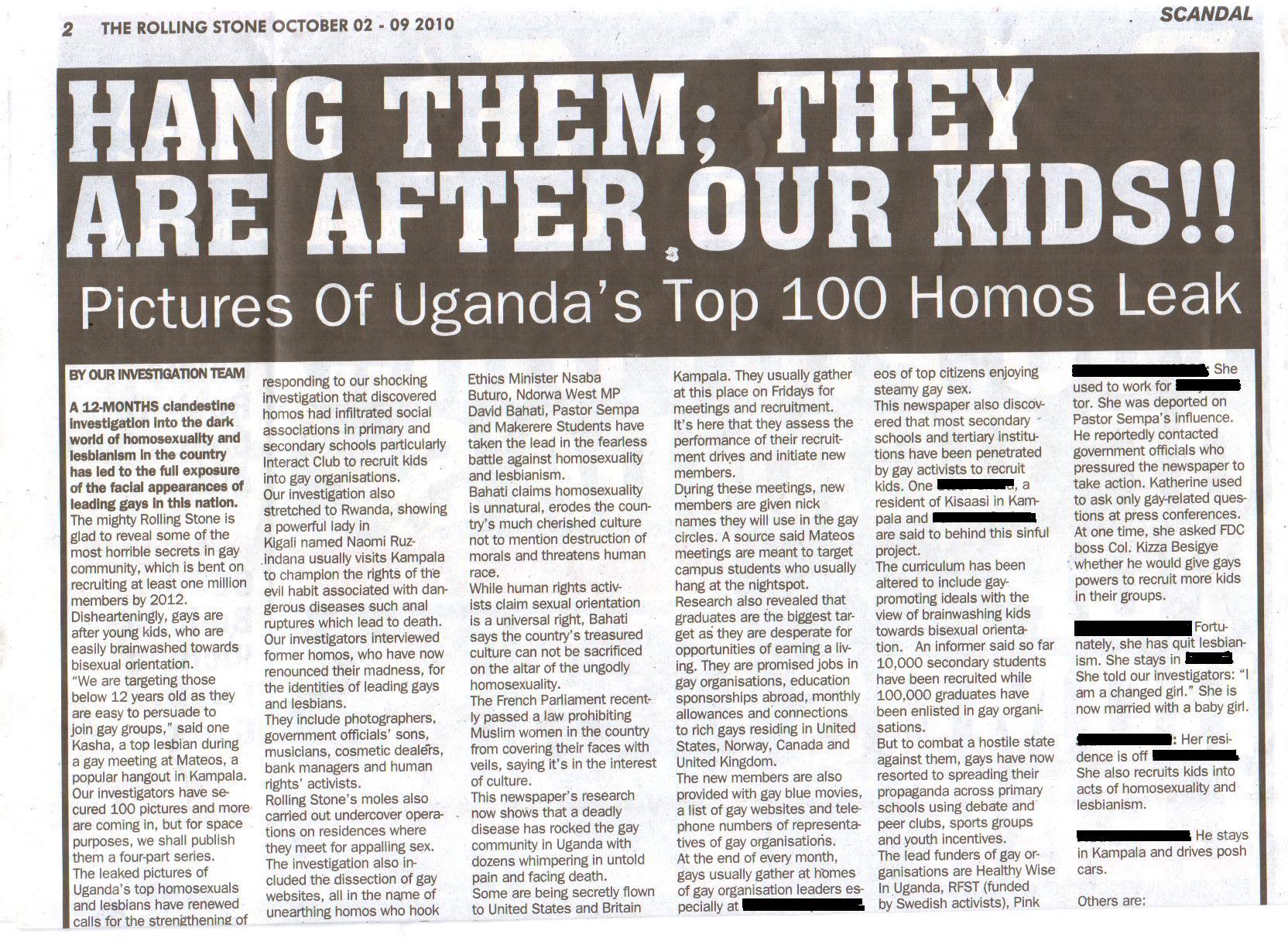
Three years ago, Uganda’s Ethics and Integrity Minister Nsaba Buturo observed that “killing them [gay people] might not be helpful“. The death sentence was indeed dropped from the bill that now awaits President Yoweri Museveni’s signature, after having been passed by their lawmakers in December.

hangthemprotectedBut that’s cold comfort to those persecuted for their sexuality – a sentence of life imprisonment can be imposed not only for gay sex, but also for “all behaviour, including touching, that might lead to or show an intention to have homosexual sex”. It gets worse, though – at least in terms of how much prejudice the Ugandan Members of Parliament are willing to flaunt: the ministerial task team advising the President on the bill “falsified the information contained in the report given by medical and psychological experts, twisting it to show that homosexuality should indeed be further criminalised“.

A concern for truth has never been a hallmark of this sort of bigotry, as you no doubt know. From claiming that homosexuality isn’t “African” (even though there’s plenty of evidence for pre-colonial same-sex sex) to Museveni’s own recent statements that people might become gay for “‘mercenary reasons’ or, in the case of lesbians, a lack of sex with men.”

In part, the blame for these fabrications and the attendant persecution can be laid at the door of American evangelical Christians, in particular Scott Lively, president of “Defend The Family International”, who thinks that homosexuality caused the Holocaust. But he’s also tapping into a rich wellspring of hatred and confusion – from David Bahati’s contempt for homosexuality (he’s the first-term MP who drafted the death-penalty version of the bill), to the current “Ethics and Integrity” Minister, who talks about “the right kind of child rape” (the heterosexual kind, of course – watch the interview starting at 35m40s in the video embedded below).

It’s laws and lawmakers like these that remind one of how far we still have to go as a species, before being remotely respectable.

http://www.youtube.com/watch?v=L9ytwGW9eO0

Eusebius McKaiser asks: “Could I vote DA?”

Finding myself in a bookstore with some time to kill, I sat down to read Eusebius McKaiser’s new book, Could I Vote DA?, and am now in a position to recommend that (some of) you do so, too.

Regardless of the book’s title – although the DA (the Democratic Alliance, South Africa’s only self-identified liberal party) is the main focus – Eusebius does a fine job of capturing the essence of some key ideas in politics, such as the point and value of a political ideology, what liberalism entails and doesn’t entail, affirmative action, and the strategic and tactical dilemmas faced by those in the political arena.

The book is overtly (even proudly) subjective, and Eusebius’s character is manifest on every page. For some people that will be a negative, but for those of you who can read past an impression of a character that’s not your preference, the personal narrative does, I think, help to bring the ideas to the forefront.

One aspect of the book and its subjectivity that I wasn’t enamoured of was what seemed (at times) to be gratuitous sniping at some former and current DA representatives or employees, in particular their former Executive Director of Communications, Gareth van Onselen (also a friend). They don’t see eye to eye on some things, and neither of them are fond of being told they are wrong, but Eusebius’s account of some recent dealings between van Onselen and people in the DA seemed a little too eager to “school” van Onselen.

(Much of the conversation regarding Gareth van Onselen is in a chapter detailing the disagreement between himself and Mmusi Mainane – the DA’s National Spokesperson and Deputy Federal Chairperson – on the topic of ubuntu, so this is an opportune time to link you to an email conversation Gareth and I had on the topic of ubuntu a couple of years ago.)

The language of the book is very informal, containing many colloquialisms and much slang. In tone and content, I’d think it well-suited to a younger audience – perhaps those “born frees” that will be voting in a National Election for the first time.

Those of you who know your political philosophy won’t learn much by way of theory, but can certainly still enjoy the book not only for how it might get you to think about issues again, even afresh (of value, because our beliefs and views can easily calcify without our realising it), but also for its gossip value – Eusebius gets to hear plenty of interesting stories while hosting his morning show on PowerFM, and in similar gigs prior to that.

The question of what market this was aimed at is an interesting one – the book retails for roughly R230, which might, I fear, place it slightly out of that youth market’s comfort zone. Stephen Grootes recently published SA Politics Unspun for around R185, and while Richard Calland’s The Zuma Years retails for a similar price to Eusebius’s book, Calland’s is research-intensive rather than a piece of reflective political philosophy.

These books aren’t directly comparable, but they do give a sense of what other publishers thought a reasonable price for a book about politics, in a market that we know doesn’t read an awful amount in any case. I hope I’m wrong, and that Eusebius can treat me to a gloating dinner with his royalties later this year.

A final though: the key point, for me, made in Eusebius’s book was regarding the tension between principle and pragmatism, and how difficult it is to strike a balance that both satisfies the electorate while not selling out the values you are ostensibly promoting. The DA has mostly stuck to (an attempted) defence of principle, even while foundering in doing so at various points (to mention just one example, Eusebius highlights the illiberal stance of Helen Zille on HIV/AIDS, something I’ve also previously written about).

But when they try to make a case for something that’s about more than only principle – or when they make a case for a principle in a way that’s designed to appeal to more people than only their liberal base (if that is still their base at all, as I questioned when writing about the Maimane vs. van Onselen thing, their message seldom seems both co-ordinated and coherent. Last year’s BBBEE confusion was the most striking example of this, and these examples all speak of a party that knows it needs to change it’s manner of engaging our voting population, rather than the voting population that can be found in textbooks.

Eusebius makes this case very well, and very thoughtfully, and his book is a welcome contribution to South Africa’s political debate, especially with an election less than three months away.

DignitySA on Belgium’s child euthanasia decision

This is too interesting an issue to be posted on Facebook alone, so I’d like to share Prof. Sean Davison’s (of DignitySA) comment on Belgium’s recent Parliamentary vote to approve (voluntary) euthanasia for children. As many readers will know, I support voluntary euthanasia, and in a local context, support Davison and DignitySA’s efforts in campaigning for a right to die in South Africa. You can “like” DignitySA on Facebook, and/or become a member via the DignitySA website.

What the Belgian Parliament has voted to allow is unprecedented, in the sense that it will allow for voluntary euthanasia (in short, you choose to die – we’re not talking about “pulling the plug” on a comatose person) for a child of any age, rather than only children of a certain age (in the Netherlands, voluntary euthanasia is permitted for children 12 and older).

On their Facebook page, Davison offered this comment:

I can understand that the Belgian law makers were motivated by compassion when passing this law but it is hard to believe that a child has the capacity to make an informed decision about whether to live or die when adults struggle with the concept. So often an adult who has chosen to end their life when terminally ill will cling on and cling on, unable to follow through with their decision. How can a young child be expected to make such a decision?

Our culture and humanity has determined the age when a person is responsible and mature enough to be able to vote, to join the army and die for the country, and to get married.

It is this same responsibility and maturity a person needs to be able to make a decision on whether to live or die. This is not a choice that should be given to a child.”

I can understand a conservative stance on this, but don’t agree with it. Ages of maturity are convenient fictions that correlate with competencies of various sorts, yes – but we use those convenient fictions only because it’s too time and labour-intensive (or, practically impossible) to determine whether the competencies actually exist in individuals.

At the age of (roughly) 16 (or 18), we know that most humans will be safe enough drivers, or responsible enough drinkers, etc. If we had the means, money and time, we’d want to be able to test 15 year-olds to see whether they were capable of these things, just as we’d want to test 19 year-olds and deny them these rights, if they aren’t capable of using them responsibly. At least, that’s my view.

Assisted suicide is one of those issues where the demand is so low, and infrequent, that the relevant competencies can arguably be tested directly, allowing us to do away with the convenient fictions.

In this case, the Belgian Parliament has ruled that “Children, just as adults do now, will need to go through extensive psychological evaluations with multiple doctors. Parental consent will be required as well as a written request by the patient.” For comparative purposes, consider that in the Netherlands (for children 12 and older), only 5 children have met these criteria and chosen suicide since 2002, so there’s no reason to believe this is creating a slippery slope.

As difficult as these decisions are – even more so for people we regard as more vulnerable – the Belgian stance seems logically consistent, and reasonable. Having said that, I’m sympathetic to the caution. It’s just that we’re not going to fix all our our anachronistic moral standards without some moral courage.

@Women24, sexism and @6000

One of yesterday’s social media flare-ups (the rule, I think, is that we need at least 3 per day) was caused by a post at 6000.co.za, in which Mr. 6K highlighted what he regarded as mixed messages emanating from the media outlet Women24.

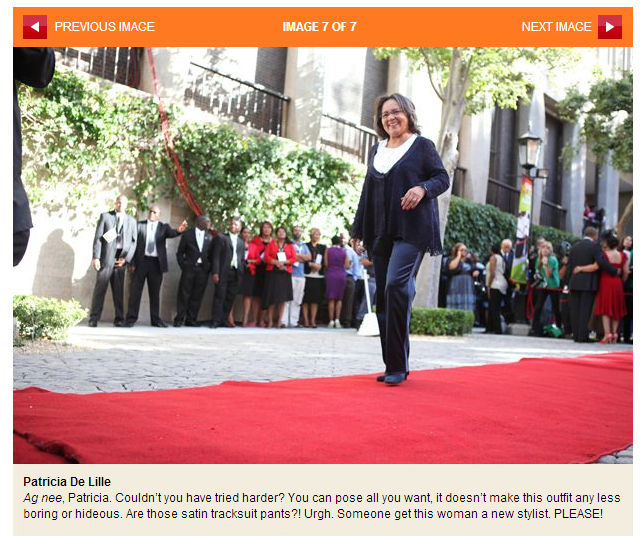
The mixed messages, according to 6K, result from the fact that Jana Joubert of Women24 had asserted that it’s wrong to criticise Members of Parliament for what they wear, and that we should instead focus on how well they do their jobs. This standard – with which 6K agreed (as do I) – was highlighted as being in conflict with previous Women24 posts like this one:

De Lille at SONA2013, image via 6K

For those who can’t see the caption, the text under this photograph of Patricia de Lille reads: “Ag nee, Patricia. Couldn’t you have tried harder? You can pose all you want, it doesn’t make this outfit any less boring or hideous. Are those satin tracksuit pants?! Urgh. Someone get this woman a new stylist. PLEASE!”

Highlighting this and a few other examples, 6K says:

But before women24.com go out of their way to tell us what we should or shouldn’t be saying about the fashion on the red carpet at SONA or anywhere else, maybe they need to get their own house in order.

So, is the accusation of “mixed messages” justified, and fair? I don’t think it’s fair, and I think that the justification available is weak – so weak, in fact, that the point didn’t merit making. But, I also think that Women24 – and specifically their editor, Lili Radloff – are avoiding a real issue in the way they chose to respond to 6K.

(An aside: the fact that there is arguably fault on both sides has nothing to do with the relative severity of the faults in question. I’m making no suggestion of equivalence, and as you’ll hopefully see, I think 6K was undoubtedly in the wrong – on aggregate – in this case.)

I don’t think the criticism of Women24 was fair because the image of de Lille (and the other examples used) were from the same event last year, while Joubert’s comment regarding shaming women for their outfits was made this week. Not only do times change and editorial policies change, but 6K and Radloff are also Twitter ‘friends’, so he could easily have sought comment or clarity from her on whether she sees a mixed message or contradiction, before making that accusation in public.

Doing so would be required of a journalist, and I can hear 6K (he’s a friend, in case that matters to anyone) telling me off, in that he’s “just a blogger”. I don’t think that matters – new media and old have blurred these distinctions, and when a flare-up like this ends up being discussed on radio (as this one was), we can be sure that there’s a chance for reputational harm – which incurs some responsibility, even if not the high levels of it we’d demand of a ‘real journalist’.

So, I’m claiming that 6K didn’t do sufficient homework before posting what he did. For those of you who don’t read his blog, he’s not averse to being controversial, and I think that impulse got in the way of common sense in this instance.

The reason his critique was only weakly (and insufficiently) justified is that a year isn’t that long a time, and that – to the best of my knowledge – the editorship have not made this policy change clear. In fact, Radloff’s early Tweets in response to 6K (“we might have botched it a bit this time“, or “I hear what you’re saying“) – posted before Radloff realised the images were from last year – make no mention of a policy change, which would seem to have been the strongest available response. Instead, we saw what amounted to an apologetic response at first, before 6K’s use of old images became apparent.

But make no mistake about it – in an environment where everyday sexism occurs, well, every day, Radloff and Women24 – a large, feminist-driven website – are obviously going to be aggrieved by being told that they are inconsistent, and unfortunately (but also, in reality) the sex of the critic will always come in to play in situations like these.

Arguments should stand or fall on their own merits, but given the lunacy of identity politics, they don’t. 6K could – and should – have anticipated that his post was going to read as an attack on the politics of Women24, which in turn could – and should – have made him ultra-attentive to getting his facts right.

In closing, where Women24 are erring is arguably in thinking that the market is able to separate individual voices from the overall brand, as Radloff asserted on Twitter (again, in an early defence before it became clear that 6K had used last year’s images). “Different opinions”, she said, are not the same as “mixed messages”, which was the phrase 6K used in his post title.

I don’t agree with that. A readership would perceive it as mixed messaging if a website set up (at least in part) to serve a cause spoke of the wrongness of mocking attire with one voice, and then did that mocking with another. The early rebuttals to 6K, which included the “different opinions” claim, didn’t strike me as indicative of having thought through this aspect of brand identity sufficiently.

But these are matters for another day, as is the unfortunate presence of pseudoscience on the pages of Women24 (both astrology and multivitamins feature strongly).

When we get around to engaging each other – on these and other issues – let’s try not to assume the worst, though. It’s getting more and more difficult to talk about issues without presumptions of guilt or virtue, and we all play a part in creating – but if we care to be more careful, undermining – a culture in which blaming, judging, and shouting are valued more than understanding is.

Gender-based violence and apophenia

Earlier today, my friend @kelltrill said

https://twitter.com/kelltrill/status/434275566293090304

and this led to a little bit of to-and-fro between her and some others who seemed to think it somehow obvious that if Oscar Pistorius had intentionally killed Reeva Steenkamp, it would have to be classified as gender-based violence. Now, that might be typical usage of the phrase gender-based violence. But if it is, I’d like to suggest to you that it’s wrong, and lazy, to speak of cases like this (i.e. a man killing a woman) as axiomatically gender-based.

Steenkamp & PistoriusNone of what I say here is intended to minimise or trivialise the fact that women are overwhelmingly more likely to be the victims of domestic assault by their partners than men are. There are hundreds of things I could link you to, but the evidence is so overwhelming that there’s no need – you can easily find something yourself. (And in case any MRA’s happen to wander past here, no, I’m not saying that men aren’t sometimes victims of various forms of discrimination themselves.)

Furthermore, I’m quite happy to regard this case as at least in part an instance of gender-based violence (on the assumption, for the sake of argument, that Pistorius intended to shoot Steenkamp). I’m happy to do so because Pistorius fits a classic alpha-male stereotype – proud, strong, with a history of short-temperedness and violence. The stereotype might not fit or be fair, but I’m disclosing it to wall it off, in that this case in particular is not my focus – I want to instead address the use of that generalisation (gender-based violence), with the case as a springboard for doing so.

The mere fact that a victim is female (or whatever) does not mean that the violence can be described as whatever-based. If Pistorius knew that he was shooting Steenkamp, then – obviously – the most fitting label for this action is Steenkamp-based violence, where Steenkamp is also a woman.

Even if it’s true (as it is) that more men abuse and kill their female partners than vice-versa, Pistorius can’t be known to have been more likely to shoot Steenkamp than he would be to shoot anyone else who he was ill-disposed to, or where he could benefit from doing so.

If a person had a history of violence against a certain sex, race, nationality or whatever, the generalisation has more merit – but before establishing whether those facts hold, we shouldn’t jump from a) the existence of a general culture of violence against X to b) the conclusion that a particular instance of violence against X fits that pattern.

I’ve argued something similar in a post about “Satanic” killings, where while it’s easy to generalise, doing so can obscure important details about motivation and how we should respond (for example, that psychiatrists might be more useful commentators than ghostbusters like Kobus Jonker).

The same danger of over-generalising in a confounding sort of way could occur with a murder or assault that is perpetrated across races – in South Africa, entrenched distrust between races could (more in some parts of the country than others) explain the motivations behind a murder, but they can’t be assumed to do so.

Take Eugene Terre’Blanche as an example: yes, he was a white supremacist, but the farmworkers who murdered him might have done so because he was also an abusive employer, or a rapist (as the murderers alleged). So while you could call that an instance of race-based violence, doing so would (or, could) distract from more pertinent details.

In short, what I’m arguing is that we should be careful of affixing convenient labels to events or people, even if they are often true. Harriet Hall has a review of an interesting-looking new book on critical thinking on Science-based Medicine, where I was introduced to a useful idea I hadn’t encountered before. It’s called apophenia, and

It means the spontaneous perception of connections and meaningfulness of unrelated phenomena, the tendency to find personal information in noise, seeing patterns where there are none, the kind of subjective validation that cold reading exploits.

To recap: I don’t dispute that gender-based violence is a real thing, and a real problem. But to call every instance of violence across genders (usually male on female) an example of gender-based violence is hyperbolic, in that it might be a judgement that claims more than what the evidence tells us.

This, in turn, could be problematic, not only because it’s a simple instance of laziness in not making fine discriminations regarding what data can tell us, but also because the more things you fit into a category, the more diluted that category might become.

It’s precisely because gender-based violence is such a real thing, and is such a problem, that we might want to be more cautious about affixing that label to cases that it might not fit.

On causes, Noakes, and making prudent claims related to diet

Three pieces related to diet and the low-carb high-fat fad are worthy of highlighting this week, because all of them are a counterpoint to the “sugar is addictive and you’re a victim of a conspiracy” seam that continues to be mined by the likes of Professor Tim Noakes. The first is by Gary Taubes, who Noakes cites as being responsible for removing the scales from his own eyes, and the second is a response to Taubes by Dr David Katz, who says that Taubes is asking the wrong questions.

You can read those pieces yourself – the only aspect I want to highlight here is how moderate Taubes’ tone is. He acknowledges that the science isn’t settled, but that he’s biased in favour of “sugars and refined grains” being the problem. He even includes the rider that “we all have our biases”. Indeed we do. But on that minimal (and yes, selective) quote, Taubes could be saying the same thing that mainstream nutrition science is – which is at a significant remove from the claims made by Noakes, who speaks as if there’s no doubt that carbohydrates are the cause of most of our ills, and that most of our ills can be eliminated (or at least managed) by eliminating the majority of carbs from our diets.

In other words, Taubes at least speaks as if he acknowledges the possibility of being wrong. Noakes, by contrast, leaps straight to rather humorous epithets when people disagree with him, calling them victims of “Group Think”, “statinators”, or “The Anointed”. Alternatively, he’ll poison the well by making very generalised aspersions about funding, as if to pre-emptively taint any claims that are being made. It’s tinfoil-hat territory, and in short, in no way confidence-inspiring, at least not for those of us who want to resist signing up to a cult.

And it’s the third piece that merits your careful attention, if you care for holding science and scientists up to rigorous and principled scrutiny. Not because it says anything new, but because it quite clearly articulates a very essential, and simple, principle of scientific reasoning. Namely: what question is being asked, and what sort of an answer will we be willing to accept as legitimate? The key passage for me – at least in terms of highlighting how Noakes is compromising critical thinking – is this one:

It seems likely that we were seduced by the early successes of epidemiology with point-causes with large effects — infectious diseases — and we were similarly seduced by Mendel’s carefully engineered successes with similar point causes — single genes — for carefully chosen traits, but these are paradigms that don’t fit the complex world we’re now in. What Mendel showed was that causal elements were inherited with some specifiable probability, and he did that in a well-posed setting (selective choice of traits and highly systematized breeding experiments). But Mendel’s ideas rested on the notion that while the causal elements (we now call them alleles) were transmitted in a probabilistic way, once inherited they acted deterministically. Every pea plant with the same genotype had the same color peas, etc. We now know that that’s an approximation for some simple situations, but not really applicable generally.

This passage reminds me of the dispute between Humean accounts of causation and what I’ll call the “causal powers” account, described very usefully in Harre and Madden’s 1975 book, Causal Powers: A Theory of Natural Necessity. In short, the distinction could be captured in discriminating between the fact that high carbs typically mean high quantities of refined foods, sugars, a sedentary lifestyle etc. and the fact that neither does it need to mean that, nor that those causal factors exist in isolation.

By way of example: To say that aspirins relieve headaches is to say that, because of its nature, an aspirin can relieve a headache while a laxative cannot. The means by which it achieves this are neither occult nor unfathomable – it does not have this power in spite of its nature; it is rather because of its nature that this is possible.

In cases like these, scientists are able to investigate the chemical composition of an aspirin, and then to figure out why it has the effect it has on the body, describable in terms of chemical reactions within the body. An aspirin’s power to relieve headaches is furthermore something which exists even when the tablet is not being used to relieve a headache. When we say that aspirins relieve headaches, we are saying that in a particular situation (essentially, a person having a headache), aspirins will be more effective than other things, because they by nature have the power to relieve headaches.

When we open the medicine cupboard, looking for something to relieve our headache, we choose aspirin over a laxative because we think or indeed know that it currently has such and such powers. The difference between a placebo and an aspirin is not that the aspirin will relieve the headache and the placebo will not, as there will be situations in which the aspirin is ineffective or the placebo effective, the difference is in the natures of the two substances, and that, by nature, aspirins generally behave in such a way as to exhibit the power to relieve headaches.

Harre and Madden go on to draw a distinction between enabling conditions and stimulus conditions, where enabling conditions are those that ensure that a thing is in a state of readiness to create a certain effect, and stimulus conditions which actually bring about an effect, assuming that the enabling conditions have been fulfilled. In other words, we’re talking about potential causal factors rather than absolute causes.

Enabling conditions for an aspirin would be that the aspirin is in a state whereby it could possibly alleviate pain – if an aspirin is consumed after its sell-by date, the possibility exists that certain changes have taken place in its chemical structure, resulting in that aspirin not being able to relieve pains. So, assuming that the aspirin is enabled in this way (this is not to say that this is the sole enabling condition), what are the stimulus conditions which actually bring about the response from the aspirin that causes the headache to be relieved?

To relate that to diet, what are the conditions under which carbohydrates cause obesity, or type 2 diabetes, or whatever? Noakes would respond to say that the conditions are quite clear – namely that they obtain when one is insulin-resistant. But he only mentions this qualification when challenged to do so. Page 22 of the Real Meal Revolution states quite plainly – without any qualifications – that “fat does not make you fat. Carbs do”.

The very next page introduced insulin, but without any suggestion that we might have variable insulin reactions to carbohydrates. And the page ends with a generalised warning of a “near-perpetual cycle of weight gain. Unless, of course, you break the addiction…”. Never mind, of course, that the word and concept of “addiction” is being used in a rather quackish sense here.

In other words, the qualification that this only applies to some is introduced grudgingly, under duress, whereas his generalised opposition to what he dubs the ‘prudent diet’ recommendations gives the clear signal that he’d prefer for dietary guidelines to suggest a low-carb high-fat approach, for everyone. As he says in an interview in early February 2014, he’s calling for a “return to your dietary roots, bringing you back to the way humans are meant to eat and returning your body and mind back to the trim, happy, energised state our ancestors experienced thousands of years ago. They didn’t get fat or suffer from obesity, diabetes or other lifestyle illnesses” – and as he’s pointed out in every talk I’ve heard and read, those dietary roots (allegedly) involved high fat diets and low carbohydrate intake.

Yes, he does allow for wiggle-room, with some of us allowed to eat “a maximum of 200 grams of carbohydrates a day, depending on your insulin resistance”. But he’s also claimed that 60% or more of us would benefit from the LCHF diet, so it seems clear that – unless you prove yourself carb-worthy by whatever standard he sets – the presumption is that you, like him, should avoid carbs.

Here’s the thing: dieticians already know that excessive consumption of carbs is a bad thing, especially when they come in super-refined forms, and especially in the form of sugar. If that were all Noakes were saying, nobody would care. He’s saying something more, which is that we don’t need to fear saturated fat, and that the proportions of proteins and saturated fat we consume should increase, at the expense of the proportions of carbs.

When making these sorts of claims, he cites sources like the Harvard School of Public Health, even though they include the (standard) cautions against saturated fats. Just as he and his followers have been claiming that Sweden has “officially” adopted LCHF, even though they’ve done no such thing. And when faced with challenge, the retort is that you’re indulging in “Group Think”, as though conspiracy theory isn’t a perfect example of exactly that.

Take the example of that tweet, pasted above. In Noakes-science, that’s evidence (or so it seems). For the rest of us, we might say a) that’s a post-hoc (ergo fallacious) argument; or b) that it seems fairly straightforward to intuit that high cholesterol is sometimes a potential causal factor, but never a necessary one, in causing heart attacks; and c) what about the other 50% – does their elevated cholesterol not mean anything, on this model?

As I’ve said before, I really hope he’s right (leaving aside the fact that non-human animals will be killed in even higher numbers if his diet takes off). But damn, I wish he could try sounding like a scientist for a change.

[Geek alert] On metadata, MP3’s and Bliss

In a departure from my usual themes here on Synapses, I’d like to tell those of you who are obsessed concerned about their music library organisation about a program I recently discovered, called Bliss. (A spot of disclosure is in order right from the start: the developer of Bliss, Dan Gravell, was kind enough to give me a free license for testing purposes).

What Bliss claims to do is to organise your music library, album art and metadata, downloading the missing bits where necessary. Those of you who have your music in the cloud will know how annoying it is to have two albums by the same artist listed, with half the tracks in each,  because of some minor difference in the metadata. My library isn’t necessarily huge (12 000 or so songs), but contained enough of those sorts of issues to merit some attention.

Yes, there are other tools out there that do this (or a similar) job, and I’ve tried many of them. What makes Bliss different is that it runs as a background process, and once you’ve defined the rules you’d like to apply to your music, it will scan and correct any new music you add to the specified folder, as well as populate the relevant fields for existing music.

The rules themselves can be defined with a great deal of specificity, perfect for anoraks like myself. Do you want to enforce a minimum of two digits for track numbers, so track 1 becomes 01? What dimension and file-size album art is the minimum you’ll accept – and what should be regarded as too large? Bliss will automatically convert where necessary, and give you options if more than one image fits the album.

If tracks are not tagged at all, it generates an acoustic fingerprint, which is then used to find and offer suggestions for tracks and albums that that match the fingerprint. The walkthrough on tagging on the Bliss website gives you a good overview of how powerful the basic functionality is, but if you wanted to really get stuck in, or clean up tags that other software has inserted (iTunes is often a culprit here), there’s no end to the level of detail available.

Bliss tagging options

So, how well did it work? After running overnight, around 300 albums had successfully been edited to meet the standards I stipulated, without any human intervention whatsoever. This variously included downloading missing artwork, renaming files and directories, and find (or correcting) metadata. And, of all those albums now listed as “compliant”, I’ve only spotted one mistake, where a collectors edition of an album had ended being re-tagged as the standard studio album.

Another 100 or so were highlighted as needing attention, but as you can see in the screenshot below, the attention required often added up to little more than clicking a button to accept a recommendation.

Screen Shot 2014-02-08 at 08.12.02

How much human intervention is required will largely depend on the parameters you define, so think carefully about how important something like “genre” is to you, before letting Bliss get started. Many of my albums were identified as non-compliant, simply because I had thought it a good idea to specify that all albums needed to be tagged as one of X defined genres. But because the existing library had so many more, idiosyncratic genres, this resulted in many prompts for attention. Re-running Bliss with the instruction to not care about genres decreased the human input required significantly.

A negative so far is that if you’ve got a significant library, the program takes quite a few minutes to launch (this will obviously vary not only based on library size, but system capabilities). So, it’s more suited to running in the background on a media server, where you don’t need to reboot and launch the program very often.

Then, I have still ended up with quite a few – probably around 50 – albums where I had to resort to using MP3Tag – a very good piece of free software – to fill in blanks that Bliss hadn’t (and, to correct the mistake mentioned above, where the album had been incorrectly tagged). But all in all, I suspect that Bliss has saved me many hours of effort in manually checking and correcting tags, and especially downloading artwork (seeing as my tags were already in fairly good shape).

If you want to check it out, Bliss is available for all major operating systems (Linux, OS X, Windows), and it allows 100 ‘fixes’ before asking you to pay anything. I’d suggest making a copy of a couple of albums, pointing Bliss at that directory, and seeing what it does in that controlled environment. If your experience is like mine, you’ll want to fine-tune your instructions to the program before letting it loose on your full library.

Then, if you like what you see – and I suspect you will, assuming you don’t already have a system in place – you can either purchase 1000 fixes for 10GBP, or unlimited fixes (including support for future versions of Bliss) for 30GBP.

Faith healers and medical deceivers

On the last night of January, I participated in a rather interesting hour of radio, during which Hlomla Dandala hosted a interview with me and someone claiming to be a faith healer. The faith healer’s name is Pastor Louisa, and you can find some information on her ministry – which includes curing people of AIDS – on her website.

I do have a recording of the show, but haven’t yet found a way to convert it into something that plays outside of the TuneIn Radio app on my phone (informed advice on this is welcome) – if I do get it converted, I’ll be sure to post it here.

What became clear fairly on in the show is that Louisa is not a charlatan, in the sense that she’s knowingly exploiting others. She was desperately sincere, and also, unfortunately, sincerely confused. When invited to facilitate a miracle over the phone to someone who called in, she engaged in a few minutes of shouty, enthusiastic prayer and exhortations to be confident and inspired, after which she asked the caller  whether she “felt better”.

Yes, said the caller. I then asked – “so, does that get added to your list of miracles performed?”. Yes, said Pastor Louisa. On those weak standards, all of us perform dozens of miracles every day – just figure out what language people like to hear, or what buttons they like pushed, make them happy, and then claim to have performed a miracle!

Also, she made it clear that she never tells people to stop taking their medicine. Dandala asked her how she knows whether it’s the prayer or the medicine that heals… and the predictable answer that she gave was that she “just knows”. As far as I can determine, then, she gives her god the credit for the job performed by modern medicine.

You’ve heard how this (faith healing) works before, I imagine, or rather, how it doesn’t work. On the recommendation of Dan Dennett, I watched the documentary Marjoe a few years back, and it’s a wonderful expose of charismatic preachers and healers, involving Marjoe Gortner taking a documentary crew behind the scenes of his final revival tour, held after he had already lost his faith. Watch it if you can, but basically, if people want to believe something strongly enough, it’s difficult to stop them doing so.

The difficulty in talking to Louisa was in resisting the impulse to mock, but instead to feel sympathy for her confusion, and the desperation of those who take her seriously. I failed in this effort at least once, when she spoke about how she had to stop talking to us because she was out in the open, under a tree, and it was cold (this was late at night). I suggested that a miracle might sort this out – after all, if she could cure Aids, what’s the problem with a little heating?

Failures of good grace aside, these people can be dangerous, especially in communities we don’t often hear about, where faith healers and other quacks can do their thing without being exposed to scrutiny. Communities like the Amish are a similar problem. And the overarching problem we all have in a constitutional democracy is in striking the balance between objective application of the law and respecting the various freedoms we believe people are entitled to, like subscribing to and practicing a religion.

For adults, there’s less of a concern regarding people being free to harm themselves than there is for children, who can’t be expected to know any better. But desperation, and poor educations, mean that adults are also sometimes more gullible than one would like, which is why it’s incumbent on all of us to speak out against quackery where we find it, while still trying to avoid being gratuitously cruel to those we criticise.

And those of us in positions of authority should perhaps be most careful, because their trust is vested in us, and they spend money, time and attention on us.

Someone getting a lot of attention right now is Professor Tim Noakes, as he goes around the country giving talks and radio interviews to promote the book he’s recently co-authored, The Real Meal Revolution. During a recent interview with Redi Tlhabi, he informs listeners (at 38m40s) that there is “absolutely no risk” involved in cancer victims trying the ketogenic diet, because it’s proven that starving cancer of carbohydrates is an effective treatment.

Well, yes, it can be. But as he so often does, he’s cherry-picking, or simply believing in the version of “science” that suits his agenda. Because according to the Sanford-Burnham Medical Research Institute, and other sources,

Many scientists have tried killing tumors by taking away their favorite food, a sugar called glucose. Unfortunately, this treatment approach not only fails to work, it backfires–glucose-starved tumors get more aggressive.

This is only true for some glucose-starved tumours, to be sure, but it still means that saying “absolutely no risk” is absolutely untrue, and that Noakes is giving advice – to an audience of thousands – that stands a good chance of harming a listener who happens to have the sort of cancer that responds aggressively to a low carbohydrate diet.

As I’ve said many a time, this isn’t the approach of someone who is a responsible scientist. But, just like the faith-healer, I think he’s utterly sincere, and utterly committed to fostering our good health. More the pity, then, that he’s unable to see how his religious fervour might end up achieving the opposite goal, at least for some. And how – consistently – he’s wreaking havoc on basic principles of critical reasoning, and setting a terrible example for budding scientists everywhere.

Journalists in politics, and the myth of objectivity

The news of Donwald Pressly’s suspension from Independent Newspapers (allegedly following his putting himself forward as a candidate for the Democratic Alliance in the 2014 elections) has given rise to some discussion on journalistic “objectivity”, and whether journalists should be members of political parties. I’m largely in agreement with Eusebius McKaiser’s views on this, but want to add a few comments of my own.

Both Pressly (and previously, Brendan Boyle) were suspended when it emerged that they had put their names forward for internal consideration by the Democratic Alliance (DA), in a process that is meant to be confidential. They had not yet been appointed to any position, nor been selected or assigned to any ranking on the Party’s list of candidates. Leaving aside the leaking of this information (itself involving ethical issues), they had indicated that they would be willing to leave their current jobs for a career in Parliament, rather than already taken up jobs involving representing a political party.

In other words, they already held the political viewpoints that made this a plausible career choice for them. All that changed was that those viewpoints were made more public. And despite already having those viewpoints, their ability to report fairly on matters political hadn’t been called into doubt before this, at least not to my knowledge. As a friend remarked, “both are excellent and ethical contributors in the public sphere, and, in their professional lives, have upheld the journalistic standards expected of them”.

Despite already holding these views, and doing their jobs (at least) competently, the view seems to be that once readers are made aware that you hold those views, you can no longer be trusted – even if you (arguably) write the same sorts of things before and after. This seems to imply that readers are unable to judge the content of the writing as presented to them, including considering whether details are accurately presented in whatever it is that they are reading, and whether or not the journalist is trying to nudge them into taking one side over another.

In other words, readers need their hands held, but more importantly, their hands are being held by an arbitrary fiction. First, arbitrary because not only do most people already hold political views, but also because it’s only certain forms of view that get counted in these situations. If you’re a member of Greenpeace, you can’t be “objective” in the strong sense demanded of Pressly and Boyle. If you’re a democrat, or a constitutionalist, or a non-racist, you’re expressing a view – but some views are deemed to not impugn your “objectivity”, while others apparently do.

And the arbitrary defining line between objectivity and not is simply party membership, regardless of what you write, or how you write it, because judging whether you’re making sense on the page is apparently beyond us. This seems a paternalistic, and infantalising, view of my competencies as a reader.

Then, objectivity itself is an impossible standard to set. What you’re looking for is balance, not objectivity, because we’re simply not capable of what Nagel called “the view from nowhere”. Whatever you write is going to include certain sources, exclude others, chase some leads and not others – and all of these decisions are made by a person, with existing beliefs. In other words, by a subjective human agent. But his or her job is to offer as balanced a report as they can – and this involves being aware of your biases to the extent that you are able, so that you can compensate for them when necessary.

So, I disagree strongly with how Boyle and Pressly were treated. We need to develop new norms about this, in my view – the traditional interpretation of ‘objective’ journalism simply isn’t sustainable, and was always a myth that we were simply afraid to acknowledge. Awareness of biases is what should be cultivated, with people being deployed on a different desk only when bias is interfering with accuracy. Anything else is, to my mind, awarding yet another victory to paranoia and fear-mongering – assignation of guilt by means of whispers and innuendo, in a way that rewards readers for the logical error of making ad hominem judgements about journalists.

Then, there’s also a practical problem, in terms of timing – both Pressly and Boyle are being asked to give up their jobs months before an election for the hypothetical possibility that they might become DA representatives. That doesn’t seem fair, and is most probably unconstitutional.

Having said all that, of course editors need to respond to the market as it is, not how I’d like it to be. So I can understand why these journalists were suspended, while still hoping that we can realise it’s an error to respond in this way.

Scientism vs. Philosophism?

Earlier this week, Twitter user @fardarter alerted me to a paper recently published by Massimo Pigliucci, in the journal Midwest Studies in Philosophy. The paper isn’t very technical (and, not behind a paywall), so non-philosphers shouldn’t be afraid of taking a look, assuming that you’re interested in its core topic, namely what Pigliucci describes as the “scientistic turn” in the atheist movement.

Pigliucci’s paper has strong words for Hitchens, Dawkins, Harris, Stenger and PZ Myers, setting them up as exemplars of a

totalizing attitude that regards science as the ultimate standard and arbiter of all interesting questions; or alternatively that seeks to expand the very definition and scope of science to encompass all aspects of human knowledge and understanding.

As you might expect, the paper has attracted responses from some of its targets. Jerry Coyne’s response is rather ill-tempered, even as he criticises Pigliucci for his “arrogance” and “attack-doggishness”. PZ Myers is characteristically snarky in his dismissal of Pigliucci’s paper, pointing out that Pigliucci needs to cherry-pick examples for his case to have any merit at all.

Before I add my own (slightly tangential) contribution, I’d also want to remind you of 50 Great Myths About Atheism, in which Russell Blackford and Udo Schüklenk address the topic “Atheism implies Scientism” as myth #43. My brief review of “50 Great Myths” is available on that Amazon page, but in brief, this chapter – and the rest of the book – are well-worth reading for a nuanced take on this and other important issues.

And, nuance is precisely the problem with the two responses to Pigliucci highlighted above, as well as with parts of Pigliucci’s paper itself. There’s a world of difference between the “proper”, and unapologetic, scientism of Alex Rosenberg and the strong naturalism of a Coyne or a Myers, just as there’s a world of difference between the out-there philosophising of Nick Bostrom’s “Simulation argument” and the (typically) pragmatic work of a Daniel Dennett, for example.

The fruitful discussions – in my experience at least – have been in the spaces between these caricatures, and I think that a commenter on Myers’ post, Dominik Miketa, gets it right when he says

I think that atheism itself is not a scientific position, but a philosophical position heavily informed by science, the difference arising due to the fact that, as Massimo has noted, it is pretty much impossible to pin down a set of specific ‘God hypotheses’ that we could mechanically verify or falsify. To be more concrete, you say “Why shouldn’t we reject ideas that might be pretty to some people, but contradict reality?” To which I reply: because you can’t actually show that those ideas contradict reality. What you can do is show that given the theories which form our best-supported science and a satisfactory philosophy of science, those ideas ought to be rejected. To say that science itself has done the work is to skip a step, which may seem nitpicky here, but can be crucial when the science is at least a bit hazy and can be perceived by some as ambiguous – in the case of evo psych, say.

Scientific reasoning and philosophy are partners in a truth-seeking endeavour, and it’s precisely because of this intersection (in atheism) that we need to be aware of nuance, because when you have firmly-held beliefs – and when you’re challenging firmly held-beliefs in others – it can be easy to become complacent or dogmatic about our strategies, and even our epistemic habits.

Spending a lot of time with younger atheists, I notice plenty of the smugness (unwittingly, no doubt) captured in the picture below. Here Neil deGrasse Tyson is used to make the point that science is awesome (which it certainly is) – in fact, so awesome that nothing else can make an impact.

DGT

In my experience (and a similar point is made at the conclusion of the comment that I quote above), this sort of attitude is contiguous with the attitude that says “religion is universally bad”, and gets in the way of many attempts at cross-cultural understanding, or interfaith work.

And to my mind, this attitude is currently being reinforced by the fact that many of the prominent new atheists are scientific in outlook, even when they are trying to do philosophy (cf. Sam Harris). Now, this isn’t the fault of these new atheists – as Myers points out in his response, for example, it’s not at all plausible to describe him as being hostile to philosophy.

For readers, philosophy is (or, can be) difficult, so it’s no surprise that we might remember, and have more conversations about, scientifically-framed debunkings of the latest quackery from Deepak Chopra or whomever. That pleasure of finding “the evidence” that destroys some opponent’s case is seductive, to be sure, just as it’s satisfying (mostly for reasons of ego, I’d wager) for Pigliucci, Myers and Coyne to trade insults across their respective bows.

But perhaps, while they are doing so, readers might want to remind themselves, and sometimes be reminded, that this isn’t a zero-sum game. Blog squabbles are just another example of framing things as a contest, a verbal smack-down, where each party defends turf that they’ve either claimed or been pigeonholed into.

In this case, as is so often true, there’s something to be learned from everybody. As Russell Blackford said in a Twitter conversation we were having on this, a few hours ago, “we need patience and doxastic openness all round!”

Amen to that.