Religious Public Holidays in a “secular” state

Originally published in the Daily Maverick
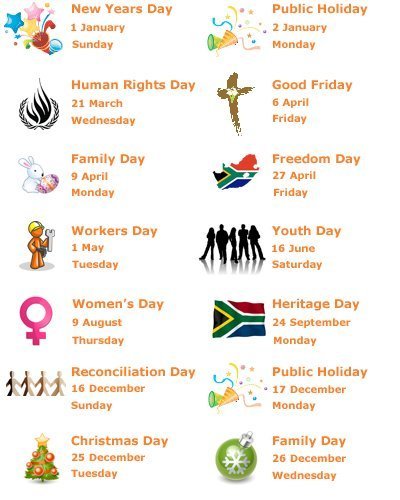
The commission with the improbably long name (more formally known as the Commission for the Promotion and Protection of the Rights of Cultural, Religious and Linguistic Communities, or CRL) is currently holding public hearings on South Africa’s calendar. Following the receipt of four complaints from members of the public, the CRL has set out to determine the extent to which religious bias informs which Public Holidays we get to enjoy, and which we don’t.

On the one hand, the debate seems easy to resolve. We’re not officially a Christian country, so on the face of it, having Good Friday and Christmas Day as 2 of the 12 Public Holidays is surely discriminatory, in that it privileges one religion over others. If you include Family Day – surely Easter Monday in all but name – a full quarter of the holidays are Christian, and none represent other faiths.

If this discrimination is thought unmerited or wrongful, we’d have two options. We could try to represent all faiths, or we could resolve to represent none. Then, it is of course also possible to argue that the discrimination is warranted, seeing as roughly three-quarters of South Africans claim to be Christian.

You might not expect to hear this from an atheist, but I’m rather sympathetic to the claim that it’s not unfairly discriminatory to allocate 2 of the 12 public holidays to the Christian faith. Religion, per se, does not justify public holidays, even if your religion regards certain days as holy. But sometimes tradition, history or heritage does seem to do so, when it can plausibly be argued to represent a significant majority of a population.

In the case of South Africa, three-quarters of the country appear to self-identify as Christian, and therefore three quarters of the country happen to regard the same days as holy. Seeing as many of them won’t be showing up for work on those days in any event, it seems to make perfect economic and moral sense to recognise that day as special. For most of the country, in other words, it is indeed special.

Not recognising those days as special could simply mean that additional (non-official) public holidays would result. If these two (perhaps 3) days are indeed the most holy days in the year for Christians, a possible alternative is of course to let people choose to take these days as part of 12 holiday days everyone is entitled to, on days of their choosing. But why create the logistical nightmare of forcing this large community to co-ordinate their holidays in this way?

Second, if all holidays are a matter of choice, it’s not only the co-ordination of them between family, friends and communities that’s an issue – we might also suspect that some people would end up getting no public holidays at all. It’s one thing for an employer to pressure someone to work on an official Public Holiday – easier still would be for an employer to keep refusing to allow someone to take any self-designated day off. Having 12 pre-identified days makes everyone’s planning easier, and makes it more difficult for employers to exploit their staff.

So however we resolve the public holiday debate, giving everyone 12 days off – on days of their own choosing – seems the worst possible choice we could make. Our alternatives, as mentioned above, are to include all religions or to include none. Including all of them is clearly out of the question, unless by “all” we mean some limited set, rather than all. Deciding on who gets to be included in that limited set would require some discrimination, though, and seems to get us back to square one – who gets to decide which religions are privileged, and why?

If, as suggested above, making these decisions is premised on popularity, then we should bear in mind that we might sometimes need to revise which public holidays are celebrated and which not. If South Africa eventually becomes a majority Muslim or Jewish country, for example, the holidays should change accordingly. This is perhaps the main issue: such a revision will be unpopular and divisive, and therefore unlikely to occur.

So we might want to consider the discrimination to be unjustified, and resolve that public holidays need to be entirely detached from religious holy days. Then, the days would never need changing and would be selected on a more principled basis. They could be arranged in such a way that the impact on the work week – and the economy – is minimised. Public holidays in the middle of the week invariably result in absenteeism on adjacent days, and this problem could be resolved by stipulating holidays on “the third Monday of June”, for example, rather than on a fixed date.

As indicated earlier, though, arguments that the current arrangements are discriminatory (coming from both other faiths and nonbelievers) seem to my mind overstated. Discrimination is not always wrong, though it’s easy to understand a non-Christian religious person feeling more aggrieved in this case, seeing as to all intents and purposes, having two Christian days recognised where no other faith has a day does appear to present Christianity as the de facto national religion.

Debating this issue on the grounds of discrimination seems to result in more heat than light. We’re becoming a nation of complainers, always on the lookout for who is abusing our dignity or denying some putative right. If there is a slight to other faiths and no faith here, it’s a minor one. But if we are to consider whether the current public holidays are the right ones, there are serious issues to debate – most importantly how we can derive maximum public benefit at lowest cost to the economy. Let’s hope the Commission takes the opportunity to consider those issues, rather than being exclusively concerned with religious (and non-religious) sensitivities.
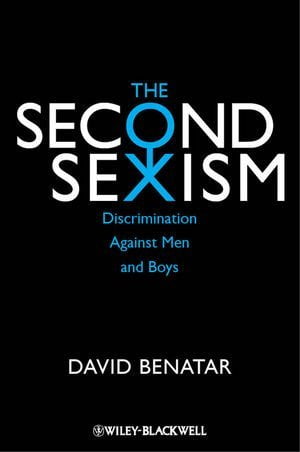
The Second Sexism

Originally published in Daily Maverick

Focusing on one manifestation of an issue can sometimes obscure other manifestations. Or, it could even obscure the fact that what we’re dealing with is a systemic issue or even problem, with multiple manifestations. To (briefly) return to a theme we’re all sick of, treating certain cultural beliefs related to respect as normative in the case of The Spear is one thing, but if someone were to claim that the same cultural norms justified abolishing equal suffrage, we’d be less sympathetic.

Arguments that use some established norm or cultural preference to motivate for a certain conclusion are open to these charges of inconsistency – both in terms of when the arguments are leveled, and in how we respond to them. Political correctness and the expectation that we respect the views of others tend to censor us – at least until the stakes seem high enough that silence is no longer appropriate.

Little evidence of integrity at the Film and Publications Board

As submitted to the Daily Maverick

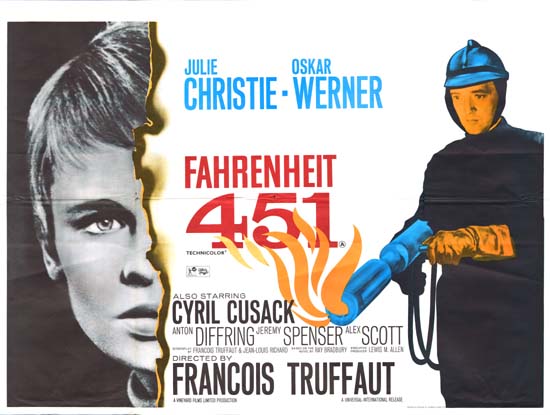
When the Minister of Higher Education calls for a painting to be “destroyed for good”, it’s difficult to not be reminded of Ray Bradbury’s “Fahrenheit 451”. In case you’re unfamiliar with the book, the title describes the temperature at which paper auto-ignites, and the plot addresses the burning of books as a method for suppressing dissenting ideas.

Framed as a method of thought-control, the destruction or censorship of paintings and books should horrify all of us who hope to live in a free society. So instead of framing it in those terms, why not instead make a case based on “protecting the children”? After all, who but a moral monster would be opposed to protecting children?

This is not yet another column about Zuma’s Spear, but rather an attempt to highlight the creeping threat to liberty exemplified in Nzimande’s statement about The Spear, as well as the Film and Publication Board’s (FPB) decision to classify (images of) the painting as 16N. That the former hasn’t attracted significant outrage is a surprise, because even though Nzimande might well have been speaking as the leader of the Communist Party, he also happens to be the man who oversees the country’s higher education system.

As one of the thousands of academics whose professional lives are influenced by this man’s judgement, I have cause to be concerned about a statement like this. As do all of us, not simply through being invested in the country’s future, but because it’s a stark distillation of the level of cynical manipulation of voters that some in the ruling party are willing to deploy. It’s not simply inappropriate for a Minister of Education to call for the destruction of artworks – it’s a complete abrogation of his responsibilities.

But seeing as those he reports to happen to be sympathetic to that view, we should of course expect no censure, apology or retraction. Meanwhile, if the FPB could have their way, images of Murray’s painting would be scrubbed from the Internet lest some under-16 (or sensitive adult) happens to come across it. The danger is of course real, in the sense that a Google search for “South African art” might well highlight the offensive image in question.

The FPB will be engaging with Internet service providers and search engines to “enforce this decision going forward”, which could well mean the dusting off of the Internet and Cell Phone Pornography Bill, Malusi Gigaba’s plan to enforce the moral standards of a few right-wing Christian organisations on all of us. One of the organisations consulted in the drafting of that Bill was the Family Policy Institute (FPI), headed by Errol Naidoo.

You might remember Naidoo from his call to boycott Woolworths for their decision to take Christian magazines off their newsstands (the profitability of a private company obviously being subservient to Naidoo’s interpretation of God’s wishes). Or, perhaps you’d recall his involvement in blocking both Multichoice and TopTV from screening adult content.

But in case all of those campaigns happen to coincide with your preferences, we’re also talking about the person who called the Civil Unions Act a “grossly negligent act of Parliament”, and whose monthly newsletters rarely fail to mention the immoral and unnatural scourge of homosexuality, and the complicity of the “liberal media” in obscuring the imminent downfall of civilization that will be precipitated by consenting adults in their bedrooms.

The reason Naidoo and the FPI are relevant to the discussion around the FPB’s decision to classify The Spear is that the FPB statement laments the “suggestions made that have sought to question the integrity and independence of the FPB”. I’d hope that in this instance, integrity would include being guided by the spirit and letter of the Bill of Rights in matters such as freedom of sexual preference and orientation.

But this hope seems somewhat unfounded when you look at the FPB’s website. On their home page, you’ll find a sidebar element headed “Useful Links” – but you’ll only find one link there, and that link is to the Family Policy Institute. In case my objection is not entirely clear, I’m not making the claim that religion (or Christianity in particular) can have nothing useful to say in matters of morality or in decisions regarding what children should be exposed to.

The claim is instead that the FBP is endorsing an organisation, and a man, who is a proud homophobe, and who has repeatedly demonstrated that his views on sexuality in general seem to be plucked straight from the pages of Leviticus. To describe this link as “useful” seems somewhat at odds with integrity, at least as I understand it.

Perhaps there’s a more innocent explanation, namely that the FPB has no idea who or what they are endorsing. If this is the case, we have no less cause to question their competence in effectively performing the task of deciding what to classify and how to do so. Incompetence – at least from the perspective of those who wish to view artworks or movies – is hardly more reassuring than significant lapses in judgement.

So it’s not just that the FPB have made a ruling that’s likely to survive even internal appeal processes, never mind court challenges. The issue is also that the chilling of free speech or artistic expression can happen by degrees, and can be disguised by the motivation of “protecting the children”. Because, framed in those terms, who would dare complain? If you do complain – at least once protecting the children is understood in the terms of folk like Naidoo – you might as well confess to being a paedophile.

Finally: recognition as a ‘homosexual activist’

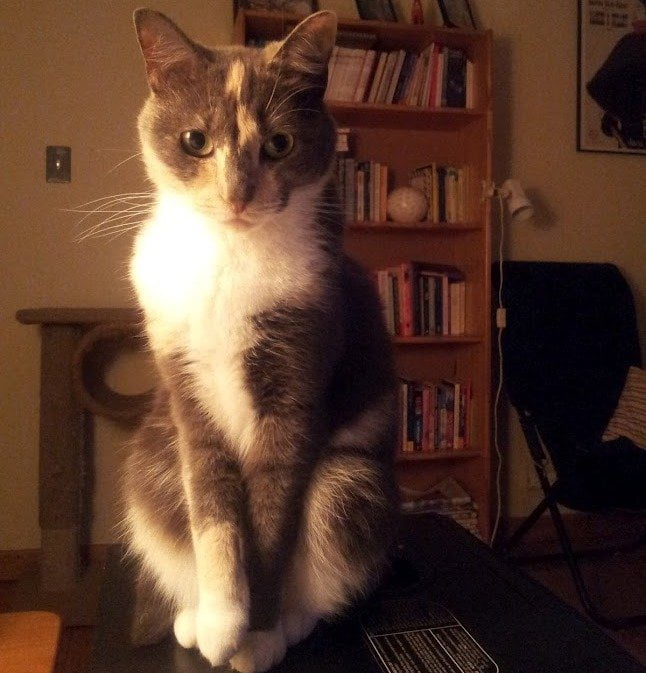
Thank you, thank you. I wouldn’t be here without the help and support of my cats, Mogwai (pictured), Mr Jones and Mot. I must of course also thank the Family Policy Institute, and particularly its leader, Errol Naidoo, for bestowing this honour on me. The reason for Errol bestowing this honour on me is at this stage slightly ambiguous, but for the sake of argument, let’s assume he means “homosexual activist” in both possible senses. Here’s an extract from his latest emailed newsletter:

Homosexual activist, Jacques Rosseau [sic] has slammed the Film & Publication Board for its association with Family Policy Institute. Apparently, my work to protect children from exposure to porn on TV and the internet is considered “censorship” a crime worse than the social degradation of children.

While I’m grateful, Errol, I do need to point out a couple of problems with the reasoning of your selection committee in bestowing this honour on me. First, it’s not quite true that I’m a “homosexual activist” – instead, I try to be an activist against idiocy of various forms, but particularly the sorts of idiocy that results in discrimination. Yours, for example. But also gender or racial discrimination, or giving one particular religious viewpoint undue attention when it comes to deciding on matters of public policy.

Second, the most important reason for mentioning you in that column was to say that the Film and Publications Board shouldn’t be endorsing homophobes. As a state body, you’d think they had a duty to respect the provisions related to equality in the Constitution. So, when some religious creep (not all religious folks count here) calls homosexual behaviour unnatural and immoral, and threatening to “the family” (the families that homosexuals are in don’t count, of course), you’d think they should distance themselves from you. But no – you’re listed as a “useful link” on their website (but without any text saying something along the lines of “This link is useful if you want to know what a bigot looks like”).

Third, I’m fully in support of protecting “the children” from undue harm. But you’ve never (and nor has anyone else) demonstrated that the children will crack the two pin codes required to view porn late at night, nor that there is good reason to swallow your doomsday-ism about the harms that result from pornography in any case. The evidence is inconclusive, and until you can get God to talk to us herself, rather than through folk like yourself, I’ll rather not base public policy decisions on your say-so, thanks.

The rest of the newsletter consists of the usual self-congratulatory detail related to how he’s saving civilization through setting up urgent meetings to discuss stuff. Or sometimes, waiting to see if people are willing to meet with him:

I am waiting on confirmation to meet with the DG of Communications, Ms Rosey Sekese and the CEO of ICASA who are currently in Cape Town to discuss the urgent need to amend legislation to specifically prohibit pornography on TV and to install filters on the internet to block online porn.

It’s a good thing that not even any Christians I know take him, or his organisation, seriously. Except, that’s not quite right: they do take him seriously to the extent that they see him as an embarrassment to their faith, and as very bad PR for Christianity in general. Replace “faith” with “species” in the previous sentence, and the Christians and I are in full agreement.

(A pdf of the full newsletter, in case you want to read more. But there’s no good reason to.)

The creeping nannyism of South African smoking regulations

Originally published in the Daily Maverick
South Africa has some of the most stringent restrictions on the sale, advertising and consumption of tobacco in the developed world. In general, this is a good thing. It seems to me entirely appropriate for harmful substances to be reasonably difficult to get hold of, and that they shouldn’t be made to appear attractive to prospective users.