Flemming Rose and the UCT TB Davie Academic Freedom Lecture

The University of Cape Town Executive have decided to countermand the invitation extended to Flemming Rose by the Academic Freedom Committee (AFC) to deliver the annual TB Davie Academic Freedom Memorial Lecture.

While the AFC (a committee that I currently chair) has released a statement on this decision, I would like to offer some additional comment. Any views expressed here should not be assumed to be shared by anyone else, in particular other members of the AFC.

Science vs soundbites and sensationalism #IFT16

Late last year, I had the pleasure of meeting outgoing IFT President, Colin Dennis, at a talk I gave at the 2015 SAAFoST conference in Durban. For those of you who are interested in food science and nutrition, and who don’t know of SAAFoST, I’d like to point you in the direction of their “Food Facts Advisory Service“, where you can find a number of informative pieces on food facts and fears.

In any event, Prof. Dennis suggested that he would be keen on inviting me to speak at a future IFT event. To my great surprise and pleasure, that invitation ended up being to give one of the keynote talks – alongside such luminaries as Dr Ben Goldacre – at the IFT  congress in Chicago, which has just concluded today.

New York, The Cure

T and D and I recently went to New York, to witness The Cure in concert at Madison Square Garden. D should really be writing this story, as he’s the professional storyteller, who often tells stories so well that you can hardly believe them to be true.

Perhaps I’m the right second-choice, though, as while T could derive the quotient of any two numbers you give him to 5 decimal places (maybe more – no insult intended!), and then tell you something about the importance of that number to some vital – but really obscure – detail regarding human history, he doesn’t style himself as a writer.

I think I took too few photographs, but photographs wouldn’t tell the full story in any case. Neither will I, but here are a few pieces of the story, starting with a subway ride to Coney Island. It was lunchtime, and I had impressed upon T and D the importance of visiting Totonno for pizza.

Two years previously, I had tried to take B, K, and S to the same establishment, walking the 700 meters or so from the subway stop to the pizzeria (that’s far, at midday in July), only to find that they were closed. Today, I had made sure they were open, and the pizza was as good as I remembered.

Walking out, T and I wondered whether D was a Cure fan of sufficient intensity to really think this pilgrimage worthwhile. So we set him the standard test in these situations, namely asking what his favourite album was. He answered correctly, and T and I knew we were all of like mind.

After pizza, we expended (too few of our) carbohydrates on a boardwalk-walk, ending up at a cocktail bar, where we scored an extra frozen margarita, after the charming and generous barkeep caused a little spillage in handing it to D – or when D grasped it too eagerly. In any event, 3 guys, 4 cups. 4 strong cups, drunk alongside a bare-torso’d and buff man, sporting a tattoo of a Saint, and far too many muscles.

We got back to Manhattan late afternoon, and decided to have drinks at the rooftop bar of my hotel. There was a woman collecting money at the entrance to the elevator – a “couvert charge”, as so many signs at the entrance to clubs in the 80’s and 90’s read. But my room was on the 10th floor, and these folks were ‘my guests’, so we headed towards my floor, and simply passed it by, arriving at the rooftop shortly thereafter.

D went outside, and T and I went to the bar. Cosmopolitans sounded like a good idea to us, and so it was that we emerged into the New York skyline with three glowingly-pink drinks. Onto a rooftop patio populated entirely by muscular black men taking selfies, and who were quite clearly gay.

One of them asked us what we were drinking. D told him it was a Cosmopolitan. He turned his string vest away from us, and D took a photo of our three pink drinks, with that man in the background, taking a selfie.

Later, we walked to Madison Square Garden, where the efficiency was impressive. As was D’s – while T and I stood in the queue to buy T-shirts, he struck up a conversation with a random stranger, which ended up resulting in

  • a seat 10 rows from the front, where D calculated that he would (if he wanted to) be able to run onstage and seize one of Robert Smith’s guitars before security got to him, and
  • advice from one of the security guards that he could use whatever bathroom he liked, depending on which queue was shorter, because by law, they were not allowed to ask whether you identified as male, or female, or whether you reject the choice entirely.

T and I were between D and the nosebleed seats, and alongside two very enthusiastic women, one of whom was quite bonkersly happy, all googley-eyed and yelling things I couldn’t hear or chose to ignore. For some reason, T bought them a few drinks, and they spilled vodka on my Cure T-shirt as it lay on the ground in a bag next to T.

The concert was easily the best one I’ve ever been to. The sound was perfect, the songs were old, and the Garden was full of people as excited to be there as I was. We drank many vodkas, and many bourbons after those. We smiled, from the first note to the last note of the (4th!) encore.

Waking up the next morning, I thought to myself: Suggesting that D walk me home (we were heading in the same direction) is the sort of thing I can imagine a friend like T thinking of. Happily following the suggestion is likewise the sort of thing a friend like D wouldn’t hesitate to do.

And when I saw them both the next morning, it turned out that this is exactly what happened.

Scientism and the limitations of logic

Slate recently published an interesting piece on “scientism”, which both perpetuates a caricature of science and rationality, and also points to a genuine problem with some folk who can’t see beyond science and reason as tools for addressing our political and social dilemmas.

“Scientism” is the belief that all we need to solve the world’s problems is, you guessed it, science. People sometimes sub in the phrase rational thinking, but it amounts to the same thing. If only people would drop religion and all their other prejudices, we could use logic to fix everything.

Last week, Neil deGrasse Tyson offered up the perfect example of scientism when he proposed a country of #Rationalia, in which “all policy shall be based on the weight of evidence.”

Tyson is a very smart man, but this is a very stupid tweet, and a very stupid idea. It is even, we might say, unreasonable and without sufficient evidence. Of course imagining a society in which all actors behave logically sounds appealing. But employing logic to consider the concept reveals that there could be no such thing.

There are two very different things being described here. To base all policy on the weight of evidence is a fundamentally different thing to desiring a society in which all actors are Mr. Spocks, all logic and no emotion. In conflating them, Jeffrey Guhin sets up the caricature I mentioned at the top.

Many pro-science and rationality folks, including myself and the vast majority of scientific skeptics I’ve been hanging out with at conferences for the last decade, would agree with Tyson’s tweet while rejecting the implication that it means we need to be all logic, all the time.

The reason for this is simple, and points to Guhin’s misunderstanding of the broader – and social – context to scientific reasoning. Emotions, intuitions, aesthetic preferences and what have you are all things that make us human, and social creatures, yes – but they are also data points in themselves.

In other words, policy that is based on the “weight of evidence” does not need to be blind to these human details, and is in fact compromised if it’s not sensitive to these details. We care, for example, about compliance with the law, so it would be irrational to enact a law that caused such a negative (emotional) reaction that compliance was impossible.

We also care about happiness, meaning that it would be irrational to treat each other solely as logical agents. Doing so would make marriages and friendships unbearable, and parent-child relations dysfunctional. Our relationships admit to – and even cherish – the idiosyncrasies of our various subjective points of view.

Guhin does go on to make various good points about scientific overconfidence, reminding us that “experts often get it wrong”. But this is again to rely on a misunderstanding of science – good science knows that it’s fallible, and this is in fact one of its key virtues when compared with pseudoscience.

The fact that scientific reasoning leads to errors (he mentions scientific racism, phrenology, eugenics and other examples) is only a crippling problem for science if there’s some better alternative for resolving empirical problems. Until we have one, the point is that science is self-correcting, and that we can discover and discard our mistakes.

More critically, the scientific method is of course vulnerable to exploitation by those who want to use it for odious reasons – but isn’t dogma (for example religious fundamentalism) more so? And, to note that people use the language of science to prop up eugenics doesn’t entail that they used good scientific reasoning to do so. Instead, we can now recognise it as an abuse of the scientific method, rather than a proper application of it.

Guhin has harsh words for Tyson, for the “I f***king love science crew”, and for Dawkins, as I also previously have for all three cases. But the problem with these evangelists for science is largely a political one, rather than them being wrong on the principle of the matter. If you communicate with others in ways which make it sound like you think they are stupid (Dawkins), people aren’t going to listen. If you communicate in ways which make it sound like you are stupid, for example in dismissing the value of philosophy (Tyson), you’ll also lose part of your audience. And if you just share (sometimes incorrect) memes on a Facebook group, nobody is going to believe you actually love science at all.

Guhin is right to remind us to not appear as evangelical as those we sometimes find ourselves arguing with. I’ve been watching folks on Twitter making the tone-deaf “the evidence must decide” sort of arguments with regard to various arguments about race and economics in South Africa, and they don’t get that even if that’s true, social progress also requires not being an ass.

But to conflate “rational thinking” with “scientism”, as Guhin does, is a mistake. Rational thinking can incorporate both following the evidence, and doing so in a way that is aware of one’s own biases, and all of our emotions, needs, wants and fears.

Those are all evidence too, yes. But – crucially – one of the ways we can get along better is knowing when to point that out, versus knowing when to take off our “Mr Logic” caps, and simply relate to each other as human beings.

Democracy – the worst form of government…

… “except for all those other forms that have been tried from time to time”, as Churchill reminded us.

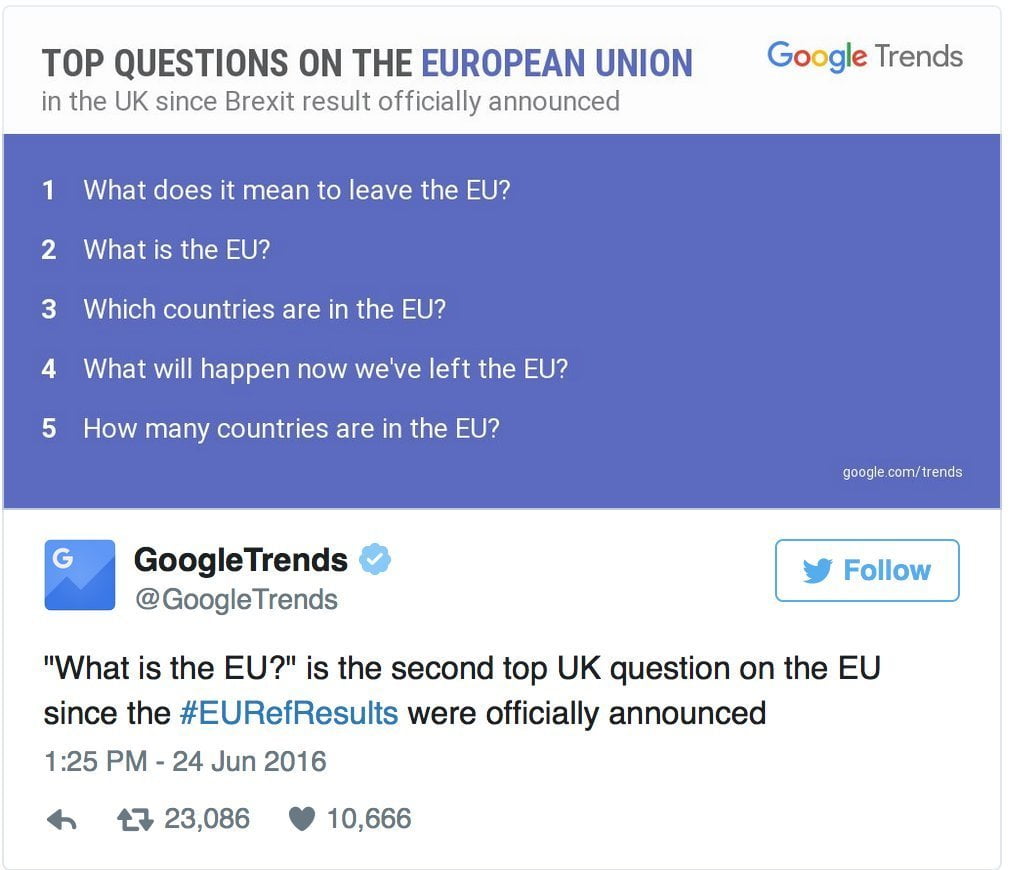
People are still talking about #Brexit, as one might expect given the severity of some potential consequences of the United Kingdom withdrawing from the EU. But some people – including one that I have great respect for, Prof. A.C. Grayling – are arguing that UK Parliamentarians should vote against any motion to trigger Article 50 of the Lisbon Treaty.

Article 50 would start the official clock on an EU exit, whereas what we have now is a non-binding advisory reflecting the will of the voters. As the English lawyer and respected legal commentator David Allen Green puts it:

What happens next in the event of a vote to leave is therefore a matter of politics not law. It will come down to what is politically expedient and practicable. The UK government could seek to ignore such a vote; to explain it away and characterise it in terms that it has no credibility or binding effect (low turnout may be such an excuse).

Of course, it might not be politically possible for Parliament to reject the vote, even if the majority of parliamentarians wanted to, given that doing so would be acting expressly against what the voters have asked for.

A separate question is whether the voters knew what they were doing. Another is whether the referendum was constructed appropriately, in that you might want to require a larger (perhaps 2/3) majority for a decision of this magnitude.

My concern is that you can’t like democracy only when you happen to agree with the decisions taken by an electorate. To say that voters didn’t have access to all the information they needed to make the “right” choice here is to my mind false – they had the information, but some of them perhaps didn’t access it until too late, and some of them perhaps never thought about it enough.

No amount of “buyers remorse” proves the point that the will of the people was not expressed in the #Brexit vote, whether or not you regard the people as fools or sages for making the decision they did.

So I’d disagree with Grayling here. A choice has been made, and according to the rules of democracy, Parliament would be acting without a mandate if it were to ignore the vote. Sometimes the electorate makes decisions that suit you, sometimes it doesn’t – you don’t get to change the rules when you don’t like the outcome.

If I were supreme leader, I’d want to ignore the will of the people in this case, as well as in many others. And that, in short, is why the majority vote gets to decide – because even when “they” make the wrong choice, you’re still protected from having to suffer the whims of a dictator.

What does Trump say about us?

On June 16 of 2015, a friend and I found ourselves in a New York hotel, feeling somewhat compromised after a late night and much revelry. Thanks to our throbbing heads, the spectacle of Donald Trump’s glass elevator arrival – in order to give the first of many bombastic and often fact-free speeches in support of his Presidential ambitions – invoked many sighs and “oh my god”‘s, but not much discussion.

When we did talk of it later, and in conversations that took place in subsequent months with him and others, it was oftentimes with a tone of incredulity, in that the chances of a Trump victory – or even nomination – seemed vanishingly small, and his attempt to seek the nomination therefore a simple manifestation of an ego the size of a planet (hello Marvin!).

We all know better now, of course. By which I don’t mean that the ego stuff is false – he certainly has it, and is flaunting it like only a narcissist can. But when I arrive back in NYC on June 16 this year, Trump will have been the confirmed Republican nominee for nearly two months already, with Hillary Clinton the only remaining potential “loser” for him to defeat (once Bernie Sanders gets out of the way, that is).

And one year on, the thing I want to briefly touch on is the narrative that Trump’s ascendancy has provoked in some quarters, whereby voters are being described as “irrational” or “stupid”. Some surely are either or both of these things, but there’s no reason to think – and no plausible mechanism whereby – voters suddenly become more irrational and/or stupid, en masse, in the period since the last election, or even over a generation or two.

Describing your opponents or “enemies” via abusive terms helps us to keep “our” tribe together, and helps “them” to do the same, but it involves no attempt to explain why people might make ostensibly irrational choices, nor to help us figure out how to minimise the chances of their doing so in the future.

One part of this Trump campaign (including the behaviour of his supporters at rallies) that needs explanation is not only how you can get away with talking nonsense so much of the time, but more crucially how it can be that you can get away with blatant racism and sexism while campaigning as a Presidential candidate.

And on that aspect of things, I’d encourage you to read this piece by Thomas B. Edsall, about which a friend remarked:

Edsall here gives what I think is a crucial part of the diagnosis of Trump’s success. Decades of shaming racists, nativists, sexists, and homophobes into concealment, instead of arguing with them, has been unwise but strongly institutionalized politics and now the bill has arrived.

It’s been said before, but “call-out culture” and mob shaming on the Internet might satisfy our tribal lusts, but if you’re looking to change thinking and behaviour, you might want to consider a different tactic.

Harambe and our hubris

One of the lessons we could learn from the killing of Harambe, the gorilla recently shot by Cincinnati Zoo staff, is that we humans are forgetting that not everything is under our control, and that it never could be.

We are not omniscient and omnipotent gods – all we can do is plan as best we can, and take reasonable precautions against unknown risks. And even when you do so, something could still go wrong, as ended up being the case on Saturday, when a child fell into this gorilla’s enclosure.

It’s easy, from the sidelines, to insist that the mother was negligent. Perhaps she was – but at the same time, the only way to guarantee the safety of your children is to keep them in a protective bubble at the end of a leash. In a padded room. Even if you’re careful, mistakes happen.

It’s easy to say that the zoo is at fault. But this is the only time this had ever happened to them since 1978, and it’s an incident that exposes a weakness in the enclosure security that they hadn’t known about until now, presumably after taking all reasonable precautions in enclosure design and maintenance.

It’s easy to choose sides, and say that it’s outrageous that an endangered animal had to die because of someone’s negligence, because why couldn’t they tranquilize it instead – even as expert after expert reminds you that a 400lbs gorilla would take a good few minutes to go down after a (successful) shot, which would give its agitation more than enough time to be channeled into an expression that kills the child.

We want winners and losers, heroes and people to blame. Some are taking blaming the mother so seriously that over 400 000 of them (more by the time you read this) want the parents to be “held accountable”, and tell us that this incident demonstrates a “negligence may be reflective of the child’s home situation”.

These things seldom stop with petitions, though. Mob justice ensues, and people are bullied on Twitter, Facebook and the like. Sometimes it’s not even the “right” person being bullied, but a namesake only, that some keyboard warrior for Harambe has discovered and intends to shame into abjection.

This was an accident with tragic consequences, which are sometimes unavoidable despite our best efforts. Everyone will learn from it, including – hopefully – the mother, whose immediate response was to thank God, rather than the game-ranger who actually (probably) saved her child.

Meanwhile, as people mourn Harambe, a gorilla on the Internet (as far as most are concerned), they wouldn’t give a moment’s thought to joining any initiative aimed at saving western gorillas more generally.

Meanwhile, as people mourn Harambe (at least the people who – like me – still eat meat), they won’t give a moment’s thought to the animal suffering they are responsible for, simply because they prefer a certain sort of food.

This desire for “justice” and for “shaming” is within our control. This lack of perspective where we think that we could have done better, and someone else is blameworthy – even though we know a fraction of the context – is within our control.

But knowing all possible eventualities, preparing for every possible risk, and making the perfect decision in the moment (rather than bloviating about what it was, in retrospect) is not something we can reasonably expect of ourselves, or anyone else.

The mutual symbiosis of a “regressive left” and a “reactionary right”

It’s not insightful to say that social media are probably unrepresentative of what the common person thinks, nor that platforms like Twitter encourage hyperbole and argument.

I do however think that the hyperbole is an expression of the same lack of charity and unwillingness to find a middle ground that we see in newspaper coverage of contentious issues such as Hilary vs. Bernie, whether Trump is a fascist or not, or whether South African students need to be applauded or pilloried.

It’s possible for us to disagree with each other, but to do so in such a way that doesn’t caricature, and that doesn’t disincentivise any future attempts at debate. And, there is of course little chance of persauding someone that they are wrong, if they are no longer talking to you.

That last point is why last night, I tweeted:

Consider this example, from yesterday’s Washington Post, titled “College students run crying to Daddy Administrator“. I’m sometimes as annoyed by students as anyone could be – it’s difficult to avoid being so when you deal with 1 500 of them a year. They can be lazy, oversensitive, rude, and so forth.

But, they are also inexperienced at being a small anonymous cog in a large machine that isn’t necessarily geared for giving them personal attention, or for allowing them the time to discover, and explain, what it is that feels alienating, oppressive or offensive.

They also, quite simply, haven’t necessarily learned the conventions and language of what it is to negotiate in good faith in a civil society – why would they have, having grown up on discussion forums, Twitter and Facebook?

Colleges are supposed to be places where young adults develop the critical thinking and social skills to peacefully, productively engage with people with whom they disagree, whose ideas they may even find detestable. But today’s students — and tomorrow’s workers — are discouraged from resolving such conflicts on their own.

They are not learning to use their “logic and reason and words,” as President Obama urged in his Rutgers University commencement speech, during which he chided students for forcing Condoleezza Rice to withdraw from an earlier talk.

That (from the Washington Post piece) is all true. But I think it’s also true that calling people “babies”, or mocking them for taking offense too easily, can serve to simply validate their concerns.

Likewise, insisting that everyone who disagrees with you – no matter whether their disagreement is polite and thoughtful (even if wrong or confused, by your lights) is a member of some out-group like the “regressive left” can serve to simply confirm to them that you’re part of some “reactionary right” – and neither side is then left feeling that there is any point in talking to the other.

It is indeed a problem that people can have overly thin skins, because robust debate and disagreement is necessary to improve our arguments and our characters. But it’s also a problem when you have concerns (even if they might be trivial or unjustified concerns to others), and those you express the concerns to respond with ridicule.

Both these extremes are a problem, and there’s no reason you have to choose either of them.

Ungovernables from the subcontinent, busy in Berlin

I returned yesterday from a week in Berlin, which I can highly recommend for those of you who haven’t visited. While I don’t normally do the standard touristy stuff, there’s so much history in this city that I thought it well-worth the guided tours that our group went on.

The traveling party consisted of a bunch of folks from #Africablogging, a blogging network I joined last year, that is dedicated to supporting democratic culture and debate in Africa, and the trip was generously sponsored by the Konrad Adenauer Stiftung media programme.

The highlights are too many to mention, but I’d recommend a trip to the lakeside villa where the Wannssee Conference was held in order to plan the “final solution”, the Jewish Museum, and the Stasi prison Gedenkstätte Berlin-Hohenschönhausen.

The other highlight was that we got to attend (and I spoke, on freedom of speech in the age of social media) re:publica, a very worthwhile conference on all things Internet and digital media. There were fantastic talks on drones, surveillance, Snowden, trolls, and more.

Randall Munroe of xkcd was there, Laurie Penny was there, and around another 6 500 people were there too, so it was rather festive, given the lovely Spring weather and the German penchant for drinking beer all day.

And, the other thing I really enjoyed was spending time with my fellow #Africablogging authors, from Zimbabwe, Kenya, Nairobi and elsewhere on the continent.

In marked contrast to South African conversations, for example the conversations sparked by the incident I wrote of in my last post, we spoke about race and politics openly, and honestly, without folks leaping to conclusions or forcing you to accept false dichotomies.

I haven’t figured out why South Africans seem (in general) so averse to nuance in political conversations, and so keen on identity politics being allowed to dictate those conversations, by contrast to my experience of other sub-Saharan cultures. But however it is that they got there, I hope we too can, someday.

“Boys with tips” and “Girl with cake”

When Girl with Cake was a thing, I wrote that even well-intentioned charitable giving should not be considered immune to criticism, as even that sort of charity can perpetuate stereotypes about the recipient. Another way in which charity could be criticized is if it’s inefficient – if the same efforts would be better directed elsewhere, which is one point made by proponents of “effective altruism“.

Yet another way in which charity can go wrong is when it validates stereotypes about the providers of charity, and this is to my mind the problem with the recent campaign to crowdsource tips for an Obz Cafe waitress who experienced some brutish behavior at the hands of a dinner table populated by Rhodes Must Fall activists.

Ntokozo Qwabe (NQ), a graduate of Oxford University and the most prominent voice of the Rhodes Must Fall campaign in Oxford, relates what happened as follows:

They take a pen & slip in a note where the gratuity/tip amount is supposed to be entered. The note reads in bold: “WE WILL GIVE TIP WHEN YOU RETURN THE LAND”. The waitress comes to us with a card machine for the bill to be sorted out. She sees the note & starts shaking. She leaves us & bursts into typical white tears (like why are you crying when all we’ve done is make a kind request? lol!). Anyways, so this white woman goes to her colleagues who are furious. She exits to cry at the back & a white male colleague of hers reluctantly comes out to address us & to annoy us more with his own white tears telling us that he finds our act “racist”.

(You can read the rest at the Daily Vox.)

In reponse to this, Sihle Ngobese (SN) visited the restaurant, found the waitress – Ashleigh Shultz (AS) – and gave her the tip that the RMF table could (and should, unless they received terrible service) have given her, were it not for the fact that they objectified this woman as a placeholder for white oppression, despite knowing nothing about her, her politics, or her financial circumstances. (Something they of course should have been aware of is the likelihood that, as a waitress, she and some hypothetical intersectional movement might well find some common ground on the issue of class and privilege.)

Some say that this isn’t racist, because black people can’t be racist. I don’t agree with that, even though I understand the disctinction being made. This is because I don’t see the point of distinguishing between race-based bigotry expressed by people of a subjugated race and that expressed by a privileged race. ‘Racism’ seems a useful shorthand for both, albeit of necessity accompanied by the acknowledgement that the priviliged race is likely to not only be racist more often, but also to be oblivious to their racism more often.

Next, Roman Cabanac and Jonathan Witt (who host the Renegade Report podcast on CliffCentral) started a Twitter crowdfunding campaign that ended up generating R44 778 in donations for the waitress in question. (Another crowdfunding effort also sprung up, generating an additional R15 000+.) [EDIT: Twitter user @GarethKourie points out that this second campaign has reached $5000, so, more like R70 000, meaning that AS has now been tipped around R115 000.]

Later on, we find out that the waitress has a mother who has cancer. This information was however not available at the time the campaigns started, so should be irrelevant to any analysis of whether the campaigns were appropriate or not – they were not generated to raise money for cancer treatment, but to offset her experience of abuse by RMF, and to demonstrate a moral counterweight to the callousness of NQ and his dinner companions.

Both of those goals could, in my view, have been achieved without creating the impression of a couple of (literally) white knights charging in to protect one of their own against the (literally) dark forces of RMF. And, creating that impression simply lends credence to one of the legitimate concerns of the RMF movement, namely that white South Africans (and people, in general) are far too unaware and unconcerned about the fate of black people compared to the fate of other whites.

It’s of course true that it should, in theory, be possible to separate these issues from race, and to simply regard this as an act of generosity. But to think that people will (or even should) do so now in the political landscape that is South Africa is either naive or wilfull denialism. To refuse to countenance any criticism on this topic – as the Renegade Report hosts have done in their Twitter responses – is difficult to read as anything other than a commitment to making a point, rather than being humanitarians, even if the outcome of their commitment is a plus for humanitarianism, on balance.

The offset to her experience, and the restoration of her dignity, in a sense, was to my mind accomplished by the initial R50 donation and the outpouring of support on Twitter. The moral counterweight was provided by the same outpouring of support, as well as extensive and robust criticism of NQ, including from many black commentators who are usually sympathetic to RMF. Some of the criticism was, of course and unfortunately, racist and ad hominem abuse directed at NQ, which again simply serves to gift him the moral high ground he in no way deserves in this instance.

The job was done, in other words, meaning that if you wanted to crowdsource charitable donations, you should look further afield than this case. Anything beyond the extensive criticism and the symbolic tip – and especially something that ends up generating an amount of money that will outstrip what many black South Africans earn annually, is going to have a hard time appearing to be a humanistic gesture.

This waitress is relatively undeserving of this gift compared to so many other people. The gesture can’t help but appear to be motivated less by generosity than by a vindictive “sticking it to NQ”, showing how much of a better person “we” (the donors) are.

And, as I said on Twitter, you’ll find that (or at least I find, and I eat out too many times every week) black waitstaff are routinely treated rudely, and (I imagine) tipped less generously than white ones, assuming that the level of expressed respect correlates with the level of financial support offered as tip. My claim is not that “if you can’t help everybody, you should help nobody” or something of that sort. Of course we are forced to pick our causes.

My point is that helping this one is a strike against the “fascist” RMF (as they have been described by at least one of the Renegade Report hosts), masquerading as charity, and that the optics of this case are exceedingly poor, serving to reinforce negative racial stereotypes.

It doesn’t help the argument to assert that some of the donors are black, or that this sort of argument is of the “social justice warrior” variety. The latter is a vacuous slur that completely escapes the force of argument in the sense that even if it’s true (and it is) that some folk concerned with social justice are knee-jerk thoughtless reactionaries, not all of them are. Arguments need to be addressed on their merits, not with cliches. And even if some black people donated, they don’t provide political cover because they can also be prejudiced against RMF, or thoughtless regarding the impression this campaign creates.

Of course, these black donors are also not effective body shields against criticism when the campaign is spearheaded (after the first tip from SN) by white folk, where most donors are white folk, and where the “movement” enourages support from the likes of Milo Yiannopoulos. If he’s on your side, you really need to reconsider your strategy.

To summarise, I don’t think this is an example of effective altruism, and I also think it faily obvious that it feeds into confirming stereotypes about “whiteness”. Those who support the campaign might well not believe in the entire concept of “whiteness”, and I would agree with them that it’s an overplayed concept, often used as a thoughtless dismissal of opposing points of view.

But the fact that is sometimes (even often) abused doesn’t mean that it’s never true that we can perpetuate harmful stereotypes, and impede progess, regarding race relations in what we do and how we choose to do it – as is the case here.