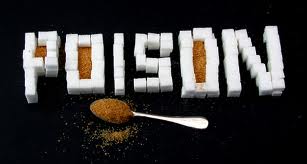
Pseudoscience Friday – Sweden abandons “diet dogma” (not), and sugar addiction

There are some pieces of information that one could call “zombie facts”, for two reasons – first, they are compromised in terms of their mere existence (zombies don’t exist, and these aren’t facts) and second because they are very difficult to kill.

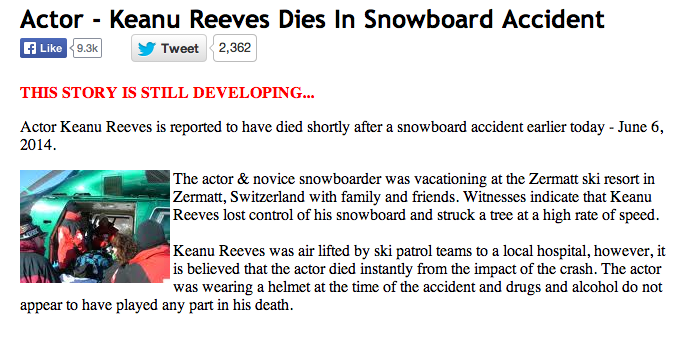
In February 2012, we learnt that Keanu Reeves had died in a snowboarding accident, and it took myself and a few others most of the day before we managed to get South African Twitter to stop circulating this zombie fact.

When pointing out that the website in question has a footnote attesting to being 100% fake made no difference, I started tweeting that I – and many others – had died also. Go ahead and die for yourself, if you like, by editing this URL.

Screen Shot 2014-06-06 at 12.13.12

Pseudoscience Friday – The DA swallows Food Babe’s babble

downloadIt’s taken less than a week for dedicated time-wasting to begin, for some members of the Democratic Alliance in the Eastern Cape. Soon, they’ll bring this time-wasting to Parliament, if we are to trust this DA statement telling us that MP Annette Steyn will take questions on the issue of Sasko (and others) adding ADA to their bread to the relevant Minister.

Briefly, for context: ADA (Azodicarbonamide) is a chemical used in bread production (as well as in the production of yoga mats, among other things), and ADA is legal for use in quantities smaller than 45 parts per million. It helps with both bleaching of bread, and giving it a lighter and fluffier texture.

And, says the Eastern Cape DA,

according to the World Health Organisation ADA is known to cause respiratory problems such as asthma, allergies and skin problems. Scientists are of the opinion that ADA has the potential of causing cancer.

Furthermore, the

people most affected by this potential health risk are the poor people of the Eastern Cape who do not have access to information about ADA. They are the very people who need the most protection from questionable foodstuffs that could compromise their already precarious health status.

The fact that something is a legal additive doesn’t mean it’s safe, of course. However, the fact that a chemical can be dangerous under certain circumstances does not mean that it’s unsafe under other conditions – for example, in the production of bread. As this superb Guardian article reminds us, it’s the dose that makes the poison.

And, the fact that Australia, the UK and some countries in Europe have banned ADA in bread does also not demonstrate that it’s harmful either – it might just be that they have succumbed to the fearmongering propagated by the likes of Vani Hari (the self-styled Food Babe), who is so dedicated to over-reacting to the mention of any chemical in food that I’d not be surprised to see her falling for the Dihydrogen Monoxide panic next.

Vani Hari started a petition that was instrumental in getting Subway to remove ADA from their bread, where she cited the same World Health Organisation (WHO) information quoted above. However, she either didn’t read what the WHO said, or she’s happy to lie in service of fearmongering. The DA also don’t seem to have read the WHO report, which says (my emphasis):

Case reports and epidemiological studies in humans have produced abundant evidence that azodicarbonamide can induce asthma, other respiratory symptoms, and skin sensitization in exposed workers.

In other words, factory workers – working with large quantities of ADA – could be at risk. This has zero relevance to 45 parts per million (or less) in bread. Steve Novella addresses this misrepresentation of scientific evidence, alongside other examples, in a superb blog post on Vani Hari’s Subway petition. (Here’s another by him, on Hari’s concerns regarding DoubleTree Hotels adding “antifreeze” to their cookies.)

Then, as David Gorski points out, there might not be any ADA left in finished bread in any case:

Moreover, azodicarbonamide arguably not even in the final product. According to this article, once flour is wetted with water, reaction with azodicarbonamide with the constituents of flour is rapid. In the experiments described, it only took 30 minutes for all the azodicarbonamide to disappear, with trace amounts left. By 45 minutes, there weren’t even trace amounts left.

In other words, what we have here might be worse than simple “chemicals are bad” panic – we’ve might have a homeopathic version of that panic!

Also on the topic of the naturalistic fallacy and pseudoscience, you might want to take a look at this open letter to Woolworths, which manages to combine a moral panic around GMOs with the more sensible point that food should be adequately labelled.

As a friend pointed out on Twitter, it didn’t take long for the food version of Godwin’s Law – namely the invocation of demon Monsanto – to crop up in the comments. But emotion doesn’t resolve scientific queries, and if you want to read a more sober account of what we know and don’t know about GMOs, I’d recommend Grist’s “20 questions” roundup to you.

(Pun fully intended.)

Epistemic prudence, Noakes, and the limits of authority

Wittgenstein said “Whereof one cannot speak, thereof one must be silent”, and that quote seems as good a place as any to kick off a post on appeals to authority, the death of expertise, and the boundaries of disciplines. As I argued in a 2012 column, agnosticism is often the most reasonable position on any issue that you’re not an expert in (with “agnosticism” here meaning the absence of conviction, not necessarily the absence of an opinion).

Neil deGrasse Tyson, and the usefulness (or not) of philosophy

abou-tyson2Neil deGrasse Tyson has provoked some debate on the value of philosophy and its role in relation to science, following comments that he made on the Nerdist podcast in March this year. He’s not the first scientist to question the value of philosophy, and the most recent high-profile case was Lawrence Krauss, who (in a 2012 interview) said:

Philosophy used to be a field that had content, but then “natural philosophy” became physics, and physics has only continued to make inroads. Every time there’s a leap in physics, it encroaches on these areas that philosophers have carefully sequestered away to themselves, and so then you have this natural resentment on the part of philosophers.

In short, he’s saying that the space remaining in which philosophy might make an important contribution to physics shrinks all the time. I agree with that, but

I have a drug problem

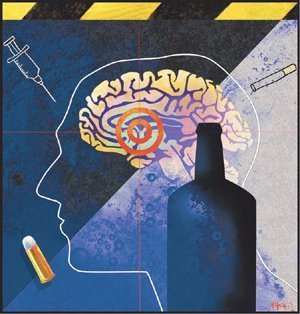
addictionAnd that problem is stigma. Addiction is a biological mechanism, where the desire for a certain stimulus is reinforced through (among other mechanisms) a dopamine “hit” in the nucleus accumbens. It’s a chronic brain “disease” of sorts, influencing your reward system and your motivations. Despite this, many folk continue to think and talk about it primarily as a moral failing, or – on another end of the spectrum of unhelpful interventions – dilute the significance of addiction by using the term to refer to the fact that we enjoy certain foods as evidence of “sugar addiction” or “carbohydrate addiction”.

As Salon puts it in a piece on why addiction carries such a stigma, “the idea that those with addictive disorders are weak, deserving of their fate and less worthy of care is so inextricably tied to our zeitgeist that it’s impossible to separate addiction from shame and guilt”. And that shame and guilt, in turn can sometimes stop people from seeking out treatment while there’s still time to do so.

In Cape Town, we have a significant drug problem – from tik and its association with poverty and gangsterism, to the alcohol abuse that helps to fuel road death statistics. Besides taking responsibility for your own substance-use and (perhaps) abuse, there is one other simple thing we can all consider doing to contribute to alleviating Cape Town’s drug problem. Even if each individual contribution is slight, the collective contribution could be significant.

That contribution is in helping to end the stigma, thereby encouraging people to seek treatment and support. A wider public understanding of what addiction is can remind us to not be unnecessarily judgmental, nor to be overly simplistic about it in referring to social media or sugar addictions as if they are in the same league as a tik addiction. We can also inform ourselves about what the Government is doing (which includes a rapidly-expanding outpatient programme for opiate detox, an emergency helpline, and a significant annual spend on treatment and rehab.

This post was part of a City of Cape Town substance abuse awareness campaign.

If you’d like to add your voice to the Cape Town community and help deal with the substance abuse problem that affects the city, you are invited to share your own story. Post your story of how drug abuse affected your life in The City of Cape Town, and share it on Twitter by using the hashtag #ihaveadrugproblem. If you or someone you know needs help with substance abuse, phone the free 24hr helpline on 0800 435 748.

A Quixotic note regarding Noakes

That title, because I do think it an implausible and potentially unreachable goal to convey (relatively) subtle points about epistemology when the points in question relate to an emotive topic, namely our health and diet.

According to a few folk on Twitter, my blog posts on the topic have amounted to “rabid attacks”, which I find distinctly odd, seeing as the only ad hominem – and emotionally animated rather than merely critical – engagements I’ve seen have been directed at those of us who dare to challenge anything related to the LCHF diet and its proponents.

So, in bulleted points to try to minimise confusion, here are my concerns and positions. These are the same concerns and positions I’ve expressed from the start, contrary to what some “rabid” comments have claimed in response to my posts and columns on the topic.

  • Regardless of the efficacy of the LCHF diet in treating various conditions, and regardless of the truth or falsity of hypotheses assumed by the LCHF diet, we should all have a concern for good scientific thinking, and clear reasoning in expressing the conclusions we’d like to see adopted. Science does not work in absolute truths – it’s an inductive process, whereby we chisel away at falsehoods to arrive at a clearer understanding of what’s most likely to be true.
  • That project of triangulating on the truth is harmed by expressing scientific claims in absolutist language, and by creating movements akin to cults, where people are more likely to forget that anecdotes aren’t data, that being wrong in the past doesn’t guarantee you’re right now, that emotional commitment leads to confirmation bias, and so forth.
  • My criticisms of Noakes have mostly been that – whether or not he’s right – he doesn’t present his case in a way which demonstrates sound scientific reasoning. We reveal ourselves when we “show our working”, and it’s not reassuring to see anti-vaccine quacks and evolution-deniers quoted approvingly when arguing for LCHF. It demonstrates a desperation to make a case, and a lack of sound judgement.

Likewise, not focusing on the details, or the evidence, is a bad sign. Take this tweet as example:

  • It references the UCT Health Sciences Centenary Debate between Dr. Jacques Rossouw (my father) and Noakes. But notice how it references it – by dismissing me as a latecomer who somehow rushes in to defend my father’s cause. However, the evidence shows that I was writing about this 9 months before that debate, and that Rossouw père hasn’t been engaged with Noakes at all for around 20 years, and only got involved in this debate on an invitation from the Medical School when an ex-colleague had learnt that he was coming here on holiday. It misrepresents (a truly rabid critic might even say “lies”) to further a particular narrative.
  • Likewise, it’s misrepresentation to tweet (as Prof. Noakes regularly does) links to Noakes’ SAMJ article criticising the WHI study that Rossouw directed without acknowledging that there were at least two responses to the Noakes article, arguing that his criticisms are misguided.
  • A summary of the problem might be this: Noakes’ audience is primed to believe, and primed to think that critics are deluded, because of the narrative they’ve been told, and because their anecdotal experience (in the short-term, at least) confirms that narrative. And then, the way in which Noakes responds to critics (e.g. “I ignore what I consider not to be evidence“) seems to do little to help them think critically about science, because criticism starts – and sadly, also ends – with the charge that traditional views of diet are deluded.
  • It’s entirely possible that the long-term harms of high meat or fat consumption are overstated, and therefore that Noakes is right. But I can’t imagine him saying that it’s entirely possible that we don’t yet know if there are long-term harms from following his advice, or that it’s entirely possible that a moderate diet, involving a focus shift away from any single or particular macronutrients, might be best for most people. Nothing seems possible, except that he’s right.
  • Then, the LCHF crowd get relationships and potential taint utterly wrong in any case – just because someone works for “Big Food”, the FDA, the South African Heart Foundation or whatever – or is someone’s father/son – doesn’t absolve you of the need to make and respond to arguments. Sure, the connections can lead to the increased probability of some sort of bias, but you still need to show the bias, and not simply evade challenges by asserting it.

I’ve written at length about logic, epistemology, scientific reasoning, anecdotes and their irrelevance, and other issues to do with Noakes’ warrant for presenting his case with the degree of certainty that he does. I’ve said very little about the diet itself, because that is not my focus – and it doesn’t need to be my focus.

The retort that there is “bad science” on the other side is not compelling, in that it’s a) bad science (if it is) mostly because the LCHF people think it reaches entirely the wrong conclusions; and/or b) because it uses poor data. My accusations of “bad science” are premised on the selective quotations, dubious authorities cited and so forth as demonstrated in social media, rather than being about “bad science” in the sense described in (a) and (b) above.

To capture the essence of the only things I have ever said about diet specifically

  • I’m concerned about the affordability of the LCHF diet for poorer populations.
  • I can see how people might be concerned about animal welfare and an increase in the farming and killing of animals. I eat meat, but think it’s a moral failing that I do – and furthermore, I think that the immorality of meat-eating will be the subject of a moral consensus in my lifetime.
  • Independent groups like the Harvard School of Public Health continue to caution against excessive consumption of saturated fat.
  • I’m not at all persuaded by what LCHF folks assert as evidence of the failure of the so-called “prudent diet” – first, because it’s not at all clear that people have ever been eating that way (in general); and second because it caricatures dieticians as having recommended a diet that they claim they aren’t recommending at all. A series of blog posts at Nutritional Solutions are worth reading in this regard.
  • In short, the increase in obesity and the like still seems mostly explicable by the advent of television, increased access to motorised transport, desk-bound lifestyles, and excess consumption of food.
  • Yes, it certainly seems true that fats (in general) have been demonised far more than they should have, and that some of us might have started eating too much of other things (including carbohydrates, especially in the form of sugars) to compensate for a flavour-deficit after shunning fat.

This doesn’t, however, automatically lead to the conclusion that carbohydrates are in general bad, nor to the conclusion that we need no longer be at all concerned about the long-term effects of a diet with significant levels of saturated fat. “Real food” is good, sure – and refined carbs are “bad”. And what that means is, when you carry on eating your modest portions of a balanced diet (which is surely what you eat, right?), you should continue to be wary of including too many processed and refined foods.

That’s what I’ve always been told. What’s “new” is that fats aren’t as bad as we thought, and I (along with many of you, no doubt) were misinformed when we were told that they were rather evil. The truth is probably in the middle somewhere – and why replace one exaggerated position (“fats will stop your heart!”) with another (“carbs will give you diabetes!”).

As Oscar Wilde had it, “the truth is rarely pure and never simple”.

On causes, Noakes, and making prudent claims related to diet

Three pieces related to diet and the low-carb high-fat fad are worthy of highlighting this week, because all of them are a counterpoint to the “sugar is addictive and you’re a victim of a conspiracy” seam that continues to be mined by the likes of Professor Tim Noakes. The first is by Gary Taubes, who Noakes cites as being responsible for removing the scales from his own eyes, and the second is a response to Taubes by Dr David Katz, who says that Taubes is asking the wrong questions.

You can read those pieces yourself – the only aspect I want to highlight here is how moderate Taubes’ tone is. He acknowledges that the science isn’t settled, but that he’s biased in favour of “sugars and refined grains” being the problem. He even includes the rider that “we all have our biases”. Indeed we do. But on that minimal (and yes, selective) quote, Taubes could be saying the same thing that mainstream nutrition science is – which is at a significant remove from the claims made by Noakes, who speaks as if there’s no doubt that carbohydrates are the cause of most of our ills, and that most of our ills can be eliminated (or at least managed) by eliminating the majority of carbs from our diets.

In other words, Taubes at least speaks as if he acknowledges the possibility of being wrong. Noakes, by contrast, leaps straight to rather humorous epithets when people disagree with him, calling them victims of “Group Think”, “statinators”, or “The Anointed”. Alternatively, he’ll poison the well by making very generalised aspersions about funding, as if to pre-emptively taint any claims that are being made. It’s tinfoil-hat territory, and in short, in no way confidence-inspiring, at least not for those of us who want to resist signing up to a cult.

And it’s the third piece that merits your careful attention, if you care for holding science and scientists up to rigorous and principled scrutiny. Not because it says anything new, but because it quite clearly articulates a very essential, and simple, principle of scientific reasoning. Namely: what question is being asked, and what sort of an answer will we be willing to accept as legitimate? The key passage for me – at least in terms of highlighting how Noakes is compromising critical thinking – is this one:

It seems likely that we were seduced by the early successes of epidemiology with point-causes with large effects — infectious diseases — and we were similarly seduced by Mendel’s carefully engineered successes with similar point causes — single genes — for carefully chosen traits, but these are paradigms that don’t fit the complex world we’re now in. What Mendel showed was that causal elements were inherited with some specifiable probability, and he did that in a well-posed setting (selective choice of traits and highly systematized breeding experiments). But Mendel’s ideas rested on the notion that while the causal elements (we now call them alleles) were transmitted in a probabilistic way, once inherited they acted deterministically. Every pea plant with the same genotype had the same color peas, etc. We now know that that’s an approximation for some simple situations, but not really applicable generally.

This passage reminds me of the dispute between Humean accounts of causation and what I’ll call the “causal powers” account, described very usefully in Harre and Madden’s 1975 book, Causal Powers: A Theory of Natural Necessity. In short, the distinction could be captured in discriminating between the fact that high carbs typically mean high quantities of refined foods, sugars, a sedentary lifestyle etc. and the fact that neither does it need to mean that, nor that those causal factors exist in isolation.

By way of example: To say that aspirins relieve headaches is to say that, because of its nature, an aspirin can relieve a headache while a laxative cannot. The means by which it achieves this are neither occult nor unfathomable – it does not have this power in spite of its nature; it is rather because of its nature that this is possible.

In cases like these, scientists are able to investigate the chemical composition of an aspirin, and then to figure out why it has the effect it has on the body, describable in terms of chemical reactions within the body. An aspirin’s power to relieve headaches is furthermore something which exists even when the tablet is not being used to relieve a headache. When we say that aspirins relieve headaches, we are saying that in a particular situation (essentially, a person having a headache), aspirins will be more effective than other things, because they by nature have the power to relieve headaches.

When we open the medicine cupboard, looking for something to relieve our headache, we choose aspirin over a laxative because we think or indeed know that it currently has such and such powers. The difference between a placebo and an aspirin is not that the aspirin will relieve the headache and the placebo will not, as there will be situations in which the aspirin is ineffective or the placebo effective, the difference is in the natures of the two substances, and that, by nature, aspirins generally behave in such a way as to exhibit the power to relieve headaches.

Harre and Madden go on to draw a distinction between enabling conditions and stimulus conditions, where enabling conditions are those that ensure that a thing is in a state of readiness to create a certain effect, and stimulus conditions which actually bring about an effect, assuming that the enabling conditions have been fulfilled. In other words, we’re talking about potential causal factors rather than absolute causes.

Enabling conditions for an aspirin would be that the aspirin is in a state whereby it could possibly alleviate pain – if an aspirin is consumed after its sell-by date, the possibility exists that certain changes have taken place in its chemical structure, resulting in that aspirin not being able to relieve pains. So, assuming that the aspirin is enabled in this way (this is not to say that this is the sole enabling condition), what are the stimulus conditions which actually bring about the response from the aspirin that causes the headache to be relieved?

To relate that to diet, what are the conditions under which carbohydrates cause obesity, or type 2 diabetes, or whatever? Noakes would respond to say that the conditions are quite clear – namely that they obtain when one is insulin-resistant. But he only mentions this qualification when challenged to do so. Page 22 of the Real Meal Revolution states quite plainly – without any qualifications – that “fat does not make you fat. Carbs do”.

The very next page introduced insulin, but without any suggestion that we might have variable insulin reactions to carbohydrates. And the page ends with a generalised warning of a “near-perpetual cycle of weight gain. Unless, of course, you break the addiction…”. Never mind, of course, that the word and concept of “addiction” is being used in a rather quackish sense here.

In other words, the qualification that this only applies to some is introduced grudgingly, under duress, whereas his generalised opposition to what he dubs the ‘prudent diet’ recommendations gives the clear signal that he’d prefer for dietary guidelines to suggest a low-carb high-fat approach, for everyone. As he says in an interview in early February 2014, he’s calling for a “return to your dietary roots, bringing you back to the way humans are meant to eat and returning your body and mind back to the trim, happy, energised state our ancestors experienced thousands of years ago. They didn’t get fat or suffer from obesity, diabetes or other lifestyle illnesses” – and as he’s pointed out in every talk I’ve heard and read, those dietary roots (allegedly) involved high fat diets and low carbohydrate intake.

Yes, he does allow for wiggle-room, with some of us allowed to eat “a maximum of 200 grams of carbohydrates a day, depending on your insulin resistance”. But he’s also claimed that 60% or more of us would benefit from the LCHF diet, so it seems clear that – unless you prove yourself carb-worthy by whatever standard he sets – the presumption is that you, like him, should avoid carbs.

Here’s the thing: dieticians already know that excessive consumption of carbs is a bad thing, especially when they come in super-refined forms, and especially in the form of sugar. If that were all Noakes were saying, nobody would care. He’s saying something more, which is that we don’t need to fear saturated fat, and that the proportions of proteins and saturated fat we consume should increase, at the expense of the proportions of carbs.

When making these sorts of claims, he cites sources like the Harvard School of Public Health, even though they include the (standard) cautions against saturated fats. Just as he and his followers have been claiming that Sweden has “officially” adopted LCHF, even though they’ve done no such thing. And when faced with challenge, the retort is that you’re indulging in “Group Think”, as though conspiracy theory isn’t a perfect example of exactly that.

Take the example of that tweet, pasted above. In Noakes-science, that’s evidence (or so it seems). For the rest of us, we might say a) that’s a post-hoc (ergo fallacious) argument; or b) that it seems fairly straightforward to intuit that high cholesterol is sometimes a potential causal factor, but never a necessary one, in causing heart attacks; and c) what about the other 50% – does their elevated cholesterol not mean anything, on this model?

As I’ve said before, I really hope he’s right (leaving aside the fact that non-human animals will be killed in even higher numbers if his diet takes off). But damn, I wish he could try sounding like a scientist for a change.

Faith healers and medical deceivers

On the last night of January, I participated in a rather interesting hour of radio, during which Hlomla Dandala hosted a interview with me and someone claiming to be a faith healer. The faith healer’s name is Pastor Louisa, and you can find some information on her ministry – which includes curing people of AIDS – on her website.

I do have a recording of the show, but haven’t yet found a way to convert it into something that plays outside of the TuneIn Radio app on my phone (informed advice on this is welcome) – if I do get it converted, I’ll be sure to post it here.

What became clear fairly on in the show is that Louisa is not a charlatan, in the sense that she’s knowingly exploiting others. She was desperately sincere, and also, unfortunately, sincerely confused. When invited to facilitate a miracle over the phone to someone who called in, she engaged in a few minutes of shouty, enthusiastic prayer and exhortations to be confident and inspired, after which she asked the caller  whether she “felt better”.

Yes, said the caller. I then asked – “so, does that get added to your list of miracles performed?”. Yes, said Pastor Louisa. On those weak standards, all of us perform dozens of miracles every day – just figure out what language people like to hear, or what buttons they like pushed, make them happy, and then claim to have performed a miracle!

Also, she made it clear that she never tells people to stop taking their medicine. Dandala asked her how she knows whether it’s the prayer or the medicine that heals… and the predictable answer that she gave was that she “just knows”. As far as I can determine, then, she gives her god the credit for the job performed by modern medicine.

You’ve heard how this (faith healing) works before, I imagine, or rather, how it doesn’t work. On the recommendation of Dan Dennett, I watched the documentary Marjoe a few years back, and it’s a wonderful expose of charismatic preachers and healers, involving Marjoe Gortner taking a documentary crew behind the scenes of his final revival tour, held after he had already lost his faith. Watch it if you can, but basically, if people want to believe something strongly enough, it’s difficult to stop them doing so.

The difficulty in talking to Louisa was in resisting the impulse to mock, but instead to feel sympathy for her confusion, and the desperation of those who take her seriously. I failed in this effort at least once, when she spoke about how she had to stop talking to us because she was out in the open, under a tree, and it was cold (this was late at night). I suggested that a miracle might sort this out – after all, if she could cure Aids, what’s the problem with a little heating?

Failures of good grace aside, these people can be dangerous, especially in communities we don’t often hear about, where faith healers and other quacks can do their thing without being exposed to scrutiny. Communities like the Amish are a similar problem. And the overarching problem we all have in a constitutional democracy is in striking the balance between objective application of the law and respecting the various freedoms we believe people are entitled to, like subscribing to and practicing a religion.

For adults, there’s less of a concern regarding people being free to harm themselves than there is for children, who can’t be expected to know any better. But desperation, and poor educations, mean that adults are also sometimes more gullible than one would like, which is why it’s incumbent on all of us to speak out against quackery where we find it, while still trying to avoid being gratuitously cruel to those we criticise.

And those of us in positions of authority should perhaps be most careful, because their trust is vested in us, and they spend money, time and attention on us.

Someone getting a lot of attention right now is Professor Tim Noakes, as he goes around the country giving talks and radio interviews to promote the book he’s recently co-authored, The Real Meal Revolution. During a recent interview with Redi Tlhabi, he informs listeners (at 38m40s) that there is “absolutely no risk” involved in cancer victims trying the ketogenic diet, because it’s proven that starving cancer of carbohydrates is an effective treatment.

Well, yes, it can be. But as he so often does, he’s cherry-picking, or simply believing in the version of “science” that suits his agenda. Because according to the Sanford-Burnham Medical Research Institute, and other sources,

Many scientists have tried killing tumors by taking away their favorite food, a sugar called glucose. Unfortunately, this treatment approach not only fails to work, it backfires–glucose-starved tumors get more aggressive.

This is only true for some glucose-starved tumours, to be sure, but it still means that saying “absolutely no risk” is absolutely untrue, and that Noakes is giving advice – to an audience of thousands – that stands a good chance of harming a listener who happens to have the sort of cancer that responds aggressively to a low carbohydrate diet.

As I’ve said many a time, this isn’t the approach of someone who is a responsible scientist. But, just like the faith-healer, I think he’s utterly sincere, and utterly committed to fostering our good health. More the pity, then, that he’s unable to see how his religious fervour might end up achieving the opposite goal, at least for some. And how – consistently – he’s wreaking havoc on basic principles of critical reasoning, and setting a terrible example for budding scientists everywhere.

Problems with evidence-based medicine aren’t a license to make stuff up

In the paper that brought the idea of evidence-based medicine (EBM) to prominence, Professor David Sackett et. al. wrote that

Evidence based medicine is the conscientious, explicit, and judicious use of current best evidence in making decisions about the care of individual patients. The practice of evidence based medicine means integrating individual clinical expertise with the best available external clinical evidence from systematic research. By individual clinical expertise we mean the proficiency and judgment that individual clinicians acquire through clinical experience and clinical practice. … By best available external clinical evidence we mean clinically relevant research, often from the basic sciences of medicine, but especially from patient centred clinical research into the accuracy and precision of diagnostic tests (including the clinical examination), the power of prognostic markers, and the efficacy and safety of therapeutic, rehabilitative, and preventive regimens.

In short, EBM is about integrating the best available research knowledge with the expertise of clinicians, who might – and often do – spot something that a model or a manual might not recognise as significant. As much of a naturalist as you might be – and I’m a very committed one – raw data exists in a context, and the context might often be a significant clue in telling you what data are relevant, and how they should be interpreted.

downloadSo I share some of Dr. Malcolm Kendrick’s concerns, when he writes that “EBM is now almost completely broken as a tool to help treat patients” thanks to the “evidence” being susceptible to corruption by vested interests, and pharmaceutical companies in particular. If you fund enough research, and suppress results that you don’t like, it’s certainly possible to end up with all the “evidence” pointing in a favourable direction. Favourable for you, that is, but not for the patient.

But the fact that something is funded by a pharmaceutical company doesn’t guarantee bias. There’s a difference between being cognisant of potential biases, and writing something off in advance, just because of whence it came. That sort of pre-emptive dismissal is a logical error called “the genetic fallacy“, and you can tell when it’s being committed if someone stops paying attention to the evidence at all, or starts claiming that they don’t need to even bother doing so. Like this, perhaps (from Kendrick’s post):

Some years ago I stated that I no longer believe in many research papers that I read. All I tend to do is look at the authors, look at the conflicts of interest, look at the companies who sponsored the study, and I know exactly what the research is going to say – before I have even read the paper.

I have also virtually given up on references. What is the point, when you can find a reference to support any point of view that you want to promote? Frankly, I do not know where the truth resides any more. I wish to use evidence, and the results of clinical studies, but I always fear that I am standing on quicksand when I do so.

We are at a crisis point. Medical research today (in areas where there is money to be made) is almost beyond redemption. If I had my way I would close down pubmed, burn all the journals, and start again, building up a solid database of facts that we can actually rely on – free from commercial bias. But this is never, ever, going to happen.

It’s rather alarming to see the person responsible for writing The Great Cholesterol Con – and for encouraging most of us to stop taking statins to lower cholesterol – professing “I do not know where the truth resides any more”. (If he really means that, a career in anthropology rather than medicine might suit him better, I’d suggest, in that he’s already learnt a key mantra of the field.)

Another peculiar thing you’ll find on his website represents quite a cunning stratagem. You see, he’s talked himself into a bit of a bind with this “don’t trust The Man” stuff – if he ever wants to sell you something like a drug, how could he offer you “evidence” in support of it’s efficacy, assuming that he or someone else with a vested interest was involved in that research?

Easy – by redefining what conflict of interest means. For him only, mind you – not for others, where it means that you can’t trust them, and don’t even have to read them to know that you can’t trust them. In his “Disclosure of Interest” page, he notes “I have become the medical director for a company making a heart health supplement called ProKardia”, for whom he does paid consultancy work. And here’s the cunning bit:

If I do write about ProKardia or any of the ingredients in ProKardia, in a positive light, you need to know that I have a financial interest. I did not use the word conflict of interest in this statement, as I do not believe I have a conflict. I have become involved in developing, and using, a product that I entirely believe to be a good thing.

Got that? He has a financial interest alone, but no conflict. Authors of papers with connections to something he doesn’t trust, or research sponsored by pharmaceutical companies, always represent a conflict – and you don’t even have to read the paper in question to know this. (Which, amusingly, means that even if they were to try to insert the same Humpty Dumpty clause into their papers, Kendrick would never read that either.)

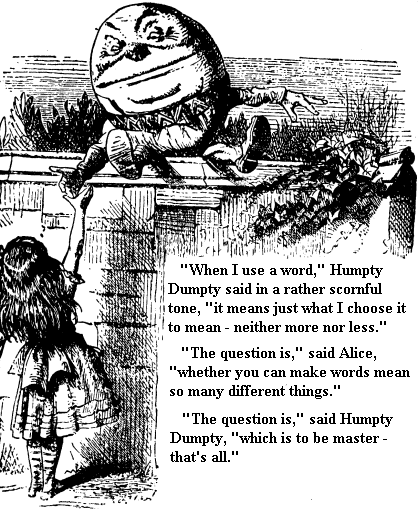
I say “Humpty Dumpty clause”, because the book Alice in Wonderland contains this fabulous line: “‘When I use a word,’ Humpty Dumpty said in rather a scornful tone, ‘it means just what I choose it to mean — neither more nor less.'”

It’s the same causal relationship to what words – and evidence – means that allows for claims that sugar is addictive (as addictive as cocaine, according to some), or that Harvard have endorsed low-carb high-fat diets. They haven’t – they’ve just said that carbs can sometimes be worse than fats, particularly the “bad”, saturated fats – yet the LCHF proponents cherry-pick this as support, even though the same group are explicit that the type of fat matters, and that animal fats remain something to be cautious about.

Or, it’s this casual relationship that allows for claims that Sweden has officially adopted the LCHF diet, even though the report – now finally available in English (the summary, at least), though that didn’t stop English speakers like Tim Noakes from relying on blog sources as authoritative on what it said – actually says (my emphasis):

in the short term (six months), advice on strict or moderate low carbohydrate diets is a more effective means of achieving weight loss than advice on low fat diets. In the long term, there are no differences in the effect on weight loss between advice on strict and moderate low carbohydrate diets, low fat diets, high protein diets.

I realise that this is just one element of the debate, which includes diabetes, heart disease and so forth. But these are two examples of scientists cherry-picking data that happens to support something they want to argue for – or that can be made to appear to support it, so long as you whip up enough hysteria, or persuade them that there’s some conspiracy afoot.

As Mark Wallace points out in piece for The Guardian on “addictive” sugar, “if the issue is people failing to act responsibly, then it won’t be rectified by treating them like children”. To that, we can add “treating them like fools”.

And when the same people doing the cherry-picking are giving themselves licence to simply ignore research they don’t like, and to dismiss conflict of interest issues (in their case, but not for you) with a regal wave, they stop being scientists, and start becoming shills.

Homeopathic anecdotes aren’t data either

When I tweeted the negative sentiment below, about the author of a book on how to ‘treat’ your toddler with homeopathy, little did I know that the irate replies would still be coming in 6 hours later.

homeopathyYes, my tweet was hyperbolic, and the answer to my question – in a direct sense at least – is most probably zero. But what the question hopes to provoke is reflection on the indirect consequences of recommending that parents treat one-year-old babies with homeopathic ‘remedies’ instead of medicine. Even if, as one person admonished me, the book claims to “aid basic ailments like constipation and insomnia. Hardly life-threatening.”

First, because the reply presumes that parents can diagnose a basic ailment in the first place. If a parent is told that her child’s constipation can be treated with homeopathy, she might persist with that course of treatment for long enough that the problem becomes more than “basic”, requiring proper medical attention. And the time wasted in seeking that, or in not giving the child proper medicine, could indeed be life-threatening. Ask Gloria Sam, the 9-month-old who died when her (perfectly treatable, and not life-threatening) eczema was ‘treated’ with homeopathy instead of a visit to a GP.

Second, because the book claims more than that, and my critic was cherry-picking examples. Other things that homeopathy can treat, only according to the Amazon blurb, are “breathing difficulties” and “vomiting”, both of which seem to be things that you’d hope concern parents more than simply inspiring the application of some sugar pills or water (in other words, a homeopathic “medicine”).

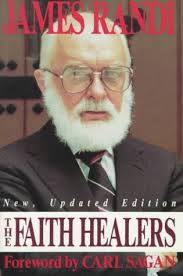
Because that is of course the third, and most important reason. Trial after trial has shown that there’s nothing to it beyond the placebo effect, something that a group of friends and I satirically demonstrated by joining the 10:23 protests a couple of years ago, where we each downed a bottle of a homeopathic ‘remedy’ (I think mine was arsenic). Here’s James Randi doing the same, taking a bottle of ‘sleeping pills’ as he often does to make this point (the clip also includes him making other arguments worth hearing).

[ted id=835]

And no, there’s no good evidence to suggest it has to be more than placebo, “because it works on animals” – we’ve got no reason to believe it works on animals any better than it does on humans (in fact, the perceived effect on animals seems to simply be an effect on humans, in terms of how they perceive the treatment and health of their pets).

But evidence isn’t what defenders of homeopathy are interested in. For them, anecdotal evidence is ‘argument’ enough, even though they would never stop to think about how they would reject similarly weak claims if they came in a version they don’t like. Kitten blood! It works for me! Crystals! Prayers to the Pink Unicorn! (Or, prayers to a ‘real’ god, just not one of the ones you happen to believe in.)

Racists defend their views with anecdotal evidence, as do sexists – reality is ignored in favour of confirmation bias. And we don’t think that doing so is a good, or a reasonable thing to do. Because the evidence is meant to matter, and the evidence isn’t “up to me”, and the experiences I might have had or not had. Part of the point of science is to provide us with resources that offer objective guidance, because we go into decisions knowing that – by and large – we’re too prone to various cognitive errors to be trusted.

The point is that a double-standard applies in people who are willing to defend their consumption and prescription of homeopathic ‘remedies’, in that they are willing to accept a very low standard of evidence on the grounds that the risks are low – “any responsible homeopath”, I’m told, “will advise their patients to take antibiotics where necessary, or to seek conventional treatment”.

But some homeopaths are less responsible than others. The coroners report was pretty clear in highlighting how Penelope Dingle would have suffered far less harm if not for her homeopath’s advice, and more generally, as Ben Goldacre makes clear in the Lancet, homeopaths simply get in the way of effective treatment:

Homoeopaths can undermine public-health campaigns; leave their patients exposed to fatal diseases; and, in the extreme, miss or disregard fatal diagnoses. There have also been cases of patients who died after medically trained homoeopaths advised them to stop medical treatments for serious medical conditions.

More prosaically, you’re simply wasting money if you spend it on homeopathy. This is one of the most annoying #middleclassproblems for me – alongside things like anti-vaccination sentiments, or obsessions with angels, or The Secret – in that it’s only the middle and upper classes who have the luxury of glamorising their anecdotal evidence in such a fashion. If homeopathy worked so well – given that it’s possible to produce it so cheaply – why would Bill Gates (etc.) not simply distribute it to those dying of malaria instead?

Of course “Western” or allopathic, or “chemical” (pick your favourite pejorative term) can’t cure everything. Nothing can. But homeopathy doesn’t outperform a straight placebo, meaning that any good effect you observe after taking a homeopathic remedy can’t have anything to do with that remedy. And much of ‘regular’ (by which I mean, real) medicine does. Furthermore, the stuff that doesn’t work – and the doctors that are quacks – tend to get driven out of the market over time.

Except for homeopaths, partly because of this almost religious devotion to “alternative” medicine (and the associated conspiracies around mainstream medicine), and partly because what homeopaths say, and prescribe, involves completely unfalsifiable claims. And that’s a bad thing – not only in general, but particularly when lives are at stake.

Check out What’s the Harm for a partial catalogue of homeopathy’s victims.