Bungalow, racial classification, Zille and Twitter outrage (again)

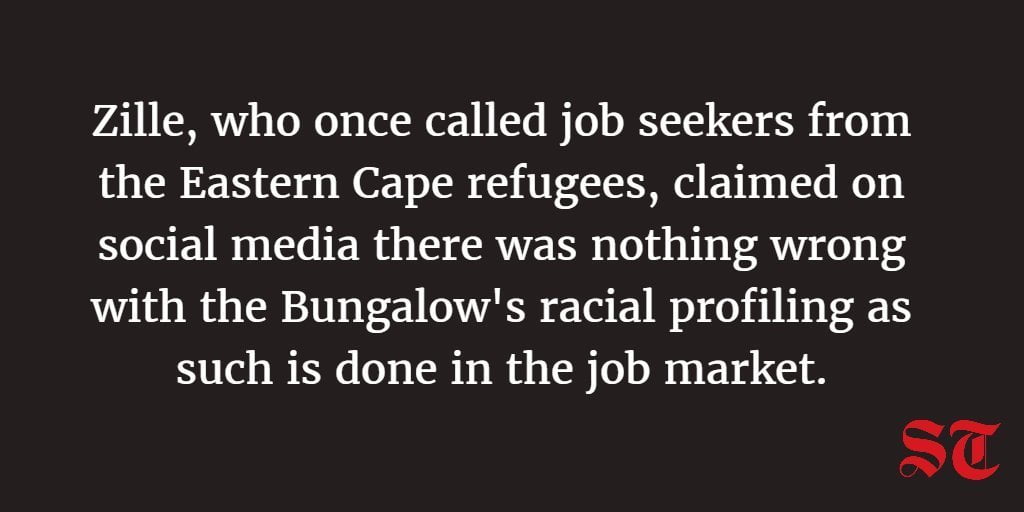
Earlier this month Mike Dzange, a waiter at a Camps Bay restaurant called The Bungalow sparked a Twitter debate and quite a few columns when he opted to include “2 BLACKS” on the docket of a couple he was serving.

The couple was black, as was the waiter – and while that doesn’t preclude the possibility of the waiter himself having internalised some racist attitudes (here, simply meaning that he might never use that shorthand for white couples), it does make it less likely that he was intending to demean this couple.

Stransham-Ford and physician-assisted euthanasia

Allowing physician-assisted euthanasia (or suicide) is the morally correct thing to do, as I’ve argued many times in the past. This doesn’t however mean that any given attempt to make it legally permissible is sufficiently persuasive.

A court has to decide on the merits of the case before it, and the Supreme Court of Appeal’s decision to uphold an appeal by the Ministers of Justice and Health (among others), against the Pretoria High Court’s 2015 ruling permitting Stransham-Ford’s assisted suicide, seems to have been the correct one.

Emotion trumps evidence in a post-fact world (same as it ever was)

As you’ve no doubt heard, “post-truth” has been named “word of the year” by Oxford dictionaries. But that shouldn’t lead us to think that truth or evidence has ever mattered as much as we might prefer, or that this post-truth world represents a complete break from the past.

All of us have always been susceptible to various forms of irrational thought resulting from bias in how we interpret – and even recognise – evidence, as elegantly illustrated in the work of people like Kahneman and Tversky, as well as in popular science books by Dan Ariely and others (like me and Caleb Lack (sorry not sorry)).

Populism, more than prejudice, is the problem with Trump

This has been a pretty bad year. What we’ve lost includes Muhammad Ali, Prince, Alan Rickman, David Bowie, Maurice White, Glenn Frey, George Martin, Garry Shandling, Merle Haggard, Elie Wiesel, and Micheal Cimino. (And then Leonard Cohen too…)

Oh, and, potentially, centrist politics – at least for a time. Brexit was at least in part a triumph of the political right, fueled by fears of immigrants and a nationalistic fervor, by contrast to the vision of a world united by common values and open (in both the legal and cultural senses) borders.

South Africa’s LGBTI folk can have rights – others, not so much

South Africa has supported “a call for the suspension of the United Nations LGBTI rights expert“, because sexual orientation and gender identity “should not be linked to existing international human rights”. [Update, 22 November: SA has reversed course, and now support the establishment of the LGBTI rights expert position.]

Say what you will about whether “gender identity” is a confused concept (here’s Rebecca Reilly-Cooper with a thoughtful article on that), the fact remains that theoretical disputes are a separate matter from the fact that LGBTI folk are subjected to discrimination, harassment and violence exactly because of those identities.

Brief notes on a crisis: #FeesMustFall

The University of Cape Town’s Senate met this morning. I had to leave at 12:15, but the meeting – which started at 10:00 – had up until that point merely confirmed what we all know is the case: that there are no easy answers, and very little agreement on how to proceed.

What agreement there was consisted of a general consensus that we’d like to be able to teach, and that students would like to be able to learn. Teaching and learning are obviously core business for a university, and why most of us are there, so agreement on this is no surprise.

Academic freedom at the University of Cape Town

The Academics Union at UCT recently organised a panel discussion on academic freedom at UCT, following the dis-invitation of Flemming Rose as the TB Davie Memoral speaker.

The text below was my opening statement at that panel discussion. There are obviously many other issues that could be addressed, and we were asked to limit our contributions to five minutes, so what follows is of necessity restricted in scope.

Dealing with “unintentional racism”

Eusebius McKaiser invited me onto his radio show to talk about intentions and their role in assigning praise and blame, or more broadly, in determining the moral status of speech and action. You can listen to the podcast of the conversation, and/or read further if you’re interested in a fuller description of my views on the topic.

On the proposed South African sugar tax

As Africa Check reports in Daily Maverick, it’s not yet clear what the effects of the proposed sugar tax in South Africa will be. But it is clear that South Africa has a serious obesity problem – and that sugar is a clear causal factor for obesity.

A Mail&Guardian journalist recently approached me for comment on this (I’ll update this post with a link to the piece when it’s published), but because the M&G article will likely only quote snippets, here’s a fuller response to a few sugar tax issues.

Caster Semenya, and fairness in sport (and life)

If we were to design athletic competition from scratch, how would we proceed? I think, given all the biases we’ve challenged or discarded since the first time athletic competition was tracked (sex, gender, race), we’d hope to find some way to match competitors in a way that created the spectacle required, and rewarded skill and effort, but did not rely on an arbitrary characteristic of humans to separate us into categories.