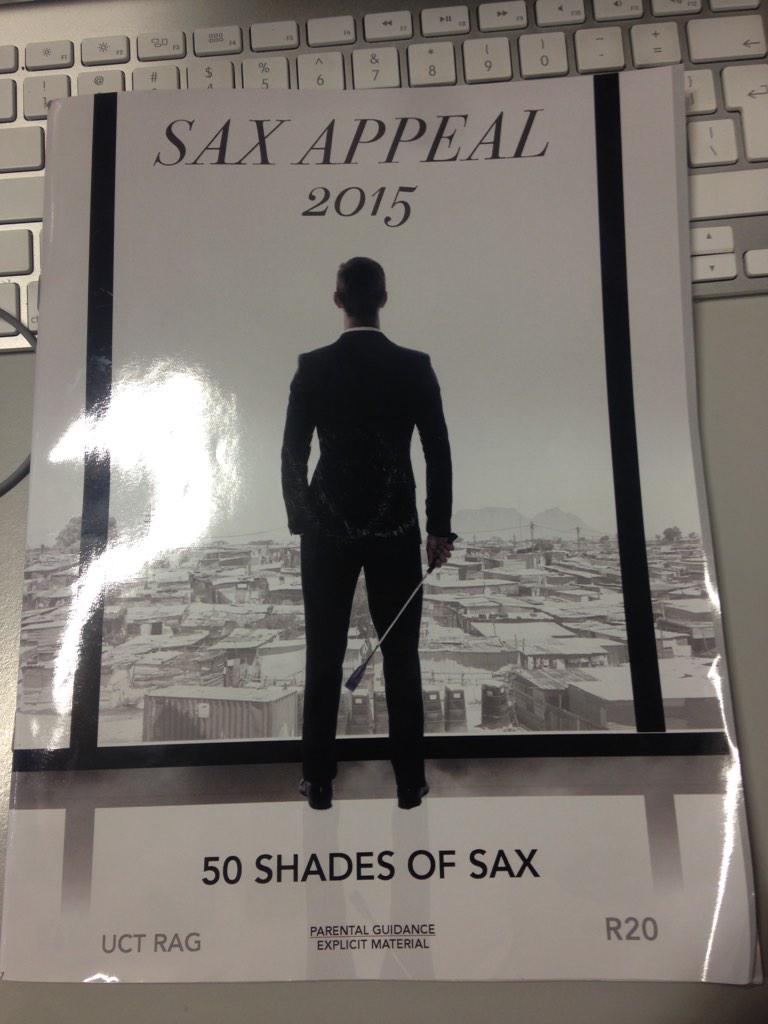
The 2015 #SaxAppeal cover

van_berger_2015-Feb-12
Credit: https://twitter.com/van_berger

This is not a “rage-blog”. I’m not indignant, offended or any of those things by the Sax Appeal 2015 cover that I saw via Twitter this morning. It depicts Christian Grey (a rich white guy who is into BDSM) looking out over shacks where poor black people live.

I do, however, think it was a poor choice of image, for the two reasons I’ll outline below. But first, a general point, which is the actual motivation for this post: there are usually intermediate options between the polarised sorts of shouting at each other that social media seems to encourage.

Criticism is quickly read as outrage, and in a case like this, can also lead to accusations of conservatism, fuddy-duddyishness and so forth. On the other end of the spectrum, those who support the image can overstate its virtues, and not recognise any value in concerns expressed by others.

There’s a gulf between those options, and that’s where I’m speaking from. I was shocked by the image, but I mean shocked in a descriptive sense, rather than as an index of moral outrage – it took me aback. So, that’s a plus for the “good satire” reading, in that being forced to take notice is a good start.

But the cover ultimately misses the mark, and was a poor choice. First, because risky satirical choices are only a smart move if you’ve got credibility as a satirist or satirical publication. Without that, you can appear to be simply echoing the reality you’re trying to critique, or appear oblivious to dimensions of it.

Simply being known as a satirical magazine one isn’t the same thing as people knowing you to be good at that job, and therefore interpreting you in that light – and sorry to say, but I don’t think Sax Appeal been good at it for a while.

Second, you significantly increase your chances of being read uncharitably by virtue of the targets that you pick. In this instance, there’s a context of:

  • 5 years of debate on admissions policy, race and transformation
  • public criticism from UCT academics on the perceived slow pace of transformation at UCT
  • a funding crisis at a national level, affecting the ability of poor students to enter universities
  • a rather public tantrum by a prominent media house owner on UCT’s transformation track-record
  • a university that is situated in a city that is perceived by some as racist

And so forth. In other words, this was a very risky issue on which to push the boat out. I certainly don’t think they were intending to be crude or offensive – in fact, I know some of the people involved, and trust them in this regard – but this was a poor decision.

(Sax Appeal has taken note of the reaction, and posted the statement quoted below to Facebook.)

STATEMENT ON SAX APPEAL COVER CONTROVERSY:

On behalf of the SAX Appeal Editorial Team, we regret the hurt caused by this year’s cover photo.

We understand the concern about what is perceived by some as racist or patronizing undertones of the image; but we would like to state unequivocally that our intention was not to make light of racism or to humiliate its victims.

Our intention was to open up discussion about the problematic power relations in South Africa. The legacy of apartheid has left a tragic divide between rich and poor, black and white, rural and urban – a divide that is still perpetuated daily.

Just as the themes of 50 Shades of Grey allude to power dynamics in sex, our hope with 50 Shades of SAX was to discuss the other power dynamics that still pervade our society. Even though the privileged no longer oppress the underprivileged daily with batons or whips, we hoped that the cover image would inspire discussion about the secretive, underhand ways in which the privileged still get their way.

These issues, including those within the magazine, such as the discussion around homophobia in Islam, the psychiatric profile of God and of golf being representational of white privilege, were included in the magazine to bring about such discussion.

In this way, SAX 2015 has taken a very different turn compared to previous editions. Sensitive topics were not written about to ridicule the marginalized or disadvantaged but to induce meaningful discussion about these topics. These are issues that we did not think we could avoid discussing, but if we missed the mark in our attempt at discussion, we regret the effect that this has caused.

We hope that this perspective might add to the debate that has been sparked on social media and that it might point it in a direction that is critical and constructive around issues of race and socioeconomics.

Wrong about race in South Africa and UCT

agi_events_010Two snippets, from two quite different sources, raise concerns about self-serving (as opposed to principled) thinking about race in South Africa and at the University of Cape Town, where I teach.

First, we have Douglas Gibson expressing concern that “race is back in fashion” in South African conversation. Gibson is the former Chief Whip of the Democratic Party, which became the Democratic Alliance (DA), South Africa’s official opposition.

I’ve only had a couple of conversations with Gibson, but have read many of his speeches and columns over the years, and regard him as a determinedly old-school liberal, rather than someone who is happy to let pragmatism dominate, as seems to be the case for many in today’s DA.

One character trait of what I describe as an old-school liberal is often an inclination towards idealism, in this case manifesting as a desire that South Africans be race-blind, to want to engineer a South Africa that is nonracial or post-racial. He opens his column with an example of race-blindness, in this case that of his son:

Thirty five years ago a little white boy aged three, standing in his bathing costume next to the pool, stroked the arm of a little black girl, also in a bathing costume, and said, “Ooh, you’ve got a lovely tan.” My son didn’t see race and certainly had no race prejudice. That was at the height of apartheid. He is still not a racist, just as many other whites are not.

There are two distinct points to make about examples like this. The first is that we can agree (or not) that this is an ideal future to try and arrive in. The second is that we can agree (or not) on how to get there.

A concern that I and others have about DA rhetoric is that it seems to want to get there by insisting on it, and by asking us all to just ignore race, because in doing so we’ll discover all sorts of other relevant and interesting things about each other as individuals.

As ever, I think some things are easier to say and support from one point of view rather than another. I don’t experience what it’s like to be black in South Africa, but if what I’ve heard is accurate – and I’ve heard it from black intellectuals far more qualified and socio-economically advantaged than me – they perceive racism far more often than they should (the “should” here would of course be zero times).

I’ve said in the past that the perception of Cape Town as being racist can’t simply be dismissed, and still think that even if we agree on an (eventual) goal of non-racism, we might find (a) that we can never get there or (b) that the way to get there is precisely to acknowledge race and prejudice, rather than pretend people don’t have these experiences.

To put it crudely – columns like Gibson’s, romantically espousing non-racialism, can be read as part of the problem in their denial of the validity of the lived experience of people who feel discriminated against. It can appear like you’re being told to simply “get over it”, and I think that’s condescending.

The other example I want to highlight is from Dr Xolela Mangcu, who is at the furthest remove possible from Gibson in at least two respects, in that he is a black Biko scholar, rather than a white liberal. Mangu has been columning voluminously about UCT’s new admissions policy for the past few months, and some of these columns have attracted responses from our Vice-Chancellor, Dr Max Price.

In Mangcu’s most recent opinion piece on race and transformation at UCT, he says the following:

Numbers matter also because there should be a critical mass of black professors in the University Senate, which is the highest decision-making body when it comes to academic affairs. I just find it difficult to imagine that doing away with race-based affirmative action would have been such a high priority for the Senate, or would have passed so easily, if that august body was populated by a large number of black full professors.

And here’s my problem: even if you think the admissions policy flawed, Mangcu’s words there seem to me to insult the black professoriate, or otherwise to indicate a laziness of thought on this issue, or are otherwise simply mendacious.

To briefly run through the options: the extract could insult black members of Senate, in that it suggests that they cannot be of independent mind regardless of perceived race-interest, and think that a policy might be the correct policy on principle even if it attracts the sorts of controversy it has.

Second, it could indicate a laziness of thought, in that he’s simply assuming that everyone who is a black Senator is somehow going to ineluctably reach the same conclusions about the policy as he did – in other words, that his is the only reasonable interpretation.

The arrogance of this would be one problem, and the second would be that it would make his argument circular, in that he’d be saying “the policy is wrong, and if Senate were black in the majority, they would vote against it, which proves that the policy is wrong”.

Finally, it could well be that Mangcu doesn’t think his analysis is the only defensible one, and it could be that he simultaneously knows that some black Professors support it. If these conditions were both met (and if I haven’t left out other options) then it seems that he’s misrepresenting the case for rhetorical effect – just like Gibson is.

My point, in short, is that given that we recognise how fraught these conversations are, we should be careful to have them honestly, contextually, and objectively, in the sense that the quality of arguments can still matter, even if you think there’s something distinct about how race informs an argument.

The TB Davie Academic Freedom Lecture 2014 – Max du Preez

mdpEarlier today, I had the privilege of introducing Max du Preez to the audience gathered for the 2014 TB Davie Lecture at UCT. The lecture was recorded, and once the video and podcast are available, I’ll be sure to let you know. In the meanwhile, here are my introductory remarks.


Over the course of a 40-year career in journalism, Max du Preez has earned multiple local and international awards for fearless and principled reporting, including the Nat Nakasa Award for Courageous Journalism, as well as having been named the Yale Globalist International Journalist.

He is the author of numerous books that draw on his long history in South African culture and politics, most recently “A rumour of spring”, in which he reflects on whether South Africa can expect “a long winter or an early spring” in relation to the evolution of our democracy.

In 1992, UCT awarded Max du Preez an honorary Master of Social Science degree, and the citation is worth re-visiting. It speaks of:

his fearless exposition of power corruption in high places, in the face of all kinds of attempts at silencing him, from criminal and civil proceedings in the Courts to extrajudicial strong-arm methods.

Max Du Preez has consistently made it clear that he is not serving any sectional interest, but that of all the people of this country, and his cause is to promote the values that should operate in the new South Africa.

After graduating from Stellenbosch University, he joined Die Burger as a cub reporter, and the Editor sent him to cover the Parliamentary sessions. This proved to be an error of judgement. Max Du Preez’ overall impression of the Parliament was one of moral corruption and intellectual poverty, and he conveyed this in his reports; Die Burger’s impression of Max Du Preez was that they had a problem reporter on their hands.

He was hastily transferred to Die Beeld in Johannesburg. There he reported on the Mozambiquan independence, and the Soweto riots of June 16 1976, but caused so many problems for the Government-supporting Nationale Pers that he was banished to the Siberia of South Africa, the Namibian desk.

In Windhoek, he was quickly branded a Swapo ally, and Du Preez and Nationale Pers soon parted company. In 1980 he joined the Financial Mail in the post of political editor, the only Afrikaner on the staff, and in his own words, “their token boer.”

Later he transferred within the same media group as political correspondent to the Sunday Times and Business Day.

In 1987 Dr Van Zyl Slabbert invited Du Preez to join the delegation of Afrikaner personalities who attended that highly controversial and historic meeting with the then banned African National Congress in Dakar, Senegal.

It was there that the idea of starting an independent Afrikaans language weekly newspaper was born.

That newspaper, launched in 1988, was die Vrye Weekblad- the Independent Weekly. The newspaper was almost immediately in court, thanks to the first few editions having to appear on the street illegally after the Minister of Justice responded to the threat it posed by raising the cost of registering a newspaper from R10 to R30 000.

At this newspaper, it was du Preez and his colleague Jacques Pauw who led the exposure of apartheid-era murder squads at Vlakplaas when other publications wanted no part of the story – or simply denied its truthfulness. Without their hard work and courage, many of these details might well have remained a secret to this day.

The paper was forced to close in February 1994, thanks to the costs incurred in defending its charge that South African Police General Lothar Neethling had supplied poison to security police to kill activists.

Du Preez went on to be the founder and editor of the television programmes Special Report (documenting the Truth and Reconciliation Commission) and Special Assignment.  Du Preez ended up being dismissed from Special Assignment for “gross insubordination towards management”, after objecting to a management decision to bar the screening of a segment on witchcraft.

That same weekend, Special Assignment won six awards at a television prize-giving.

If a more recent sort of threat, by actor and economic freedom fighter Fana Mokoena to “seize his farm” is more typical these days, it’s not because du Preez has slowed down, or toned down, his challenges to political authority and the abuse of power. Nor could it be because he has a farm, as he has none – but accuracy is seldom a primary concern for bullies.

It might instead be exactly because – thanks in part to him and other courageous editors – newspapers in South Africa no longer need fear being bombed, as the Vrye Weekblad offices were in 1991.

To return to the 1992 citation,

Mr Chancellor, the sensational disclosures which struck at the malignant core of apartheid are only part of Max Du Preez’ achievements. He is clearly a non-conformist, an independent thinker, a maverick. Some would use stronger terms. The French noun might be a sansculotte-  ‘without breeches”. In Afrikaans, the expression is earthier – he is hardegat.

Ladies and Gentlemen: please welcome Max du Preez.

Academic freedom in South Africa

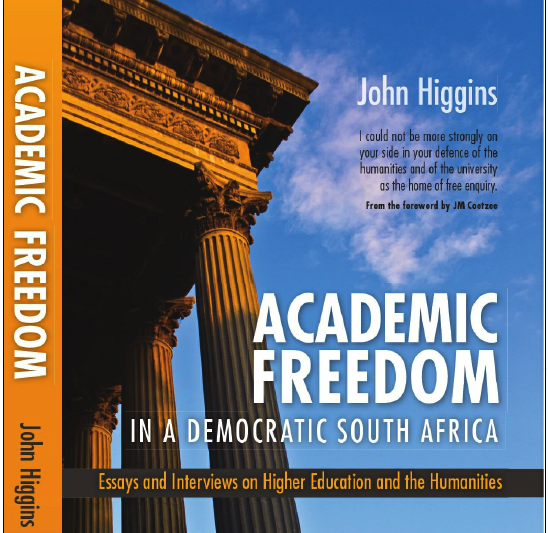
Higgins on academic freedomOn December 11, my University of Cape Town (UCT) colleague Prof John Higgins will be holding the Cape Town launch of his new book, “Academic Freedom in a Democratic South Africa” (click on the picture to enlarge and to get details). I’ll certainly be attending, both to support John (a friend) and also because it’s a subject of great interest to me.

In my capacity as chair of the Academic Freedom Committee at UCT, I was approached by a local journalist for comment on some issues raised in this book. Because only a sentence or two (if anything) might survive the editing process, here’s the full list of questions and my answers, for those of you interested in this topic.

1.Do you think academic freedom is under threat in South Africa?
There are certainly implicit threats to academic freedom, and also explicit ones such as the Higher Education and Training Laws Amendment Act.

2.If yes, kindly give us a few reasons to support your answer
Attempts to control the possession and dissemination of information as in the Protection of State Information Bill is an implicit threat, as is the occasionally hostile reaction of the State to uncomfortable questions being asked of it, for example regarding topics such as the arms deal or Nkandla. The South Africa public might itself present a different sort of threat, in that political and socio-economic preoccupations sometimes appear to create a distinctly anti-intellectual climate, where demands for “ideological purity” can intrude on academic activity. Then, legislation such as the Act – regardless of whether this is the intent or not – allow the Minister to subvert university autonomy for overly vague and broad reasons, thereby putting universities in a state of perpetual probation, hardly conducive to freedom.

3.Do you think that the ANC’s policies on higher education seek to subordinate universities’ important decision making to the policies of government?
Whether they seek to do so is one question, whether they will serve to do so quite another. Regardless of the intentions behind these policies – which some certainly seem to think sinister – the policies (the aforementioned Act, and also potentially the eventual scope and power of the Ministerial Oversight Committee on Transformation) could certainly serve to subvert university autonomy.

4.Does this amount to curtailing “academic Freedom?”.
The State has legitimate interests in the role and functioning of public universities, so the universities cannot demand that academic freedom be defined without any concern for those interests. But the way in which government has developed and seeks to implement these policies – often with little or no discussion or negotiation with the universities – does add up to an intrusion on academic freedom.

5.The ANC has clearly said it wants universities to churn graduates who are competent in dealing with a modern economy. In other words, universities suddenly become instruments to achieve certain policies of government. Does this pose a threat to academic freedom?
Yes, certainly. While the developmental needs of South Africa certainly merit a focus on, for example, STEM disciplines (Science, Technology, Engineering, Mathematics), this should not come at the expense of the long-term goal of producing strategic and creative thinkers of the sort that typically emerge from the liberal arts – history, philosophy and the like. A disproportionate focus on more practical fields might serve our interests in the short-run, but also serve to cripple academic enquiry and progress (and thus, freedom) in disciplines that are more esoteric.

6.Do you think the ANC’ s policies on higher education seek to control universities even more than what the National party did?
The comparison is unnecessary, and a distraction from the more important issue of whether the current government seeks to do so to a troublesome extent. This sort of comparison is perhaps emblematic of exactly the anti-intellectualism described earlier, in that keeping score in this way is good for headlines, rather than inspiring critical thought.

7.Do you think the Higher Education and Training Laws amendment Act is problematic for Academic Freedom? If yes, how so?
It could be problematic, depending on the extent to which the powers it allows for are used or abused. The Act makes it easier for government can place a university under administration, dissolving that university’s Council and assuming its powers. It sanctions more government intervention than is currently the case, and does so on grounds that are broad and poorly defined. We should have no objection to dysfunctional Councils being challenged or replaced, but if the Act allowing for this also allows, for example, Councils that aren’t “ideologically pure” to be replaced, then institutional autonomy and academic freedom are significantly threatened, and to an unacceptable degree. Further cause for concern regarding this Act is that key stakeholders, including Higher Education South Africa (Hesa), which represents the vice-chancellors and the Council on Higher Education (CHE) were not consulted in its drafting.

UCT Admissions policy – race and redress

uctThe various Faculty Boards at the University of Cape Town are currently considering alternative models for UCT student admissions. These models arise from a debate the University has been having for some time now, regarding whether “race” is still the most effective identifier of likely disadvantage available to us. Some participants in this debate argue that race has become an increasingly crude proxy for disadvantage, resulting in a large number of false positives (which in turn has the effect of shrinking the number of places available for people who are actually disadvantaged, whatever their race might be).

That line of argument is also frequently accompanied by the observation that the racial categories we use in South Africa (and elsewhere, but South Africa has a particular history in this regard) are innately odious, and should be eliminated from legislation, policy and discourse wherever we can.

Some critics of that position argue that to eliminate recognition of race as a special category for attention simply perpetuates racism, and that any policy shift in this regard would be regressive. Others argue for the more moderate position that while race should be eliminated from policy in principle, it is too soon to do so – and that even though race is mostly a proxy for disadvantage, it remains the best one we have available to us in the present moment.

The contribution to the debate offered below merits wide distribution, and is shared here with the permission of the author, Professor Anton Fagan of the Law Faculty. For what it’s worth, I agree with his position, and find the paragraph below to be a strikingly crisp articulation of the obvious wrongness of including race as a criterion for disadvantage in perpetuity:

to make an applicant’s preferential admission conditional upon her having identified herself as ‘black’, ‘coloured’, ‘Indian’ or ‘Chinese’ is to make the receipt of something that is deserved, unconditionally, conditional upon a Faustian bargain. To get what she deserves, as a matter of justice, an applicant is compelled to validate one of the foundational principles of the racist apartheid order – the principle that everyone falls, naturally and in a way that can be read off one’s biologically-determined features in a mirror, or can be determined by inspecting one’s nails or one’s genitals, into one of the following groups: black, coloured, Indian, Chinese, and white.

___________________________________

UCT’S NEW ADMISSION POLICY

ANTON FAGAN

UCT’s new admission policy has much to recommend it. In so far as it seeks to undo inequality, by looking at home and educational circumstances, it represents a major step forward. However, the criteria by which the ‘Faculty Discretion’ is to be exercised, especially ‘racial diversity’, are troubling.

In 1987, I was an LLB student here at UCT. In an evidence class, the lecturer discussed a 1957 Appellate Division decision called R v Vilbro. It concerned the admissibility of a witness’s opinion as to whether the accused were ‘white’ or ‘coloured’ for the purposes of the Group Areas Act. The Court held that such an opinion was admissible. For, it said:

‘There may be people who have had a reason to apply their minds specially to the question of distinguishing the races. Such a witness was, in the present case, the Chief Inspector of Indian and Coloured Education . . . .’

‘[T]here may be people who, in respect of the persons whose race is in issue, may have had more opportunities of observing them than the magistrate. The latter only sees them in court, dressed up for the occasion, a woman probably with make-up . . . Other people may have seen them more frequently and in different circumstances, and have had more opportunities and more time of forming a definite impression about them.’

Upon hearing these passages, a student in the class, Zehir Omar, shouted out angrily: ‘Who was the judge?’ I sat forward expectantly, like everyone else, keen to hear who this racist was. The lecturer answered: ‘Fagan CJ.’

The effect of this view of admissibility was that the accused’s conviction under the Act was upheld. But that was not the main reason for Mr Omar’s outrage and my shame. Indeed, I am not sure that the lecturer even mentioned this outcome. Our outrage and shame were grounded, primarily, on something that Mr Omar, and I, and many others in the class took for granted: racial classification, in itself, is morally repugnant. We knew that the division of persons into ‘coloureds’, ‘whites’ and ‘natives’ had no biological basis. We knew that this division was not merely a social, but a political and ideological, construct. We knew that it took its life from, and was inextricably linked to, the practice of racism under apartheid.

You may know the book Racecraft, written by Karen Fields and Barbara Fields, and published last year. The Fields are sisters. One is Professor of History at Columbia University. The other is a sociologist, based at the Center for African and African American Research at Duke University. They have written a great deal on slavery, witch craft, and racism. The following extracts from their book show some of its key ideas:

‘Anyone who continues to believe in race as a physical attribute of individuals, despite the now commonplace disclaimers of biologists and geneticists, might as well also believe that Santa Claus, the Easter Bunny and the tooth fairy are real, and that the earth stands still while the sun moves.’

‘Race is not an element of human biology . . . nor is it even an idea that can be plausibly imagined to live an eternal life of its own. Race is not an idea but an ideology. It came into existence at a discernible historical moment for rationally understandable historical reasons . . . Thus we ought to begin by restoring to race . . . its proper history.’

‘[R]ace is neither biology nor an idea absorbed into biology . . . It is ideology, and ideologies do not have lives of their own. . . . If race lives on today, it [is] because we continue to create it today.’

‘[T]he first principle of racism is belief in race, even if the believer does not deduce from that belief that the member of the race should be enslaved or disfranchised or shot on sight by trigger-happy police officers . . .’

‘[W]hat “race” is’ ‘is a neutral-sounding word with racism hidden inside’.

The current UCT application form requires applicants to identify their ‘population group’, the choice being between ‘black’, ‘coloured’, ‘Indian’, ‘Chinese’ or ‘white’. An applicant may refuse to choose any of these, in which case he or she will be assigned to the open category. It is fair to assume that UCT’s new admission policy will be implemented with an application form that requires more or less the same.

The effect of this will be a continued naturalisation of race. The division of persons into ‘black’, ‘coloured’, ‘Indian’, ‘Chinese’ or ‘white’ is presented as part of the natural ordering of the world, rather than as what it really is, namely an historically-contingent, politically-constructed and ideologically-driven ordering. The historical, political and ideological connection between these categories and the racism of the apartheid state is simply swept from view. Rather than that categorisation being presented as being deeply-embedded in a particular history, politics and ideology, it is presented as a free-floating categorisation with a logic and reality all of its own.

Worse than that, the categorisation into ‘black’, ‘coloured’, ‘Indian’, ‘Chinese’ or ‘white’ is supposed to be insensitive to distinctions of social standing or class. Being the son of a billionaire entrepreneur, or the daughter of an unemployed domestic worker, will neither qualify nor disqualify an applicant for any of the categories. It follows that the primary basis for categorisation must be biological difference. The effect, therefore, is not merely to continue the naturalisation of race. It is to entrench a form of bio-racism.

The Fields sisters gave their book the title Racecraft, because they see the idea that a person has a particular race as analogous to the idea that a person is a witch. Just as there are not really witches, and never have been, so there are not really races, and never have been. Neither ‘witch’ nor ‘race’ has, as they put it, ‘material existence’. Both the idea that a person is of some race and the idea that a person is a witch are merely ‘illusions’ or ‘fictions’ created and sustained by social practices. Now imagine that a university has decided to provide redress for those who were victimised on the ground that they were witches. It would be odd for the university to pursue that redress by asking every applicant to the university this question: ‘Are you a witch or are you not?’, and then to make the provision of the redress conditional upon the person answering: ‘Yes, I am a witch.’

There undoubtedly are many applicants to UCT who, because of inequality, deserve preferential admission. However, to make an applicant’s preferential admission conditional upon her having identified herself as ‘black’, ‘coloured’, ‘Indian’ or ‘Chinese’ is to make the receipt of something that is deserved, unconditionally, conditional upon a Faustian bargain. To get what she deserves, as a matter of justice, an applicant is compelled to validate one of the foundational principles of the racist apartheid order – the principle that everyone falls, naturally and in a way that can be read off one’s biologically-determined features in a mirror, or can be determined by inspecting one’s nails or one’s genitals, into one of the following groups: black, coloured, Indian, Chinese, and white.

Getting what one unconditionally deserves is made conditional upon one’s willingness to treat as real, as essential, as natural, and as morally-neutral, an ordering of the world created by the apartheid state in order to pursue its racist objectives. If you do not admit to being a witch, you will get no justice. If you do not admit to being what D F Malan and H F Verwoerd decided you are, namely a coloured, a black, a member of the other, you will not get the justice you are entitled to. Writing about the American context, the Fields sisters make a similar point:

‘Like a criminal suspect required to confess guilt before receiving probation, or a drunk required to intone “I am an alcoholic” as a prerequisite to obtaining help, persons of African descent must accept race, the badge that racism assigns to them, to earn remission of the attendant penalties. Not justice or equality but racial justice or racial equality must be their portion.’

The continued requirement of racial identification in UCT’s application form reveals a failure of imagination on our part. Damaged as we are by the experience of apartheid, we find it hard to envisage a future in which South Africans do not see each other through the spectacles which Dr Malan and Dr Verwoerd welded onto our noses. And because we find it so hard to envisage this future, we do not recognise that one of the first steps we must take to secure it is to remove the distorting lenses of our racist apartheid past. We must refuse, collectively, to continue seeing the world, and each other, in the way which the racist apartheid project required.

It is possible to do so. We have a policy in my family that none of us refers to race. As a result, my six year old, Lihle, does not see race – at any rate, not yet. Of course he sees skin colour, and hair colour, and so on. But he does not see race. A few months back, my daughter’s boyfriend was having supper with us. Lihle turned to him and said: ‘Rahul, you and I are both brown.’ But that was not a case of Lihle seeing race, and certainly not race as constructed by the racist apartheid state. For then he would have said: ‘Rahul, you are Indian but I am black.’ – which he did not say.

Were I an idealist, I would now propose that all reference to race or population groups, as well as any requirement of racial classification, be removed from UCT’s application forms. Like the Fields sisters, I would argue that what matters is not racial inequality and racial injustice, but inequality and injustice full stop. And I would argue, as they do, that a continued focus on race, on the one hand, is not necessary to achieve equality and justice and, on the other, is likely to blind us to, and therefore also to leave uncorrected, many of the inequalities and injustices that plague our society.

But I am enough of a realist to curb my ambition a little. I therefore propose, as a compromise, the following:

No applicant should be asked to state whether he or she actually is ‘black’, ‘coloured’, ‘Indian’, ‘Chinese’ or ‘white’, or is a member of a population group so described. Instead, applicants should be asked to which of these groups the racist apartheid state most probably would have assigned them.

This way of posing the question makes visible the historical contingency of this racial classification and its connection with the racist programme of the apartheid state. It therefore helps to guard against the naturalisation of these racial categories, and against the entrenchment of the belief that they are an inevitable biological or cultural fact. It also avoids the Faustian compact spoken of earlier: an applicant entitled to redress would not be required, as the price for getting it, to treat as true one of the racist apartheid state’s great falsehoods, namely the claim that there are black persons, and coloured persons, and Indian persons, and Chinese persons, and white persons, and that each of these are a kind of person essentially different from every other.

Jonathan Glover: TB Davie Memorial Lecture on Academic Freedom, 2013

NYXThis year, the Academic Freedom Committee of the University of Cape Town (that I’m privileged to be chairperson of) welcomed Prof. Jonathan Glover to present the annual T.B. Davie Lecture Memorial Lecture. It’s been a pleasure spending time with him, and hearing him speak – not only earlier today, but also yesterday at a seminar on the boundaries of psychiatry. I’ll post links to video once UCT makes them available, but in the meanwhile, here are the opening remarks I delivered earlier today.

___________________________

In his book HUMANITY: A MORAL HISTORY OF THE TWENTIETH CENTURY, Jonathan Glover discusses the brutality of that century with reference to the declining authority of morality, and diminished faith in the possibility of moral progress.

We don’t need to agree on a framework for moral judgments, or any particular content produced by such frameworks, to be sympathetic to one of Glover’s premises – that “questions about people and what they are like” should be central to our ethical debates.

He argues that the 20th Century has brought some erosion of our moral identities, making it easier for us to treat each other as mere objects, rather than as equally valuable members of overlapping societies. Among the potential causes of this he discusses are the imposition of belief systems or ideologies by powerful actors, especially governments; the postmodern abandonment of the search for objective truth; confusing ends and means; and the physical distancing between agents, often enabled by technology.

A suggestion he offers for resisting this erosion is for us to focus on developing a vision beyond the given, the surface impression, or the merely pragmatic. We should cherish our imaginative awareness, and foster the democratic habits of tolerance, persuasion and compromise. Crucially, Glover argues, we should develop our abilities to resist dogmatism and to accept complexity or ambiguity.

These forms of engagement are perhaps becoming increasingly rare, but the place where they are traditionally exercised is the University. Despite the need to respond to aspects of what markets might desire, we cannot forget that we’re not only in the business of producing marketable students, or generating research outputs that are aimed at attracting funding rather than developing knowledge.

Learning is sometimes found in our mistakes – in being wrong – rather than in our successes. When we no longer provide the space and opportunity to make productive mistakes, instead focusing on being an efficient production line of graduates and research outputs, we run the risk of sacrificing some of the virtues that make universities, and UCT, such fruitful places in which to work and learn.

Given these considerations, I’m very pleased to welcome Prof. Jonathan Glover to UCT today. His 1977 book CAUSING DEATH AND SAVING LIVES was certainly one of the texts that helped me realise that I wanted to devote my academic attention to philosophy, and in particular, that highlighted the role practical ethics could play in bettering our lives.

Glover’s work has frequently focused on improving lives – HUMANITY, discussed earlier, is one example, and numerous others can be found in his writings on neuroscience, psychology, disability and genetic design, and in his teaching of ethics, for many years at Corpus Christi and New College, Oxford, and now at Kings College, London.

Towards the end of HUMANITY’s first chapter, Glover writes: “another aim of the book is to defend the Enlightenment hope of a world that is more peaceful and more humane, the hope that by understanding more about ourselves we can do something to create a world with less misery”.

Understanding more about ourselves is facilitated by spaces such as the one we are in today, hosted by universities such as ours. Threats to academic freedom could be said to run counter to that hope of understanding ourselves, and by extension, counter to reducing the amount of misery in the world.

It is these interests and insights of his, among others, that make it my great pleasure to welcome Professor Jonathan Glover to UCT to deliver the 2013 TB Davie Memorial Lecture, on the topic of “Universities, the market and academic freedom – how treating education and research as merely marketable commodities can threaten academic freedom”.

UCT, race, and the seductive moral outrage machine

Originally published in Daily Maverick

Despite the many columns I’ve written on the dangers of jumping to easy conclusions, the UCT student survey ranking how attractive various “races” are provided a reminder of how difficult it can be to follow one’s own advice. Especially with regard to emotive topics, the moral outrage machine can be quite seductive.

On that “most attractive race” thing in the UCT student newspaper

So, this peculiar thing appeared in the UCT student newspaper, Varsity, earlier in the week:

Screen Shot 2013-04-05 at 9.46.51 AM

A couple of people have asked whether I’d be writing about it. To one, I replied that it was “too silly”. Which it is. But even sillier than this is the news that the Young Communist League are apparently going to report Varsity to the Human Rights Commission (they are “shocked and disgusted“, you see).

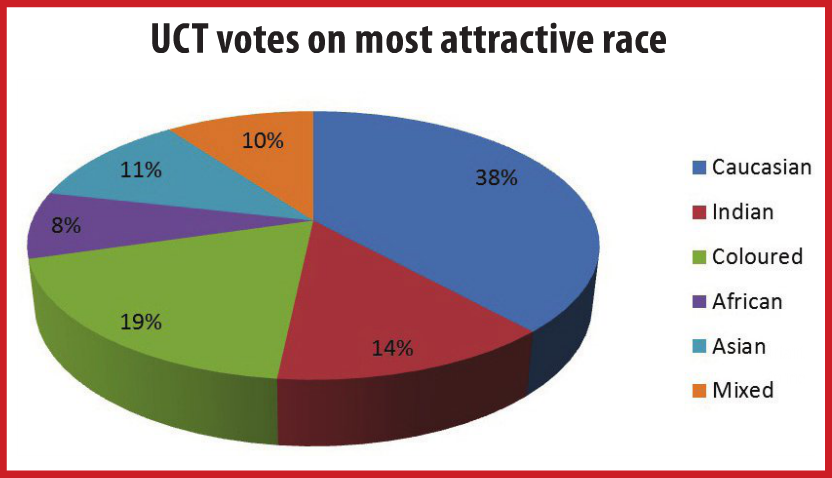
For context, a couple of details: To repeat, this is a student newspaper, and it is not edited or subject to any pre-publication controls by any official agents of the University administration or staff. Second, it was published in the opinion pages, and third, it was an accompaniment to this article – in fact, it’s a graphical representation of the results of Qamran Tabo’s straw poll of 60 students.

Yes, 60 students. So, Varsity chose a stupid headline for the graphic, in that “UCT” haven’t voted on anything. Varsity no doubt chose the headline to attract attention, seeing as that is what headlines are for. But an attention-grabbing headline on such a sensitive topic should perhaps be chosen with more care.

As, of course, should be what you choose to publish in the first place, or how much you edit what’s been submitted. Presenting this as quasi-scientific was an error, as the editor concedes.  It’s not just the sample size, it’s also the peculiar way in which the sample was drawn. Tabo chose to survey 10 individuals from each of the following “racial groups”: “white, coloured (culturally), Indian, East Asian, biracial and African”. Now, Tabo doesn’t define how she knew who was who here, and whether they are all self-identified (as “culturally coloured” surely must be). Anyway – let’s leave it at that, agreeing that the pie-chart is a reflection of what these students reported, and nothing to do with UCT as a whole.

But even if it was about UCT as a whole, it’s still possible that – for whatever reason, but mostly for a reason Tabo cites (the preponderance of white people presented as attractive in popular media) – a larger group of people would report this same preference. And this would be a reflection of racism in popular culture, yes, where certain appearances are normalised as attractive, and others not. Furthermore, it’s a great shame that this is so prevalent, and so persuasive, that it’s probably the case that a large number of students (and others) have “fallen for it”, as it were.

It wouldn’t necessarily be racist to point this out, though. Saying “students report that they find race x more attractive than race y” (and please, throughout this blog post, assume the quotation marks around “race”) can simply be reporting a fact. The idea that humans might “rank” races on any characteristic is of course offensive, particularly in South Africa or anywhere (okay, everywhere then) where people have been oppressed as a result of their race. But the author knows this, and starts by reports the fact (for the 60 students) of these preferences, before going on to conclude:

Of course everyone has the right to choose who they want as a romantic partner, but it is interesting to observe how race, which is really just a collection of arbitrary physical features, acts as a barrier when it comes to who we choose to love.

Having been at UCT and in South Africa long enough, I have come to realise that we would have better luck creating a research wing at Med School dedicated to cloning white people to feed the demand than trying to understand the origins of some our supposed “preferences”. Hopefully one day, when the world’s entire population becomes creolised, characters will be the only deciding factor for who we want to date.

And that’s just right, surely? The author decries the fact that these students use an arbitrary characteristic, rather than someone’s character, to determine who they would like to date. There’s nothing racist about the conclusion, and it can’t be racist to report that people do have these (potentially racist) preferences. This really does seem a storm in a tea-cup, caused by little more than a poor headline and social media hysteria.

Furthermore, as I’ve previously argued with regard to the dos Santos and Tshidi cases, even real racist speech should perhaps not be reported to the HRC, and we certainly shouldn’t feed the pitchfork-wielding mobs of outraged folk on social media, because they’ll simply start feeling more entitled to bully us into silence the more they succeed in doing so. I confess I fell for it too, yesterday, when I described this as “embarrassing” for UCT on Twitter.

It is embarrassing, sure – but it’s also embarrassing that our knees jerk so quickly, and so violently, when anyone mentions the fact that people do still think in racial terms, regardless of the fact that we wish they wouldn’t. Outrage won’t make the problem go away, and neither will pretending that people don’t have attitudes we wish they didn’t.

[Edit]Related: I thought it was a mistake for UCT (the Vice-Chancellor, in fact) to apologise for the “blasphemous” Sax Appeal in 2009. They certainly shouldn’t apologise for this.[/edit]

University of Cape Town march: #WeSayEnough

Originally published in the Daily Maverick.

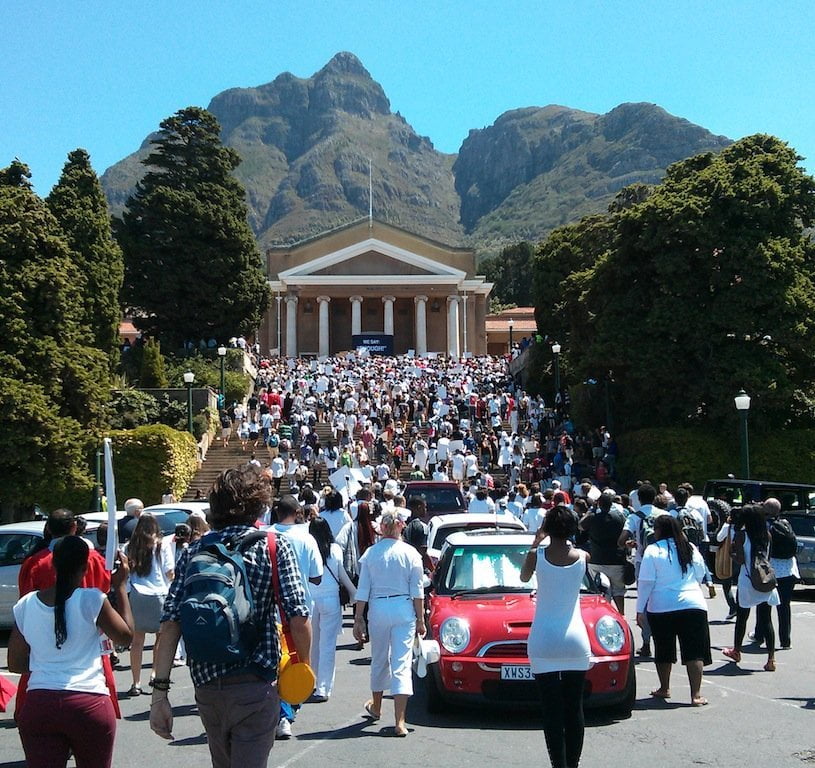
Last week, an estimated 3000 members of the University of Cape Town community marched under the banner of #WeSayEnough. The march was a protest march, as these things typically are – in this case, a protest against the sexual and other violence against (particularly) women in South Africa. I joined the march, and I suppose this column is my attempt to explain why I did so.

Some of you might think this needs no explanation. Perhaps you routinely engage in the spectrum of activities that range from voting in online polls, signing petitions, putting plastic rhino noses on your cars, or donating time or money to some cause or other. But my starting point would be (or, perhaps “would have been”) to point out that the last two are different sorts of interventions than the first three. Giving time and money seems easier to categorise under “doing something”, rather than being simple liberal breast-beating.

Those who, like me, do think it needs an explanation might talk of slacktivism, desktop activism, or clicktivism. Even though this protest took place on foot instead of behind a desk, in academic garb or white t-shirts with protest slogans, one could ask what it might accomplish for all of us to assemble to say “enough”. Sure, we’ve all had enough, you might say, and everyone already knows it.

You might even say, as I did in my last column last week, that these actions aren’t likely to change the minds of the perpetrators of violence. But even if that’s true, I’m glad that we marched.

First, because the signal of solidarity that 3000 marchers with placards and songs send is a far stronger signal than a progress bar on a website, indicating that you want to save a rhino. I’d like to think that at least some victims of sexual violence participated in or were aware of the march, and saw that they aren’t forgotten.

This show of solidarity might comfort, which is only a trivial thing if you think our emotional states irrelevant. I remember thinking during the march that critics of these sorts of protests would most likely not also boycott funerals. Of course, funerals are not typically protests, but they are largely symbolic events, just as this march was. For someone to ask at a funeral “what’s the point? What is this going to change?” would not, I’d imagine, go down too well. We understand that the point it solidarity, and so it was with the march on February 20, 2013.

Second, as our Vice-Chancellor noted in his address to the marchers, we marched to insist that we’re not happy with this level of violence becoming expected or normalised. We marched to say that we won’t be silent as new (and ever lower) expectations of security are spoken of as if they were an acceptable consequences of living in South Africa. Or, more specifically, of living as a woman in South Africa.

We marched because it should concern us that the Oscar Pistorius media extravaganza has allowed us to forget Anene Booysen, and that during the four days of courtroom action in the Pistorius bail hearing last week, it’s likely that more than 400 women would have been raped (if the one-every-four-minutes statistic is accurate).

So much for our Delhi moment, then, as many South Africans seem to have moved on to having an O.J. Simpson moment – with the focus again on a compromised hero than on another dead woman. We marched, in other words, to remind each other that this is not normal, and should never be treated as if it is.

Third – again, as noted by Dr. Price, we marched to tell the government that they have betrayed the social contract. The criminal justice system can be improved, and NGO’s like Rape Crisis better supported. Funding could be made available to universities so as to train social workers, and also to support research in areas that could help us better understand and address this toxic masculinity and patriarchy that allows for the normalisation of sexual violence.

But mostly, and finally, I marched because of the energy that a crowd can generate. Columns, petitions and speeches can reach people, sure – but thousands of singing and chanting people, united in common purpose, generate a passion that might have a lasting effect on a larger number of people. And before anyone accuses me of an unreasonable level of idealism, I’m talking about the people who were there, rather than those who heard about it.

The people who were there were receptive to what Dr. Price and the other speakers had to say, and they were committed to doing what they could to minimise sexual violence, and to help the victims of it. And what they – especially the students – heard did offer strategies that will be effective, even if each of us can only make a small difference. Each of them, in this case, were the majority of the crowd, and these students were given some challenging assignments.

They were reminded that they need to criticise and ostracise their friends who commit even the slightest violence against their partners. They were reminded that sex is not the guaranteed outcome of a date, and that they should not let their friends believe it is, because that belief is likely to contribute to date rape. They were reminded that men of integrity need to be completely sure that their partner consents to sex, and that the language of boasting about “conquests” after the fact constitutes an unacceptable objectification of their sexual partners.

I think that solidarity is important, and that refusing to treat sexual violence as normal is important. The fact that the continent’s premier university takes this stand sends a message to government, and I think that’s important. Lastly, words like those above, in the context of a receptive audience such as the one we generated, can make a difference. And that is why I marched.

The 2012 TB Davie lecture: Introductory remarks

On August 1, 2012, Ferial Haffajee delivered the 47th annual TB Davie Lecture at the University of Cape Town. As chair of the Academic Freedom Committee, I had the privilege of introducing her, and this is the text of my introductory remarks.

TB Davie led the university as Vice-Chancellor from 1948 until his death in 1955. He is remembered as a fearless defender of the principles of academic freedom. He championed this cause and the autonomy of the university, defining academic freedom as the university’s right to determine who shall be taught, who shall teach, what shall be taught and how it should be taught, without regard to any criterion except academic merit.

This legacy is honoured through the TB Davie memorial lecture series, beginning in 1959 with a lecture by former chief justice and UCT chancellor, Albert van de Sandt Centlivres, after whom a building adjacent to this one is named. In subsequent years, the lecture has been delivered by, among others, ZK Matthews, Walter Sisulu, Wole Soyinka, Kader Asmal and Frederik Van Zyl Slabbert.

When the Academic Freedom Committee invited Ferial Haffajee to deliver the 47th annual TB Davie Lecture, it was in the knowledge that we were inviting one of South Africa’s media luminaries. Her career started with an internship at what was then the Weekly Mail in 1991 – a publication at which she gained immediate exposure to the challenges of working in a medium where a desire to reveal and discuss matters in the public interest would frequently be met by powerful dissenting voices, requesting (and sometimes requiring) that you refrain from speaking.

After leaving the Weekly Mail, Ferial worked in radio as a producer and reporter at the SABC, before joining the Financial Mail as Political Editor, and later Managing Editor. In 2004, she rejoined what had by then become the Mail & Guardian, where she served as editor for 5 years. In 2009, she was appointed editor in chief at the City Press.

Throughout these 20-odd years, Ferial has been no stranger to controversy and having to fend off attempts at censorship. In 2005, the High Court barred the Mail & Guardian from publishing a story on the Oilgate scandal, detailing how the Imvume oil company had paid millions of taxpayers rands to the ANC. Just as the publication had done in the 1980’s, Ferial insisted on running the story, but with the banned segments blacked out.

In 2006, she published one of what became known as the Danish cartoons, to illustrate a story about the protests generated by the infamous depictions of the prophet Muhammad. Threats to both herself and her family resulted from this choice.

The committee knew all of this when inviting her to address us today. What we did not, and could not, have been aware of is just how appropriate a choice of speaker Ms Haffajee would end up being. I refer of course to the events of May this year, when Brett Murray’s painting The Spear was hung and then defaced at the Goodman Gallery, and published then later retracted by the City Press.

The Spear highlighted various fractures and absurdities in South African society. One absurdity, for me at least, was in hearing a sitting Minister of Education call for the destruction of an artwork. Another was the inconsistency between the near-complete silence from social media pundits as well as government spokespersons when members of the political opposition are racially slurred or crudely insulted, and the contrast between this and the outrage generated by the alleged lack of respect shown by this painting, and the publication of it. A morality that appears to be selective is difficult to fathom, and sometimes difficult to respect.

For some, it was of course always absurd that an act of satire could be this divisive, this inflammatory. For others, the lack of sympathy or understanding for the outrage was the real absurdity – and a real travesty of decency. In South Africa, these fractures are sometimes quite shallow beneath the surface. A key question is of course how to deal with them. Another key question is how one gets – and perhaps stays – in a position to be able to address them, and at what cost.

Academic freedom and media freedom are natural bedfellows, perhaps most obviously because of the symbiosis between a media revealing things that might benefit from academic study, and through academic activity frequently being newsworthy. But more crucial, perhaps, is media freedom simply as a barometer of a country’s freedom more generally.

In a 2009 interview, Ferial said “Until just over a year ago, I was singing that we enjoyed world-class media freedom, especially compared to some other African countries such as the Democratic Republic of Congo, where four radio journalists were murdered last year, or Ethiopia, where all independent journalists are in jail or exile. But the ratcheting up of rhetoric against journalists since Polokwane is very, very dangerous. There is a fundamental philosophical difference between how the ANC perceives media freedom and how we journalists see it.”

Explaining her decision to withdraw The Spear from the City Press website earlier this year, she remarked “I hope we are not crafting a society … where we consign journalism to a free expression constrained by the limits of fear. This week society began the path of setting its mores on how we treat presidents in art and journalism; what is acceptable and what is not.”

Expression is at most partly free when one is afraid to speak. Arguably, it’s not at all free. Demands for silence on the grounds of culture, tradition or offences to dignity can sometimes be self-serving in that they forestall much possible debate or reflection on the merits of an artwork or speech act. Not the merits in terms of quality and originality, which are a separate matter, but the merits in terms of the discomfort and self-reflection the artwork could inspire.

The easiest way to justify poor arguments or mistaken ideas is simply to refuse to discuss them – and if it is a mistaken idea that presidents, for example, merit special protection from these sorts of insults, playing the race card or the culture card serves to rule that discussion out of order, leaving us unable to discuss those ideas.

It’s easy to agree that a painting like The Spear is disrespectful – I’d imagine that’s part of the point. You might think the painting in unacceptably bad taste, but your aesthetic preferences and cultural norms are of no more consequence than anyone else’s – at least in theory.

Many of you might share my hope that we can learn to deal with insults without feeling the need for protection from the courts, or from a Film and Publications Board which exhibits a very dubious moral authority in listing a known homophobic organisation as a “useful link” on its website.

I have this hope because it remains true that any restrictions on free speech on the basis of offence or slights to dignity threaten to put us on an unprincipled and very slippery slope. These sorts of things are perhaps easier for some of us to believe, and say, than it is for others. But it’s also true that some of us have easier access to the courts than others do.

Absolute freedom, including the freedom to offend, is usually not the only value at issue in contestations such as these. It is sometimes the case that one might be free to speak, but chose not to exercise that freedom – or simply, to regret having done so because the harms seem to far be outweighing any possible benefits, making absolute principles difficult to defend. As someone who experienced these dilemmas at first hand, we look forward to hearing Ferial Haffajee’s thoughts on creeping censorship, and the spearing of freedom.

You can download the audio of Ferial’s talk via this UCT page.

Previous posts on The Spear: