Alain de Botton’s “atheism 2.0” comes with a temple in London – or at least it will, if his plans come to fruition. According to an article in the Guardian, de Botton has already raised half of the £1m this project is likely to cost, with the rest of the money to come from public donations (if things go according to plan). Regardless of the fact that £1m could fund all sorts of unarguably worthwhile things – schools, hospitals, vaccinations – instead of one arguably worthless thing, I’m not going to complain if private citizens want to waste their money. They’re entitled to do so, even if we might sometimes like to hope some public good can accrue.
But of course, de Botton thinks that this project is in the public good. The Guardian reports that he sees this as an example of those “awe-inspiring buildings that give people a better sense of perspective on life”. As many critics have already pointed out, though, a sense of perspective – whatever that might mean to you – can be attained from various sources other than temples. Andrew Copson (chief executive of the British Humanist Society) is quoted as saying, “the things religious people get from religion – awe, wonder, meaning and perspective – non-religious people get them from other places like art, nature, human relationships and the narratives we give our lives in other ways”.
Richard Dawkins (whose “destructive” atheism de Botton envisages atheism 2.0 as combating) has also spoken of finding awe and wonder in the natural world – see, for examples, his wonderful book Unweaving the Rainbow. (As an aside, with the exception of some passages in The God Delusion, it seems to me entirely false that Dawkins fits this “destructive” caricature that de Botton, Eagleton and others like to present.)
But de Botton has responded to some of the concerns regarding this building, and in particular the idea that atheism needs a “temple”. An emailed statement from de Botton can be read at Hanna Thomas’ blog, where he states that
contemporary architecture [should] look more closely at the examples of religious architecture, in order to give their buildings some of the qualities that are most appealling in religious buildings; to put it bluntly, in order that these effects not reside heretofore only in the cul-de-sac of religious architecture.
As is sometimes the case with jokes – where explaining them tends to deepen embarrassment, or further highlight the weakness of the joke – this statement (you should read the whole thing) doesn’t make the idea of atheist temples any more sensible, or any less facile. Architects are surely already aware of the majesty of many cathedrals and religious buildings, and are already borrowing the elements they find worthwhile. This process doesn’t need formalisation, or a new name, or to be roped into the service of presenting atheism as a unifying creed/society/club of any sort.
Atheists are connected, or similar, in not being theistic. Beyond that, we’re just like everyone else. For some, cathedrals remain awe-inspiring, as do beautiful parts of the natural landscape. If I was inclined to gaze at things while pondering meaning or mortality, there’s no shortage of impressive things to look at while doing so. The fact that some of them were built in the service of religion makes no difference to me, except for the fact that I’ll tend to not enter them when people are praying, singing hymns or delivering sermons (as examples from one set of traditions).
Then there are some who don’t care much for architecture or natural beauty. I’m more in this camp than in the former one, but this doesn’t mean that I lack triggers or reasons for being taken “out of the everyday”, “encourag[ing] contemplation, perspective and (at times) a pleasing terror”. Books and films do that, as do people, the tribal loyalties of being a football fan, and so forth.
For some, shopping malls could do it too – who knows. But if it’s buildings as works of art, or fulcrums of inspiration that you’re after, it’s not only the case that (as I mention above) I’d be very surprised if architects aren’t already aware that features from religious buildings do the trick. Second, there’s no shortage of ostensibly “secular buildings” that are pretty darn awe-inspiring in their own right. Consider, for example, the work of Frank Lloyd Wright, or the Guggenheim museum in Bilbao.
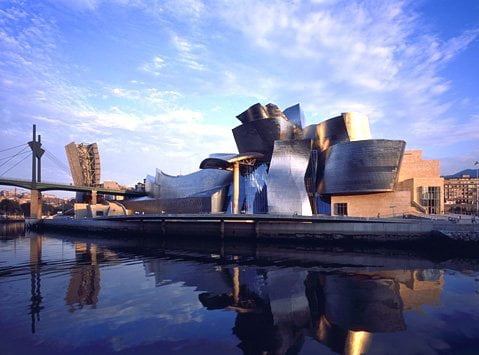
As with the very idea of atheism 2.0, de Botton is dressing up the obvious as if it’s insightful. And his further explanation of how he thinks these are good ideas don’t make them appear any more so.
[EDIT]: de Botton’s statement was also sent to Richard Wiseman (and others), and is attracting some good comments on Wiseman’s blog.